
Nurse Call Systems Market Size and Share
Market Overview
| Study Period | 2020 - 2031 |
|---|---|
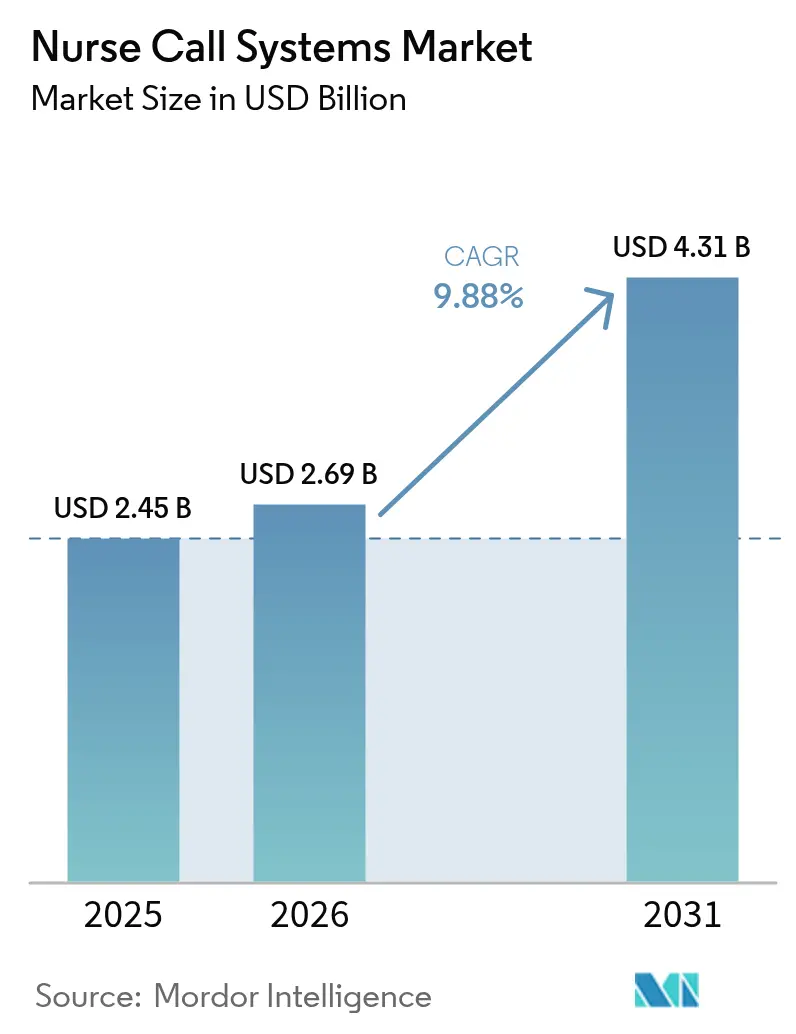
| Market Size (2026) | USD 2.69 Billion |
| Market Size (2031) | USD 4.31 Billion |
| Growth Rate (2026 - 2031) | 9.88 % |
| Fastest Growing Market | Asia Pacific |
| Largest Market | North America |
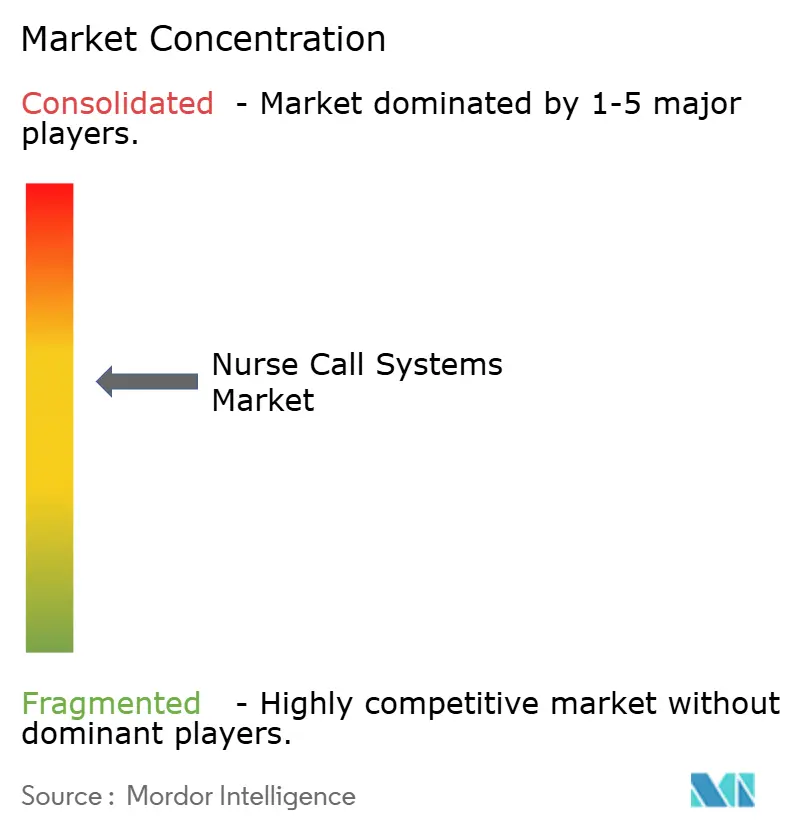
| Market Concentration | Medium |
Major Players *Disclaimer: Major Players sorted in no particular order Image © Mordor Intelligence. Reuse requires attribution under CC BY 4.0. | |
Nurse Call Systems Market Analysis by Mordor Intelligence
The Nurse Call Systems Market size is expected to grow from USD 2.45 billion in 2025 to USD 2.69 billion in 2026 and is forecast to reach USD 4.31 billion by 2031 at 9.88% CAGR over 2026-2031.
Increasing life expectancy has expanded the over-65 population, driving hospitals to implement automated alarm routing systems. This enables nursing staff to allocate their time to more complex and critical tasks. Healthcare providers are also adopting software-as-a-service (SaaS) models, which shift expenditures from capital budgets to operating budgets—a structure that hospital CFOs can approve without requiring significant bond issuances. Meanwhile, cybersecurity incidents, such as the February 2024 Change Healthcare breach, have elevated security certifications from optional to mandatory criteria in vendor selection, intensifying competition in the market. Additionally, the transition of low-acuity procedures to ambulatory and home care settings is fueling demand for wireless, cloud-native devices that extend alarm visibility beyond hospital premises.
Key Report Takeaways
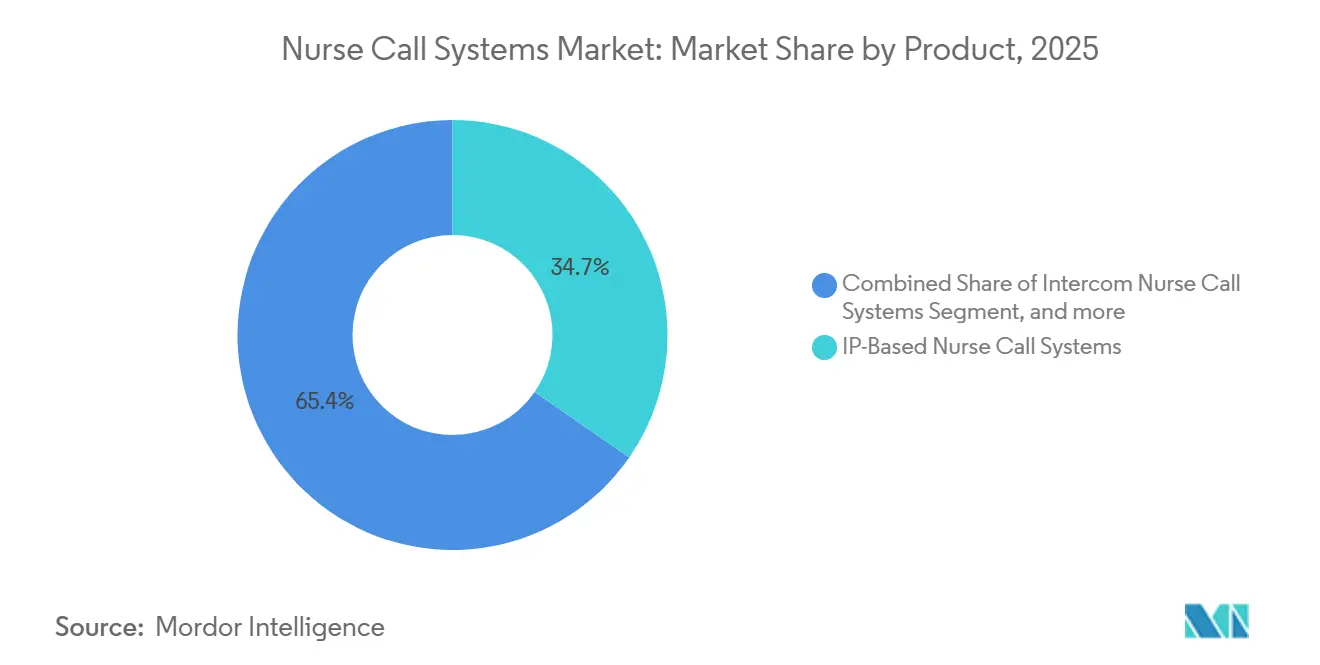
- By product, IP-based nurse call systems led with 34.65% revenue share in 2025, while mobile and cloud-enabled platforms are set to expand at an 11.54% CAGR through 2031.
- By modality, wireless systems dominated with a 62.65% share in 2025 and are projected to grow the fastest at an 11.67% CAGR over 2026-2031.
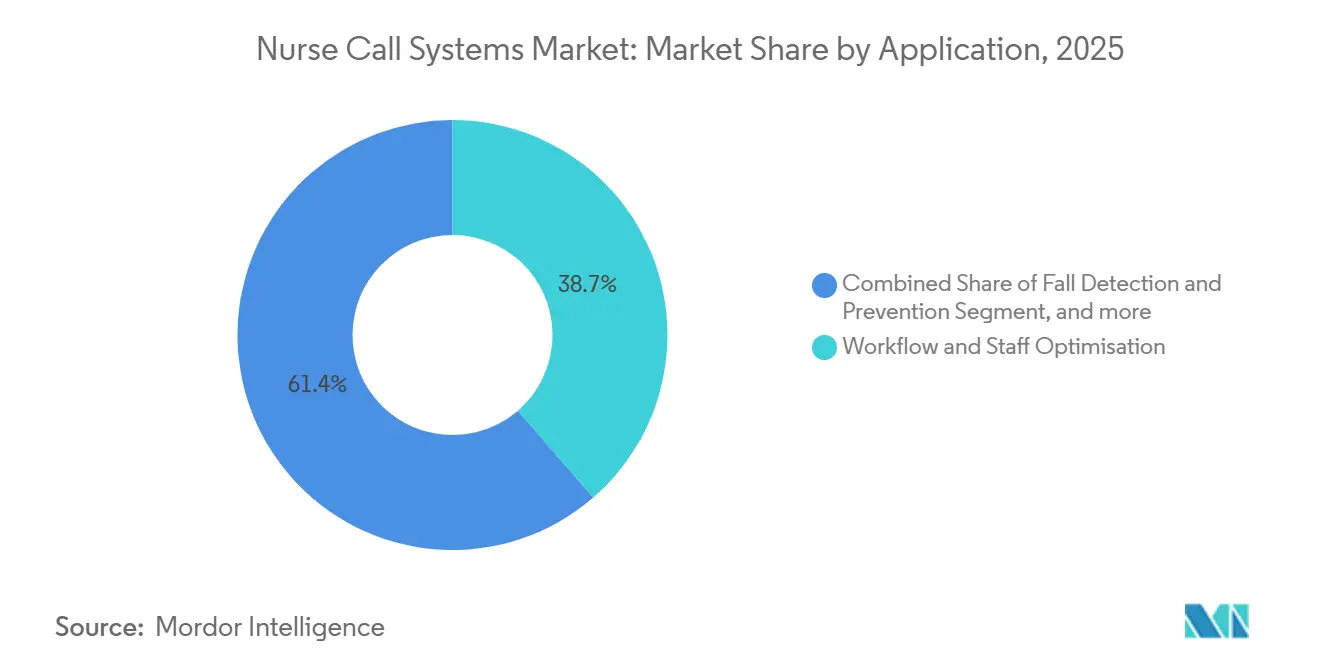
- By application, workflow, and staff optimization held 38.65% of 2025 deployments, whereas fall-detection and prevention solutions are forecast to advance at a 12.12% CAGR to 2031.
- By end user, hospitals and specialty clinics accounted for 48.32% in 2025, while home healthcare settings are poised to register the highest 12.65% CAGR during 2026-2031.
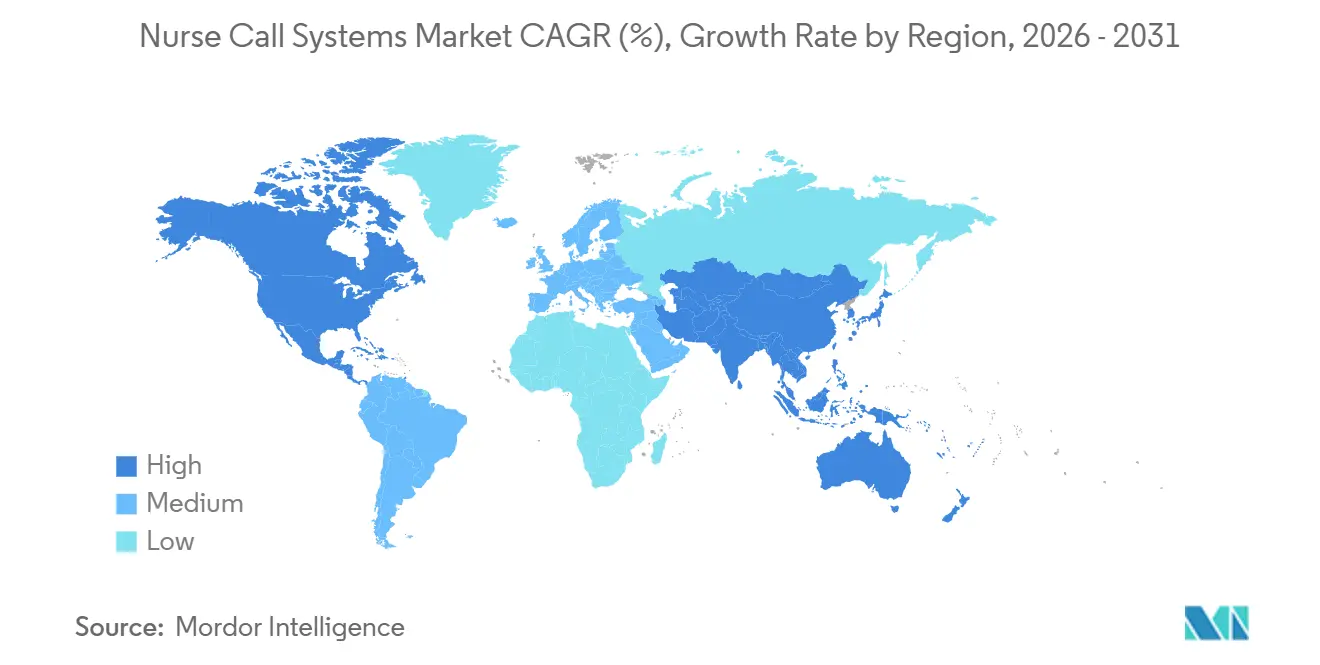
- By geography, North America captured 41.43% of global revenue in 2025, but Asia-Pacific is expected to record the quickest growth at a 10.43% CAGR through 2031.
Note: Market size and forecast figures in this report are generated using Mordor Intelligence’s proprietary estimation framework, updated with the latest available data and insights as of 2026.
Market Trends and Insights
Drivers Impact Analysis of Nurse Call Systems Market*
| Driver | (~) % Impact on CAGR Forecast | Geographic Relevance | Impact Timeline |
|---|---|---|---|
| Growing Geriatric Population and Rising Chronic Disease Burden | +2.3% | Global, acute in Japan and Western Europe | Long term (≥ 4 years) |
| Accelerating Hospital Digitalization and Smart Infrastructure Spending | +2.8% | North America, EU, Tier-1 APAC cities | Medium term (2-4 years) |
| Regulatory Push for Patient Safety and Rapid Response Metrics | +1.9% | U.S., EU, Australia | Short term (≤ 2 years) |
| Convergence of Nurse Call with Unified Clinical Communication Platforms | +2.1% | North America and Western Europe | Medium term (2-4 years) |
| Expansion of Home Health and Remote Patient Monitoring Ecosystems | +1.5% | North America, Japan, Australia | Long term (≥ 4 years) |
| Transition From Capex to Subscription-Based “Nurse Call as a Service” Models | +1.4% | Global, especially mid-market hospitals | Medium term (2-4 years) |
| Source: Mordor Intelligence | |||


Growing Geriatric Population and Rising Chronic Disease Burden
The number of people aged 60 and above will double to 2.1 billion by 2050, with 80% living in low- and middle-income countries where bed capacity remains low. Japan already faces a projected nursing shortfall of 270,000 by 2025 despite wage increases, driving hospitals to deploy sensor-based call systems that automatically triage alerts. Multimorbidity further strains legacy hardware: patients with three or more chronic conditions trigger 4.2-times more call-button activations than general med-surg wards. Medicare now penalizes hospitals in the worst quartile for falls, intensifying demand for predictive fall-detection modules. Vendors integrating accelerometer data from wearable pendants can issue pre-emptive alerts up to 30 seconds before an incident, protecting margins tied to value-based purchasing.
Accelerating Hospital Digitalization and Smart Infrastructure Spending
U.S. hospital IT budgets expanded 18.3% per year from 2019-2023, doubling connected-infrastructure outlays to USD 12.8 billion in 2024[1]Healthcare Financial Management Association, “Connected Infrastructure Spending Trends,” hfma.org. EHR vendors now require FHIR-compliant alarm routing, pulling forward refresh cycles by two to three years. A 400-bed site that unified nurse call with RTLS shaved average response times from 4.2 to 1.8 minutes, translating into 12,000 recaptured nurse-hours and USD 1.4 million in avoided overtime. Yet capital for full IP backbones still ranges from USD 500,000 to USD 2 million, pushing many rural hospitals toward wireless overlays or five-year subscription contracts priced at USD 8-15 per bed per month.
Regulatory Push for Patient Safety and Rapid Response Metrics
Joint Commission goal NPG.01.05.01 obliges accredited hospitals to audit response times biennially and remediate any breaches[2]Joint Commission, “National Patient Safety Goal NPG.01.05.01,” jointcommission.org. CMS adds financial teeth: facilities in the poorest safety quartile lose up to 1% of Medicare reimbursements. Australia’s 2025 EQuIP update similarly mandates real-time queue visibility, fueling adoption of RTLS-integrated dashboards. Compliance with IEC 60601-1-8 and ISO 13485 has shifted from procurement preference to hard requirement, trimming the vendor pool to companies with mature quality systems.
Convergence of Nurse Call with Unified Clinical Communication Platforms
Ascom’s Telligence 7 and comparable suites aggregate alarms from pumps, ventilators, and EHR workflows into a single mobile interface, cutting interruptions by 28% per shift. However, fewer than 40% of U.S. hospitals achieved seamless FHIR data exchange by 2025, and proprietary middleware can cost USD 50,000-150,000 per integration. ONC’s TEFCA framework should simplify sharing, but most nurse call vendors have not yet exposed compliant APIs, citing limited reimbursement incentives.
Restraints Impact Analysis of Nurse Call Systems Market*
| Restraint | (~) % Impact on CAGR Forecast | Geographic Relevance | Impact Timeline |
|---|---|---|---|
| High Capital Expenditure for IP Conversions in Legacy Facilities | -1.6% | U.S. rural centers, EU public hospitals | Short term (≤ 2 years) |
| Interoperability and Data Integration Challenges Across Vendor Systems | -1.2% | Global multi-vendor hospital estates | Medium term (2-4 years) |
| Escalating Cybersecurity and Privacy Compliance Costs | -1.4% | Global, heightened in U.S. and EU | Short term (≤ 2 years) |
| Workforce Shortages Limiting Effective Utilization of Advanced Features | -1.0% | U.S., Japan, Western Europe | Long term (≥ 4 years) |
| Source: Mordor Intelligence | |||
High Capital Expenditure for IP Conversions in Legacy Facilities
Retrofitting a 300-bed hospital costs USD 1.2-1.8 million and may disrupt wards for up to nine months[3]American Hospital Association, “Rural Hospital Financial Pressures,” aha.org. Margins at rural U.S. hospitals average below 2%, rendering full migrations unrealistic without grants or bond financing. European public facilities face budget levels still 8-12% below pre-pandemic baselines, extending the life of 1990s wired systems. Battery-powered wireless overlays cut headline costs to USD 300,000-500,000 for a 200-bed site but sacrifice deep EHR and RTLS integration. Subscription pricing eases cap-ex yet meets resistance from finance teams that prefer depreciable assets.
Interoperability and Data Integration Challenges Across Vendor Systems
Hospitals often pay USD 50,000-150,000 per custom API plus 15-20% annual maintenance, a burden that 62% of IT leaders cite as the prime barrier to unified communications. Only six of 22 major vendors published FHIR-compliant APIs by 2025, usually limited to alarm routing rather than workflow analytics required for Joint Commission audits. The vacuum extends to cyber-hardening: connected nurse call devices enlarge attack surfaces, and each breach now costs providers an average USD 4.35 million in remediation and fines.
*Our forecasts treat driver/restraint impacts as directional, not additive. The impact forecasts reflect baseline growth, mix effects, and variable interactions.
Nurse Call Systems Market Segment Analysis
By Product:
Cloud Platforms Outpace IP InfrastructureCloud-enabled suites are advancing at a 11.54% CAGR and are on track to eclipse USD 1.6 billion in the nurse call systems market by 2031. IP-based systems still accounted for 34.65% of revenue in 2025 because they embed alerts into RTLS badges and EHR workflows, but adoption remains concentrated in academic medical centers. Basic audio-visual hardware persists in long-term care where Medicaid rates lag private pay. Intercom products serve behavioral units that restrict mobile devices.
Hospitals balancing cap-ex limits and integration demands are shifting toward hybrid models: on-premise servers manage real-time routing while analytics reside in the cloud. Ascom’s Telligence 7 represents this middle path, whereas TekTone’s Tek-CARE300III overlays wireless buttons on existing wires at one-third the cost of full IP migration. Subscription penetration, still below 20%, should accelerate as finance teams acclimate to operating expense treatment and vendors demonstrate lower churn.


By Modality:
Wireless Dominance Reflects Retrofit EconomicsWireless platforms accounted for 62.65% revenue in 2025 and will climb at 11.67% CAGR. Retrofit speed and network-rewiring avoidance make them the default for aging facilities and ambulatory surgery centers. Yet battery logistics add USD 18,000 and 600 nursing hours per year for a typical 300-bed hospital, a cost that wired PoE installations avoid.
Cybersecurity has risen in the decision matrix: the 2024 Change Healthcare event illustrated how unsecured IoT nodes can escalate risk exposure. Vendors now tout AES-256 encryption and SOC 2 Type II attestations as table stakes, increasing development costs that smaller entrants struggle to absorb. Wireless also enables at-home monitoring reimbursed by Medicare Advantage at USD 50-65 per patient monthly, opening an adjacent revenue stream.
By Application:
Fall Detection Surges on Liability PressureFall-prevention modules will grow at a 12.12% CAGR through 2031, benefiting from CMS penalties that shave 1% off reimbursements for poor performers. Workflow optimization maintained 38.65% deployment share in 2025, but hospitals increasingly view analytics as a gating feature for staffing models rather than a premium add-on.
Each injurious fall adds USD 14,000 in costs and 6.9 days to the length of stay, making predictive algorithms financially compelling. Machine-learning blends of accelerometer, gyroscope, and pressure data have cut false positives below 8%, mitigating alarm fatigue. Privacy regulation, such as California’s 2024 CMIA update, now requires explicit consent for location tracking, adding paperwork but not derailing growth.
By End User:
Home Healthcare Redefines Market BoundariesHome-healthcare demand is projected to grow 12.65% per year, reshaping the nurse call systems market. Hospital and specialty clinics still generated 48.32% revenue in 2025, anchored by Joint Commission audits, yet reimbursement models now pay for remote monitoring under CPT 99453-58.
Long-term care facilities face new CMS staffing minimums of 3.48 hours per resident daily, accelerating purchases of workflow dashboards that document response times. Vendors linking in-hospital and at-home devices, such as Baxter’s Voalte, enable health systems to manage populations holistically, building cross-selling moats while satisfying HIPAA’s minimum necessary data rules.
Geography Analysis
North America and APAC Nurse Call Systems Market
North America delivered 41.43% of 2025 revenue, buoyed by Joint Commission mandates and CMS penalties. Ongoing digitization grants the region an early-adopter edge, yet replacement cycles slow absolute growth. Asia-Pacific will record a 10.43% CAGR, the fastest worldwide, as China’s 2025 health spend reached USD 1.2 trillion and Japan’s seniors now constitute 29% of its population. Nurse shortages exceeding 270,000 have pushed Japan toward acuity-based triage, benefiting advanced call suites.
India and Australia Nurse Call Systems Market
India’s Ayushman Bharat insurance program stipulates the installation of functional nurse call systems in empaneled hospitals, creating a steady baseline demand. Australia’s 2025 EQuIP update, which mandates queue-depth visibility, has translated into RTLS-linked upgrades across public hospitals.
EMEA and South America Nurse Call Systems Market
Europe’s expansion lags because public budgets remain 8-12% below pre-pandemic levels. The Middle East shows a two-speed pattern: Gulf states fund smart hospitals as part of diversification plans, whereas sub-Saharan Africa struggles with limited capital. South America is similarly split; Brazil mandated call coverage for SUS-accredited sites, but Argentina’s 200% inflation in 2024 froze most capital spending.
Mordor Intelligence provides coverage of the nurse call systems market across other key regional markets. Detailed country-level analysis extends to Brazil, Thailand, Vietnam, India, Mexico, Ukraine, South Korea, Taiwan, Kuwait, and Saudi Arabia incorporating local coverage and market participation, as required.

Regulatory Landscape
In the United States, nurse call systems are shaped primarily by safety and installation frameworks that combine product certification with facility electrical codes. ANSI/UL 1069 (Hospital Signaling and Nurse Call Equipment) is the central product safety standard, and its 8th Edition became effective on February 8, 2024, tightening requirements around wireless performance, networked configurations, and fault detection. That change raises the compliance bar for both IP-based and wireless deployments.
On the facility side, installations commonly need to align with NFPA 70 (National Electrical Code) and NFPA 99 (Health Care Facilities Code). OSHA expectations for electrical safety in workplaces also reinforce the need for equipment to be listed or labeled by a Nationally Recognized Testing Laboratory (NRTL). In addition, state and local building codes, including examples such as California Building Code, Title 24, can dictate where devices must be placed across specific care settings, affecting system design, bill of materials, and commissioning documentation.
Value Chain Analysis
The value chain begins with component and subsystem suppliers, including wired and wireless communication modules, embedded compute, power supplies, cabling and connectors, and patient station peripherals. It then moves to OEM design and manufacturing, where safety certification, notably ANSI/UL 1069, can gate product release into many hospital procurement workflows. Downstream, system integration and installation are typically delivered through the vendor, certified partners, and regional integrators that address network readiness, bedside device placement, and acceptance testing aligned with hospital engineering and life-safety requirements.
Software and interoperability are increasingly the differentiating layer in the chain. Nurse call vendors are relying more on standards-based interfaces such as HL7 messaging and FHIR to connect with EHRs and unified clinical communications, while event-driven integration patterns like REST and MQTT support routing to mobile devices and operational platforms. Program work such as HL7-IHE Gemini (SDPi) and IHE profiles points to plug-and-trust connectivity that reduces reliance on proprietary middleware, but many deployments still require paid connectors and ongoing maintenance. That keeps integration services and lifecycle support, including cyber hardening, updates, analytics tuning, and clinical workflow optimization, as meaningful revenue pools beyond initial hardware sales.
Competitive Landscape
The top five suppliers—Ascom, Baxter International (Hillrom), Rauland-Borg, Siemens Healthineers, and Tunstall—held roughly 52% of 2025 revenue, indicating moderate concentration. Rauland-Borg’s Responder Enterprise and Siemens’ Invision lock in clients through proprietary middleware, charging USD 50,000-150,000 per third-party connector. Regional integrators such as IndigoCare in Australia and Fujian Huanyutong in China win share in secondary cities by offering lower service costs and faster on-site support.
Technology differentiation now centers on predictive analytics and cybersecurity. Ascom’s Telligence 7 routes acuity-scored alarms over LTE failover, reducing Wi-Fi congestion, while Austco embeds machine learning to forecast staffing needs across multi-site networks. The shift to “Nurse Call as a Service” subscription is forcing sales teams to master multi-year SaaS negotiations, bringing revenue recognition volatility not yet captured in public guidance.
Nurse Call Systems Industry Leaders
Honeywell International Inc.
Ascom
Baxter International
Rauland-Borg Corporation
Jeron Electronic Systems Inc.
- *Disclaimer: Major Players sorted in no particular order
Nurse Call Systems Market Companies Covered in this Report
- Accutech Healthcare
- Alpha Communications
- Ascom
- Austco Healthcare
- Baxter
- BEC Integrated Solutions LLC
- Caretronic
- Cornell Communications
- Critical Alert
- Fujian Huanyutong Technology Co.
- Honeywell International
- IndigoCare
- Intercall Systems
- Jeron Electronic Systems Inc.
- Momentum Healthcare
- Rauland-Borg Corporation
- Siemens Healthineers
- Systems Technologies
- TekTone Sound & Signal Mfg. Inc.
- Tunstall Healthcare Group
- Vigil Health Solutions Inc.
- West-Com Nurse Call Systems Inc.

Market Opportunities and Future Outlook
Modernization programs are creating whitespace where hospitals want IP capabilities without prolonged ward disruption and high rewiring costs. Facility-level examples such as Static Systems Group completing an integrated full-IP, Power-over-Ethernet nurse call architecture at Stepping Hill Hospital in March 2026 point to active spend on resilient, network-based nurse call designs that reduce single points of failure and fit broader smart-hospital infrastructure roadmaps.
Interoperability-led upgrades also open a near-term path for vendors that can reduce the cost and complexity of connecting nurse call events into operational and clinical platforms. Technical documentation in 2026 cites 30-40% response-time reductions when nurse call events integrate with real-time asset management using MQTT/REST patterns, and UL 1069 Edition 8 (effective February 2024) raises the threshold for wireless reliability and networked performance monitoring. Together, these factors push buyers toward suppliers with tested integrations, auditable response-time visibility, and security-ready architectures that can support multi-site deployments across acute care, long-term care, and expanding home-health workflows.
Recent Industry Developments in Nurse Call Systems Market
- May 2026: Wreadycare announced a nurse call and intercom project for the 1,200-bed Second Bethune Hospital of Jilin University. The large single-site deployment highlights continued tender activity for enterprise-scale installations in Asia-Pacific and reinforces the role of major hospital builds as anchor wins for vendors and integrators.
- March 2026: Sensio acquired ISECO, adding a nurse call specialist serving social and healthcare centers in Spain and Portugal. The deal supports a broader consolidation theme in patient safety and assisted living technology, while expanding channel access and installed-base reach in Iberia for nurse call and related care communications.
- June 2025: Rauland expanded its Vendor Integration Partner Program to include virtual nursing and sitting platforms, naming Artisight, hellocare.ai, and NESA. The formalization of integration pathways between nurse call workflows and virtual care operations targets lower friction for hospitals standardizing on multi-vendor clinical communication stacks.


Nurse Call Systems Market Report Scope and Research Methodology
Market Definition and Coverage
This market covers nurse call systems used to connect patients and care teams inside healthcare settings, so alerts and requests can be raised, routed, and responded to through wired or wireless communication setups.
Scope exclusions: We exclude general hospital paging, consumer smart home alert gadgets, and non-clinical building intercom systems that are not used for nurse call workflows.
Segments Covered in This Report
- By Product
- Nurse Call Buttons
- Intercom Nurse Call Systems
- Basic Audio/Visual Systems
- IP-Based Nurse Call Systems
- Mobile & Cloud-Enabled Platforms
- By Modality
- Wired Systems
- Wireless Systems
- By Application
- Emergency Medical Alarms
- Workflow & Staff Optimisation
- Fall Detection & Prevention
- Wanderer Control & Dementia Care
- By End User
- Hospitals & Specialty Clinics
- Long-Term Care Facilities
- Nursing Homes
- Home-Healthcare Settings
- Geography
- North America
- United States
- Canada
- Mexico
- Europe
- Germany
- United Kingdom
- France
- Italy
- Spain
- Rest of Europe
- Asia-Pacific
- China
- Japan
- India
- Australia
- South Korea
- Rest of Asia-Pacific
- Middle East & Africa
- GCC
- South Africa
- Rest of Middle East & Africa
- South America
- Brazil
- Argentina
- Rest of South America
- North America
Data Sources, Market Sizing, and Validation
Desk Research
Desk research starts by mapping where nurse call demand is created and how it is procured, since installations typically track facility expansion and clinical upgrades. We use public sources such as the World Health Organization for health system indicators, the OECD for hospital capacity and long-term care context, and the US Centers for Medicare and Medicaid Services for facility and utilization signals that influence modernization cycles.
To keep the model grounded, we also review sources such as the US FDA device databases for product and regulatory cues, national statistics offices for construction and healthcare investment series, and trade and customs statistics for import and export trends in relevant communication equipment categories. Company annual reports, investor decks, press releases, and reputable industry news are reviewed to understand product mix shifts, including wired to wireless and the move toward IP-based platforms. Where needed, we reference paid subscriptions for company financials and patent databases, and for shipment-level import and export records to sanity check directional volumes. This list is not exhaustive, and many other public and internal reference points were used for data collection, validation, and clarification.
Primary Interviews and Surveys
Primary work is used to pressure test desk assumptions on upgrade cadence, typical system pricing, and what features are actually being purchased, including fall detection, wanderer control, and workflow support. We speak with manufacturers, channel partners, and hospital and long-term care stakeholders across major regions so our demand indicators and adoption rates do not lean on one geography or one facility type.
Distribution of primary research fieldwork respondents
| Company type | Respondent position | Region |
|---|---|---|
| Top tier: 36% | CXOs: 13% | APAC: 46% |
| Mid tier: 46% | Functional/Unit leaders: 37% | EMEA: 30% |
| Smaller Players: 18% | Managers: 50% | Americas: 24% |
Market-Sizing & Forecasting
Sizing is built using a top-down approach where facility counts and care capacity indicators are used to reconstruct the addressable demand pool, which is then filtered by adoption and refresh behavior for nurse call upgrades. We translate that demand into value using typical system pricing bands, with adjustments for wired versus wireless mix and the shift toward IP-based deployments.
Key inputs include hospital and long-term care facility base by region, new build and renovation activity, replacement cycles for legacy systems, penetration of wireless and mobile nurse call, and the attach rate of functions like fall detection and wanderer control. When enough signals are available, we corroborate totals with selective bottom-up approximations, such as a sampled ASP times unit volume check across a shortlist of suppliers and channel feedback. If the two views drift beyond a reasonable range, we revise the totals.
For forecasting, we use scenario analysis supported by a light multivariate view, because adoption is influenced by both capacity growth and technology refresh priorities. Variables like healthcare infrastructure investment, aging population pressure on long-term care, and digitization initiatives are translated into region-level growth paths, and then reviewed with primary experts so the final curve matches what procurement teams are indicating.
Data Validation & Update Cycle
Validation is done through multiple checks so the final number does not depend on one data series or one interview set. We compare the modeled output against independent signals such as facility expansion rates, import and export directionality for relevant equipment classes, and observed price movements in common system configurations, and then anomalies are reworked before sign-off.
A second analyst review is applied to assumptions that can swing the result, including replacement timing, wireless mix, and currency conversion timing for regional totals. If a variance looks structural, respondents are re-contacted to confirm whether the change is real or a one-off data point. Reports are refreshed annually, and interim updates are made when material events occur, followed by a final pre-delivery pass so clients receive the latest updated view.
Mordor Intelligence's Nurse Call Systems Market Estimate Compared With Other Published Estimates
Published market sizes for nurse call systems can look different even when the growth story sounds similar, because the studies do not always count the same things in the same year. The main differences usually come from what is treated as a nurse call system versus adjacent clinical communication tools, and from how replacement demand is separated from new facility installations.
Some external estimates blend broader patient communication and monitoring device lines into the total, and they may apply a faster price increase curve for advanced features. In Mordor Intelligence's model, revenue is counted for nurse call systems and related modules only when they are procured as part of nurse call deployments in healthcare facilities, and adjacent paging and general intercom equipment is kept out of scope even if it is used in the same buildings.
Benchmark comparison
| Source | Market Size | Gaps in Research Methodology |
|---|---|---|
| Mordor Intelligence | USD 2.45 B (2025) | |
| Global Consultancy A | USD 2.42 B (2025) | Uses a slightly different product taxonomy that can shift revenue between basic button systems and broader patient communication devices, and the reconciliation to facility upgrade cycles is not always made explicit. |
| Industry Publisher B | USD 2.90 B (2025) | Often presented with a wider inclusion of clinical communication and monitoring add-ons, and the value build can lean more on generalized CAGR application with less visible adjustment for wired to wireless mix and replacement timing. |
The table shows a tight cluster around 2025 for narrowly defined system revenue, and a wider spread when adjacent categories are folded in. By tying the value build to facility counts, upgrade cadence, and realistic pricing bands by system type, our estimate stays traceable to clear demand drivers and can be repeated and stress-tested as new signals emerge.


Key Questions Answered in the Report
How fast will revenue grow for nurse call solutions?
Revenue is forecast to rise from USD 2.69 billion in 2026 to USD 4.31 billion by 2031, implying a 9.88% CAGR.
Which modality leads current adoption?
Wireless systems dominated with 62.65% share in 2025 thanks to low retrofit costs.
What is the biggest growth opportunity by application?
Fall-detection platforms are projected to expand at 12.12% annually through 2031 as hospitals target Medicare penalty avoidance.
Why are cloud-native platforms gaining traction?
Subscription models convert capital expense into operating expense and integrate easily with RTLS and EHR workflows.
Which region will grow fastest?
Asia-Pacific is expected to post the highest 10.43% CAGR, supported by rising health spend in China and rapid aging in Japan.
How are hospitals addressing cyber risk?
Providers now require SOC 2 Type II attestations and AES-256 encryption, and allocate an average USD 4.35 million per breach for remediation.
Page last updated on:


 Your data is secure and never sold or shared.


