
Roasted Coffee Market Size and Share
Market Overview
| Study Period | 2021 - 2031 |
|---|---|
| Market Size (2026) | USD 54.62 Billion |
| Market Size (2031) | USD 72.87 Billion |
| Growth Rate (2026 - 2031) | 5.93 % |
| Fastest Growing Market | Asia-Pacific |
| Largest Market | Europe |
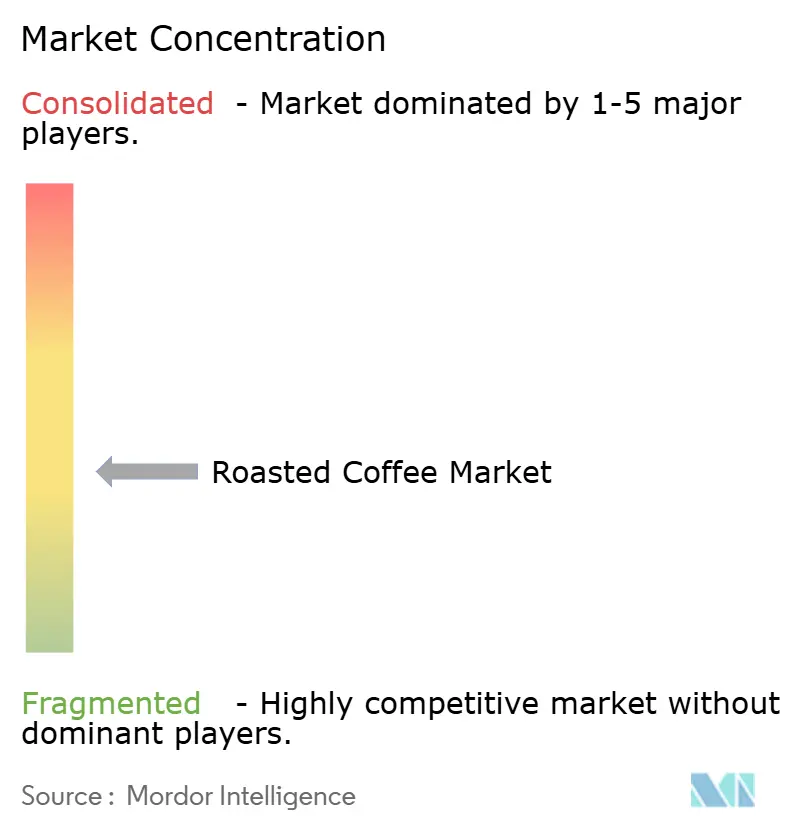
| Market Concentration | Medium |
Major Players *Disclaimer: Major Players sorted in no particular order Image © Mordor Intelligence. Reuse requires attribution under CC BY 4.0. | |
Roasted Coffee Market Analysis by Mordor Intelligence
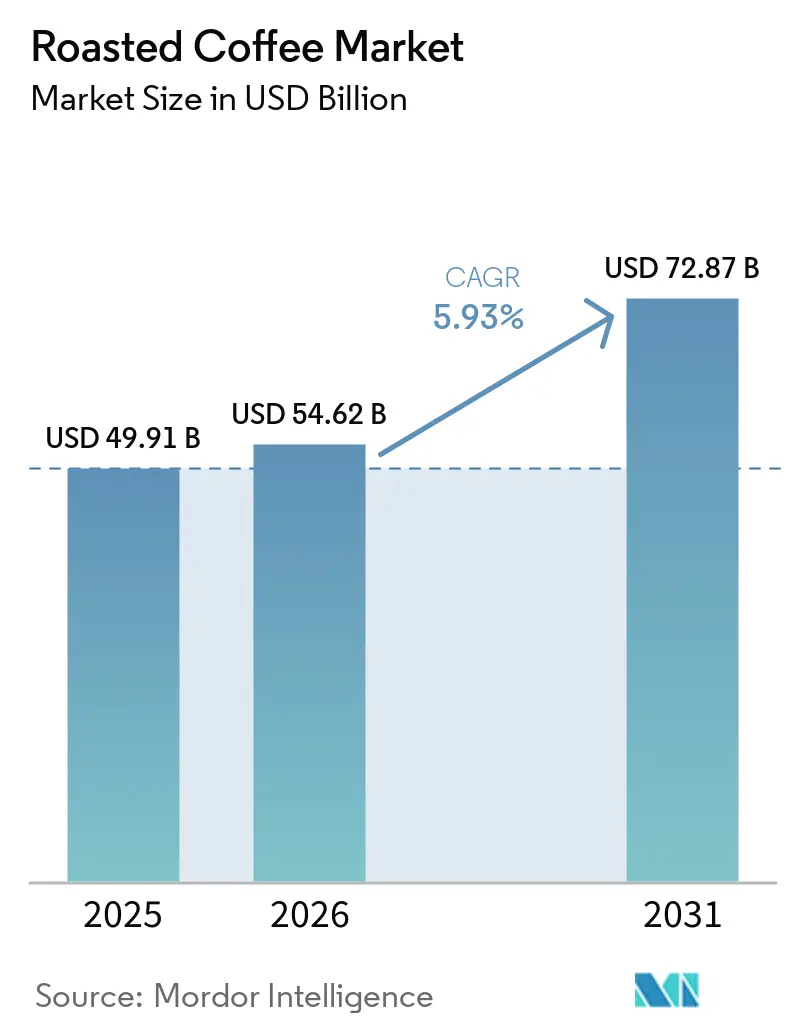
The Roasted coffee market size is projected to expand from USD 49.91 billion in 2025 and USD 54.62 billion in 2026 to USD 72.87 billion by 2031, registering a CAGR of 5.93% between 2026 to 2031. The roasted coffee market is moving beyond commodity positioning as buyers increasingly prioritize bean origin, roast profile, and documented sourcing. This shift supports pricing power for products that clearly communicate quality, while undifferentiated supermarket blends face increasing pressure. Improved home espresso equipment has raised consumer expectations for at-home coffee preparation and increased demand for café-quality beans. The expansion of urban cafés across Asia-Pacific is creating more out-of-home consumption occasions in markets with historically limited coffee consumption. Supply volatility, climate exposure, and new traceability requirements will shape procurement decisions, favoring roasters with resilient sourcing systems.
Key Report Takeaways
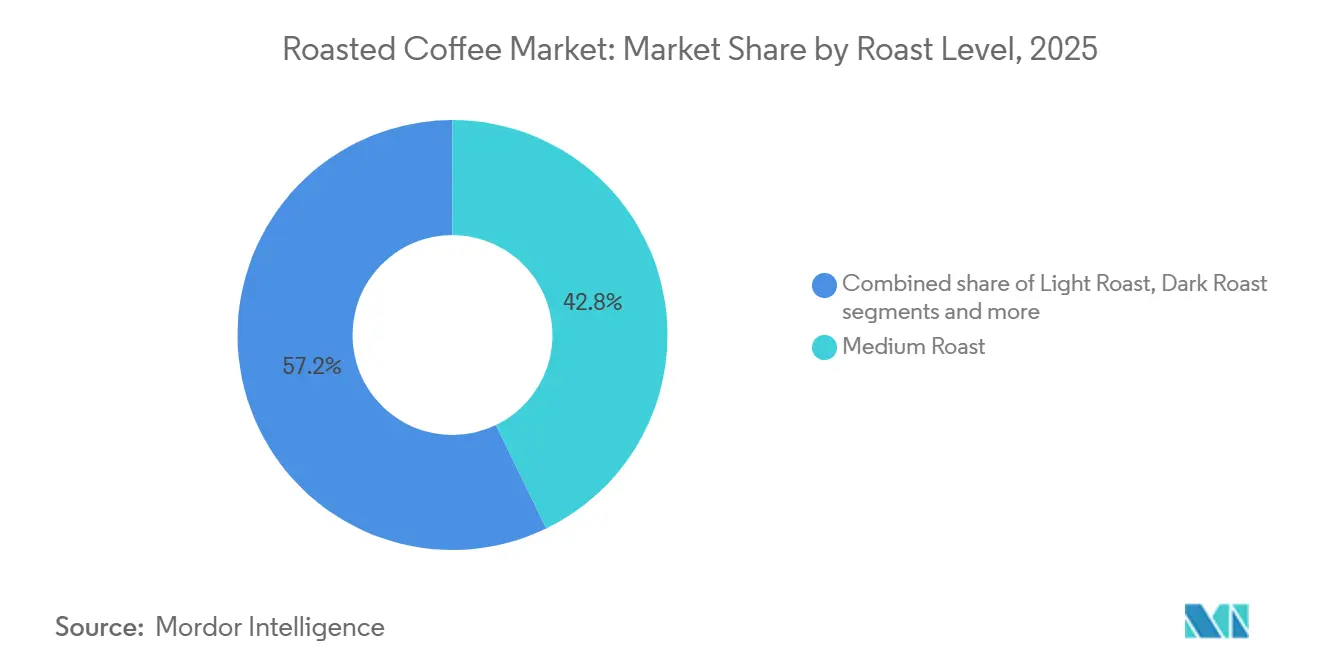
- By roast level, medium roast accounted for the largest share of the roasted coffee market, at 42.82% in 2025, while dark roast is projected to grow at the fastest CAGR of 7.68% during 2026-2031.
- By bean type, Arabica accounted for the largest share of the roasted coffee market, at 61.37% in 2025, while Robusta is projected to grow at the fastest CAGR of 7.25% during 2026-2031.
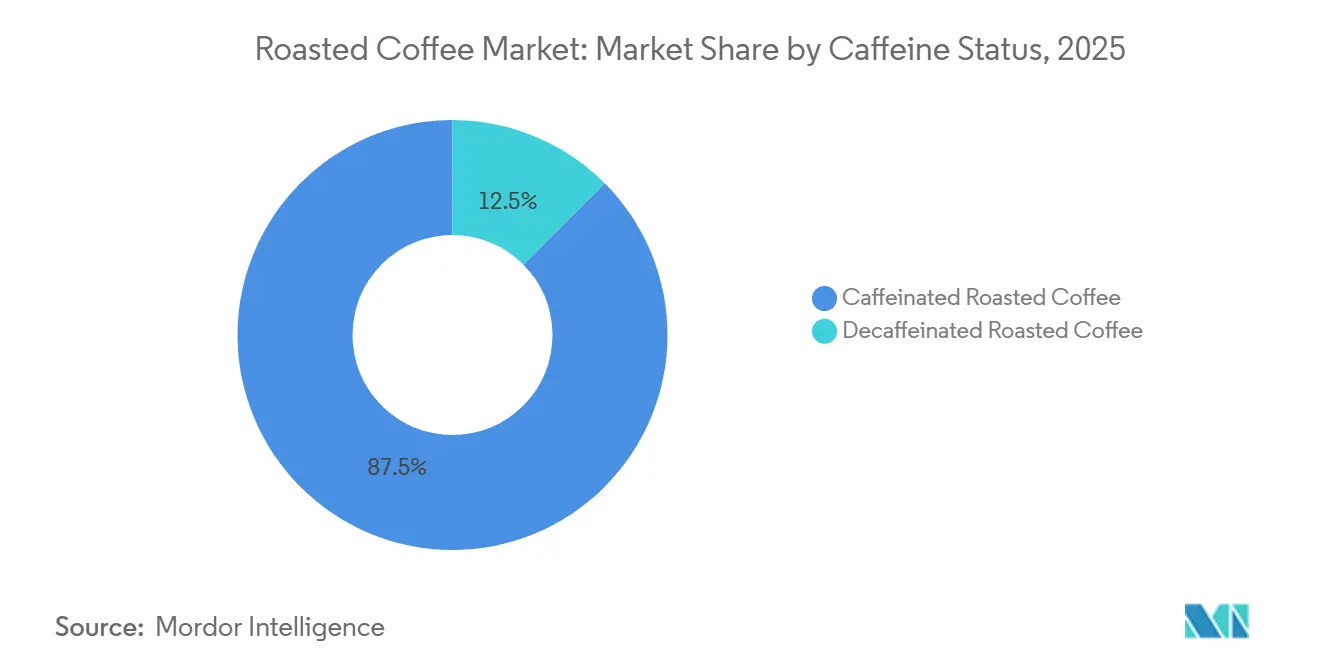
- By caffeine status, caffeinated coffee accounted for the largest share of the roasted coffee market, at 87.48% in 2025, while decaffeinated coffee is projected to grow at the fastest CAGR of 6.72% during 2026-2031.
- By distribution channel, off-trade accounted for the largest share of the roasted coffee market, at 68.77% in 2025, while on-trade is projected to grow at the fastest CAGR of 7.19% during 2026-2031.
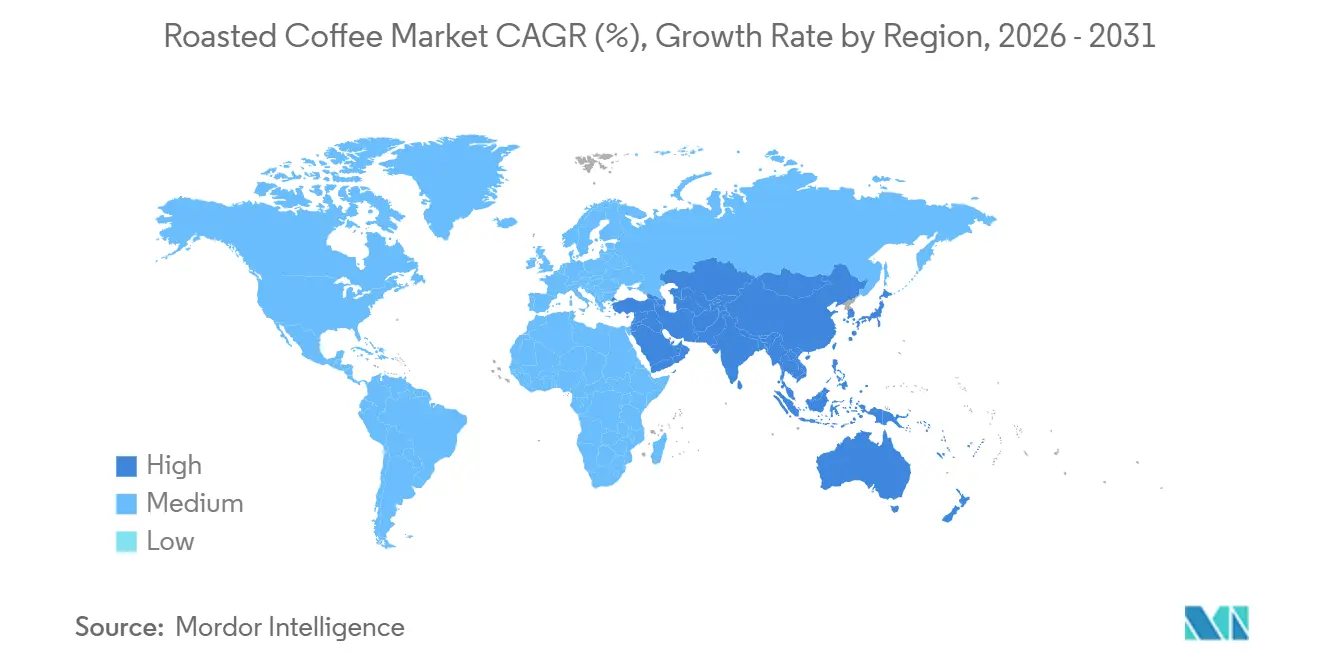
- By geography, Europe accounted for the largest share of the roasted coffee market, at 36.38% in 2025, while Asia-Pacific is projected to grow at the fastest CAGR of 7.42% during 2026-2031.
Note: Market size and forecast figures in this report are generated using Mordor Intelligence’s proprietary estimation framework, updated with the latest available data and insights as of January 2026.
Market Trends and Insights
Drivers Impact Analysis of Roasted Coffee Market*
| Driver | (~) % Impact on CAGR Forecast | Geographic Relevance | Impact Timeline |
|---|---|---|---|
| Premiumization and specialty coffee adoption | +1.8% | Global, with Europe and North America leading | Long term (≥ 4 years) |
| Expansion of café culture and at-home brewing | +1.2% | Asia-Pacific core, with spillover to the Middle East, Africa, and Latin America | Medium term (2-4 years) |
| E-commerce, subscriptions, and direct-to-consumer availability | +0.8% | North America and Europe, expanding to Asia-Pacific | Medium term (2-4 years) |
| Convenience formats and occasion diversification | +0.7% | Global | Short term (≤ 2 years) |
| Roast-at-origin value retention and origin branding | +0.5% | Europe and North America, with select Asia-Pacific importers | Medium term (2-4 years) |
| Automated micro-roasting and personalization | +0.4% | North America, Europe, and Asia-Pacific urban markets | Long term (≥ 4 years) |
| Source: Mordor Intelligence | |||
Premiumization and Specialty Coffee Adoption
Specialty consumption is expected to support growth in the roasted coffee market as consumers place greater value on preparation quality, provenance, and differentiated flavor profiles. The National Coffee Association reported that 45% of U.S. adults consumed an espresso-based beverage during the previous week in April 2026, up from 40% in 2022[1]. Specialty coffee consumption during the previous day reached a 14-year high of 46% in spring 2025, highlighting the growing consumer preference for premium, higher-quality coffee products. Germany illustrates this shift in consumption patterns, as whole-bean coffee volume reached 193,800 metric tons in 2025, despite a decline in total roasted coffee volume. This trend indicates that consumers increasingly favor whole-bean coffee, which offers greater freshness, customization, and perceived quality, over other roasted coffee formats.
Expansion of Café Culture and At-Home Brewing
The roasted coffee market benefits from the growth of both home brewing and café consumption, which increases consumer familiarity with premium coffee. Consumers who invest in home espresso equipment often prefer beans that replicate café-style beverages, while regular café customers seek retail beans that deliver a comparable at-home experience. Tata Starbucks aimed to surpass 500 stores across 80 Indian cities and achieve EBITDA positivity in fiscal year 2026. The company plans to open 50–100 stores annually, expanding out-of-home coffee consumption occasions across India. This expansion will increase consumer exposure to premium coffee offerings and support demand for roasted coffee products.
E-Commerce, Subscriptions, and Direct-To-Consumer Availability
Direct-to-consumer channels allow roasters to build closer relationships with households that purchase coffee regularly. Subscription models improve visibility into recurring demand and reduce reliance on supermarket category decisions. They also enable brands to use customer preferences for roast, flavor, and consumption frequency to plan product offerings. Freshness can provide a meaningful advantage when roasters ship beans shortly after roasting. The channel is most established in North America and Europe, while specialty subscription formats are also emerging in Asia-Pacific. This route provides smaller premium roasters with an additional way to compete in markets where securing large retail shelf positions is difficult.
Roast-At-Origin Value Retention and Origin Branding
Roasting at origin enables producing countries to capture a greater share of coffee value before products enter export markets. Ethiopia, Colombia, and Vietnam are strengthening systems that support origin-branded roasted coffee products. Ethiopia’s Coffee and Tea Authority is developing the Ethiopia Coffee Traceability and Management System, which links coffee from farm plots to export records[2]. The United States Department of Agriculture forecasts that Ethiopia will export 30,000 bags of roasted coffee in 2026/27. Although this volume remains small, it represents a shift from Ethiopia’s historically green-coffee-led export model. Colombia’s National Federation of Coffee Growers operates across more than 600 municipalities and maintains records for 1.8 million coffee lots. These systems provide origin-branded products with documented provenance, which is particularly relevant to premium buyers in the roasted coffee market.
Restraints Impact Analysis of Roasted Coffee Market*
| Restraint | (~) % Impact on CAGR Forecast | Geographic Relevance | Impact Timeline |
|---|---|---|---|
| Green coffee price and supply volatility | -0.8% | Global | Short term (≤ 2 years) |
| Climate-related crop and quality risk | -0.5% | Latin America, Africa, and Southeast Asia | Long term (≥ 4 years) |
| Short freshness window and packaging dependence | -0.3% | Global | Short term (≤ 2 years) |
| Traceability, deforestation, and packaging compliance cost | -0.4% | Europe and North America | Medium term (2-4 years) |
| Source: Mordor Intelligence | |||
Green Coffee Price and Supply Volatility
Green coffee price volatility remains a constraint on the roasted coffee market, as roasters face uncertain input costs and challenges in margin planning. The International Coffee Organisation Composite Indicator Price reached 354.52 U.S. cents per pound in February 2025 before averaging 256.05 U.S[3]. cents per pound in May 2026. Although the May 2026 price was 28% below the previous peak, intra-month volatility remained high, averaging 8.8%. Arabica exports declined by 9.3% year over year to 6.46 million bags in May 2026, extending a 13-month downward trend. Brazil’s 2026/27 production forecast of 66.7 million bags could ease supply pressures; however, weather-related risks continue to complicate forward procurement, according to the National Supply Company. The European Union Deforestation Regulation will apply from December 30, 2026, for large and medium-sized operators and from June 30, 2027, for small and micro enterprises, increasing compliance requirements in sourcing decisions.
Climate-Related Crop and Quality Risk
Climate risk is becoming increasingly relevant to long-term sourcing in the roasted coffee market, as heat and water conditions affect yields and quality in producing regions. Climate Central projects that 25 major coffee-producing countries will record an average of 47 additional coffee-harming days with temperatures above 30°C between 2021 and 2025. Every major producing country experienced more days of extreme heat during this period. Research scheduled for publication in 2025 projects potential Arabica yield losses of 23–35% in Latin America and 16–21% in Africa under modeled climate scenarios. TechnoServe and UNIDO’s (United Nations Industrial Development Organization) benchmarking work, in June 2026, identified acute near-term exposure among Latin American and Indonesian producers due to rising temperatures and unstable water availability. Roasters will need to diversify origin portfolios and place greater emphasis on altitude, water resilience, and supply continuity.
*Our forecasts treat driver/restraint impacts as directional, not additive. The impact forecasts reflect baseline growth, mix effects, and variable interactions.
Roasted Coffee Market Segment Analysis
By Roast Level:
Medium Retains Broad Compatibility While Dark Roast Gains MomentumMedium roast is projected to account for 42.82% of the roasted coffee market share in 2025, reflecting its broad compatibility with espresso machines, drip brewers, and pour-over methods. It remains a common choice among retailers and foodservice buyers seeking a single profile suitable for multiple preparation styles. Its balanced character also supports widespread household consumption in North America and Northern Europe. Germany’s whole-bean category is projected to reach 193,800 tonnes in 2025, indicating sustained demand for quality-focused roast profiles in a mature market. The category’s ability to serve multiple formats helps maintain its leading position in the roasted coffee market. Commercial espresso demand provides additional support, as standardized espresso bases remain important for high-volume procurement. Medium roast, therefore, remains the broadest option for buyers requiring flexibility across retail and foodservice channels.
Dark roast is forecast to record the fastest growth in the roast-level segment, at a CAGR of 7.68% between 2026 and 2031. Its fuller profile suits espresso-oriented consumption and applications such as ready-to-drink coffee and concentrates. The expansion of café culture in Asia-Pacific supports demand, as stronger coffee profiles align with prevailing consumer preferences. Dark roast also provides a recognizable coffee flavor base for cold applications. Although light roast accounts for a smaller volume share, it holds a premium position in specialty coffee because it preserves the floral and fruit notes of selected origins. Stronghold Robotics plans to introduce the S2 roasting platform globally in April 2026, featuring 100 heat and airflow adjustment increments. More flexible roasting equipment will give cafés and specialty retailers greater control over individual roast profiles. This development may create a more personalized roast mix over time, while dark roast continues to benefit from expanding espresso and cold-coffee consumption occasions.

By Bean Type:
Arabica Leads While Robusta Builds A Specialty PositionArabica is projected to account for 61.37% of the global roasted coffee market value in 2025, supported by its established presence in specialty and mainstream retail coffee markets across Europe and North America. It remains central to origin-led products and premium coffee menus. Its widespread use provides familiarity for consumers and enables leading brands to maintain consistent offerings. Arabica’s sensitivity to heat further increases the importance of high-altitude production areas. Producers and roasters will continue to rely on Arabica for premium portfolios, although they will need to manage sourcing decisions more closely. Its leading value position will ensure that Arabica retains a major role in the roasted coffee market.
Robusta is forecast to be the fastest-growing bean type, registering a CAGR of 7.25% during 2026–2031. Higher-grade Vietnamese and Indonesian Robusta is increasingly positioned as origin-specific specialty coffee rather than solely as a low-cost blending input. This shift supports a more durable strategic role for Robusta beyond near-term price substitution. In June 2026, Trung Nguyen Legend invested about USD 83.6 million to establish a processing complex in Dak Lak to support the higher-value positioning of Vietnamese Robusta. Arabica-Robusta blends will remain important for instant coffee, capsules, and standard office offerings. However, origin-specific Robusta may secure a larger role in premium sourcing portfolios as climate conditions continue to pressure Arabica supply.
By Caffeine Status:
Caffeinated Coffee Holds The Base While Decaf ExpandsCaffeinated coffee accounted for 87.48% of global roasted coffee value in 2025, reflecting the central role of caffeine in daily coffee occasions. The segment serves established routines across household, workplace, retail, and café consumption. Its scale gives it the widest range of formats and price points. Espresso-based beverages remain an important source of demand, with 45% of U.S. adults reporting consumption in the prior week during April 2026. Caffeinated coffee also benefits from the growth of on-trade consumption in emerging cities. This broad base will keep the category dominant through the forecast period. Consumers continue to seek convenience, flavor, and energy from familiar caffeinated products. The segment therefore remains the core volume and value base of the roasted coffee market.
Decaffeinated coffee is projected to expand at a 6.72% CAGR from 2026 to 2031, making it the fastest-growing caffeine-status segment. Better flavor outcomes from Swiss Water Process and carbon dioxide decaffeination are making premium decaf more credible for specialty buyers. Aging consumers and health-conscious younger consumers are expanding occasions where coffee is desired without caffeine effects. National Coffee Association data showed that 7% of Americans consumed decaf coffee on a given prior day in 2025, with stronger consumption among people aged 40 and older. Asia-Pacific is expected to provide the fastest regional growth for decaf at 8.2%, led by India, Indonesia, and Japan. This gives specialty roasters an early opportunity to build decaf offerings in younger coffee cultures. Blending choices will remain important because Arabica supply constraints affect the quality and cost balance of commercial decaf products.
By Distribution Channel:
Off-Trade Leads While On-Trade Expands In Emerging CitiesOff-trade accounted for 68.77% of the global roasted coffee market value in 2025, supported by supermarkets, hypermarkets, convenience stores, and online retail channels. This channel provides consumers with regular access to packaged coffee across a broad range of price points. It remains essential for household replenishment and established branded product lines. Online retail is becoming an increasingly important component of off-trade distribution as households seek fresher and more curated coffee options. The retail landscape is shifting toward capsules, fresh-bean specialty formats, e-commerce, and specialist coffee outlets. These changes require large brands to maintain shelf relevance while adapting to more direct consumer purchasing relationships. Off-trade will remain the largest distribution channel in the roasted coffee market, as it supports habitual at-home consumption at scale.
On-trade is projected to be the fastest-growing distribution channel, registering a CAGR of 7.19% during 2026-2031. The expansion of café networks across Asia-Pacific and the Middle East and North Africa is increasing out-of-home coffee consumption. Tata Starbucks operated more than 500 stores across 80 Indian cities in fiscal year 2026, demonstrating the scale of the addressable café opportunity. Specialty café standards are also raising quality expectations for foodservice bean procurement. Cold brew, ready-to-drink coffee, and espresso concentrates are creating consumption occasions beyond traditional café visits and supermarket purchases. These developments are making channel boundaries less distinct for brands and retailers. On-trade operators will require products that perform across standard espresso offerings, premium café beverages, and emerging cold coffee formats. These factors position on-trade as the clearest distribution growth avenue within the roasted coffee market.
Geography Analysis
Europe Roasted Coffee Market
Europe held a 36.38% share of the roasted coffee market in 2025, making it the largest regional market. High per-capita consumption and well-established preferences for premium products support value growth, even when volumes remain flat. In Germany, out-of-home coffee consumption reached a record 125,500 tonnes in 2025. In Italy, 39 torrefazioni closed in 2025 as high green coffee costs placed pressure on smaller operators. European consumers are increasingly shifting toward capsules, fresh-bean specialty products, sustainability certifications, and local roasters. The EUDR will require deforestation-free documentation for regulated coffee inputs, increasing the importance of compliance capabilities across European coffee supply chains.
APAC Roasted Coffee Market
Asia-Pacific is forecast to register the fastest regional CAGR of 7.42% during 2026–2031. Urbanization, rising disposable incomes, and expanding café networks are shifting traditionally tea-led consumption patterns toward more frequent coffee consumption occasions. India represents a key growth market, with Tata Starbucks surpassing 500 stores across 80 cities and becoming EBITDA-positive in fiscal year 2026. China’s expanding roasted coffee consumption and production base is strengthening demand for premium Arabica and Robusta imports. Japan remains a mature, high-value market with diverse consumption formats, while Singapore and Australia continue to influence the specialty coffee market. Regional growth will depend on how effectively brands align local taste preferences with premium and convenient product formats.
The Americas and MEA Roasted Coffee Market
North America remains a significant roasted coffee market, supported by strong brands, advanced retail formats, and a highly competitive café landscape. U.S. consumers continue to increase their consumption of espresso-based beverages, driving demand for higher-quality roasted beans across mass-market and premium channels. South America combines its position as the largest coffee-producing region with substantial domestic consumption, including Brazil’s 15% annual growth in the specialty coffee segment in 2025. The Middle East and Africa present a mixed outlook, with Gulf markets supporting premium coffee imports and East Africa maintaining its importance as a supply base. Mexico also offers a measured growth opportunity, as urban consumers increasingly favor specialty coffee. Collectively, these regions broaden demand while increasing the value of traceable and resilient sourcing.
Competitive Landscape
The roasted coffee market is moderately concentrated. Leading companies compete through brand recognition, capsule and pod systems, distribution reach, and product-format breadth. Independent players differentiate themselves through origin-specific offerings, roast quality, and relationships with cafés and local retailers. Keurig Dr Pepper acquired 96.22% of JDE Peet’s shares, which was completed in April 2026. The combination brings Jacobs, Douwe Egberts, L’OR, Peet’s, and the Keurig brewing system under one portfolio, creating a larger global competitor to Nestlé’s Nescafé, Nespresso, and licensed Starbucks businesses. The transaction would increase the importance of system ownership, as capsules and pods can drive repeat purchases. It would also reinforce the need for leading companies to compete across bagged coffee, single-serve formats, and café-branded products.
Nestlé sold Blue Bottle Coffee to Centurium Capital in April 2026 while retaining the rights to Blue Bottle-branded Nespresso pods. This move would indicate a greater focus on scalable premium formats that operate within established systems.Keurig Dr Pepper and Nestlé USA also partnered to manufacture and distribute Starbucks K-Cup pods in the United States and Canada in April 2026. In 2025, JDE Peet’s launched Dubai Chocolate coffee across 22 countries, demonstrating how branded flavor extensions created new consumption occasions. These actions indicate that large companies are balancing scale with innovation across flavors, formats, and platforms. Geographic expansion into underpenetrated markets remains another important strategy for the largest companies.
The strongest opportunities exist in origin-certified premium products in markets still served primarily by commodity blends, particularly India and Southeast Asia. Direct-to-consumer subscriptions also enable mid-tier specialty brands to build customer relationships beyond grocery retail. Lavazza launched Tablì in Italy in September 2025 and entered the United States in August 2026. The 100% coffee tab system eliminates the need for capsules, wrapping, or coatings. Supported by more than 15 patents, the system demonstrates the use of proprietary format design in the single-serve coffee market. Bellwether Coffee expanded into Australia in March 2026 through a partnership with Xtracted Espresso Solutions. On-site roasting technologies may enable cafés and specialty retailers to exert greater control over green-bean purchasing and roasting decisions, creating competition for branded roasted coffee suppliers in high-end foodservice accounts. Therefore, the overall landscape remains competitive despite increasing concentration among the largest groups.
Roasted Coffee Industry Leaders
-
Nestlé S.A.
-
JDE Peet's N.V.
-
Starbucks Corporation
-
The J.M. Smucker Company
-
Luigi Lavazza S.p.A.
- *Disclaimer: Major Players sorted in no particular order
Roasted Coffee Market Companies Covered in this Report
- Nestle S.A.
- JDE Peet's N.V.
- Starbucks Corporation
- The J.M. Smucker Company
- Luigi Lavazza S.p.A.
- Keurig Dr Pepper Inc.
- Tchibo GmbH
- Melitta Group
- Massimo Zanetti Beverage Group S.p.A.
- Strauss Group
- UCC UESHIMA COFFEE CO., LTD.
- The Kraft Heinz Company
- Illycaffe S.p.A.
- Farmer Bros. Co.
- Tata Consumer Products Limited
- Coffee Holding Co., Inc.
- Tres Coracoes Alimentos S.A.
- Trung Nguyen Group
- Ajinomoto AGF, Inc.
- Blue Bottle Coffee
Recent Industry Developments in Roasted Coffee Market
- August 2026: Luigi Lavazza S.p.A. launched Tablì in the U.S. market, introducing the world's first single-serve coffee system using 100% coffee tabs without capsules, wrapping, or coating. The company also announced plans to expand global availability through Amazon later in 2026.
- June 2026: Keurig Dr Pepper acquired 96.22% of JDE Peet’s shares in a USD 18 billion transaction, resulting in the company’s delisting from Euronext Amsterdam. The company also announced plans to separate the business into Beverage Co. and Global Coffee Co. by the end of 2026.
- April 2026: Keurig Dr Pepper and Nestlé USA extended their strategic partnership to continue manufacturing and distributing Starbucks K-Cup pods across the United States and Canada.
- March 2026: Bellwether Coffee expanded into Australia through a distribution and service partnership with Xtracted Espresso Solutions, introducing its electric shop roaster to the Australian market for the first time.
Global Roasted Coffee Market Report Scope
The roasted coffee market encompasses coffee beans roasted for consumption through retail, foodservice, and institutional channels. By type, the market is segmented into light roast, medium roast, dark roast, and espresso roast. By bean type, the market is segmented into arabica, robusta, and blended coffee. By caffeine status, the market is segmented into caffeinated roasted coffee and decaffeinated roasted coffee. Based on distribution channel, the market is segmented into on-trade and off-trade. The report offers a detailed analysis across major economies across regions such as North America, Europe, Asia-Pacific, South America, and the Middle East and Africa.
| Light Roast |
| Medium Roast |
| Dark Roast |
| Espresso Roast |
| Arabica |
| Robusta |
| Blended Coffee |
| Caffeinated Roasted Coffee |
| Decaffeinated Roasted Coffee |
| On-Trade | |
| Off-Trade | Supermarkets/Hypermarkets |
| Convenience/Grocery Stores | |
| Online Retail Stores | |
| Other Distribution Channel |
| North America | United States |
| Canada | |
| Mexico | |
| Rest of North America | |
| Europe | Germany |
| United Kingdom | |
| Italy | |
| France | |
| Spain | |
| Netherlands | |
| Belgium | |
| Sweden | |
| Poland | |
| Rest of Europe | |
| Asia-Pacific | China |
| India | |
| Japan | |
| Australia | |
| Singapore | |
| Rest of Asia-Pacific | |
| South America | Brazil |
| Argentina | |
| Colombia | |
| Rest of South America | |
| Middle East and Africa | South Africa |
| Saudi Arabia | |
| Rest of Middle East and Africa |
| By Roast Level | Light Roast | |
| Medium Roast | ||
| Dark Roast | ||
| Espresso Roast | ||
| By Bean Type | Arabica | |
| Robusta | ||
| Blended Coffee | ||
| By Caffeine Status | Caffeinated Roasted Coffee | |
| Decaffeinated Roasted Coffee | ||
| By Distribution Channel | On-Trade | |
| Off-Trade | Supermarkets/Hypermarkets | |
| Convenience/Grocery Stores | ||
| Online Retail Stores | ||
| Other Distribution Channel | ||
| By Geography | North America | United States |
| Canada | ||
| Mexico | ||
| Rest of North America | ||
| Europe | Germany | |
| United Kingdom | ||
| Italy | ||
| France | ||
| Spain | ||
| Netherlands | ||
| Belgium | ||
| Sweden | ||
| Poland | ||
| Rest of Europe | ||
| Asia-Pacific | China | |
| India | ||
| Japan | ||
| Australia | ||
| Singapore | ||
| Rest of Asia-Pacific | ||
| South America | Brazil | |
| Argentina | ||
| Colombia | ||
| Rest of South America | ||
| Middle East and Africa | South Africa | |
| Saudi Arabia | ||
| Rest of Middle East and Africa | ||
Key Questions Answered in the Report
What is the projected growth rate for roasted coffee through 2031?
The category is forecast to grow at a 5.93% CAGR from 2026 to 2031, reaching USD 72.87 billion by 2031.
Which roast level has the largest share of roasted coffee sales?
Medium roast led with 42.82% in 2025 because it suits espresso, drip brewing, and pour-over preparation.
Which coffee bean type is growing fastest?
Robusta is projected to grow at a 7.25% CAGR through 2031 as higher-grade origin-specific products gain interest.
Why is Asia-Pacific important for coffee companies?
Asia-Pacific is projected to record the fastest regional CAGR of 7.42% through 2031, supported by urbanization and café expansion.