
Roads and Highways Infrastructure Construction Market Size and Share
Market Overview
| Study Period | 2020 - 2031 |
|---|---|
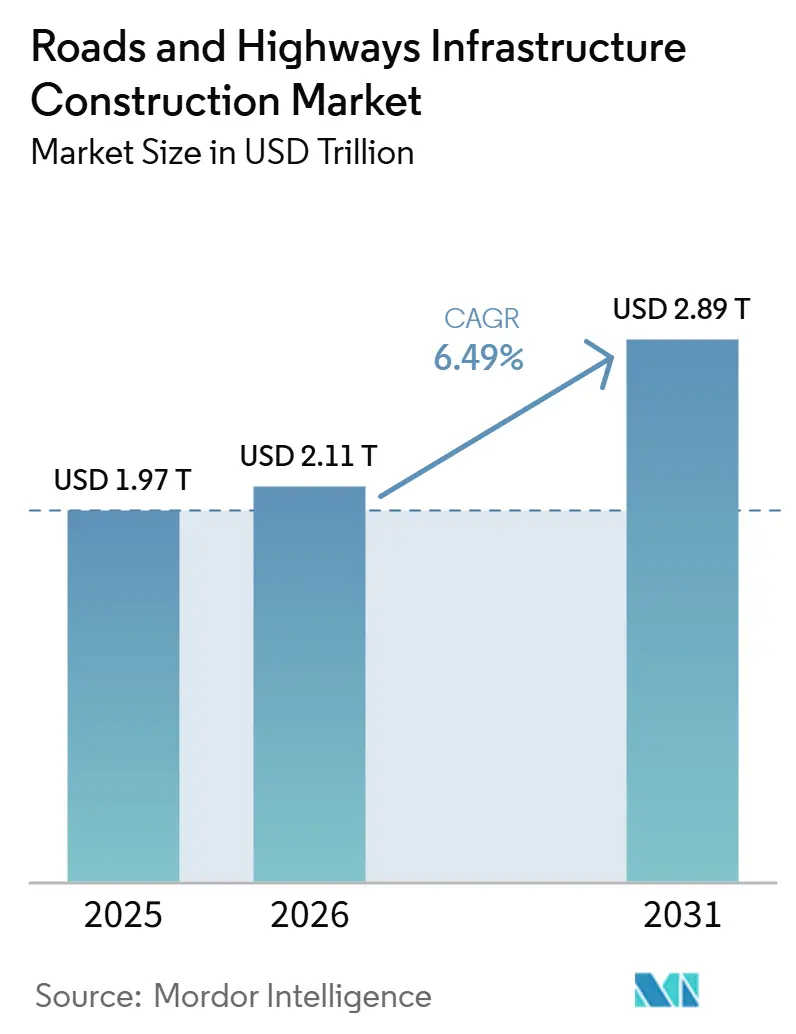
| Market Size (2026) | USD 2.11 Trillion |
| Market Size (2031) | USD 2.89 Trillion |
| Growth Rate (2026 - 2031) | 6.49 % |
| Fastest Growing Market | Asia-Pacific |
| Largest Market | Asia-Pacific |
| Market Concentration | Medium |
Major Players *Disclaimer: Major Players sorted in no particular order Image © Mordor Intelligence. Reuse requires attribution under CC BY 4.0. | |
Roads and Highways Infrastructure Construction Market Analysis by Mordor Intelligence
The Roads And Highways Infrastructure Construction Market size is projected to be USD 1.97 trillion in 2025, USD 2.11 trillion in 2026, and reach USD 2.89 trillion by 2031, growing at a CAGR of 6.49% from 2026 to 2031.
Public programs are supporting long project pipelines, while concession structures are moving more operating and revenue risk to private partners. Asia-Pacific held 42.60% of the roads and highways infrastructure construction market in 2025 and is also positioned for the fastest growth through 2031. China is prioritizing upgrades under its 15th Five-Year Plan, while India continues to add new corridors and digital road systems. Contractors increasingly need engineering, rehabilitation, and systems integration skills within the same project scope. Land access, material costs, and limited skilled labor remain practical limits on delivery schedules.
Key Report Takeaways
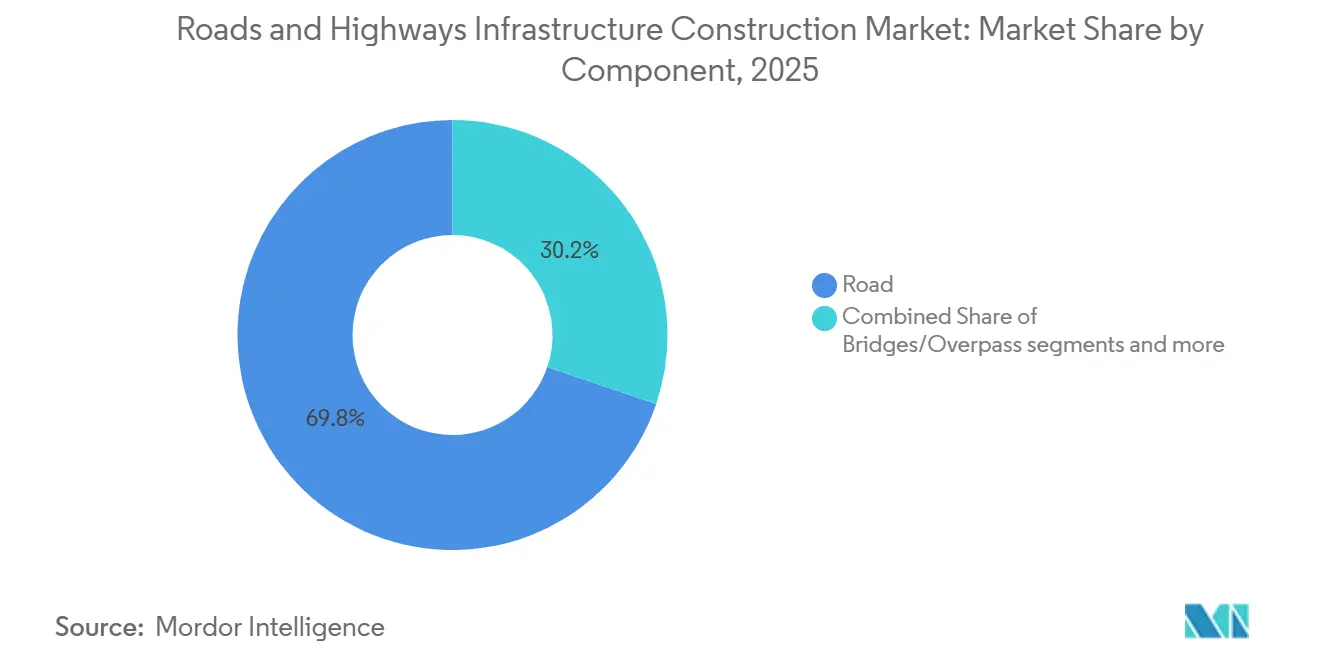
- By component, roads accounted for 69.80% of the roads and highways infrastructure construction market share in 2025, while bridges/overpass is forecast to grow at a 7.30% CAGR through 2031.
- By construction type, new construction accounted for 74.20% of the roads and highways infrastructure construction market in 2025, while renovation is forecast to grow at a 7.10% CAGR through 2031.
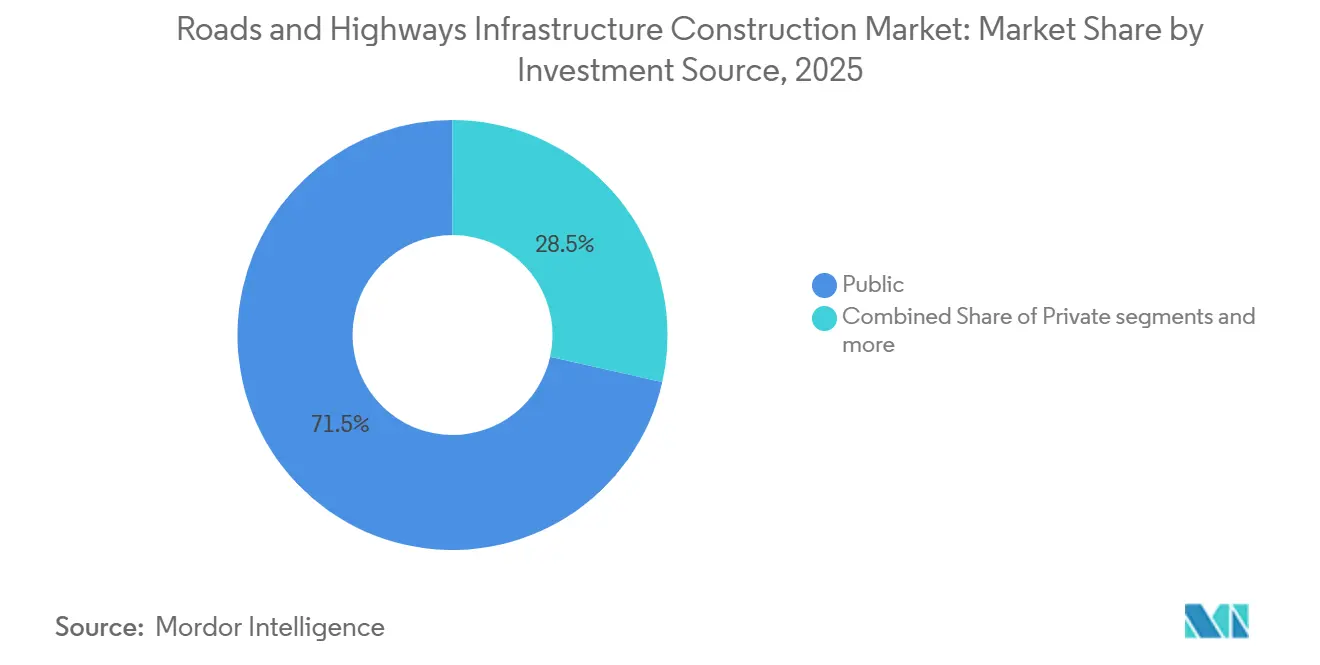
- By investment source, public investment held 71.50% of the roads and highways infrastructure construction market size in 2025, while public-private partnerships are forecast to grow at a 7.80% CAGR through 2031.
- By type, national programs held 57.40% of the roads and highways infrastructure construction market share in 2025, while the state segment is forecast to grow at a 7.10% CAGR through 2031.
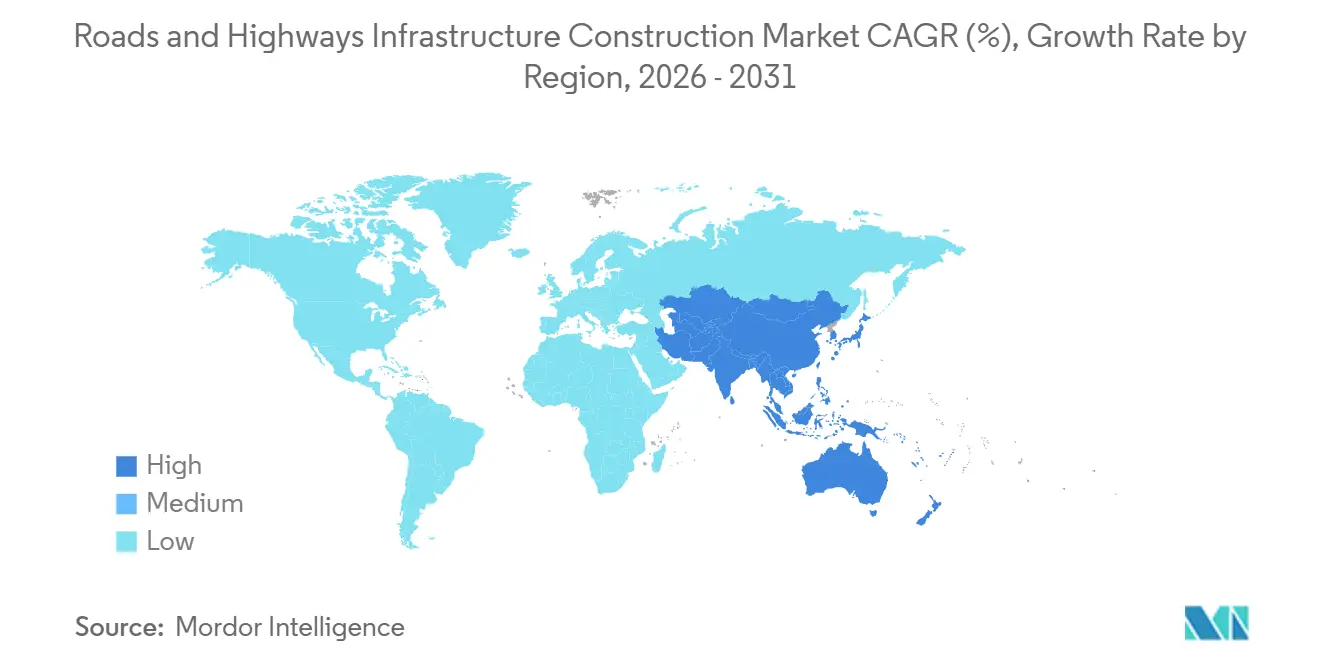
- By geography, Asia-Pacific accounted for 42.60% of the roads and highways infrastructure construction market share in 2025 and is projected to register the highest CAGR of 7.40% through 2031.
Note: Market size and forecast figures in this report are generated using Mordor Intelligence’s proprietary estimation framework, updated with the latest available data and insights as of January 2026.
Market Trends and Insights
Drivers Impact Analysis of Roads and Highways Infrastructure Construction Market*
| Drivers | (~) % Impact on CAGR Forecast | Geographic Relevance | Impact Timeline |
|---|---|---|---|
| National Corridor Investment Programs | +2.0% | Global, with core in Asia-Pacific, Europe, and North America | Medium term (2-4 years) |
| Bridge Rehabilitation Backlogs | +1.2% | North America and Europe core, with spillover to South Asia | Short term (≤ 2 years) |
| Urban Expressway Expansion | +0.8% | Asia-Pacific and the Middle East, with early gains in South America | Medium term (2-4 years) |
| Smart Road and Connected Traffic Systems | +0.7% | Europe, North America, and Asia-Pacific, with emerging activity in Middle East and Africa | Long term (≥ 4 years) |
| Industrial and Trade Corridor Development | +0.7% | Global, concentrated in the Middle East and Africa, South Asia, and South America | Long term (≥ 4 years) |
| Prefabricated and Recycled Construction Methods | +0.5% | Global, with leading adoption in Europe and India | Medium term (2-4 years) |
| Source: Mordor Intelligence | |||
National Corridor Investment Programs
National corridor programs give contractors a clearer view of future work than isolated annual budgets. India planned 124 national highway projects worth INR 3.45 lakh crore (USD 41.1 billion) for FY2025-26 across the hybrid annuity model (HAM), engineering, procurement, and construction (EPC), and build-operate-transfer (BOT) delivery modes. The Ministry of Road Transport and Highways allocated INR 3.09 lakh crore (USD 36.89 billion) to the road sector for 2026-27[1]National Highways Authority of India and Ministry of Road Transport and Highways, “NHAI Surpasses Target, Constructs 5,313 km in 2025-26,” Ministry of Road Transport and Highways, economictimes.indiatimes.com. China completed RMB 330 billion (USD 48.11 billion) in major transport investments during the first quarter of 2026, and 1,845 highway and waterway projects valued at RMB 100 million (USD 13.9 million) or more were under acceleration. As mature networks turn toward rehabilitation, the roads and highways infrastructure construction market is likely to offer more stable packages for contractors with specialized renewal skills. The National Highways Authority of India (NHAI) also monetized INR 28,307 crore (USD 3.3 billion) through Infrastructure Investment Trust (InvIT) and Toll-Operate-Transfer (TOT) vehicles in FY2025-26, demonstrating how operating assets can generate capital for further corridor investment.
Bridge Rehabilitation Backlogs
Bridge repair backlogs create a visible future workload for civil contractors. The American Society of Civil Engineers identified more than 46,000 structurally deficient bridges in the United States in 2025, and 220,295 bridge spans needed repair or replacement. The Federal Highway Administration estimated that clearing the United States bridge backlog by 2038 would require USD 28.9 billion each year. The USD 27.5 billion formula bridge program under the Bipartisan Infrastructure Law has committed 55% of funds to more than 6,000 projects by 2025. This work supports the construction of roads and highway infrastructure because repair contracts require specialized staging, inspection, and traffic management capabilities. Similar maintenance gaps in other countries can translate into safety and fiscal concerns, driving contracted renovation work over the forecast period.
Urban Expressway Expansion
Urban expressway expansion is supporting road construction activity in rapidly growing metropolitan areas across the Asia-Pacific and the Middle East. Population growth and outward urban development are increasing the need for higher-capacity links between residential districts, employment centers, airports, and logistics facilities. These projects often include elevated sections, interchanges, bridges, tunnels, and access roads, which can raise their engineering requirements. South American cities are also beginning to add urban corridor capacity to address congestion that affects freight movement and daily travel. The work supports the roads and highways infrastructure construction market by creating long-term packages that combine new construction with complex traffic management. Project delivery depends on coordinated land access, utility relocation, and public approval because construction occurs in dense urban settings.
Smart Road and Connected Traffic Systems
Intelligent transportation systems are increasing the technical content of road projects. Italy certified the Tangenziale di Napoli as its first Smart Road in June 2026, with vehicle-to-infrastructure communication, real-time hazard alerts, and support for autonomous vehicle guidance. Spain approved Royal Decree 450/2026, which requires AI-enabled Intelligent Transport Systems (ITS) and real-time access to mobility data across national road and urban transport networks. NYSDOT selected Parsons in July 2026 for a USD 33 million statewide iNET platform contract covering design, integration, testing, and operations. These requirements expand the role of systems design in the construction of roads and highway infrastructure. Contractors that combine civil works with digital integration can compete for work that pure construction firms may not be able to deliver on their own. Standard cost benchmarks may not yet fully reflect this added systems content, which can favor firms with established technology partners.
Restraints Impact Analysis of Roads and Highways Infrastructure Construction Market*
| Restraints | (~) % Impact on CAGR Forecast | Geographic Relevance | Impact Timeline |
|---|---|---|---|
| Land Acquisition and Community Opposition | -1.3% | South Asia core, with significant effects in Southeast Asia and Africa | Short term (≤ 2 years) |
| Material and Equipment Cost Volatility | -1.0% | Global, with the greatest pressure in North America and Europe | Medium term (2-4 years) |
| Skilled Workforce and Specialized Equipment Shortages | -0.6% | North America and Australia core, with spillover to Europe | Medium term (2-4 years) |
| Permitting, Environmental Reviews, and Utility Relocation | -0.5% | Global, with the most acute compliance factors in OECD markets | Medium term (2-4 years) |
| Source: Mordor Intelligence | |||
Land Acquisition and Community Opposition
Land acquisition can determine whether a road project moves from approval to construction. India reported in July 2025 that 489 national highway projects due by March 2025 were pending due to land acquisition, forest clearance, and railway approvals. The Thiruvananthapuram Outer Ring Road saw its land acquisition cost rise from INR 1,800 crore (USD 214.3 million) to INR 3,800 crore (USD 452.4 million). These delays can lead to revised schedules, increased claims exposure, and greater uncertainty for contractors. The roads and highways infrastructure construction market depends on governments securing land and core clearances before awarding major works. When owners leave those issues unresolved, they transfer risks that contractors have limited legal power to control. This can reduce the value created by public investment despite a strong announced pipeline.
Material and Equipment Cost Volatility
Material prices remain a challenge for fixed-price road contracts. Construction input costs in the United States were 7.1% higher year over year in June 2026, while hot-rolled steel bars rose 16% over the same period. United Kingdom bituminous mixture prices increased 11% between May 2025 and May 2026. United States steel mill product costs rose 17% in 2025 after Section 232 tariffs reached 50% on many products. Contractors in the roads and highways infrastructure construction market need escalation clauses and procurement controls to limit exposure to sudden material changes. Commodity hedging can also help, though it cannot eliminate risks arising from regional supply disruptions. Contract terms that more evenly share material risk can improve the delivery of large public projects.
*Our forecasts treat driver/restraint impacts as directional, not additive. The impact forecasts reflect baseline growth, mix effects, and variable interactions.
Roads and Highways Infrastructure Construction Market Segment Analysis
By Component:
Roads Led Activity While Bridge/Overpass Modernization ExpandsRoad carriageway construction accounted for 69.80% of the roads and highways infrastructure construction market share by component in 2025. Its position reflects the scale of national and state highway programs in Asia, Africa, and South America, where baseline connectivity remains incomplete. Bridges/overpass is forecast to grow at a 7.30% CAGR from 2026 to 2031. Their growth is supported by aging structures in North America and Europe and by elevated corridor needs in dense Asia-Pacific cities. Tunnels are gaining interest in Alpine routes and Southeast Asian urban bypasses, where surface land is difficult to obtain. Other structures include interchanges, flyovers, and junction works that support complex freight and urban links. These projects often require grade separation as traffic volumes rise. The component mix, therefore, includes both long-distance road construction and concentrated engineering works. The roads and highways infrastructure construction market continues to be led by pavement volume, but specialized structures are gaining weight in project value.
Precast asphalt panels can use higher levels of reclaimed asphalt pavement in controlled plant conditions without compromising quality, according to a 2025 study in the International Journal of Pavement Engineering. This approach is relevant to bridge deck replacement, where shorter construction periods can reduce disruption. Skanska and its joint venture partner received a USD 534 million contract for the Vincent Thomas Bridge Deck Replacement in Los Angeles in April 2026. The project uses an accelerated 16-month full closure and is scheduled for completion in March 2029. Such packages reward contractors who can manage work in live urban networks. Smart surfaces and intelligent transportation systems are also becoming part of pavement work. This makes the boundary between roads and ancillary structures less clear in some contracts. Contractors must coordinate pavement, structures, communications, and traffic management more closely. The broad roads and highways infrastructure construction market, therefore, supports firms that can integrate these related scopes.


By Construction Type:
New Construction Holds Volume While Renovation Gains PaceNew construction accounted for 74.20% of the roads and highways infrastructure construction market by construction type in 2025. Greenfield work remains important in South and Southeast Asia, Sub-Saharan Africa, and parts of South America. These regions are still developing primary road networks that link cities, industrial areas, and ports. Renovation is forecast to grow at a 7.10% CAGR from 2026 to 2031. China is shifting from major network expansion toward upgrades under the 15th Five-Year Plan. The Ministry of Transport identified 80,000 km of facilities for renovation by 2030. As network density grows, maintenance and renewal can represent a larger share of contracting activity. This shift favors firms that can diagnose pavement condition and plan work with limited disruption. It also reduces the relative advantage of contractors focused only on high-volume earthworks.
Renovation projects often require more engineering work and less raw material than new corridors. This can change the cost structure and contractor selection process. India’s Central Road Research Institute and Bharat Petroleum Corporation Limited developed plastic-waste geocells for a structural base layer and validated the material on a 160-meter stretch near Delhi in 2025. A 2026 lifecycle assessment of a construction and demolition waste and reclaimed asphalt pavement mixture reported climate impacts of 129.81 kg carbon dioxide equivalent per functional unit. These examples show how renovation can combine lifecycle considerations with project delivery requirements. Public owners may increasingly specify recycled or lower-impact materials in renewal contracts. Contractors also need dependable material testing and quality assurance methods. New construction remains the largest part of the roads and highways infrastructure construction market, but renovation provides a larger opening for specialized methods. The change is gradual, yet it can shape long-term capability requirements.
By Investment Source:
Public Funding Provides Scale While Public-Private Partnerships Grow FasterPublic investment accounted for 71.50% of the roads and highways infrastructure construction market share by investment source in 2025. Government funding is especially important in China, India, and Gulf countries, where large network plans depend on public balance sheets. Private investment is more limited because traffic revenue can be uncertain, and payback periods are long. Public-private partnerships (PPPs) are forecast to grow at a 7.80% CAGR from 2026 to 2031. The increase reflects fiscal pressure and efforts to assign operating and revenue risks through long-term concessions. PPPs can preserve project delivery while limiting immediate public budget demands. Their success depends on clear contracts, stable regulation, and credible demand forecasts. The roads and highways infrastructure construction market needs both public capital and private operating capability to support large pipelines. The investment mix will vary based on local laws, traffic patterns, and government creditworthiness.
Georgia’s SR 400 Express Lanes began construction in March 2026 under a 56-year Design-Build-Finance-Operate-Maintain concession led by ACS Infrastructure, Acciona, and Meridiam. The USD 10.99 billion project established records for PPP bond financing and TIFIA lending in the United States. Kenya restructured the Nairobi-Nakuru-Mau Summit Highway into a user-pay toll PPP, reducing capital cost from USD 1.93 billion to USD 1.342 billion. These examples show that project economics can change even when the physical road need remains unchanged. Concession guidelines in the United States, Brazil, and Saudi Arabia are supporting more formal risk-sharing structures. Public agencies still set the rules that determine whether private capital can participate. Contractors who understand finance, construction, operations, and maintenance can respond to a broader set of tenders. PPP growth adds a different route into the roads and highways infrastructure construction market, rather than replacing public investment.

By Type:
National Networks Lead While State Systems Build ConnectionsNational road programs accounted for 57.40% of the roads and highways infrastructure construction market by type in 2025. They include access-controlled expressways, grade separations, and long multi-lane corridors. These projects have high capital needs and attract large international contractors. State networks are forecast to grow at a 7.10% CAGR from 2026 to 2031. Their expansion reflects investment in connections between smaller cities, industrial zones, and completed national routes. Local roads have lower average contract values but more projects. They also provide early use cases for new materials and procurement approaches. The roads and highways infrastructure construction market, therefore, includes a hierarchy of network needs, from national links to local access. Contractors may need different operating models to serve each level effectively.
China invested RMB 144.3 billion (USD 21.31 billion) in rural roads during the first half of 2026. The program covered 34,000 km of construction and upgrades, and safety barriers on 21,000 km. Norway awarded Skanska a USD 435 million contract for the Arctic E6 highway Megården-Sommerset section in 2026. The project replaces an accident-prone route and supports year-round access. Colas, through The Miller Group, won a EUR 345 million (USD 376 million) contract for the western section of Ontario’s Bradford Bypass. The project shows how provincial programs can create material opportunities for international firms. National projects remain the largest funding channel. State, provincial, and local projects broaden the pipeline and can test new delivery.
Geography Analysis
APAC Roads and Highways Infrastructure Construction Market
Asia-Pacific accounted for 42.60% of the roads and highways infrastructure construction market share in 2025 and is projected to remain the fastest-growing region, expanding at a CAGR of 7.40% during 2026–2031. China’s transport fixed-asset investment totaled RMB 3.67 trillion (USD 550.5 billion) in 2025, while highway mileage in operation reached 199,000 km. China now prioritizes 80,000 km of facility upgrades and a 500,000 km rural road improvement program under its 15th Five-Year Plan. India complements that renovation focus with continued greenfield expansion. NHAI completed 5,313 km of national highways in FY2025-26 and recorded INR 2,44,362 crore, or USD 29.09 billion, in capital expenditure. India also deployed its first Cooperative Intelligent Transport Systems project near New Delhi, in partnership with Kapsch TrafficCom. Vietnam, Indonesia, and the Philippines add further demand through upgrades to national corridors. Urban growth in these countries supports both new roads and system upgrades. The region’s pipeline combines large-scale construction with growing digital and rehabilitation requirements.
North America and Europe Roads and Highways Infrastructure Construction Market
North America and Europe are important sources of road value because they combine established networks with sustained rehabilitation needs. The United States Bipartisan Infrastructure Law projects are entering active construction after design and permitting stages. Labor availability is a practical constraint as construction volumes rise. Germany is deploying EUR 58 billion (USD 63.22 billion) from its special infrastructure fund in 2026, with transport among the intended investment areas. Italy’s Autostrade per l’Italia is modernizing a 3,000 km motorway network through a EUR 1.2 billion (USD 1.31 billion) program backed by the European Investment Bank. Smart Road certification is a core part of that program. TEN-T requirements also encourage cross-border planning across European member states. These conditions support longer-term renovation, safety, and the work of digital systems.
South America and MEA Roads and Highways Infrastructure Construction Market
South America, the Middle East, and Africa have strong project pipelines, although their funding models differ. VINCI Highways holds a 30-year concession for 594 km of Brazil’s BR-040 and is committed to widening more than 300 km[2]VINCI, “VINCI Wins the BR-040 Highway Concession in Brazil,” VINCI, vinci.com. Brazil’s Minas Gerais state committed BRL 100 billion (USD 19.0 billion) to infrastructure through 2032, with highways receiving the largest share. Saudi Arabia opened more than 900 km of roads across several regions in the first half of 2026. The United Arab Emirates’ AED 750 million (USD 204 million), Emirates Road Enhancement Project was 30% complete ahead of schedule in 2026. Kenya’s Rironi-Mau Summit PPP also reflects a wider shift toward user-pay structures in Africa. These regions offer work across new corridors, city links, and concession-based upgrades. Project execution depends on sound governance, affordable finance, and effective land access arrangements.

Competitive Landscape
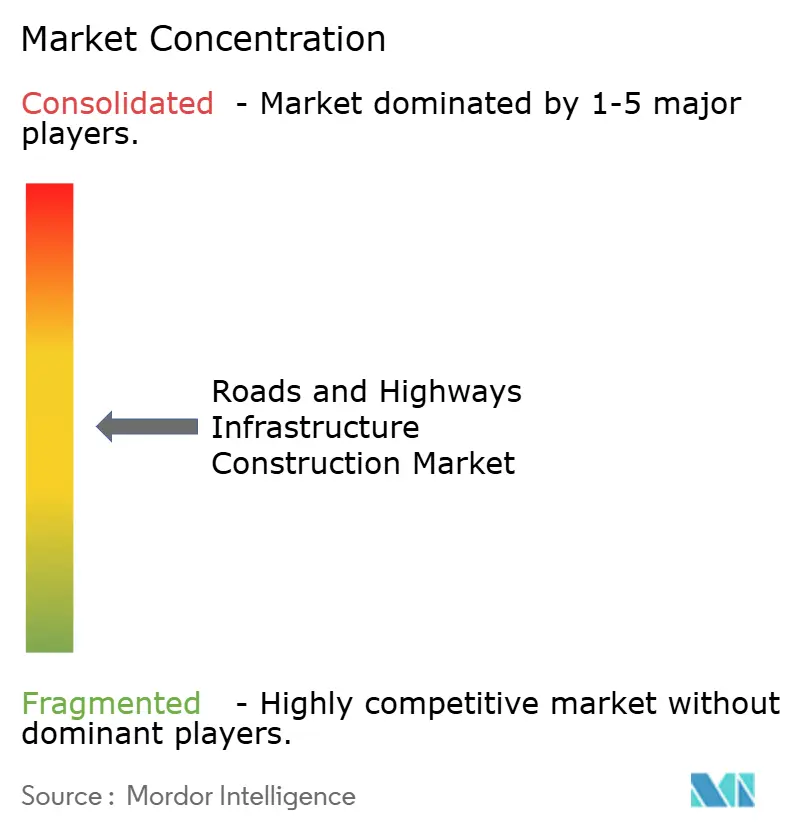
The roads and highways infrastructure construction market is moderately concentrated, with a relatively small group of global engineering and construction companies accounting for a significant share of large-scale expressway, motorway, bridge, and concession projects. China Communications Construction Company (CCCC) and China State Construction Engineering Corporation (CSCEC) maintain strong positions across Asia, Africa, and parts of Latin America, supported by integrated engineering capabilities and access to state-backed financing. European contractors, including VINCI, ACS, Skanska, STRABAG, Ferrovial, HOCHTIEF, Eiffage, Balfour Beatty, Colas, Acciona, and Royal BAM Group, compete through extensive concession portfolios, design-build expertise, and experience in complex bridge, tunnel, and urban transportation infrastructure. VINCI's February 2026 exclusive negotiations with the French government for the EUR 364 million (USD 397 million) A154/A120 motorway concession further demonstrate how long-term concession expertise and regulatory relationships strengthen competitive positioning in mature infrastructure markets. While these global players dominate large and technically complex projects, regional and local contractors continue to compete effectively in domestic road programs and smaller public infrastructure contracts.
Technology and integrated project delivery are becoming increasingly important competitive differentiators in the roads and highways infrastructure construction market. Contractors with advanced Building Information Modeling (BIM) capabilities, intelligent transportation systems (ITS) integration, digital project management, and asset lifecycle expertise are better positioned to secure complex infrastructure programs. HOCHTIEF's EUR 450 million (USD 491 million) Berliner Brückenzug A59 expansion contract, awarded in December 2025, illustrates the importance of technical expertise in delivering large projects while maintaining live traffic operations. Leading contractors are also strengthening their capabilities through digital engineering investments, technology partnerships, and acquisitions that improve design optimization, construction efficiency, and long-term asset management. Compliance with internationally recognized standards such as ISO 9001 and ISO 55000 has become increasingly important, particularly in public-private partnership (PPP) procurements across Europe and North America.
Competitive dynamics continue to evolve as governments increasingly bundle financing, design, construction, and long-term operations into integrated procurement models. Large multinational contractors are well-positioned to capitalize on these opportunities because of their financial strength, concession experience, and ability to manage complex, multi-country infrastructure programs. At the same time, regional contractors remain competitive in domestic highway expansion, rehabilitation, and maintenance projects where local market knowledge, regulatory familiarity, and established government relationships provide advantages. As a result, competition in the roads and highways infrastructure construction market is expected to remain centered on financial capacity, technical expertise, concession experience, digital capabilities, and execution performance rather than price alone.
Roads and Highways Infrastructure Construction Industry Leaders
China Communications Construction Company Limited (CCCC)
China State Construction Engineering Corporation Limited (CSCEC)
VINCI SA
ACS, Actividades de Construcción y Servicios, S.A.
Bechtel Corporation
- *Disclaimer: Major Players sorted in no particular order
Roads and Highways Infrastructure Construction Market Companies Covered in this Report
- China Communications Construction Company Limited (CCCC)
- China State Construction Engineering Corporation Limited (CSCEC)
- China Railway Group Limited (CREC)
- VINCI SA
- ACS, Actividades de Construcción y Servicios, S.A.
- Bechtel Corporation
- Bouygues Travaux Publics
- Skanska AB
- STRABAG SE
- Ferrovial SE
- HOCHTIEF Aktiengesellschaft
- Larsen & Toubro Limited
- Fluor Corporation
- Kiewit Corporation
- Eiffage SA
- Balfour Beatty plc
- Colas SA
- Acciona, S.A.
- Obayashi Corporation
- Royal BAM Group N.V.

Recent Industry Developments in Roads and Highways Infrastructure Construction Market
- July 2026: Leeds City Council appointed Balfour Beatty to deliver a GBP 120 million (USD 152 million) 7-year maintenance and structural improvement program on the Leeds Inner Ring Road, combining routine maintenance with major structural interventions across the A58(M) route, which carries 83,000 vehicles per day, with large-scale works commencing in 2027.
- May 2026: A STRABAG-led consortium was awarded a EUR 177 million (USD 193 million) contract to build a 16.3 km section of the Czech Republic’s D35 motorway, including 18 bridge structures and 2,782 meters of noise barriers, with construction commencing in April 2026.
- April 2026: VINCI Construction received a 10-year NZD 400 million (USD 218 million) road maintenance contract from NZ Transport Agency Waka Kotahi covering one of New Zealand’s largest state highway networks.


Global Roads and Highways Infrastructure Construction Market Report Scope
The Roads and Highways Infrastructure Construction Report is Segmented by Component (Road, Bridges/Overpass, Tunnels, and Others), Construction Type (New Construction and Renovation), Investment Source (Public, Private, and More), Type (National, State, and Local), and Geography (North America, Europe, Asia-Pacific, South America, and Middle East and Africa). The Market Forecasts are Provided in Terms of Value (USD).
| Road |
| Bridges/Overpass |
| Tunnels |
| Others |
| New Construction |
| Renovation |
| Public |
| Private |
| Public-Private Partnership |
| National |
| State |
| Local |
| North America | United States |
| Canada | |
| Mexico | |
| Europe | United Kingdom |
| Germany | |
| France | |
| Italy | |
| Spain | |
| Russia | |
| Rest of Europe | |
| Asia-Pacific | China |
| India | |
| Japan | |
| Australia | |
| South Korea | |
| SouthEast Asia (Singapore, Malaysia, Thailand, Indonesia, Vietnam, and Philippines) | |
| Rest of Asia-Pacific | |
| South America | Brazil |
| Argentina | |
| Rest of South America | |
| Middle East and Africa | Saudi Arabia |
| United Arab Emirates | |
| Turkey | |
| South Africa | |
| Nigeria | |
| Rest of Middle East and Africa |
| By Component | Road | |
| Bridges/Overpass | ||
| Tunnels | ||
| Others | ||
| By Construction Type | New Construction | |
| Renovation | ||
| By Investment Source | Public | |
| Private | ||
| Public-Private Partnership | ||
| By Type | National | |
| State | ||
| Local | ||
| By Geography | North America | United States |
| Canada | ||
| Mexico | ||
| Europe | United Kingdom | |
| Germany | ||
| France | ||
| Italy | ||
| Spain | ||
| Russia | ||
| Rest of Europe | ||
| Asia-Pacific | China | |
| India | ||
| Japan | ||
| Australia | ||
| South Korea | ||
| SouthEast Asia (Singapore, Malaysia, Thailand, Indonesia, Vietnam, and Philippines) | ||
| Rest of Asia-Pacific | ||
| South America | Brazil | |
| Argentina | ||
| Rest of South America | ||
| Middle East and Africa | Saudi Arabia | |
| United Arab Emirates | ||
| Turkey | ||
| South Africa | ||
| Nigeria | ||
| Rest of Middle East and Africa | ||


Key Questions Answered in the Report
What is the expected growth rate for roads and highways infrastructure construction?
The sector is forecast to grow at a 6.5% CAGR from 2026 to 2031, reaching USD 2,886 billion by 2031.
Which component leads roads and highways infrastructure construction?
Road carriageway construction held 69.8% of activity by component in 2025. Bridges and overpasses are the fastest-growing component at a 7.3% CAGR.
Why are public-private partnerships growing in highway projects?
PPPs are forecast to grow at a 7.8% CAGR as governments use concession models to share financing, operating, and revenue risks.
Which region has the strongest position in road construction?
Asia-Pacific held 42.6% of global activity in 2025 and is expected to record the fastest regional growth through 2031.
How are digital systems changing highway construction?
Smart Road and intelligent transport requirements add communications, data, and systems integration work to conventional civil construction scopes.
Page last updated on:





