
Retirement FinTech Market Size and Share
Market Overview
| Study Period | 2020 - 2031 |
|---|---|
| Market Size (2026) | USD 19.5 Billion |
| Market Size (2031) | USD 28.90 Billion |
| Growth Rate (2026 - 2031) | 8.20 % |
| Fastest Growing Market | Asia-Pacific |
| Largest Market | North America |
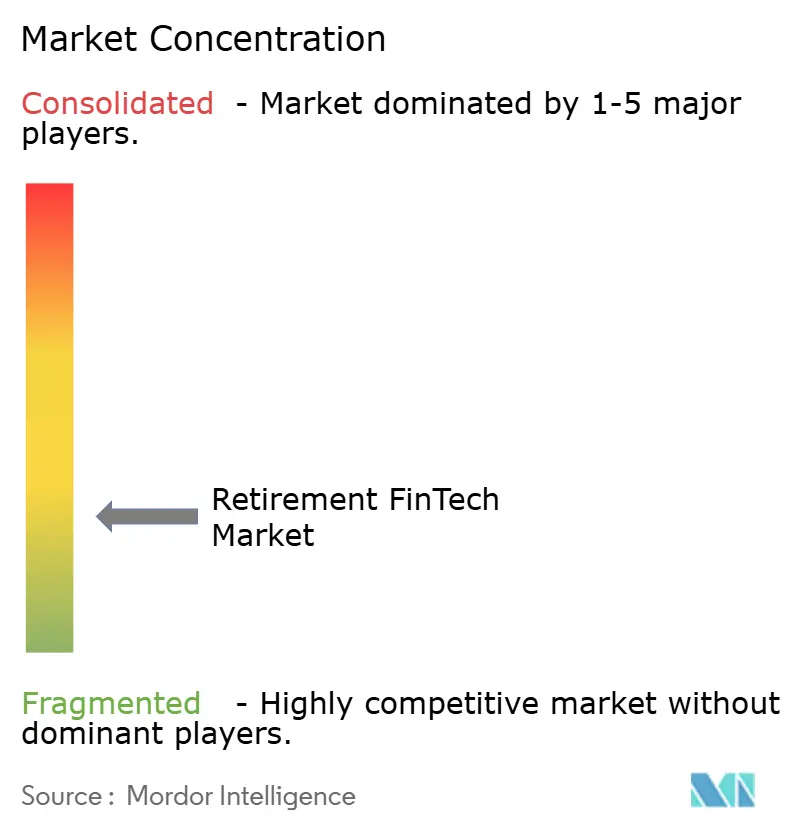
| Market Concentration | Low |
Major Players *Disclaimer: Major Players sorted in no particular order Image © Mordor Intelligence. Reuse requires attribution under CC BY 4.0. | |
Retirement FinTech Market Analysis by Mordor Intelligence
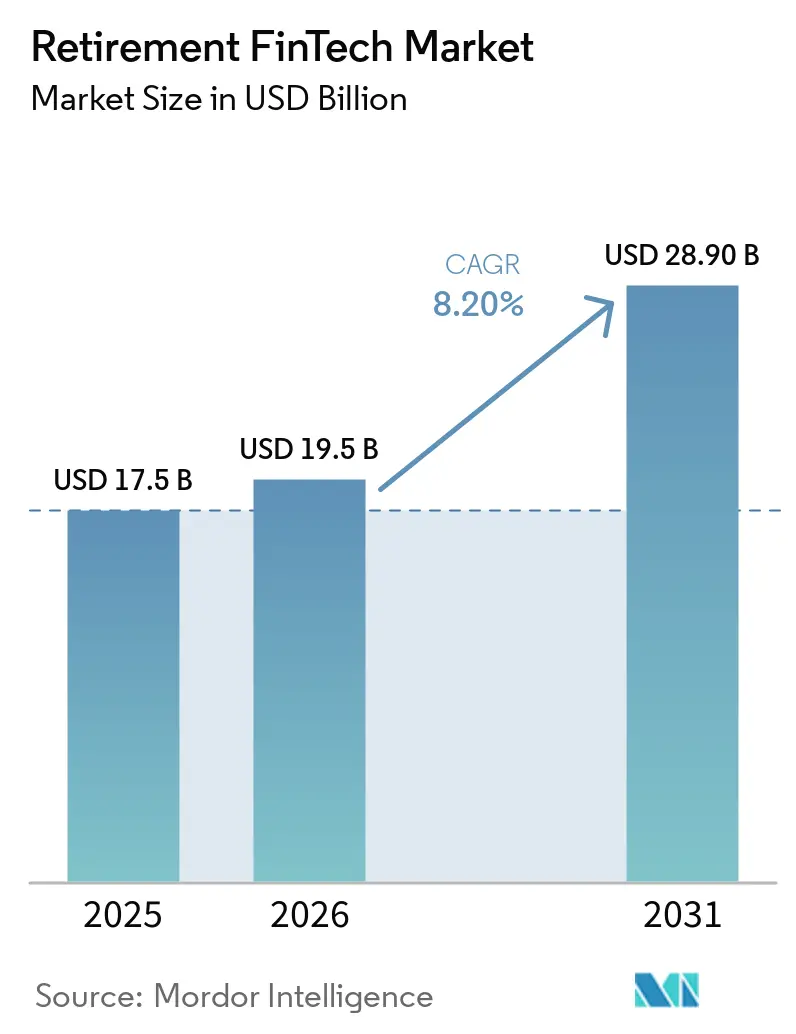
The Retirement FinTech Market size was valued at USD 17.5 billion in 2025 and is estimated to grow from USD 19.5 billion in 2026 to reach USD 28.90 billion by 2031, at a CAGR of 8.20% during the forecast period (2026-2031).
Growth reflects the movement from defined-benefit plans toward participant-directed defined-contribution arrangements that need digital administration, planning, and advice tools. Providers are also adapting their systems for retirement income as more participants move from saving to withdrawing. Payroll connectivity, data exchange, and simple digital journeys are becoming important competitive requirements for providers that serve smaller employer plans. The retirement fintech market also faces higher expectations for cybersecurity, audit controls, and compliance as more participant data and transactions move online.
Key Report Takeaways
- By product function, plan administration and recordkeeping captured 37.5% of the retirement fintech market share in 2025, while retirement-income, drawdown, and annuity enablement is projected to grow at 14.2% CAGR through 2031.
- By component, software and platforms captured 55.9% of the retirement fintech market share in 2025 and are projected to grow at 10.4% CAGR through 2031.
- By buyer, recordkeepers, third-party administrators, and pension administrators captured 33.2% of the retirement fintech market share in 2025, while employers and plan sponsors are projected to grow at 11.5% CAGR through 2031.
- By geography, North America captured 42.3% of the retirement fintech market share in 2025, while Asia-Pacific is projected to grow at 11.1% CAGR through 2031.
Note: Market size and forecast figures in this report are generated using Mordor Intelligence’s proprietary estimation framework, updated with the latest available data and insights as of January 2026.
Global Retirement FinTech Market Trends and Insights
Drivers Impact Analysis*
| Driver | (~) % Impact on CAGR Forecast | Geographic Relevance | Impact Timeline |
|---|---|---|---|
| Aging Populations and Digital Retirement Planning | +1.8% | Global, most acute in North America, Europe, and East Asia | Long term (≥ 4 years) |
| Individualized Saving and Defined-Contribution Models | +1.5% | North America, Europe, and the Asia-Pacific | Medium term (2-4 years) |
| Mobile, Cloud, and AI Adoption | +1.6% | Global, with strong momentum in North America and Asia-Pacific | Short term (≤ 2 years) |
| Pension Reforms and Digital Participation | +1.0% | Asia-Pacific, Europe, the Middle East, and Africa | Medium term (2-4 years) |
| Account Aggregation and Pension Consolidation | +0.7% | North America, Europe, and the Asia-Pacific | Medium term (2-4 years) |
| Digital Income and Decumulation Solutions | +1.3% | North America, Europe, and the Asia-Pacific | Medium term (2-4 years) |
| Source: Mordor Intelligence | |||
Aging Populations and Demand for Digital Retirement Planning
Population aging is increasing demand for retirement platforms that can serve large participant populations efficiently while supporting the full retirement journey, from enrollment and contributions to withdrawals, income planning, and longevity management. As individuals take greater responsibility for retirement outcomes, digital platforms can provide clearer account information, personalized planning, and scalable administration, while employers and plan administrators benefit from automated recordkeeping and communications. This is particularly relevant as retirement systems increasingly need to support participants through the decumulation phase rather than focusing only on accumulation, creating opportunities for integrated fintech platforms that combine administration, engagement, and retirement-income capabilities. The broader retirement industry is also seeing growing demand for personalized guidance and technology-enabled services.
Shift Toward Individualized Retirement Saving and Defined-Contribution Models
The shift toward defined-contribution (DC) retirement models is increasing the responsibility placed on individuals to make investment, savings, and retirement-income decisions, strengthening demand for digital planning, advice, and engagement tools. T. Rowe Price reported that 74% of Gen X, millennial, and Gen Z participants want to execute transactions through virtual assistants, highlighting growing expectations for convenient digital retirement experiences[1]T. Rowe Price, “2026 U.S. Retirement Market Outlook: Adapting to an Evolving System,” T. Rowe Price, troweprice.com.. Retirement fintech platforms can address this need by combining account management with personalized guidance, financial-wellness features, and automated workflows, while emergency-savings capabilities can create additional engagement with workplace retirement plans. The opportunity is particularly relevant for smaller employers that require simplified onboarding, administration, and payroll integration, supporting demand for standardized, fintech-native solutions.
Digitalization of Retirement Planning Through Mobile, Cloud and AI Technologies
Digital delivery is changing how participants, advisers, and plan sponsors access retirement information. Fidelity Investments introduced Fidelity Retirement Intelligence within myPlan+ in April 2026, offering personalized income projections, Social Security optimization, and portfolio rebalancing through natural-language interactions[2]Fidelity Investments, “Fidelity Investments to Expand Target Date Lineup With Launch of Guaranteed Income Solution,” Fidelity Newsroom, fidelity.com.. These tools improve access to retirement information but increase the need for reliable data, oversight, and controls. Japan also announced plans in July 2026 to lift its ban on investment recommendations for 4 million individual defined-contribution pension participants, following a 15-fold growth in iDeCo accounts over 10 years. This change could support digital advice in a market where savers often prefer capital-preservation assets. Cloud-based, API-enabled systems can also connect payroll, tax, insurance, and banking data with retirement workflows, helping providers offer a more complete view of retirement decisions.
Government Pension Reforms and Expansion of Digital Retirement Participation
Pension reforms are increasing demand for scalable retirement technology. India launched EPFO 3.0 in July 2026, extending pension coverage to more than 600 million workers, including gig and unorganized workers. The Pension Fund Regulatory and Development Authority launched StAR NPS in June 2026 with DigiLocker-based digital onboarding. In the United Kingdom, the Pension Schemes Act 2026 introduced guided-retirement mechanisms, while the Financial Conduct Authority’s Targeted Support regime allows algorithmic suggestions for defined consumer groups[3]https://thefintechmag.com/fca-launches-targeted-support-regime-enabling-banks-and-pension-providers-to-offer-group-financial-suggestions/. These reforms increase the need for digital platforms with localized compliance capabilities.
Restraints Impact Analysis*
| Restraint | (~) % Impact on CAGR Forecast | Geographic Relevance | Impact Timeline |
|---|---|---|---|
| Cybersecurity, Fraud, and Data Privacy Risks | -1.0% | Global, particularly North America and the Asia-Pacific superannuation markets | Short term (≤ 2 years) |
| Pension Regulation and Fiduciary Compliance | -0.8% | North America, Europe, and the Asia-Pacific | Medium term (2-4 years) |
| Legacy Infrastructure and Fragmented Data | -0.7% | North America and Europe | Long term (≥ 4 years) |
| Algorithmic Transparency and Liability Risks | -0.6% | North America, the United Kingdom, and Europe | Medium term (2-4 years) |
| Source: Mordor Intelligence | |||
Cybersecurity, Fraud, and Retirement Data Privacy Risks
Retirement accounts hold sensitive salary, identity, beneficiary, and asset data, making them attractive fraud targets. A coordinated credential-stuffing attack affected Australia’s superannuation sector in April 2025, involving AustralianSuper, Rest Super, Hostplus, Australian Retirement Trust, and Insignia Financial. More than 20,000 accounts were affected across the sector, highlighting the risks of digitally accessible accounts and withdrawal processes. The United States Department of Labor extended its cybersecurity guidance to all Employee Retirement Income Security Act-covered plans in September 2024, increasing compliance and audit requirements for plan administrators. Strong identity checks, fraud monitoring, secure data handling, and incident response processes can raise costs and lengthen implementation timelines. In the retirement fintech market, cybersecurity capabilities influence buyer confidence and provider selection.
Complex Pension Regulations and Fiduciary Compliance Requirements
Different pension and advice rules create a substantial compliance burden for platforms operating across borders. The United States Department of Labor vacated the 2024 Retirement Security Rule in March 2026, returning the fiduciary definition to the 1975 five-part test. Providers must consider how this test, Regulation Best Interest, Employee Retirement Income Security Act requirements, and state rules apply to digital-advice workflows. Compliance can vary by account type, participant category, and distribution channel, slowing product launches and complicating cross-border expansion in the retirement fintech market. In the United Kingdom, the Pension Protection Fund published an artificial intelligence governance plan in May 2026 for scheme administration and investment use. Trustees must understand, document, and remain accountable for the systems they use. These requirements add governance work for platforms introducing automated participant recommendations, while legacy systems and fragmented retirement data can complicate evidence collection and audit trails. Smaller entrants may face a greater relative burden because they have fewer established compliance resources.
*Our forecasts treat driver/restraint impacts as directional, not additive. The impact forecasts reflect baseline growth, mix effects, and variable interactions.
Segment Analysis
By Product Function: Income Solutions Are Growing Faster Than Administration
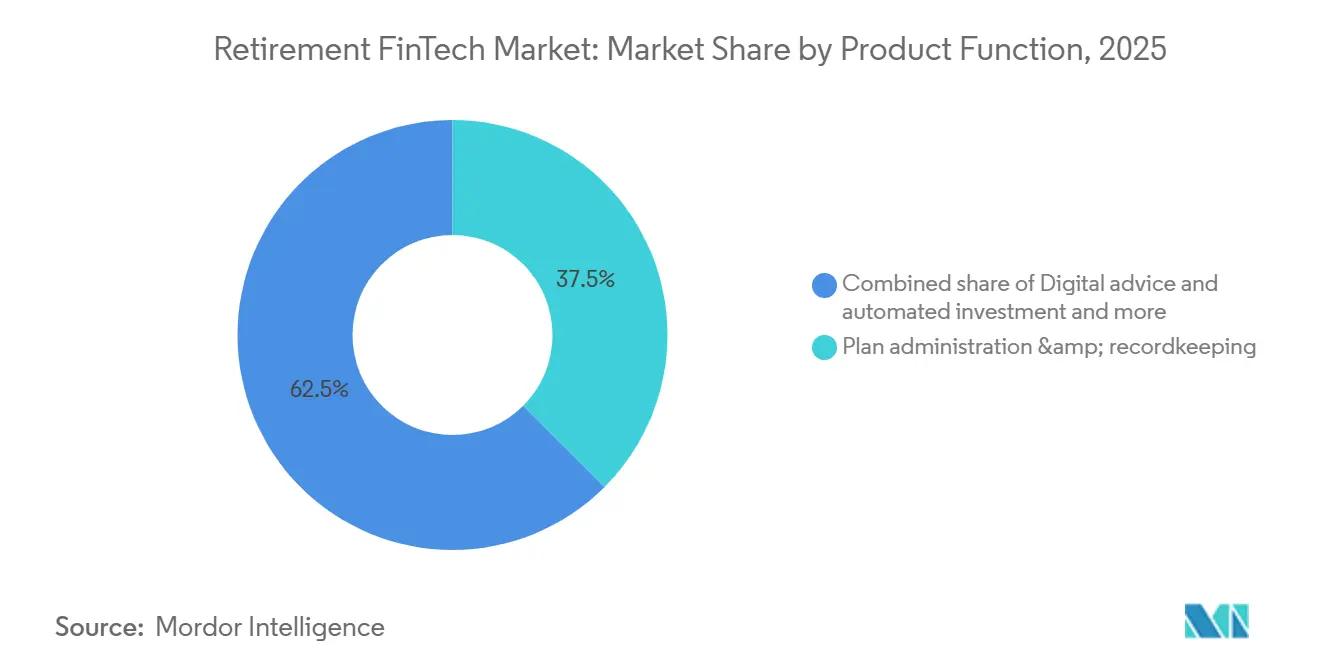
Plan administration and recordkeeping held 37.5% of the retirement fintech market size in 2025. The segment remains central because providers must process contributions, maintain account records, meet reporting requirements, and communicate with participants. Core administration is deeply embedded in retirement plan operations, which supports continued demand for recordkeeping systems. At the same time, lower administrative fees have increased pressure on vendors to improve scale and add complementary capabilities. Contribution, payroll, and data integration functions are important because they reduce the work needed to establish and maintain a plan.
Retirement-income, drawdown, and annuity enablement is forecast to expand at a 14.2% CAGR from 2026 to 2031 in the retirement fintech market. This product's function addresses income planning, withdrawal sequencing, tax considerations, and longevity risk as participants approach retirement. Fidelity launched Guaranteed Income Direct in 2024 to allow in-plan conversion of 401(k), 403(b), and 457(b) savings into immediate annuities. Engagement tools, financial wellness services, and automated investment features support participants throughout their saving years. Account aggregation and consolidation also matter in the United Kingdom and India, where fragmented pension arrangements can leave individuals with multiple accounts.


By Component: Software Leads While Managed Delivery Remains Relevant
Software and platforms accounted for 55.9% of the retirement fintech market size in 2025. The segment is also projected to grow at a 10.4% CAGR from 2026 to 2031, reflecting demand for software that connects retirement activity with payroll, banking, insurance, and tax systems. Cloud-native systems can support faster integration and data exchange than older monolithic applications. Software providers are also incorporating automated planning and participant-support features. These capabilities must be accompanied by auditability and governance as artificial intelligence functions become more common.
Professional services remain relevant for complex migrations from bespoke legacy systems. Implementation, integration, and consulting work are particularly important for public-sector institutions with specialized requirements. Managed administration and technology-enabled business-process outsourcing provide recurring services for employers that do not have internal pension administration teams. Automation may place pressure on outsourcing margins, but customized schemes can still require human operational support. Empower completed its acquisition of Milliman’s retirement administration business in September 2026, adding 1.5 million participants and USD 130 billion in assets under administration. The transaction shows that scaled managed-administration capabilities remain important in the retirement fintech market.
By Buyer: Employers Are Expanding Their Role in Distribution
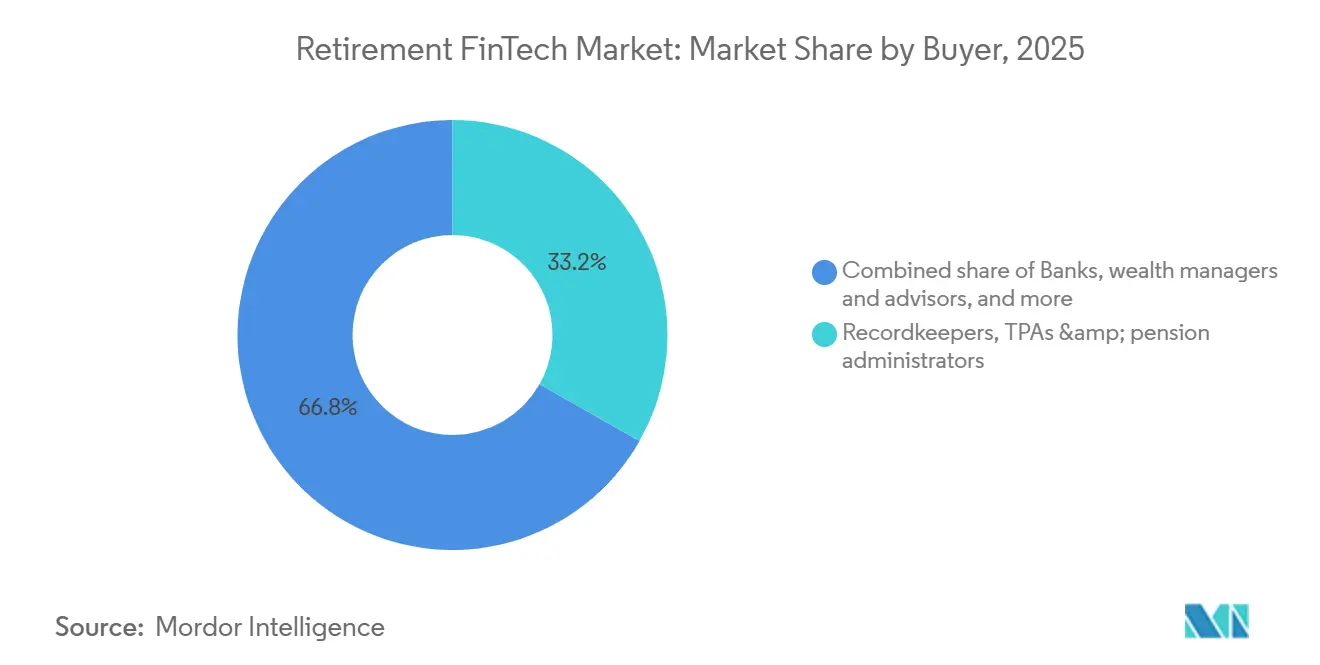
Recordkeepers, third-party administrators, and pension administrators held 33.2% of the retirement fintech market share in 2025. These buyers purchase administration software, data-integration tools, and managed-services contracts to operate retirement programs. Their requirements include dependable processing, compliance support, data security, and consistent participant communication. Consolidation among large providers makes technology capability more important when they evaluate vendors and operating models. Banks, wealth managers, and advisers also use white-labeled retirement infrastructure when they want to offer retirement services without developing every system internally.
Employers and plan sponsors are forecast to grow at an 11.5% CAGR from 2026 to 2031. Broader coverage requirements for smaller employers and state auto-individual retirement account programs are supporting this demand. Payroll-embedded platforms can reduce administrative friction for employers with smaller defined-contribution plans. This can improve the economics of serving plans with less than USD 5 million in assets. Public-sector pension institutions typically have longer procurement cycles and more customization needs, but successful contracts can create durable revenue. Insurers and annuity providers are also acquiring income-delivery capabilities as more retirement products focus on decumulation.
Geography Analysis
North America is projected to hold a 42.3% share of the retirement fintech market in 2025. The United States has a large defined-contribution system and a substantial base of employer-sponsored retirement plans, which support demand for advanced administration and participant-engagement tools. SECURE 2.0 is expanding coverage requirements for smaller employers and supporting the broader adoption of digital retirement services. FinTech-native recordkeepers manage more than 150,000 defined-contribution plans. Human Interest is expected to raise USD 100 million in 2025 at a USD 3 billion valuation, while Vestwell is expected to raise USD 385 million in February 2026.
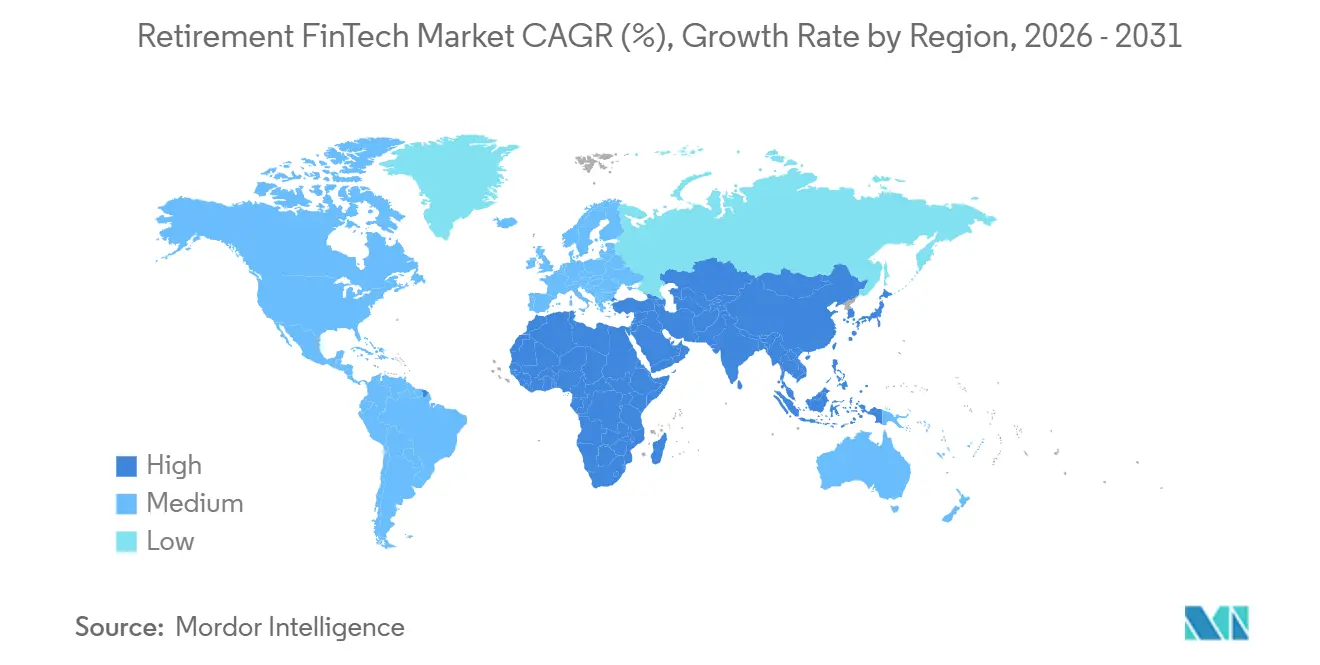
Asia-Pacific is forecast to grow at a CAGR of 11.1% from 2026 to 2031 in the retirement fintech market. Pension system digitalization is generating demand across India, Japan, South Korea, and Southeast Asia. India’s StAR NPS platform enables digital enrollment through DigiLocker verification and supports access for residents aged 18 to 85. The Pension Fund Regulatory and Development Authority has set an onboarding charge of INR 200 (USD 2.30) per subscriber. South Korea has designated robo-adviser retirement-pension services as innovative financial services. Shinhan Securities launched Shinhan SOL Robo Pension in August 2026, with a minimum subscription amount of KRW 1 million (USD 730).
Europe, South America, and the Middle East and Africa have distinct retirement-system structures and digital-adoption patterns. The United Kingdom’s Pension Schemes Act 2026 and the Financial Conduct Authority’s Targeted Support regime are expected to support algorithm-based retirement guidance for defined groups. Italy, Germany, and Spain are also revising occupational pension regulations, which may increase demand for digital distribution and administration solutions. South America remains at an earlier stage of development, where digital-wallet and mobile-money systems may facilitate the gradual adoption of micro-pension platforms. The Middle East and Africa represent a longer-term opportunity, driven by private savings mandates in Saudi Arabia and the United Arab Emirates. Providers operating in these regions require localized products, regulatory expertise, and appropriate distribution partners.

Competitive Landscape
The market remains fragmented by provider count and plan count, although large recordkeepers hold substantial concentrations of assets under administration. Fidelity and Empower have substantial assets under administration and established operating capabilities. Empower completed the acquisition of Milliman’s retirement administration business in September 2026 for USD 340 million. The transaction added 1.5 million participants, 400 defined-benefit plans with USD 80 billion in assets, and more than 1,100 defined-contribution plans with USD 50 billion in assets.
Vanguard announced in August 2026 that it would acquire Altruist for USD 4 billion to USD 5 billion. Altruist is expected to operate as a standalone business, giving Vanguard a direct route to independent financial advisers and adviser technology. The transaction broadens competition between asset managers, custodians, and adviser-platform providers. Human Interest also partnered with UBS in March 2026 to make its technology-first 401(k) administration and compliance platform available to more than 5,000 UBS Financial Advisers. These moves show that distribution partnerships and acquisitions are shaping the retirement fintech market.
Challenger platforms compete through payroll integration, participant experience, and faster implementation. PensionBee represents a consumer-facing approach based on pension aggregation and direct participant engagement. PensionBee reported customer retention above 95% and revenue growth of 40% in the first half of 2026. RightCapital launched Iris in June 2026, while Altruist launched Hazel in September 2026, adding artificial-intelligence-led planning capabilities to adviser workflows. A portable account for gig workers remains an opportunity because employer-based defined-contribution structures do not always serve workers with non-traditional employment. The competitive position of each provider will depend on its ability to connect retirement services with the systems that participants and employers already use.
Retirement FinTech Industry Leaders
Fidelity Investments
Empower Annuity Insurance Company
The Vanguard Group, Inc.
Charles Schwab Corporation
SS&C Technologies Holdings, Inc.
- *Disclaimer: Major Players sorted in no particular order

Recent Industry Developments
- September 2026: Empower closed its acquisition of Milliman’s retirement administration business for USD 340 million. The acquisition added 1.5 million participants, 400 defined-benefit plans with USD 80 billion in assets, and more than 1,100 defined-contribution plans with USD 50 billion in assets.
- August 2026: Vanguard announced its acquisition of Altruist for USD 4 billion to USD 5 billion. Altruist will operate as a standalone entity and give Vanguard access to independent financial advisers and adviser technology.
- August 2026: Shinhan Securities launched the artificial-intelligence-powered Shinhan SOL Robo Pension with Korea Investment Management. The service provides automated asset allocation across exchange-traded funds and stocks for individual retirement pension accounts, with a minimum subscription of KRW 1 million (USD 730).
- July 2026: Japan announced plans to lift the ban on investment advice for iDeCo participants. The policy change concerns 4 million individual defined-contribution pension account holders and could support adviser-led and automated advice.


Global Retirement FinTech Market Report Scope
| Plan administration and recordkeeping |
| Contribution, payroll and data-integration rails |
| Participant engagement, planning and financial wellness |
| Digital advice and automated investment |
| Account aggregation, dashboards and consolidation |
| Retirement-income, drawdown and annuity-enablement |
| Software and platforms (SaaS or license) |
| Professional services (implementation, integration, consulting) |
| Managed administration / technology-enabled BPO |
| Recordkeepers, TPAs and pension administrators |
| Banks, wealth managers, and advisors |
| Insurers and annuity providers |
| Employers and plan sponsors |
| Public-sector pension institutions |
| North America | United States |
| Canada | |
| Mexico | |
| South America | Brazil |
| Argentina | |
| Rest of South America | |
| Europe | United Kingdom |
| Germany | |
| France | |
| Italy | |
| Spain | |
| Rest of Europe | |
| Asia-Pacific | China |
| Japan | |
| India | |
| South Korea | |
| Australia | |
| Indonesia | |
| Thailand | |
| Malaysia | |
| Singapore | |
| Vietnam | |
| Rest of Asia-Pacific | |
| Middle East and Africa | Saudi Arabia |
| United Arab Emirates | |
| Turkey | |
| South Africa | |
| Egypt | |
| Rest of Middle East and Africa |
| By Product Function | Plan administration and recordkeeping | |
| Contribution, payroll and data-integration rails | ||
| Participant engagement, planning and financial wellness | ||
| Digital advice and automated investment | ||
| Account aggregation, dashboards and consolidation | ||
| Retirement-income, drawdown and annuity-enablement | ||
| By Component | Software and platforms (SaaS or license) | |
| Professional services (implementation, integration, consulting) | ||
| Managed administration / technology-enabled BPO | ||
| By Buyer | Recordkeepers, TPAs and pension administrators | |
| Banks, wealth managers, and advisors | ||
| Insurers and annuity providers | ||
| Employers and plan sponsors | ||
| Public-sector pension institutions | ||
| By Geography | North America | United States |
| Canada | ||
| Mexico | ||
| South America | Brazil | |
| Argentina | ||
| Rest of South America | ||
| Europe | United Kingdom | |
| Germany | ||
| France | ||
| Italy | ||
| Spain | ||
| Rest of Europe | ||
| Asia-Pacific | China | |
| Japan | ||
| India | ||
| South Korea | ||
| Australia | ||
| Indonesia | ||
| Thailand | ||
| Malaysia | ||
| Singapore | ||
| Vietnam | ||
| Rest of Asia-Pacific | ||
| Middle East and Africa | Saudi Arabia | |
| United Arab Emirates | ||
| Turkey | ||
| South Africa | ||
| Egypt | ||
| Rest of Middle East and Africa | ||


Key Questions Answered in the Report
What is the projected value of retirement fintech market by 2031?
The retirement fintech market is forecast to reach USD 28.9 billion by 2031, growing at an 8.2% CAGR from 2026 to 2031.
Which product function is growing fastest in retirement technology?
Retirement-income, drawdown, and annuity enablement is expected to grow at a 14.2% CAGR through 2031.
Why are employers adopting digital retirement platforms?
Employers use these platforms to reduce administrative work, connect retirement plans with payroll, and support wider coverage requirements.
Which region is growing fastest for retirement technology services?
Asia-Pacific is forecast to grow at an 11.1% CAGR through 2031, supported by pension-system digitalization and reforms.
What are the main risks for retirement platform providers?
Cybersecurity, fraud, data privacy, fragmented pension rules, and fiduciary requirements can increase operating costs and slow deployment.
How are large providers competing in retirement services?
Large providers are using acquisitions, adviser distribution, payroll partnerships, and income solutions to broaden their capabilities.
Page last updated on:





