
Remote Signing Services Market Size and Share
Market Overview
| Study Period | 2020 - 2031 |
|---|---|
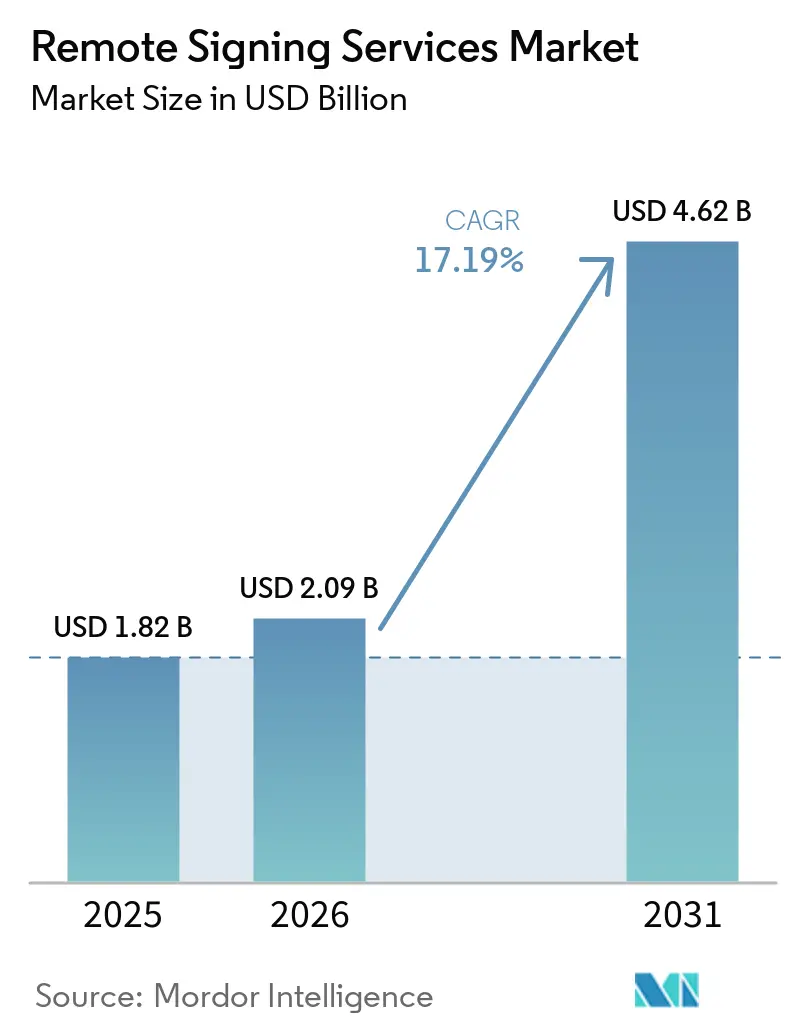
| Market Size (2026) | USD 2.09 Billion |
| Market Size (2031) | USD 4.62 Billion |
| Growth Rate (2026 - 2031) | 17.19 % |
| Fastest Growing Market | Asia-Pacific |
| Largest Market | North America |
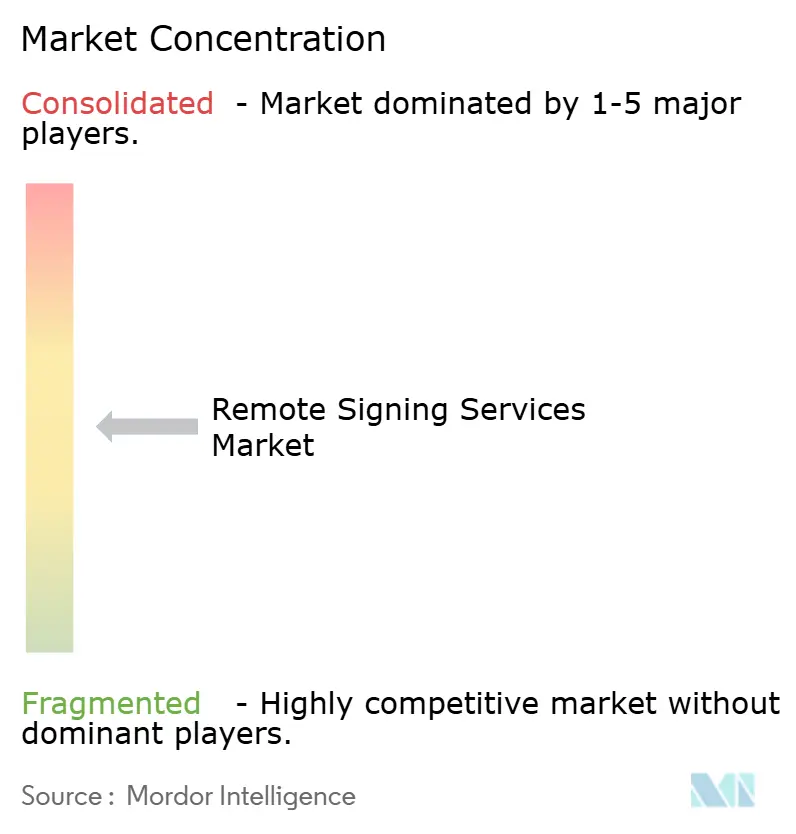
| Market Concentration | Medium |
Major Players *Disclaimer: Major Players sorted in no particular order Image © Mordor Intelligence. Reuse requires attribution under CC BY 4.0. | |
Remote Signing Services Market Analysis by Mordor Intelligence
The remote signing services market size is projected to expand from USD 1.82 billion in 2025 to USD 2.09 billion in 2026, and to USD 4.62 billion by 2031, registering a CAGR of 17.19% between 2026 and 2031. The remote signing services market is moving from paper-based document completion toward signing functions built into business software and remote workflows. Regulation is making secure signing a compliance need in healthcare, financial services, and public procurement, rather than an optional efficiency tool. Vendors are responding by combining signatures with identity checks, document integrity checks, and agreement management within broader digital trust platforms. This approach favors suppliers that can support regulated workflows, local rules, and software integration simultaneously. It also creates room for regional providers that understand national trust-service requirements and data-residency obligations.
Key Report Takeaways
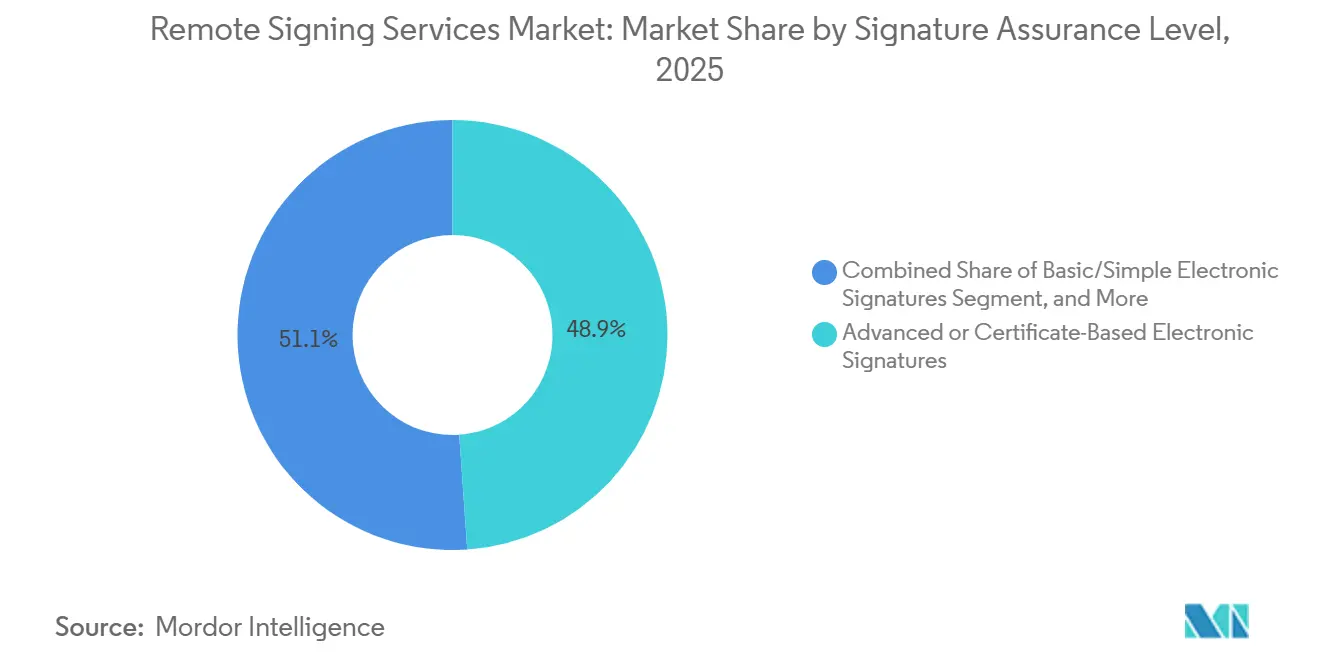
- By signature assurance level, advanced or certificate-based electronic signatures held 48.91% of the remote signing services market share in 2025, while qualified or equivalent high-assurance electronic signatures are projected to expand at a CAGR of 20.73% through 2031.
- By organization size, large enterprises held 69.26% revenue share in 2025, while SMEs are projected to expand at a CAGR of 22.17% through 2031.
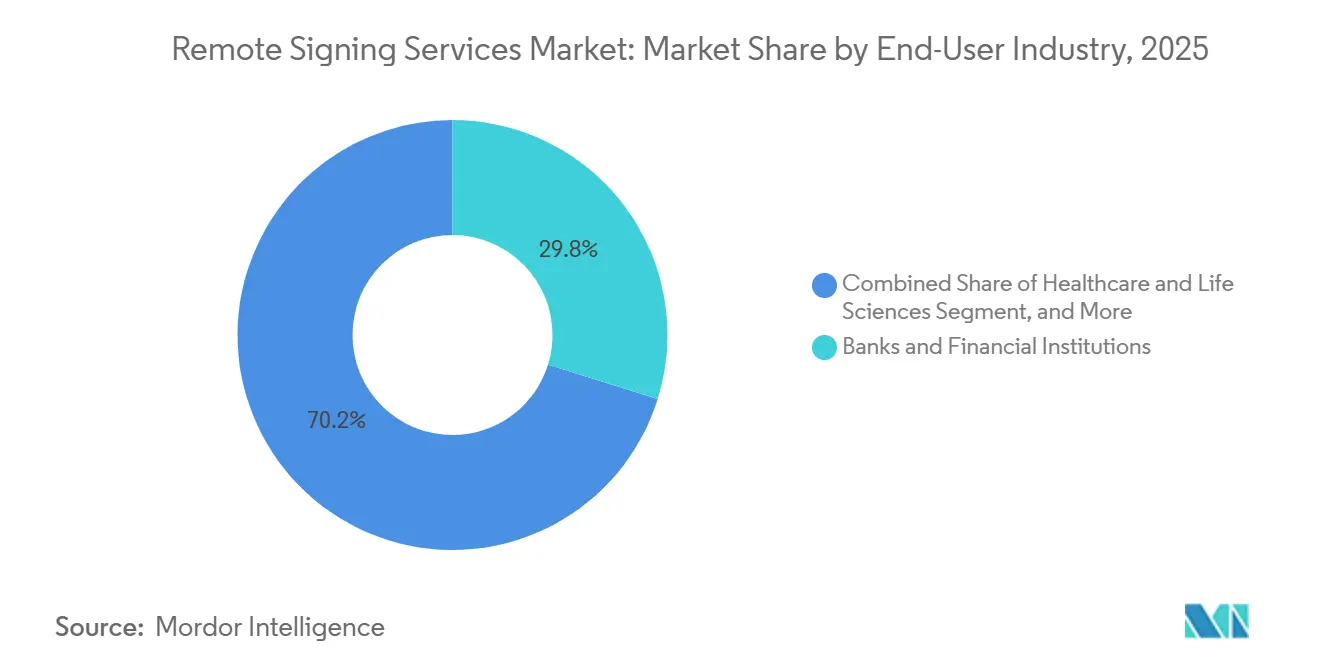
- By end-user industry, BFSI accounted for 29.81% of revenue in the remote signing services market in 2025, while healthcare and life sciences are projected to expand at a CAGR of 19.26% through 2031.
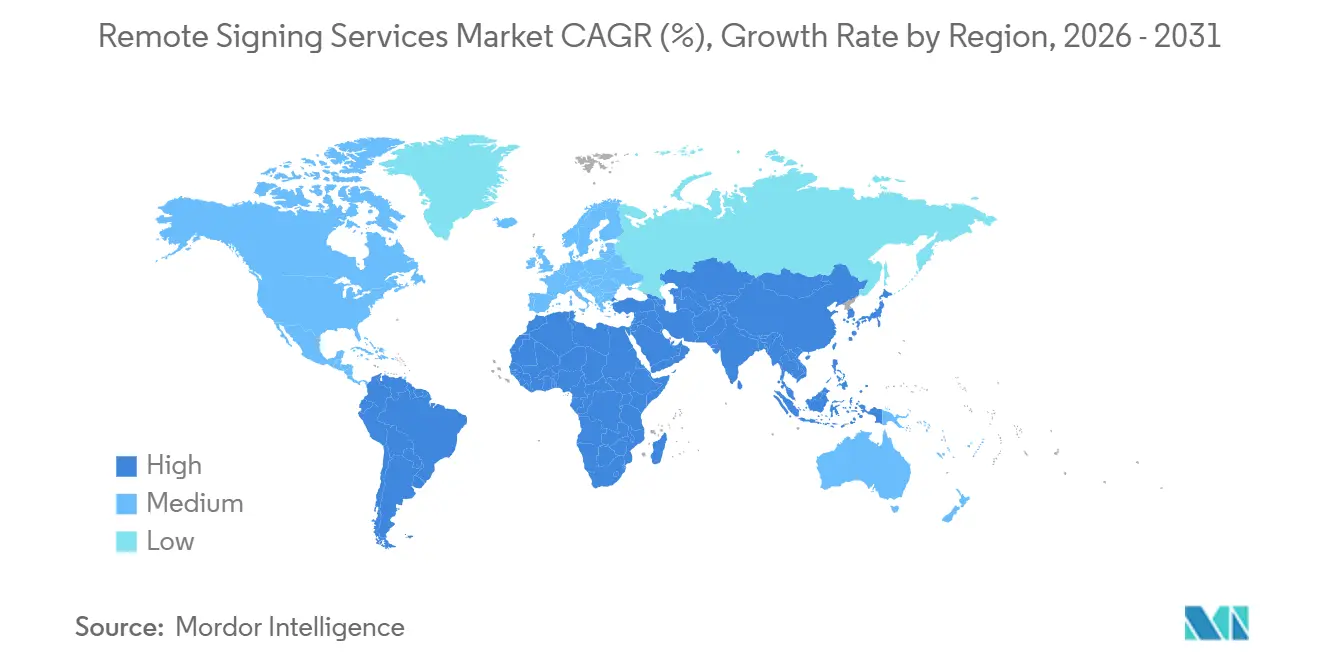
- By geography, North America accounted for 36.71% of revenue in the remote signing services market in 2025, while Asia-Pacific is projected to expand at a CAGR of 21.83% through 2031.
Note: Market size and forecast figures in this report are generated using Mordor Intelligence’s proprietary estimation framework, updated with the latest available data and insights as of January 2026.
Global Remote Signing Services Market Trends and Insights
Drivers Impact Analysis*
| DRIVER | (~) % IMPACT ON CAGR FORECAST | GEOGRAPHIC RELEVANCE | IMPACT TIMELINE |
|---|---|---|---|
| Paperless and Distributed Workflows | +4.8% | Global | Short term (≤ 2 years) |
| Qualified Remote Signature Recognition | +3.6% | EU, North America, Brazil, China, APAC | Medium term (2-4 years) |
| Embedded Signing APIs | +2.9% | Global | Short term (≤ 2 years) |
| Digital Identity and Remote Onboarding | +2.4% | APAC, North America, Europe | Medium term (2-4 years) |
| High-Assurance Document Integrity Demand | +1.9% | Europe, North America | Medium term (2-4 years) |
| EUDI Wallet and Cross-Border Trust Services | +1.5% | EU core, spill-over to MEA and APAC | Long term (≥ 4 years) |
| Source: Mordor Intelligence | |||
Expansion of Paperless and Distributed Workflows
Remote and hybrid operating models have made faster document completion important in commercial relationships. The remote signing services market benefits when sales, procurement, legal, and human resources teams can complete documents without a physical meeting. Digitalized contract processes also reduce handoffs between parties and improve visibility over document status. DocuSign reported that its platform was embedded in more than 1,100 partner-built applications, showing how signing has become part of business software rather than a separate task. This shift places more value on suppliers that integrate with customer relationship management, enterprise resource planning, and contract lifecycle management systems. It puts pressure on standalone tools that cannot fit into the customer’s wider workflow.
Regulatory Recognition of Qualified Remote Signatures
Regulatory rules are setting clearer adoption requirements for high-assurance signing in several jurisdictions. The European Digital Identity framework required each EU Member State to make at least 1 digital identity wallet available by the end of 2026. In the United States, CMS finalized the CMS-0053-F rule in March 2026 for healthcare claims attachments and electronic signatures.[1] The rule took effect on May 26, 2026, and CMS estimated USD 781 million in annual savings from replacing manual attachment processes. Brazil also updated ICP-Brasil digital signature policies through Instrução Normativa No. 33 in June 2025. These requirements make secure and auditable electronic signatures more relevant for organizations that work across regulated processes.
Embedded Signing APIs in Enterprise Software
Application programming interfaces are changing how organizations buy signing capabilities. Instead of purchasing a separate application for each user, organizations can place signature requests inside customer, employee, procurement, and finance workflows. DocuSign announced the general availability of its Model Context Protocol Server in September 2026, allowing supported AI agents to initiate governed agreement and e-signature workflows. Nitro introduced its Nitro Sign API for enterprise workflows in October 2025, targeting integration with CRM, ERP, and HR systems. The remote signing services market, therefore, rewards vendors with documented interfaces and clear controls around security and compliance. Embedded deployment can also make it harder for customers to switch providers after signing, as functions become part of core workflows. This pattern supports recurring demand from organizations that need to sign at multiple points in a business process.
Growth of Digital Identity and Remote Onboarding
Remote onboarding is combining identity verification and electronic signatures into a single process for regulated and high-volume workflows. This approach can reduce the need for repeated verification steps when organizations reuse a verified digital identity in subsequent agreements. The electronic signatures market benefits when providers connect identity checks, credential management, and signing controls through an integrated workflow. In Brazil, ICP-Brasil cloud certificates generated more than 3.5 million qualified electronic signatures per day, and by 2025, more than 50% of doctors used digital certificates for patient records, prescriptions, and telemedicine documentation.[2] Providers that combine identity verification with signing can support enterprise customers that need traceable, reusable credentials for remote onboarding. This model is particularly relevant in financial services, healthcare, and public-sector workflows where identity assurance and document integrity are closely connected.
Restraints Impact Analysis*
| RESTRAINT | (~) % IMPACT ON CAGR FORECAST | GEOGRAPHIC RELEVANCE | IMPACT TIMELINE |
|---|---|---|---|
| Cross-Border Trust-Service Accreditation Fragmentation | -1.8% | EU, APAC, MEA | Medium term (2-4 years) |
| HSM-Backed Qualified Signing Cost | -1.4% | Global, most acute in emerging markets | Medium term (2-4 years) |
| Low-Bandwidth Identity-Proofing Friction | -0.9% | Africa, South Asia, Rural APAC | Long term (≥ 4 years) |
| Data Residency and Sovereign Cloud Constraints | -0.7% | China, EU, GCC | Long term (≥ 4 years) |
| Source: Mordor Intelligence | |||
Cross-Border Trust-Service Accreditation Fragmentation
Trust-service accreditation remains linked to national certification frameworks, which can complicate acceptance across borders. A signature that meets 1 jurisdiction’s requirements may need extra checks when presented in another jurisdiction. The EUDI Wallet framework aims to improve this position in Europe, but national implementation continues to differ across Member States.[3] Asia-Pacific also operates through separate legal frameworks, including India’s IT Act, Japan’s E-Sign Law, and Singapore’s Electronic Transactions Act. Multinational organizations can therefore need separate compliance arrangements for different operations. This fragmentation can raise deployment costs and slow the adoption of remote signing services in cross-border processes.
High Cost of HSM-Backed Qualified Signing
Qualified electronic signatures require secure signature-creation arrangements and can require certified hardware security module infrastructure. The expense is easier to support when large organizations distribute it across many signed documents. Smaller organizations may instead use lower-assurance signatures or pay per-signature charges from a qualified trust-service provider. The difference can limit the adoption of the highest assurance level, even when organizations recognize its value for compliance. It also separates the market into large users who can support dedicated infrastructure and smaller users who need hosted options. The remote signing services market depends on service models that make qualified signing accessible without shifting the full infrastructure burden onto small and medium-sized businesses.
*Our forecasts treat driver/restraint impacts as directional, not additive. The impact forecasts reflect baseline growth, mix effects, and variable interactions.
Segment Analysis
By Signature Assurance Level: Advanced Signatures Held the Largest Position, While Qualified Signatures Grew Faster
Advanced or certificate-based electronic signatures held 48.91% of the remote signing services market share in 2025. This level is widely used by BFSI, legal, and enterprise workflow teams that need a strong link to signer identity. It gives organizations more assurance than basic click-to-sign processes. It can also avoid the fully qualified trust-service provider infrastructure required by the most stringent tier. Basic or simple electronic signatures continue to serve lower-risk consumers, internal HR, and routine workflow needs. Their use remains relevant in North America and Asia-Pacific, where click-to-sign processes are familiar. However, their position is narrowing as compliance requirements call for stronger evidence of identity. The electronic signatures industry is therefore placing greater value on auditable signing controls in regulated workflows.
Qualified or equivalent high-assurance electronic signatures are projected to expand at a CAGR of 20.73% from 2026 to 2031. These signatures are relevant when the signer's identity and the integrity of a document require the highest level of assurance. The EUDI wallet framework is intended to allow EU citizens to create qualified electronic signatures without charge from December 2027. This provision can make qualified signing more accessible across the region. Namirial announced full eIDAS 2 compliance in Italy, Spain, and France in June 2026.[4] Its announcement included certification of a signing workflow based on the EUDI wallet. This gives qualified trust-service providers a clearer way to compete by aligning with regulatory requirements and building cross-border capabilities.

By Organization Size: Large Enterprises Generated Most Revenue While SMEs Expanded Faster
Large enterprises held 69.26% revenue share in 2025. Their lead reflected earlier deployment in contract lifecycle management and content management environments. These customers increasingly invest in API security, higher-assurance signing, and agreement analysis after signature completion. This broadens the vendor role from completing a document to managing information throughout an agreement’s life. DocuSign reported more than 1.9 million business customers in September 2026.[5] Its product direction has included identity verification, e-signature, and post-execution agreement management. The remote signing services market size for large-enterprise deployments remains driven by the need for controlled integration across complex business processes.
SMEs are projected to expand at a CAGR of 22.17% from 2026 to 2031. Subscription pricing and cloud delivery reduce the need for organizations to purchase and operate their own signing infrastructure. Digital-native firms in fintech, legal technology, and telehealth can also embed signing capabilities into the products they offer customers. This makes SMEs both users and potential distribution channels for signing services. Nitro’s October 2025 API launch addressed automated signature requests within enterprise workflows. The launch reflected demand from organizations that need signing functions to work with established systems. The electronic signatures industry can benefit as smaller firms move from paper processes to software-based document completion. Hosted tools remain important because they lower the technical burden for these customers.
By End-User Industry: BFSI Led Revenue While Healthcare and Life Sciences Recorded the Fastest Growth
BFSI accounted for 29.81% of the remote signing services market in 2025. Financial institutions need audit trails, identity checks, and secure records for many customer and internal processes. Signing is used in lending, account opening, transaction approval, and amendments to financial agreements. Higher-assurance signatures can reduce exposure from using simple click-to-sign methods for sensitive transactions. OneSpan stated in July 2026 that it served more than 60% of the world’s 100 largest banks. Its DigipassONE offering combined authentication, transaction signing, digital credentials, analytics, and in-application protection. Government, legal services, and IT and telecommunications also drive demand for document traceability and workflow integration.
The healthcare and life sciences industry is projected to expand at a CAGR of 19.26% from 2026 to 2031. The CMS-0053-F rule established a national standard for electronic signatures in healthcare claims attachment transactions. The compliance date is May 26, 2028, following the rule’s May 2026 effective date. This gives providers, payers, and clearinghouses a defined timeframe to update authenticated signature processes. In Brazil, digital certificates were already used by more than 50% of doctors for patient records, prescriptions, and telemedicine documentation by 2025. Healthcare organizations may standardize on a stronger signing infrastructure when they support multiple regulated use cases. This demand can extend to adjacent sectors that require comparable identity and audit controls.
Geography Analysis
North America accounted for 36.71% of the remote signing services market share in 2025. The United States provides broad legal recognition for electronic signatures through the E-SIGN Act and UETA. This legal foundation has supported use across commercial and public-sector processes. Healthcare adds a specific compliance requirement through CMS-0053-F, which took effect in May 2026.[6] The rule gives covered organizations until May 2028 to comply. DocuSign’s more than 1.9 million business customers also supported the region’s role as a major revenue base. Canada contributed to the demand for financial services and government digital service modernization.
The EUDI Wallet timetable and differing national implementation paths shape Europe’s position. The European Digital Identity regulation required Member States to provide at least 1 wallet by the end of 2026. This creates a shared framework for future qualified signing and digital identity use. Organizations still need to account for national differences in wallet readiness and trust-service arrangements. Namirial achieved eIDAS 2 compliance in Italy, Spain, and France in June 2026. Its EUDI Wallet-based workflow showed how providers are preparing to offer compliant services across several European markets. Germany and the United Kingdom remain important markets for the use of legal, real estate, and financial services.
Asia-Pacific is projected to expand at a CAGR of 21.83% from 2026 to 2031. Growth is linked to digital identity programs in India, evolving electronic-document rules in China, and continuing digitization in Japan. The region contains different national frameworks, which increases the importance of local compliance support. Brazil, in South America, also remains significant because ICP-Brasil cloud certificates generated more than 3.5 million qualified electronic signatures per day by 2025. Data residency requirements and local trust infrastructure also influence the size of the remote signing services market in emerging regions. The Middle East and Africa remain an emerging area where government and BFSI users require in-country digital trust services.
Competitive Landscape
The remote signing services market is moderately concentrated, with global platforms operating alongside jurisdiction-focused qualified trust-service providers. DocuSign, Adobe, DigiCert, OneSpan, and Thales have broad visibility across enterprise signing, certificate, identity, and trust requirements. Regional specialists such as eMudhra, Namirial, Penneo, and Dokobit can compete by leveraging local compliance expertise. This structure allows large platforms to serve multinational customers while specialists address local rules and public-sector needs. Suppliers increasingly compete on the combination of identity, signature, and document integrity functions. The remote signing services market is less favorable for providers that offer only basic document signing without integration or assurance capabilities.
DigiCert expanded its document trust offering in 2026 with Content Trust Manager and enhanced Document Trust Manager. The company stated that the offerings supported centralized key management and pre-integrated support for DocuSign and Adobe Sign. It also stated that Content Trust Manager used the C2PA standard to help organizations verify the authenticity of digital content. DocuSign made its MCP Server generally available in September 2026 for governed agent-based agreement workflows. OneSpan introduced DigipassONE in July 2026 to combine authentication, transaction signing, digital credentials, analytics, and in-application protection. These actions show that providers are expanding their role beyond completing a single document.
Regional opportunities remain where qualified trust-service provision is limited or where signing, know-your-customer checks, and archiving are not linked in 1 workflow. Signicat’s 2026 eID and Wallet Hub was designed to connect legacy national eIDs and EUDI Wallets through a unified interface. Namirial introduced an AI-powered digital onboarding platform in April 2026 that combined KYC identity verification, electronic signatures, and secure archiving. This creates a more complete proposition for regulated financial institutions and businesses. The remote signing services market can continue to reward providers that meet local data, identity, and trust requirements. No combined market-share figure for the leading providers was supplied. The available evidence supports a competitive structure with a concentrated leadership group and a meaningful group of local specialists.
Remote Signing Services Industry Leaders
-
DocuSign, Inc.
-
Adobe Inc.
-
OneSpan Inc.
-
Entrust Corporation
-
Namirial S.p.A.
- *Disclaimer: Major Players sorted in no particular order
Recent Industry Developments
- September 2026: DocuSign announced general availability of its MCP Server, enabling AI agents, including Claude, ChatGPT, Gemini, and Copilot, to invoke agreement intelligence and e-signature workflows natively, the company simultaneously accelerated to over 1.9 million business customers globally.
- July 2026: OneSpan introduced DigipassONE, a unified platform combining authentication, transaction signing, digital credentials, analytics, and in-application protection under shared platform services, OneSpan serves over 60% of the world's 100 largest banks.
- June 2026: Namirial achieved full eIDAS 2 compliance in Italy, Spain, and France, among the first pan-European QTSPs to do so, certifying its EUDI Wallet-based signing workflow under ETSI TS 119 461 v2.1.1.
- May 2026: CMS-0053-F, HIPAA electronic-signature standard for healthcare claims, took effect May 26, 2026, CMS projects approximately USD 781 million in annual industry savings from eliminating manual claims-attachment processes. Compliance is required by May 26, 2028.
- April 2026: DigiCert launched Content Trust Manager, leveraging the C2PA standard, and released enhanced Document Trust Manager with centralized key management and pre-integrated support for DocuSign and Adobe Sign, supporting eIDAS 2, ZertES, and AATL.
Global Remote Signing Services Market Report Scope
The remote signing services market consists of cloud‑based platforms and qualified trust services that enable individuals to create legally binding electronic signatures without physical tokens or on-premises hardware. Private signing keys are stored and protected in secure, certified environments (often HSMs operated by qualified providers), while signers authenticate remotely via web or mobile channels; this market underpins digital onboarding, e‑contracts, and paperless workflows across enterprises, the public sector, and consumer services.
The Remote Signing Services Market Report is Segmented by Signature Assurance Level (Basic/Simple Electronic Signatures, Advanced or Certificate-Based Electronic Signatures, and Qualified or Equivalent High-Assurance Electronic Signatures), Organization Size (Large Enterprises, and Small and Medium-Sized Enterprises), End-User Industry (Banking, Financial Services, and Insurance, Government and Public Administration, Healthcare and Life Sciences, Legal Services, Information Technology and Telecommunications, and Other End-user Industries), and Geography (North America, South America, Europe, Asia-Pacific, and Middle East and Africa). The Market Forecasts are Provided in Terms of Value (USD).
| Basic/Simple Electronic Signatures |
| Advanced or Certificate-Based Electronic Signatures |
| Qualified or Equivalent High-Assurance Electronic Signatures |
| Large Enterprises |
| Small and Medium-Sized Enterprises |
| Banking, Financial Services, and Insurance |
| Government and Public Administration |
| Healthcare and Life Sciences |
| Legal Services |
| Information Technology and Telecommunications |
| Other End-user Industries |
| North America | United States | |
| Canada | ||
| South America | Brazil | |
| Mexico | ||
| Rest of South America | ||
| Europe | Germany | |
| United Kingdom | ||
| France | ||
| Rest of Europe | ||
| Asia-Pacific | China | |
| Japan | ||
| India | ||
| Rest of Asia-Pacific | ||
| Middle East and Africa | Middle East | Saudi Arabia |
| United Arab Emirates | ||
| Rest of Middle East | ||
| Africa | South Africa | |
| Rest of Africa | ||
| By Signature Assurance Level | Basic/Simple Electronic Signatures | ||
| Advanced or Certificate-Based Electronic Signatures | |||
| Qualified or Equivalent High-Assurance Electronic Signatures | |||
| By Organization Size | Large Enterprises | ||
| Small and Medium-Sized Enterprises | |||
| By End-User Industry | Banking, Financial Services, and Insurance | ||
| Government and Public Administration | |||
| Healthcare and Life Sciences | |||
| Legal Services | |||
| Information Technology and Telecommunications | |||
| Other End-user Industries | |||
| By Geography | North America | United States | |
| Canada | |||
| South America | Brazil | ||
| Mexico | |||
| Rest of South America | |||
| Europe | Germany | ||
| United Kingdom | |||
| France | |||
| Rest of Europe | |||
| Asia-Pacific | China | ||
| Japan | |||
| India | |||
| Rest of Asia-Pacific | |||
| Middle East and Africa | Middle East | Saudi Arabia | |
| United Arab Emirates | |||
| Rest of Middle East | |||
| Africa | South Africa | ||
| Rest of Africa | |||
Key Questions Answered in the Report
What is the remote signing services market size?
The remote signing services market size is projected to expand from USD 1.82 billion in 2025 to USD 2.09 billion in 2026, and to USD 4.62 billion by 2031, registering a CAGR of 17.19% between 2026 and 2031.
Which signature assurance level led revenue?
Advanced or Certificate-Based Electronic Signatures led with 48.91% revenue share in 2025.
Which organization size is expected to grow fastest?
SMEs are projected to record the highest growth, with a 22.17% CAGR from 2026 to 2031.
Why are healthcare organizations adopting electronic signatures?
The CMS-0053-F rule created requirements for authenticated electronic signatures in healthcare claims attachments, with compliance required by May 2028.
Which region is expected to grow fastest?
Asia-Pacific is projected to expand at a CAGR of 21.83% from 2026 to 2031.
What makes qualified electronic signatures important?
They support high-assurance signing where identity verification, document integrity, and regulatory compliance are important.