
Refined Nickel Market Size and Share
Market Overview
| Study Period | 2021 - 2031 |
|---|---|
| Market Size (2026) | USD 41.74 Billion |
| Market Size (2031) | USD 58.35 Billion |
| Growth Rate (2026 - 2031) | 6.93 % |
| Fastest Growing Market | Asia-Pacific |
| Largest Market | Asia-Pacific |
| Market Concentration | Medium |
Major Players *Disclaimer: Major Players sorted in no particular order Image © Mordor Intelligence. Reuse requires attribution under CC BY 4.0. | |
Refined Nickel Market Analysis by Mordor Intelligence
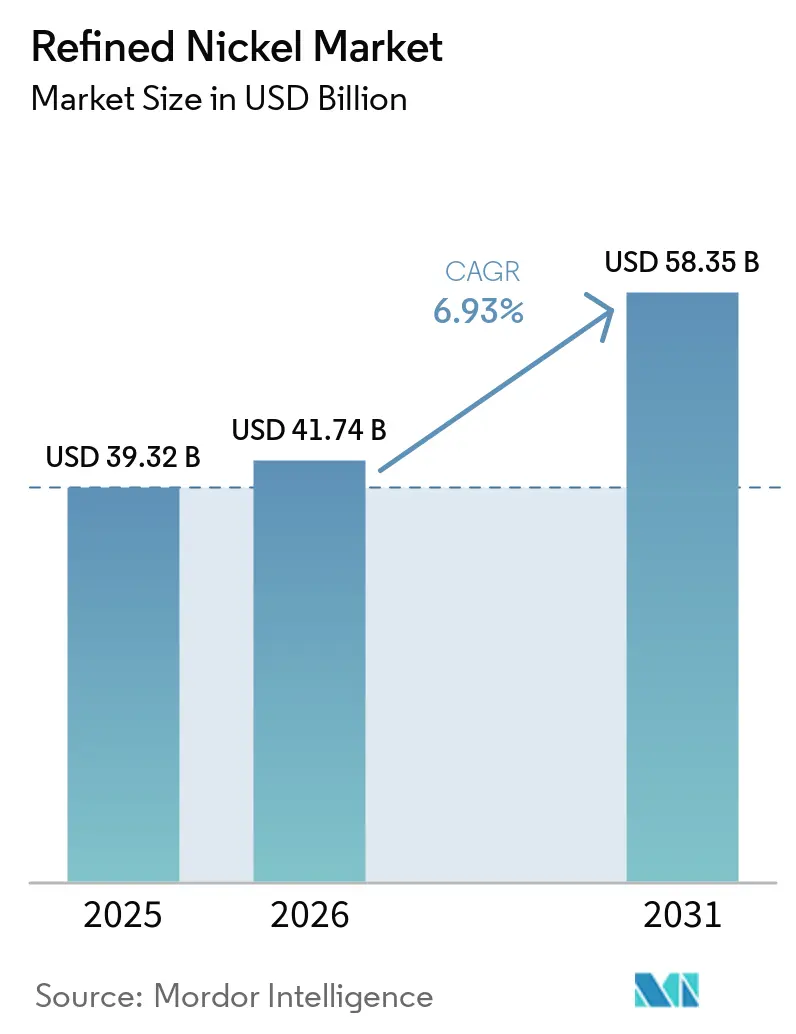
The refined nickel market size is projected to expand from USD 39.32 billion in 2025 and USD 41.74 billion in 2026 to USD 58.35 billion by 2031, registering a CAGR of 6.93% between 2026 and 2031. The refined nickel market continues to depend most heavily on stainless steel fabrication, which accounted for more than two-thirds of primary nickel consumption. Battery demand is growing again as energy storage expands, although the broad adoption of lithium iron phosphate cells limits nickel use in entry-level electric vehicles.[1]International Energy Agency, “Global Battery Markets Are Growing Strongly and So Are the Supply Risks,” International Energy Agency, iea.org Asia remains central to the refined nickel market because Chinese stainless mills and Indonesia’s battery-material operations link demand with processing capacity. A supply surplus in 2025 kept prices under pressure, while Indonesia’s ore quota reduction has made feedstock availability more important for smelters. Producers are responding through integrated processing, higher-purity products, and supply arrangements that meet United States and European sourcing rules.
Key Report Takeaways
- By purity grade, standard purity held 60.15% of global demand in 2025, while high purity is forecast to grow at a 7.34% CAGR through 2031.
- By production technology, electrorefining and electrowinning held 52.54% of global output in 2025, while hydrometallurgical refining is forecast to grow at a 7.56% CAGR through 2031.
- By application, stainless steel held 65.28% of global refined nickel demand in 2025, while batteries are forecast to grow at a 7.88% CAGR through 2031.
- By end-use industry, metallurgy held 43.83% of global refined nickel demand in 2025, while the automotive and transportation segment is forecast to grow at an 8.61% CAGR through 2031.
- By geography, Asia Pacific held 62.22% of global refined nickel demand in 2025 and is forecast to grow at an 8.09% CAGR through 2031.
Note: Market size and forecast figures in this report are generated using Mordor Intelligence’s proprietary estimation framework, updated with the latest available data and insights as of January 2026.
Global Refined Nickel Market Trends and Insights
Drivers Impact Analysis*
| Driver | (~) % Impact on CAGR Forecast | Geographic Relevance | Impact Timeline |
|---|---|---|---|
| Stainless Steel And Special Steel Demand | +2.1% | Global, led by China, Indonesia, and India | Medium term (2-4 years) |
| High-Nickel Battery And Energy-Storage Deployment | +1.5% | Asia-Pacific core, with effects in Europe and North America | Long term (≥ 4 years) |
| Industrialization And Infrastructure Investment | +1.2% | Asia-Pacific, South Asia, and Middle East and Africa | Medium term (2-4 years) |
| Strategic Localization Of Critical-Mineral Processing | +0.8% | North America and Europe | Medium term (2-4 years) |
| Sulfur-Route And MHP-To-Sulfate Integration | +0.7% | Asia-Pacific, including Indonesia, South Korea, and Japan | Short term (≤ 2 years) |
| Source: Mordor Intelligence | |||
Stainless Steel And Special Steel Demand
Stainless steel remains the main source of demand in the refined nickel market because it uses nickel-bearing austenitic grades across construction, machinery, transport equipment, and process industries. INSG expects stainless steel to account for more than two-thirds of total primary nickel consumption in 2026, confirming its continuing role as the volume base for producers and traders.[2]International Nickel Study Group, “The Market 2026-07,” International Nickel Study Group, insg.org China and Indonesia support this demand through infrastructure work, machinery production, export manufacturing, and stainless steel capacity that is closely linked to domestic nickel processing. Greater use of scrap can lower emissions and costs without eliminating nickel demand from 300-series stainless grades, which remain important where corrosion resistance and durability are required. Special steels used in aerospace and energy equipment provide a smaller but higher-value outlet for refined metal, particularly in components exposed to high temperatures or demanding operating conditions. These applications are less exposed to battery chemistry changes and support demand for high-grade material when broader stainless purchasing is affected by price movements.
High-Nickel Battery And Energy-Storage Deployment
The refined nickel market benefits from demand for nickel-rich NMC cathodes in long-range vehicles, larger electric vehicle formats, and uses where battery weight and energy density directly affect the product design. These cathodes remain relevant where energy density affects vehicle performance and driving range, even as manufacturers use LFP cells in models where lower cost is the priority. Global battery energy storage capacity reached 301.7 gigawatts in 2025, a 66% increase from the prior year, creating a much larger base for demand across the wider battery supply chain. Stationary storage, therefore, creates an additional channel for battery materials, even though much of its capacity uses LFP chemistry rather than nickel-bearing cathodes. United States sourcing rules are encouraging automakers to qualify Class 1 nickel suppliers outside Chinese-controlled supply chains, which changes the value placed on traceable material. This supports long-term offtake discussions for material that meets required sourcing standards and can be supplied consistently through the operating life of vehicle programs.
Industrialization And Infrastructure Investment
Industrial development across China, South Asia, and Southeast Asia supports a broad base of nickel-containing steel demand that is not dependent on any single battery technology or end market. China’s manufacturing and renewable energy investment programs support applications that use stainless steel and specialty alloys in equipment, production systems, and infrastructure. INSG forecasts Chinese primary nickel consumption to grow 6.4% in 2026, reflecting the scale of this manufacturing base and its related metals demand. India’s stainless steel and battery sectors are also increasing demand for nickel-intensive inputs as industrial capacity and vehicle supply chains develop. Indonesia adds internal consumption as its stainless mills and battery-material facilities process material near Morowali and Weda Bay instead of relying only on exports of intermediate products. This pattern supports standard-purity grades as well as battery-related products across the refined nickel market, giving producers a wider group of industrial customers.
Strategic Localization Of Critical-Mineral Processing
Policy is changing the location, ownership expectations, and commercial purpose of refining investment in the refined nickel market. The European Commission designated 47 strategic projects in March 2025 under the Critical Raw Materials Act, including 12 nickel-focused assets across the selected portfolio. The legislation seeks a more resilient supply chain for materials needed by European industry and increases attention to projects that can meet regional processing needs. The French Sandouville facility illustrates the move from conventional nickel metal toward precursor cathode active material production, aligning existing refinery assets with battery supply requirements. United States and European coordination on critical minerals also supports offtake structures and reference-price mechanisms for nickel, with sourcing compliance becoming more important in purchase decisions. These measures make refinery location and ownership more important in procurement decisions, particularly for automakers and cell producers seeking eligibility under public incentive programs.
Restraints Impact Analysis*
| Restraint | (~) % Impact on CAGR Forecast | Geographic Relevance | Impact Timeline |
|---|---|---|---|
| Nickel Market Surpluses And Price Volatility | -1.8% | Global, especially LME and SHFE markets | Short term (≤ 2 years) |
| LFP Battery Substitution And Slower High-Nickel EV Penetration | -1.4% | Global, especially China, Europe, and North America | Medium term (2-4 years) |
| Sulfur And Strait Of Hormuz Logistics Exposure | -0.8% | Asia-Pacific, especially Indonesia, with effects in Middle East and Africa | Short term (≤ 2 years) |
| Source: Mordor Intelligence | |||
Nickel Market Surpluses And Price Volatility
Supply surpluses remain a major constraint on investment across the refined nickel market because they lower prices and make future cash flows less certain for refiners and mine developers. The market recorded a 209,000-tonne surplus in 2025 as Indonesian nickel pig iron and mixed hydroxide precipitate output increased faster than consumption in several end uses. Combined LME and SHFE warehouse stocks exceeded 289,500 tonnes by October 2025, showing the extent of material available in visible exchange inventories. LME nickel traded between USD 13,815 per ton in April 2025 and USD 19,365 per tonne in May 2026, creating a broad range for producers, consumers, and inventory holders. Price volatility makes margin planning difficult and can delay long-cycle project decisions when operators cannot establish a clear return on new capacity. Aggregate supply can still coexist with tighter availability of compliant Class 1 material for certain Western buyers that require ownership, origin, and quality characteristics.
LFP Battery Substitution And Slower High-Nickel EV Penetration
LFP chemistry is limiting the pace of battery-related nickel demand in the refined nickel market because these batteries do not require nickel-bearing cathode materials. LFP represented more than 55% of global electric vehicle battery deployments in 2025, compared with 43% in 2023, indicating that its use moved well beyond a small entry-level segment. In China, LFP represented 81.2% of electric vehicle battery installations, where local manufacturers have used the chemistry extensively in affordable vehicle models. Nickel-rich NMC remains important for premium vehicles, but LFP has a lower cost per kilowatt-hour for mass-market applications and stationary storage. This difference narrows the addressable battery segment for nickel producers, even while overall electric vehicle and storage deployment continue to expand. The removal of U.S. federal electric vehicle purchase tax credits in September 2025 also reduced near-term battery demand expectations in North America, adding another constraint on vehicle-led nickel consumption.
*Our forecasts treat driver/restraint impacts as directional, not additive. The impact forecasts reflect baseline growth, mix effects, and variable interactions.
Segment Analysis
By Purity Grade: High-Purity Demand Is Expanding
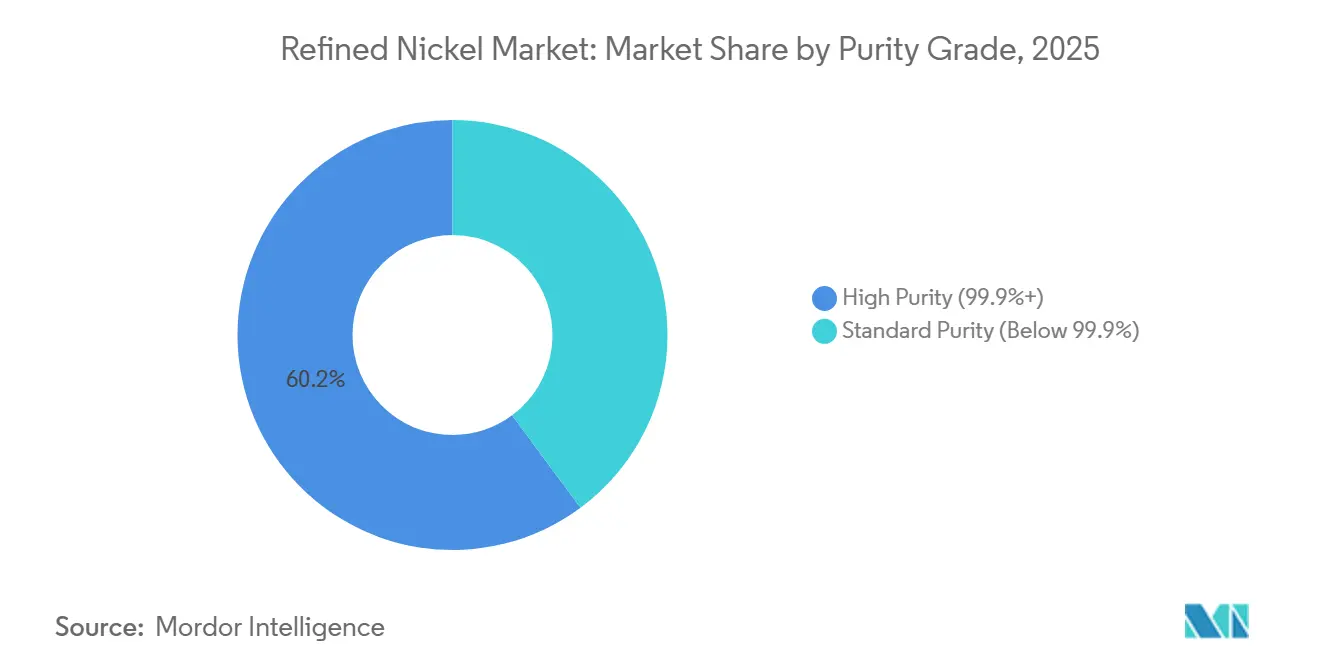
Standard purity refined nickel held 60.15% of the refined nickel market in 2025, reflecting the large volume of metal needed by stainless steel producers rather than a narrow group of specialty consumers. Stainless steel production supports this position through established spot markets and long-term mill supply agreements that give buyers predictable quality and delivery arrangements. LME-registered cathodes, rounds, and pellets remain important to the stainless supply chain because they are widely recognized, easy to handle, and suitable for established melting practices. The segment benefits from existing handling systems and recognized product standards, which reduce the need for customers to alter processes or qualify alternative feedstocks.
High purity nickel with 99.9% or greater purity is forecast to expand at a 7.34% CAGR through 2031, ahead of standard grades as technical requirements become more demanding. Battery cathode precursors, specialty electroplating, and superalloys require tight control over impurities because minor variations can affect performance, production consistency, or qualification. NMC 811 production requires purity above 99.95% and closely controlled cobalt and copper content, creating a clear distinction from metal used primarily in stainless steel. Norilsk Nickel reported 30% volume growth for its Nornickel Plating Grade product in 2025, showing how established refiners are seeking higher-value sales within their product portfolios. European sustainable-finance policy could also support high-purity refining projects by making access to capital more closely tied to the role of refined materials in the energy transition.



By Production Technology: Hydrometallurgical Capacity Is Growing
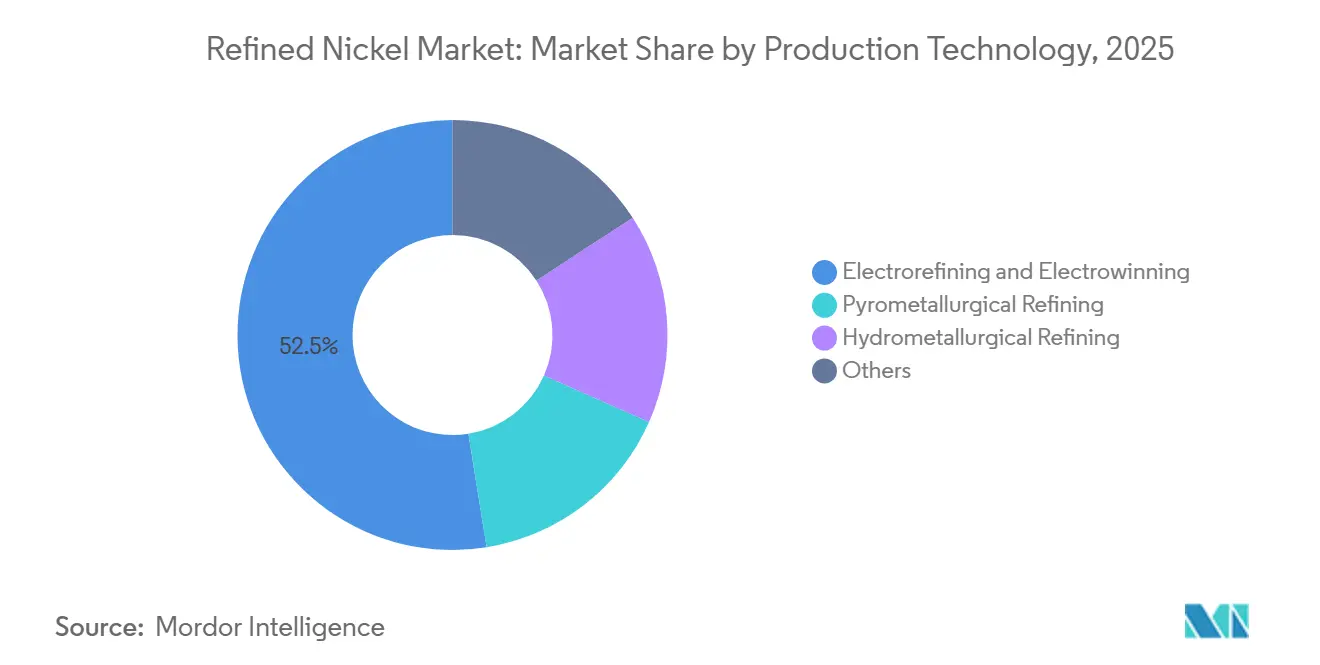
Electrorefining and electrowinning held 52.54% of the refined nickel market size in 2025, supported by a substantial installed base of proven refinery operations. Established facilities operated by Norilsk Nickel, Sumitomo Metal Mining, and Jinchuan Group support this technology’s position through integrated processing, long operating histories, and established relationships with buyers. These operations have recognized brands, integrated processes, and experience producing high-purity material that can meet exchange and industrial requirements. Sulfide ore feed also supports electrorefining outside Indonesia, giving this route an important position in regions that are less reliant on laterite ore and HPAL processing.
Hydrometallurgical refining is forecast to grow at a 7.56% CAGR through 2031, driven by the growth of laterite-based processing capacity and the need for battery-material intermediates. This expansion is tied to HPAL-MHP-to-sulfate capacity in Indonesia, the Philippines, and Australia, where operators are connecting ore processing with downstream chemical conversion. Nickel Industries’ ENC project adds new capacity for MHP, nickel sulfate, and nickel cathode, illustrating the wider product mix available from integrated operations. Battery recycling can also support electrowinning, as research showed nickel deposition efficiencies of 78% to 93% from lithium-ion battery black mass leachate and deposit purity above 90%. Pyrometallurgical refining retains a role but faces pressure from laterite-based processing routes that can serve battery-chemical demand more directly.
By Application: Stainless Steel Leads while Batteries Grow Faster
Stainless steel accounted for 65.28% of refined nickel market share by application in 2025, making this application the clearest determinant of broad consumption and trading conditions. This concentration means changes in stainless production can quickly affect nickel demand, physical premiums, and inventories held within the supply chain. China’s infrastructure spending, machinery exports, and use of scrap continue to support stainless activity while keeping nickel-bearing grades relevant to industrial production. Indonesian mills also absorb nickel pig iron near their production sites, linking domestic resource processing with steel output and reducing the distance between raw material and end use.
Batteries are forecast to grow at a 7.88% CAGR through 2031, making them the fastest-growing application even after the effect of LFP substitution is considered. NMC cathodes remain suited to long-range passenger vehicles and commercial electric vehicles that need high energy density and cannot accept the same trade-offs as lower-cost models. LFP dominates much of stationary storage capacity and entry-level vehicle production, limiting nickel demand in these applications while leaving room for nickel-rich chemistry in other formats. Other applications, including superalloys and chemical processing equipment, provide demand that is not affected by battery chemistry and is shaped instead by engineering specifications. Marine emissions rules can also support corrosion-resistant stainless grades used in exhaust gas treatment systems, adding a smaller but durable source of demand.
By End-Use Industry: Metallurgy Holds Scale while Automotive Leads Growth
Metallurgy accounted for 43.83% of the refined nickel market size by end-use industry in 2025, covering uses that extend from bulk stainless production to specialized alloy fabrication. The category includes stainless steel, alloy fabrication, specialty steel, and nonferrous metallurgical uses, each of which depends on nickel for different material properties. Nickel improves corrosion resistance, low-temperature toughness, and high-temperature strength in industrial applications where failure, maintenance, or short equipment life can be costly. Electronics and industrial machinery add demand through plating contacts, pump components, valves, and precision equipment, where material purity and consistent performance affect certification.
The automotive and transportation segment is forecast to grow at an 8.61% CAGR through 2031, supported by both battery demand and the use of nickel-containing materials in vehicle design. Demand comes from NMC cathodes, vehicle structures, battery enclosures, and stainless components that can offer corrosion resistance and long service life. India’s auto sector is moving toward 10 million units of annual production, which could expand the use of nickel-containing components across domestic manufacturing and supplier networks. India also relies on Indonesia for 80% of its ferronickel requirements, linking its future demand to the reliability of regional supply. European vehicle emissions targets continue to support manufacturers’ electric vehicle programs despite near-term consumer demand pressures in some markets.
Geography Analysis
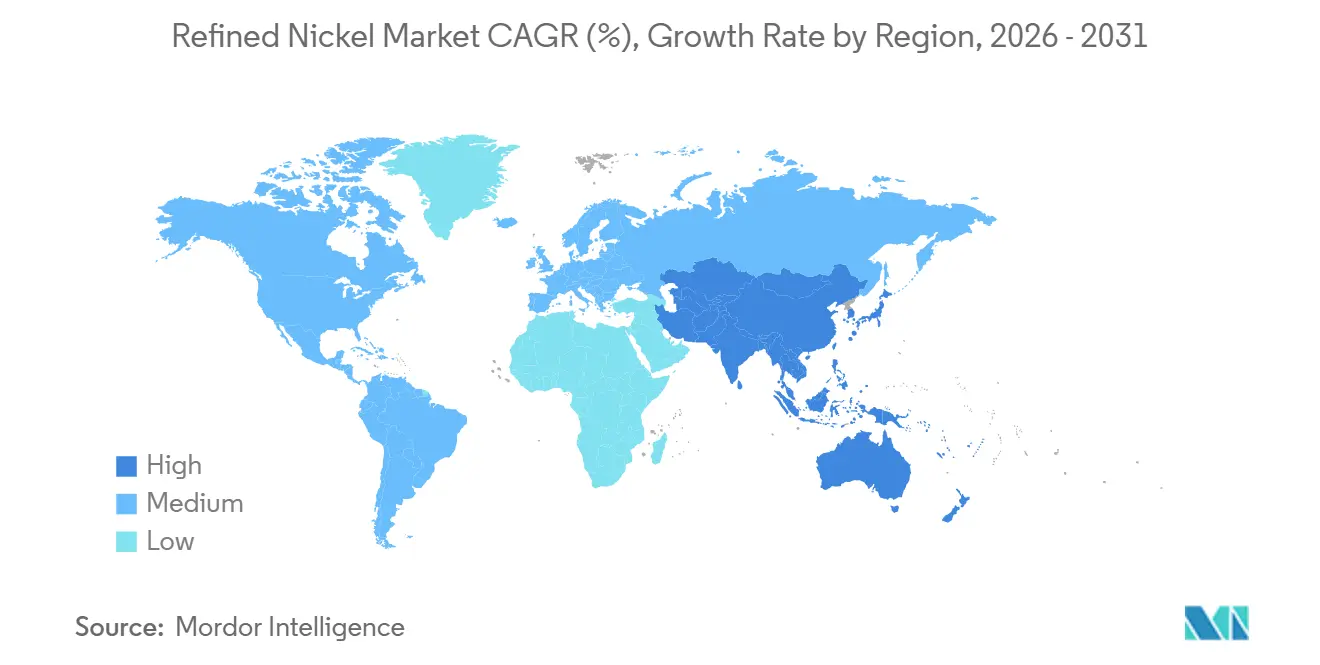
Asia-Pacific accounted for 62.22% of the refined nickel market share in 2025 and is forecast to grow at an 8.09% CAGR through 2031. China, Indonesia, Japan, and South Korea combine large consumption with processing and high-grade manufacturing capacity. China accounted for more than 65% of global primary nickel consumption in 2025. Chinese primary nickel consumption is forecast to grow 4.3% in 2026. Indonesia’s consumption grew 5.3% in 2025 and is forecast to increase 10.3% in 2026. Its stainless mills and battery plants consume NPI and MHP within the country. Japan retains a premium refining base, while India adds demand through stainless steel and electric vehicle activity.
North America and Europe have slower volume growth but greater interest in local processing and compliant supply. The United States primary nickel consumption grew 5.2% in 2025 and is forecast to grow 0.8% in 2026. United States Section 232 measures support domestic stainless steel production and mill demand. Europe’s nickel usage is forecast to recover 1.8% in 2026 after a 0.5% decline in 2025. The European Union’s Critical Raw Materials Act supports investment in strategic projects and a 40% domestic processing target by 2030. These policies create a separate demand base for material that meets regional sourcing requirements.
South American supply includes Vale Base Metals’ Brazilian operations, Sherritt International’s Moa joint venture in Cuba, and South32’s Cerro Matoso operation in Colombia. Vale Base Metals formed a consortium in February 2026 to invest up to USD 200 million in the Thompson Nickel Belt in Canada. Sherritt produced 25,240 tonnes of finished nickel at Moa in 2025 and guided for 26,000 to 28,000 tonnes in 2026. The Middle East and Africa remain smaller supply regions. Chinese producers are assessing opportunities outside Indonesia as policy conditions become more restrictive.

Competitive Landscape
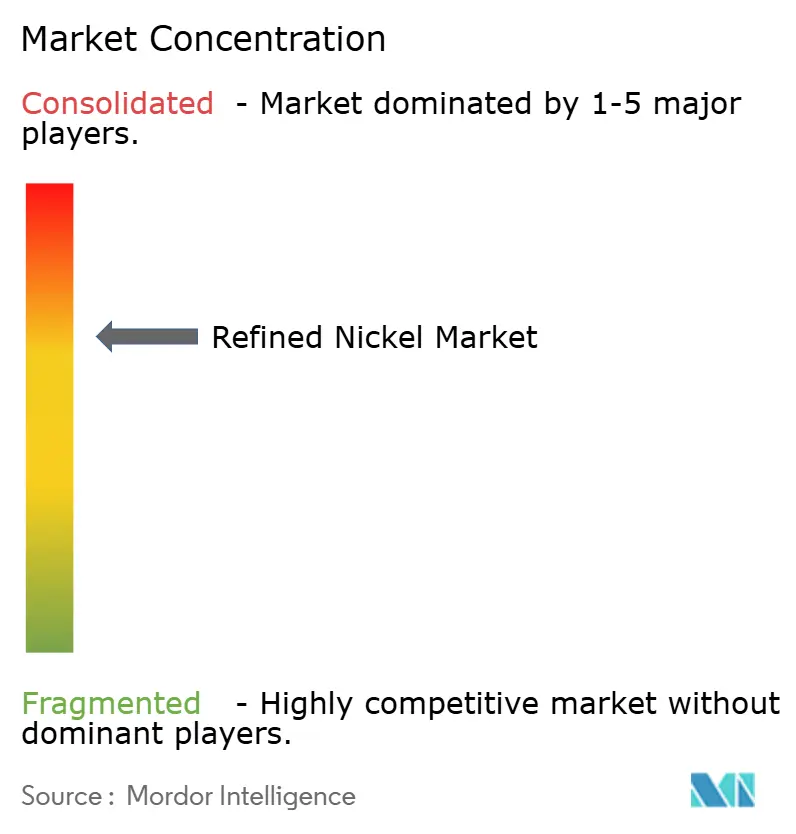
The refined nickel market is semi-consolidated among established electrorefiners and more fragmented in battery-chemical processing, where new Indonesian projects have added several competing sources of material. Norilsk Nickel, Jinchuan Group, and Vale Base Metals remain important suppliers of refined material because their operations can serve industrial users seeking established product specifications. Norilsk Nickel provided 2026 guidance of 193,000 to 203,000 tonnes, while Jinchuan Group produced 230,000 tonnes in 2025. Indonesian HPAL capacity is increasingly led by Chinese-controlled integrated groups that combine ore supply, chemical processing, and downstream battery-material production. This gives these groups cost and supply-chain advantages, while established electrorefiners focus on purity, recognized brands, and operating efficiency.
Tsingshan’s PTENICO nickel cathode brand entered the Shanghai Futures Exchange and London Metal Exchange systems in December 2025. The brand has 50,000 tonnes per year of capacity and 99.96% purity, taking Tsingshan further into Class 1 nickel supply and futures-linked pricing. BHP had suspended Nickel West operations in October 2024, removing 75,000 to 80,000 tonnes per year of non-Chinese sulfide-based supply and reinforcing the cost pressure faced by higher-cost producers. The change also places greater attention on suppliers that can offer reliable material outside the expanding Indonesian processing base.
The refined nickel market has a commercial opening for suppliers that meet FEOC and CRMA requirements. Producers in Canada, Australia, Finland, and Norway can pursue policy-aligned offtake agreements with North American and European battery manufacturers that need material with clear sourcing credentials. Vale’s February 2026 Thompson Nickel Belt consortium preserves options for Class 1 supply to its Copper Cliff refinery. Nickel Industries also started the ENC acid plant in June 2026, extending its HPAL processing position and supporting production across MHP, nickel sulfate, and nickel cathode. Indonesia’s quota enforcement remains material because lower ore allowances can limit output even at integrated operations and affect availability for downstream smelters.
Refined Nickel Industry Leaders
Norilsk Nickel
Jinchuan Group Co., Ltd.
Glencore
Vale
Sumitomo Metal Mining Co., Ltd.
- *Disclaimer: Major Players sorted in no particular order

Recent Industry Developments
- July 2026: Nickel Industries started up the sulphuric acid plant at its Excelsior Nickel Cobalt (ENC) HPAL project at IMIP, Central Sulawesi, with a nameplate capacity of approximately 72,000 tonnes per year of contained nickel equivalent in MHP, nickel sulfate, and nickel cathode. The commissioning marks a key step in Nickel Industries' EV battery supply chain strategy and demonstrates HPAL's integration into LME-grade refined nickel production.
- February 2026: Vale Base Metals formed an Exiro-led consortium with Orion Resource Partners and the Canada Growth Fund to invest up to CAD 280 million (USD 200 million) in the Thompson Nickel Belt in Manitoba. Vale retained an 18.9% minority stake and signed a long-term offtake agreement for nickel concentrate, preserving Class 1 supply optionality for its Copper Cliff refinery.


Global Refined Nickel Market Report Scope
Refined nickel is pure or primary nickel metal that has a high nickel content, generally above 99%. It is made by removing impurities from raw nickel ores or crude intermediates like nickel matte and ferronickel.
The refined nickel market is segmented by purity grade, production technology, application, end-use industry, and geography. By purity grade, the market is segmented into high purity (99.9%+) and standard purity (below 99.9%). By production technology, the market is segmented into electrorefining and electrowinning, pyrometallurgical refining, hydrometallurgical refining, and others. By application, the market is segmented into stainless steel, batteries, plating, and other applications. By end-use industry, the market is segmented into industrial machinery, metallurgy, electronics, automotive and transportation, building and construction, and other end-use industries. By geography, the market is segmented into Asia Pacific, North America, Europe, South America, the Middle East and Africa. The report also covers the refined nickel market size and forecasts for the refined nickel market in 15 countries across major regions. For each segment, the market sizing and forecasts have been done on the basis of value (USD).
| High Purity (99.9%+) |
| Standard Purity (Below 99.9%) |
| Electrorefining and Electrowinning |
| Pyrometallurgical Refining |
| Hydrometallurgical Refining |
| Others |
| Stainless Steel |
| Batteries |
| Plating |
| Other Applications |
| Industrial Machinery |
| Metallurgy |
| Electronics |
| Automotive and Transportation |
| Building and Construction |
| Other End-Use Industries |
| Asia-Pacific | China |
| India | |
| Japan | |
| South Korea | |
| ASEAN Countries | |
| Rest of Asia-Pacific | |
| North America | United States |
| Canada | |
| Mexico | |
| Europe | Germany |
| United Kingdom | |
| France | |
| Italy | |
| NORDIC Countries | |
| Russia | |
| Rest of Europe | |
| South America | Brazil |
| Argentina | |
| Rest of South America | |
| Middle East and Africa | Saudi Arabia |
| South Africa | |
| Rest of Middle East and Africa |
| By Purity Grade | High Purity (99.9%+) | |
| Standard Purity (Below 99.9%) | ||
| By Production Technology | Electrorefining and Electrowinning | |
| Pyrometallurgical Refining | ||
| Hydrometallurgical Refining | ||
| Others | ||
| By Application | Stainless Steel | |
| Batteries | ||
| Plating | ||
| Other Applications | ||
| By End-Use Industry | Industrial Machinery | |
| Metallurgy | ||
| Electronics | ||
| Automotive and Transportation | ||
| Building and Construction | ||
| Other End-Use Industries | ||
| By Geography | Asia-Pacific | China |
| India | ||
| Japan | ||
| South Korea | ||
| ASEAN Countries | ||
| Rest of Asia-Pacific | ||
| North America | United States | |
| Canada | ||
| Mexico | ||
| Europe | Germany | |
| United Kingdom | ||
| France | ||
| Italy | ||
| NORDIC Countries | ||
| Russia | ||
| Rest of Europe | ||
| South America | Brazil | |
| Argentina | ||
| Rest of South America | ||
| Middle East and Africa | Saudi Arabia | |
| South Africa | ||
| Rest of Middle East and Africa | ||


Key Questions Answered in the Report
What is the present and forecast refined nickel market size?
The refined nickel market size is USD 41.74 billion in 2026 and is forecast to reach USD 58.35 billion by 2031, at a 6.93% CAGR. These values reflect continuing demand from stainless steel and selected battery applications.
Which refined nickel application is growing fastest?
Batteries are forecast to grow at a 7.88% CAGR through 2031, supported by demand for high-energy-density NMC cathodes in long-range and commercial electric vehicles.
Which region leads refined nickel consumption and growth?
Asia Pacific held 62.22% of demand in 2025 and is forecast to grow at an 8.09% CAGR through 2031. Its position combines China’s consumption with Indonesia’s rapidly expanding processing base.
Why does LFP chemistry affect nickel demand?
LFP cells contain no nickel and represented more than 55% of global electric vehicle battery deployments in 2025. Their expanding use reduces the portion of battery production requiring nickel-bearing cathodes.
Page last updated on:





