
Recyclable Packaging Adhesives Market Size and Share
Market Overview
| Study Period | 2022 - 2032 |
|---|---|
| Market Size (2027) | USD 1.85 Billion |
| Market Size (2032) | USD 2.58 Billion |
| Growth Rate (2027 - 2032) | 6.89 % |
| Fastest Growing Market | Asia-Pacific |
| Largest Market | Asia-Pacific |
| Market Concentration | Medium |
Major Players *Disclaimer: Major Players sorted in no particular order Image © Mordor Intelligence. Reuse requires attribution under CC BY 4.0. | |
Recyclable Packaging Adhesives Market Analysis by Mordor Intelligence
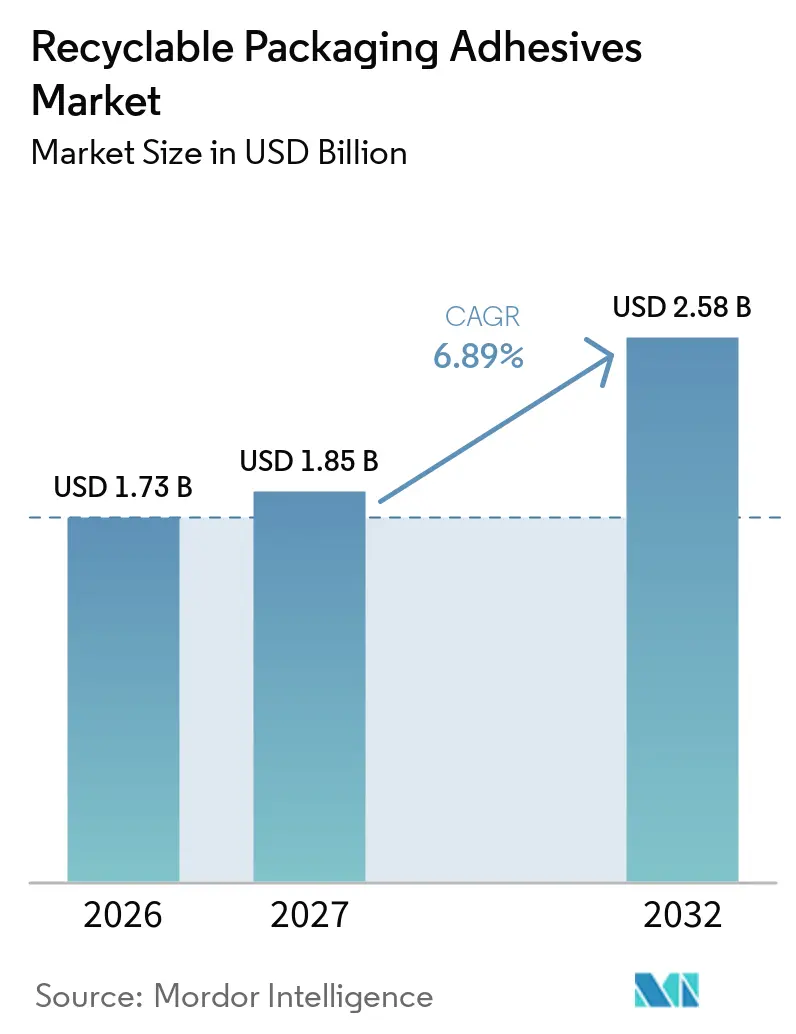
The Recyclable Packaging Adhesives Market size was valued at USD 1.73 billion in 2026 and is estimated to grow from USD 1.85 billion in 2027 to reach USD 2.58 billion by 2032, at a CAGR of 6.89% during the forecast period (2027-2032). The recyclable packaging adhesives market is moving toward adhesive systems that are assessed for performance during recycling, rather than selected only for bonding performance. Brand owners and converters are replacing conventional laminate systems with formulations designed for recyclable packs, which lengthens qualification work and adds testing and certification costs. These requirements support higher-value formulations, even where packaging output follows the underlying pace of packaging production. Regulation, packaging redesign, and certification are therefore changing product selection and competitive strategy across the recyclable packaging adhesives market. Suppliers with validated formulations, regulatory capability, and diverse feedstock options are better placed to serve this demand.
Key Report Takeaways
- By adhesive type and technology, water-based adhesives held 54.31% of the recyclable packaging adhesives market share in 2026, while hot-melt adhesives are projected to advance at a 7.13% CAGR through 2032.
- By resin chemistry, ethylene-vinyl acetate held 30.15% of the recyclable packaging adhesives market share in 2026, while bio-based resins are projected to advance at a 7.43% CAGR through 2032.
- By application, flexible packaging held 35.62% of the recyclable packaging adhesives market share in 2026, while labels and tapes are projected to advance at a 7.76% CAGR through 2032.
- By geography, Asia-Pacific held 42.54% of the recyclable packaging adhesives market share in 2026 and is projected to advance at a 7.27% CAGR through 2032.
Note: Market numbers in this report are based on Mordor Intelligence's proprietary estimation framework, which combines nine months of actuals with Q4 projections for base year 2026.
Global Recyclable Packaging Adhesives Market Trends and Insights
Drivers Impact Analysis*
| Driver | (~) % Impact on CAGR Forecast | Geographic Relevance | Impact Timeline |
|---|---|---|---|
| Regulatory Push for Design-for-Recycling and Recycled Content | +1.8% | Global, with highest compliance pressure in EU and North America | Short term (≤ 2 years) |
| Growth of Mono-Material and Recyclable Flexible Packaging | +1.5% | APAC core, with significant spillover to EU and North America | Medium term (2–4 years) |
| E-Commerce and Corrugated Packaging Volume Expansion | +1.2% | Global, concentrated in APAC, North America, and Western Europe | Short term (≤ 2 years) |
| Certification-Led Demand for Stream-Specific Adhesive Performance | +1.0% | North America & EU, with growing relevance in APAC | Medium term (2–4 years) |
| Shift Toward Water-Based and Solvent-Free Adhesive Formulations | +0.8% | Global | Long term (≥ 4 years) |
| Source: Mordor Intelligence | |||
Regulatory Push for Design-for-Recycling and Recycled Content
The EU Packaging and Packaging Waste Regulation, Regulation (EU) 2025/40, started applying from mid-2026 and requires packaging placed on the EU market to meet phased recyclability requirements[1]. The regulation identifies adhesives, labels, and coatings as design parameters that must not undermine sorting or recycling efficiency. This changes adhesive selection from a bonding decision into a compliance decision for participants in the recyclable packaging adhesives market, since recycling performance must be considered with bond strength, processing needs, and the expected destination of the package after use. The regulation also sets recycled-content requirements for specified plastic packaging, which increases the value of adhesive systems that preserve recycled material quality and helps make the quality of recovered material a practical design consideration for converters and brand owners. Henkel AG & Co. KGaA stated that its Technomelt EM 335 RE hot-melt adhesive can achieve up to 98% removal in standard recycling processes, supporting cleaner polyethylene terephthalate recycling streams. Suppliers able to document recycling compatibility can meet specifications that uncertified alternatives may not satisfy.
Growth of Mono-Material and Recyclable Flexible Packaging
Mono-material packaging is changing the technical requirements placed on laminating adhesives, because a product designed for a single material stream must still meet the demanding functional requirements of food and consumer goods packaging. Conventional multilayer flexible packs often bond dissimilar materials, while polyethylene and polypropylene structures need adhesives that work with the recycling stream of the primary polymer. This requires dependable film-to-film bonding while maintaining the optical and mechanical properties expected in food packaging. H.B. Fuller Company invested in VerdaFresh in May 2026, a barrier technology intended to eliminate non-recyclable ethylene vinyl alcohol barrier layers and support mono-material packaging structures. The change raises the importance of precise adhesive formulation because converters need recyclable packaging without losing shelf-life protection, pack performance, line efficiency, or the appearance expected by brand owners and consumers. It also creates opportunities for suppliers that can pair adhesive technology with broader barrier and packaging design capability.
E-Commerce and Corrugated Packaging Volume Expansion
E-commerce continues to raise demand for corrugated boxes and carton-sealing adhesives in the recyclable packaging adhesives market, where fulfillment operations need consistent bonds across high-throughput systems and variable storage or transport conditions. U.S. retail e-commerce sales reached USD 304.2 billion in the second quarter of 2025, increasing 1.4% from the prior quarter[2]. Fulfillment centers need rapid-setting adhesives that maintain reliable open times across changing warehouse temperatures. Automated carton-sealing systems also increase the value of formulations that perform consistently at high line speeds, since downtime, poor adhesion, or delayed set times can interrupt fulfillment operations and affect delivery efficiency. Henkel AG & Co. KGaA introduced its Technomelt E-COM portfolio for automated on-demand packaging lines that process up to 1,000 boxes per hour, showing how suppliers are designing products for this operating environment. As platforms and consumer brands pursue circular packaging targets, recycling compatibility is becoming part of carton-sealing adhesive procurement rather than an optional product feature.
Certification-Led Demand for Stream-Specific Adhesive Performance
RecyClass in Europe and the Association of Plastic Recyclers Design for Recyclability framework in North America are making certification a practical procurement requirement. The 2025 cooperation report from the Association of Plastic Recyclers and RecyClass identifies adhesives, inks, and barrier materials as key components where unified testing standards remain limited, especially for polyethylene flexible packaging. Brand owners seeking recognition in more than 1 region may need separate validation under both systems, creating additional testing work and making prior certification experience more valuable to companies selling across Europe and North America. That process favors formulators that have already made the investment in testing and documented their performance. BASF received RecyClass approval in March 2026 for its acResin UV 3532 pressure-sensitive adhesive for labels on polyethylene terephthalate bottles. Certification therefore becomes a barrier to entry and a means of differentiating recyclable packaging adhesives market offerings with similar bonding performance, because the cost and time needed to validate a product are not easily matched by generic suppliers.
Restraints Impact Analysis*
| Restraint | (~) % Impact on CAGR Forecast | Geographic Relevance | Impact Timeline |
|---|---|---|---|
| Food-Contact Migration and Substance-of-Concern Compliance | -1.1% | Global, most acute in EU and FDA-regulated markets | Short term (≤ 2 years) |
| Feedstock Cost and Availability Volatility | -0.9% | Global, with Europe most exposed to Q2 2026 petrochemical spikes | Short term (≤ 2 years) |
| Recycling-Stream Contamination from Adhesive Residues | -0.6% | Global | Medium term (2–4 years) |
| Source: Mordor Intelligence | |||
Food-Contact Migration and Substance-of-Concern Compliance
Food-contact compliance can lengthen development cycles for new adhesive formulations, particularly when suppliers are introducing chemistry intended to improve recyclability, use alternative feedstocks, or meet stricter customer requirements. Multi-layer flexible packaging requires suppliers to consider the finished pack, not only the adhesive in isolation. In the United States, the Food and Drug Administration’s 21 Code of Federal Regulations (CFR) Part 175 governs adhesives used in food-contact packaging. European rules also establish safety requirements that cover adhesive components within the assembled package. This makes migration testing and supporting documentation important before commercial launches, particularly for new bio-based and low-migration chemistries, and it can require coordination between adhesive suppliers, converters, packaging producers, and food brand owners. Smaller formulators with limited regulatory resources can face a slower path to commercialization in the recyclable packaging adhesives market.
Feedstock Cost and Availability Volatility
Raw-material availability and pricing affect the economics of hot-melt, water-based, and solvent-free adhesive formulations, because packaging customers often expect stable product performance and predictable supply even when upstream conditions change. Vinyl acetate monomer, ethylene-vinyl acetate, acetyls, polyols, and acrylic monomers are important inputs for packaging adhesives. Supply interruptions can extend lead times, restrict allocations, and delay reformulation work for converters, who may need to qualify replacement materials before returning a packaging line to normal operating conditions. Dow reported in its second-quarter 2025 results that the divestiture of its laminating adhesives business and lower downstream polymer prices reduced Packaging and Specialty Plastics net sales. Bio-based inputs such as rosin, terpene, and tall-oil tackifiers are also exposed to supply variability. These conditions can widen the cost difference between conventional and bio-based solutions, especially in price-sensitive applications.
*Our forecasts treat driver/restraint impacts as directional, not additive. The impact forecasts reflect baseline growth, mix effects, and variable interactions.
Segment Analysis
By Adhesive Type and Technology: Water-Based Adhesives Lead Revenue, While Hot-Melt Adhesives Expand
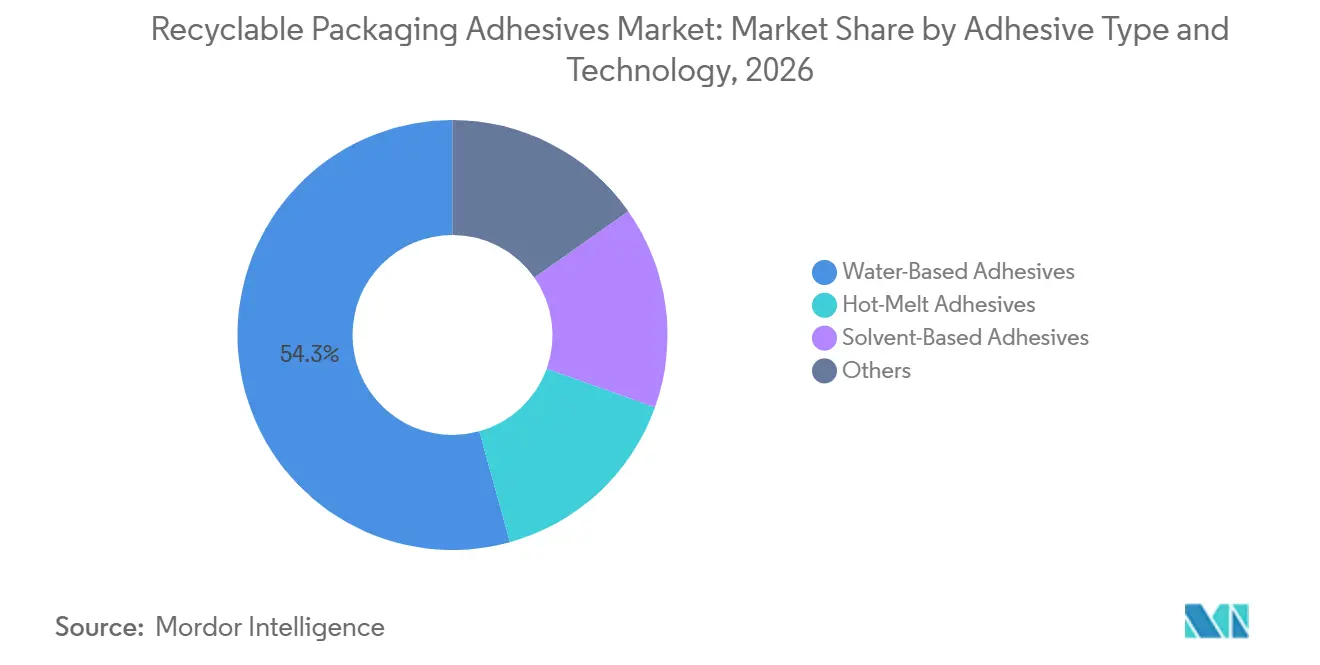
Water-based adhesives held 54.31% of the recyclable packaging adhesives market share in 2026. Their position reflects ongoing work in acrylic emulsion and polyurethane dispersion chemistry for food-contact packaging, labels, and related uses. Hot-melt adhesives are projected to advance at a 7.13% CAGR through 2032, supported by reformulation for recycling performance. Alkali-dispersible products are designed to separate during polyethylene terephthalate washing, helping preserve flake quality for reuse. Solvent-based adhesives remain relevant in retort and high-barrier applications where validated water-based or solvent-free alternatives are still limited.
The recyclable packaging adhesives industry is shifting away from solvent-based laminating systems in visible food packaging categories as sustainability commitments enter supplier specifications. This is changing competition in the recyclable packaging adhesives market because suppliers need evidence that their systems work in real recycling conditions. Solvent-free 2-component polyurethane systems can serve demanding uses where converters need strong bonds and improved recyclability. Ultraviolet-curable and radiation-curable systems are gaining visibility in pressure-sensitive labels. Within the recyclable packaging adhesives market, BASF’s acResin UV 3532 received RecyClass approval for polyethylene terephthalate bottle recycling in March 2026. Repulpable products can differentiate suppliers in paper and corrugated packaging, where customers need adhesives compatible with paper recycling.

By Resin Chemistry: Ethylene-Vinyl Acetate Leads While Bio-Based Resins Accelerate
Ethylene-vinyl acetate held a 30.15% share in the recyclable packaging adhesives market in 2026. It is widely used in hot-melt carton sealing, bookbinding, and corrugated packaging because it works with high-speed application equipment. Bio-based resins are projected to advance at a 7.43% CAGR through 2032 as sustainability commitments and extended producer responsibility frameworks influence material selection. Acrylics are important within water-based adhesive systems and can serve both laminating and pressure-sensitive label applications. Resin selection depends on the package structure, recycling route, food-contact requirement, and required application performance.
Polyurethanes remain important in retort, boil-in-bag, and high-barrier packaging because their performance is difficult to replace. Primary aromatic amine migration concerns require specifically designed polyurethane systems for food packaging. BASF’s water-based Epotal range is intended to avoid primary aromatic amine formation during recycling of polyethylene terephthalate and polyethylene laminates. Rosin-based, starch-derived, and polyvinyl acetate systems form part of the other resin category. Suppliers that combine feedstock security with compliant formulations have a stronger route to adoption in recyclable packaging. The recyclable packaging adhesives market therefore rewards reliable material availability alongside product-level recycling performance.
By Application: Flexible Packaging Leads While Labels and Tapes Pull Ahead in Growth
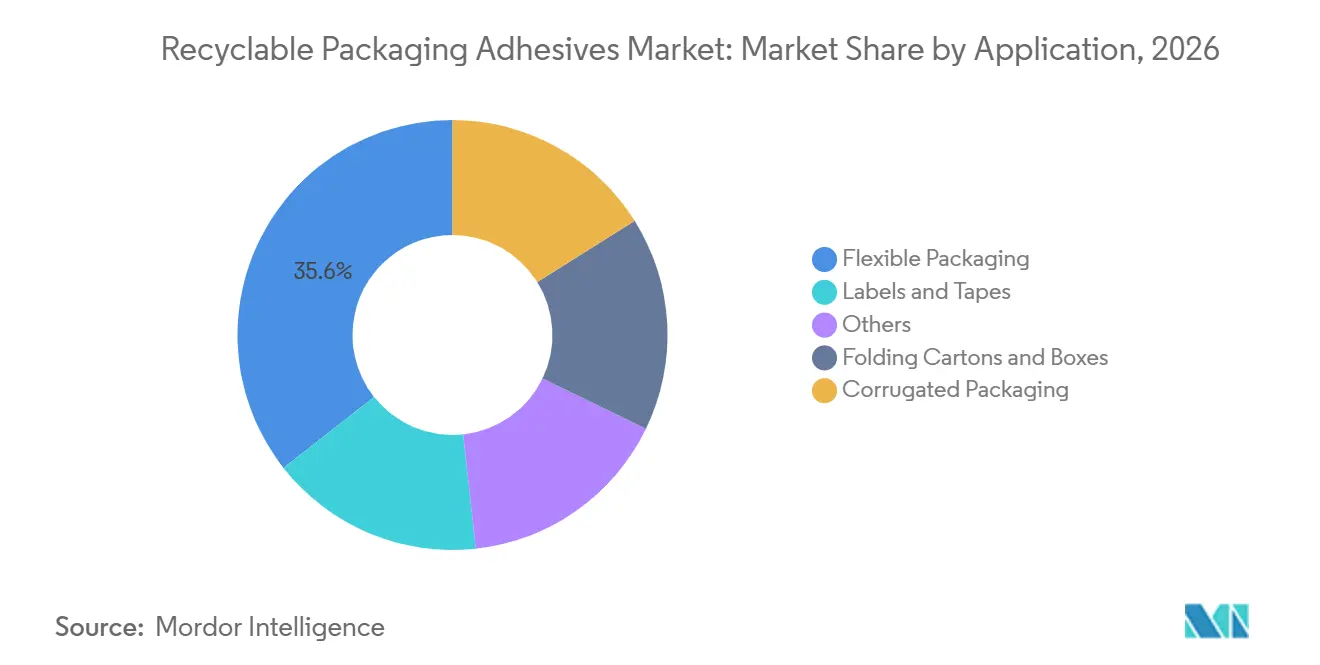
Flexible packaging held a 35.62% share in the recyclable packaging adhesives market in 2026. The segment includes pouches, wraps, and multilayer films used for food, personal care, pharmaceuticals, and other consumer products. Its scale creates extensive need for laminating adhesives that protect product quality while enabling recyclable pack design. Labels and tapes are projected to advance at a 7.76% CAGR through 2032 because pressure-sensitive label adhesives influence whether polyethylene terephthalate and high-density polyethylene packaging meets design-for-recycling requirements. Avery Dennison Corporation received RecyClass Technology Approvals in October 2026 for AD CleanFlake pressure-sensitive label constructions on thermoformed polyethylene terephthalate trays.
Folding cartons and boxes remain stable applications where run speed, low-temperature bond integrity, and carbon-footprint considerations guide selection. Corrugated packaging is linked to e-commerce demand, and starch-based systems remain widely used in standard board production. Specialty formats include pharmaceutical blister packs, medical device trays, and security packaging, where compliance, tamper evidence, and sterilization compatibility carry greater weight. These niches can generate higher unit values than standardized packaging formats. Flexible packaging and labels attract particular attention because they face intense recycling scrutiny, while fiber-based applications offer a route for differentiated adhesive formulation. This gives the recyclable packaging adhesives market several application paths for product innovation rather than a single route to growth.
Geography Analysis
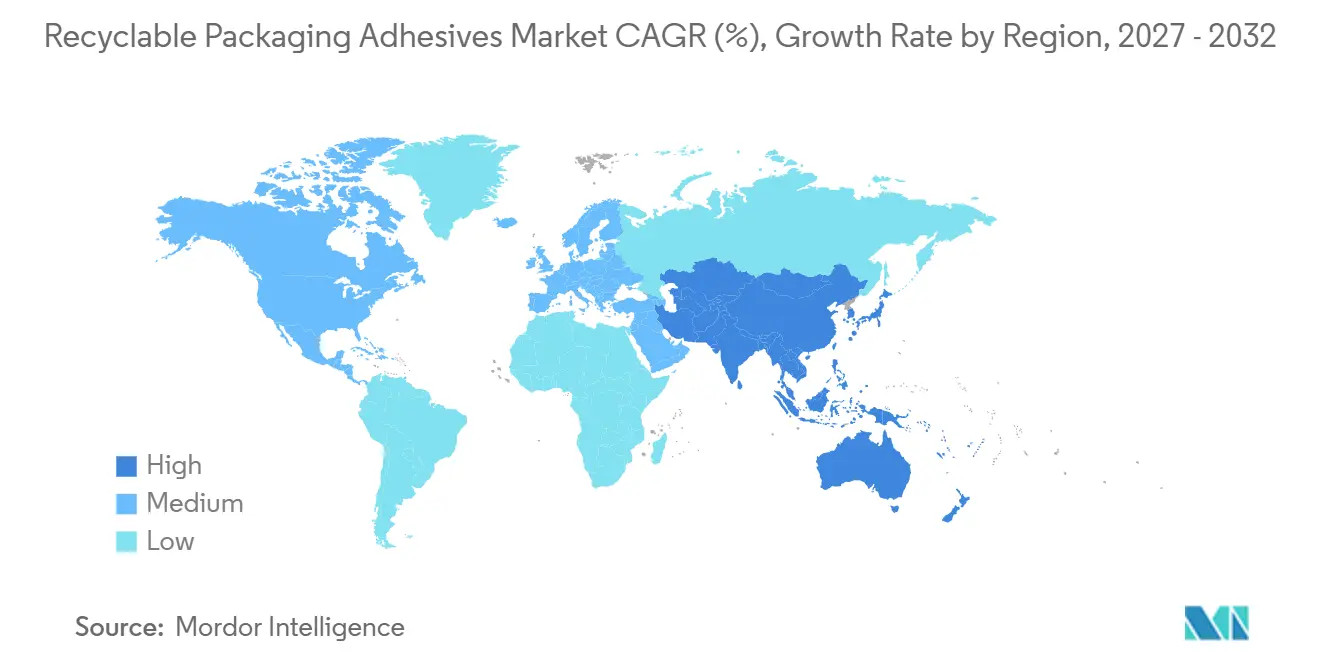
Asia-Pacific held a 42.54% share in the recyclable packaging adhesives market in 2026 and is projected to advance at a 7.27% CAGR through 2032. China is central to regional demand because of its large packaging base and role as an export hub for adhesive intermediates. Henkel AG & Co. KGaA opened a Packaging Recyclability Assessment and Testing Center in China in September 2025 to evaluate adhesive technologies at end of life. India is building demand through e-commerce fulfillment infrastructure and food processing growth. Thailand, Vietnam, and Indonesia are also adding demand through mono-material packaging programs.
North America combines advanced adhesive technology adoption with established recyclability certification programs. The Association of Plastic Recyclers framework guides evaluation of packaging components, including adhesives, in the region. U.S. retail e-commerce sales of USD 304.2 billion in the second quarter of 2025 support corrugated and carton-sealing adhesive demand. H.B. Fuller Company’s VerdaFresh investment reflects interest in combining barrier coating and adhesive capability for mono-material packs.
Europe is the most regulation-intensive geography in the recyclable packaging adhesives market. The Packaging and Packaging Waste Regulation is creating specifications based on recyclability grades and recycled-content requirements. Germany, France, and the United Kingdom are important markets, with Germany prominent in corrugated and fiber-based packaging. South America and the Middle East and Africa are smaller demand centers with potential for expansion. Brazil’s food and beverage packaging base supports South American demand, while recycling infrastructure constraints can slow adoption across parts of both regions.
Competitive Landscape
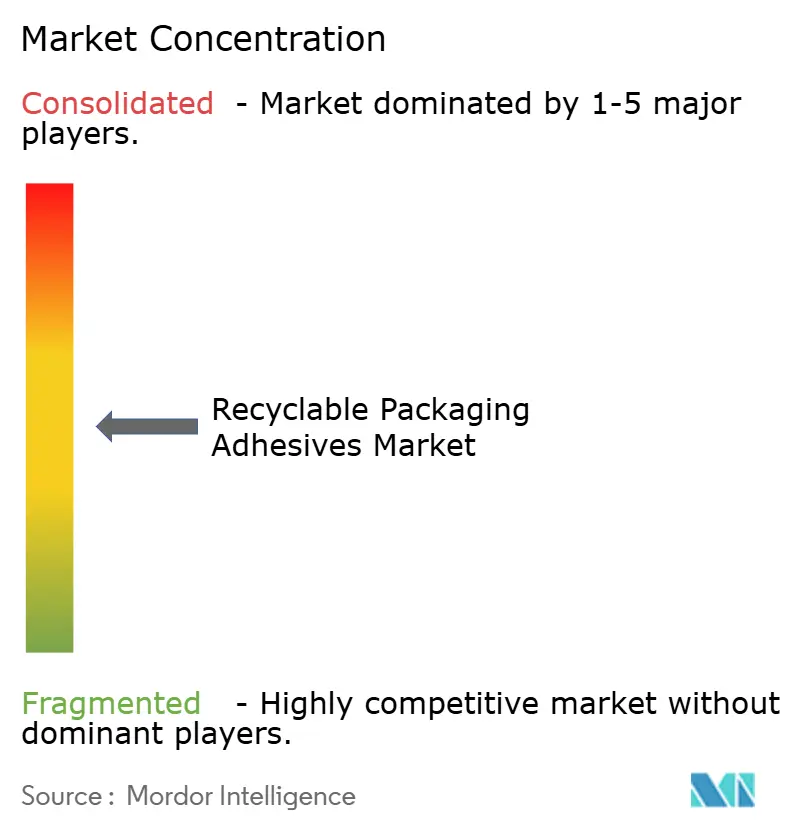
The recyclable packaging adhesives market is moderately concentrated, with the top five players including Henkel AG & Co. KGaA, H.B. Fuller Company, Arkema, Dow, and Avery Dennison Corporation. Henkel AG & Co. KGaA and H.B. Fuller Company pair adhesives with recycling assessment and technical support, which makes their customer offering broader than product chemistry alone. Henkel AG & Co. KGaA’s Packaging RecycLab in Düsseldorf replicates recycling conditions and provides recyclability assessments, showing how service capability can support differentiation. BASF is developing its acResin portfolio through RecyClass engagement, while Avery Dennison is using CleanFlake approvals to build its pressure-sensitive label position. Jowat SE focuses on specialized hot-melt and water-based systems for paper packaging.
Certification and intellectual property are important competitive tools because alkali-dispersible polymers, wash-off pressure-sensitive products, and bio-based tackifier systems need differentiated formulation. Food-contact-compliant bio-based adhesives for retort and high-barrier flexible packaging remain difficult for many converters to source. Aluminum-packaging label adhesives also have seen less recycling-focused innovation than systems for polyethylene terephthalate and high-density polyethylene packaging. Paramelt and Jowat SE can compete in cold-chain corrugated and fiber-based packaging through repulpable hot-melt systems, where focused technical capability has value.
Company actions demonstrate how leading suppliers use product investment and portfolio moves to close capability gaps. H.B. Fuller Company announced its VerdaFresh investment in May 2026 to support advanced oxygen-barrier technology for recyclable mono-material packaging. BASF’s RecyClass approval for acResin UV 3532 in March 2026 gives it a verified pressure-sensitive adhesive option for polyethylene terephthalate bottle labels. Henkel AG & Co. KGaA launched a cold-seal solution for barrier-coated paper in February 2026, strengthening its recyclable fiber-based packaging offering. DIC Corporation reported that its acquisition of Sapici S.p.A. established a global platform for environmentally focused adhesives and waterborne polyurethane resins. These moves position suppliers across packaging performance and end-of-life compatibility.
Recyclable Packaging Adhesives Industry Leaders
-
Henkel AG & Co. KGaA
-
H.B. Fuller Company
-
Arkema
-
Dow
-
Avery Dennison Corporation
- *Disclaimer: Major Players sorted in no particular order
Recent Industry Developments
- May 2026: Henkel AG & Co. KGaA opened its upgraded Packaging Competence Center in Düsseldorf with advanced equipment for testing adhesives and coatings under industrial production conditions. The facility supports the Recyclable Packaging Adhesives Market by accelerating development, validation, and scale-up of recyclable packaging adhesive solutions.
- March 2026: BASF received RecyClass approval for acResin UV 3532, an acrylic hot-melt pressure-sensitive adhesive for polyethylene terephthalate (PET) bottle labels. The approval supports the market by confirming compatibility with European PET recycling processes and enabling cleaner recycled PET streams.
Global Recyclable Packaging Adhesives Market Report Scope
Recyclable packaging adhesives are adhesive formulations designed to bond packaging materials while supporting recycling and material recovery processes. They provide reliable adhesion during packaging use while enabling easier separation, repulping, or recycling of bonded packaging components.
The Recyclable Packaging Adhesives Market is segmented by adhesive type and technology, resin chemistry, application, and geography. By adhesive type and technology, the market is segmented into water-based adhesives, hot-melt adhesives, solvent-based adhesives, and others. By resin chemistry, the market is segmented into acrylics, polyurethanes, ethylene-vinyl acetate, bio-based resins, and others. By application, the market is segmented into flexible packaging, folding cartons and boxes, corrugated packaging, labels and tapes, and others. The report also covers the market size and forecasts for recyclable packaging adhesives across 15 countries. For each segment, the market sizing and forecasts have been done on the basis of value (USD).
| Water-Based Adhesives |
| Hot-Melt Adhesives |
| Solvent-Based Adhesives |
| Others |
| Acrylics |
| Polyurethanes |
| Ethylene-Vinyl Acetate |
| Bio-Based Resins |
| Others |
| Flexible Packaging |
| Folding Cartons and Boxes |
| Corrugated Packaging |
| Labels and Tapes |
| Others |
| Asia-Pacific | China |
| India | |
| Japan | |
| South Korea | |
| ASEAN Countries | |
| Rest of Asia-Pacific | |
| North America | United States |
| Canada | |
| Mexico | |
| Europe | Germany |
| United Kingdom | |
| France | |
| Italy | |
| NORDIC Countries | |
| Rest of Europe | |
| South America | Brazil |
| Argentina | |
| Rest of South America | |
| Middle East and Africa | Saudi Arabia |
| South Africa | |
| Rest of Middle East and Africa |
| By Adhesive Type and Technology | Water-Based Adhesives | |
| Hot-Melt Adhesives | ||
| Solvent-Based Adhesives | ||
| Others | ||
| By Resin Chemistry | Acrylics | |
| Polyurethanes | ||
| Ethylene-Vinyl Acetate | ||
| Bio-Based Resins | ||
| Others | ||
| By Application | Flexible Packaging | |
| Folding Cartons and Boxes | ||
| Corrugated Packaging | ||
| Labels and Tapes | ||
| Others | ||
| By Geography | Asia-Pacific | China |
| India | ||
| Japan | ||
| South Korea | ||
| ASEAN Countries | ||
| Rest of Asia-Pacific | ||
| North America | United States | |
| Canada | ||
| Mexico | ||
| Europe | Germany | |
| United Kingdom | ||
| France | ||
| Italy | ||
| NORDIC Countries | ||
| Rest of Europe | ||
| South America | Brazil | |
| Argentina | ||
| Rest of South America | ||
| Middle East and Africa | Saudi Arabia | |
| South Africa | ||
| Rest of Middle East and Africa | ||
Key Questions Answered in the Report
What is the size of the recyclable packaging adhesives market?
The Recyclable Packaging Adhesives Market size was valued at USD 1.73 billion in 2026 and is estimated to grow from USD 1.85 billion in 2027 to reach USD 2.58 billion by 2032, at a CAGR of 6.89% during the forecast period (2027-2032).
What is driving demand for recyclable packaging adhesives?
Packaging recyclability rules, mono-material designs, e-commerce packaging demand, and certification requirements are increasing demand for verified adhesive formulations.
Which adhesive type and technology held the largest share in 2026?
Water-based adhesives held 54.31% share in 2026.
Which application is projected to advance fastest through 2032?
Labels and tapes are projected to advance at a 7.76% CAGR through 2032 as pressure-sensitive adhesive performance affects packaging recyclability.