
Recovery Orchestration Market Size and Share
Market Overview
| Study Period | 2020 - 2031 |
|---|---|
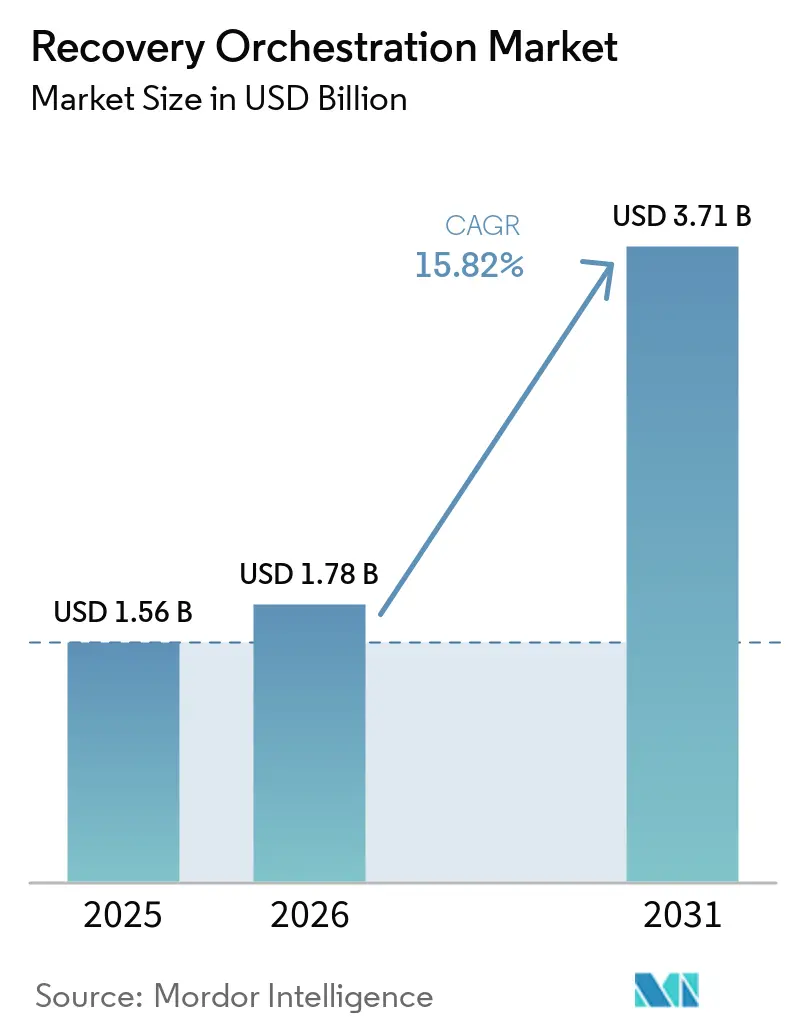
| Market Size (2026) | USD 1.78 Billion |
| Market Size (2031) | USD 3.71 Billion |
| Growth Rate (2026 - 2031) | 15.82 % |
| Fastest Growing Market | Asia-Pacific |
| Largest Market | North America |
| Market Concentration | Medium |
Major Players *Disclaimer: Major Players sorted in no particular order Image © Mordor Intelligence. Reuse requires attribution under CC BY 4.0. | |
Recovery Orchestration Market Analysis by Mordor Intelligence
The recovery orchestration market size was valued at USD 1.56 billion in 2025 and estimated to grow from USD 1.78 billion in 2026 to reach USD 3.71 billion by 2031, at a CAGR of 15.82% during the forecast period (2026-2031). Ransomware and other cyberattacks are making tested recovery processes more important for enterprise security and IT teams that must restore systems without returning compromised data or configurations to operation. Hybrid and multi-cloud estates are increasing the number of systems, configurations, and dependencies that must be restored in the correct order, which makes informal runbooks harder to maintain and less dependable during an incident. Regulations are also shifting recovery testing from an internal practice to an auditable obligation for many organizations, giving procurement, legal, security, and operational teams a shared interest in documented recovery performance. Leading suppliers are expanding platforms toward dependency-aware recovery, cleanroom validation, and closer links with security operations, while specialist providers continue to serve focused functions such as identity recovery and automated runbooks. The recovery orchestration market, therefore, offers opportunities for providers that can simplify reliable recovery across hybrid settings without requiring large specialist teams or forcing customers to standardize on a single infrastructure environment, particularly where legacy systems, cloud services, and regulated data operations must continue to coexist.
Key Report Takeaways
- By component, software held 58.42% of the recovery orchestration market share in 2025, while services are projected to expand at a CAGR of 19.66% through 2031.
- By deployment mode, cloud-based recovery held 61.19% of the recovery orchestration market share in 2025 and is projected to expand at a CAGR of 21.23% through 2031.
- By recovery extent, resource and workload-level recovery held 57.53% of the recovery orchestration market share in 2025, while application and business-service recovery is projected to expand at a CAGR of 19.92% through 2031.
- By organization size, large enterprises accounted for 71.23% of revenue in 2025, while small and medium-sized enterprises are projected to expand at a CAGR of 19.84% through 2031.
- By industry vertical, BFSI held 24.93% of the recovery orchestration market share in 2025, while the government and public administration industry is projected to expand at a CAGR of 22.76% through 2031.
- By geography, North America held 42.71% of the recovery orchestration market share in 2025, while Asia-Pacific is projected to expand at a CAGR of 21.49% through 2031.
Note: Market size and forecast figures in this report are generated using Mordor Intelligence’s proprietary estimation framework, updated with the latest available data and insights as of January 2026.
Global Recovery Orchestration Market Trends and Insights
Drivers Impact Analysis*
| DRIVER | (~) % IMPACT ON CAGR FORECAST | GEOGRAPHIC RELEVANCE | IMPACT TIMELINE |
|---|---|---|---|
| Escalating Ransomware and Cyberattack Recovery Requirements | +4.2% | Global | Short term (≤ 2 years) |
| Expansion of Hybrid and Multi-Cloud Infrastructure | +3.5% | Global, with North America and Asia-Pacific leading | Medium term (2-4 years) |
| Regulatory Demand for Tested and Auditable Recovery | +2.8% | EU and North America primarily | Short term (≤ 2 years) |
| Rising Cost of IT Downtime and Operational Disruption | +2.3% | Global, most acute in North America and Europe | Medium term (2-4 years) |
| Recovery Drift From Continuous Cloud Configuration Changes | +1.6% | North America and Europe, cloud-mature markets | Medium term (2-4 years) |
| Dependency-Aware Recovery for Cascading Third-Party Failures | +1.2% | Global, with North America leading | Long term (≥ 4 years) |
| Source: Mordor Intelligence | |||
Escalating Ransomware and Cyberattack Recovery Requirements
Recovery orchestration has become closely connected with cyber defense because ransomware exposes the operational limits of traditional backup and restore processes during an active incident. Sophos surveyed 3,400 organizations across 17 countries and reported that average recovery costs, excluding ransom payments, fell 44% to USD 1.53 million in 2025. The same study found that 53% of organizations achieved full recovery within 1 week, compared with 35% in the previous year. IBM placed the average total cost of a ransomware incident at USD 5.08 million in 2025, while its 2026 report recorded a new high in breach costs amid AI-enabled attacks.[1] Rubrik reported in 2026 that 88% of IT and security leaders were concerned about meeting current recovery time objectives, as threats were shortening the exploitation window from months to seconds. This supports demand in the recovery orchestration market for workflows that prepare isolated environments, validate data for threats, and restore business systems in sequence.
Expansion of Hybrid and Multi-Cloud Infrastructure
Hybrid and multi-cloud adoption has created recovery challenges that point backup tools cannot fully address across distributed enterprise estates. Workloads can sit across on-premises data centers, private clouds, and several cloud regions with different networking models, identity designs, and configuration management systems. A disruption in 1 layer can affect dependent layers and exceed the recovery time that a manual process can meet under a business continuity commitment. Organizations managing these estates must also address configuration drift caused by DevOps deployments, auto-scaling activity, and changes in cloud settings. Recovery plans can become outdated when data, infrastructure, and application configurations are not maintained together. The recovery orchestration market is benefiting as infrastructure-as-code recovery brings configuration versions, recovery plans, and data restoration into the same controlled process.
Regulatory Demand for Tested and Auditable Recovery
Compliance rules are making recovery testing an auditable business requirement rather than an internal governance exercise. DORA became directly applicable across the European Union in January 2025 and requires financial entities to maintain and periodically test ICT business continuity policies, disaster recovery plans, and backup procedures under Articles 11 and 12. DORA also requires documentation that can be provided to regulators, making routine test evidence and recovery records more relevant to oversight. Its 4-hour initial incident notification threshold can create pressure when recovery time objectives for critical functions exceed 4 hours. NIS2 also covers backup management, disaster recovery, and crisis management for essential and important entities, while SEC rules require public companies to report material cyber incidents within 4 business days after determining that they are material.[2] These obligations strengthen demand in the recovery orchestration market for tested workflows, reliable audit trails, and documented recovery capability.
Rising Cost of IT Downtime and Operational Disruption
IT downtime can create direct financial exposure that supports investment in recovery capabilities. For many midsize and large enterprises, even a limited disruption can create substantial costs through lost transactions, interrupted operations, and recovery work. The financial burden can become particularly acute when multiple connected systems cannot return to service in the required sequence. Transaction-intensive financial services, e-commerce, and telecommunications operations can face higher per-minute costs than general enterprise operations because service interruption directly affects transactions. Recovery delays can also contribute to customer losses, reputational damage, and higher insurance costs that standard downtime calculations may not fully capture. These effects are making the recovery orchestration market more relevant to enterprise risk planning and board-level resilience reporting.
Restraints Impact Analysis*
| RESTRAINT | (~) % IMPACT ON CAGR FORECAST | GEOGRAPHIC RELEVANCE | IMPACT TIMELINE |
|---|---|---|---|
| High Implementation Complexity Across Heterogeneous Environments | -2.4% | Global | Medium term (2-4 years) |
| Shortage of Recovery Engineering and Cybersecurity Skills | -2.0% | Global, most acute in North America and Europe | Long term (≥ 4 years) |
| Incomplete Dependency Mapping and Recovery Data Quality | -1.5% | Global | Medium term (2-4 years) |
| Conflicting Data Residency, Immutability, and Recovery Requirements | -1.1% | EU, Asia-Pacific, data-localization markets | Short term (≤ 2 years) |
| Source: Mordor Intelligence | |||
High Implementation Complexity Across Heterogeneous Environments
Recovery orchestration can be difficult to deploy across legacy infrastructure, containerized workloads, cloud services, and SaaS applications. Each environment adds integration work, distinct configuration requirements, and cross-team coordination, which can delay the customer's practical value. Accurate dependency mapping is central because a platform needs current topology data to sequence recovery correctly across data, applications, networks, and identities. Many large enterprises do not maintain this data at production quality across all teams and systems, especially where operating models have developed separately. Missing third-party dependencies or outdated network settings can cause a recovery sequence to fail during execution and lengthen an incident response. These issues can slow adoption in the recovery orchestration market when buyers must protect heterogeneous environments without an established map of service relationships.
Shortage of Recovery Engineering and Cybersecurity Skills
Recovery orchestration requires capabilities in backup administration, network engineering, identity management, application operations, and incident response. This combination is scarce and can be costly for organizations to hire, retain, and coordinate across separate operational teams. ISC2 surveyed more than 16,000 cybersecurity professionals in its 2025 workforce study and found that 95% reported at least 1 skills gap in their teams, with 59% describing gaps as critical or significant.[3] Recovery engineering requires these functions to work together under incident conditions, which makes the skills gap more difficult to address with isolated training. The constraint can result in delayed projects, underused platform features, incomplete testing, and continued reliance on manual recovery processes. Commvault expanded Cleanroom Recovery to managed service providers in April 2025, showing how suppliers are using service channels to help customers operate complex recovery settings.
*Our forecasts treat driver/restraint impacts as directional, not additive. The impact forecasts reflect baseline growth, mix effects, and variable interactions.
Segment Analysis
By Component: Software Leads as Services Scale Through Channel Expansion
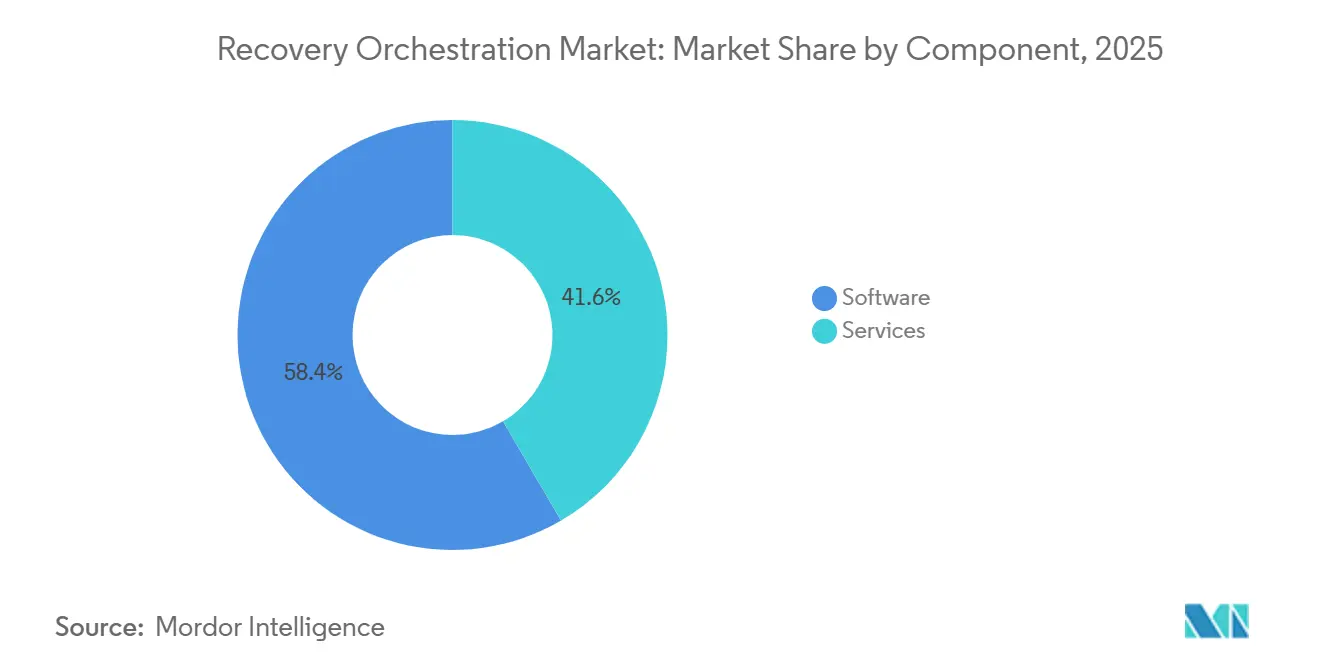
Software accounted for 58.42% of the recovery orchestration market in 2025. The position reflected enterprise demand for platform architectures that connect recovery processes with security operations workflows and that can be deployed as part of a wider resilience program. API-based software can link recovery functions with security information and event management, security orchestration, automation and response, and identity tools. This allows recovery teams to use operational signals from connected systems rather than running a separate backup administration task, while maintaining recovery policies, test results, and sequenced procedures within the same platform environment. Software also provides a consistent place to define runbooks, manage recovery policies, test recovery steps, and record test results. Services held the remaining share of the component split, while services are projected to expand at a CAGR of 19.66% through 2031, the fastest rate among components.
The service opportunity is linked to limited internal recovery engineering capacity and the practical work required to design, test, update, and operate a recovery program across changing enterprise systems. Managed cleanroom recovery and orchestration-as-a-service models can give organizations specialized support for designing, validating, and updating recovery processes. In April 2025, Commvault extended Cleanroom Recovery to managed service providers, adding AWS support alongside Azure and automated recovery of file shares.[4] The move showed how channel delivery can broaden access without replacing software-first architectures or requiring every customer to build a dedicated recovery team. Containerized workloads, SaaS environments, and infrastructure-as-code pipelines may require implementation support, runbook automation, periodic testing, and ongoing tuning as systems evolve. These needs can make services a sustained revenue stream alongside platform subscriptions in the Recovery orchestration industry, as customers require help translating a recovery policy into operational procedures for individual workloads, critical applications, and related operating teams. The model can also support recurring validation as applications, cloud resources, network rules, and identity settings change over time, helping providers and customers keep recovery procedures aligned with the environment they are intended to protect.
By Deployment Mode: Cloud Adoption Reflects Infrastructure Migration and Hyperscaler Convergence
Cloud-based recovery held 61.19% of the recovery orchestration market size in 2025. Cloud-based deployment is projected to expand at a CAGR of 21.23% through 2031, the highest rate across deployment modes. Its position reflects ongoing workload migration to cloud environments and the need to recover services across more than 1 region or operating setting. Elastic capacity can provide resources during a recovery event without maintaining a permanently sized secondary facility, which can be useful when the scope of disruption or recovery demand is not known in advance. Multi-region replication can support recovery planning for applications and data that are distributed across locations. Consumption-based pricing can also align recovery costs with current risk exposure, making cloud delivery a principal route for new adoption in the recovery orchestration market.
On-premises deployment remains relevant for air-gapped systems and sectors with stringent data sovereignty requirements. Its broader share can decline even when these uses remain important in regulated settings that require local control over critical data or in recovery environments. Hybrid deployment is also expanding as enterprises protect workloads across on-premises and cloud infrastructure without completing full infrastructure consolidation, allowing them to manage differing data, application, and control requirements in the same recovery program. In August 2026, AWS introduced Recovery Plans in Elastic Disaster Recovery for sequential recovery of multi-server applications and drills.[5] Users can define dependency sequences, validate them through non-disruptive drills, and set approval checkpoints before proceeding through a planned recovery process. Providers that avoid cloud-provider lock-in can address organizations operating across several environments and seeking consistent recovery governance.
By Recovery Extent: Workload-Level Maturity Creates an Opening for Application-Service Specialists
Resource- and workload-level recovery accounted for 57.53% of the recovery orchestration market share in 2025. This segment covers organizations that have automated backup and restoration at the compute and storage layers and can restore individual resources in accordance with defined procedures. The share shows that many enterprises have advanced individual-resource recovery practices and have established a basis for broader automation, even when the dependencies that connect resources into a business service remain outside the recovery sequence. It also indicates that many have not extended recovery to full application dependencies that determine whether a service works after infrastructure has been restored. Network rules, identity settings, DNS records, service relationships, and configuration elements must be restored in a tested order for an application to function. The recovery orchestration market size for application and business-service recovery is projected to expand at a CAGR of 19.92% through 2031.
Application and business service recovery can bridge the gap between infrastructure recovery and the restoration of functional services for users and customers. In June 2026, Rubrik introduced Autonomous Business Recovery for Cloud Applications in private preview. The offering uses the Preemptive Recovery Engine to discover application stacks, identify recovery dependencies, and validate clean recovery points. It also prepares sequenced plans that cover data, networking, identity, and configuration layers, which are often maintained by separate enterprise teams. Site and platform recovery addresses the most complex scenario: restoring entire data center environments or platform layers. The segment is the smallest among the named recovery extents, but its importance may increase as organizations consider geographic redundancy and broader service continuity needs.
By Organization Size: SME Adoption Accelerates as Cloud-Native Pricing Lowers the Entry Threshold
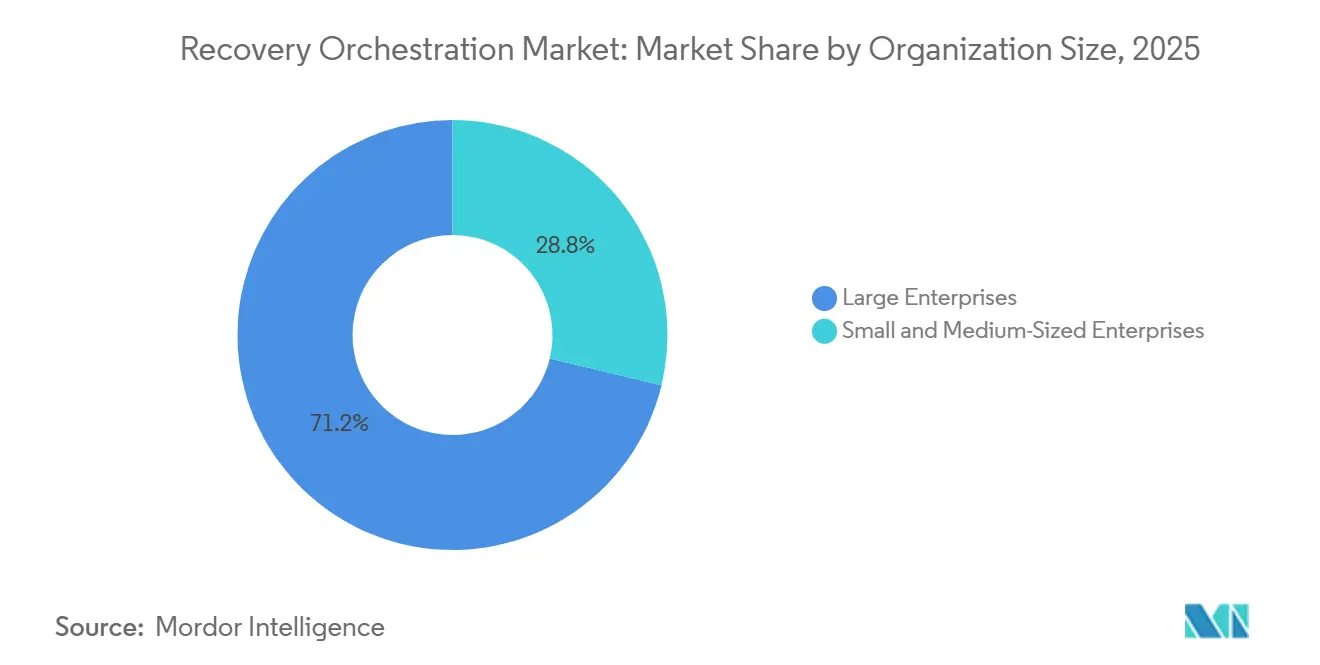
Large enterprises accounted for 71.23% of the recovery orchestration market revenue in 2025. This position reflects their infrastructure complexity, regulatory obligations, established IT investment, and need to coordinate recovery across many business systems. BFSI institutions, critical infrastructure operators, and large technology companies drove early adoption because they needed tested recovery capabilities for compliance and insurance requirements. These organizations can also have a larger number of applications and dependencies, making manual coordination difficult during a disruption. Small and medium-sized enterprises are projected to expand at a CAGR of 19.84% through 2031. Subscription delivery can reduce upfront capital requirements and make advanced recovery functions available without a large initial infrastructure commitment.
Ransomware groups have increasingly targeted mid-market companies that lack large recovery engineering teams or extensive specialist resources. This can create demand for managed recovery services and pre-built blueprints that reduce configuration work while preserving a structured recovery process, particularly for organizations that cannot dedicate staff to dependency discovery and runbook maintenance. Suppliers are simplifying onboarding for this customer group by providing clearer setup paths and repeatable operating models. They are also using managed service providers and pre-validated recovery templates to support customers who cannot sustain in-house recovery engineering. These capabilities can abstract dependency mapping and runbook work that was once limited to large enterprise deployments with more dedicated staff. The recovery orchestration industry can broaden its customer base while preserving the role of specialists in implementation, testing, and ongoing operations.
By Industry Vertical: BFSI Anchors Demand as Government Investment Accelerates
BFSI accounted for 24.93% of the recovery orchestration market in 2025. Financial institutions face transaction continuity and identity and data integrity requirements that make an incomplete recovery particularly disruptive. DORA in Europe and SEC disclosure rules in the United States have made tested, auditable recovery a core operating requirement for many firms. Cleanroom validation and threat scanning can support reliable restoration by verifying recovery conditions before systems are returned to use. The government and public administration industry is projected to expand at a CAGR of 22.76% through 2031. The sector's continuity requirements can extend across citizen services, administrative systems, and essential public functions.
Public-sector digital transformation and cyberattacks on government infrastructure are supporting investment in continuity of essential functions. National cybersecurity requirements are adding to this demand by increasing attention to recovery planning, continuity testing, and the ability to demonstrate readiness when agencies are responsible for essential services. Healthcare and life sciences, IT and telecommunications, and energy and utilities are also highly relevant because failures can affect patient safety, service continuity, or operational technology. Industrial manufacturing, retail and e-commerce, transportation and logistics, oil and gas, education, and media are also adopting recovery orchestration in cases where service interruptions have operational consequences. Adoption varies with prior incidents, reliance on digital systems, and the maturity of existing IT governance. The recovery orchestration market can serve these verticals by tailoring workflows to their operating systems, data obligations, dependency structures, and recovery testing practices.
Geography Analysis
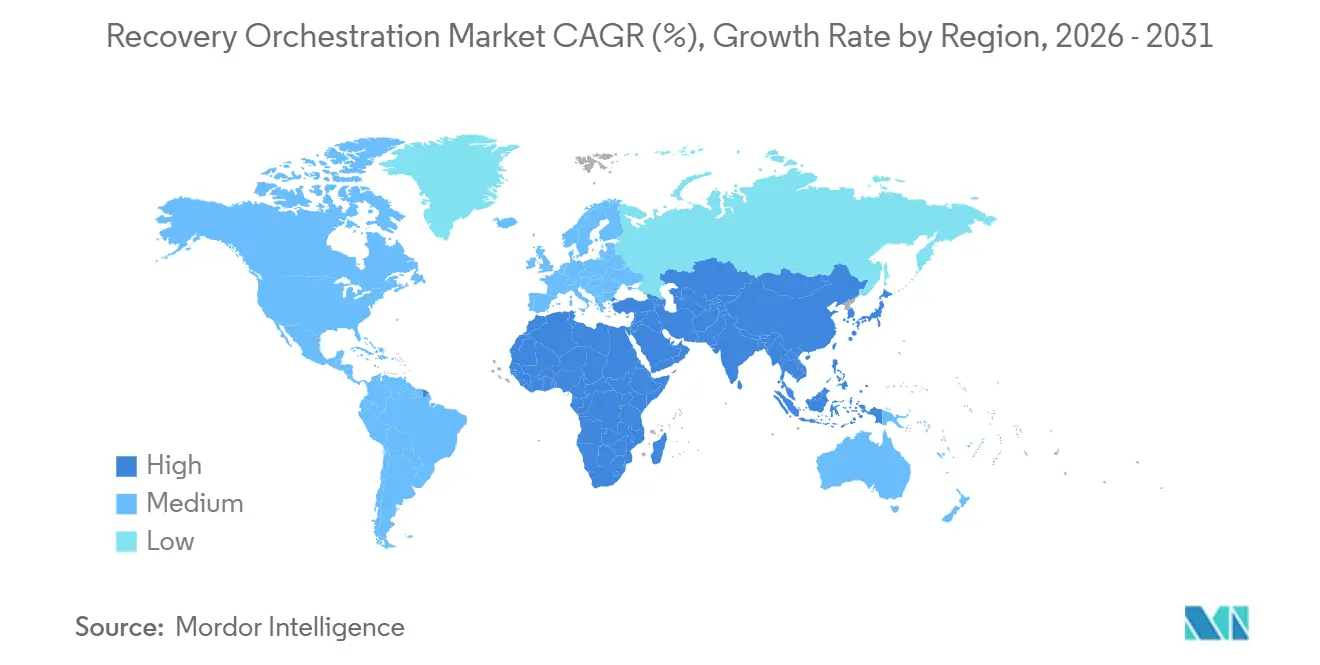
North America held 42.71% of the recovery orchestration market share in 2025. The United States was the main contributor because ransomware has targeted critical infrastructure across healthcare, energy, financial services, and government agencies. SEC disclosure rules make documented recovery time objectives and audit trails relevant to legal teams, boards, and IT operations. Canada adds demand through public-sector resilience programs and financial services adoption. Mexico’s technology and manufacturing sectors constitute an emerging demand base, in which greater digitalization can increase the need for structured recovery processes.
North America has the most developed competitive ecosystem, including tier-1 supplier headquarters and specialists in identity recovery, infrastructure-as-code restoration, and runbook automation. This supplier base can create pressure on pricing, product development, and the scope of functions that enterprise buyers expect from their providers, including integration with security systems, identity services, and infrastructure management tools. Europe is shaped by the combined effect of DORA and NIS2 across financial services, energy, telecommunications, and critical infrastructure.[6] Germany, the United Kingdom, France, Italy, and the BENELUX countries represent major European markets in enterprise IT spending. Financial services firms subject to DORA Articles 11 and 12 face particularly detailed testing and documentation obligations, which affect technology procurement and recovery governance. South America, led by Brazil and Argentina, has early-stage demand shaped by cybersecurity frameworks and financial-sector digitization, although limited local expertise and uneven IT governance can constrain adoption.
Asia-Pacific is projected to expand at a CAGR of 21.49% through 2031. The growth is linked to cloud adoption in India, China, Japan, and South Korea, and to increasing cyber threats affecting financial institutions, telecommunications providers, and public agencies that depend on the continuous availability of critical digital services. India’s digital infrastructure expansion and attacks on public-sector institutions have elevated resilience in enterprise and government planning. China’s data localization requirements and Japan’s operational technology security priorities are influencing deployment design and can favor hybrid and on-premises use cases alongside cloud recovery. The Middle East and Africa, led by the UAE and Saudi Arabia, are seeing early-stage demand as national Vision programs and sovereign cloud investments build the supporting infrastructure for recovery programs. Government and financial services organizations are leading demand in these markets as their operating requirements place a high value on continuity and controlled data environments.
Competitive Landscape
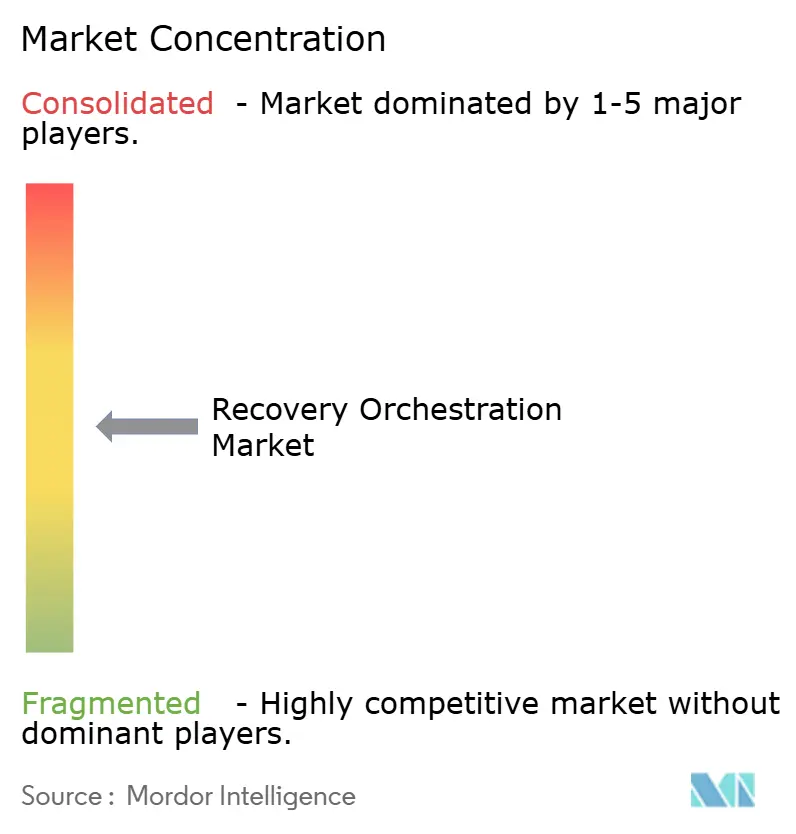
The recovery orchestration market is moderately concentrated around Veeam Software, Commvault, Rubrik, and Cohesity. These suppliers have broad portfolios that bring together dependency-aware recovery, anomaly detection, cleanroom isolation, and security workflow integration. Their central strategy is moving beyond traditional backup toward systems that connect incident detection with tested and sequenced recovery across the data, application, network, and identity layers. In August 2026, Commvault made its integration with CrowdStrike Charlotte Agentic SOAR generally available. It enabled recovery actions such as access restrictions, suspension of the data aging policy, and cleanroom restoration within CrowdStrike workflows. The integration can reduce manual coordination between security and recovery teams during an incident.
Specialists such as Semperis, Firefly Technologies, and Cutover address identity recovery, infrastructure-as-code restoration, and runbook automation. Their role shows that important use cases remain fragmented despite the reach of broader platforms, particularly where recovery requires deep knowledge of a single operational layer. In November 2025, Commvault announced Synthetic Recovery, enhanced Cleanroom Recovery with runbook automation, and Threat Scan Advanced as part of its Cloud Unity release. These product moves reflected the use of intellectual property, automation, and validation functions to differentiate recovery capabilities. In July 2026, Veeam released Data Platform v13.1 with support for 14 hypervisor platforms, Active Directory Forest Recovery, and extended malware scanning for NAS environments.
Broadcom has positioned Automic Automation for VMware Cloud Foundation around the sequenced restoration of databases and networks, as well as application validation. Broadcom stated that the offering can reduce recovery time objectives by up to 75% and recovery resources by up to 80%. The application and business-service layer remains an important opening for focused providers because it requires restoration of connected elements rather than only individual infrastructure resources. Buyers need dependable sequencing, clean-state validation, evidence from recovery tests, and support across hybrid environments, because a restored workload has limited value if the related configuration, identity, and network components are not ready at the same time. Suppliers that can meet these needs can compete against fragmented point backup tools in mid-market and large-enterprise deployments. The recovery orchestration market continues to reward credible proof of tested recovery performance rather than broad claims alone, since buyers need confidence that their priority business services can be restored in the required order under incident conditions.
Recovery Orchestration Industry Leaders
-
Veeam Software Group GmbH
-
Hewlett Packard Enterprise Company
-
Commvault Systems, Inc.
-
Rubrik, Inc.
-
Druva Inc.
- *Disclaimer: Major Players sorted in no particular order
Recent Industry Developments
- August 2026: Commvault announced the general availability of its integration with CrowdStrike's Charlotte Agentic SOAR platform, enabling joint customers to automate Commvault cyber recovery actions, including access restriction, backup data aging policy suspension, and cleanroom restoration, as native steps within CrowdStrike security workflows. The integration reduced manual coordination between security and recovery teams during active incidents and was also available through the CrowdStrike Marketplace.
- August 2026: AWS introduced Recovery Plans within AWS Elastic Disaster Recovery, enabling automated sequential launch of multi-server applications during recovery and drill operations with configurable wait times between dependency tiers. Customers could define recovery sequences once across database, application, and service layers, run non-disruptive drill validation, and add human approval checkpoints, directly addressing the orchestrated-dependency challenge for multi-tier enterprise applications.
- July 2026: Veeam Software announced the general availability of Veeam Data Platform v13.1 at VeeamON Sydney, expanding hypervisor support to 14 platforms including Red Hat OpenShift Virtualization, Sangfor aSV, XCP-ng, and Citrix XenServer. The release added Active Directory Forest Recovery for post-incident identity restoration, extended malware scanning to NAS environments, and aligned with NIST post-quantum cryptography standards.
- June 2026: Rubrik unveiled Autonomous Business Recovery for Cloud Applications at Rubrik FORWARD 2026, in private preview. Powered by the Preemptive Recovery Engine, it automatically discovered full cloud application stacks, validated clean recovery points, pre-built sequenced recovery plans covering data, networking, IAM, and configuration layers, and orchestrated a complete rebuild of an organization’s Minimum Viable Business during an incident.
Global Recovery Orchestration Market Report Scope
The recovery orchestration market comprises automated platforms and services that manage and validate disaster-recovery and cyber-recovery workflows across hybrid and multi-cloud environments. These solutions help organizations restore applications, data, and infrastructure in the required sequence through application dependency mapping, runbook automation, automated failover and failback, recovery testing, and compliance reporting. By integrating with backup, storage, and cloud platforms, recovery orchestration solutions reduce recovery time objectives (RTOs), minimize manual errors, support business continuity during ransomware attacks and infrastructure failures, and maintain regulatory compliance through documented, auditable recovery processes across enterprise IT, cloud-native applications, and critical infrastructure deployments.
The Recovery Orchestration Market Report is Segmented by Component (Software, and Services), Deployment Mode (Cloud-Based, On-Premises, and Hybrid Deployment), Recovery Extent (Resource and Workload-Level Recovery, Application and Business-Service Recovery, Site and Platform Recovery, and Other Recovery Extents), Organization Size (Large Enterprises, and Small and Medium-Sized Enterprises), Industry Vertical (Government and Public Administration, Industrial Manufacturing, Retail and E-Commerce, Transportation and Logistics, Energy and Utilities, Oil and Gas, IT and Telecommunication, Media and Entertainment, Education and Research Institutions, Healthcare and Life Sciences, Banking, Financial Services, and Insurance (BFSI), and Other Industry Verticals), and Geography (North America, South America, Europe, Asia-Pacific, and Middle East and Africa). The Market Forecasts are Provided in Terms of Value (USD).
| Software |
| Services |
| Cloud-Based |
| On-Premises |
| Hybrid |
| Resource and Workload-Level Recovery |
| Application and Business-Service Recovery |
| Site and Platform Recovery |
| Other Recovery Extents |
| Large Enterprises |
| Small and Medium-Sized Enterprises |
| Government and Public Administration |
| Industrial Manufacturing |
| Retail and E-Commerce |
| Transportation and Logistics |
| Energy and Utilities |
| Oil and Gas |
| IT and Telecommunication |
| Media and Entertainment |
| Education and Research Institutions |
| Healthcare and Life Sciences |
| Banking, Financial Services, and Insurance (BFSI) |
| Other Industry Verticals |
| North America | United States | |
| Canada | ||
| Mexico | ||
| South America | Brazil | |
| Argentina | ||
| Rest of South America | ||
| Europe | Germany | |
| United Kingdom | ||
| France | ||
| Italy | ||
| BENELUX | ||
| Rest of Europe | ||
| Asia-Pacific | China | |
| Japan | ||
| India | ||
| South Korea | ||
| Australia | ||
| Rest of Asia-Pacific | ||
| Middle East and Africa | Middle East | United Arab Emirates |
| Saudi Arabia | ||
| Rest of Middle East | ||
| Africa | South Africa | |
| Nigeria | ||
| Egypt | ||
| Rest of Africa | ||
| By Component | Software | ||
| Services | |||
| By Deployment Mode | Cloud-Based | ||
| On-Premises | |||
| Hybrid | |||
| By Recovery Extent | Resource and Workload-Level Recovery | ||
| Application and Business-Service Recovery | |||
| Site and Platform Recovery | |||
| Other Recovery Extents | |||
| By Organization Size | Large Enterprises | ||
| Small and Medium-Sized Enterprises | |||
| By Industry Vertical | Government and Public Administration | ||
| Industrial Manufacturing | |||
| Retail and E-Commerce | |||
| Transportation and Logistics | |||
| Energy and Utilities | |||
| Oil and Gas | |||
| IT and Telecommunication | |||
| Media and Entertainment | |||
| Education and Research Institutions | |||
| Healthcare and Life Sciences | |||
| Banking, Financial Services, and Insurance (BFSI) | |||
| Other Industry Verticals | |||
| By Geography | North America | United States | |
| Canada | |||
| Mexico | |||
| South America | Brazil | ||
| Argentina | |||
| Rest of South America | |||
| Europe | Germany | ||
| United Kingdom | |||
| France | |||
| Italy | |||
| BENELUX | |||
| Rest of Europe | |||
| Asia-Pacific | China | ||
| Japan | |||
| India | |||
| South Korea | |||
| Australia | |||
| Rest of Asia-Pacific | |||
| Middle East and Africa | Middle East | United Arab Emirates | |
| Saudi Arabia | |||
| Rest of Middle East | |||
| Africa | South Africa | ||
| Nigeria | |||
| Egypt | |||
| Rest of Africa | |||
Key Questions Answered in the Report
What is the recovery orchestration market size?
The recovery orchestration market size was valued at USD 1.56 billion in 2025 and estimated to grow from USD 1.78 billion in 2026 to reach USD 3.71 billion by 2031, at a CAGR of 15.82% during the forecast period (2026-2031). The estimate reflects demand for tested, automated recovery processes across complex enterprise technology environments.
What is driving adoption of recovery orchestration platforms?
Ransomware exposure, hybrid infrastructure, auditable recovery requirements, and the cost of downtime are supporting adoption. These pressures place greater emphasis on recovery plans that can be tested and executed across applications, configurations, and related services.
Which deployment model is growing fastest?
Cloud-based recovery is projected to grow at a CAGR of 21.23% through 2031. Elastic capacity, multi-region replication, and consumption-based pricing support this deployment model for organizations managing distributed workloads.
Which recovery capability is growing fastest?
Application and business-service recovery is projected to grow at a CAGR of 19.92% through 2031. It focuses on restoring connected services, including data, networks, identity settings, and configurations, rather than only individual resources.
Which organizations are adopting these platforms fastest?
Small and medium-sized enterprises are projected to grow at a CAGR of 19.84% through 2031. Subscription models, managed service delivery, and pre-built recovery blueprints can lower the entry barrier for these organizations.
Which region is expanding fastest?
Asia-Pacific is projected to grow at a CAGR of 21.49% through 2031. Cloud adoption, cybersecurity concerns, data requirements, and digital infrastructure investment across key economies are supporting this outlook.