
RAN Intelligent Controller Application Ecosystem Market Size and Share
Market Overview
| Study Period | 2020 - 2031 |
|---|---|
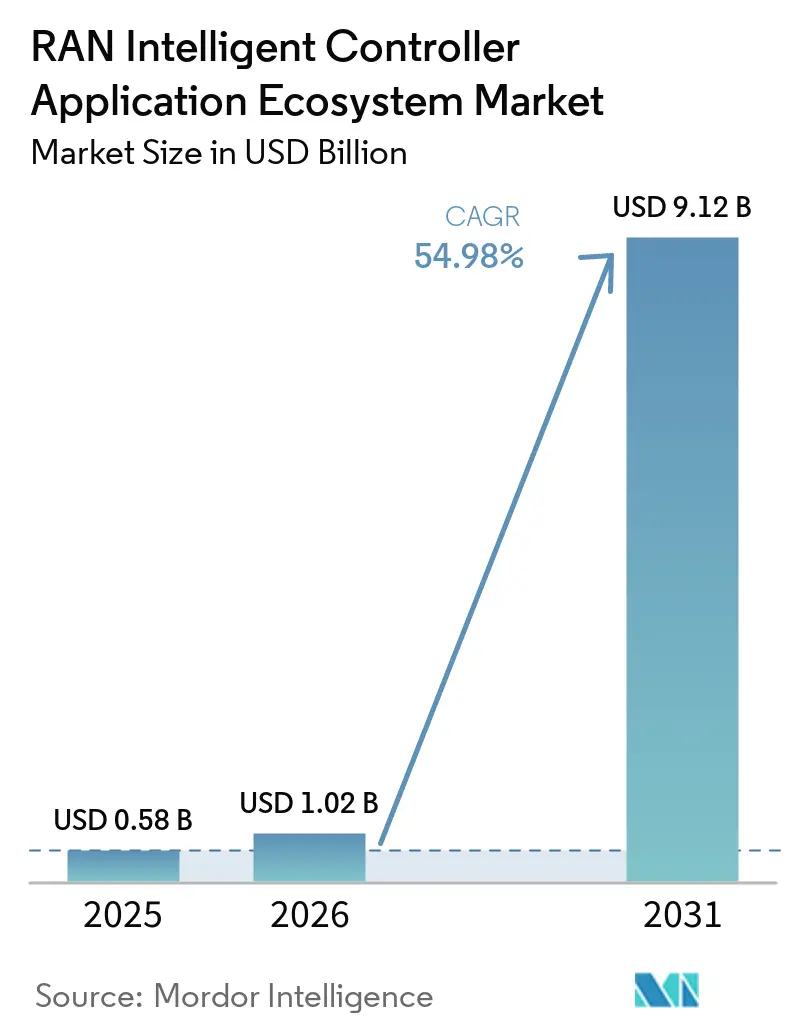
| Market Size (2026) | USD 1.02 Billion |
| Market Size (2031) | USD 9.12 Billion |
| Growth Rate (2026 - 2030) | 54.98 % |
| Fastest Growing Market | Middle East |
| Largest Market | Asia-Pacific |
| Market Concentration | Medium |
Major Players *Disclaimer: Major Players sorted in no particular order Image © Mordor Intelligence. Reuse requires attribution under CC BY 4.0. | |
RAN Intelligent Controller Application Ecosystem Market Analysis by Mordor Intelligence
The RAN intelligent controller application ecosystem market size was valued at USD 0.58 billion in 2025 and estimated to grow from USD 1.02 billion in 2026 to reach USD 9.12 billion by 2031, at a CAGR of 54.98% during the forecast period 2026-2031. The RAN intelligent controller application ecosystem market is moving from a standards-led concept toward production deployments that support automated management of 5G and Open RAN networks. Release 5 of the O-RAN specifications reduced uncertainty around AI and machine-learning workflows, while North American standards adoption gave operators clearer interoperability requirements for procurement. Demand is centered on closed-loop control to improve network performance and reduce energy use across existing 4G, 5G, and Open RAN estates. The RAN intelligent controller application ecosystem market also reflects a practical preference for stable, vendor-led deployments, even where operators want more application choice over time. This gives established platform providers an advantage, while application specialists depend on wider testing, integration, and conflict-management capabilities before portable applications become common.
Key Report Takeaways
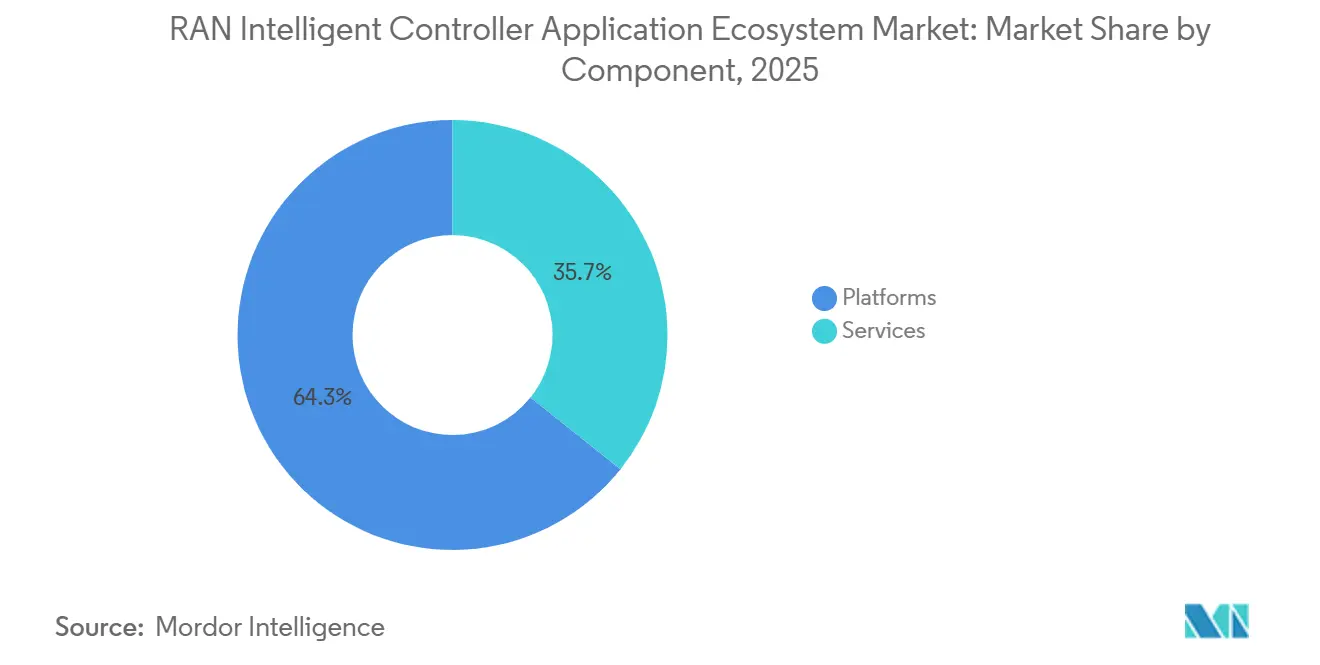
- By component, platforms held 64.26% of the RAN intelligent controller application ecosystem market share in 2025, while services are projected to expand at a 56.35% CAGR through 2031.
- By function, non-real-time RIC held 69.38% of the 2025 RAN intelligent controller application ecosystem market, while near-real-time RIC is projected to grow at a 55.94% CAGR through 2031.
- By technology, 5G held 75.54% of the RAN intelligent controller application ecosystem market in 2025, while 5G-Advanced and 6G test environments are projected to expand at a 55.47% CAGR through 2031.
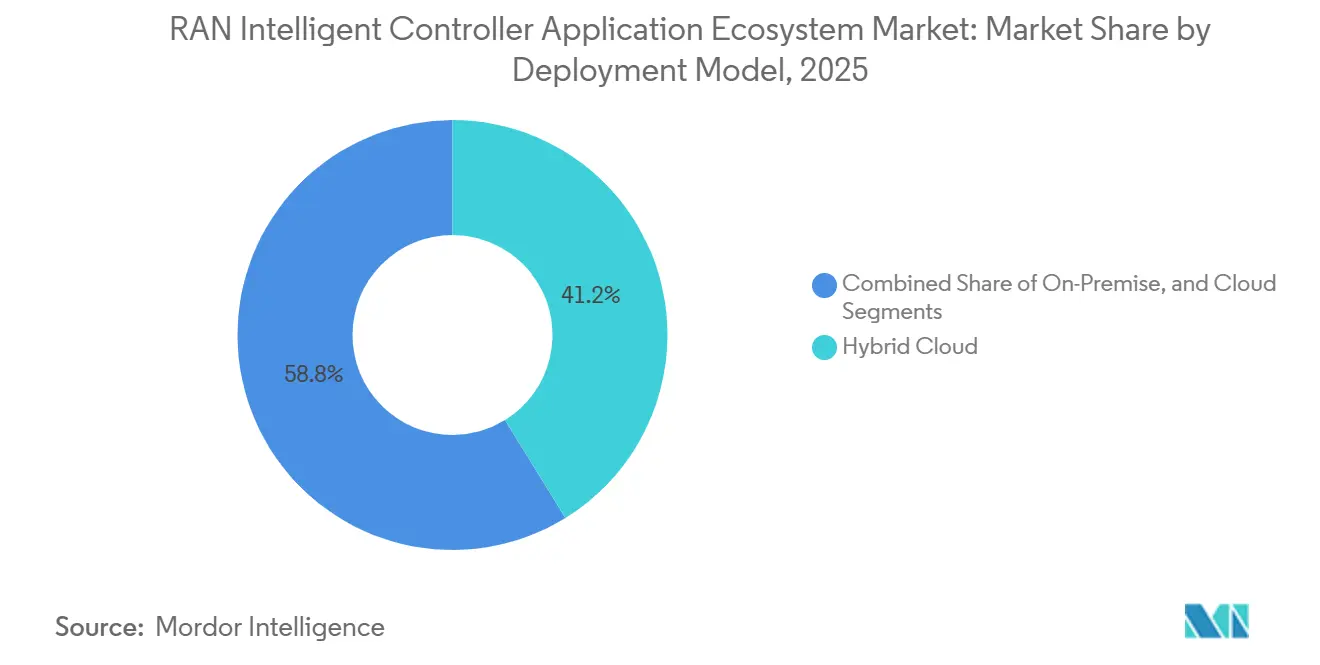
- By deployment model, hybrid cloud held 41.20% of the 2025 market, while cloud deployments are projected to grow at a 55.83% CAGR through 2031.
- By end user, MNOs held 73.15% of the market in 2025, while private 5G and enterprise network operators are projected to grow at a 56.72% CAGR through 2031.
- By geography, Asia-Pacific held 38.75% of the market in 2025, while the Middle East is projected to grow at a 56.18% CAGR through 2031.
Note: Market size and forecast figures in this report are generated using Mordor Intelligence’s proprietary estimation framework, updated with the latest available data and insights as of January 2026.
Global RAN Intelligent Controller Application Ecosystem Market Trends and Insights
Drivers Impact Analysis*
| Driver | (~) % Impact on CAGR Forecast | Geographic Relevance | Impact Timeline |
|---|---|---|---|
| 5G and Open RAN Commercialization | +12.8% | Global, with leading gains in Asia-Pacific and North America | Short term (≤ 2 years) |
| Rising Demand for AI-Driven RAN Automation | +11.2% | Global, strongest in North America, Europe, and Asia-Pacific | Short term (≤ 2 years) |
| Pressure to Reduce RAN Energy Consumption | +8.5% | Global, with compliance factors strongest in Europe and Asia-Pacific | Medium term (2-4 years) |
| Increasing Multi-Vendor RAN Complexity | +6.4% | Global, particularly in markets with diverse vendor ecosystems | Medium term (2-4 years) |
| Production Deployment of Third-Party rApps and xApps | +5.2% | North America, Europe, and leading Asia-Pacific markets | Medium term (2-4 years) |
| RIC-Based Closed-Loop Control for Private Networks and Network Slicing | +4.1% | Asia-Pacific core, with spillover to the Middle East and Europe | Long term (≥ 4 years) |
| Source: Mordor Intelligence | |||
5G and Open RAN Commercialization
O-RAN ALLIANCE completed Release 5 in November 2025 and finalized AI and machine-learning workflow services for non-real-time and near-real-time RIC functions. The release gave operators in the RAN intelligent controller application ecosystem market a clearer technical basis for procuring platforms and applications. ATIS published the corresponding specifications, including Near-RT RIC Architecture v7.00, which provided North American operators with a clearer interoperability reference. These developments supported the adoption of RIC in both existing networks and new Open RAN installations. Brownfield deployment can enlarge the addressable customer base because operators do not need to replace their entire radio network before introducing automation applications. The main near-term opportunity is therefore tied to networks that are already operating 4G or 5G infrastructure and need an incremental path to automation.
Rising Demand for AI-Driven RAN Automation
The RAN intelligent controller application ecosystem market is gaining momentum as operators move from static network rules toward automated control that responds to changing network conditions. Mavenir reported mobility-related KPI gains above 40% from deep reinforcement learning-based AI agents in live 5G non-standalone deployments across more than 25 sites per operator in South Asia.[1]Mavenir, “Mavenir's Network Intelligence as a Service AI Agents Deliver 40% Mobility KPI Gains in 5G Non-Standalone Networks,” Mavenir, mavenir.com The applications ran on standard CPUs, which reduced the need for dedicated GPU infrastructure. This approach can make advanced automation more accessible to operators who do not maintain extensive AI infrastructure. Cloud-hosted rApp delivery can also shift network optimization from a capital purchase toward a recurring managed service. The architecture keeps time-sensitive control closer to the network while moving model training and some analytics to cloud resources, potentially reshaping relationships between operators and cloud providers.
Pressure to Reduce RAN Energy Consumption
Energy management is a key driver for operators in the RAN intelligent controller application ecosystem market to adopt RIC-based automation, as RAN equipment accounted for 80% of mobile network power consumption in Rakuten Mobile's 2025 assessment. Rakuten Mobile deployed an AI-powered RIC platform across its Japanese 4G and 5G Open RAN network in May 2025 to support traffic prediction and dynamic base station utilization. The company received TM Forum Level 4 Autonomy validation for RAN Energy Efficiency Optimization in February 2026. A 2026 IEEE study found that closed-loop, AI-native energy-saving rApps can achieve up to 19.5% energy savings without reducing quality of service. These results support investment where operators face higher electricity costs and formal energy-reporting requirements. European compliance obligations can make energy-focused automation relevant even when broader network spending is under pressure.
Increasing Multi-Vendor RAN Complexity
The RAN intelligent controller application ecosystem market benefits directly from the need to manage networks that integrate equipment, software, and interfaces from multiple vendors. NTT DOCOMO documented differences in specification interpretation, version mismatches, and optional-feature incompatibilities in its published experience with nationwide intelligent RAN deployment. These issues can increase operational effort, but they also create a clear case for a common orchestration layer. NTT East's March 2026 Local 5G test involved 26 companies and reported 65% power reduction under certain test conditions through RIC-controlled transmit-power optimization. Operators can use a service management and orchestration layer to manage the transition between legacy RAN and Open RAN rather than waiting for a uniform network architecture. This makes heterogeneous deployments a continuing source of demand through 2028.
Restraints Impact Analysis*
| Restraint | (~) % Impact on CAGR Forecast | Geographic Relevance | Impact Timeline |
|---|---|---|---|
| Interoperability Gaps Across Legacy RAN and O-RAN Interfaces | -4.2% | Global, most acute in North America and Europe where multi-vendor environments are advanced | Short term (≤ 2 years) |
| Security, Privacy, and Automation Governance Concerns | -3.4% | Global, with regulatory influence strongest in Europe and North America | Medium term (2-4 years) |
| Limited Commercial Availability of Portable xApps and rApps | -2.1% | North America and Europe | Medium term (2-4 years) |
| Conflicting Control Policies Across Co-Located Applications | -1.5% | Global, intensifying as xApp ecosystems scale | Long term (≥ 4 years) |
| Source: Mordor Intelligence | |||
Interoperability Gaps Across Legacy RAN and O-RAN Interfaces
Open RAN specifications have matured, but RAN intelligent controller application ecosystem deployment teams still face integration problems that extend project schedules and raise systems integration costs. The NTIA Institute for Telecommunication Sciences reported that integration events can expose timer configuration issues, message-handling differences, bit-rate incompatibilities, and standards-version mismatches. ATIS also noted that implementation choices across architecture, functionality, and performance can complicate interoperability. These issues place a substantial burden on operator integration teams. Some operators may return to a single-vendor RIC, orchestration, and RAN arrangement after difficult integration work. This can favor large infrastructure vendors and limit the immediate opportunity for application vendors that rely on portability across platforms.
Security, Privacy, and Automation Governance Concerns
Open RAN disaggregation can expand the security exposure of network management because xApps may access near-real-time RIC functions through the E2 interface. A 2024 peer-reviewed study identified access-control weaknesses in current O-RAN implementations and described how a malicious xApp could affect E2 nodes. The Quad Open RAN Security Report also identified risks from data-poisoning attacks against AI and machine-learning functions used in closed-loop control. Release 5 introduced a Zero Trust Architecture framework and mandatory TLS 1.x across most O-RAN interfaces. Verification of AI model integrity at the application level remains less mature than interface security requirements. This can slow approval cycles for government and enterprise operators with strict risk and data governance requirements.
*Our forecasts treat driver/restraint impacts as directional, not additive. The impact forecasts reflect baseline growth, mix effects, and variable interactions.
Segment Analysis
By Component: Services Expand Alongside Platform Investment
Platforms held 64.26% of the RAN intelligent controller application ecosystem market in 2025, reflecting early operator spending on the non-real-time RIC and near-real-time RIC software that supports later application deployment. Operators need to acquire, integrate, and validate this platform with their service management and orchestration layer before deploying rApps or xApps at scale. That requirement places platform suppliers at the center of initial engagements and makes foundational software the main revenue point during the build-out phase. Platform demand also reflects the need to manage application workflows, policies, and operating data across a live network environment. The RAN intelligent controller application ecosystem industry, therefore, remained centered on foundational software in 2025.
Services are projected to grow at a 56.35% CAGR through 2031, as continuous optimization can be delivered through a subscription rather than a large upfront platform contract. Managed services can lower entry barriers for operators that do not maintain dedicated AI infrastructure, while also moving spending toward recurring agreements. This delivery model can provide ongoing optimization without requiring the operator to operate all supporting infrastructure internally. Its use will depend on dependable integration with the platform that controls the network environment. Until portable rApps achieve broad commercial use, a substantial share of service revenue is likely to remain within platform-specific ecosystems.


By Function: Near-Real-Time RIC Gains with Low-Latency Use Cases
Non-real-time RIC accounted for 69.38% of the RAN intelligent controller application ecosystem market in 2025, as operators favored policy-based automation for functions operating above the 1-second control threshold. The segment offered a lower-complexity starting point for initial RIC investment and a way to introduce automation applications gradually through standard interfaces. Rakuten Mobile integrated third-party rApps into its non-real-time RIC environment through a nationwide deployment in February 2026. That deployment indicates why non-real-time functions remain the near-term lead, even as operators evaluate more demanding control use cases. It also provides vendors with a commercial environment for policy automation, application integration, and operational learning.
Near-real-time RIC is projected to grow at a 55.94% CAGR through 2031 because it supports sub-second control for traffic steering, interference mitigation, and network-slice enforcement. These functions cannot be addressed by non-real-time architectures alone, making the segment increasingly relevant as automation requirements become more time-sensitive. NEC developed an O-RAN ALLIANCE-compliant near-real-time RIC platform for virtualized RAN in February 2025, including load balancing and service-level agreement-based slice control through the E2 interface.[2]NEC Corporation, “NEC Develops Near Real-Time RIC to Enhance Functionality of 5G vRAN,” NEC Corporation, nec.com Release 5 also finalized AI and machine-learning workflows for near-real-time RIC APIs. These capabilities position the segment to benefit as low-latency automation becomes commercially reliable.
By Technology: 5G Remains the Main Deployment Base
5G held 75.54% of the RAN intelligent controller application ecosystem market in 2025, providing the installed base for the most active RIC production deployments. Commercial 5G networks in markets such as Japan and Canada provide operators with an immediate environment for assessing automation applications. Their scale connects RIC demand to the modernization of live networks rather than only to research programs or new network builds. Existing 5G footprints also give platform providers opportunities to support energy management, traffic control, and service-quality improvement. 5G is likely to remain the principal commercial base as operators increase their automation use cases.
5G-Advanced and 6G test environments are projected to grow at a 55.47% CAGR through 2031, supported by research programs that treat next-generation RIC architecture as an important technical capability. South Korea's 5G-A vRAN Platform Project is developing standardized xApps and rApps for Open RAN interoperability. A 2026 study presented a development and validation framework for AI and machine-learning rApps in standards-compliant non-real-time RIC environments. This work addresses the gap between a functional prototype and a production-ready application, while 4G remains relevant where operators use unified orchestration layers to seek energy savings before completing a 5G transition. The resulting mixed-generation environment expands the range of networks that RIC suppliers can address.
By Deployment Model: Hybrid Architectures Lead Current Adoption
Hybrid cloud accounted for 41.20% of the RAN intelligent controller application ecosystem market in 2025, combining on-premise near-real-time RIC nodes for latency-sensitive control with cloud-based non-real-time RIC and orchestration functions. This arrangement balances response-time needs with cloud resources for analytics and model training, and it can fit operators who are modernizing legacy systems while adopting new cloud capabilities. It enables operators to retain direct control of time-sensitive network operations while using remote resources for less time-critical functions. The architecture also supports a practical transition when infrastructure, security requirements, and application readiness vary across the operator estate. Hybrid cloud, therefore, remained the leading deployment approach in the current transition period.
Cloud deployments are projected to grow at a 55.83% CAGR through 2031, supported by services that can reduce hardware refresh and maintenance requirements. NTT DOCOMO deployed Nokia's MantaRay AutoPilot on a public cloud in June 2026 for commercial mobile network optimization, demonstrating AI-driven, intent-based optimization at Tier 1 operator scale. Public cloud can support analytics, model training, and application orchestration, while on-premises systems remain relevant for government, defense, and enterprise operators with data sovereignty or security restrictions. This division allows the operator to retain time-sensitive control at the edge and use cloud capacity where it is operationally suitable. The direction of travel is toward more disaggregated hybrid configurations rather than a single deployment model for every RIC function.

By End User: Enterprise Networks Create a New Demand Path
MNOs held 73.15% of the RAN intelligent controller application ecosystem market in 2025, supported by their spectrum assets, subscriber scale, and operational resources. Samsung and TELUS deployed Canada's first commercial RIC in September 2025 with applications for load balancing, energy savings, and KPI analysis. The deployment showed how RIC applications can be incorporated into multi-year national network modernization programs. MNOs will remain central to platform spending because they operate large networks and have established processes for integrating automation into operations. Their experience also gives other end users reference cases for commercial adoption.
Private 5G and enterprise network operators are projected to grow at a 56.72% CAGR through 2031, as manufacturing campuses, ports, and logistics facilities can use closed-loop RAN management in which connectivity directly affects operational activity. Rakuten Symphony and Celona announced a collaboration in April 2026 to develop Open RAN-based private 5G solutions for logistics, manufacturing, ports, mining, and agriculture. Government and defense operators are also considering RIC capabilities for mission-critical communications and slice enforcement. Neutral-host providers add another demand path, as ACES deployed a Middle East O-RAN neutral-host indoor 4G and 5G small-cell site at King Abdullah Financial District in 2025.
Geography Analysis
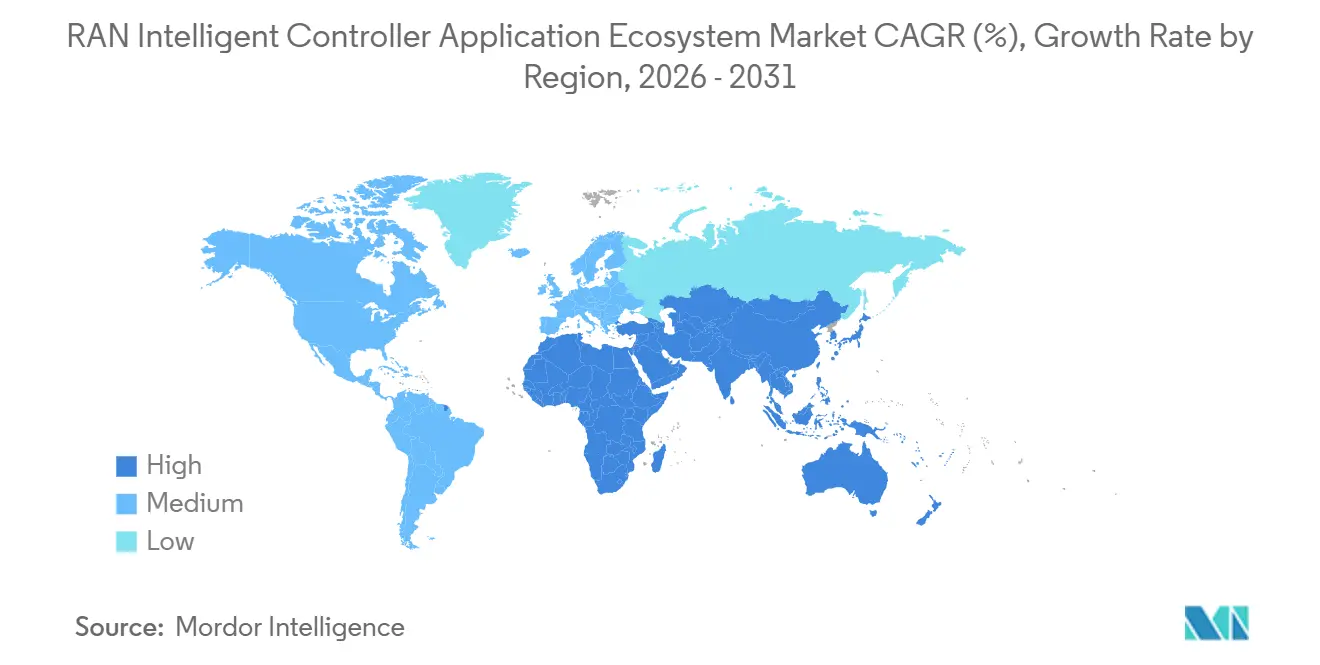
Asia-Pacific held 38.75% of the RAN intelligent controller application ecosystem market in 2025. Japan supported this position through a mature commercial Open RAN environment that includes Rakuten Mobile's open virtualized RAN network and NTT DOCOMO's nationwide multi-vendor deployment. NTT DOCOMO's deployment experience was published by the O-RAN ALLIANCE in August 2025 as a global reference.[3]O-RAN ALLIANCE and NTT DOCOMO, “Best Practices and Lessons Learned From Open and Intelligent RAN Commercial Deployment by NTT DOCOMO, Japan,” O-RAN ALLIANCE, o-ran.org South Korea supports regional activity by investing in next-generation RIC architectures. Its 5G-A vRAN Platform Project focuses on interoperability across heterogeneous vendor environments. India, China, Australia, and other Asia-Pacific markets present opportunities through large network bases and ongoing Open RAN activity. Japan is likely to retain a leading role through 2028, while South Korea is positioned for strong network-level growth as 5G-Advanced standards advance.
North America and Europe drove substantial RIC investment through 2025. The United States supported North American activity through deployments by AT&T and Verizon, while TELUS provided a Canadian commercial example. Verizon integrated Samsung's AI-powered Energy Saving Manager with Qualcomm's Dragonwing RIC in its commercial network in 2025. This showed that multi-vendor application deployment can be achieved in a Tier 1 carrier setting. Europe is moving toward wider Open RAN adoption, although many operators continue to manage a mix of legacy and open infrastructure. South America remains an early-adopter region.
The Middle East is projected to grow at a 56.18% CAGR through 2031, the fastest regional rate in the RAN intelligent controller application ecosystem market. Saudi Arabia and the UAE link digital infrastructure investment to national economic objectives, supporting Open RAN and AI-driven automation activity. Africa had the smallest regional presence, with South Africa and Egypt at an early stage of Open RAN exploration. The Middle East's commercial momentum could encourage procurement among Africa-focused operators that share vendor relationships and financing arrangements in the wider region.

Competitive Landscape
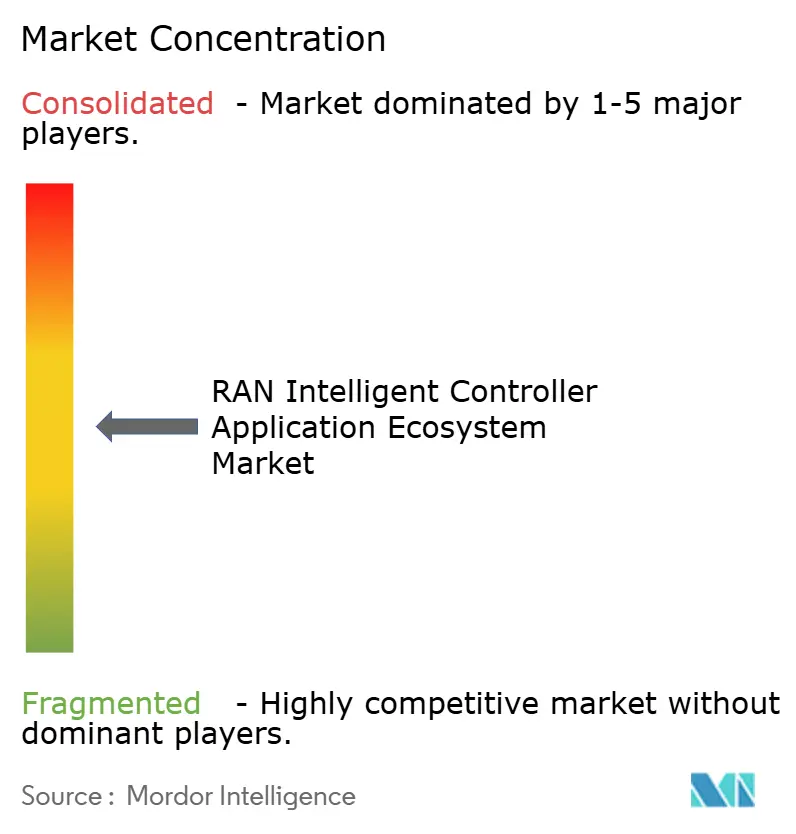
The RAN intelligent controller application ecosystem market is moderately concentrated at the platform level and fragmented at the application level. Ericsson, Nokia, and Samsung Electronics lead large-scale MNO platform deployments through established RAN relationships and integrated orchestration stacks. Their approach can reduce integration risk for operators while preserving vendor concentration within systems intended to support broader interoperability. Ericsson and Nokia announced a mutual ecosystem membership in March 2026, allowing rApps built for either company's platform to run on the other platform via the R1 interface.
Mavenir, Rakuten Symphony, and Accelleran hold relevant mid-tier roles through AI-native software, operator experience, and Open RAN-compliant enterprise platforms. Smaller specialists, including AirHop Communications, RIMEDO Labs, BubbleRAN, Net AI, and Aira Technologies, focus on applications and tools that address specific network needs. Their commercial position depends heavily on access to platform-vendor ecosystems rather than direct operator relationships. ATIS RICARCH v7.00 created an interoperability framework that supports the procurement of certified third-party applications. This can support a more structured rApp marketplace over time.[4]ATIS, “O-RAN ALLIANCE Specifications Published As ATIS Standards,” ATIS, atis.org The RAN intelligent controller application ecosystem industry has not yet established a dominant repository for certified and production-ready xApps and rApps.
Opportunity is concentrated in private 5G applications for industrial automation, interference mitigation in dense deployments, and quality-of-service management through network slices. A second opportunity is the development of AI model repositories that can give operators access to tested applications without bespoke integration contracts. Policy conflict management becomes more important as more applications operate together on a single platform. The RAN intelligent controller application ecosystem market will remain shaped by the trade-off between application portability and operator preference for proven platform integration. Large vendors are likely to retain an advantage where they can provide a complete RIC, orchestration, and RAN environment. Application specialists can improve their position as testing centers, certification processes, and conflict-management methods develop further.
RAN Intelligent Controller Application Ecosystem Industry Leaders
Telefonaktiebolaget LM Ericsson
Nokia Corporation
Samsung Electronics Co., Ltd.
Huawei Technologies Co., Ltd.
ZTE Corporation
- *Disclaimer: Major Players sorted in no particular order

Recent Industry Developments
- June 2026: NTT DOCOMO deployed Nokia's MantaRay AutoPilot AI network optimization system, Japan's first deployment and the world's first commercial mobile network optimized via this system on a public cloud, effective June 19, 2026. The system eliminates manual parameter design using AI-driven intent specifications and executes full optimization cycles in as little as 15 minutes.
- April 2026: Rakuten Symphony and Celona announced a collaboration to develop end-to-end Open RAN-based private 5G solutions for enterprise customers, combining Rakuten Symphony's cloud-native infrastructure with Celona's 5G LAN enterprise platform for logistics, manufacturing, ports, mining, and agriculture sectors.
- March 2026: Ericsson and Nokia announced mutual automation-ecosystem membership. Ericsson joined Nokia's SMO Marketplace and Nokia joined Ericsson's rApp Ecosystem, enabling rApps from both companies to run across each other's platforms through the standardized R1 interface and targeting progression toward Level 4 network autonomy.
- March 2026: NTT East released Joint Demonstration Report Version 2.0 for Japan's Local 5G Optimization Project, documenting the country's first publicly disclosed private 5G RIC multi-vendor connectivity test across 26 companies. RIC-controlled RAN transmit power optimization achieved a 65% power reduction under certain test conditions.


Global RAN Intelligent Controller Application Ecosystem Market Report Scope
The RAN Intelligent Controller (RIC) application ecosystem market covers software applications, platforms, and related services that enable intelligent, automated, and optimized management of radio access networks (RANs). The market includes near-real-time RIC and non-real-time RIC applications, such as xApps and rApps, which support network optimization, traffic management, energy efficiency, spectrum utilization, quality of service, and security. The report analyzes market trends, competitive dynamics, technology developments, deployment models, end users, and regional adoption across the study period.
The RAN Intelligent Controller Application Ecosystem Market Report is Segmented by Component (Platforms, and Services), Function (Non-Real-Time RIC, and Near-Real-Time RIC), Technology (4G, 5G, and 5G-Advanced and 6G Test Environments), Deployment Model (Cloud, On-Premise, and Hybrid Cloud), End User (Mobile Network Operators, Private 5G and Enterprise Network Operators, Government and Defense Network Operators, and Neutral-Host and Shared-Infrastructure Providers), and Geography (North America, South America, Europe, Asia-Pacific, Middle East, and Africa). The Market Forecasts are Provided in Terms of Value (USD).
| Platforms |
| Services |
| Non-Real-Time RIC |
| Near-Real-Time RIC |
| 4G |
| 5G |
| 5G-Advanced and 6G Test Environments |
| Cloud |
| On-Premise |
| Hybrid Cloud |
| Mobile Network Operators |
| Private 5G and Enterprise Network Operators |
| Government and Defense Network Operators |
| Neutral-Host and Shared-Infrastructure Providers |
| North America | United States |
| Canada | |
| Mexico | |
| South America | Brazil |
| Argentina | |
| Rest of South America | |
| Europe | Germany |
| United Kingdom | |
| France | |
| Russia | |
| Rest of Europe | |
| Asia-Pacific | China |
| Japan | |
| India | |
| South Korea | |
| Australia | |
| Rest of Asia-Pacific | |
| Middle East | Saudi Arabia |
| United Arab Emirates | |
| Turkey | |
| Rest of Middle East | |
| Africa | South Africa |
| Egypt | |
| Rest of Africa |
| By Component | Platforms | |
| Services | ||
| By Function | Non-Real-Time RIC | |
| Near-Real-Time RIC | ||
| By Technology | 4G | |
| 5G | ||
| 5G-Advanced and 6G Test Environments | ||
| By Deployment Model | Cloud | |
| On-Premise | ||
| Hybrid Cloud | ||
| By End User | Mobile Network Operators | |
| Private 5G and Enterprise Network Operators | ||
| Government and Defense Network Operators | ||
| Neutral-Host and Shared-Infrastructure Providers | ||
| By Geography | North America | United States |
| Canada | ||
| Mexico | ||
| South America | Brazil | |
| Argentina | ||
| Rest of South America | ||
| Europe | Germany | |
| United Kingdom | ||
| France | ||
| Russia | ||
| Rest of Europe | ||
| Asia-Pacific | China | |
| Japan | ||
| India | ||
| South Korea | ||
| Australia | ||
| Rest of Asia-Pacific | ||
| Middle East | Saudi Arabia | |
| United Arab Emirates | ||
| Turkey | ||
| Rest of Middle East | ||
| Africa | South Africa | |
| Egypt | ||
| Rest of Africa | ||


Key Questions Answered in the Report
What is the size of the RAN intelligent controller application ecosystem market?
The RAN intelligent controller application ecosystem market size is estimated at USD 1.02 billion in 2026 and is forecast to reach USD 9.12 billion by 2031, at a 54.98% CAGR.
What is driving adoption of RAN intelligent controller applications?
In the RAN intelligent controller application ecosystem market, operators are adopting RIC applications to automate network control, reduce energy use, and manage mixed 4G, 5G, and Open RAN networks.
Which component leads RIC application spending?
Platforms led spending with a 64.26% share in 2025 because they provide the foundational software for deploying RIC applications.
Why are private 5G operators important for RIC adoption?
Private 5G and enterprise network operators are projected to grow at a 56.72% CAGR through 2031 as industrial sites adopt automated network management.
Which region is growing fastest for RIC applications?
The Middle East is projected to grow at a 56.18% CAGR through 2031, supported by digital infrastructure programs in Saudi Arabia and the UAE.
Page last updated on:





