
Railway Sliding Bearing Market Size and Share
Market Overview
| Study Period | 2019 - 2031 |
|---|---|
| Market Size (2026) | USD 1.55 Billion |
| Market Size (2031) | USD 1.95 Billion |
| Growth Rate (2026 - 2031) | 4.70 % |
| Fastest Growing Market | Asia-Pacific |
| Largest Market | Asia-Pacific |
| Market Concentration | Medium |
Major Players *Disclaimer: Major Players sorted in no particular order Image © Mordor Intelligence. Reuse requires attribution under CC BY 4.0. | |
Railway Sliding Bearing Market Analysis by Mordor Intelligence
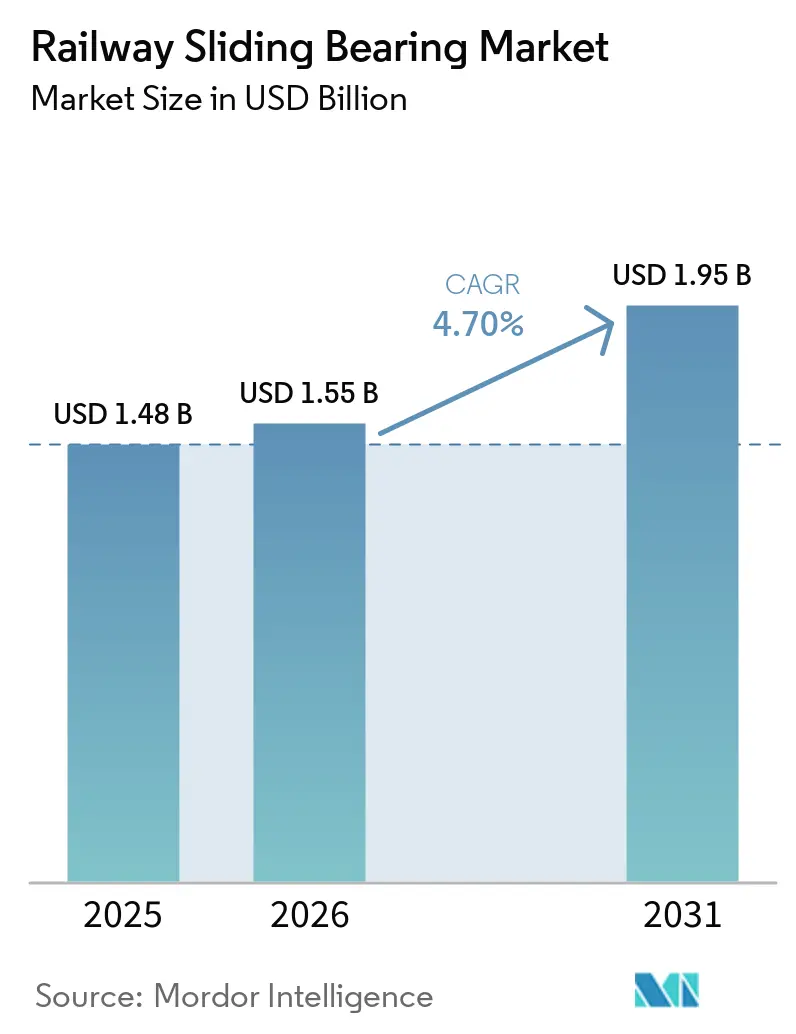
The railway sliding bearing market size was valued at USD 1.48 billion in 2025 and is estimated to grow to USD 1.55 billion in 2026 and reach USD 1.95 billion by 2031, at a CAGR of 4.70% during the forecast period (2026-2031). Investment in rail networks supports demand for components used in bogies, brakes, doors, and traction linkages. Higher operating speeds and loads raise the importance of material performance, service life, and qualification records. Suppliers are responding with maintenance-free designs, composite materials, and services that support longer maintenance intervals. Electrification changes the mix of required products, reducing some diesel-related demand while increasing demand for insulated and electrically suitable bearing solutions. Regulation of PFAS compounds may also affect material selection, particularly for products that use PTFE-based layers.
Key Report Takeaways
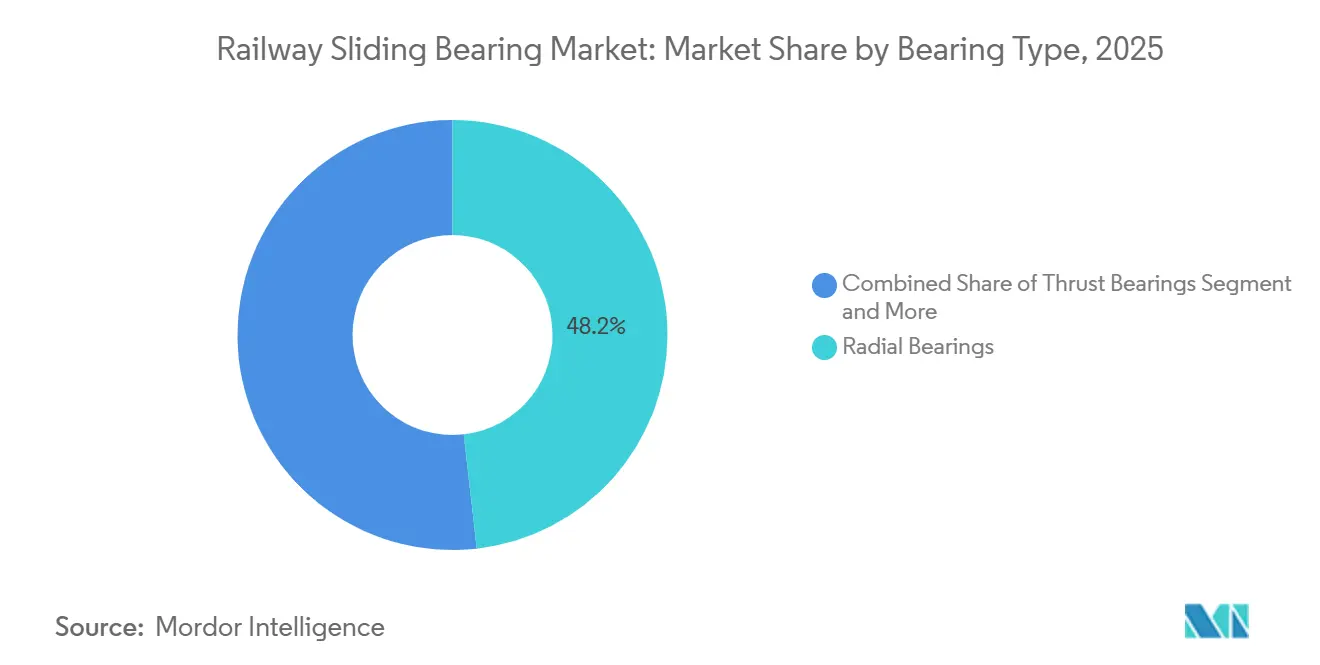
- By bearing type, radial bearings held 48.15% of the railway sliding bearing market share in 2025 and are projected to grow at a 5.41% CAGR through 2031.
- By material, metallic materials held 70.12% of the railway sliding bearing market share in 2025, while non-metallic materials are expected to grow at a 6.24% CAGR through 2031.
- By application, engine and traction systems accounted for 30.18% of the railway sliding bearing market size in 2025, while interior systems are forecast to advance at a 5.87% CAGR through 2031.
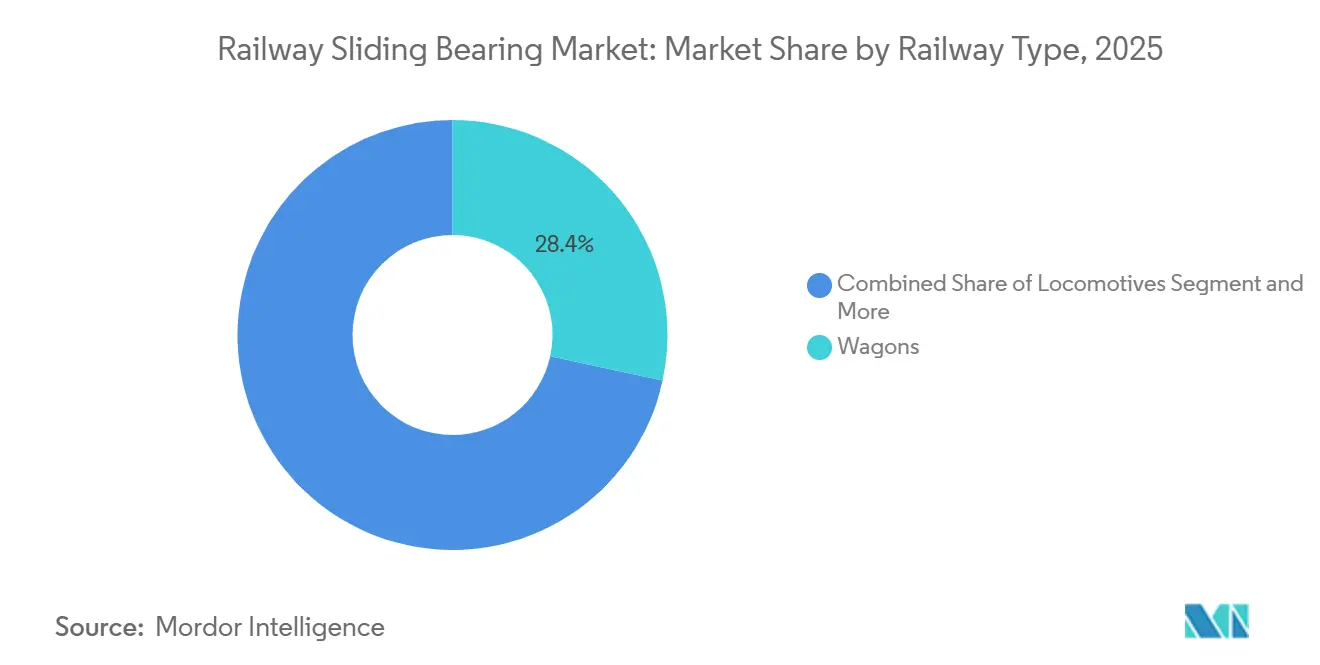
- By railway type, wagons held 28.44% of the railway sliding bearing market share in 2025, while high-speed trains are projected to expand at a 6.58% CAGR through 2031.
- By sales channel, original equipment manufacturing accounted for 63.21% of the railway sliding bearing market size in 2025, while maintenance, repair, and overhaul is expected to grow at a 7.04% CAGR through 2031.
- By geography, Asia-Pacific held 41.25% of the railway sliding bearing market share in 2025 and is forecast to grow at a 5.12% CAGR through 2031.
Note: Market size and forecast figures in this report are generated using Mordor Intelligence’s proprietary estimation framework, updated with the latest available data and insights as of January 2026.
Market Trends and Insights
Drivers Impact Analysis of Railway Sliding Bearing Market*
| Driver | (~) % Impact on CAGR Forecast | Geographic Relevance | Impact Timeline |
|---|---|---|---|
| Metro, Light Rail, and High-Speed Network | +1.0% | Global, with strongest activity in China, India, Southeast Asia, and European corridors | Medium term (2-4 years) |
| Rail Infrastructure Modernization Investment | +0.9% | Global, with near-term relevance in North America, Europe, and South Asia | Short term (≤ 2 years) |
| Low-Friction, Maintenance-Free Bearing | +0.7% | Global, with strong demand in Asia-Pacific and Europe | Medium term (2-4 years) |
| Fleet Renewal and Aftermarket Replacement | +0.6% | North America, Europe, and Asia-Pacific | Medium term (2-4 years) |
| Load, Speed, and Reliability Requirements | +0.5% | Global freight corridors and high-speed lines | Medium term (2-4 years) |
| Sensor-Ready and Condition-Monitoring Retrofit | +0.4% | Europe, North America, Japan, India, and Southeast Asia | Long term (≥ 4 years) |
| Source: Mordor Intelligence | |||
Expansion of Metro, Light Rail, and High-Speed Networks
Urban rail expansion supports recurring demand for the railway sliding bearing market because each new vehicle contains bearing points in doors, suspension, bogies, and traction assemblies. China had 48,000 km of high-speed railway in operation at the end of 2024, and the network remains a major source of rolling-stock and maintenance demand [1]“National Railway Administration,” National Railway Administration of China, nra.gov.cn . India has committed to extend metro rail to several new cities by 2026, adding demand for parts that operate in humid and dusty environments. Metro specifications increasingly favor maintenance-free designs where lubricant control is important in tunnels and enclosed stations. This shift supports composite bearing use in applications that require low noise and reduced routine servicing. Latin America also offers an emerging procurement pipeline through 155 active rail projects that the Development Bank of Latin America and the Caribbean identified in 2025.
Government Investment in Rail Infrastructure Modernization
Public investment provides a longer planning horizon for the railway sliding bearing market and supports supply agreements with qualified manufacturers. India budgeted INR 2,65,200 crore (approximately USD 27.79 billion) for railway capital expenditure in 2025-26, including INR 2,52,200 crore (approximately USD 26.43 billion) of central budget support. The U.S. Department of Transportation proposed significant funding for Federal Railroad Administration programs for fiscal year 2026, with allocations for Amtrak and CRISI grants. These programs support fleet modernization, safety upgrades, and corridor improvements that require certified rail components. Government-funded work also reinforces the role of EN, UIC, and national certification requirements in supplier selection. Established qualification records therefore remain important when operators award multi-year contracts.
Demand for Low-Friction, Maintenance-Free Bearing Systems
Rail operators are seeking lower lifecycle costs, which supports the railway sliding bearing market for products that extend maintenance intervals. SKF introduced an enclosed cylindrical roller unit for Y25 freight bogies in 2025 with a maintenance interval of 1.2 million km or 12 years. Schaeffler’s metal-polymer bearing materials provide dry-running performance for applications where regreasing can require a vehicle to leave service [2]“Plain Bearings,” Schaeffler, schaeffler.com. Composite designs can also reduce vibration transmission compared with metallic alternatives. This property is relevant where operators seek quieter rail vehicles and more consistent passenger comfort. DIN EN 45545 fire-protection compliance has become a basic material qualification requirement for rail applications in Europe.
Fleet Renewal and Scheduled Aftermarket Replacement
Scheduled overhaul programs create a predictable source of railway sliding bearing market demand outside new vehicle production. Network Rail’s agreement for the supply and overhaul of 2,500 wheelsets per year runs from April 2026 through March 2031 and includes bearings, axles, brake discs, and gearbox components [3]“Find a Tender,” UK Government, find-tender.service.gov.uk. Alstom’s Crewe facility has capacity for 4,000 bogie overhauls per year and uses vibration analysis to inform replacement planning. Condition monitoring can extend some bearing replacement intervals from fixed mileage schedules toward condition-based decisions. This change increases the importance of diagnostics and service capabilities in aftermarket contracts. Suppliers with approved aftermarket portfolios can benefit because structured overhauls often retain original equipment specifications.
Restraints Impact Analysis of Railway Sliding Bearing Market*
| Restraint | (~) % Impact on CAGR Forecast | Geographic Relevance | Impact Timeline |
|---|---|---|---|
| Steel, Copper, PTFE, and Specialty-Alloy Cost | -0.5% | Global, particularly for lower-integrated manufacturers | Short term (≤ 2 years) |
| OEM Qualification and Certification | -0.4% | Global, with higher barriers in Europe and Japan | Medium term (2-4 years) |
| Axle and Rolling-Dominant Applications | -0.3% | Global, with a stronger effect in North American freight rail | Long term (≥ 4 years) |
| Engine-Specific Bearing Demand | -0.3% | Europe and China, with later effects in North America and South Asia | Long term (≥ 4 years) |
| Source: Mordor Intelligence | |||
Volatility in Steel, Copper, PTFE, and Specialty-Alloy Costs
The railway sliding bearing market uses steel, copper alloys, PTFE, and specialty alloys across several product designs. Copper-alloy and bronze grades remain relevant for bogie kingpins, suspension pivots, and heavy-haul freight applications. PTFE supply is also exposed to uncertainty created by the European PFAS restriction process. Cost changes can compress margins on long-duration original equipment contracts where escalation provisions are limited. Larger suppliers may be better able to manage material substitution and sourcing across their product portfolios. Smaller producers face a more difficult balance between contracted prices, input availability, and qualification requirements.
Long OEM Qualification Cycles and Railway Certification Requirements
Long approval cycles can slow new product adoption in the railway sliding bearing market. Schaeffler’s Schweinfurt railway test facility is recognized for rail vehicle bearing testing and holds DIN EN ISO/IEC 17025 accreditation for axlebox bearing performance work. These processes support safety, but they can delay a move from laboratory validation to series production. The barrier is especially important for new material suppliers and composite products in high-criticality applications. European and Japanese procurement frameworks often require extensive certification evidence. Established suppliers can use their homologation record to retain positions in long-running rolling-stock programs.
*Our forecasts treat driver/restraint impacts as directional, not additive. The impact forecasts reflect baseline growth, mix effects, and variable interactions.
Railway Sliding Bearing Market Segment Analysis
By Bearing Type:
Radial Bearings Hold the Broadest Application BaseRadial bearings held 48.15% of the railway sliding bearing market share in 2025 and are projected to grow at a 5.41% CAGR through 2031. Their use spans bogie pivot interfaces, anti-roll bar bushings, and suspension linkages in passenger and freight vehicles. The design manages radial loads within compact spaces. This makes radial configurations a common choice in new rolling-stock designs. Demand is supported by metro and high-speed train procurement, where weight and noise requirements favor composite radial sliding surfaces. The segment also benefits from the need for durable parts that can operate through long service intervals.
Thrust and angular-contact bearings serve more specialized applications that involve axial or combined loads. They are used in bogie pivots, articulated joints, tilting trains, and Jacobs bogies. Linear bearings remain a smaller category, but their role is expanding in electromechanical actuators. These systems are replacing some pneumatic and hydraulic arrangements in doors and pantographs. igus uses polymer plain bearings and stainless-steel spindles in dryspin high-helix lead screw systems for train sliding steps. PTFE-fabric and fiber-reinforced sliding surfaces are gaining attention as suppliers prepare for possible restrictions affecting fluorinated materials. SKF has also developed customized PTFE-fabric-lined bearing solutions for rolling-stock anti-roll devices.



By Material:
Metallic Materials Retain Load-Bearing StrengthMetallic materials held 70.12% of the railway sliding bearing market share in 2025. Steel, copper alloys, and bronze grades provide the load capacity needed for heavy-haul freight, traction equipment, and bogie frame joints. Steel and stainless-steel materials are widely used in structural bearing applications. Copper alloys and bronze are used in slow-oscillation, high-load applications such as pivot plates and draft gear interfaces. Their long qualification history with rail original equipment manufacturers supports continued use. Aluminum-bronze materials are also used where corrosion resistance is important, including coastal and high-humidity operating conditions.
Non-metallic materials are forecast to grow at a 6.24% CAGR through 2031, the fastest rate among material categories. PTFE composites, engineering polymers, and fiber-reinforced products are used across a wider range of rail applications. GGB’s GAR-MAX fiber-reinforced composite bearings for train bogie kingpins have a static load capacity up to 415 MPa. Electrification increases demand for materials that provide electrical insulation. Operators also value lower noise and maintenance-free operation in vehicles with intensive daily service. igus states that its iglidur RW250 material meets DIN EN 45545 requirements for railway vehicles. Material selection will increasingly depend on performance evidence, fire requirements, and the progress of PFAS regulation.
By Application:
Traction Systems Lead, While Interior Systems Grow FasterEngine and traction systems accounted for 30.18% of the railway sliding bearing market size in 2025. These systems contain bearing points in diesel engines, gearboxes, and electric traction interfaces. Their demand is high because load ratings, temperatures, and required service intervals are more stringent than in many onboard applications. Diesel traction uses bearing positions in crankshaft and big-end systems. Electric traction requires suitable designs for motors, gearboxes, and related drive components. This requirement preserves demand even as the balance between diesel and electric fleets changes.
Interior systems are projected to grow at a 5.87% CAGR through 2031. Metro and light-rail vehicles use sliding bearings in doors, folding steps, vestibule articulation, and seat-adjustment systems. Brake systems remain a stable safety-critical application. igus states that its polymer plain bearings for train brakes can operate from minus 100°C to 250°C without added lubrication. Bogie systems increasingly use composite products that combine damping and load-bearing functions. Exterior applications include pantographs, couplers, and door threshold assemblies. Schaeffler’s J20G series uses an insulating coating designed to resist direct voltages of at least 3,000 V and provide resistance of at least 250 megaohms for electrically demanding applications.
By Railway Type:
Wagon Fleets Support Replacement DemandWagons held 28.44% of the railway sliding bearing market share in 2025. The global freight wagon fleet creates recurring replacement demand through mileage-based overhaul schedules. Wagon applications include bogie pivot plates, draft gear interfaces, and coupler housings. These conditions place high static and shock loads on bearing components. Bimetal and copper-alloy materials remain relevant in these applications. The Railway Sliding Bearing Market benefits from the need to maintain freight equipment over long operating lives.
Y25 freight bogies are a major focus for service-life improvements in Europe. High-speed trains are forecast to grow at a 6.58% CAGR through 2031 and require demanding bearing specifications. Schaeffler developed an axlebox bearing for inboard-mounted powered wheelsets that was validated at 405 km/h in Deutsche Bahn testing during June 2025. Locomotives and coaches remain replacement-led categories. Electric multiple units benefit from procurement as rail operators replace older diesel-electric fleets. Metro and light rail are smaller than wagons by share but offer broad geographic growth across new urban systems.
By Sales Channel:
OEM Programs Provide the Largest Revenue BaseOriginal equipment manufacturing accounted for 63.21% of the railway sliding bearing market size in 2025. Once a bearing is qualified for a rolling-stock program, it can remain specified for the production run and often through the vehicle lifecycle. This creates durable revenue for approved suppliers. It also raises the entry cost for challengers seeking to replace incumbents. Major rail manufacturers have active programs across several regions. The channel therefore remains tied to new vehicle procurement cycles and supplier qualification depth.
Maintenance, repair, and overhaul is expected to grow at a 7.04% CAGR through 2031. The installed fleet base, tighter inspection requirements, and condition-based maintenance contracts support this demand. Alstom received a contract in January 2026 to overhaul 398 power bogies from Southeastern’s Class 465 Networker fleet. The work includes bearings, wheels, traction motors, and gearbox components. Timken states that its rail bearing reconditioning can return units to like-new specifications in one-third of the time and at up to 60% of the cost of new units. Distributor and replacement sales remain important in freight markets that need rapid field replacement after unscheduled failures.
Geography Analysis
APAC Railway Sliding Bearing Market
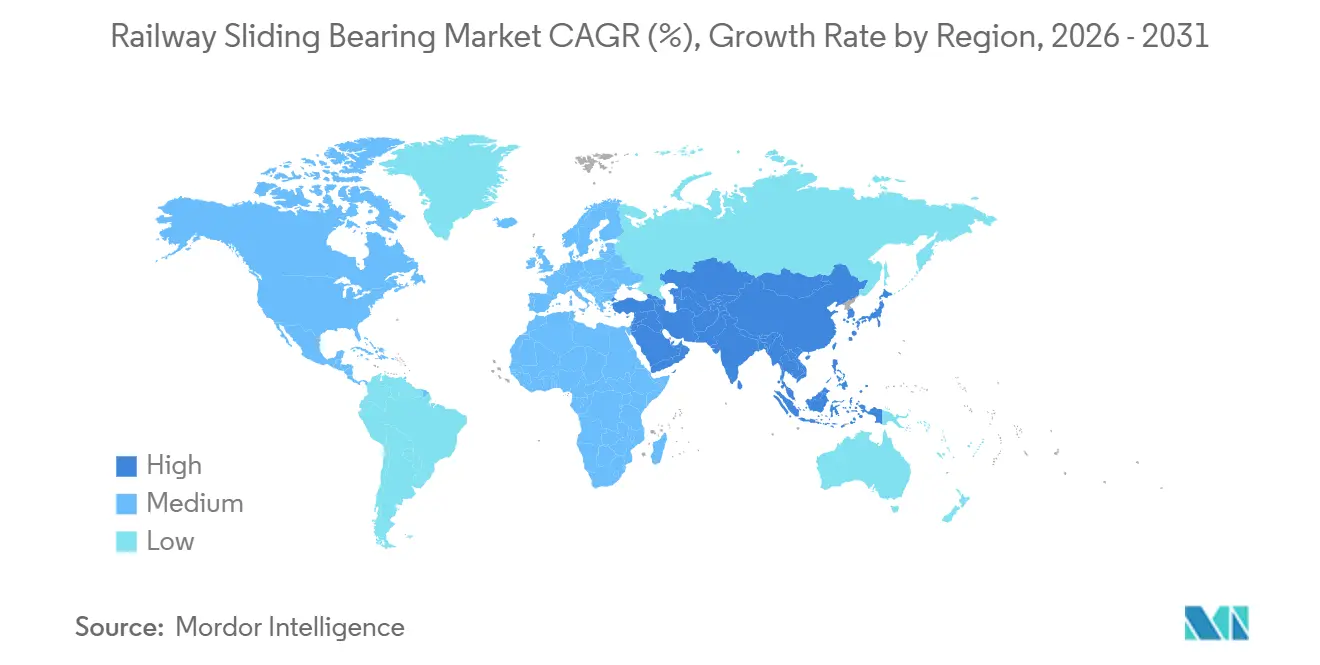
Asia-Pacific held 41.25% of the railway sliding bearing market share in 2025 and is forecast to grow at a 5.12% CAGR through 2031. China’s high-speed rail network had 48,000 km of operating route at the end of 2024, supporting rolling-stock and maintenance demand. India’s 2025-26 railway capital expenditure supports tracks, stations, and rolling-stock procurement. Japan and South Korea create quality-focused demand through high-frequency urban rail and high-speed operations. NSK and NTN announced plans to form a joint holding company, subject to regulatory approval. Australia and Southeast Asia add growth through metro development in Sydney, Bangkok, and Jakarta.
Europe Railway Sliding Bearing Market
Europe remains a technically demanding region for the Railway Sliding Bearing Market. Its operators require compliance with fire-protection, UIC, and other rail certification requirements. These standards can limit access for suppliers without certified product portfolios. Germany and the United Kingdom are principal country markets. France, Italy, and the Czech Republic also contribute through national rail networks and domestic manufacturing. PFAS-related regulatory developments may influence the material choices made by European operators and suppliers.
The Americas and MEA Railway Sliding Bearing Market
North America is shaped by a large freight rail network and recurring inspection and reconditioning demand. Timken’s AP series is a prevailing axle-end bearing standard in the region. The U.S. Department of Transportation’s fiscal year 2026 rail budget supports modernization, corridor work, and passenger rail applications. Canada and Mexico create secondary demand through commuter and infrastructure investment. South America has an emerging project pipeline that includes Brazil’s Ferrovía Norte-Sul and Uruguay’s Ferrocarril Central. Middle East and Africa remain smaller markets, with Gulf metro and high-speed projects and South African freight operations supporting demand.

Competitive Landscape
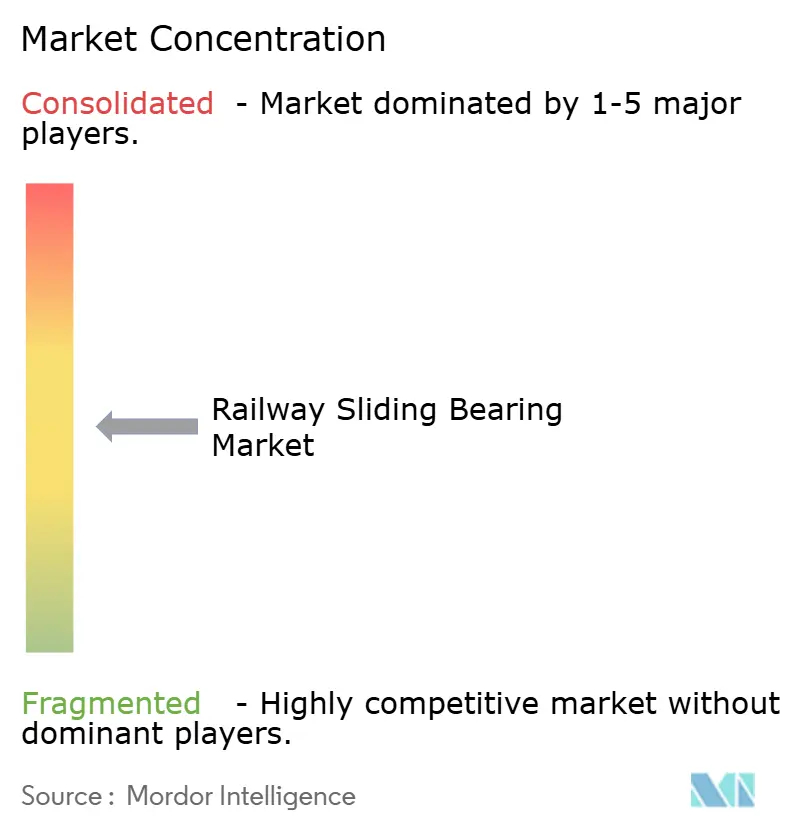
The railway sliding bearing market is moderately consolidated among international engineering groups and regional specialists. AB SKF, Schaeffler, NSK, and The Timken Company compete on certified performance, qualification depth, maintenance intervals, and engineering support. Price is not the only selection factor in safety-critical railway applications. SKF has described tribological black oxide coatings that reduce bearing torque at low and intermediate speeds in railway wheel-end applications. Schaeffler presented friction-optimized TAROL axlebox bearings and expanded remanufacturing services at InnoTrans 2026. Condition monitoring and diagnostic services are also becoming part of supplier offers.
Chinese manufacturers, including Wafangdian Bearing Group, LYC Bearing Corporation, C&U Group, and Fujian Longxi Bearing Group, hold strong positions in domestic procurement. They are also expanding toward Southeast Asia, South Asia, and African freight corridors. In these markets, price and delivery responsiveness can carry more weight than the qualification depth held by European suppliers. NSK and NTN’s announced holding-company plan reflects pressure on standalone mid-tier companies in high-volume bearing segments. This Railway Sliding Bearing Market also contains specialist suppliers that compete through focused materials or application expertise. ZOLLERN concentrates on hydrodynamic and sliding bearing systems, while igus concentrates on polymer tribology.
Sensor-enabled bearing solutions are relevant in retrofit maintenance programs where operators extend the life of existing fleets. PTFE-free and PFAS-compliant composites are also an area of product development because the European regulatory process may alter permitted material choices. igus introduced PTFE-free versions of iglidur G, X, and H materials in 2025, supporting applications that need alternatives to conventional PTFE formulations. Schaeffler’s current-insulated products respond to electrically demanding traction applications. SKF’s long-interval Y25 solution reflects the importance of service-life performance in freight fleets. The available draft does not provide combined market-share data for leading companies, so a numeric concentration assessment cannot be supported from the supplied information.
Railway Sliding Bearing Industry Leaders
AB SKF
Schaeffler AG
NTN Corporation
The Timken Company (GGB)
RBC Bearings Incorporated
- *Disclaimer: Major Players sorted in no particular order
Railway Sliding Bearing Market Companies Covered in this Report
- AB SKF
- Schaeffler AG
- NTN Corporation
- The Timken Company (GGB)
- MinebeaMitsumi Inc.
- RBC Bearings Incorporated
- MinebeaMitsumi Inc.
- RBC Bearings Incorporated
- igus GmbH
- Fujian Longxi Bearing Group
- igus GmbH
- ZOLLERN GmbH & Co. KG

Recent Industry Developments in Railway Sliding Bearing Market
- August 2026: Georgia is expected to significantly transform its railway sector through rolling stock acquisitions supported by international financial institutions, including the Asian Development Bank (ADB) and the World Bank. The program aims to replace aging locomotives and railcars and strengthen Georgia’s role as a key logistics hub on the Middle Corridor (or Trans-Caspian Corridor).
- April 2025: igus GmbH introduced PTFE-free versions of its iglidur G, X, and H plain bearing materials at Hannover Messe 2025, reaching a milestone where 75% of plain-bearing applications were achievable in PTFE-free formulations; the iglidur JPF material was awarded Kunststoff Magazin Product of the Year 2025 in the Materials category.


Global Railway Sliding Bearing Market Report Scope
The scope includes segmentation by bearing type (radial bearings, thrust bearings, linear bearings, angular contact bearings, and other bearing types), material (metallic materials (steel and stainless steel, copper-alloy and bronze, and aluminum-bronze and other metallic materials), and non-metallic materials (PTFE-based composites, engineering polymers, and fiber-reinforced composites)), application (engine and traction systems, brake systems, bogie systems, interior systems, and exterior systems), railway type (locomotives, diesel multiple units, electric multiple units, coaches, wagons, light rail and metro, and high-speed trains), and sales channel (original equipment manufacturing, maintenance, repair, and overhaul, and distributor and replacement sales). The analysis also covers regional-level segmentation, including North America, South America, Europe, Asia-Pacific, the Middle East, and Africa. Market size and growth forecasts are presented by value in USD.
| Radial Bearings | Thrust Bearings | |
| Linear Bearings | ||
| Angular Contact Bearings | ||
| Other Bearing Types | ||
| By Material | Metallic Materials | Steel and Stainless Steel |
| Copper-Alloy and Bronze | ||
| Aluminum-Bronze and Other Metallic Materials | ||
| Non-Metallic Materials | PTFE-Based Composites | |
| Engineering Polymers | ||
| Fiber-Reinforced Composites | ||
| By Application | Engine and Traction Systems | |
| Brake Systems | ||
| Bogie Systems | ||
| Interior Systems | ||
| Exterior Systems | ||
| By Railway Type | Locomotives | |
| Diesel Multiple Units | ||
| Electric Multiple Units | ||
| Coaches | ||
| Wagons | ||
| Light Rail and Metro | ||
| High-Speed Trains | ||
| By Sales Channel | Original Equipment Manufacturing | |
| Maintenance, Repair, and Overhaul | ||
| Distributor and Replacement Sales | ||
| By Geography | North America | United States |
| Canada | ||
| Rest of North America | ||
| South America | Brazil | |
| Argentina | ||
| Rest of South America | ||
| Europe | Germany | |
| United Kingdom | ||
| France | ||
| Italy | ||
| Russia | ||
| Rest of Europe | ||
| Asia-Pacific | China | |
| India | ||
| Japan | ||
| South Korea | ||
| Australia | ||
| Rest of Asia-Pacific | ||
| Middle East and Africa | United Arab Emirates | |
| Saudi Arabia | ||
| Turkey | ||
| South Africa | ||
| Rest of Middle East and Africa | ||
| By Bearing Type | Radial Bearings | Thrust Bearings | |
| Linear Bearings | |||
| Angular Contact Bearings | |||
| Other Bearing Types | |||
| By Material | Metallic Materials | Steel and Stainless Steel | |
| Copper-Alloy and Bronze | |||
| Aluminum-Bronze and Other Metallic Materials | |||
| Non-Metallic Materials | PTFE-Based Composites | ||
| Engineering Polymers | |||
| Fiber-Reinforced Composites | |||
| By Application | Engine and Traction Systems | ||
| Brake Systems | |||
| Bogie Systems | |||
| Interior Systems | |||
| Exterior Systems | |||
| By Railway Type | Locomotives | ||
| Diesel Multiple Units | |||
| Electric Multiple Units | |||
| Coaches | |||
| Wagons | |||
| Light Rail and Metro | |||
| High-Speed Trains | |||
| By Sales Channel | Original Equipment Manufacturing | ||
| Maintenance, Repair, and Overhaul | |||
| Distributor and Replacement Sales | |||
| By Geography | North America | United States | |
| Canada | |||
| Rest of North America | |||
| South America | Brazil | ||
| Argentina | |||
| Rest of South America | |||
| Europe | Germany | ||
| United Kingdom | |||
| France | |||
| Italy | |||
| Russia | |||
| Rest of Europe | |||
| Asia-Pacific | China | ||
| India | |||
| Japan | |||
| South Korea | |||
| Australia | |||
| Rest of Asia-Pacific | |||
| Middle East and Africa | United Arab Emirates | ||
| Saudi Arabia | |||
| Turkey | |||
| South Africa | |||
| Rest of Middle East and Africa | |||


Key Questions Answered in the Report
Which bearing type leads railway use?
Radial bearings led with 48.15% share in 2025 and are projected to grow at a 5.41% CAGR through 2031.
Why are non-metallic railway bearing materials growing?
Non-metallic materials are forecast to grow at a 6.24% CAGR because they can provide insulation, low noise, and maintenance-free operation.
Which rail application has the largest bearing demand?
Engine and traction systems accounted for 30.18% of revenue in 2025 because they require high-specification components in drive assemblies.
Which region leads railway sliding bearing demand?
Asia-Pacific held 41.25% share in 2025 and is forecast to grow at a 5.12% CAGR through 2031.
Page last updated on:





