
Market Overview
| Study Period | 2021 - 2031 |
|---|---|
| Forecast Data Period | 2026 - 2031 |
| Base Year Market Size (2025) | USD 125.36 Million |
| Market Size (2026) | USD 134.31 Million |
| Market Size (2031) | USD 189.48 Million |
| Growth Rate (2026 - 2031) | 7.14 % |
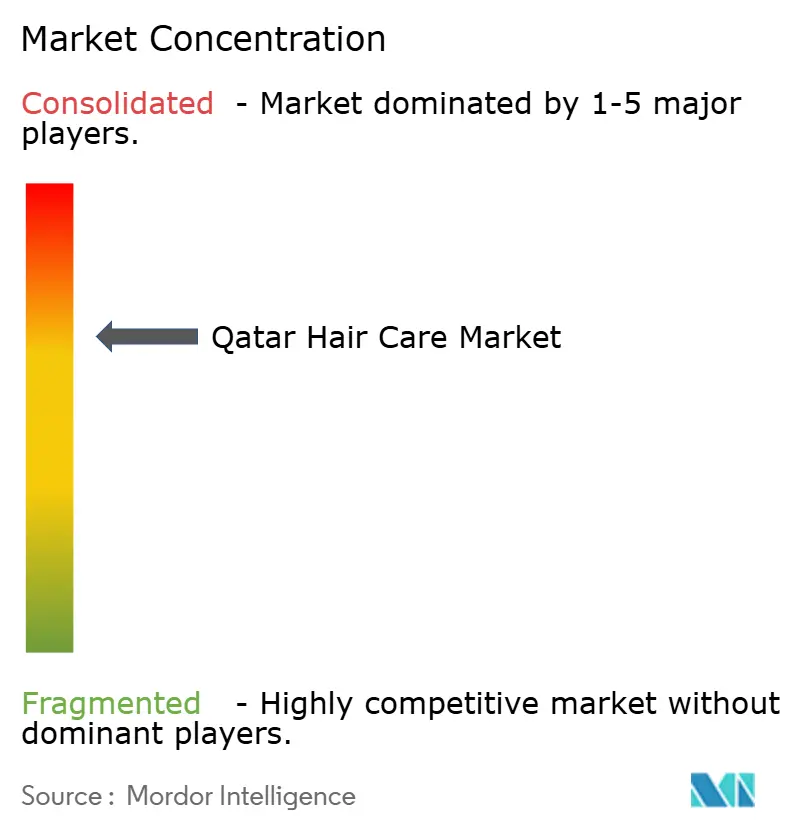
| Market Concentration | Medium |
Major Players
*Disclaimer: Major Players sorted in no particular order Image © Mordor Intelligence. Reuse requires attribution under CC BY 4.0. |
|
Qatar Hair Care Market Analysis by Mordor Intelligence
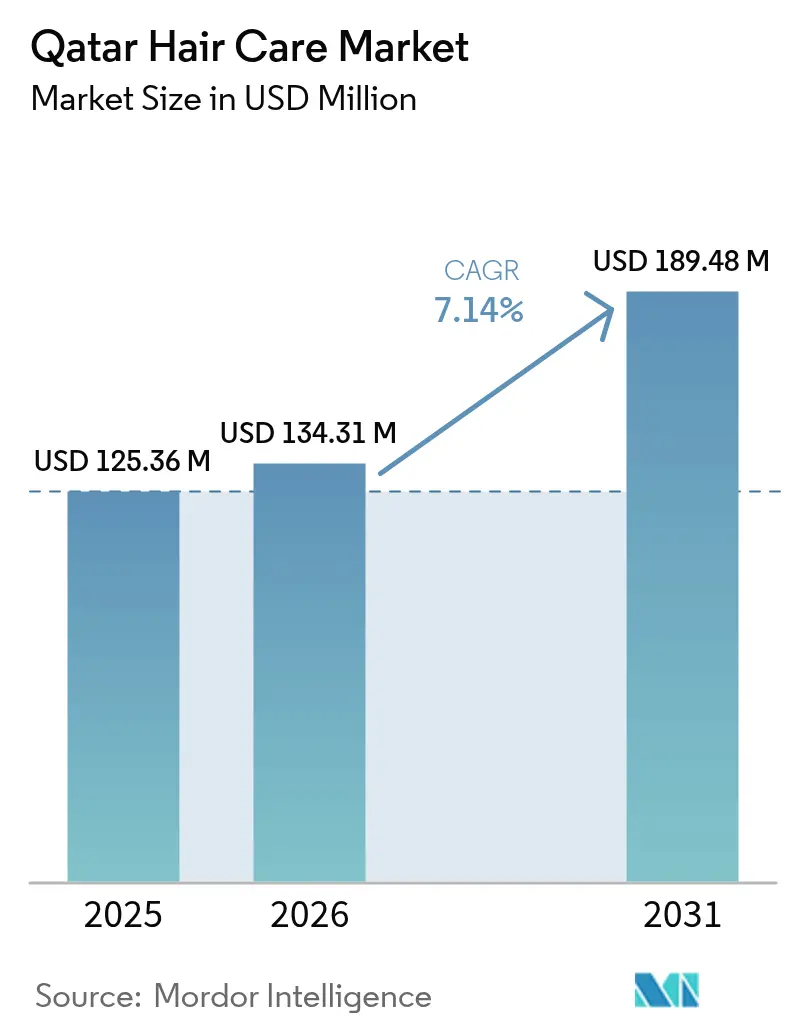
The Qatar hair care market size was valued at USD 125.36 million in 2025 and estimated to grow from USD 134.31 million in 2026 to reach USD 189.48 million by 2031, at a CAGR of 7.14% during the forecast period (2026-2031). The market growth is influenced by several factors transforming the beauty and personal care industry in Qatar. Consumer awareness regarding hair health has increased, resulting in higher demand for preventive and specialized hair care products that address specific concerns like scalp health, dandruff, and hair loss - conditions that are intensified by Qatar's climate and environmental conditions. Higher disposable incomes and an expanding affluent population have increased the consumption of premium and luxury hair care products. Government support for the beauty and personal care sector, combined with improvements in product formulations and digital marketing strategies, contributes to market expansion. The market shows a significant transition toward natural and organic products, with consumers preferring safer alternatives to synthetic chemicals. This shift has prompted brands to develop new product lines with botanical ingredients and sustainable packaging.
Key Report Takeaways
- By product type, shampoo led with 49.12% of Qatar hair care market share in 2025, while hair styling products are expected to post the fastest 7.69% CAGR to 2031.
- By category, mass products held 71.88% of the Qatar hair care market size in 2025, whereas premium products show the strongest outlook at an 8.06% CAGR to 2031.
- By ingredient type, conventional/synthetic items accounted for 74.10% share of the Qatar hair care market size in 2025; matural and organic alternatives are set to rise at an 8.22% CAGR through 2031.
- By distribution channel, supermarkets/hypermarkets captured 69.55% of Qatar's hair care market share in 2025, yet online retail stores are projected to expand at an 8.61% CAGR to 2031.
Note: Market size and forecast figures in this report are generated using Mordor Intelligence’s proprietary estimation framework, updated with the latest available data and insights as of 2026.
Qatar Hair Care Market Trends and Insights
Drivers Impact Analysis*
| Driver | (~) % Impact on CAGR Forecast | Geographic Relevance | Impact Timeline |
|---|---|---|---|
| Consumer inclination towards natural/organic ingredients | +1.2% | Qatar, with spillover to GCC | Medium term (2-4 years) |
| Rapid adoption of male grooming routines | +0.9% | Qatar urban areas, expanding to suburban | Short term (≤ 2 years) |
| Increased tourism driving uptake of retail hair care in key urban outlet | +1.8% | Qatar national, concentrated in Doha | Long term (≥ 4 years) |
| Rising internet penetration driving online growth | +1.1% | Qatar national | Short term (≤ 2 years) |
| Social media and celebrity endorsement influence | +0.8% | Qatar, with regional influence from the United Arab Emirates/Saudi Arabia | Medium term (2-4 years) |
| Growing demand for personalized hair care solutions | +0.7% | Qatar affluent segments, expanding downmarket | Long term (≥ 4 years) |
| Source: Mordor Intelligence | |||
Consumer Inclination Towards Products Formulated with Natural/Organic Ingredients
The Qatar hair care market is experiencing significant transformation, with consumers increasingly gravitating toward natural and organic hair care products. This shift is primarily driven by heightened awareness about ingredient safety and transparency in the region's growing beauty sector. Consumers in Qatar are actively moving away from products containing synthetic chemicals like sulfates, parabens, and silicones, due to mounting concerns about their long-term effects. The market evolution is further shaped by Qatar's rising education levels, extensive social media penetration, and increased access to global beauty information, making consumers, particularly young, affluent women, more selective in their product choices. They demonstrate a strong preference for clean-label formulations perceived as safer for long-term hair and scalp health. Qatar's distinctive climate conditions, including extreme heat, high humidity, and mineral-rich water, have intensified consumer focus on hair protection, leading to substantial demand for natural ingredients such as argan oil, aloe vera, coconut oil, tea tree, and naturally-derived keratin.
Rapid Adoption of Male Grooming Routines
The hair care market in Qatar is experiencing significant growth driven by male consumers who are expanding beyond basic shampoos into specialized styling products, treatments, and premium formulations. This market evolution has led to distinct product development approaches, with male-focused brands emphasizing technical specifications and performance metrics. In Qatar's cultural context, where personal appearance holds substantial social importance in professional and personal environments, the growth of male grooming routines has become particularly significant. Companies are responding to this trend through product innovation. For instance, L'Oréal's Men Expert One-Twist Hair Color, the first permanent hair color technology designed specifically for men, exemplifies this development by addressing grey hair concerns while ensuring natural results and simple application. The market's expansion is supported by growing acceptance of male grooming routines, creating opportunities for brands that effectively combine masculinity with personal care in their product offerings.
Increased tourism driving uptake of retail hair care in key urban outlet
Tourism growth is significantly driving the Qatar hair care market, particularly through increased demand for hotel amenities and salon services. According to the Qatar National Tourism Council, 1.5 million international visitors arrived in Qatar in Q1 2025, spurring retail demand as travelers seek familiar and premium personal care brands [1]Source: Qatar National Tourism Council, "Qatar Tourism Reports,"qatartourism.com. In Doha, airport duty-free shops, The Pearl, and Villaggio Mall are witnessing a surge in sales for products like L’Oréal Elvive travel kits, Moroccanoil Treatment Light, and Pantene Pro-V Smooth & Silky miniatures. This growth is driven by the increasing number of tourists and business travelers seeking convenient, high-quality hair care solutions. Retailers are not only expanding shelf space for these travel-size SKUs but also for premium offerings. Additionally, cross-promotions with travel retailers and curated tourist bundles from brands like Herbal Essences and OGX are effectively tapping into transient consumer spending, underscoring the significant influence of tourism on Qatar’s retail hair care scene.
Rising Internet Penetration Driving Qatar's Hair Care Market Growth
The high internet penetration rate in Qatar significantly influences the hair care market by transforming consumer behavior and retail dynamics. According to the Communications Regulatory Authority, Qatar achieved a 99.7% internet usage rate among individuals in 2023, with 95% of households having internet access, positioning it among the world's most digitally connected nations [2]Source: Communications Regulatory Authority, "Qatar Achieves 3rd Highest Score Globally in the ITU’s ICT Development Index 2023,"cra.gov.qa. This extensive connectivity has changed how consumers interact with hair care products and brands. Social media platforms influence consumer preferences through hair trends, styling tutorials, product reviews, and influencer content, particularly among millennials and Gen Z consumers. This digital exposure drives demand for specific products such as sulfate-free shampoos, hair growth serums, keratin treatments, and specialized scalp care items. The digital infrastructure in Qatar supports e-commerce growth, enabling consumers to access international and niche hair care brands through online delivery services. E-commerce platforms remove geographical limitations and facilitate direct-to-consumer (DTC) business models, allowing global and boutique brands to enter the Qatari market without substantial investment in physical retail locations.
Restraints Impact Analysis*
| Restraint | (~) % Impact on CAGR Forecast | Geographic Relevance | Impact Timeline |
|---|---|---|---|
| Stringent halal and GCC-unified label compliance | -0.8% | Qatar national, aligned with GCC standards | Long term (≥ 4 years) |
| Presence of counterfeit hair care products | -1.1% | Qatar with regional spillover effects | Medium term (2-4 years) |
| Health concerns over chemical ingredients | -0.6% | Qatar urban areas, educated demographics | Medium term (2-4 years) |
| Limited research and development capabilities | -0.9% | Qatar national, affecting innovation | Long term (≥ 4 years) |
| Source: Mordor Intelligence | |||
Stringent Halal and GCC-Unified Label Compliance Hinder Innovation Cycles
The Qatar hair care market encounters substantial regulatory barriers through mandatory Halal certification requirements and GCC-Unified Label Compliance protocols. These stringent regulations stipulate that personal care and cosmetic products adhere to comprehensive Halal standards, explicitly prohibiting ingredients derived from pork, alcohol, or non-permissible animal sources. This regulatory framework imposes strict limitations on the utilization of conventional preservatives, emulsifiers, and fragrance compounds prevalent in international formulations. As a result, manufacturers must undertake extensive product reformulation specifically for the Gulf market or navigate complex certification processes, resulting in prolonged product launch cycles and a constrained product portfolio. The GCC Standardization Organization (GSO) regulations further mandate comprehensive ingredient disclosures, Arabic-language labeling requirements, expiry date specifications, and detailed traceability documentation, thereby imposing substantial operational and compliance challenges for manufacturers in the market.
Presence of counterfeit hair care products affects market revenues
The proliferation of counterfeit products in Qatar's hair care market significantly impedes legitimate market expansion by diminishing consumer expenditure and deteriorating brand credibility. These unauthorized products systematically target established international brands, generating substantial revenue deficits and posing considerable safety hazards to consumers. Quality control issues persist beyond counterfeiting, as regulatory authorities have identified non-compliant cosmetic products, including expired and prohibited items, in various beauty establishments across Qatar. The systematic infiltration of counterfeit products through unauthorized distribution networks and digital marketplaces presents substantial challenges for detection and regulatory enforcement. Legitimate manufacturers are compelled to allocate substantial financial resources toward anti-counterfeiting initiatives and consumer awareness programs, thereby constraining their capacity for product innovation and market development. Qatar's regulatory authorities implement stringent enforcement protocols, including systematic inspections and compliance monitoring, to safeguard trademark rights and preserve market integrity.
*Our forecasts treat driver/restraint impacts as directional, not additive. The impact forecasts reflect baseline growth, mix effects, and variable interactions.
Segment Analysis
By Product Type: Styling Products Drive Category Evolution
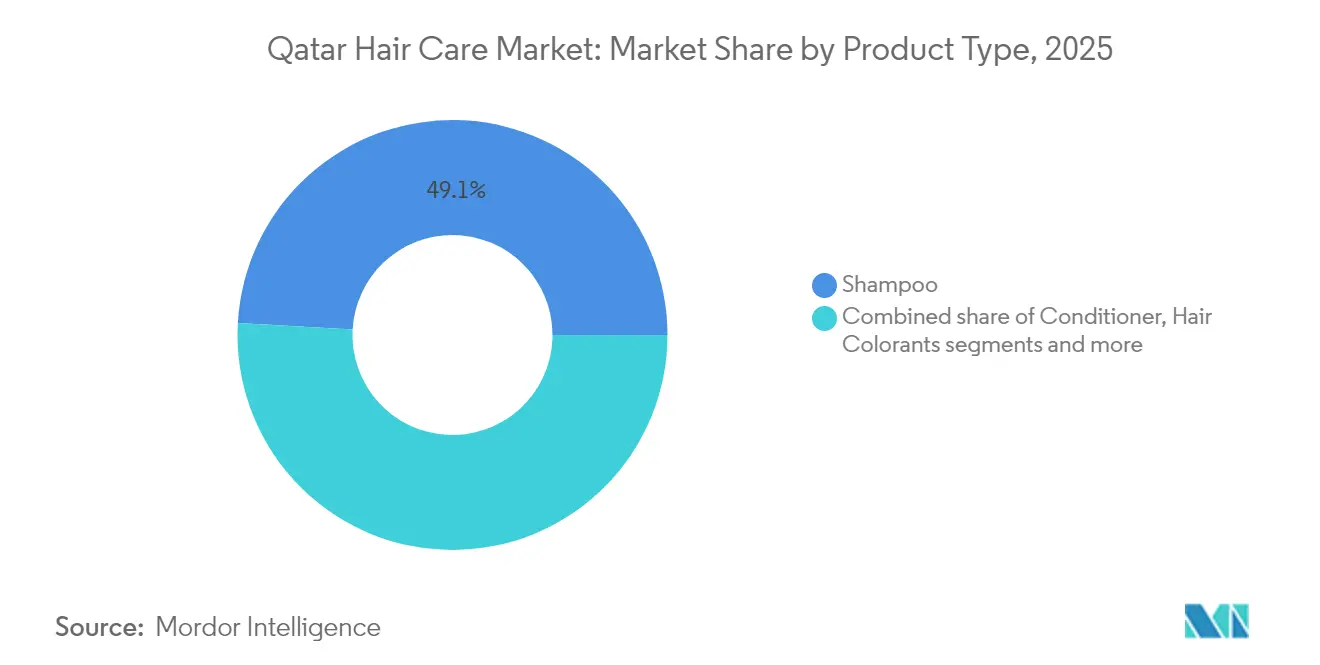
The shampoo segment maintains a substantial 49.12% market share in 2025, establishing its position as an essential hygiene product in consumer routines. Market expansion is attributed to heightened awareness regarding scalp health, increased urbanization, and enhanced accessibility to premium formulations through established retail channels. The hair styling products segment demonstrates significant market momentum, registering a CAGR of 7.69% through 2031, indicating a fundamental shift in consumer preferences from basic grooming practices to sophisticated personal care regimens.
The conditioner segment exhibits sustained market demand as a vital complementary product to shampoo. Segment growth is primarily attributed to increased consumer understanding of hair maintenance requirements and the necessity for protection against Qatar's environmental conditions, specifically elevated temperatures, ultraviolet radiation exposure, and water mineralization. The hair colorants segment experiences growth constraints due to established cultural and religious considerations within Qatar's conservative demographic, particularly regarding permanent hair colorants, which certain segments consider incompatible with Islamic principles.



By Category: Premium Segment Captures Aspirational Spending
Mass products hold 71.88% market share in 2025, driven by their accessibility, affordability, and broad appeal. These products are widely available across retail channels, serving Qatar's diverse expatriate population, which constitutes the majority of the country's residents. The consumer base, predominantly comprising working-class and middle-income individuals from South Asia, Southeast Asia, and Africa, focuses on essential grooming products at reasonable prices. Brands like Head and Shoulders, Pantene, Dove, and Sunsilk maintain market presence by offering affordable, multi-functional hair care products for daily use. Regular promotions, bulk purchase discounts, and prominent retail placement support consistent sales volumes.
Premium hair care products demonstrate significant growth potential with a projected CAGR of 8.06% through 2031, supported by Qatar's strong economic performance and increasing consumer focus on advanced hair care solutions. Qatar's GDP per capita of USD 71.65 thousand in 2025, as reported by the IMF, enables a substantial consumer segment, primarily young Qatari nationals and high-income expatriates, to invest in specialized hair care products . This demographic seeks natural, organic, halal-certified products free from sulfates and parabens, along with dermatologist-recommended and professional-grade solutions for specific concerns, including hair thinning, scalp sensitivity, heat damage, and color treatment maintenance.
By Ingredient Type: Clean Beauty Gains Momentum
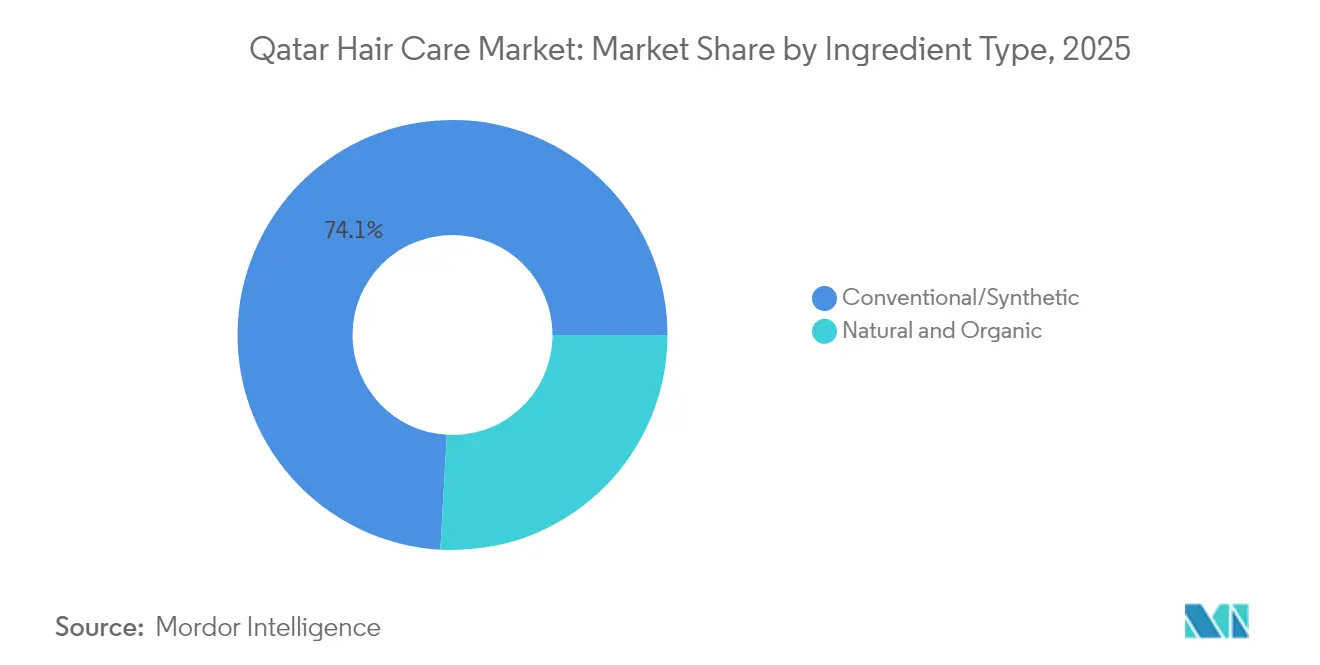
Conventional and synthetic formulations constitute a substantial 74.10% market share in Qatar's hair care market in 2025. This significant market presence is attributed to their competitive price positioning, comprehensive distribution infrastructure, and established consumer confidence in product efficacy. These formulations demonstrate consistent performance in addressing critical hair concerns, including hair loss prevention and scalp condition management. The comprehensive product portfolio and strategic marketing initiatives implemented by multinational corporations continue to solidify their market dominance.
Natural and organic ingredients exhibit an 8.22% CAGR, primarily attributed to heightened consumer consciousness regarding chemical ingredient implications and adherence to halal certification requirements. Plant-derived ingredients demonstrate superior compatibility with Islamic compliance standards compared to synthetic alternatives. The implementation of government technical guidelines, which emphasize stringent ingredient safety protocols and quality specifications, provides a substantial regulatory framework for natural formulations. Increasing consumer awareness regarding potential health implications continues to influence market demand toward natural alternatives, particularly in high-frequency usage products such as shampoos and conditioners.
By Distribution Channel: Online Retail Stores Reshape Purchase Journeys
Supermarkets and hypermarkets maintain market dominance with a substantial 69.55% distribution share in 2025. Prominent retail establishments, including Carrefour and Lulu Hypermarket, operate extensive networks strategically positioned throughout urban centers and residential districts. These retail establishments service Qatar's domestic and expatriate demographics by providing comprehensive hair care product portfolios, encompassing mass-market shampoos to mid-tier styling formulations at competitive price points. The integration of hair care procurement with routine household purchases, complemented by strategic promotional initiatives, merchandise bundling, and brand activation programs, facilitates sustained consumer engagement and revenue generation.
The online retail segment demonstrates a substantial growth trajectory, projecting a CAGR of 8.61% through 2031. This expansion is attributed to Qatar's advanced internet infrastructure, elevated smartphone adoption rates, and evolving consumer preferences toward digital commerce solutions. The e-commerce landscape facilitates market entry for specialized and emerging brands to establish competitive positions against incumbent entities through strategic digital marketing initiatives and direct-to-consumer distribution models. Specialty retailers maintain their market presence through the provision of premium hair care merchandise and professional consultation services.
Geography Analysis
The Qatar hair care market operates within the GCC regulatory framework, which implements standardized regulations and technical standards for cross-border trade. The market shows growth potential due to Qatar's high per capita income and tourism-focused economy. The expansion of tourism, driven by major sporting events and infrastructure development, increases the demand for premium hair care products in hospitality establishments and professional salons.
The Emirates Standardisation and Meteorological Authority enforces strict certification requirements for cosmetics across GCC markets, creating regulatory consistency for market participants. Qatar's geographic location and advanced logistics infrastructure position it as a distribution hub for international brands in the Gulf region. The Qatar Vision 2030 development strategy supports economic diversification and tourism growth, driving demand for hair care products through service sector expansion and increased consumer purchasing power.
The hair care market growth stems from cultural preferences emphasizing personal grooming, particularly in premium segments. The large expatriate population creates diverse demand patterns, requiring specialized product formulations and international brands to meet multicultural consumer needs. This demographic mix, along with rising disposable income and increased beauty awareness among local and expatriate populations, supports the continued expansion of Qatar's hair care market within the GCC region.
Regulatory Landscape
Hair care products marketed in Qatar operate under a GCC-aligned cosmetics compliance framework. Products must align with GCC Standardization Organization requirements, including GSO 1943:2024 safety requirements and GSO 2528:2024 rules for product claims, along with bilingual (Arabic and English) labeling and traceability documentation. In practice, market entry centers on Ministry of Public Health (MoPH) registration or listing for relevant cosmetic categories and conformity checks through Qatar General Organization for Standards and Metrology (QGOSM), with supporting test reports typically generated by ISO/IEC 17025-accredited laboratories to demonstrate compliance with restricted and prohibited substance limits.
At the border, imported hair care products are handled through Qatar customs processes that align with the GCC Customs Union, where a 5% ad valorem tariff on most imported goods (CIF basis) is commonly used as a reference point for cost build-up. Beyond product compliance, commercial readiness also includes import-procedure digitization (commonly routed via the Al Nadeeb platform) and retail price governance where applicable, which can influence go-to-market timelines for both multinational and niche brands and elevates the value of local regulatory and documentation capabilities.
Competitive Landscape
Qatar's hair care market shows moderate consolidation with multinational brands maintaining dominance through established distribution networks and regulatory compliance capabilities. Market leaders benefit from economies of scale in their operations, implementing unified technical standards and certification processes to optimize supply chain efficiency. The primary companies operating in the market include L'Oréal S.A., Procter & Gamble Company, Unilever PLC, Henkel AG & Co. KGaA, and Dabur India Limited.
Companies prioritize halal certification, cultural adaptation, and premium positioning to serve Qatar's affluent consumers, while investing in compliance infrastructure to meet regulatory requirements. The market sees increased adoption of digital commerce platforms and personalized marketing approaches, supported by government initiatives. Opportunities remain in male grooming products, natural formulations, and specialized products designed for Qatar's climate and humidity conditions.
New entrants face barriers due to regulatory complexity and certification requirements, giving advantages to established companies with existing compliance systems. The market faces challenges from counterfeit products and regulatory enforcement, requiring companies to implement anti-counterfeiting measures and consumer education programs. Product innovation focuses on hybrid formulations that combine styling and hair health benefits, meeting consumer demand for multi-functional products suited to local lifestyles and climate conditions.
Qatar Hair Care Industry Leaders
-
L'Oréal S.A.
-
Procter & Gamble Company
-
Unilever PLC
-
Henkel AG & Co. KGaA
-
Dabur India Limited
- *Disclaimer: Major Players sorted in no particular order

Market Opportunities and Future Outlook
Opportunities are concentrated in compliant, higher-value product architectures that fit Qatar-specific purchasing contexts. Premium scalp care, repair, and climate-stress routines (heat, humidity, and mineral-rich water) need to align with halal and GCC labeling requirements. The regulatory environment also creates room for brands that can complete fast reformulation and documentation for GSO 1943:2024 safety requirements and GSO 2528:2024 product-claims rules while keeping clean-label positioning, including sulfate-free and paraben-free formats, with bilingual pack compliance. A second execution lever sits in pricing readiness, as imported beauty and personal care products can require Ministry of Commerce and Industry (MoCI) retail price approval based on landed cost structure, which favors suppliers that can manage cost transparency and stable sourcing.
On channels, professional and specialty pathways remain relevant given a large salon footprint, with 747 beauty salons reported as of October 2025. This supports distribution and education space for professional treatments, styling, and post-service maintenance regimens. At the same time, the country-wide digital infrastructure (with 99.7% individual internet usage reported for 2023 by the Communications Regulatory Authority in the core report context) supports online-led brand discovery and direct-to-consumer expansion, including assortments that can be harder to range broadly in hypermarkets. New entry and scaling efforts can also tie into ongoing retail expansion narratives in 2026 media coverage of Qatar retail and beauty, supporting omnichannel launch playbooks that pair hypermarket visibility (Carrefour, Lulu) with targeted digital activation and replenishment.
Recent Industry Developments
- May 2026: Unilever highlighted hair care as a contributor to its Q1 2026 performance, reinforcing hair as a priority category across emerging markets, including the Middle East and North Africa footprint that supplies Gulf retail. The emphasis supports continued investment behind large-scale brands that compete strongly in Qatar's mass segment while using innovation and marketing to defend share.
- June 2025: Henkel Consumer Brands launched the Schwarzkopf Gliss hair care range across GCC markets, featuring its Liquid Hair-Repair Technology. The GCC-wide rollout is relevant for Qatar because it expands the premium repair and treatment proposition available through regional distribution, increasing competitive intensity in specialized care.
- July 2024: FSN E-Commerce Ventures Limited (Nykaa) incorporated a wholly owned subsidiary in Qatar, Nysaa Cosmetics Trading, to trade cosmetics, toiletries, beauty, and hair care products. The move strengthens online-led assortment expansion in Qatar by improving the route-to-market for international and niche hair care brands seeking local trading capability.


Research Methodology Framework and Report Scope
Market Definition and Coverage
This market covers the value of hair care products sold in Qatar for everyday cleansing, conditioning, coloring, and styling needs, counted at the point where products are sold through retail and similar channels.
Scope exclusions: We exclude salon services and procedures, as well as devices such as dryers and straighteners.
Segmentation Overview
-
By Product Type
- Shampoo
- Conditioner
- Hair Colorants
- Hair Styling Products
- Other Product Types
-
By Category
- Premium Products
- Mass Products
-
By Ingredient Type
- Natural and Organic
- Conventional/Synthetic
-
By Distribution Channel
- Specialty Stores
- Supermarkets/Hypermarkets
- Online Retail Stores
- Other Channels
Data Sources, Market Sizing, and Validation
Desk Research
Desk research was used to set the market boundaries and to build demand and channel assumptions for Qatar. We reviewed public sources such as Qatar Planning and Statistics Authority releases, UN Comtrade trade statistics for relevant hair preparations, World Bank macro indicators, and selected WHO health and hygiene references where they helped explain usage habits.
To connect trade signals with what is actually sold, company annual reports and investor presentations were checked for portfolio focus, brand strategy, and category growth comments, followed by reputable press coverage and retailer announcements that indicate channel shifts. Where needed, we also referenced paid subscriptions used for company financials and intelligence, plus a patent database to spot formulation and claim trends that can influence premium positioning. These desk sources are not exhaustive, and additional public and paid references were used for data collection, cross-checking, and clarification.
Primary Interviews and Surveys
Primary work focused on validating what is selling in Qatar and how pricing and product mix are moving across mass and premium ranges. We spoke with brand-side executives, distributors and importers, modern trade and specialty retail stakeholders, and experienced professionals who track consumer beauty spend, so assumptions from desk research could be confirmed, adjusted, or replaced where gaps existed.
Distribution of primary research fieldwork respondents
| Company type | Respondent position |
|---|---|
| Top tier: 34% | CXOs: 14% |
| Mid tier: 51% | Functional/Unit leaders: 38% |
| Smaller Players: 15% | Managers: 48% |
Market-Sizing & Forecasting
Sizing starts with a top-down demand pool build that links Qatar population and consumer spending to hair care usage, and then it is shaped by channel reality and product mix. We first mapped value-share splits across key product groups and selling channels, and then aligned those splits with what interviews indicated is actually stocked and promoted.
Key model inputs included hair care spend per shopper, premium versus mass mix, online retail penetration, promotional intensity that shifts average selling prices, and the balance of imported versus locally distributed products (used as a practical check through trade signals and distributor feedback). To keep totals realistic, we ran selective bottom-up approximations using sampled price points across common SKUs, channel checks for unit movement patterns, and distributor-level sell-in ranges, with gaps handled using conservative midpoint assumptions that were re-tested in validation calls.
Forecasting used scenario analysis, supported by short ARIMA-based trend checks on the most stable drivers, then adjusted using expert views on near-term inflation, retail expansion, and category switching between shampoo, conditioners, and styling items. This approach keeps the forecast explainable and repeatable, even when detailed public volume series are limited.
Data Validation & Update Cycle
Outputs were validated through triangulation across independent signals, then variance checks were done across category totals, channel totals, and implied price levels. When a data point created an unusual jump or a mix shift that did not match market behavior, the assumption was re-opened, checked against desk evidence, and re-confirmed through follow-up outreach.
Before sign-off, the model and its key assumptions go through a multi-step internal review so calculation logic, currency handling, and growth drivers stay consistent. Reports are refreshed annually, and interim updates are completed when major events materially change pricing, import flows, or channel structure. Right before delivery, a final analyst pass ensures the latest public data and recent market developments are reflected.
Mordor Intelligence's Qatar Hair Care Market Market Size Compared With Other Published Estimates
It is normal to see different market sizes for Qatar hair care, even when the topic sounds identical. The differences usually come from what is counted as hair care, which selling channels are included, and how prices are converted and updated over time.
By tracking category mix and price progression across channels, Mordor Intelligence keeps the 2025 total tied to what shoppers can actually buy in Qatar, rather than blending in salon services, wider personal care baskets, or aggressive premiumization assumptions. Another driver is timing, since some publications freeze exchange rates or inflation earlier, while others extend forecasts from a different base year that can pull the current-year value up or down.
Benchmark comparison
| Source | Market Size | Gaps in Research Methodology |
|---|---|---|
| Mordor Intelligence | USD 125.36 M (2025) | |
| Market Research Publisher A | USD 84.58 M (2024) | Uses a different base year and a longer forecast window, and the valuation approach appears to lean more on historical trend extrapolation, which can understate current mix shifts in premium products and e-commerce. |
| Industry Research Publisher B | USD 286.70 M (2025) | The estimate is materially higher, which is typically explained by broader scope choices, such as counting adjacent beauty items, inflating per-capita spend assumptions, or applying higher assumed average prices without channel-level checks. |
Overall, the spread is best explained by boundary choices and how pricing and mix are carried forward from the base year. Our approach stays traceable to clear demand drivers, channel reality, and cross-checks that can be repeated when new data becomes available.


Key Questions Answered in the Report
What is the current value of the Qatar hair care market?
The market stands at USD 134.31 million in 2026 and is projected to reach USD 189.48 million by 2031.
Which product category is growing the fastest?
Hair styling products lead growth with a 7.69% CAGR thanks to rising male grooming and social-media influence.
How important is e-commerce for hair-care sales in Qatar?
Online retail stores book the fastest distribution growth at an 8.61% CAGR because high internet penetration supports digital checkout and personalised recommendations.
Why are natural and organic hair-care products gaining traction?
Consumers seek halal-compliant, cleaner ingredients, pushing natural and organic lines to an 8.22% CAGR while regulators enforce full ingredient transparency.
Page last updated on:


 Your data is secure and never sold or shared.


