
Poultry Packaging Market Size and Share
Market Overview
| Study Period | 2020 - 2031 |
|---|---|
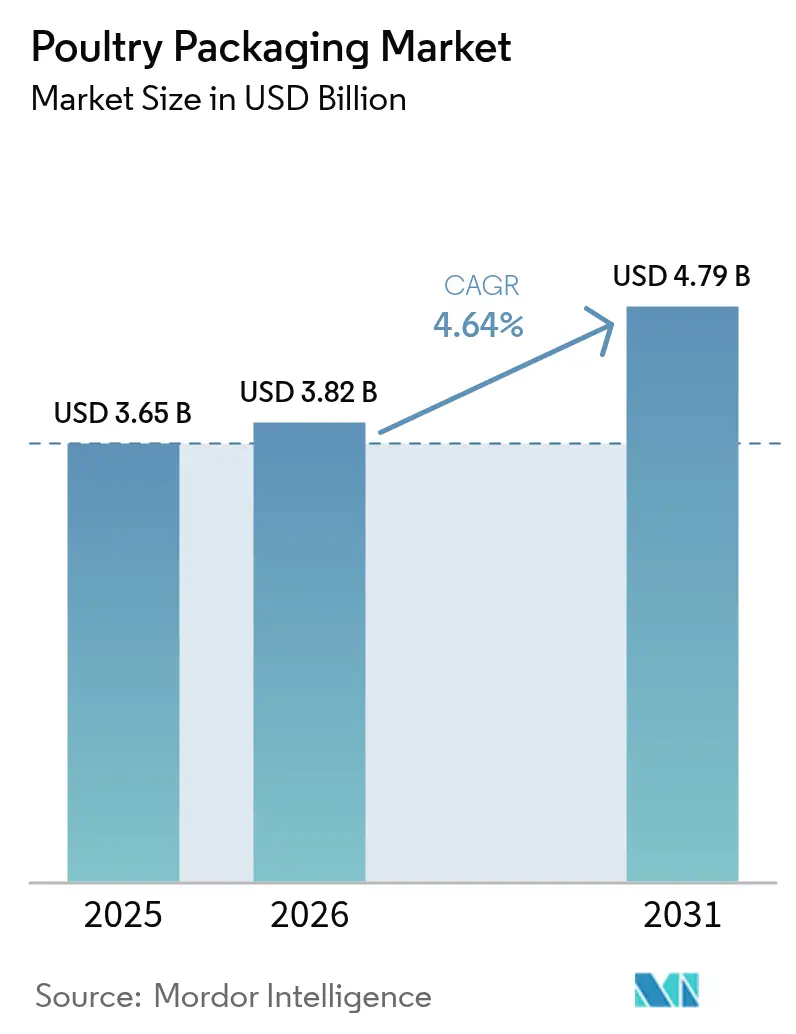
| Market Size (2026) | USD 3.82 Billion |
| Market Size (2031) | USD 4.79 Billion |
| Growth Rate (2026 - 2031) | 4.64 % |
| Fastest Growing Market | Asia Pacific |
| Largest Market | Asia Pacific |
| Market Concentration | Medium |
Major Players *Disclaimer: Major Players sorted in no particular order Image © Mordor Intelligence. Reuse requires attribution under CC BY 4.0. | |
Poultry Packaging Market Analysis by Mordor Intelligence
The poultry packaging market size is expected to grow from USD 3.65 billion in 2025 to USD 3.82 billion in 2026 and is forecast to reach USD 4.79 billion by 2031 at 4.64% CAGR over 2026-2031. Rising demand for case-ready poultry, new modified-atmosphere solutions, and sustainability regulations underpin this steady growth. Retailers prefer shelf-stable chicken trays that reduce shrink and labor. E-commerce adds volume for insulated formats that survive multi-day transit. Material shifts toward paper-based laminates press producers to innovate barrier layers without losing throughput. Meanwhile, merger activity is altering bargaining power between converters and processors, and technology firms are embedding sensors that warn of temperature abuse at every link in the chain.
Key Report Takeaways
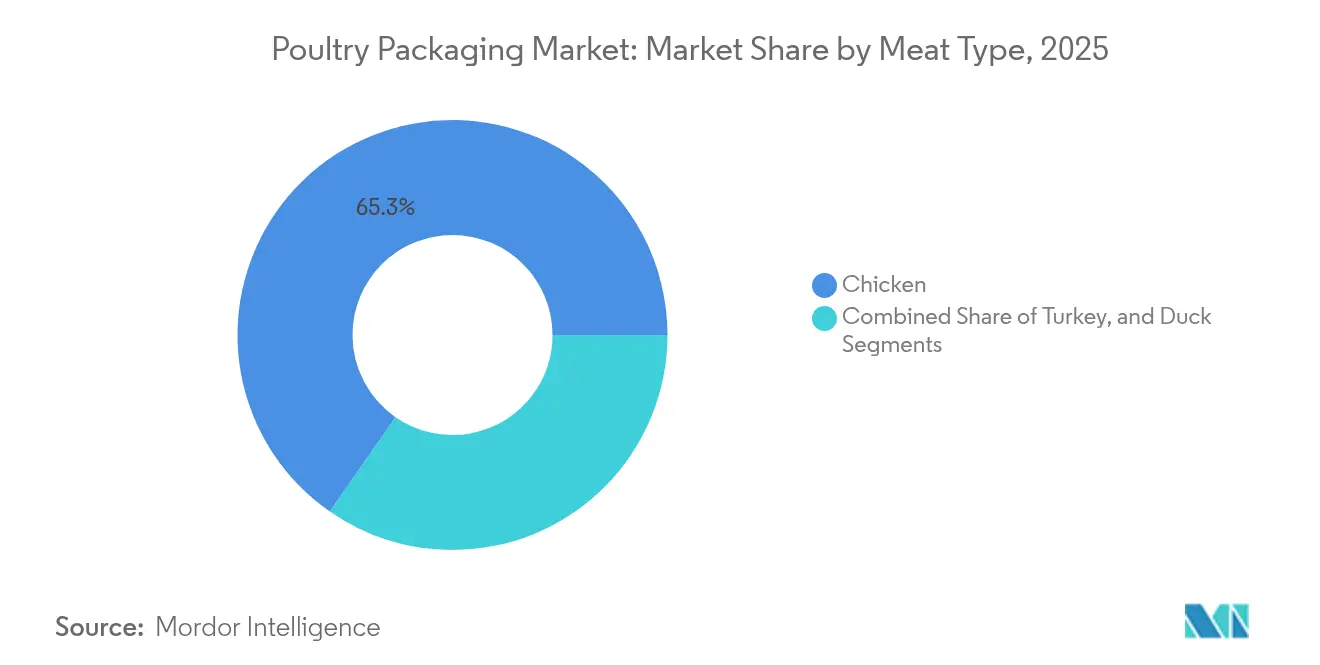
- By meat type, chicken led with 65.34% poultry packaging market share in 2025, while duck is projected to expand at a 5.45% CAGR to 2031.
- By packaging format, flexible solutions commanded 62.45% of the poultry packaging market size in 2025; the same format is forecast to grow at 5.27% through 2031.
- By material, plastics retained 67.02% share of the poultry packaging market size in 2025, whereas paper and paperboard is expected to post the fastest 5.31% CAGR to 2031.
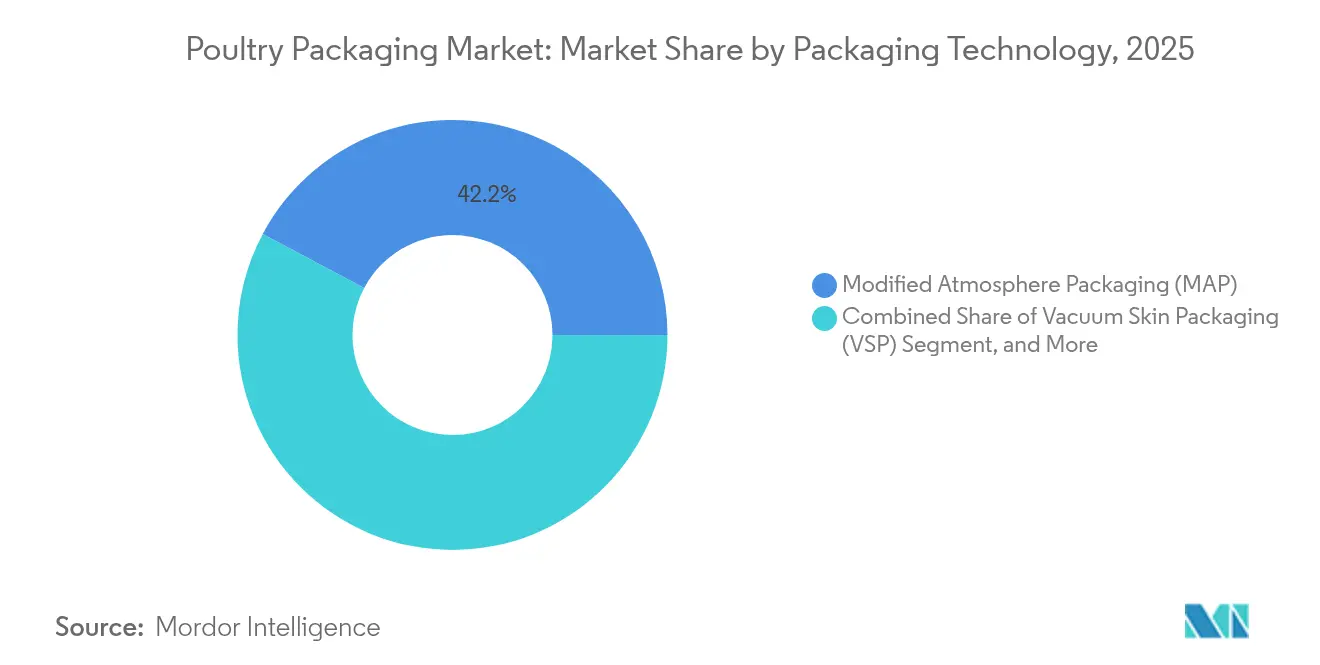
- By packaging technology, modified-atmosphere systems accounted for 42.21% of the poultry packaging market size in 2025; active and intelligent formats are set to advance at 5.18% CAGR.
- By distribution channel, retail captured 56.98% share of the poultry packaging market in 2025, while e-commerce retail is projected to grow at 5.14% through 2031.
- By geography, Asia-Pacific held 38.45% of the poultry packaging market in 2025 and is expected to grow the fastest at a 5.11% CAGR to 2031.
Note: Market size and forecast figures in this report are generated using Mordor Intelligence’s proprietary estimation framework, updated with the latest available data and insights as of 2026.
Market Trends and Insights
Drivers Impact Analysis of Poultry Packaging Market*
| Driver | (~) % Impact on CAGR Forecast | Geographic Relevance | Impact Timeline |
|---|---|---|---|
| Rising demand for convenience and case-ready | +1.2% | North America, EU | Medium term (2-4 years) |
| Surge in MAP and vacuum-skin technologies | +0.8% | Developed markets | Short term (≤2 years) |
| Shift toward bio-based and recyclable input | +0.7% | EU, expanding to North America | Long term (≥4 years) |
| E-commerce cold-chain expansion | +0.6% | Global, led by Asia-Pacific | Medium term (2-4 years) |
| Adoption of intelligent freshness sensors | +0.4% | Developed markets | Long term (≥4 years) |
| Recycled-content mandates | +0.5% | EU, California | Medium term (2-4 years) |
| Source: Mordor Intelligence | |||
Rising Demand for Convenience and Case-Ready Poultry
Millennial and Generation Z shoppers favor quick, no-mess poultry meals that arrive in easy-peel trays or ovenable pouches. Large retailers therefore specify centralized case-ready programs that cut in-store labor and improve product consistency. Tray producers now integrate absorbent pads and gas-flush valves that extend freshness by several days. Equipment vendors such as G.Mondini supply modular lines that blend precise portioning with lower film gauge, trimming material use without sacrificing visual appeal. Foodservice chains mirror this shift by ordering pre-marinated, vacuum-skin packs that move from cooler to grill in one step. Premium meal-kit platforms exploit the same packaging to boost shelf life during shipping, capturing higher margins that offset advanced film costs.
Surge in MAP and Vacuum-Skin Technologies
Modified-atmosphere packaging improves shelf life by slowing microbial growth, yet early high-oxygen blends accelerated lipid oxidation and color shifts. Converters now trial carbon-monoxide adjuncts that stabilize bloom without raising safety concerns. Vacuum-skin films from firms like Duropac prevent purge and withstand puncture, making them attractive for bone-in cuts. Plasma-treated trays that create in-pack ozone cut Campylobacter by 90% and Salmonella by 60% without chemicals. Equipment makers such as MULTIVAC pair MAP valves with micro-perforated lids so processors can tune gas ratios to each SKU.
Shift Toward Bio-Based and Recyclable Materials
The EU Packaging and Packaging Waste Regulation mandates 30% recycled PET by 2030 and 100% recyclability by the same year, pushing converters toward mono-material films [1]. Amcor’s AmFiber papers mimic plastic barrier while allowing curbside recycling. In the United States, polylactic-acid blends secured FDA food-contact clearance, but limited composting slows uptake. Chitosan coatings add natural antimicrobial activity yet require allergen assessment. Accredo Packaging’s sugarcane-based pouches sequester 43 g CO2 per unit while matching mechanical strength.
E-Commerce Cold-Chain Expansion
Direct-to-consumer poultry kits travel farther and encounter more hand-offs than retail loads. Fiber-based insulation such as DS Smith’s TailorTemp replaces styrene coolers and maintains temperature for 36 hours. Reusable containers with GPS loggers from Candor Food Chain hold safe temperatures for nine days and remove the need for dry ice. Smart labels report excursion events by reading color change, letting brands refund only affected boxes rather than entire shipments.
Restraints Impact Analysis of Poultry Packaging Market*
| Restraint | (~) % Impact on CAGR Forecast | Geographic Relevance | Impact Timeline |
|---|---|---|---|
| Avian-influenza supply disruptions | -0.9% | Global, North America focus | Short term (≤2 years) |
| Stringent food-contact compliance costs | -0.6% | EU, North America | Medium term (2-4 years) |
| Feedstock-price volatility for polyolefins | -0.4% | Global commodity markets | Short term (≤2 years) |
| Consumer skepticism toward high-O₂ MAP | -0.3% | Educated markets | Medium term (2-4 years) |
| Source: Mordor Intelligence | |||
Avian-Influenza Supply Disruptions
The 2024–2025 HPAI wave removed millions of birds from supply chains, unsettling production schedules and altering tray demand by weight class. USDA spent USD 1.8 billion on indemnities, but barns need up to 24 weeks to repopulate, prolonging volume instability. Rapid biosensors from Washington University now detect H5N1 in five minutes, enabling earlier lockdowns and targeted culls. Shorter flock cycles force processors to order more flexible sizes and adjust brand mix, which in turn influences run-length planning for converters.
Stringent Food-Contact Compliance Costs
Thirty-five PFAS notifications lost FDA clearance, obliging converters to reformulate grease barriers by June 2025. The EU further bans PFAS outright under Regulation 2025/40, adding lab certification for each new structure. The USDA now considers Salmonella an adulterant in raw poultry, triggering mandatory recalls and increasing liability for packers. New migration testing protocols add USD 50,000–100,000 to development cycles, disadvantaging smaller converters and encouraging alliances with labs that specialize in extractables work.
*Our forecasts treat driver/restraint impacts as directional, not additive. The impact forecasts reflect baseline growth, mix effects, and variable interactions.
Poultry Packaging Market Segment Analysis
By Meat Type:
Chicken Retains Scale, Duck Accelerates PremiumizationThe chicken category owns 65.34% of the poultry packaging market, thanks to broad consumer acceptance and streamlined deboning lines. High throughput lets processors negotiate film cost and spur experimentation with peel-reseal lids that cut food waste. Duck, despite its modest base, grows at a 5.45% CAGR as upscale retailers introduce portion-controlled breasts in sleek vacuum-skin trays. Here, the poultry packaging market size for duck is forecast to climb steadily as exotic proteins move into mainstream freezers. Enhanced barrier bags from Amcor prevent grease migration and preserve dark-meat color, meeting premium presentation standards.
Duck’s rise compels converters to integrate oil-resistant coatings while keeping clarity for retail appeal. Automation now portions duck to weight specs, enabling case-ready rollouts similar to chicken. Turkey holds share through seasonal whole-bird formats, yet value-added roasts and sliced deli packs sustain year-round demand. Each protein therefore demands tailored barrier, puncture strength, and silhouette, nudging film suppliers to broaden portfolios without inflating SKU count.

By Packaging Format:
Flexible Films Drive Material EfficiencyFlexible structures delivered 62.45% of the poultry packaging market in 2025, supported by lower material intensity and high graphics that elevate shelf presence. The format will remain the growth leader, advancing 5.27% each year as mono-PET and PE laminates become store-drop recyclable. Within the poultry packaging market size, rigid trays retain roles in premium oven-ready SKUs and whole-bird presentations that benefit from stacking stability.
Equipment such as GEA’s PowerPak 1000 lets mid-scale plants swing between vacuum, MAP, and skin variants on a single frame, cutting change-over downtime . Flexible pouches now embed freshness sensors that change color when pH rises, turning the wrapper into a quality monitor. These upgrades defend price points in a cost-sensitive protein category and satisfy retailers that push for longer coded life to lower shrink.
By Material:
Plastics Dominate but Paperboard Gains GroundPlastics covered 67.02% of the poultry packaging market in 2025 due to unrivaled moisture and oxygen barriers. Yet paper and paperboard post a 5.31% CAGR as new dispersion coatings hit required grease resistance while enabling curbside recycling. The poultry packaging market share for plastics therefore declines gradually, though volumes still rise with protein output.
Amcor’s AmFiber Performance Paper secures over 80% fiber recovery during recycling and matches polyethylene’s water vapor barrier, illustrating rapid R&D gains. Hybrid structures that pair a thin PE sealant with heavyweight kraft are entering tray sealers without tooling change. Metal cans persist in military and remote catering uses, but their contribution to overall volume remains marginal.
By Packaging Technology:
MAP Prevails as Intelligent Layers EmergeModified-atmosphere lines captured 42.21% of the poultry packaging market in 2025, offering processors a cost-efficient route to 7-14-day shelf life. Meanwhile, active and intelligent formats climb at a 5.18% CAGR as price of sensors and scavengers declines. The poultry packaging market size for MAP will still grow but cede share to smart variants that cut recalls and provide analytics.
Iron-based scavenger sachets extend refrigerated chicken life by nine days, reducing markdowns . Color-changing inks based on polyaniline nanotubes give a visual cue to consumers whenever spoilage triggers pH shift. IoT-enabled data loggers now cost under USD 0.10 per pack when amortized over large runs, making continuous cold-chain metrics feasible for mainstream brands.
By Distribution Channel:
Retail Dominates but E-Commerce SurgesTraditional grocery generated 56.98% of revenue for the poultry packaging market in 2025, leveraging established planograms and just-in-time restocks. Nevertheless, e-commerce parcels will register a 5.14% CAGR as meal-kit and direct-farm websites multiply. The poultry packaging market size attributed to online channels thus expands quickly yet still relies on the same core converter base.
Retailers demand tamper-evident trays that showcase product color, whereas parcel shippers prefer vacuum-skin pouches nestled in fiber insulation to reduce dimensional weight. Institutional feeders and foodservice maintain consistent volume but challenge packers to balance toughness with ease of opening in busy kitchens. Converters offer modular tooling that swaps cavity depth, letting one base film serve multiple channel specifications.
Geography Analysis
APAC Poultry Packaging Market
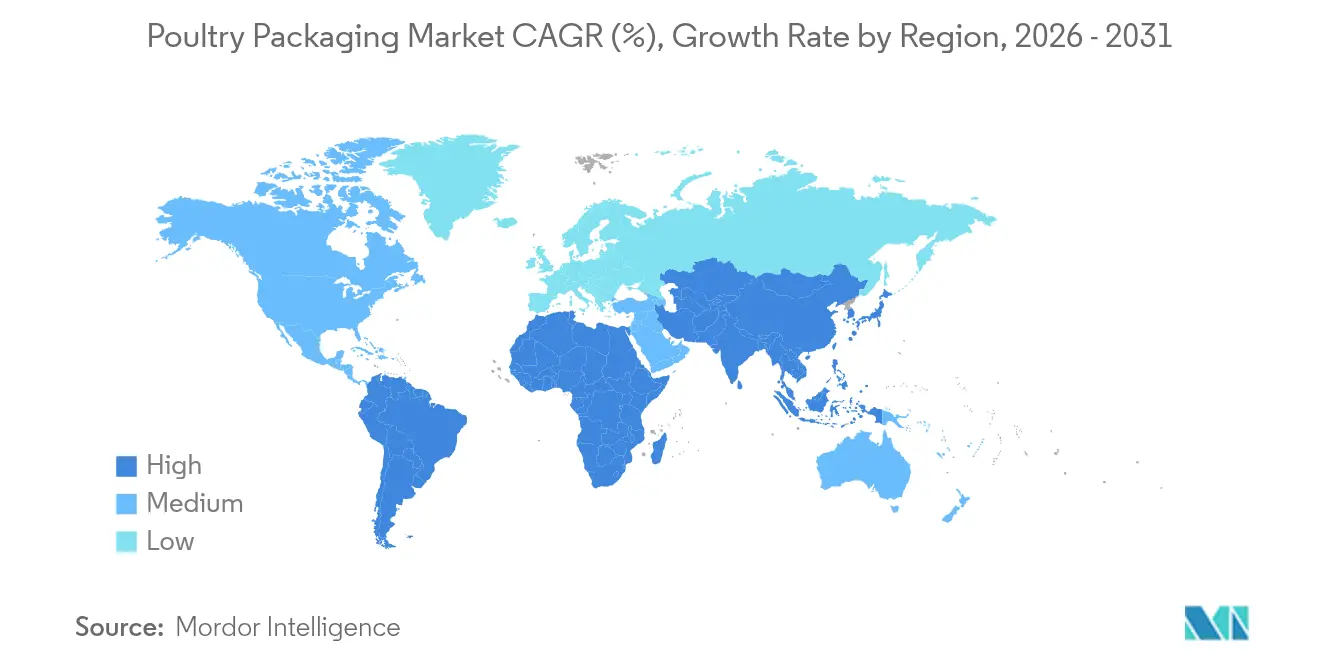
Asia-Pacific controlled 38.45% of the poultry packaging market in 2025 and is projected to expand at a 5.11% CAGR to 2031. Rapid urban migration and rising disposable income in China and India lift chilled-poultry demand, while Thailand strengthens its export position. National circular-economy rules spur adoption of recyclable laminates, and local processors engage global machinery firms to meet export hygiene codes. Multinational retailers entering Indonesia and Vietnam specify case-ready programs, unlocking new business for regional converters.
North America Poultry Packaging Market
North America ranks second in value. Federal regulation remains stable, but states such as California and Oregon add producer-responsibility fees that reward mono-material formats . Consumers display strong willingness to pay for antibiotic-free and sustainability-certified packs, encouraging brands to pilot compostable trays. Canada’s updated Zero Plastic Waste agenda echoes EU targets, further accelerating the shift to paper-polymer hybrids. Intelligent labels see early uptake as big-box stores test on-pack QR codes for traceability.
Europe Poultry Packaging Market
Europe shows low headline growth yet high innovation density. Regulation 2025/40 enforces 100% recyclability by 2030 and bans PFAS, forcing converters into rapid material substitution. Retailers collaborate with suppliers to validate fully fiber trays that keep poultry fresh for 21 days, exemplified by Coveris’ new BarrierFresh line. Smart-sensor pilots in Germany track time-temperature abuse, delivering data that informs dynamic discounting to curb waste.
Regulatory Landscape
Food safety and food-contact compliance are the main regulatory anchors for poultry packaging, while environmental packaging rules are increasingly shaping material choices. In the United States, USDA FSIS oversight of labeling and packaging practices intersects with technical requirements in 9 CFR Part 381 (including performance requirements tied to chilling and freezing for poultry products). FSIS also updated its Label Approval guidance in December 2025 with U.S.-origin labeling requirements effective January 1, 2026, tightening documentation needs for voluntary origin claims.
In Europe, the Packaging and Packaging Waste Regulation (PPWR) 2025/40 entered into force on February 11, 2025 and becomes generally applicable from August 12, 2026, with certain single-use packaging rules applying from July 20, 2026. Food-contact compliance is also being refined: the European Commission published Regulation (EU) 2026/245 and 2026/250 in February 2026 to revise plastic food-contact rules and clarify the BPA ban, while PFAS limits for EU food-contact packaging apply starting August 12, 2026. This timing is pushing converters toward PFAS-free barrier systems across poultry trays, films, and coatings.
Value Chain Analysis
The poultry packaging value chain begins with feedstocks (polyolefins and PET resins, paper and paperboard, adhesives and inks, and emerging bio-based inputs such as PLA). It then moves to packaging converters producing flexible films, shrink bags, rigid and semi-rigid trays, lidding, pads, and labels. Equipment suppliers and line integrators (including tray sealers and MAP and vacuum-skin systems) are tightly linked to materials, since they influence which film structures can run at required speeds and achieve seal integrity. Compliance testing for food-contact and migration further adds specialized laboratories to qualification workflows.
Downstream, poultry processors and co-packers specify shelf-life targets, purge control, and opening performance for case-ready programs. Retailers and e-commerce operators then layer on requirements related to leak resistance, damage tolerance, and sustainability attributes. Key friction points include resin and fiber price volatility, labor constraints in converting and processing, and capital-intensive upgrades needed to meet sanitation, recyclability, and PFAS-free requirements. The chain is also diversifying tray replacement and insulation options, supported by supplier moves such as TotalEnergies Corbion, which in July 2026 introduced a high melt-strength PLA grade (Luminy Foam 50F) positioned as a drop-in alternative for foam protein trays.
Competitive Landscape
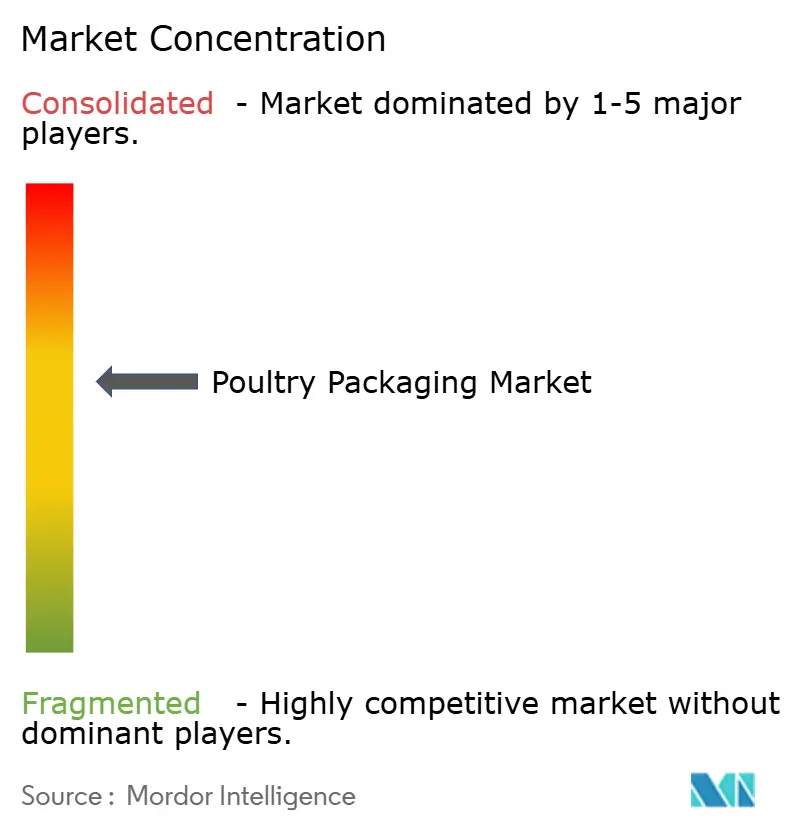
The poultry packaging market remains moderately fragmented, though recent deals signal a tilt toward consolidation. Amcor’s USD 8.4 billion purchase of Berry Global scales film extrusion and thermoforming under one roof, promising customers worldwide SKU harmonization. Sonoco’s EUR 3.615 billion acquisition of Eviosys expands metal and rigid paperboard capability, positioning the group to offer multi-material solutions.
Large groups invest heavily in sustainability science. Amcor’s Moda automated bagging line integrates AI vision that adjusts vacuum pull in real time, reducing leakers while cutting film usage. Mondi’s FlexStudios hub partners with poultry processors to co-create recyclable laminates suited to high-speed fill lines. Meanwhile, mid-tier specialists carve niches in intelligent packaging. Several have launched printed electronics that deliver temperature logs via NFC at checkout.
Technology startups become acquisition targets. Sensor-developers that perfected carbon-dot indicators now license know-how to laminate suppliers seeking differentiation. E-commerce growth lures insulation innovators who replace expanded polystyrene with molded-fiber pads. Competitive pressure therefore hinges on innovation pace as much as scale. Companies able to prove regulatory compliance across global jurisdictions gain access to multinational processors’ supplier lists, cementing long-term contracts.
Poultry Packaging Industry Leaders
-
Amcor plc
-
Mondi Group
-
Sealed Air Corporation
-
Sonoco Products Company
-
Berry Global Group Inc.
- *Disclaimer: Major Players sorted in no particular order
Poultry Packaging Market Companies Covered in this Report
- Amcor plc
- Berry Global Group Inc.
- Mondi plc
- Sealed Air Corporation
- Sonoco Products Company
- ProAmpac Holdings LLC
- UFlex Limited
- Huhtamaki Oyj
- Winpak Ltd.
- Glenroy Inc.
- LINPAC SEALPAC International BV
- Coveris Holding SA
- Smurfit Kappa Group plc
- Klockner Pentaplast GmbH
- Cascades Inc.
- DS Smith plc
- Printpack Inc.
- Graphic Packaging Holding Company
- Innovia Films Ltd.
- Flexopack SA
Market Opportunities and Future Outlook
The strongest whitespace is at the overlap of regulatory compliance and performance, especially for recyclable or fiber-forward structures that still meet poultry-grade barrier performance, seal integrity, and low-temperature toughness. The EU PPWR 2025/40 becoming generally applicable from August 12, 2026, together with EU food-contact updates such as Regulations (EU) 2026/245 and 2026/250 and tighter PFAS constraints from August 2026, supports near-term demand for PFAS-free grease barriers, mono-material lidding and films, and validated migration-compliant alternatives that can operate on existing MAP and vacuum-skin lines.
Supply opportunities are also tied to capacity and modernization on both packaging and processing sides, including higher-throughput, automation-friendly formats used in case-ready and e-commerce fulfillment. Amcor began expanding its flexible packaging facility in Dongguan, China in July 2026, adding a 7,000-square-meter manufacturing building and an automated warehouse, aligning with Asia-Pacific scale-up and shorter lead-time needs. At the same time, large poultry processors are investing in upgraded footprints that can change downstream packaging specifications and volumes, including Conagra Brands confirming a USD 220 million, multi-year expansion at its Fayetteville, Arkansas poultry manufacturing plant in March 2026 and Miller Poultry announcing a USD 90 million expansion of its Kidron, Ohio facility in July 2026. Miller Poultry also plans a shift toward air-chilling, which can affect moisture management and pack design requirements.
Recent Industry Developments in Poultry Packaging Market
- June 2026: Amcor installed its first Moda rotary vacuum chamber sealing technology in Brazil at Barra Mansa Alimentos, replacing multiple traditional belt chamber machines. The upgrade improves vacuum performance and expands protein-packing throughput, supporting higher-speed adoption of vacuum and vacuum-skin style formats used in poultry processing environments.
- June 2025: Amcor launched the Perflex shrink bag with a built-in handle for Butterball LLC boneless turkey breast products, positioned as a more sustainable alternative to netted bags. The design reduces handling complexity at packing and for consumers, and it supports material reduction initiatives while maintaining a familiar retail-ready form factor for poultry and turkey applications.
- January 2024: Sealed Air introduced a biobased, industrial compostable protein overwrap tray at IPPE 2024 in Atlanta as an alternative to expanded polystyrene trays used for poultry and red meat. The launch broadened the set of tray material options available to packers navigating retailer sustainability requirements and emerging restrictions on traditional foam formats.
Poultry Packaging Market Report Scope and Research Methodology
Market Definition and Coverage
For this study, the poultry packaging market covers the value of packaging used to pack poultry meat products, across rigid and flexible formats, when they are sold through retail, foodservice, or institutional channels.
Scope exclusions: It excludes packaging for eggs, animal feed packaging, and general-purpose packaging that is not specifically used for poultry meat.
Segments Covered in This Report
- By Meat Type
- Chicken
- Turkey
- Duck
- By Packaging Format
- Fixed / Rigid
- Flexible
- By Packaging Material
- Plastics
- Paper and Paperboard
- Metals
- By Packaging Technology
- Modified Atmosphere Packaging (MAP)
- Vacuum Skin Packaging (VSP)
- Active and Intelligent Packaging
- High-Pressure and Others
- By Distribution Channel
- Retail
- Foodservice / HORECA
- Industrial and Institutional
- By Geography
- North America
- United States
- Canada
- Mexico
- South America
- Brazil
- Argentina
- Rest of South America
- Europe
- Germany
- United Kingdom
- France
- Italy
- Spain
- Russia
- Rest of Europe
- Asia-Pacific
- China
- Japan
- India
- South Korea
- Australia and New Zealand
- Rest of Asia-Pacific
- Middle East and Africa
- Middle East
- Saudi Arabia
- United Arab Emirates
- Turkey
- Rest of Middle East
- Africa
- South Africa
- Nigeria
- Egypt
- Rest of Africa
- Middle East
- North America
Data Sources, Market Sizing, and Validation
Desk Research
Desk research was used to map the poultry packaging value chain and keep the model tied to real demand signals before any pricing or growth assumptions were applied. We referred to public statistics on poultry production and consumption, such as USDA production and cold storage series, FAO supply and food balance data, Eurostat livestock and meat datasets, and UN Comtrade trade flows for relevant packaging materials and products.
Along with this, we reviewed public sustainability and food-contact requirements from regulators, for example US FDA food-contact guidance and EU packaging and waste directives, plus packaging association publications and peer-reviewed journals on barrier films and shelf-life. Company filings, investor decks, and reputable press were used to cross-check packaging capacity moves, resin and paper price cycles, and format mix shifts. Where needed, paid subscriptions for company financials and shipment-level trade data were used to fill gaps on regional exposure and pricing direction. These sources are illustrative, and many other public and paid references were used for collection, validation, and clarification.
Primary Interviews and Surveys
Primary work focused on validating how poultry processors and packers choose packaging formats, and how packaging suppliers describe volumes and pricing movement by region. We spoke with a balanced set of participants across packaging converters, material suppliers, brand owners, and channel-side buyers, so assumptions such as mix shift to case-ready packs, MAP uptake, and downgauging trends could be checked and adjusted with respondent input.
Distribution of primary research fieldwork respondents
| Company type | Respondent position | Region |
|---|---|---|
| Top tier: 29% | CXOs: 12% | APAC: 43% |
| Mid tier: 53% | Functional/Unit leaders: 34% | EMEA: 37% |
| Smaller Players: 18% | Managers: 54% | Americas: 20% |
Market-Sizing & Forecasting
Sizing started from a top-down build where poultry output and processed poultry volumes by region were converted into an addressable packaging demand pool, and then translated into value using format-level pricing. To keep this grounded, we used checkpoints such as retail penetration of packaged poultry, the share of fresh versus frozen and processed cuts, and typical pack weight and pack-per-kg norms that drive unit counts.
The value model was then corroborated using selective bottom-up approximations, including sampled converter revenues by packaging category, channel checks for common pack prices, and volume sanity checks against material usage intensity for films and trays. Inputs that mattered most included poultry production trends, case-ready adoption rates, MAP and vacuum-skin penetration, paper versus plastic format substitution, and resin and paper price direction that influences average selling prices.
For forecasting, scenario analysis was used so changes in poultry consumption, regulation-led material shifts, and pricing cycles could be reflected without forcing one linear path. Where bottom-up signals were missing in smaller regions, gaps were handled through peer-region proxies, then rechecked with interview feedback before totals were finalized.
Data Validation & Update Cycle
Outputs were validated through multiple checks to ensure the totals stay aligned with what the market can realistically absorb. We compared modeled values against independent signals such as poultry processing throughput trends, packaging material pricing movements, and reported capacity changes, and then investigated large variances before sign-off.
A second analyst review was used to recheck key assumptions, currency conversions, and year alignment, followed by targeted re-contact when a data point looked out of pattern. Reports are refreshed annually, and interim updates are completed when material events occur, such as regulation changes, major price swings, or capacity additions. Before delivery, a final pass is done so clients receive the most current view available at that time.
Mordor Intelligence's Poultry Packaging Market Size Versus Other Published Estimates
Published market sizes for poultry packaging often vary because the boundary of what gets counted is not consistent, and because different writers pick different base years, channel coverage, and pricing logic. Some estimates start from packaging material revenues, while others start from poultry volumes, and the totals can move depending on which path is taken.
By tracking packaged poultry throughput, format mix, and average pack pricing over time, Mordor Intelligence keeps the 2026 market size aligned to poultry meat packaging demand, instead of letting adjacent food packaging categories expand the total.
Benchmark comparison
| Source | Market Size | Gaps in Research Methodology |
|---|---|---|
| Mordor Intelligence | USD 3.82 B (2026) | |
| Industry Publisher A | USD 2.81 B (2025) | Uses a 2025 base and a narrower channel lens in its narrative, which can undercount higher-value formats used in case-ready retail and foodservice packs. |
| Packaging Media B | USD 3.44 B (2025) | States a 2025 value with limited transparency on how ASPs progress by format and region, so year-to-year price cycle effects may be captured differently. |
The spread in the table mainly comes from year selection and how packaging value is translated from volume and format choices. Our approach aims to keep the total traceable to a clear demand pool, with pricing and mix assumptions that can be rechecked when market conditions change.
Key Questions Answered in the Report
What is the current size of the poultry packaging market?
The poultry packaging market reached USD 3.82 billion in 2026.
Which region offers the fastest growth?
Asia-Pacific is forecast to expand at a 5.11% CAGR to 2031, driven by urbanization and rising protein consumption.
What packaging format dominates the market?
Flexible structures hold 62.45% share and will remain the leading format due to material-efficiency and graphics advantages.
How are regulations reshaping material choices?
EU Regulation 2025/40 mandates 100% recyclability and PFAS bans by 2030, prompting a shift toward mono-material and paper-based solutions.