
Poultry Manure Biofertilizers Market Size and Share
Market Overview
| Study Period | 2021 - 2031 |
|---|---|
| Market Size (2026) | USD 1.44 Billion |
| Market Size (2031) | USD 2.43 Billion |
| Growth Rate (2026 - 2031) | 11.00 % |
| Fastest Growing Market | Asia Pacific |
| Largest Market | North America |
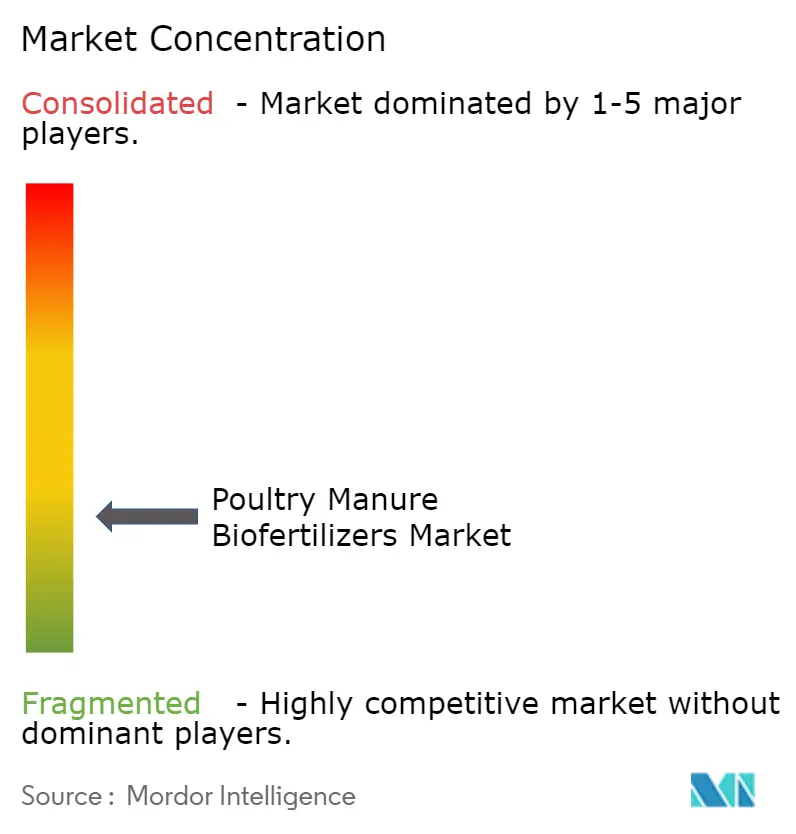
| Market Concentration | Low |
Major Players *Disclaimer: Major Players sorted in no particular order Image © Mordor Intelligence. Reuse requires attribution under CC BY 4.0. | |
Poultry Manure Biofertilizers Market Analysis by Mordor Intelligence
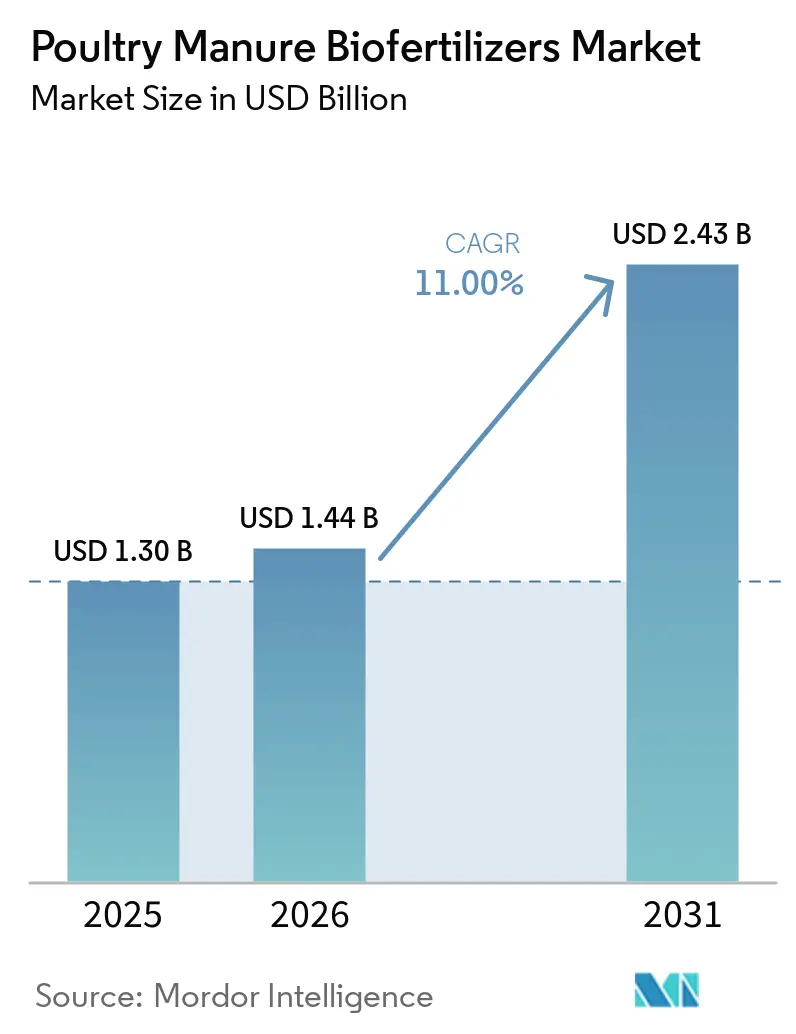
The poultry manure biofertilizers market is projected to grow from USD 1.30 billion in 2025 to USD 1.44 billion in 2026, and USD 2.43 billion by 2031, with a CAGR of 11% during the 2026-2031 period. Growth drivers include increased carbon border levies on synthetic fertilizers, mandates promoting regenerative agriculture, and the economic benefits of waste valorization in the poultry industry, which sustain long-term demand. North America held a significant share of the market revenue, while the Asia-Pacific region is projected to experience rapid growth, supported by subsidy programs and rising organic food consumption in countries such as India and China. Technological advancements, such as converting raw poultry litter into pathogen-free pellets or liquids, along with carbon-credit monetization models, are broadening the market's addressable acreage. Competitive intensity remains low, as regional composters, poultry integrators, and microbial-blend specialists each hold single-digit market shares, presenting opportunities for market consolidation and differentiation through customized microbial consortia.
Key Report Takeaways
By type, solid biofertilizers held the largest market share in the poultry manure biofertilizers market, accounting for 58% in 2025. Meanwhile, the liquid biofertilizers market is projected to grow at the fastest 13.8% CAGR from 2026 to 2031.
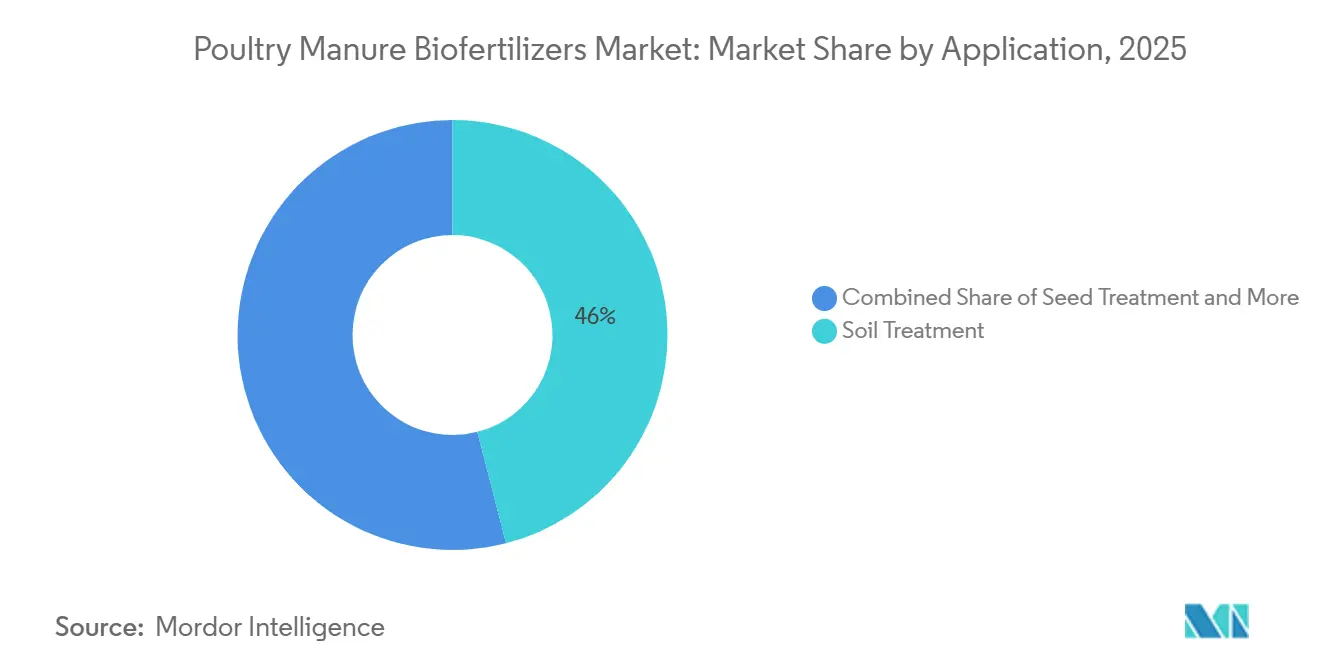
By Application, soil treatment held the largest market share of 46% in 2025, and its market size is projected to expand at the fastest 13.1% CAGR during 2026 to 2031.
By Crop Type, cereals held the largest market share in the poultry manure biofertilizers market, accounting for 39% in 2025, whereas the market size of fruits and vegetables is projected to grow at the fastest 14.2% CAGR from 2026 to 2031.
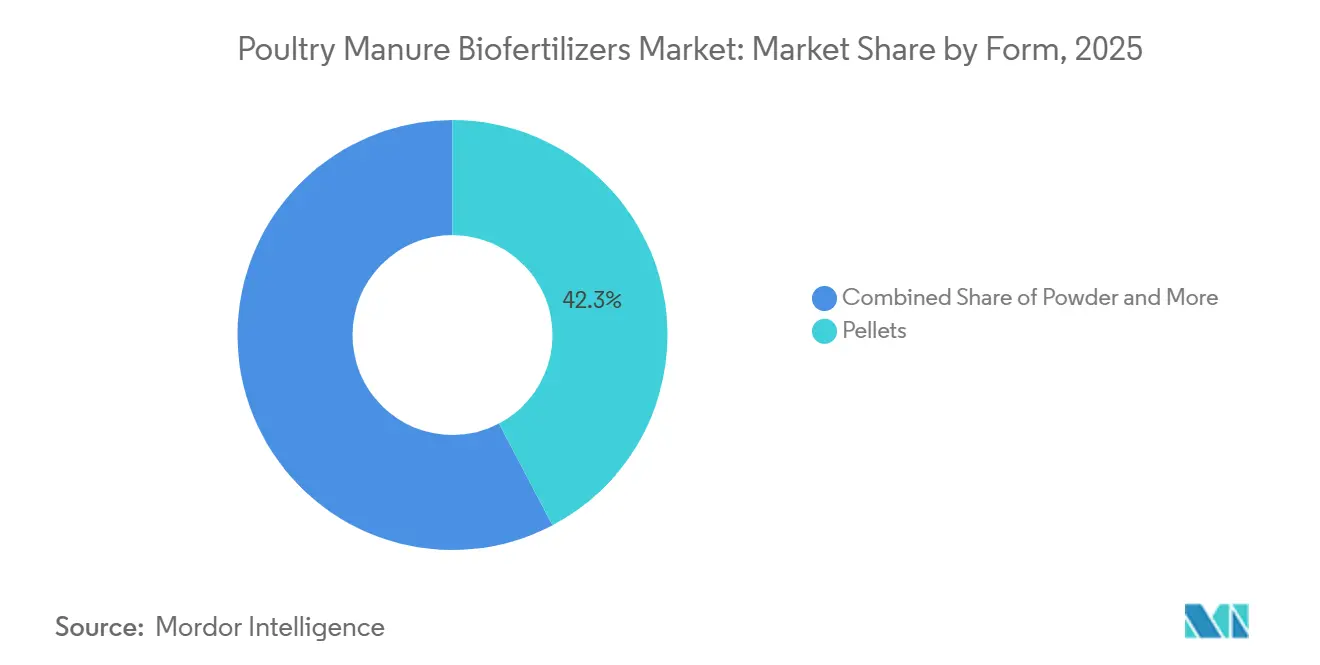
By Form, pellets held the largest market share in the poultry manure biofertilizers market, accounting for 42.3% in 2025, while the liquid suspension market size is projected to grow at the fastest 14.5% CAGR from 2026 to 2031.
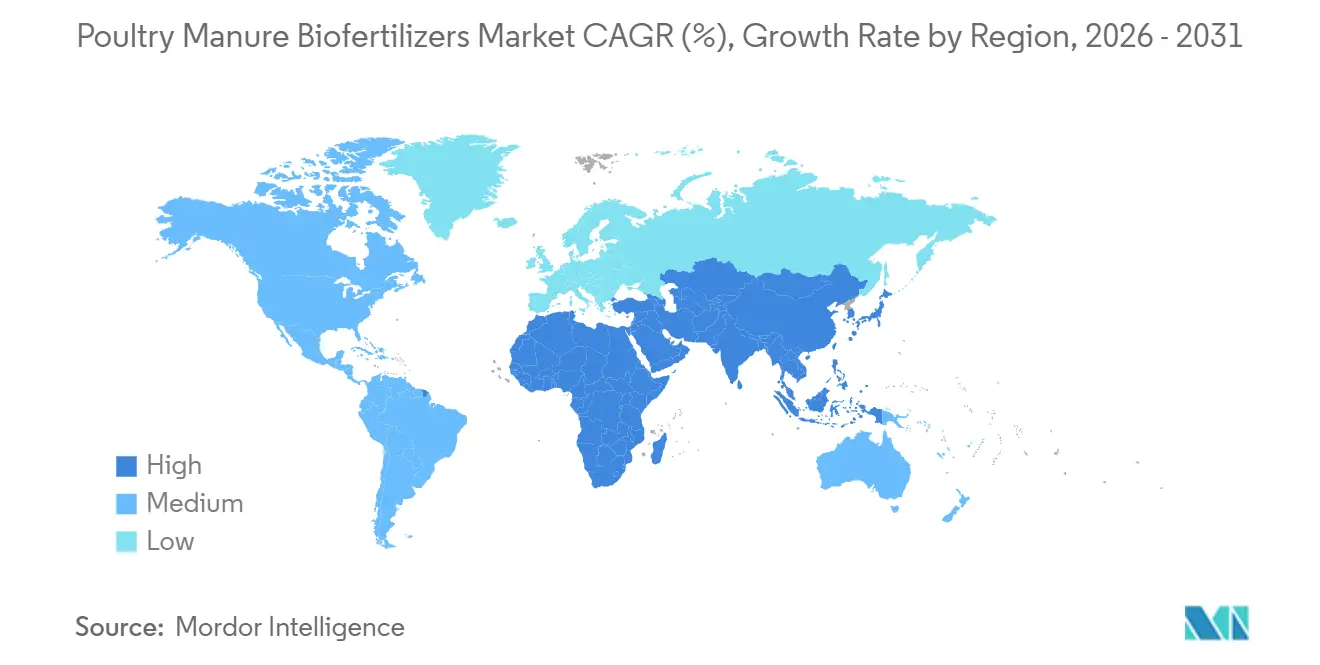
By Geography, North America accounted for the largest market share of 35% in 2025, whereas the Asia-Pacific market size is projected to expand at the fastest 14% CAGR from 2026 to 2031.
Note: Market size and forecast figures in this report are generated using Mordor Intelligence’s proprietary estimation framework, updated with the latest available data and insights as of January 2026.
Market Trends and Insights
Drivers Impact Analysis of Poultry Manure Biofertilizers Market*
| Driver | (~) % Impact on CAGR Forecast | Geographic Relevance | Impact Timeline |
|---|---|---|---|
| Widespread shift toward regenerative agriculture practices | +2.1% | Global, especially North America and Europe | Medium term (2-4 years) |
| Regulatory push to cut synthetic-fertilizer carbon footprints | +1.8% | Europe, North America, and China | Short term (≤ 2 years) |
| Poultry waste-management savings boost feedstock supply | +1.5% | North America, India, and China | Long term (≥ 4 years) |
| Adoption of pelleting and fermentation for pathogen-free products | +1.9% | United States, Netherlands, and Australia | Medium term (2-4 years) |
| Emergence of customized microbial blends from chicken litter | +1.4% | Asia-Pacific, Brazil, and Australia | Long term (≥ 4 years) |
| Carbon-credit monetization models for manure-based fertilizers | +1.2% | Europe, North America, and South America | Long term (≥ 4 years) |
| Source: Mordor Intelligence | |||
Widespread Shift Toward Regenerative Agriculture Practices
Corporate-led regenerative agriculture initiatives are driving increased demand for organic soil inputs, including poultry manure biofertilizers. For example, Unilever has adopted regenerative practices across 130,000 hectares as of 2024, with a target of 550,000 hectares by 2027 [1]. Similarly, PepsiCo plans to implement regenerative farming practices across 7 million acres (approximately 2.8 million hectares) by 2030. This large-scale shift toward soil restoration and reduced-chemical input systems is boosting reliance on organic nutrient sources, such as poultry manure-based biofertilizers, which are essential for improving soil health, enhancing microbial activity, and supporting long-term agricultural sustainability.
Regulatory Push to Cut Synthetic-Fertilizer Carbon Footprints
Climate policies are increasing the pressure to lower emissions from synthetic fertilizers, driving a transition toward organic soil inputs. The European Union’s Carbon Border Adjustment Mechanism (CBAM), effective from January 1, 2026, imposes a carbon cost on imports of emission-intensive products to align with EU climate standards [2]. This regulatory change raises compliance costs for conventional fertilizers and promotes the use of low-carbon nutrient sources. Consequently, farmers and suppliers are increasingly adopting low-carbon, nutrient-rich organic alternatives to remain cost-effective while meeting sustainability and emissions-reduction goals.
Poultry Waste-Management Savings Boost Feedstock Supply
The conversion of poultry waste into biofertilizers is gaining recognition as a cost-effective waste management strategy that benefits producers. Through waste-to-value models, poultry operators can transform manure into commercially viable agricultural inputs, reducing disposal costs and ensuring compliance with environmental regulations. Government initiatives further support this shift by promoting on-farm production of organic inputs and encouraging the circular utilization of resources. This method provides a consistent supply of feedstock while enhancing farm economics.
Adoption of Pelleting and Fermentation for Pathogen-Free Products
Technological advancements, including pelleting and anaerobic fermentation, are improving the safety, consistency, and usability of manure-based biofertilizers. These methods facilitate pathogen removal, odor reduction, and nutrient stabilization, making the products more suitable for use in commercial agriculture and high-value crops. Enhanced processing techniques also streamline storage, transportation, and application, addressing key challenges linked to raw manure. As product quality and reliability advance, farmer confidence and regulatory approvals are increasing accordingly.
Restraints Impact Analysis of Poultry Manure Biofertilizers Market*
| Restraint | (~) % Impact on CAGR Forecast | Geographic Relevance | Impact Timeline |
|---|---|---|---|
| Nutrient-content variability across poultry litter batches | -1.3% | Global, acute, where diets vary | Medium term (2-4 years) |
| Odor and logistics challenges in long-distance transport | -0.9% | North America and Europe | Short term (≤ 2 years) |
| Growth of controlled-release synthetic fertilizers mimicking organic nutrients | -1.1% | Mechanized farms worldwide | Medium term (2-4 years) |
| Slow farmer adoption in mechanized cereal regions due to application limits | -0.7% | North America Corn Belt and European wheat zones | Long term (≥ 4 years) |
| Source: Mordor Intelligence | |||
Nutrient-Content Variability Across Poultry Litter Batches
The inconsistent nutrient composition of poultry manure biofertilizers presents a major challenge for their effective utilization, especially in precision agriculture systems. Variability in factors such as feed composition, bird type, storage conditions, and handling practices leads to fluctuations in key nutrients, such as nitrogen and phosphorus. This inconsistency complicates the accurate calculation of application rates, increasing the likelihood of nutrient imbalances, reduced crop productivity, and environmental risks. Furthermore, inconsistent product quality undermines farmer confidence and hinders large-scale commercial adoption.
Odor and Logistics Challenges in Long-Distance Transport
Transporting poultry manure over long distances poses significant operational and economic challenges, limiting its scalability in broader markets. The material's high bulk density and moisture content make handling and transportation difficult, while strong odors complicate storage, movement, and community acceptance. As a result, distribution is typically restricted to nearby agricultural areas, reducing the practicality of long-distance trade. Additionally, logistical inefficiencies and elevated transportation costs make it less competitive than more concentrated, easily transportable alternatives.
*Our forecasts treat driver/restraint impacts as directional, not additive. The impact forecasts reflect baseline growth, mix effects, and variable interactions.
Poultry Manure Biofertilizers Market Segment Analysis
By Type:
Liquid Formulations Gain Fertigation TractionSolid biofertilizers held the largest 58% of the poultry manure biofertilizers market share in 2025, primarily due to their compatibility with conventional spreading equipment and established composting infrastructure. These products are widely used in cereals and pasture systems, where bulk application is cost-effective and operationally efficient. Their stability, long shelf life, and ease of transport make them well-suited for large-scale farming operations. Demand remains strong in regions with significant poultry production and integrated crop systems, where manure recycling supports sustainable nutrient management and ensures consistent improvements in soil fertility across multiple cropping cycles.
The liquid biofertilizers market size is projected to grow at a robust CAGR of 13.8% from 2026 to 2031, driven by the increasing adoption of fertigation systems in greenhouse and high-value crop production. Liquid formulations enable precise nutrient delivery, reduced odor, and improved absorption efficiency, making them particularly suitable for drip irrigation systems. Advances in fermentation and filtration technologies are enhancing product consistency and safety, addressing earlier challenges associated with raw manure use. Adoption is notably increasing in controlled-environment agriculture, where growers prioritize efficiency and uniform nutrient distribution to maximize yield and crop quality.
By Application:
Soil Treatment Dominates Amid Precision GainsSoil treatment accounted for the largest 46% of the poultry manure biofertilizers market share in 2025, driven by its role in enhancing soil structure, organic matter content, and microbial activity. This method aligns with regenerative agriculture practices and government-supported organic farming initiatives that focus on improving soil carbon levels and ensuring long-term productivity. Broadacre farmers favor soil incorporation for its compatibility with existing equipment and its ability to deliver balanced nutrients over time. Additionally, this approach supports moisture retention and nutrient cycling, making it a preferred option for cereals and other large-scale cropping systems.
The soil treatment market size is projected to grow at the fastest 13.1% CAGR from 2026 to 2031. This growth is attributed to the increasing adoption of sustainable farming practices and policy incentives encouraging the use of organic inputs. Concurrently, seed treatment and foliar applications are gaining popularity, supported by advancements in precision agriculture. Liquid biofertilizers, in particular, facilitate targeted nutrient delivery during critical growth stages, enhancing germination and plant development. These applications are especially significant in horticulture and high-value crops, where efficient and controlled nutrient use is crucial for optimizing yields and maintaining crop quality standards.
By Crop Type:
Fruits and Vegetables Lead GrowthCereals accounted for the largest 39% of the poultry manure biofertilizer market share in 2025, driven by their extensive cultivation areas and established manure application practices. Poultry manure biofertilizers supply essential nutrients such as nitrogen, phosphorus, and potassium, which are critical for maintaining soil fertility in large-scale cereal production systems. Their usage is particularly significant in regions with integrated livestock and crop farming systems, where manure recycling helps reduce input costs and promotes sustainability. Additionally, bulk application methods and compatibility with conventional farming practices contribute to the strong demand for cereals.
The market for fruits and vegetables is projected to grow at the fastest CAGR of 14.2% from 2026 to 2031, driven by rising demand for organic produce and higher profitability per acre. Horticulture growers are increasingly adopting poultry-based biofertilizers to meet organic certification standards and enhance soil health. Liquid formulations and controlled nutrient delivery systems are particularly effective for these crops, enabling precise application and improved nutrient absorption. This trend is further supported by consumer preferences for residue-free produce and retailer-driven sustainability requirements across global supply chains.
By Form:
Pellets Balance Handling and Nutrient DensityPellets accounted for the largest market share of 42.3% of the poultry manure biofertilizers market in 2025, driven by their balanced nutrient density, ease of handling, and compatibility with conventional spreading equipment. Pelletized biofertilizers offer reduced moisture content, improved storage stability, and minimized odor, making them well-suited for large-scale distribution. Their uniform size ensures consistent application rates, which is essential for broadacre farming systems. Adoption remains robust in cereals and pasture applications, where growers focus on operational efficiency and cost-effective nutrient delivery across extensive agricultural areas.
The liquid suspension market is projected to grow at the fastest CAGR of 14.5% from 2026 to 2031, supported by the increasing adoption of precision agriculture and fertigation systems. Liquid formulations enable real-time nutrient management and integration with irrigation infrastructure, enhancing efficiency and reducing waste. Technological advancements in processing and stabilization are improving product quality and shelf life. These formulations are gaining popularity in greenhouse and horticulture segments, where controlled nutrient application and uniform distribution are essential for achieving higher productivity and consistent crop performance.
Geography Analysis
North America Poultry Manure Biofertilizers Market
North America accounted for the largest market share of 35% of the poultry manure biofertilizers market in 2025, driven by robust poultry production and well-established manure utilization systems. The region benefits from integrated crop and livestock farming, enabling efficient recycling of poultry waste into biofertilizers. Infrastructure for composting, pelletization, and distribution facilitates large-scale adoption across cereals and pasture systems. Additionally, government-backed nutrient management programs and transport incentives enhance economic feasibility, reinforcing the region's market dominance. High awareness of sustainable agriculture practices and soil health management sustains consistent demand across major agricultural states and provinces.
APAC Poultry Manure Biofertilizers Market
The Asia-Pacific market size is projected to grow at the fastest 14% CAGR from 2026 to 2031. This growth is driven by government subsidies, increasing adoption of organic farming, and rising demand for sustainable agricultural inputs. Countries such as India and China are actively promoting biofertilizer use through national programs and policies to reduce reliance on chemical fertilizers. The expansion of greenhouse farming and horticulture production is accelerating the adoption of liquid biofertilizer formulations. Additionally, a growing population and increasing food demand are driving the adoption of efficient nutrient management practices, supporting rapid growth across both smallholder and commercial farming systems in the region.
EMEA and South America Poultry Manure Biofertilizers Market
Regional dynamics highlight disparities in infrastructure and investment across markets. Developed regions maintain strong adoption of advanced technologies, while emerging regions focus on expanding basic capacities. Europe, South America, and other emerging regions exhibit steady adoption, supported by regulatory frameworks and sustainability initiatives. Policies promoting low-emission fertilizers and organic farming practices encourage the use of poultry-based biofertilizers. In countries like Brazil and Argentina, localized production and processing capabilities are actively supported. Meanwhile, the Middle East and Africa are gradually adopting manure-based fertilizers in horticulture and plantation crops, contributing to broader global market penetration.
Competitive Landscape
The market is fragmented, with a defined group of players competing in areas such as feedstock sourcing, processing technologies, and distribution networks. Key players include Hello Nature International, EnviroKure, Inc., Komeco B.V., Sustane Natural Fertilizer, Inc., and Sigma AgriScience, LLC. These companies maintain strong market positions through established product portfolios and a reliable supply of manure-based biofertilizers across major agricultural regions. Their strategies emphasize expanding production capacity, enhancing product quality, and aligning with sustainability-focused farming practices, facilitating adoption in both organic and conventional agricultural systems globally.
Technological advancements remain a critical competitive factor, with companies prioritizing improvements in nutrient consistency, pathogen reduction, and application efficiency. Firms such as Ductor Oy and Darling Ingredients Inc. are investing in advanced processing and fermentation technologies to enhance product performance and scalability. Innovations in pelleting and liquid formulations are enabling better integration with modern farming practices, including precision agriculture and fertigation. These advancements are improving usability and nutrient delivery efficiency, helping companies meet evolving agronomic needs and strengthen their presence across diverse crop segments and geographic markets.
Distribution strategies and digital integration are increasingly influencing competitive dynamics by enhancing accessibility and supply chain efficiency. Companies are focusing on direct-to-farm networks and partnerships to bolster regional presence and customer reach. In January 2024, Darling Ingredients finalized the acquisition of Miropasz Group, a Polish poultry by-product rendering company with multiple processing facilities. This acquisition enhanced Darling Ingredients' ability to transform poultry waste into value-added products such as feed ingredients, low-carbon feedstocks, and organic fertilizer inputs [3]. This reflects a broader industry trend toward vertical integration and nutrient recycling.
Poultry Manure Biofertilizers Industry Leaders
-
Hello Nature International
-
EnviroKure, Inc.
-
Komeco B.V.
-
Sustane Natural Fertilizer, Inc.
-
Sigma AgriScience, LLC.
- *Disclaimer: Major Players sorted in no particular order
Poultry Manure Biofertilizers Market Companies Covered in this Report
- EnviroKure, Inc.
- Hello Nature International
- Ductor Oy
- Sigma AgriScience, LLC.
- Australian Bio-Fert Pty Ltd
- Perfect Blend, LLC
- Kreher Family Farms, Inc.
- Komeco B.V.
- Rocky Point Pty Ltd
- Darling Ingredients Inc.
- The DeLong Co., Inc.
- FOMET S.p.A.
- Stutzman Environmental Products, Inc.
Recent Industry Developments in Poultry Manure Biofertilizers Market
- December 2025: Ductor Oy collaborated with Weaver Brothers Eggs to develop a renewable natural gas and organic fertilizer project in Ohio. This initiative uses poultry manure as a feedstock, enhancing Ductor Oy's biofertilizer production capabilities in North America.
- December 2024: Hello Nature International commenced operations at a new 300,000-square-foot organic fertilizer facility in Wabash, Indiana, developed in collaboration with MPS Egg Farms. The plant has an annual production capacity of 150,000 metric tons of organic fertilizers and biosolutions, utilizing poultry manure as the primary feedstock.
- October 2024: EnviroKure, Inc. expanded its poultry manure bioconversion operations in Ohio, utilizing patented hydrodynamic technology to transform chicken manure into biofertilizers and biostimulants for sustainable agriculture. The company also conducted commercial crop trials to enhance soil health, nutrient efficiency, and farm productivity.
Global Poultry Manure Biofertilizers Market Report Scope
Poultry manure biofertilizers are organic fertilizers derived from processed poultry waste using microbial or biological methods to enhance nutrient availability for plants. These biofertilizers improve soil fertility, structure, and microbial activity, supporting sustainable agriculture by promoting efficient nutrient recycling and reducing dependence on chemical fertilizers. The poultry manure biofertilizers market report is segmented by type (solid biofertilizers and liquid biofertilizers), by application (soil treatment, seed treatment, and foliar application), by crop type (cereals, oilseeds and pulses, fruits and vegetables, and other crops), by form (pellets, powder, granules, and liquid suspension), and by geography (North America, South America, Europe, Asia-Pacific, Middle East, and Africa). The market forecasts are provided in terms of value (USD).
Segmentation Overview
| Solid Biofertilizers |
| Liquid Biofertilizers |
| Soil Treatment |
| Seed Treatment |
| Foliar Application |
| Cereals |
| Oilseeds and Pulses |
| Fruits and Vegetables |
| Other Crops |
| Pellets |
| Powder |
| Granules |
| Liquid Suspension |
| North America | United States |
| Canada | |
| Mexico | |
| Rest of North America | |
| South America | Brazil |
| Argentina | |
| Rest of South America | |
| Europe | Germany |
| France | |
| Russia | |
| Rest of Europe | |
| Asia-Pacific | China |
| India | |
| Australia | |
| Rest of Asia-Pacific | |
| Middle East | Saudi Arabia |
| United Arab Emirates | |
| Rest of Middle East | |
| Africa | South Africa |
| Kenya | |
| Rest of Africa |
| By Type | Solid Biofertilizers | |
| Liquid Biofertilizers | ||
| By Application | Soil Treatment | |
| Seed Treatment | ||
| Foliar Application | ||
| By Crop Type | Cereals | |
| Oilseeds and Pulses | ||
| Fruits and Vegetables | ||
| Other Crops | ||
| By Form | Pellets | |
| Powder | ||
| Granules | ||
| Liquid Suspension | ||
| By Geography | North America | United States |
| Canada | ||
| Mexico | ||
| Rest of North America | ||
| South America | Brazil | |
| Argentina | ||
| Rest of South America | ||
| Europe | Germany | |
| France | ||
| Russia | ||
| Rest of Europe | ||
| Asia-Pacific | China | |
| India | ||
| Australia | ||
| Rest of Asia-Pacific | ||
| Middle East | Saudi Arabia | |
| United Arab Emirates | ||
| Rest of Middle East | ||
| Africa | South Africa | |
| Kenya | ||
| Rest of Africa | ||
Key Questions Answered in the Report
What is the projected value of the poultry manure biofertilizers market by 2031?
The market is forecast to reach USD 2.43 billion by 2031.
Which region will register the fastest growth through 2031?
Asia-Pacific market size for poultry manure biofertilizers is set to grow at the fastest 14% CAGR from 2026 to 2031.
Why are liquid poultry manure biofertilizers gaining popularity?
Fermented liquids such as ACL 5-0-0 integrate with drip irrigation, carry near-zero odor, and deliver 5% ammoniacal nitrogen, making them ideal for greenhouse and high-value crops.
What limits adoption in large-scale cereal farming?
Pellets contain only 3-5% nitrogen, so logistic and application costs remain higher than for anhydrous ammonia, slowing uptake on mechanized grain acres.