
Poly Alpha Olefin Market Size and Share
Market Overview
| Study Period | 2021 - 2031 |
|---|---|
| Market Size (2026) | USD 4.57 Billion |
| Market Size (2031) | USD 5.31 Billion |
| Growth Rate (2026 - 2031) | 3.06 % |
| Fastest Growing Market | Asia-Pacific |
| Largest Market | Asia-Pacific |
| Market Concentration | High |
Major Players *Disclaimer: Major Players sorted in no particular order Image © Mordor Intelligence. Reuse requires attribution under CC BY 4.0. | |
Poly Alpha Olefin Market Analysis by Mordor Intelligence
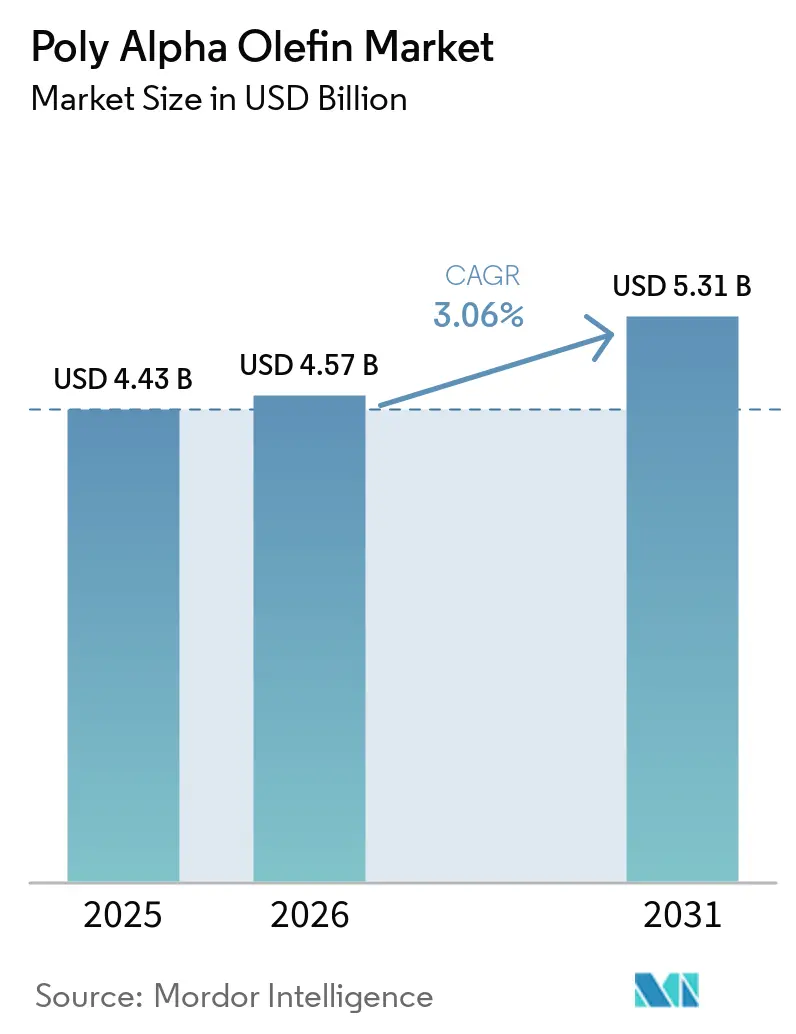
The Poly Alpha Olefin Market size was valued at USD 4.43 billion in 2025 and is estimated to grow from USD 4.57 billion in 2026 to reach USD 5.31 billion by 2031, at a CAGR of 3.06% during the forecast period (2026-2031). The poly alpha olefin market is separating into two demand areas, with Group III base oils gaining in cost-sensitive automotive formulations while poly alpha olefin (PAO) supports higher-performance applications. Battery electric vehicle e-fluids, data-center immersion cooling, and heavy industrial machinery are creating demand where dielectric strength, thermal stability, and low volatility are important. Specialty-grade PAO carries a 20%–30% price premium over standard grades because applications require tighter dielectric, thermal, and volatility specifications. Capacity investments and formulation work are therefore centered on low-viscosity e-fluids and high-viscosity industrial grades, even as commodity applications remain exposed to lower-cost alternatives. The poly alpha olefin market also faces pressure from high base-stock costs and a growing supply of Group III oils, which makes application-specific performance and original equipment manufacturer approvals more important.
Key Report Takeaways
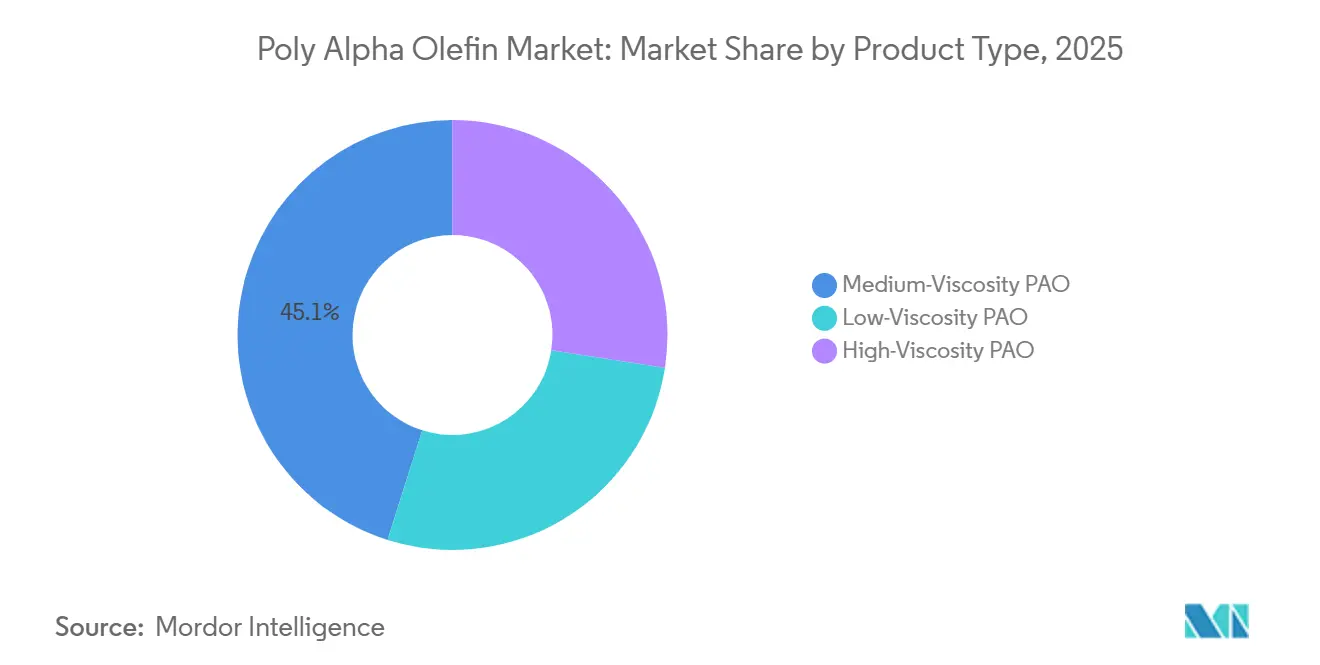
- By product type, medium-viscosity PAO held 45.12% of the poly alpha olefin market share in 2025, while high-viscosity PAO is projected to advance at a 3.56% CAGR through 2031.
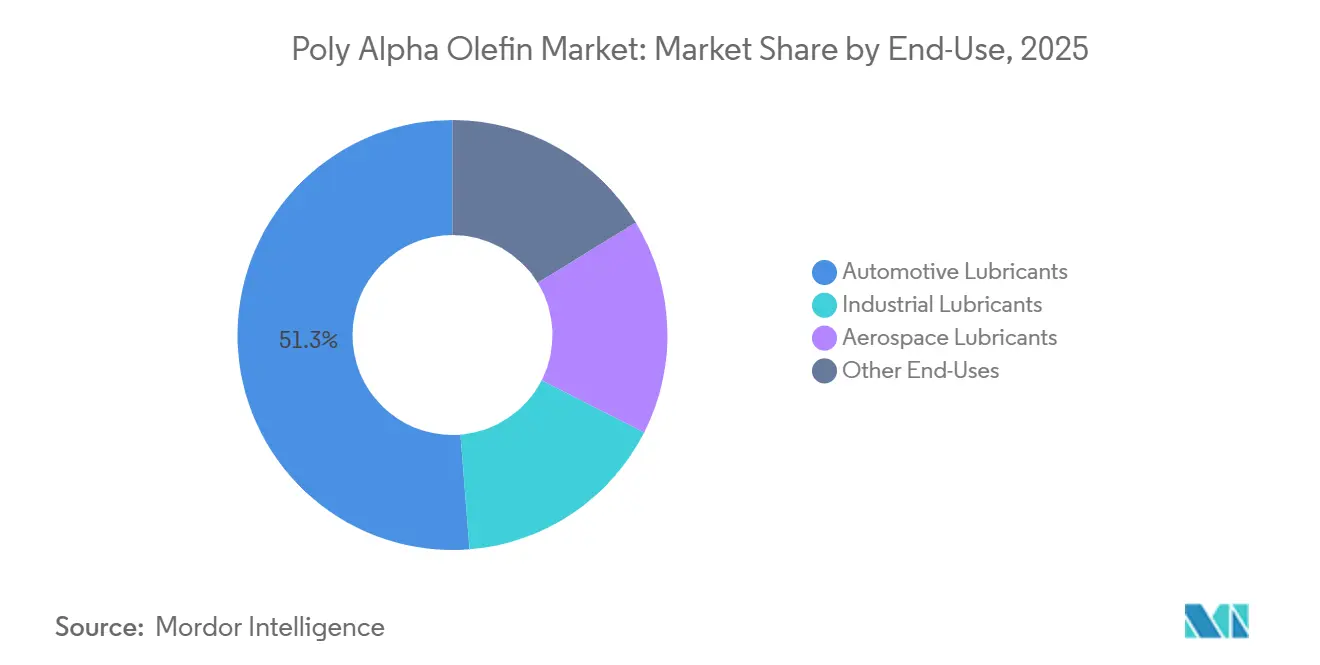
- By end-use, automotive lubricants held 51.26% of the poly alpha olefin market share in 2025, while industrial lubricants are projected to advance at a 3.92% CAGR through 2031.
- By geography, Asia-Pacific held 35.77% of the poly alpha olefin market share in 2025 and is projected to advance at a 3.61% CAGR through 2031.
Note: Market size and forecast figures in this report are generated using Mordor Intelligence’s proprietary estimation framework, updated with the latest available data and insights as of January 2026.
Global Poly Alpha Olefin Market Trends and Insights
Drivers Impact Analysis*
| Driver | (~) % Impact on CAGR Forecast | Geographic Relevance | Impact Timeline |
|---|---|---|---|
| Rising Demand for Full-Synthetic Lubricants | +1.0% | Global, with strongest pull in North America, Europe, and China | Long term (≥ 4 years) |
| EV E-Drive and Battery Thermal-Management Fluid Adoption | +0.8% | Global; concentrated in China, Europe, and North America EV production corridors | Medium term (2–4 years) |
| Longer Drain Intervals and Equipment-Life Requirements | +0.6% | Global, with pronounced effect in North America (heavy-duty trucking) and APAC (industrial) | Long term (≥ 4 years) |
| Industrial Automation and High-Performance Machinery | +0.5% | APAC core, spillover to North America and Europe | Medium term (2–4 years) |
| Expansion of Data-Center Immersion Cooling | +0.4% | North America & APAC (hyperscale hubs), spillover to EU | Short term (≤ 2 years) |
| Source: Mordor Intelligence | |||
Rising Demand for Full-Synthetic Lubricants
The shift from mineral and semi-synthetic lubricants toward full-synthetic products supports demand for PAO across passenger vehicles, commercial transport, and industrial equipment, where heat, oxidation, and long service periods can limit the suitability of conventional oils. Higher original equipment manufacturer standards are raising the performance requirements for the most demanding uses and are increasingly applied across multiple vehicle brands rather than isolated product lines. TotalEnergies reported that Stellantis expanded its lubricant partnership across 10 vehicle brands in 2026, reflecting the importance of approved high-performance formulations[1]TotalEnergies Lubricants, “TotalEnergies and Stellantis Strengthen and Expand Their Partnership with High-Performance Engine Oils,” TotalEnergies Lubricants, lubricants.totalenergies.com. The poly alpha olefin market benefits when specification changes leave less room for lower-performing base oils in premium applications, including products exposed to higher operating temperatures or longer drain intervals. Formulators that obtain approvals early can retain an advantage because competitors need time to develop, test, and approve comparable products across the required hardware and operating conditions.
EV E-Drive and Battery Thermal-Management Fluid Adoption
Electric vehicles require low-viscosity fluids that can lubricate integrated e-module gearboxes while managing heat from motor windings and battery systems in a compact powertrain layout. Synthetic polyalphaolefins have thermal stability, viscosity characteristics, and electrical compatibility with copper windings and polymeric insulators that suit these applications. These requirements differ from those for legacy passenger-car motor oils because electrical properties, heat transfer, and material compatibility now matter alongside lubrication performance. Exxon Mobil Corporation is developing novel PAO molecules for e-mobility formulations, including sub-2 cSt grades intended to improve thermal efficiency and dielectric performance. The poly alpha olefin market can gain demand from e-fluid specifications that are tied to particular vehicle platforms, rather than only from broader automotive oil consumption. Once an original equipment manufacturer specifies a fluid chemistry in an e-module, replacement demand can continue throughout the vehicle’s operating life, and formulation changes can require substantial qualification work.
Longer Drain Intervals and Equipment-Life Requirements
Longer drain intervals reduce the frequency of lubricant changes but increase the performance requirement placed on each oil fill, particularly where equipment works continuously or operates in difficult thermal conditions. Cummins Inc. reported field data supporting 100,000-mile oil drain intervals for its 2027 X15 heavy-duty engine program[2]Cummins Inc., “Not the Razor’s Edge: Data Powers 100,000-Mile Oil Drain Intervals for 2027 X15,” Cummins News, selfscreening.cummins.com. The poly alpha olefin market gains when extended service intervals require stronger thermal and oxidation resistance than conventional oils can provide, even though each asset uses oil less frequently. Maintenance contractors also have a direct interest in avoiding equipment failures and unplanned fluid changes because they may bear the operational cost of a failure and the disruption to a customer’s operations. This shifts lubricant selection toward formulations that may cost more initially but reduce downtime, service labor, and the number of scheduled interventions over an asset’s life. The resulting decision is based on equipment reliability and service planning rather than the purchase price of a single oil fill.
Industrial Automation and High-Performance Machinery
Robotics, semiconductor equipment, and high-speed compressors operate under thermal cycling, wide temperature ranges, and contamination-sensitive conditions that place a high burden on lubricants. These conditions increase the need for stable lubricant performance over extended service periods and reduce the tolerance for changes in viscosity or deposits. The poly alpha olefin market supports machinery applications where Group III base oils may not consistently meet demanding operating requirements over the intended maintenance interval. China’s manufacturing modernization is increasing the use of advanced equipment that specifies synthetic base stocks in automotive, machinery, and electronics production. This supports demand for precision-performance lubricants in automated factories, where an unplanned shutdown can affect output from several connected systems. Data-center immersion cooling adds a related application because operators need dielectric fluids that manage heat without creating electrical risk in closely packed computing equipment.
Restraints Impact Analysis*
| Restraint | (~) % Impact on CAGR Forecast | Geographic Relevance | Impact Timeline |
|---|---|---|---|
| Higher Cost Compared with Group III and Mineral Oils | -0.6% | Global; most acute in price-sensitive Asian and Latin American markets | Long term (≥ 4 years) |
| Competition From Alternative Synthetic Base Stocks | -0.5% | Global; concentrated in North America and Europe where Group III supply is deepest | Medium term (2–4 years) |
| Linear Alpha-Olefin Feedstock Price Volatility | -0.4% | Global, with highest exposure in North America and Europe where PAO producers rely on merchant LAO supply | Short term (≤ 2 years) |
| Source: Mordor Intelligence | |||
Higher Cost Compared with Group III and Mineral Oils
PAO typically carries a 40%–60% price premium over Group III base oils for comparable viscosity grades, creating a clear obstacle in applications where the required performance level is lower. Passenger-car motor oils and fleet engine oils give formulators a strong incentive to maximize Group III content where product specifications permit. LANXESS announced a 7% increase in Synton PAO base-stock prices in July 2026, citing energy, raw-material, and logistics costs. The poly alpha olefin market is therefore more resilient in industrial and commercial transport applications, where buyers can evaluate lifetime operating costs, equipment uptime, and fluid change frequency together. The benefit of fewer oil changes and less downtime is harder to communicate to passenger-car consumers, whose choice commonly follows an original equipment manufacturer recommendation rather than a detailed cost comparison.
Competition From Alternative Synthetic Base Stocks
Group III and Group III+ base oils compete with PAO in automotive and industrial applications where specifications do not require the full performance range of Group IV materials. Their lower cost can encourage formulators to use the maximum Group III content permitted by an approved formulation. The competitive pressure is strongest in North America and Europe, where supply is deep, and blenders have established access to alternative synthetic base stocks. This keeps the poly alpha olefin market focused on applications where thermal stability, dielectric performance, or extended service life creates a clear technical distinction. It also makes original equipment manufacturer approvals and application-specific performance more valuable than broad commodity availability. PAO suppliers can defend demand most effectively when a lower-cost substitution would introduce a performance or qualification risk for the end user.
*Our forecasts treat driver/restraint impacts as directional, not additive. The impact forecasts reflect baseline growth, mix effects, and variable interactions.
Segment Analysis
By Product Type: Medium-Viscosity PAO Leads, While High-Viscosity PAO Accelerates
Medium-viscosity PAO held 45.12% of the poly alpha olefin market in 2025. Its established role covers automotive engine oils, industrial gear oils, hydraulic fluids, and compressor lubricants. These applications require stable viscosity across a broad temperature range and compatibility with additive packages. High-viscosity PAO is projected to advance at a 3.56% CAGR through 2031, supported by wind-turbine gearboxes and heavy industrial gear systems. These systems require film thickness, shear stability, and low pour points that metallocene-produced grades can provide. Exxon Mobil Corporation offers its SpectraSyn Elite metallocene PAO platform in 65 cSt, 150 cSt, and 300 cSt grades for demanding formulations.
Low-viscosity PAO includes 2–6 cSt grades used in electric-vehicle drivelines, immersion cooling, and metalworking fluids. Chevron Phillips Chemical Company LLC expanded its Beringen facility to 120,000 metric tons per year, making it Europe’s largest decene-based low-viscosity PAO facility. The project targets products requiring low volatility and high purity, which are important where a fluid must manage heat or operate close to electrical components. INEOS also operates a 120,000-metric-ton-per-year low-viscosity PAO unit at Chocolate Bayou, Texas. These investments show that the poly alpha olefin industry is directing capacity toward grades used in emerging technical applications, rather than only toward traditional automotive lubricant uses. Additional supply may reduce spot premiums over time, improve access for smaller formulators, and help customers qualify fluids for new e-mobility and thermal-management programs. It may also intensify competition in products that had been constrained by supply availability, particularly as more applications move from development to commercial use.



By End-Use: Automotive Lubricants Lead Revenue, While Industrial Lubricants Accelerate
Automotive lubricants held 51.26% of the poly alpha olefin market size in 2025. The segment reflects long-standing original equipment manufacturer specifications for premium passenger-car and heavy-duty engine oils. Industrial lubricants are projected to advance at a 3.92% CAGR through 2031. Wind-turbine gearbox expansion, robotics, and precision manufacturing equipment in Asia support this growth. The segment also benefits from the replacement of mineral-oil compressor lubricants with PAO-based formulations that extend service intervals. As equipment runs at higher speeds, with tighter tolerances and broader temperature ranges, performance differences between PAO and Group III products become more relevant to plant operators.
Aircraft turbine oils and hydraulic fluids need synthetic base stocks that can operate from −60 °C to +200 °C under MIL-PRF-23827 and DEF STAN 91-97 specifications. This operating range cannot be met by mineral oils. The global commercial aircraft fleet exceeded 33,000 aircraft in 2025, and Boeing 787 and Airbus A350 platforms use PAO-based hydraulic fluids over their operating lives. Global passenger traffic exceeded pre-pandemic levels in 2024, which supports continuing aviation lubricant consumption.
Geography Analysis
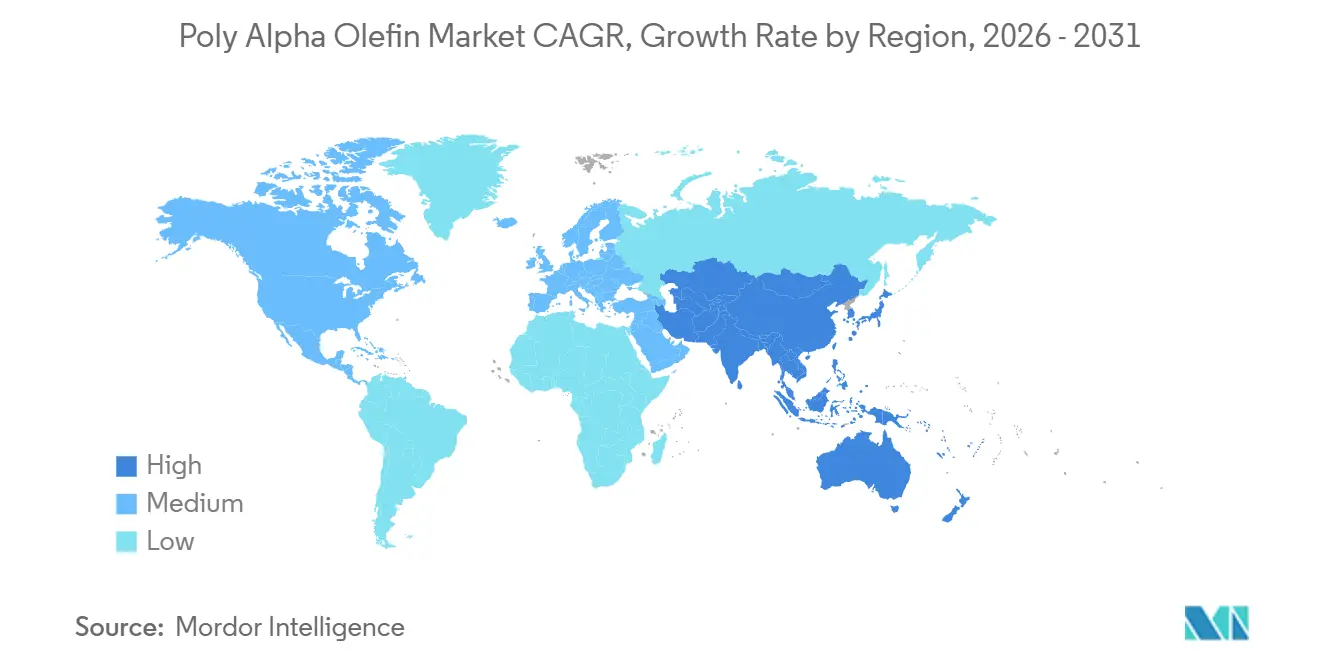
Asia-Pacific held 35.77% of the poly alpha olefin market size in 2025 and is projected to advance at a 3.61% CAGR through 2031. China’s large automotive manufacturing base, electric-vehicle adoption, and industrial modernization support the region’s demand. The region also has growing needs for advanced lubricants in machinery and electronics production. India, Japan, South Korea, and the Association of Southeast Asian Nations (ASEAN) are additional demand centers. India’s vehicle fleet and expanding pharmaceutical and electronics production support the use of high-specification synthetic lubricants.
North America is a major PAO production center, with facilities operated by INEOS, Exxon Mobil Corporation, and Chevron Phillips Chemical Company LLC along the U.S. Gulf Coast. Integrated feedstock chains, proximity to automotive manufacturers, and heavy-duty transport demand support the region’s position. Electric-vehicle platform development is also creating demand for low-viscosity grades with strong dielectric characteristics. Chevron Phillips Chemical Company LLC’s Beringen expansion supplies low-viscosity PAO for European immersion cooling and electric-vehicle applications. Europe has demanding requirements for wind-turbine gear oils, automotive original equipment manufacturer lubricants, and specialty industrial fluids.
South America and the Middle East and Africa remain smaller parts of the poly alpha olefin market. Brazil supports demand through agricultural machinery, ethanol-blended fuel engine oils, and its automotive fleet. Argentina adds specialty lubricant requirements through its industrial base. In the Middle East, infrastructure investment and regional production plans may reduce dependence on long-distance imports over time. Africa’s demand is concentrated in South Africa and Nigeria, where mining, power generation, and road transport support industrial synthetic lubricant use.

Competitive Landscape
The poly alpha olefin market is highly consolidated, with the top five players including INEOS, Exxon Mobil Corporation, Chevron Phillips Chemical Company LLC, LANXESS, and Dowpol Corporation. INEOS, Exxon Mobil Corporation, and Chevron Phillips Chemical Company LLC have integrated linear alpha-olefin-to-PAO production positions. Their production scale and feedstock integration influence product availability and pricing conditions for downstream formulators. This structure limits short-term alternatives for buyers who need qualified PAO grades. The resulting concentration favors suppliers that can combine capacity, formulation support, and reliable feedstock access.
INEOS completed a 50% expansion of its high-viscosity PAO unit in La Porte, Texas, bringing capacity to 40,000 metric tons per year by mid-2025. It also operates the 120,000-metric-ton-per-year Chocolate Bayou low-viscosity PAO unit. Chevron Phillips Chemical Company LLC completed its Beringen expansion in 2025, raising low-viscosity PAO capacity to 120,000 metric tons per year. Exxon Mobil Corporation continues work on novel PAO molecules intended for e-mobility fluids. These moves show that leaders are using both capacity additions and application-focused product development. The poly alpha olefin market is becoming more competitive in low-viscosity grades while high-viscosity performance grades remain specialized.
Downstream suppliers are also adapting theair portfolios to regulatory and application changes. FUCHS introduced its FUCHS100 strategy in 2026, centered on new mobility, sustainability, and digitalization. Intellectual property and speed of formulation are becoming more important alongside scale because end users need fluids that meet specific equipment and regulatory requirements. Competitive strategies, therefore, extend from feedstock integration to product approvals, specialized grades, and technical support for lubricant blenders and equipment customers. The value of a supplier increasingly depends on its ability to support qualification work as applications become more specialized.
Poly Alpha Olefin Industry Leaders
INEOS
Exxon Mobil Corporation
Chevron Phillips Chemical Company LLC
LANXESS
Dowpol Corporation
- *Disclaimer: Major Players sorted in no particular order


Recent Industry Developments
- April 2026: Infineum received approval for its P6895 additive technology against Stellantis’ new FPW9.55535/03 specification for automotive lubricants. The approval supports demand for high-performance lubricant formulations where PAO base oils are used to deliver improved thermal and oxidative stability.
- August 2025: Chevron Phillips Chemical Company LLC completed the expansion of its low-viscosity polyalphaolefin production unit in Beringen, Belgium, doubling capacity to 120,000 metric tons per year. The expansion increases PAO supply for automotive and industrial lubricants, as well as emerging applications such as electric vehicles, wind turbines, and immersion cooling.


Global Poly Alpha Olefin Market Report Scope
Poly alpha olefin (PAO) is a synthetic base fluid produced through the controlled polymerization of alpha olefins. It provides high thermal stability, low volatility, and good lubrication performance across a wide range of operating conditions.
The Poly Alpha Olefin Market is segmented by product type, end-use, and geography. By product type, the market is segmented into low-viscosity PAO, medium-viscosity PAO, and high-viscosity PAO. By end-use, the market is segmented into automotive lubricants, industrial lubricants, aerospace lubricants, and other end-uses. The report also covers the market size and forecasts for poly alpha olefin in 15 countries across major regions. For each segment, the market sizing and forecasts have been done on the basis of value (USD).
| Low-Viscosity PAO |
| Medium-Viscosity PAO |
| High-Viscosity PAO |
| Automotive Lubricants |
| Industrial Lubricants |
| Aerospace Lubricants |
| Other End-Uses |
| Asia-Pacific | China |
| India | |
| Japan | |
| South Korea | |
| ASEAN Countries | |
| Rest of Asia-Pacific | |
| North America | United States |
| Canada | |
| Mexico | |
| Europe | Germany |
| United Kingdom | |
| France | |
| Italy | |
| NORDIC Countries | |
| Rest of Europe | |
| South America | Brazil |
| Argentina | |
| Rest of South America | |
| Middle East and Africa | Saudi Arabia |
| South Africa | |
| Rest of Middle East and Africa |
| By Product Type | Low-Viscosity PAO | |
| Medium-Viscosity PAO | ||
| High-Viscosity PAO | ||
| By End-Use | Automotive Lubricants | |
| Industrial Lubricants | ||
| Aerospace Lubricants | ||
| Other End-Uses | ||
| By Geography | Asia-Pacific | China |
| India | ||
| Japan | ||
| South Korea | ||
| ASEAN Countries | ||
| Rest of Asia-Pacific | ||
| North America | United States | |
| Canada | ||
| Mexico | ||
| Europe | Germany | |
| United Kingdom | ||
| France | ||
| Italy | ||
| NORDIC Countries | ||
| Rest of Europe | ||
| South America | Brazil | |
| Argentina | ||
| Rest of South America | ||
| Middle East and Africa | Saudi Arabia | |
| South Africa | ||
| Rest of Middle East and Africa | ||


Key Questions Answered in the Report
What is the size of the poly alpha olefin market?
The poly alpha olefin market stands at USD 4.57 billion in 2026 and is projected to reach USD 5.31 billion by 2031.
What is driving demand for poly alpha olefins?
Full-synthetic lubricants, electric-vehicle e-fluids, longer drain intervals, industrial automation, and immersion cooling support demand.
Which product type held the largest share in 2025?
Medium-viscosity PAO led with a 45.12% share in 2025.
Which end-use is projected to advance fastest through 2031?
Industrial lubricants are projected to advance at a 3.92% CAGR through 2031, supported by wind energy, robotics, and precision manufacturing equipment.
Page last updated on:


 Your data is secure and never sold or shared.


