
Polished Concrete Market Size and Share
Market Overview
| Study Period | 2021 - 2031 |
|---|---|
| Market Size (2026) | USD 2.87 Billion |
| Market Size (2031) | USD 3.77 Billion |
| Growth Rate (2026 - 2031) | 5.59 % |
| Fastest Growing Market | Asia-Pacific |
| Largest Market | North America |
| Market Concentration | Low |
Major Players *Disclaimer: Major Players sorted in no particular order Image © Mordor Intelligence. Reuse requires attribution under CC BY 4.0. | |
Polished Concrete Market Analysis by Mordor Intelligence
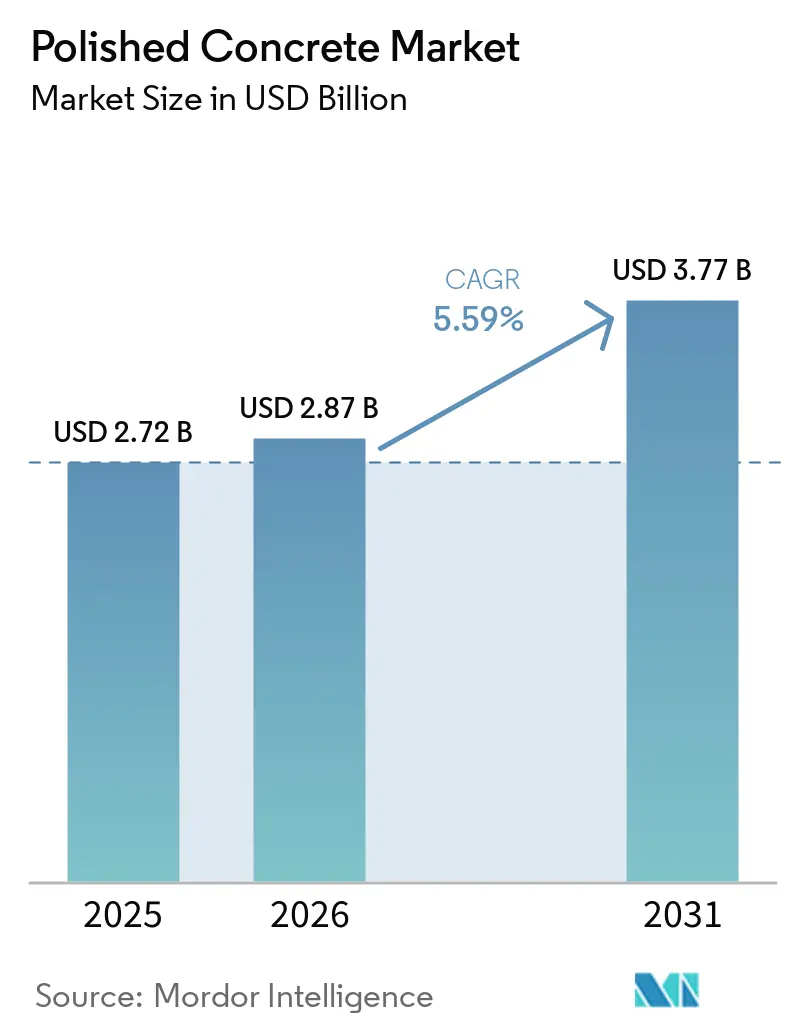
The polished concrete market size was valued at USD 2.72 billion in 2025 and is estimated to grow from USD 2.87 billion in 2026 to reach USD 3.77 billion by 2031, at a CAGR of 5.59% during the forecast period (2026-2031). The polished concrete market is driven by demand for durable flooring in logistics, manufacturing, retail, and institutional facilities. Facility operators place greater emphasis on operating costs, as polished concrete can remain in service for more than 20 years with routine cleaning and periodic re-densification. This favors systems that minimize disruptions in high-traffic buildings and reduce the need for replacement work. The market also faces pressure from cement-related carbon requirements and changes in material, energy, and tooling costs. Suppliers and contractors that combine documented environmental performance with reliable project execution are better positioned in specification-led projects.
Key Report Takeaways
- By product type, densifiers and hardeners held 36.45% of the polished concrete market share in 2025 and are forecast to expand at a CAGR of 5.96% through 2031.
- By method, dry polishing held 58.33% of the polished concrete market share in 2025 and is forecast to grow at a CAGR of 6.21% through 2031.
- By construction type, new construction accounted for 57.28% of the polished concrete market size in 2025, while renovation is forecast to expand at a CAGR of 6.43% through 2031.
- By end-user industry, non-residential facilities held 68.11% of the 2025 value and are projected to grow at the highest CAGR of 6.88% through 2031.
- By geography, North America held 37.45% of the share in 2025, and Asia-Pacific is forecast to expand at a CAGR of 6.74% through 2031.
Note: Market size and forecast figures in this report are generated using Mordor Intelligence’s proprietary estimation framework, updated with the latest available data and insights as of January 2026.
Global Polished Concrete Market Trends and Insights
Drivers Impact Analysis*
| Drivers | (~) % Impact on CAGR Forecast | Geographic Relevance | Impact Timeline |
|---|---|---|---|
| Expansion of Logistics, Manufacturing, and Distribution Facilities | +1.4% | Global, led by North America and Asia-Pacific, including China, India, and ASEAN | Short term (≤ 2 years) |
| Renovation and Remodeling of Commercial and Institutional Buildings | +1.2% | North America and Europe | Medium term (2-4 years) |
| Preference for Durable, Low-Maintenance Flooring | +1.0% | Global | Long term (≥ 4 years) |
| Demand for Sustainable and Low-Emission Flooring Systems | +0.9% | North America and Europe | Medium term (2-4 years) |
| Contractor Adoption of Automated Grinding and Polishing Equipment | +0.8% | North America and Asia-Pacific | Medium term (2-4 years) |
| Source: Mordor Intelligence | |||
Expansion of Logistics, Manufacturing, and Distribution Facilities
Logistics construction supports the polished concrete market because warehouse floors must handle forklift and automated guided vehicle traffic without frequent coating replacement. These facilities also require dust control and limited downtime to support continuous operations. More than 305 million square feet of warehouse space was under construction in the United States in Q2 2026, 18% higher than a year earlier. E-commerce, pharmaceutical cold chain, and semiconductor logistics projects increasingly require reflective, dust-controlled floor finishes. India's Production Linked Incentive programs for electronics, pharmaceuticals, and textiles support new manufacturing activity where dustless surfaces and forklift compatibility are relevant. Polished, even surfaces can also reduce forklift tire wear, adding a maintenance consideration to facility planning.
Renovation and Remodeling of Commercial and Institutional Buildings
Renovation activity provides the polished concrete market with a distinct source of demand, as owners can improve an existing slab rather than remove and replace an installed floor. The American Institute of Architects projected institutional construction spending to increase 2.8% in 2026 and commercial spending to increase 4.8% in 2026[1]American Institute of Architects, “July 2026 Consensus Construction Forecast,” American Institute of Architects, aia.org. Healthcare, office, retail, and recreation properties use renovations and repositioning to improve operational performance. In hospitals and educational buildings, polished concrete can work with hydronic radiant-floor systems and support hygiene-focused specifications. This approach can retain and radiate heat more effectively than carpet or vinyl overlays in climate-controlled spaces. Renovation also avoids adding a separate floor layer, which is relevant where owners are reviewing embodied carbon.
Preference for Durable, Low-Maintenance Flooring
Total cost of ownership is becoming more important in flooring decisions for high-traffic commercial buildings. A properly densified and polished floor can remain in service for more than 20 years with cleaning and periodic re-densification. Epoxy coatings may require stripping and reapplication after 5 to 10 years in industrial settings, while polishing maintenance can often take place during operating hours. Retailers can avoid the disruption of overnight closure for floor resurfacing. Reflective polished surfaces also improve light distribution in retail and warehouse buildings. In Japan and South Korea, 30-year lifecycle cost accounting in construction specifications supports the use of durable finishes.
Demand for Sustainable and Low-Emission Flooring Systems
Environmental documentation is becoming increasingly important in the polished concrete market for projects seeking green-building credentials. Curecrete Distribution, Inc. published a third-party verified environmental product declaration in October 2025 for its densified and polished concrete flooring system, covering a 60-year service life and referencing ISO 14025, ISO 21930, and EN 15804+A2. Mechanically polished systems with zero volatile organic compounds can support indoor environmental quality requirements. Projects can also reduce material use by finishing the structural slab rather than placing an additional flooring layer. The Global Cement and Concrete Association reported that cement carbon dioxide intensity had fallen 25% since 1990, while cement still accounted for 7% of global carbon dioxide emissions. This makes verified environmental documentation more relevant where certifications affect tenant attraction and asset value.
Restraints Impact Analysis*
| Restraints | (~) % Impact on CAGR Forecast | Geographic Relevance | Impact Timeline |
|---|---|---|---|
| Volatility in Cement, Sealant, Energy, and Diamond-Tool Costs | -1.5% | Global, with the highest impact in Europe and the Asia-Pacific | Short term (≤ 2 years) |
| Carbon Intensity Associated with Cement-Based Flooring | -0.8% | Europe, including the EU ETS, with expansion to Asia-Pacific | Medium term (2-4 years) |
| Inconsistent Slab Quality and Substrate Readiness | -0.6% | Emerging markets, Latin America, and parts of the Asia-Pacific | Long term (≥ 4 years) |
| Source: Mordor Intelligence | |||
Volatility in Cement, Sealant, Energy, and Diamond-Tool Costs
Cost pressures across cement, sealants, energy, and diamond tools are constraining contractor margins in 2026. The U.S. Bureau of Labor Statistics' concrete products producer price index rose from 391 in 2025 to 407 by July 2026[2]U.S. Bureau of Labor Statistics, “Producer Price Index, Concrete and Related Products,” U.S. Bureau of Labor Statistics, bls.gov. Higher costs can weaken project economics when contractors work under fixed-price bids. Diamond tooling presents a separate exposure, as cobalt and tungsten supply chains are geographically concentrated. Standard procurement contracts may not protect contractors from changes in those input costs. The polished concrete market is therefore more exposed, where bids do not include adequate contingencies for material and tooling cost movements.
Carbon Intensity and Substrate Readiness
Global carbon dioxide emissions from cement and concrete, including those from the cement clinker process, reached 1.5 Gt in 2024. Carbon costs under the European Union Emissions Trading System and the Carbon Border Adjustment Mechanism can raise the total cost of concrete-intensive preparation work. Public buyers in the United Kingdom, the Netherlands, and the Nordic countries may require lifecycle carbon documentation as building regulations address embodied carbon. This can limit market access for contractors who cannot provide verified data. In emerging markets, uneven slab quality and limited substrate readiness can require additional preparation before a floor can be polished. These constraints can increase project costs and make lower-complexity finishes more attractive.
*Our forecasts treat driver/restraint impacts as directional, not additive. The impact forecasts reflect baseline growth, mix effects, and variable interactions.
Segment Analysis
By Product Type: Densifiers and Hardeners Lead Demand and Growth
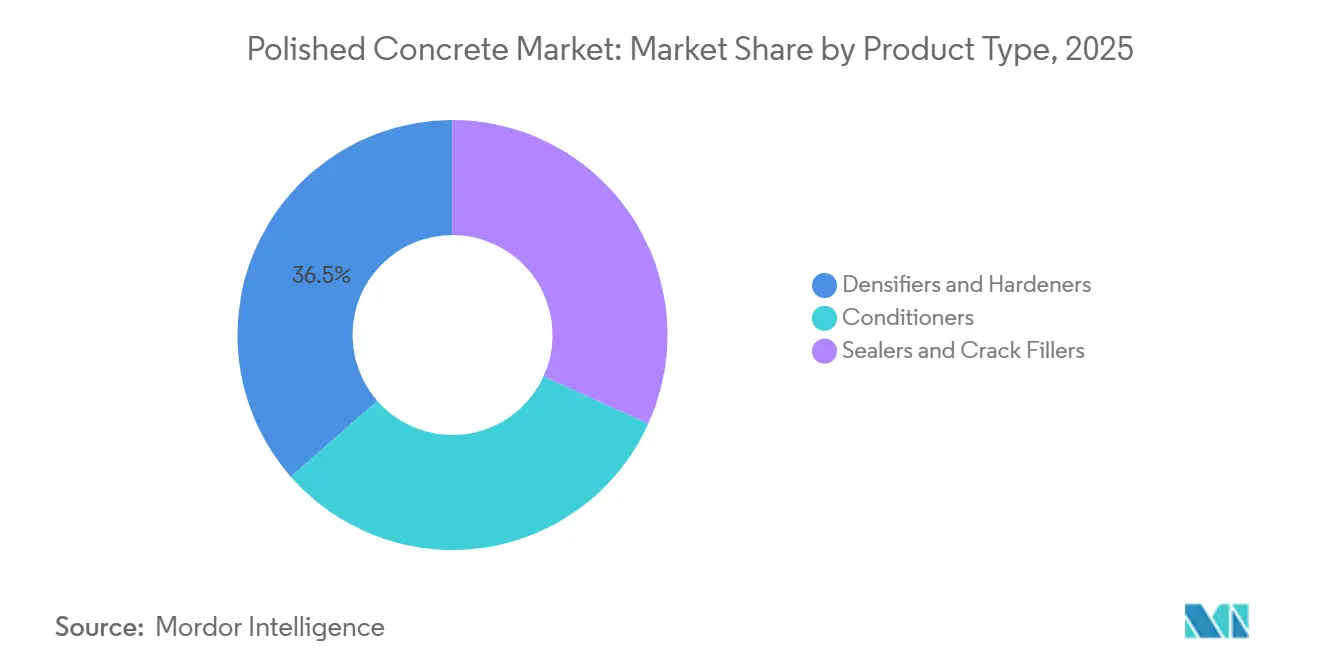
Densifiers and hardeners held 36.45% of the polished concrete market by product type in 2025 and are forecast to grow at a CAGR of 5.96% through 2031. Their leading position reflects the chemical role of lithium-silicate reactions with free calcium hydroxide in the concrete matrix. Dry polishing cannot replace this densification step when a specification calls for surface hardness and dust resistance. Demand for densifiers is also supported by repeat treatment as floors wear and are re-polished over their service life. This creates a recurring procurement requirement that is less dependent on a single installation cycle.
Sealers and crack fillers form the second-largest product category in the polished concrete market. Specifications are shifting toward water-based and low-volatile-organic-compound products as green-building requirements and local air-quality rules become stricter in North America and Europe. Conditioners remain a smaller category but are relevant in retail and hospitality sites where appearance between polishing cycles matters. Curecrete's 2025 environmental product declaration established a documented benchmark for systems used in Leadership in Energy and Environmental Design (LEED)-related projects, and larger chemical suppliers face pressure to offer comparable documentation. The need for repeat applications of densifiers helps protect demand when construction activity weakens.



By Method: Dry Polishing Combines Compliance and Productivity
Dry polishing accounted for 58.33% of the 2025 value and is projected to grow at a 6.21% CAGR through 2031. The method avoids the slurry waste generated by wet polishing, which must be managed in accordance with construction-site runoff requirements. Integrated dust collection simplifies work in enclosed commercial and industrial facilities. Dry systems reduce cleanup requirements and support predictable project execution. Wet polishing remains useful for outdoor work, heavy surface preparation, and decorative applications where diamond-tool heat is a concern.
Improved new-build slab flatness can reduce the need for aggressive cutting passes, narrowing the settings in which wet polishing is preferred. Japan and South Korea apply strict indoor dust-control requirements, making dry systems with High Efficiency Particulate Air (HEPA)-rated extraction particularly relevant in occupied or recently vacated buildings. Husqvarna and Klindex market dust-extraction equipment that supports this method. Better access to compliant equipment can lower the initial barrier for mid-sized contractors and support adoption in price-sensitive markets where wet polishing had previously been selected for cost reasons. The method's position reflects regulatory, operational, and waste-management considerations rather than a simple preference for one process.
By Construction Type: New Construction Holds Scale, While Renovation Expands Faster
New construction represented 57.28% of the polished concrete market by value in 2025. Industrial, logistics, and data center developments in North America and Asia-Pacific supported that position. Large-format facilities often use polished concrete as a standard floor specification because it meets flatness, cleanliness, and traffic requirements. Construction activity provides the installed slab area required for polishing work, making new projects important even when renovations offer a higher growth rate.
Renovation is forecast to expand at a CAGR of 6.43% through 2031. Aging commercial buildings in North America and Europe require floor restoration, and owners are considering the reduced material use of polishing an existing slab. In-situ refurbishment can restore a deteriorated slab without the disruption of removing and installing another surface. Owners seeking improved LEED outcomes can also consider polished concrete as part of indoor environmental quality and materials strategies. This creates a renovation pipeline that does not depend solely on new construction starts.
By End-User Industry: Non-Residential Facilities Lead Value and Expansion
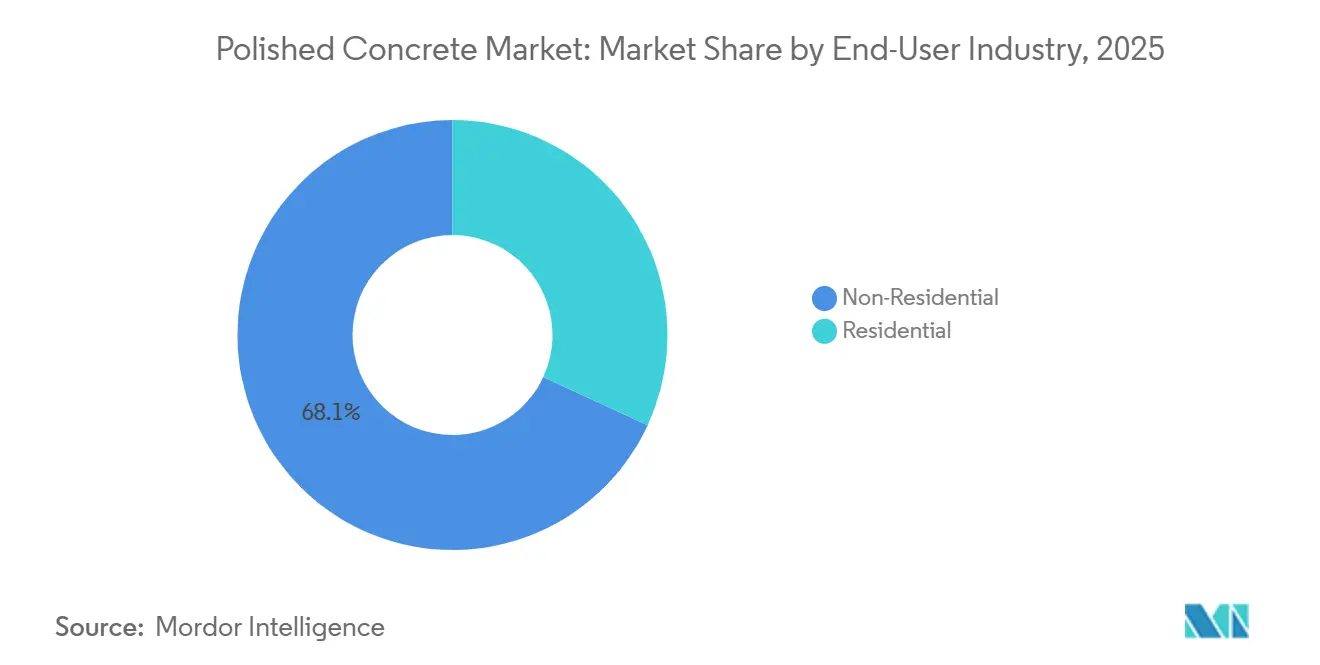
Non-residential facilities accounted for 68.11% of the polished concrete market in 2025 and are forecast to grow at a CAGR of 6.88% through 2031. This combines demand from logistics facilities, commercial renovations, and institutional buildings. Warehousing and distribution sites are among the highest-output non-residential applications, as dust suppression and forklift compatibility are important for continuous operations. Retail sites are another major user group in which high-gloss floors can improve light distribution while reducing maintenance needs compared with waxed vinyl or sealed tile.
Health care and educational institutions add demand through renovation cycles. Facility managers pursuing LEED- and WELL (WELL Building Standard)-aligned goals may value zero-volatile-organic-compound systems and surfaces suited to hygiene-focused requirements. Higher-end homes and barndominium projects in North America show incremental demand, with owners preferring industrial finishes and low-maintenance floors. The non-residential growth advantage is expected to persist through 2031, and mid-tier commercial renovation projects still offer room for greater contractor awareness of available specifications.
Geography Analysis
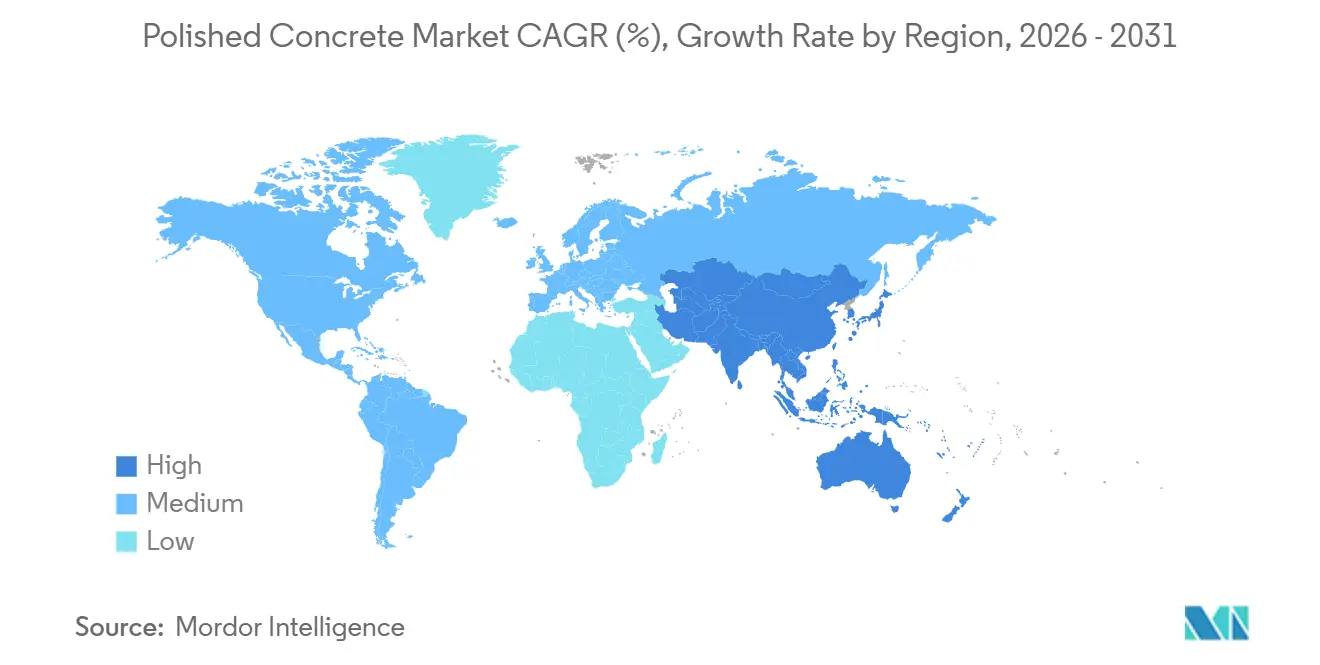
North America held 37.45% of the 2025 global value, giving the region the largest share of the polished concrete market. Mature contractor expertise, developed supply chains for densifiers and diamond tools, and a large non-residential building base support this position. Data center and healthcare projects drive demand in environments with strict cleanliness and floor flatness requirements. High labor costs also encourage contractors to adopt higher-throughput automated polishing machines in large industrial buildings. Canada provides steady industrial demand, while manufacturing expansion in Mexico adds projects in automotive and electronics supply chains. Low-emission system requirements in California, including sealant volatile organic compound rules, favor documented surface-treatment systems.
Europe is the second-largest region, with Germany, the United Kingdom, France, Italy, and Nordic countries supporting the use in commercial, institutional, and logistics projects. European Union carbon pricing on cement is increasing the importance of embodied-carbon documentation for floor systems. In Germany, industrial dust regulations and construction norms align with dry-polished systems. Healthcare and education buyers in the United Kingdom are incorporating lifecycle carbon targets into major renovation projects. Long service life and limited need for replacement are relevant to these specifications. Russia faces procurement constraints that limit market access during the forecast period.
Asia-Pacific is the fastest-growing region at a CAGR of 6.74% through 2031. China, Vietnam, Indonesia, and Thailand are adding logistics and manufacturing facilities as supply chains diversify. Japan and South Korea support the adoption of higher-specification products through 30-year lifecycle cost practices and strict indoor dust-control requirements, which favor dry systems with integrated extraction. South America presents an emerging opportunity through logistics infrastructure tied to agricultural and mineral exports in Brazil and Argentina, although price sensitivity favors simpler systems. In the Middle East and Africa, Saudi Arabia's Vision 2030 construction activity supports retail, hospitality, and industrial uses, while South Africa adds moderate industrial demand amid infrastructure and currency constraints.

Competitive Landscape
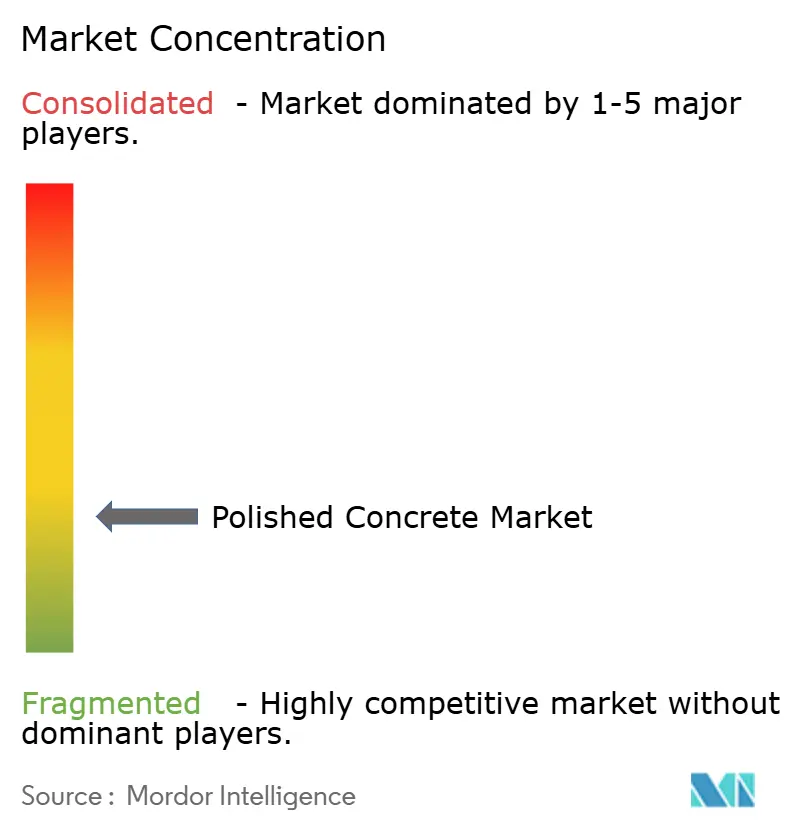
The polished concrete market is fragmented across chemical formulation, equipment, and tooling. Sika AG, BASF, MAPEI, 3M, PPG Industries, The Sherwin-Williams Company, LATICRETE, and Ardex compete in the chemicals segment, including densifiers, sealers, and conditioners. Husqvarna Group, including HTC, Klindex, and Superabrasive, operates in the grinding equipment and diamond tooling sectors. Separate procurement routes for chemicals and equipment limit system-level pricing power. Contractors that source each component separately can offer integrated project delivery, an area that remains underdeveloped at scale.
Sika completed its acquisition of HPS North America in March 2025, expanding its flooring and building-finishing portfolio. Sika completed the acquisition of Finja in Sweden and opened production facilities, including a concrete admixture plant in Florida and a plant and technical center in Belgium. Sika also completed the acquisition of Akkim in September 2026, strengthening its adhesives and sealants presence in Eastern Europe, Central Asia, the Middle East, and North Africa. These acquisitions extended its geographic and product reach across parts of the supply chain relevant to floor treatments. Equipment suppliers are also broadening their offerings through consumables, training, and dust-control systems.
Connected grinding equipment enables contractors to track grinding passes, surface hardness, and consumable wear, allowing differentiation based on execution consistency rather than material price. Nano-silica and reactive magnesium-oxide densifier systems represent a technical area of competition, as they can reduce cure times and improve hardness consistency. Mid-market consolidation is visible in the consumables and concrete-treatment space. The polished concrete market presents opportunities for contractor-facing platforms that bundle chemicals, tooling, and service contracts.
Polished Concrete Industry Leaders
Sika AG
BASF
Husqvarna Group
The Sherwin-Williams Company
PPG Industries, Inc.
- *Disclaimer: Major Players sorted in no particular order

Recent Industry Developments
- September 2026: Sika AG completed the acquisition of Akkim, a Turkish manufacturer of adhesives and sealants, expanding its manufacturing and distribution presence in the polished concrete market across Eastern Europe, Central Asia, the Middle East, and North Africa.
- March 2026: Sika AG has opened new plants in the United States, Argentina, Colombia, Bangladesh, and Tanzania. These investments increase production capacity and support the company’s sustainable construction product offerings and supply chain operations.


Global Polished Concrete Market Report Scope
Polished concrete is a concrete floor that has been mechanically ground, chemically densified, and refined with progressively finer diamond abrasives to produce a smooth, shiny, and durable surface.
The polished concrete market is segmented by product type, method, construction type, end-user industry, and geography. By product type, the market is segmented into densifiers and hardeners, sealers and crack fillers, and conditioners. By method, the market is segmented into dry polishing and wet polishing. By construction type, the market is segmented into new construction and renovation. By end-user industry, the market is segmented into residential and non-residential. The report also covers market size and forecasts for polished concrete across 16 countries in major regions. The market sizes and forecasts are provided in terms of value (USD).
| Densifiers and Hardeners |
| Sealers and Crack Fillers |
| Conditioners |
| Dry Polishing |
| Wet Polishing |
| New Construction |
| Renovation |
| Residential |
| Non-Residential |
| Asia-Pacific | China |
| India | |
| Japan | |
| South Korea | |
| ASEAN Countries | |
| Rest of Asia-Pacific | |
| North America | United States |
| Canada | |
| Mexico | |
| Europe | Germany |
| United Kingdom | |
| France | |
| Italy | |
| NORDIC Countries | |
| Russia | |
| Rest of Europe | |
| South America | Brazil |
| Argentina | |
| Rest of South America | |
| Middle East and Africa | Saudi Arabia |
| South Africa | |
| Rest of Middle East and Africa |
| By Product Type | Densifiers and Hardeners | |
| Sealers and Crack Fillers | ||
| Conditioners | ||
| By Method | Dry Polishing | |
| Wet Polishing | ||
| By Construction Type | New Construction | |
| Renovation | ||
| By End-User Industry | Residential | |
| Non-Residential | ||
| By Geography | Asia-Pacific | China |
| India | ||
| Japan | ||
| South Korea | ||
| ASEAN Countries | ||
| Rest of Asia-Pacific | ||
| North America | United States | |
| Canada | ||
| Mexico | ||
| Europe | Germany | |
| United Kingdom | ||
| France | ||
| Italy | ||
| NORDIC Countries | ||
| Russia | ||
| Rest of Europe | ||
| South America | Brazil | |
| Argentina | ||
| Rest of South America | ||
| Middle East and Africa | Saudi Arabia | |
| South Africa | ||
| Rest of Middle East and Africa | ||


Key Questions Answered in the Report
What is current market size of Polished Concrete Market?
The polished concrete market size was valued at USD 2.72 billion in 2025 and is estimated to grow from USD 2.87 billion in 2026 to reach USD 3.77 billion by 2031, at a CAGR of 5.59% during the forecast period (2026-2031).
Which type of polished concrete product drives demand?
Densifiers and hardeners held a 36.45% share in 2025 and are projected to grow at a 5.96% CAGR through 2031.
Why is dry polishing widely used?
Dry polishing held 58.33% of the 2025 value because it avoids slurry waste and works with integrated dust collection in enclosed sites.
Which end-user group is expanding fastest?
Non-residential facilities are forecast to grow at a 6.88% CAGR through 2031, supported by logistics, retail, and institutional applications.
Page last updated on:


 Your data is secure and never sold or shared.


