
Market Overview
| Study Period | 2020 - 2031 |
|---|---|
| Forecast Data Period | 2026 - 2031 |
| Base Year Market Size (2025) | USD 4.5 Billion |
| Market Size (2026) | USD 4.63 Billion |
| Market Size (2031) | USD 5.37 Billion |
| Growth Rate (2026 - 2031) | 2.98 % |
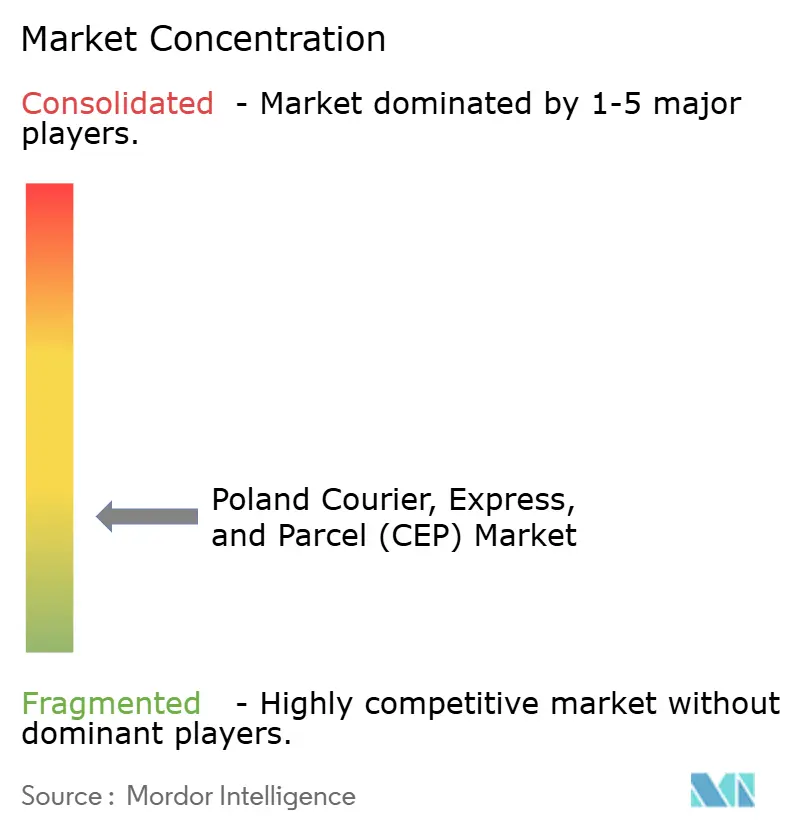
| Market Concentration | Low |
Major Players *Disclaimer: Major Players sorted in no particular order Image © Mordor Intelligence. Reuse requires attribution under CC BY 4.0. | |
Poland Courier, Express, And Parcel (CEP) Market Analysis by Mordor Intelligence
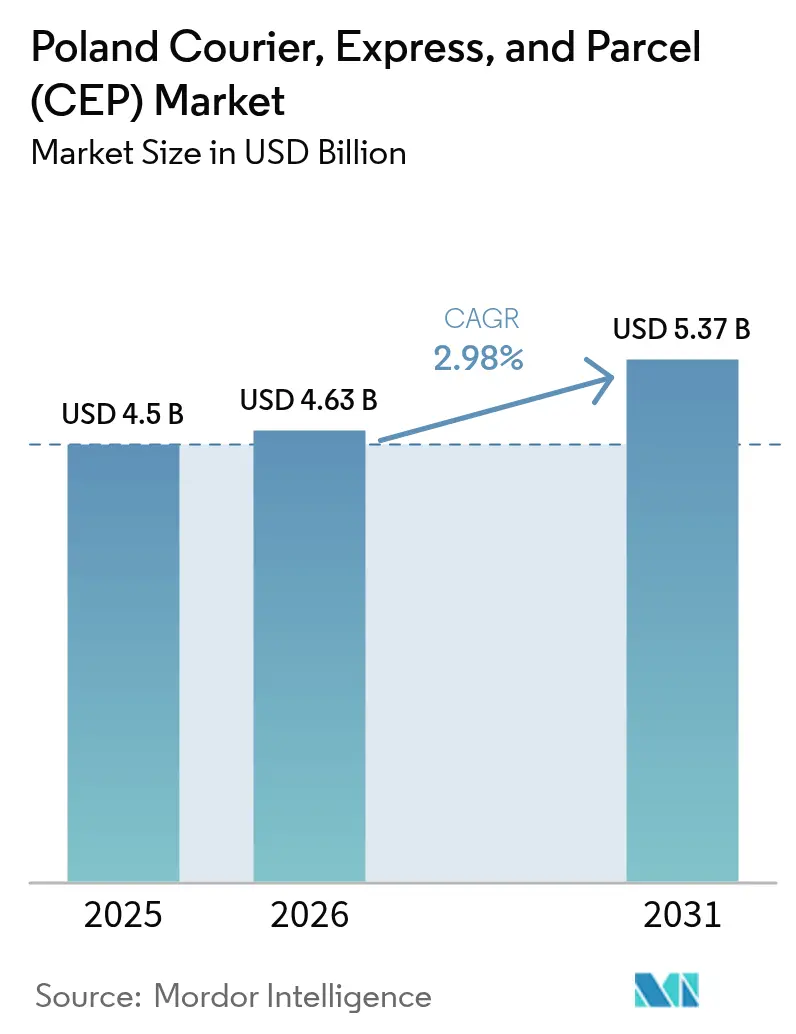
The Poland courier, express, and parcel market size is expected to grow from USD 4.5 billion in 2025 to USD 4.63 billion in 2026 and is forecast to reach USD 5.37 billion by 2031 at 2.98% CAGR over 2026-2031.
Robust e-commerce spending, expanding cross-border trade, and sustained infrastructure upgrades funded by European programs are reinforcing parcel flows across the nation. Automated parcel lockers continue to lift delivery density and lower unit costs, while technology-enabled route planning helps operators counter rising labor expenses. Regulatory stimuli that encourage zero-emission fleets support modal shifts toward rail and electric road vehicles, further shaping competitive positioning. Taken together, these drivers signal steady yet disciplined growth as the Poland courier, express, and parcel market approaches structural maturity.
Key Report Takeaways
- By destination, domestic shipments led with 65.34% of the Poland courier, express, and parcel market share in 2025, while international parcels are projected to expand at a 3.18% CAGR through 2031.
- By speed of delivery, non-express services accounted for 76.05% share of the Poland courier, express, and parcel market size in 2025; express shipments post the fastest 3.52% CAGR through 2031.
- By model, Business-to-Consumer held 51.84% revenue share in 2025 and is advancing at a 3.96% CAGR to 2031, reflecting the strength of e-commerce fulfillment.
- By shipment weight, light parcels captured 64.21% of volume in 2025 and are forecast to grow at a 3.34% CAGR, mirroring the shift toward smaller, higher-value items.
- By mode of transport, road commanded a 50.87% share in 2025, whereas rail-based and other multimodal routes are projected to rise at a 3.79% CAGR on cost and sustainability advantages.
- By end-user industry, e-commerce contributed 41.65% of demand in 2025 and is expanding at a 3.31% CAGR, signaling continued penetration in rural regions.
Note: Market size and forecast figures in this report are generated using Mordor Intelligence’s proprietary estimation framework, updated with the latest available data and insights as of 2026.
Poland Courier, Express, And Parcel (CEP) Market Trends and Insights
Drivers Impact Analysis*
| Driver | (~) % Impact on CAGR Forecast | Geographic Relevance | Impact Timeline |
|---|---|---|---|
| Explosive e-commerce volume growth post-COVID | +0.8% | Warsaw, Kraków, Gdańsk metro areas | Medium term (2-4 years) |
| Rapid adoption of parcel-locker networks | +0.6% | Urban cores spreading to suburbs and rural towns | Short term (≤ 2 years) |
| SME cross-border export surge via marketplaces | +0.4% | Border zones with Germany, Czech Republic; Warsaw logistics hub | Long term (≥ 4 years) |
| EU Fit-for-55 incentives for zero-emission fleets | +0.3% | Low-Emission Zones in Warsaw, Kraków, Wrocław | Long term (≥ 4 years) |
| AI-driven dynamic routing and micro-fulfillment | +0.2% | Nationwide, early uptake in core hubs | Medium term (2-4 years) |
| Government-funded postal infrastructure modernization | +0.2% | Nationwide with rural emphasis | Long term (≥ 4 years) |
| Source: Mordor Intelligence | |||
Explosive E-Commerce Volume Growth Post-COVID
The pandemic jump-started digital retail, and online penetration is projected to hit 25% by 2032[1]. Allegro’s cross-border expansion and Amazon’s deeper Polish footprint enlarge the total addressable parcel pool, especially for next-day international fulfillment. Shoppers now treat same-day and next-day delivery as a standard inclusion, forcing carriers to redesign networks for speed rather than cost. Cashier-less convenience stores such as Żabka’s AiFi trial create micro-fulfillment nodes that shorten last-mile distances and demand near-real-time inventory updates. Rural areas remain underserved, offering sizable upside once locker density and road upgrades unlock reliable access. Overall, e-commerce keeps parcel volumes on a durable uptrend even as urban markets near saturation.
Rapid Adoption of Parcel-Locker (APM/PUDO) Networks
InPost operates Poland’s largest parcel-locker grid, lowering failed-delivery rates and mitigating labor shortages compared with door-to-door drops. Competitors such as Orlen Paczka and GLS race to match coverage, yet first-mover habit formation grants InPost stickiness. Lockers reduce unit delivery cost by clustering stops and enable 24-hour self-service, an advantage amplified during COVID-era distancing norms. Smaller couriers integrate with the network through API links, gaining nationwide reach without building costly last-mile fleets. Consumer surveys show a strong preference for contactless pickup, suggesting further diffusion into suburban and rural districts. As density rises, network effects reinforce the moat that large locker operators enjoy, reshaping market expectations for convenience.
SME Cross-Border Export Surge Via Marketplaces
Marketplace platforms empower Polish SMEs to ship globally without mastering customs procedures. Meest Post’s 2025 launch of direct services to the United States, Canada, and the United Kingdom exemplifies demand for long-haul lanes[2]. EU trade facilitation and digital documentation tools simplify regulatory compliance, compressing delivery cycle time. Friend-shoring trends drive Western buyers toward Polish manufacturing capacity, increasing outbound parcel flows on B2B and B2C models. Currency stability inside the euro-pegged region reduces transaction risk, encouraging merchants to scale exports. This export momentum lifts the international share of Poland courier, express, and parcel market volume despite higher labor costs on West-bound routes.
EU Fit-for-55 Incentives for Zero-Emission Last-Mile Fleets
The EU’s Fit-for-55 climate package channels grants toward electric vans, depot chargers, and renewable energy hubs, directly lowering the cost of fleet transition. Municipal Low-Emission Zones provide access benefits for zero-emission vehicles, cutting detour times for compliant carriers. DHL’s new Poznań hub incorporates large-scale EV charging, signaling readiness for regulatory carbon caps. The KPO program earmarks PLN 40 billion (USD 12.2 billion) for green urban transport, unlocking co-investment with private couriers[3]. As battery prices fall, the total cost of ownership converges with diesel vans, further accelerating uptake. Zero-emission fleets also support ESG disclosures required by the Corporate Sustainability Reporting Directive, offering brand upside in a competitive field.
Restraints Impact Analysis*
| Restraint | (~) % Impact on CAGR Forecast | Geographic Relevance | Impact Timeline |
|---|---|---|---|
| Acute courier-driver shortage and wage inflation | -0.7% | Nationwide, severe in large cities | Short term (≤ 2 years) |
| EU Mobility Package wage parity | -0.4% | Cross-border routes to Western Europe | Medium term (2-4 years) |
| Urban Low-Emission-Zone surcharges | -0.3% | Warsaw, Kraków, Wrocław, Gdańsk | Medium term (2-4 years) |
| Parcel-locker vandalism and cyber-fraud | -0.1% | Areas with dense locker installation | Short term (≤ 2 years) |
| Source: Mordor Intelligence | |||
Acute Courier-Driver Shortage and Wage Inflation
Record-low jobless rates in Poland, coupled with competing industrial demand for labor, have intensified the battle for qualified drivers. Logistics wages now outpace headline inflation, squeezing margins for small carriers that cannot amortize costs via automation. Some courier firms experiment with signing bonuses and flexible schedules, but attrition remains high. Automation vendors report surging inquiries for robotic sorters, driven more by labor scarcity than by ROI calculations. Demographic aging further limits the driver pipeline, pushing operators toward electric cargo bikes and locker deliveries that require fewer licensed drivers. Wage pressure directly lowers profitability, curtailing fleet expansion plans.
EU Mobility Package Wage Parity Raising Line-Haul Costs
The posted-workers rules mandate Western wage scales for Polish drivers operating abroad, removing a key cost advantage on Frankfurt, Paris, and Amsterdam lanes[4]. Carriers must install tachograph telematics to prove time spent in each jurisdiction, adding compliance overhead. Some operators shift to relay models where a Western-based partner handles the final leg, fragmenting control over service quality. Small firms face existential stress as higher payroll costs coincide with elevated diesel prices. While larger integrators absorb the hit via scale, the regulation arguably accelerates consolidation within the Poland courier, express, and parcel industry. The rule is phased in over two years, keeping cross-border pricing in flux until full adoption.
*Our forecasts treat driver/restraint impacts as directional, not additive. The impact forecasts reflect baseline growth, mix effects, and variable interactions.
Segment Analysis
By Destination: International Parcels Capture Momentum
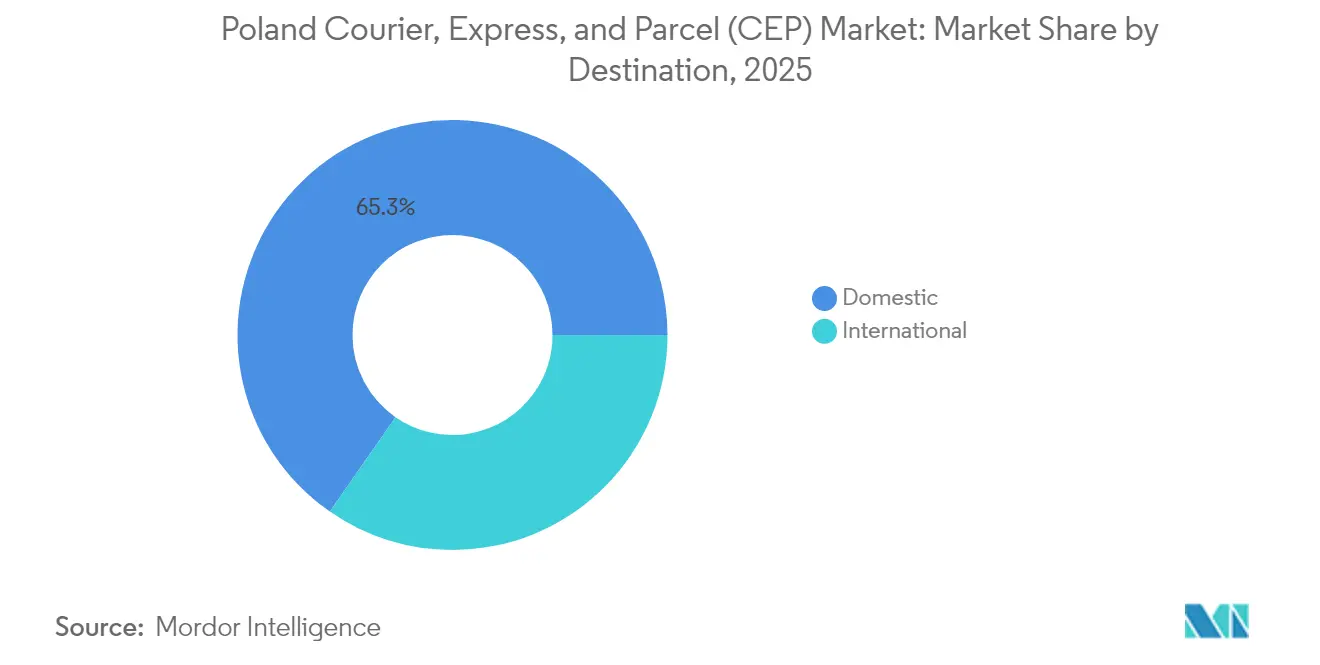
Domestic traffic retained 65.34% of Poland courier, express, and parcel market share in 2025, benefiting from mature urban consumption patterns and widespread locker networks. International shipments, however, are expected to record the quicker 3.18% CAGR through 2031 as SMEs embrace cross-border marketplaces and Poland’s central location enables gateway operations into Eastern Europe. Inbound e-commerce flows from Germany and the Czech Republic rise alongside outbound exports to the United States, Canada, and the United Kingdom, underpinning a balanced volume mix. Operators hedge currency and duty risks through digital customs platforms that cut clearance times to under two hours on priority lanes. Domestic growth now depends on rural penetration, where public funding improves road links and broadband connectivity, potentially unlocking new parcel volumes. International logistics remains sensitive to EU Mobility Package wage rules, yet increased value density permits premium pricing that partially offsets cost.
A growing share of cross-border parcels rides direct rail links through the Łódź–Chengdu corridor, shortening transit by five days relative to ocean transport and offering an attractive alternative amid Red Sea disruptions. Marketplace sellers employ fulfillment centers near border crossings, allowing them to localize inventories for same-day dispatch into Germany. Enhanced trade digitization positions Poland as a distribution hub for Central-Eastern Europe, further tilting growth toward international parcels despite persistent domestic dominance.

By Speed of Delivery: Express Demands Premium Service Levels
Non-express services still command 76.05% in 2025 due to competitive pricing and consumer willingness to wait 48–72 hours when fees are low. Express deliveries, though smaller in share, is expected to book the fastest 3.52% CAGR (2026-2031), propelled by rising expectations for next-day arrival and the growth of high-value verticals such as healthcare. E-commerce giants bundle expedited shipping into membership programs, shifting customer mindsets toward speed as a default feature. The Poland courier, express, and parcel market size for express shipments improves on the back of AI-powered sorting that raises throughput. Non-express networks adopt dynamic cut-off times and off-peak locker drop-offs to emulate some express attributes at lower costs.
Traffic segmentation blurs as InPost lockers provide parcel retrieval within hours, undermining the distinctiveness of legacy express services. However, sectors like pharma and automotive components still rely on guaranteed time windows, offering resilient revenue streams. Express margins widen slightly as shippers accept accessorial fees linked to carbon-neutral delivery options, reflecting broader ESG priorities.
By Model: B2C Parcel Flow Defines Network Design
B2C volume represented 51.84% in 2025, driven by double-digit growth in marketplace transactions and omnichannel retail. The segment’s 3.96% CAGR through 2031 necessitates dense pick-up and drop-off points, real-time tracking, and seamless return logistics. Locker architectures and flexible evening deliveries cater to consumer demand, pushing carriers to redesign routes around retail precincts and residential clusters. B2B remains vital for industrial replenishment, yet grows more slowly as digitized procurement reduces emergency shipment frequency.
C2C traffic edges up via social-commerce platforms that integrate shipping labels at checkout, providing end-to-end visibility once reserved for enterprises. For the Poland courier, express, and parcel industry, the surge in B2C parcels accelerates investment in customer-facing apps, chatbots, and loyalty programs, reinforcing market stickiness while raising service benchmarks across all models.
By Shipment Weight: Lightweight Parcels Dominate Network Economics
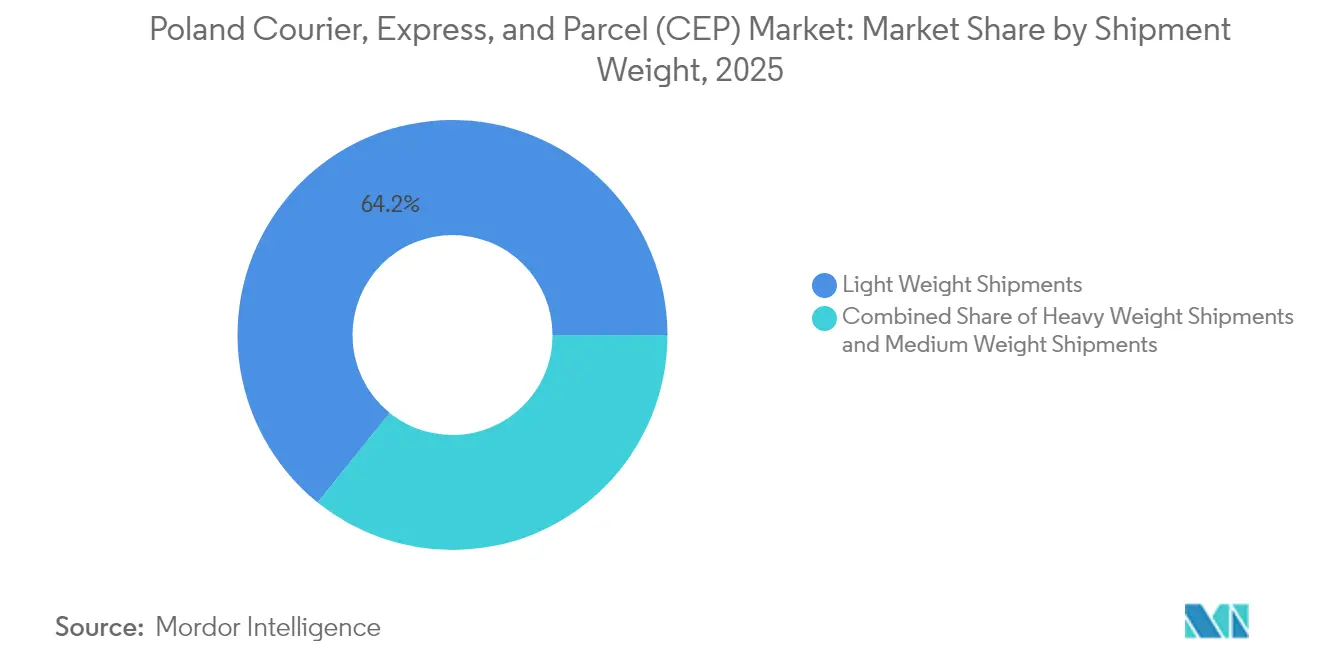
Light parcels held 64.21% in 2025 and are estimated to clock a 3.34% CAGR through 2031, as fashion, electronics, accessories, and health supplements dominate online carts. Standardized dimensions flow efficiently through automated sorters without manual intervention, cutting per-piece costs. Medium-weight categories maintain relevance for B2B spares and bulk e-grocery orders, yet growth lags. Heavy shipments gravitate toward specialized forwarders equipped with lift-gate vehicles and white-glove crews, narrowing their share within the Poland courier, express, and parcel market.
The prevalence of lightweight parcels enables pilot rollouts of cargo drones for remote village deliveries, reducing transit times. Parcel density per route rises, supporting electric van adoption despite shorter range limits. AI algorithms leverage uniform parcel data to improve cube utilization, trimming wasted truck space and thereby lowering emissions per kilogram.
By Mode of Transport: Rail and Multimodal Solutions Advance
Road retained a 50.87% share in 2025, underpinning first-mile and last-mile coverage. Rail and other multimodal options, however, outpace with a 3.79% CAGR (2026-2031), fueled by emissions regulations and rising highway tolls. Integrators deploy “rail-air” corridors—rail to central hubs and air for the final leg—to balance cost and time. The Poland courier, express, and parcel market size linked to rail trunking benefits from CEF Transport grants that modernize intermodal yards and cut cargo dwell times.
Electric line-haul trucks see test programs on Warsaw–Wrocław lanes, but charging infrastructure remains nascent. Waterway usage is minimal yet receives exploratory funding for containerized barge services on the Vistula River, a long-term sustainability play. Overall, multimodal flexibility emerges as a hedge against fuel volatility and driver scarcity.
By End User Industry: E-Commerce Retains Prime Position
E-commerce generated 41.65% of parcel demand in 2025 and is expected to grow at a 3.31% CAGR (2026-2031), cementing its lead. Saturation in metropolitan markets shifts carrier focus toward smaller cities where locker roll-outs unlock new segments. Healthcare logistics accelerate on temperature-controlled pharmaceutical deliveries and direct-to-patient services, prompting investments in validated cold-chain packaging. Financial services hold steady as regulatory mailings persist, yet digital signatures slow physical envelope volumes.
Manufacturing parcels stabilize as just-in-time systems mature, yet opportunities arise in spare-parts distribution linked to Poland’s thriving automotive cluster. Renewable-energy component shipping shows early promise as wind-farm installation ramps up in the Baltic region. Collectively, vertical specialization pressures parcel operators to diversify service portfolios beyond generic transport.
Geography Analysis
Poland’s domestic network benefits from an extensive highway grid and central European positioning, enabling overnight coverage for 85% of the population. Warsaw remains the single largest origin-destination pair, while Kraków and Wrocław add critical regional heft. Rural districts, historically underserved, receive targeted KPO grants that finance depot automation and road resurfacing, reducing delivery lead times by one day on average. Driver shortages tighten capacity in top metros, spurring experiments with autonomous mobile robots inside urban micro-hubs.
Internationally, parcel flows to Germany dominate outbound lanes, leveraging open border crossings and harmonized EU customs codes. Meest Post’s direct lanes to North America diversify risk and capture higher yield shipments motivated by Polish diaspora demand. The EU Mobility Package raises costs on West-bound trucking, nudging some traffic to rail intermodal links. Poland’s eastern frontier with Ukraine experiences sporadic spikes in humanitarian goods, showcasing the network’s agility. Overall, geography confers gateway advantages yet subjects operators to divergent regulatory regimes that complicate pricing.
Regulatory Landscape
Postal and courier activity in Poland is governed by the Law on Postal Services (Prawo pocztowe), with a consolidated text published in April 2026. Sector oversight sits with Urzad Komunikacji Elektronicznej (UKE), and operator compliance typically centers on licensing or registration obligations, consumer protection requirements covering service quality and complaints handling, and reporting duties tied to universal-access expectations, particularly where Poczta Polska carries universal-service responsibilities.
Cross-border parcel economics and data obligations are also shaped by EU-level work, including the referenced EU Delivery Act for Q4 2026, which targets modernization and rule alignment for postal services and cross-border parcel delivery. In parallel, Poland has tightened operational control requirements in adjacent transport compliance regimes, including March 2026 changes affecting exemptions for courier services under the SENT monitoring system for road and rail carriage of goods, which increases the need for process traceability and tighter systems integration for line-haul and intermodal moves.
Value Chain Analysis
The Poland CEP value chain starts with demand generation from e-commerce platforms, retailers, and SMEs, then moves through collection (merchant pickup, drop-off/PUDO), first-mile consolidation at local depots, and trunking to regional or national sort hubs. Automated sortation follows, with last-mile delivery handled through door-to-door couriers and out-of-home points (parcel lockers and pickup points). Returns handling and reverse logistics become increasingly relevant for B2C-heavy networks, while international parcels add additional nodes for export documentation, cross-border line-haul, and handover to partner networks.
Node placement and infrastructure decisions concentrate around the Warsaw logistics belt, the Lodz hub for east-west flows, and the Silesian corridor. Large operators lean on automation to lower unit costs and reduce exposure to scarce labor, while KRTI (intermodal transport development directions to 2030 with a 2040 perspective) strengthens the role of rail terminals and transshipment points through infrastructure access and tariff measures, supporting trunk segments of the chain. At the last mile, locker and dense PUDO networks led by InPost, with expansion by DPD and GLS/ORLEN, shift last-mile economics and service design.
Competitive Landscape
Competition clusters around technology leadership, network density, and regulatory readiness. InPost’s parcel-locker ecosystem delivers a formidable moat by locking in consumer habits and offering drop-point proximity within a 7-minute walk for 60% of urban dwellers. State-owned Poczta Polska leverages universal-service obligations to preserve rural reach, yet modernizes slowly relative to private rivals.
International integrators—DHL, UPS, FedEx—compete on cross-border reliability, embedding Poland into pan-European delivery meshes. Strategic moves underscore the race for scale. DHL inaugurated a 32,000 sqm hub near Poznań and EV charging stations, boosting throughput to 45,000 parcels per hour. GLS joined forces with Orlen to overlay parcel machines onto Orlen’s fuel-station network, extending out-of-home delivery to 15,000 lockers.
Smaller couriers form alliances with locker operators to remain relevant in the Poland courier, express, and parcel market. Rising compliance costs under EU wage parity drive a wave of M&A as under-capitalized firms seek exit options. Consolidation lifts the combined share of top-five carriers, signaling a gradual shift from fragmented to moderately concentrated structure.
Poland Courier, Express, And Parcel (CEP) Industry Leaders
-
InPost
-
DPD (Part of Geopost)
-
Poczta Polska
-
GLS Poland
-
DHL Group
- *Disclaimer: Major Players sorted in no particular order
Market Opportunities and Future Outlook
Out-of-home delivery continues to create gaps in network density, returns convenience, and cost control, especially outside the largest metros where locker coverage and pickup point proximity still lag established urban baselines. Operator investments are pointing to where capacity and capability are being built: InPost reported more than 28,000 parcel locker machines in Poland at end-2025 and continued scaling its European OOH footprint, while DPD Poland has highlighted a pickup/locker network and throughput growth through hub investments, including the Swedow facility near Strykow with capacity above 35,000 parcels per hour. These developments support opportunities for smaller couriers and e-commerce sellers to plug into shared OOH ecosystems, and for carriers to differentiate through integrated returns, time-windowed delivery, and cross-border label and customs tooling.
Infrastructure programs and logistics real-estate developments also support opportunities in trunk and cross-border connectivity, alongside greener, higher-throughput facilities. State-led initiatives improving port, rail, and intermodal capacity align with the market shift toward multimodal trunking and more carbon-accountable delivery, while private builds such as EV-ready, certified warehousing (including DPD-related build-to-suit facilities) broaden the base for depot automation and electrification. On the cross-border side, SME exports and marketplace-driven parcel flows create room for premium track-and-trace services and for Poland-based hubs to function as gateways into EU lanes, especially when operators manage EU wage-parity impacts through relay models, intermodal options, and stronger partner coverage.
Recent Industry Developments
- May 2026: A consortium led by Advent, FedEx, A&R, and PPF launched a formal all-cash offer for all outstanding InPost shares. The bid highlighted the strategic value of InPost's out-of-home parcel locker platform and its scalability, while stating that the group's operational headquarters would remain in Poland. This supports continuity for domestic network investment and management.
- September 2025: DPD Polska signed a long-term agreement with Allegro to integrate DPD's parcel locker and PUDO network into the Allegro Delivery program through April 2030. The integration strengthened platform-led shipping choices at checkout and positioned DPD to capture incremental B2C volumes by embedding its out-of-home network into a major e-commerce ecosystem.
- March 2024: DHL Group opened an international logistics center in Robakowo near Poznan, spanning 32,000 sqm with sorting capacity of 45,000 parcels per hour. The facility increased high-speed sortation and line-haul connectivity for both domestic and cross-border flows, tightening service levels for express and time-sensitive parcels. It also expanded scalable capacity in a key Polish corridor.
Research Methodology Framework and Report Scope
Market Definition and Coverage
For this methodology, the Poland courier, express, and parcel market is defined as the revenue earned from time definite and non time definite delivery of parcels and express documents within Poland, including domestic and international legs handled by CEP operators.
Scope exclusions: We exclude pure freight forwarding, warehousing-only services, and passenger transport revenues that do not directly relate to courier, express, or parcel delivery.
Segmentation Overview
- By Destination
- Domestic
- International
- By Speed of Delivery
- Express
- Non-Express
- By Model
- Business-to-Business (B2B)
- Business-to-Consumer (B2C)
- Consumer-to-Consumer (C2C)
- By Shipment Weight
- Heavy Weight Shipments
- Light Weight Shipments
- Medium Weight Shipments
- By Mode Of Transport
- Air
- Road
- Others
- By End User Industry
- E-Commerce
- Healthcare
- Financial Services (BFSI)
- Manufacturing
- Primary Industry
- Wholesale and Retail Trade (Offline)
- Others
Data Sources, Market Sizing, and Validation
Desk Research
Desk research was used to anchor the model to Poland level parcel activity, postal regulation context, and trade and macro signals that influence shipment demand and pricing. We referenced public materials such as Poland Statistics (Statistics Poland) for population, household, and retail indicators, and Eurostat for e-commerce, cross-border trade, and transport activity series.
To keep assumptions realistic, we also reviewed outputs from relevant regulators and associations, including the Office of Electronic Communications (postal and courier market reporting). For definitions and coverage boundaries, we used UPU publications for postal and parcel terminology, and selected EU Commission releases on cross-border parcel delivery and consumer protection rules. These were complemented with annual reports and investor presentations of listed logistics operators, plus a paid subscription focused on company financials and intelligence, along with a separate news and financials subscription to monitor service changes and price announcements. This list is illustrative only, and other public sources were used for data collection, validation, and clarification during the work.
Primary Interviews and Surveys
Primary research in Poland uses expert interviews and surveys with parcel operators, shippers, e-commerce and retail logistics managers, depot specialists, and postal-service professionals. Respondents help clarify shipment growth, service pricing, domestic and cross-border mix, weight patterns, locker use, and fuel and labor cost pressures. Analysts use these inputs to resolve gaps in secondary data and triangulate the final Poland market model.
Distribution of primary research fieldwork respondents
| Company type | Respondent position |
|---|---|
| Top tier: 25% | CXOs: 15% |
| Mid tier: 55% | Functional/Unit leaders: 30% |
| Smaller Players: 20% | Managers: 55% |
Market-Sizing & Forecasting
Sizing starts from a top-down build where Poland parcel and express demand is reconstructed from the shipped volume pool and then translated into value using blended revenue per shipment, with separate logic for domestic and international services. Once that total is formed, we corroborate it with selective bottom-up checks, including sampled operator revenue disclosures, lane and service level price cards, and shipper channel inputs, then use the results to adjust outliers.
Key inputs used in the model include courier shipment volumes, the domestic versus international mix, B2B versus B2C share shifts tied to e-commerce activity, out-of-home penetration (lockers and pickup points), and average revenue per parcel by service speed and weight bands. When a variable was not available for a full time series, we filled gaps using short historical bridges and expert-validated ratios rather than forcing overly detailed operator roll-ups.
For forecasting, we relied on scenario analysis supported by smoothing on the historical run rate, then tested the path against expected e-commerce growth, cross-border trade direction, and delivery mode mix changes. Final year values were accepted only after primary feedback aligned with the implied price and volume progression.
Data Validation & Update Cycle
Outputs were cross-checked against independent signals such as regulator-reported courier revenues, shipment volumes, and macro indicators linked to parcel demand, then reviewed for variance by year and by service mix. If the model implied an unusual jump in revenue per parcel or an unexpected shift in domestic versus international shares, we rechecked inputs and, when needed, re-contacted sources to confirm the assumption.
A multi-step review is followed where another analyst checks the logic, the math, and the consistency of definitions before sign-off. Reports are refreshed annually, and interim updates are made when material events change pricing, network capacity, or demand patterns, followed by a final pre-delivery pass so clients receive the latest view.
Mordor Intelligence's Poland Courier Express and Parcel Market Size Versus Other Published Estimates
Published market values for Poland CEP often differ because groups do not treat the same revenue pool, and the year and currency handling can also change the final USD figure. Differences usually come from whether postal activities are mixed into CEP, whether cross-border legs are included, and how out-of-home delivery is valued versus door delivery.
The main gap comes from mixing postal and courier categories together, where Mordor Intelligence counts only courier, express, and parcel delivery revenues and keeps postal letter services and messenger-only activities outside the total, which is why some broader industry numbers look higher even for a similar year.
Benchmark comparison
| Source | Market Size | Gaps in Research Methodology |
|---|---|---|
| Mordor Intelligence | USD 4.50 B (2025) | |
| Industry Dataset A | USD 3.43 B (2024) | This figure is based on regulator-reported courier service revenue in local currency for 2024 and may not fully align to CEP scope splits (express versus parcel) or to the USD conversion timing and averaging used in multi-year models. |
| Industry Database B | USD 6.65 B (2026) | This estimate uses a broader postal and courier industry definition and reports in EUR for 2026, which can pull in adjacent activities like letters and local messenger services, and then lift the total after currency conversion. |
The spread is mainly explained by scope and year alignment rather than a single math difference. When courier-only revenue is taken from official reporting, the number can sit below a CEP revenue model that includes international legs and service mix effects. When postal activities are bundled in, the total naturally rises, so keeping definitions explicit helps decision-makers compare like with like.
Key Questions Answered in the Report
What is the current value of the Poland courier, express, and parcel market?
The market reached a value of USD 4.63 billion in 2026 and is projected to hit USD 5.37 billion by 2031.
How fast is parcel demand growing in Poland?
Parcel volume is forecast to grow at a 2.98% CAGR through 2031, supported by e-commerce and cross-border exports.
Which delivery model holds the largest share in Poland?
Business-to-Consumer shipments lead with 51.84% share in 2025 and are expanding at a 3.96% CAGR.
How significant are parcel lockers in Polish logistics?
Parcel-locker networks now account for a growing share of last-mile deliveries, improving success rates and cutting unit costs.
What segments will grow fastest over the next five years?
International parcels, express deliveries, and healthcare logistics are expected to post above-market CAGRs through 2031.
How is regulation shaping fleet strategy?
EU Fit-for-55 incentives and Low-Emission Zones are accelerating the shift toward electric and multimodal transport options.