
Plastics Injection Molding Market Size and Share
Market Overview
| Study Period | 2020 - 2031 |
|---|---|
| Market Volume (2026) | 163.78 Million tons |
| Market Volume (2031) | 201.47 Million tons |
| Growth Rate (2026 - 2031) | 4.23 % |
| Fastest Growing Market | Asia Pacific |
| Largest Market | Asia Pacific |
| Market Concentration | Low |
Major Players *Disclaimer: Major Players sorted in no particular order Image © Mordor Intelligence. Reuse requires attribution under CC BY 4.0. | |
Plastics Injection Molding Market Analysis by Mordor Intelligence
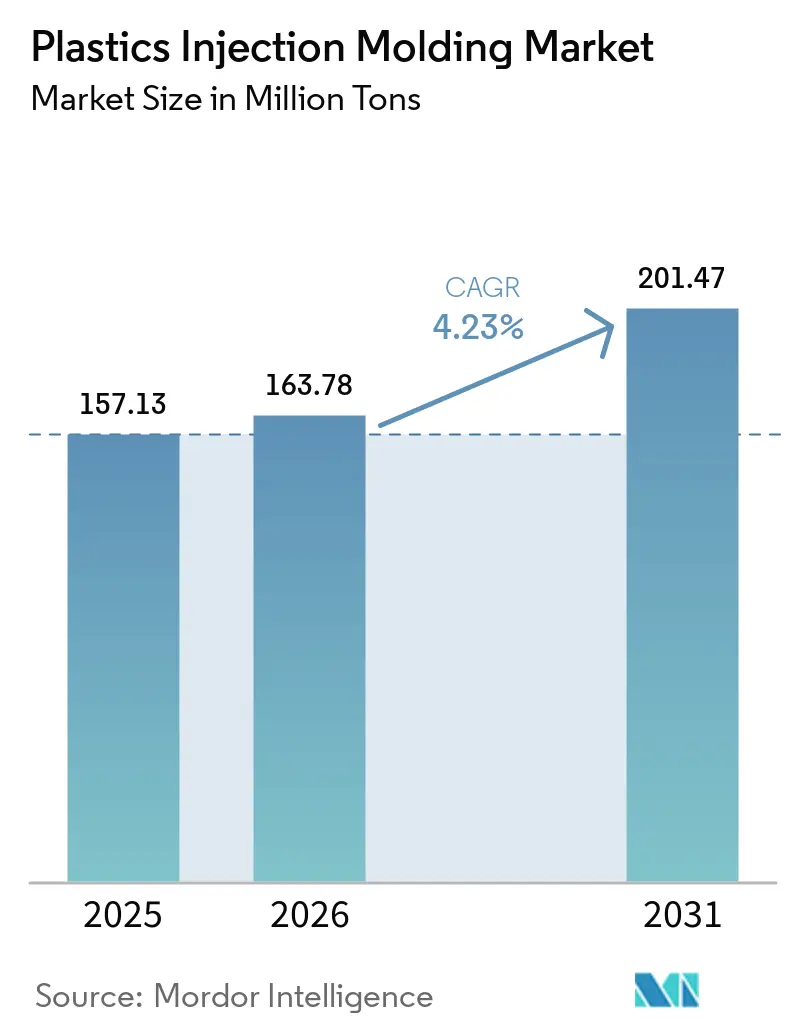
The Plastics Injection Molding Market size was valued at USD 157.13 million tons in 2025 and estimated to grow from USD 163.78 million tons in 2026 to reach USD 201.47 million tons by 2031, at a CAGR of 4.23% during the forecast period (2026-2031). This sustained expansion underscores the technology’s centrality to cost-effective, large-volume manufacturing in packaging, automotive, electronics and medical devices. E-commerce growth, accelerating electric-vehicle (EV) production and regulatory pushes for circularity collectively widen the application base of the plastics injection molding market, while energy-efficient all-electric machines and advanced material formulations help producers offset rising input costs. Asia-Pacific’s growing electronics clusters, North American reshoring initiatives and Europe’s first-mover stance on recyclability regulations all amplify regional opportunities. At the same time, volatile crude-oil-linked resin pricing and tightening global anti-plastic rules temper profit margins and compel investments in recycled feedstocks, digital quality control and end-of-life traceability systems.
Key Report Takeaways
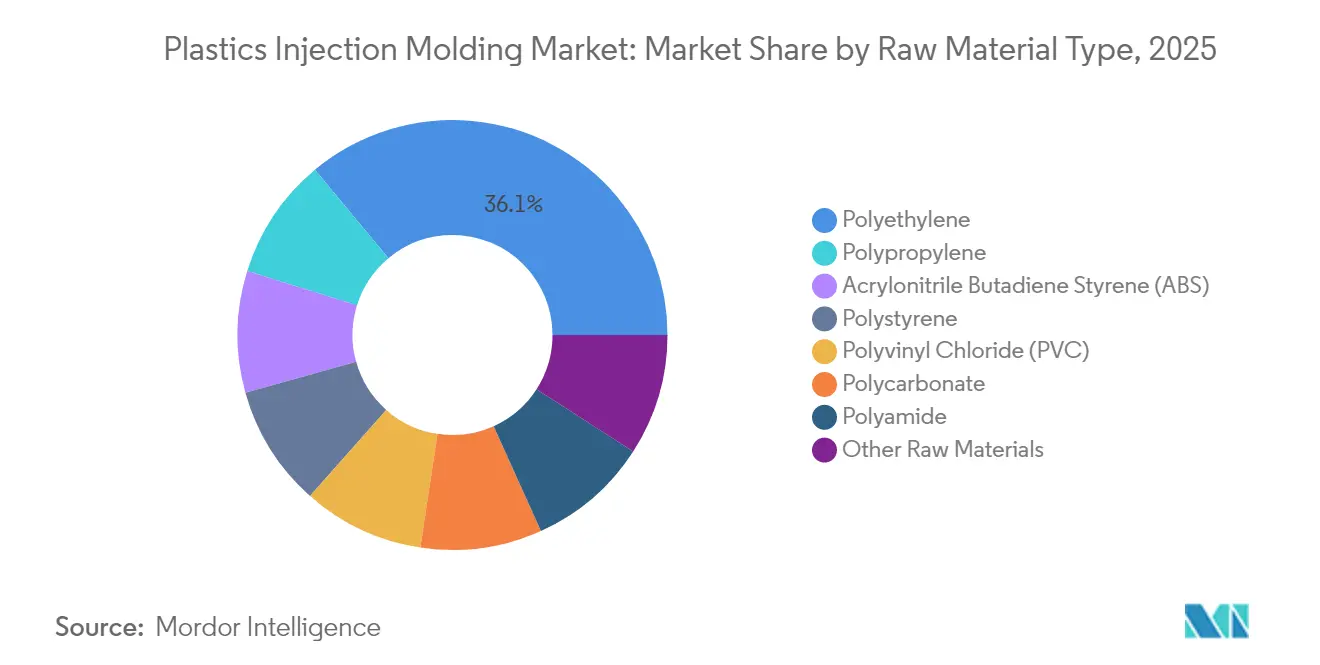
- By raw material, polyethylene captured 36.05% of plastics injection molding market share in 2025 and is projected to advance at a 5.02% CAGR through 2031.
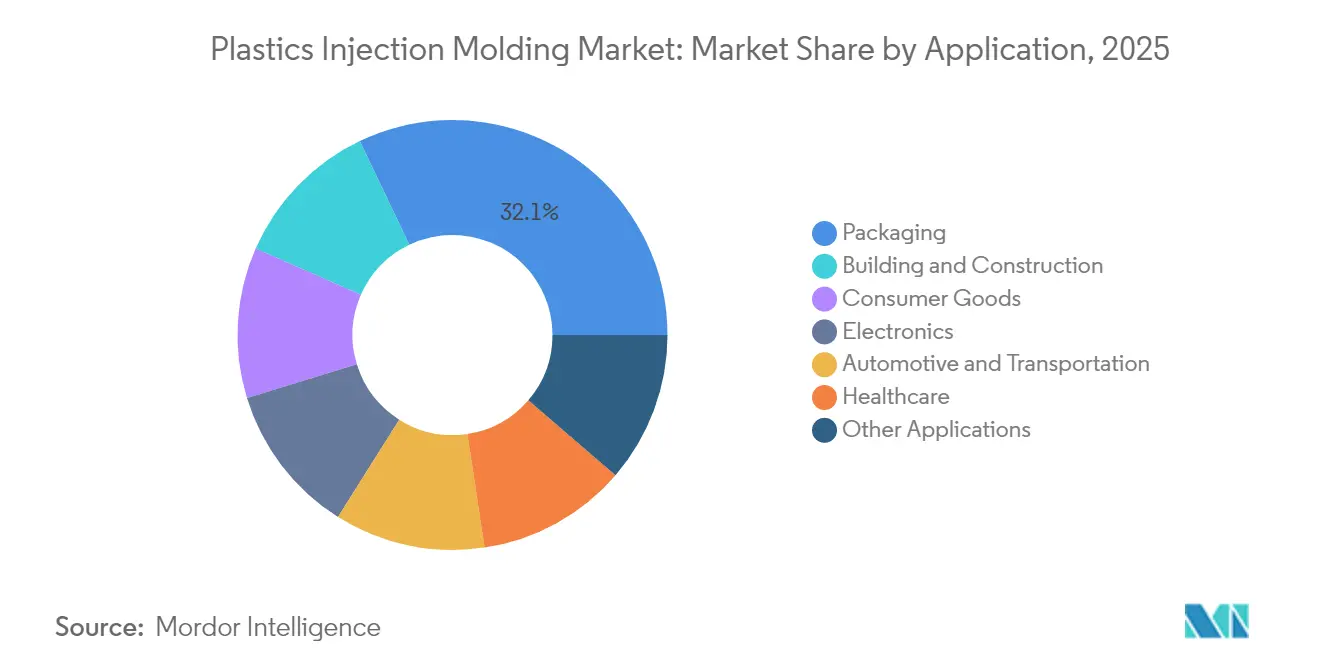
- By application, packaging accounted for 32.10% of the plastics injection molding market size in 2025, while automotive and transportation is set to expand the fastest at a 4.98% CAGR to 2031.
- By geography, Asia-Pacific commanded 34.10% share of the plastics injection molding market in 2025 and is growing at a 5.24% CAGR through 2031.
Note: Market size and forecast figures in this report are generated using Mordor Intelligence’s proprietary estimation framework, updated with the latest available data and insights as of 2026.
Market Trends and Insights
Drivers Impact Analysis of Plastics Injection Molding Market*
| Drivers | (~) % Impact on CAGR Forecast | Geographic Relevance | Impact Timeline |
|---|---|---|---|
| Surge in e-commerce-driven packaging demand | +1.2% | Global; strongest in North America and Asia-Pacific | Medium term (2-4 years) |
| Lightweighting requirements in automotive and EVs | +0.9% | Europe and North America lead; global relevance | Long term (≥ 4 years) |
| Growing need for single-use medical disposables | +0.7% | Developed markets worldwide | Short term (≤ 2 years) |
| Industrialisation in APAC electronics manufacturing | +0.8% | Asia-Pacific core; spill-over to MEA | Medium term (2-4 years) |
| OEM adoption of injection-molded EV battery housings | +0.6% | Early adoption in China, Europe, North America | Long term (≥ 4 years) |
| Source: Mordor Intelligence | |||
Surge in E-commerce-Driven Packaging Demand
Explosive parcel volumes have heightened requirements for durable yet lightweight protective solutions, prompting brand owners to specify mono-material polyethylene and polypropylene packages that minimize material use without compromising strength. The EU Packaging and Packaging Waste Regulation (PPWR), effective 2025, mandates 30% recycled content in PET food packaging by 2030, accelerating redesign of tooling and process parameters to handle higher-recycled blends[1]. U.S. Extended Producer Responsibility (EPR) fees across 14 states create an additional cost signal that rewards eco-modulated designs and favors converters with advanced resin reclamation lines. These converging mandates bolster volume growth in the plastics injection molding market, particularly in thin-wall container and closure segments where cycle-time reductions deliver material savings and higher throughput. Progressive molders are adopting in-mold labeling and digital watermarking to streamline sorting, increasing the likelihood of post-consumer resin availability and ensuring feedstock continuity.
Lightweighting Requirements in Automotive and EVs
Automotive OEMs have intensified plastics substitution to achieve stringent fleet-average CO₂ targets and maximize EV range. Tesla’s gigacasting strategy showcases how large aluminum castings reduce part counts, but it simultaneously expands demand for injection-molded interior and exterior trims that integrate with cast structures. Battery manufacturers are exploring thermoplastic housings with flame-retardant sandwich walls that cut up to 40 kg per vehicle compared with steel alternatives, a shift exemplified by Engel’s high-voltage battery enclosure prototype. ISO 14040 life-cycle assessments increasingly influence material choices, favoring recyclable resins over multi-material metal assemblies. These trends elevate engineering-grade polymers such as polyamide, polycarbonate and recycled polypropylene, while powder injection molding offers another route for producing complex widening the value pool of the plastics injection molding market through higher content per vehicle and sustained tooling demand for new EV platforms.
Growing Need for Single-Use Medical Disposables
Post-pandemic healthcare investment has driven hospitals to standardize on single-use syringes, pipettes and diagnostic cartridge systems, powering expansion of ISO 13485-certified molding capacity. DuPont’s USD 313 million acquisition of Donatelle Plastics typifies supplier consolidation aimed at capturing specialty device growth lanes. Equipment advances such as Husky’s ICHOR multi-cavity systems enable sub-two-second cycle times for drug-delivery components, boosting economies of scale. Precision resins like cyclic olefin copolymer (COC) meet optical clarity and chemical inertness requirements in infusion pumps, reinforcing the premium positioning of healthcare volumes within the plastics injection molding market. Demographic aging, elevated chronic-disease incidence and rising surgical procedures cement a long runway for single-use device expansion.
OEM Adoption of Injection-Molded EV Battery Housings
Vehicle makers are scrutinizing thermoplastic housings to reduce mass and improve crash energy absorption. BYD’s Yangwang U7 program employs two-platen presses to mold rear spoilers within ±0.3% weight tolerance, illustrating the precision achievable on large exterior panels. SABIC’s recycled polycarbonate-polybutylene-terephthalate blend offers UL 94 V-0 flame resistance without glass reinforcement, eliminating secondary finishing steps. Integrating structural ribs and cooling channels in a single molding cycle shortens assembly times and reduces part counts. Regulatory frameworks such as IATF 16949 enforce traceability and process control, raising qualification hurdles that protect incumbents positioned in this high-growth pocket of the plastics injection molding market.
Restraints Impact Analysis of Plastics Injection Molding Market*
| Restraints | (~) % Impact on CAGR Forecast | Geographic Relevance | Impact Timeline |
|---|---|---|---|
| Volatile crude-oil-linked resin pricing | -1.1% | Worldwide; import-reliant economies hit hardest | Short term (≤ 2 years) |
| Tightening global anti-plastic regulations | -0.8% | Europe and developed markets spearhead | Medium term (2-4 years) |
| Cap-ex and skills gap for all-electric high-tonnage presses | -0.5% | Concentrated in emerging economies | Long term (≥ 4 years) |
| Source: Mordor Intelligence | |||
Volatile Crude-Oil-Linked Resin Pricing
Polyethylene and polypropylene spot prices rose as crude benchmarks responded to geopolitical disruptions. U.S. tariffs introduced in 2025 raised landed costs of some resin grades by 10-15%, while Chinese oversupply, estimated at an additional 5 million tons of capacity, depressed Asian quotes and widened inter-regional arbitrage spreads. Resin distributors cite unprecedented uncertainty, with 82% of converters pursuing multisourcing strategies to guard against price spikes. Margin volatility discourages long-term tooling commitments, raising the hurdle rate for capacity additions across the plastics injection molding market and nudging processors toward hedging instruments and formula-pricing contracts.
Tightening Global Anti-Plastic Regulations
The EU PPWR’s recyclability and minimum recycled content mandates, together with national single-use bans effective 2030, are compelling redesign of entire product portfolios. In the United States, EPR fees projected at USD 4.7 billion by 2026 act as de-facto material taxes, lifting total landed costs for conventional resins. Compliance demands investment in certification, track-and-trace systems and recycled-content verification, hitting smaller converters hardest and slowing new-product launches. These headwinds curb near-term expansion of the plastics injection molding market, though they concurrently spur innovation in bio-based blends and closed-loop logistics that may unlock longer-term growth.
*Our forecasts treat driver/restraint impacts as directional, not additive. The impact forecasts reflect baseline growth, mix effects, and variable interactions.
Plastics Injection Molding Market Segment Analysis
By Raw Material Type:
Polyethylene Dominance Drives Sustainability TransitionPolyethylene secured a commanding 36.05% share of the plastics injection molding market in 2025 and is on track for a 5.02% CAGR through 2031 as recycled-content mandates reinforce its recyclability advantage. This leadership is fueled by thin-wall packaging, cap-and-closure systems and emerging automotive fuel-cell components that capitalize on the resin’s chemical resistance. Polypropylene follows closely in interior automotive trims, HVAC housings and appliance parts, leveraging high heat deflection and stiffness-to-weight ratios. Acrylonitrile butadiene styrene retains niche in consumer electronics casings, while polystyrene faces structural decline in single-use cutlery amid regulatory crackdowns.
Advanced recycling facilities capable of depolymerization and solvent-based purification are improving the quality of post-consumer polyethylene, enabling drop-in replacement for virgin resin and lowering scope-3 emissions for converters. Polycarbonate uptake advances steadily in headlamp lenses and transparent protective shields, with thin-gauge glazing options replacing heavier glass in certain automotive models. Bio-based polyamides produced from castor-bean oil are gaining interest in under-hood parts due to inherent flame retardancy and lower carbon intensity. These material-level shifts deepen the diversification of the plastics injection molding market while supporting clients’ environmental, social and governance (ESG) objectives.

By Application:
Packaging Leadership Meets Automotive InnovationPackaging retained 32.10% of the plastics injection molding market share in 2025 on the back of omnichannel retail expansion and heightened food-safety requirements. Mono-material closures, dispensing pumps and tamper-evident containers dominate new-product pipelines, reflecting retailers’ preference for fully recyclable formats. Concurrently, the automotive and transportation vertical is forecast to accelerate at 4.98% CAGR through 2031, buoyed by EV penetration and lightweighting mandates that elevate plastics content per unit.
Building and construction applications contribute steady volume through window profiles, electrical conduit and infrastructure fittings, particularly in emerging markets with rapid urbanization. Electronics demand gravitates toward high-precision thermoplastic micro molding for camera modules and wearable devices, running ultra-fast cycles on all-electric presses. Healthcare maintains premium margins owing to stringent validation, with cyclic olefin copolymer and medical-grade polypropylene seeing robust offtake in single-use drug-delivery systems. These diverse end-uses collectively reinforce the resilience of the plastics injection molding market, enabling processors to balance cyclical sectors against more stable healthcare and packaging streams.
Geography Analysis
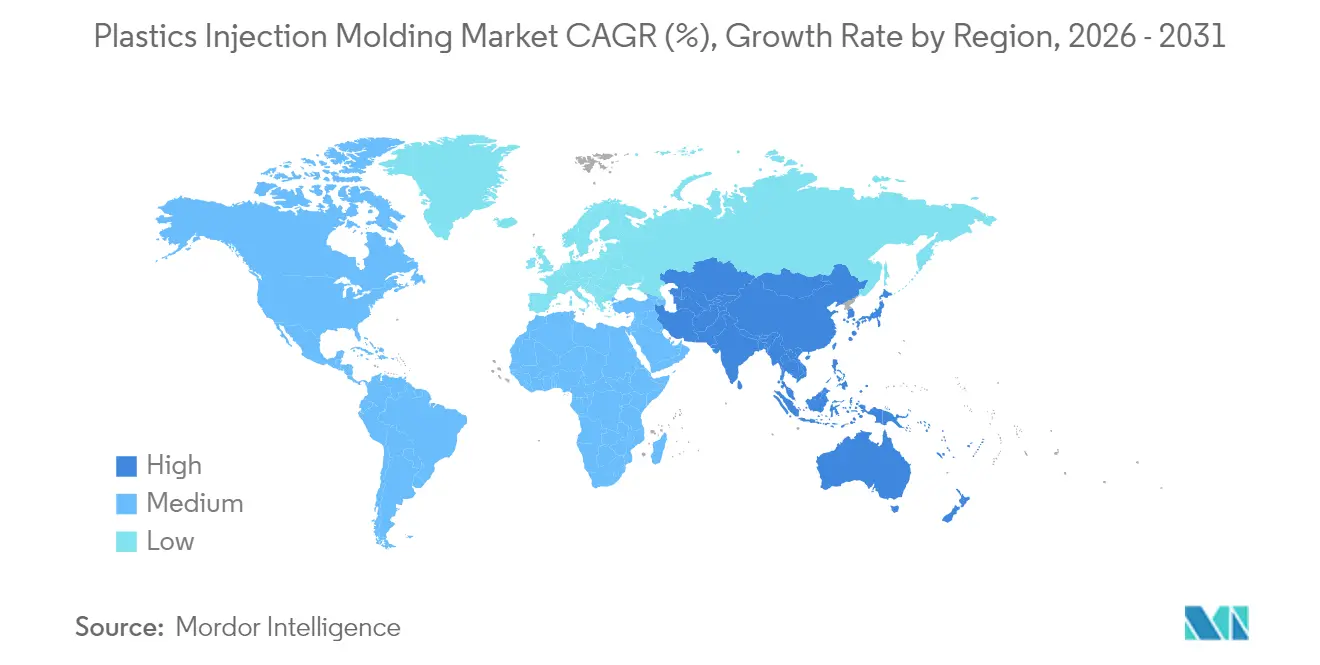
APAC and North America Plastics Injection Molding Market
Asia-Pacific held 34.10% of the plastics injection molding market in 2025 and is expanding at a 5.24% CAGR to 2031 as China, India, and Southeast Asia scale electronics and automotive output. Government incentives, lower labor costs, and proximity to downstream assembly plants underpin capacity additions. Japan is leveraging digital twins and carbon-footprint dashboards across more than 80% of factories to heighten productivity and sustainability. North America benefits from reshoring and nearshoring, with Mexico securing USD 43.9 billion in FDI during 2023 that spurs tooling imports and turnkey cell installations for automotive interiors.
United States and Canada Plastics Injection Molding Market
The United States’ USD 1.4 trillion reindustrialization plan supports semiconductor, EV battery and medical-device capacity that will boost domestic resin offtake. Canada’s mold-making clusters in Ontario continue to supply high-cavitation tools for consumer-packaging programs, though wage premiums encourage higher degrees of automation.
Europe and South America Plastics Injection Molding Market
European converters are investing in depolymerization and solvent-based purification plants to meet PPWR requirements for 30% recycled content in PET packaging by 2030. Germany’s engineering prowess underpins advanced multi-component molding for premium vehicles, while France scales bio-based cosmetic packaging aligned with consumer eco-preferences. South America depends on Brazilian automotive demand, with localized content rules compelling higher domestic plastic part production.
MEA Plastics Injection Molding Market
The Middle East and Africa are expanding through Saudi Arabia’s polymer downstream investments and South Africa’s tooling grant scheme aimed at stimulating localized part production. These diverse regional dynamics collectively broaden the geographic footprint of the plastics injection molding market.
Regulatory Landscape
Regulation affecting the plastics injection molding market is increasingly shaped by packaging circularity requirements and pellet-loss controls. In the European Union, the Packaging and Packaging Waste Regulation (PPWR), Regulation (EU) 2025/40, reaches general application on August 12, 2026, expanding sustainability, composition, and labeling requirements for packaging placed on the EU market, which flows through to molded caps, closures, and containers supplied into EU value chains.
Additional EU action includes Regulation (EU) 2025/2365, enacted on November 12, 2025, aimed at preventing plastic pellet losses across the supply chain, covering production, compounding, and processing facilities. Beyond Europe, India updated its framework via the Plastic Waste Management (Amendment) Rules, 2026 under the Environment (Protection) Act, 1986, which raises compliance expectations for plastics handling and waste management for domestic producers and exporters serving the region. At the multilateral level, UNEP-led negotiations on an international legally binding instrument on plastic pollution remain active but not finalized, keeping regulatory risk elevated for material choices, recycled-content claims, and traceability requirements.
Value Chain Analysis
The plastics injection molding value chain begins with upstream resin and additive suppliers, including polyethylene, polypropylene, engineering resins, colorants, and flame retardants. Compounders and distributors come next, followed by equipment and tooling providers, including mold makers, hot runner suppliers, auxiliaries, and machine OEMs, before injection molders supply finished parts into packaging, automotive, electronics, and healthcare. Downstream OEMs and brand owners influence resin selection, recycled-content specifications, and validation requirements, such as medical quality systems and automotive traceability, which pushes molders toward tighter process control and documentation.
Key friction points are concentrated upstream and in logistics. Crude-oil-linked resin volatility and trade actions, including 2025-era tariffs referenced in the report context, can shift landed costs and disrupt procurement strategies, while shortages of specialized additives and shipping variability can delay program launches. Regulatory pressure in Europe to reduce pellet losses and meet packaging compliance requirements increases the need for documented material handling and traceability practices across pellet reception, drying, conveying, and regrind management. In parallel, the technology layer is shifting toward higher automation and energy-efficient presses, with wider use of all-electric machines and digital process monitoring to reduce scrap, stabilize cycle times, and meet high-cavitation packaging needs and validated medical production requirements.
Competitive Landscape
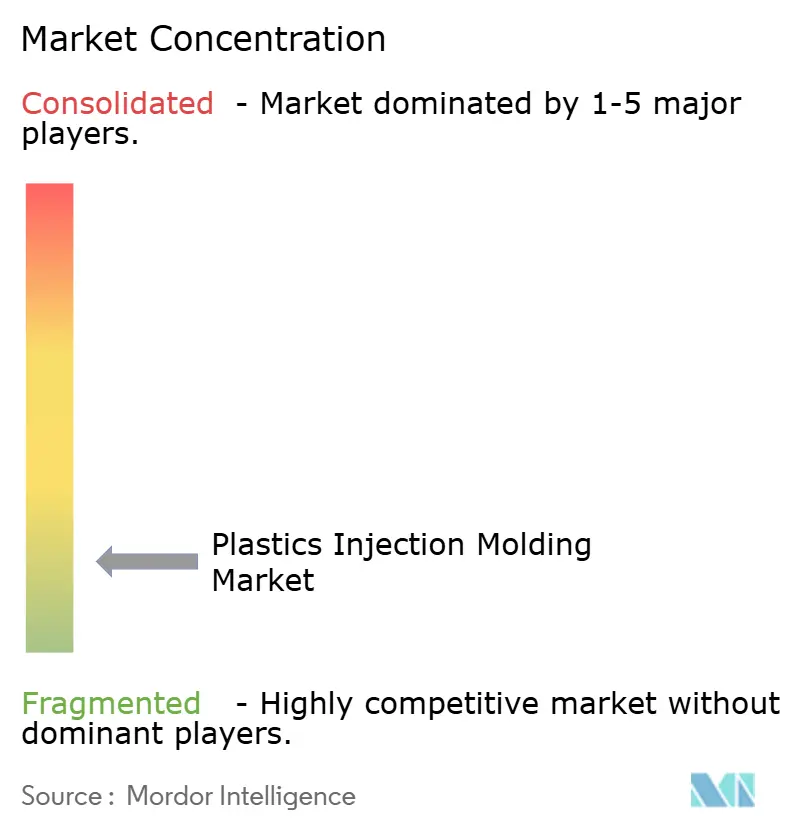
The market is highly fragmented, with regional contract molders coexisting alongside global integrated players spanning resins, machines and finished parts. Contract molding sees roll-ups aimed at regulated niches: DuPont’s Donatelle deal targets ISO 13485 medical capabilities, while Berry’s acquisition of CMG Plastics strengthens short-run food-packaging programs. Sustainability credentials act as a competitive differentiator. Meanwhile, automation retrofits with smart auxiliaries are proliferating; cooling units with machine-learning-based flow balancing and material-handling robots with condition-monitoring cut unplanned downtime and standardize part quality.
Plastics Injection Molding Industry Leaders
-
ALPLA
-
Amcor PLC
-
AptarGroup, Inc.
-
Magna International Inc.
-
Silgan Holdings Inc.
- *Disclaimer: Major Players sorted in no particular order
Plastics Injection Molding Market Companies Covered in this Report
- ALPLA
- Amcor PLC
- Antolin
- AptarGroup, Inc.
- BERICAP
- CVA Plastics
- EVCO Plastics
- FORVIA Faurecia
- HTI Plastics
- Husky Technologies
- IAC Group
- Magna International Inc.
- Marelli Holdings Co. Ltd
- Naber Plastics BV
- Quantum Plastics
- SCHAUENBURG Industrietechnik
- SEKISUI CHEMICAL CO., LTD.
- Silgan Holdings Inc.
- The Rodon Group
- TOYOTA BOSHOKU CORPORATION
Market Opportunities and Future Outlook
Regulatory and customer specifications around recyclability and recycled content create whitespace for molders that can run higher-recycled blends while maintaining throughput and part performance. The EU PPWR general application date on August 12, 2026 tightens packaging sustainability and labeling requirements, and the EU pellet-loss framework under Regulation (EU) 2025/2365 adds operational compliance pressure upstream, favoring processors that can demonstrate controlled material handling and auditable processes. These constraints also support recurring demand for tooling and process development in mono-material packaging formats, including closures, dispensing systems, and thin-wall parts.
Investment activity visible in 2026 points to capacity buildout and specialization as near-term opportunity areas. In India, Rajshree Polypack commissioned 1,000 MTPA of new injection molding capacity, taking total to 5,800 MTPA, and Mitsu Chem Plast announced an approximately 2,550 MT/year addition at its Unit 3 facility in Khalapur, with completion targeted in June 2026, indicating expanding local supply for packaging and consumer programs. In healthcare-oriented molding, Nissha Medical Technologies broke ground in May 2026 on a new 50,000-square-foot micromolding facility in New Richmond, Wisconsin, highlighting continued demand for precision, high-compliance components and the supporting ecosystem of validated tooling, metrology, and scientific molding workflows. M&A also remains a pathway to scale regulated capabilities and broaden customer access, consistent with the report context showing consolidation interest around medical and specialty programs.
Recent Industry Developments in Plastics Injection Molding Market
- July 2026: Amcor commenced an expansion project at its flexible packaging facility in Dongguan, China, adding a 7,000-square-meter manufacturing space and an automated warehouse. The upgrade increases regional capacity and responsiveness for packaging programs that use injection-molded components such as closures and dispensing systems. It also supports lead-time reduction for brand owners balancing Asia-based production with tighter sustainability and quality requirements.
- June 2025: SEKISUI CHEMICAL announced plans for a sixth plant in Pune, India, for automotive injection-molded products, with a USD 3 million investment and operations slated for January 2026. The project adds localized manufacturing capacity aligned with vehicle platform localization and supplier park strategies. It also strengthens supply continuity for molded automotive components in a region scaling both conventional and electrified vehicle production.
- January 2024: Arterex completed the acquisition of Micromold to broaden precision-component capacity for next-generation medical devices. The combination expands access to tighter-tolerance molding and regulated manufacturing capabilities for drug delivery and diagnostics. This transaction reflects ongoing consolidation aimed at higher-margin healthcare programs requiring validated processes and quality systems.
Plastics Injection Molding Market Report Scope and Research Methodology
Market Definition and Coverage
For this methodology, the plastics injection molding market covers the molding of plastic resins into finished parts using injection molding machines and tooling. Demand is captured across major end-use industries and regions.
Scope exclusions: We exclude upstream resin production and polymer compounding, as well as downstream assembly and post-molding services that are billed separately from molded-part output.
Segments Covered in This Report
- By Raw Material Type
- Polypropylene
- Acrylonitrile Butadiene Styrene (ABS)
- Polystyrene
- Polyethylene
- Polyvinyl Chloride (PVC)
- Polycarbonate
- Polyamide
- Other Raw Materials
- By Application
- Packaging
- Building and Construction
- Consumer Goods
- Electronics
- Automotive and Transportation
- Healthcare
- Other Applications
- By Geography
- Asia-Pacific
- China
- India
- Japan
- South Korea
- Rest of Asia-Pacific
- North America
- United States
- Canada
- Mexico
- Europe
- Germany
- United Kingdom
- France
- Italy
- Russia
- Rest of Europe
- South America
- Brazil
- Argentina
- Rest of South America
- Middle-East and Africa
- Saudi Arabia
- South Africa
- Rest of Middle-East and Africa
- Asia-Pacific
Data Sources, Market Sizing, and Validation
Desk Research
Desk research was used to build the first structure of the market and to anchor it to repeatable public indicators. We relied on sources such as the US Census Bureau and Bureau of Labor Statistics for manufacturing output and price trends, the International Trade Centre (ITC) and UN Comtrade for trade flows linked to molded plastic articles, and the European Commission and US EPA for regulatory signals that can shift material choices and recycled content use.
We also reviewed industry bodies and standards sources such as the Plastics Industry Association and ISO publications for process definitions and terminology, then supplemented this with company filings, investor presentations, and credible press coverage to track capacity moves and end-market demand. Where helpful, we used paid subscription sources for company financials and a patent database to validate revenue ranges and innovation directions tied to injection tooling, resins, and cycle-time improvements. These desk sources are illustrative, and we checked many other public references for data collection, validation, and clarification.
Primary Interviews and Surveys
Primary discussions were used to pressure-test the desk assumptions and translate volume signals into realistic commercial output. We spoke with a mix of molders, tooling participants, resin-linked stakeholders, and buyers from key end-use industries across APAC, EMEA, and the Americas, so gaps around utilization, scrap rates, and pricing behavior could be closed before finalizing the model.
Distribution of primary research fieldwork respondents
| Company type | Respondent position | Region |
|---|---|---|
| Top tier: 29% | CXOs: 14% | APAC: 45% |
| Mid tier: 55% | Functional/Unit leaders: 28% | EMEA: 30% |
| Smaller Players: 16% | Managers: 58% | Americas: 25% |
Market-Sizing & Forecasting
Sizing starts with a top-down build where production and trade data reconstruct the demand pool for injection molded plastic output. We align resin consumption signals, molded-plastic article trade, and manufacturing activity by region to form the initial totals.
We then check those totals using selective bottom-up approximations, such as sampled ASP times estimated shipment volumes for common molded-part families. We also run channel checks with molders and buyers to confirm whether the implied pricing and throughput look realistic.
Inputs used in the model include injection molding machine utilization rates, typical cycle times and scrap rates (which shift effective output), resin price movements that influence part pricing, end-use production indicators such as automotive and electronics output, and packaging demand signals linked to consumer goods. For forecasting, scenario analysis is applied around macro production growth and resin pricing cycles, and scenarios are filtered through what primary respondents expect for capacity additions, lead times, and customer re-sourcing behavior. When bottom-up coverage is thin in smaller countries, we handle gaps using proxy ratios (such as per-capita plastics consumption and manufacturing value added), then recheck those results against the regional totals.
Data Validation & Update Cycle
Each major assumption is checked in more than one way so the final number does not rely on a single data series. Analysts compare outputs against independent signals such as molded plastic article trade, manufacturing production indices, and end-use output trends, and then investigate outliers like sudden jumps in implied ASP or utilization that does not match industry-reported constraints.
Before sign-off, the model and logic are reviewed in steps by a separate analyst. If a large variance is detected, we re-check the source tables and re-contact selected interviewees. Reports are refreshed annually, with interim updates when material events occur, such as sharp resin price swings, large capacity announcements, or major regulatory shifts. Right before delivery, a final pass is completed so clients receive the most current view available.
Mordor Intelligence's Plastics Injection Molding Market Size Measured Against Other Published Estimates
Published market sizes for plastics injection molding can look far apart because not everyone measures the same thing in the same unit. Differences usually come from whether the figure represents molded-part output versus broader injection-molded plastics value, whether the estimate is volume or revenue based, and how pricing is translated across regions and years.
The benchmark table shows a volume-based view alongside revenue-based figures, and in Mordor Intelligence's model the market is expressed in million tons for 2026 with forecasts to 2031. This avoids mixing resin-price inflation into the size. Other publishers often report USD totals that can include wider definitions like injection molded plastics consumption value. They may also apply different currency timing, ASP progression, or base-year choices that shift the number even when underlying demand is similar.
Benchmark comparison
| Source | Market Size | Gaps in Research Methodology |
|---|---|---|
| Mordor Intelligence | USD 163.78 M (2026) | |
| Industry Research House A | USD 191.00 B (2023) | Reported as revenue in USD and built on a broader economic value view for injection molding, which can embed resin-price effects and different boundary choices versus molded output volume. |
| Trade Release B | USD 192.70 B (2024) | Uses a USD estimate year and may include different end-use coverage and pricing assumptions, where currency conversion timing and ASP escalation can lift totals without a matching increase in physical output. |
Taken together, the spread is mainly explained by unit choice and what is counted as the market, not only by growth expectations. When the scope is tied to clear production and demand indicators and then checked with realistic utilization and pricing feedback, the final sizing stays easier to trace and repeat year after year.
Key Questions Answered in the Report
How large is the plastics injection molding market in 2026?
The market reached 163.78 million tons in 2026 and is projected to grow to 201.47 million tons by 2031.
What is the forecast CAGR for plastics injection molding through 2031?
Industry volumes are expected to expand at a 4.23% CAGR between 2026 and 2031.
Which region leads current demand?
Asia-Pacific holds 34.10% of global volume thanks to robust electronics and automotive manufacturing.
Which raw material has the highest growth outlook?
Polyethylene tops both volume (36.05% share) and growth (5.02% CAGR) due to recycling initiatives and packaging demand.
What end-use segment is growing the fastest?
Automotive and transportation parts are forecast to rise at a 4.98% CAGR through 2031, propelled by EV lightweighting needs.