
Pico Projector Market Size and Share
Market Overview
| Study Period | 2020 - 2031 |
|---|---|
| Market Size (2026) | USD 3.45 Billion |
| Market Size (2031) | USD 5.23 Billion |
| Growth Rate (2026 - 2031) | 8.68 % |
| Fastest Growing Market | Asia Pacific |
| Largest Market | North America |
| Market Concentration | Medium |
Major Players *Disclaimer: Major Players sorted in no particular order Image © Mordor Intelligence. Reuse requires attribution under CC BY 4.0. | |
Pico Projector Market Analysis by Mordor Intelligence
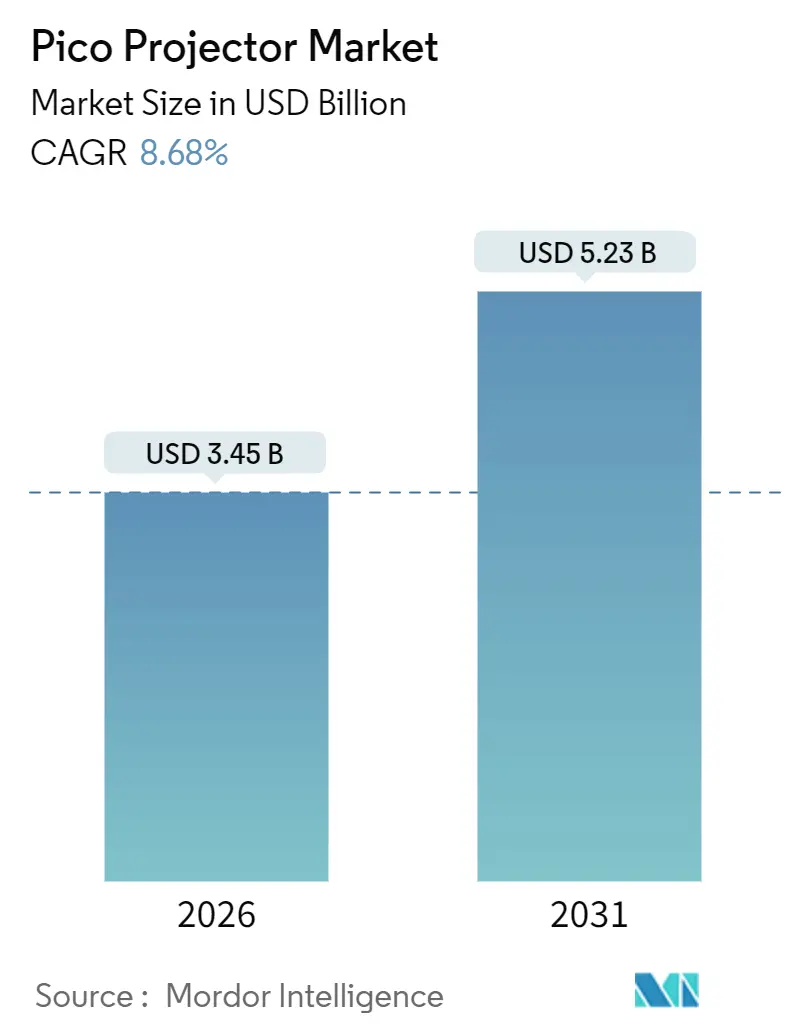
The Pico Projector Market size is estimated at USD 3.45 billion in 2026, and is expected to reach USD 5.23 billion by 2031, at a CAGR of 8.68% during the forecast period (2026-2031).
Smartphone makers that embed projection modules, automotive brands that deploy augmented-reality head-up displays in mid-tier vehicles, and enterprises that swap fixed conference-room systems for battery-powered units underpin this growth surge. Rapid migration from mercury lamps to solid-state LED and laser engines extends usable life beyond 20,000 hours, lowering ownership costs for education ministries that operate in regions with unstable grid power. Component miniaturization lets defense contractors insert ruggedized projectors into helmet systems, while consumer demand for portable backyard cinema experiences pushes vendors to deliver higher brightness at sub-USD 1,000 price points. At the same time, chipset advances from Texas Instruments and MicroVision set the cadence for new form factors, galvanizing a multipolar supplier ecosystem that feeds every major brand.
Key Report Takeaways
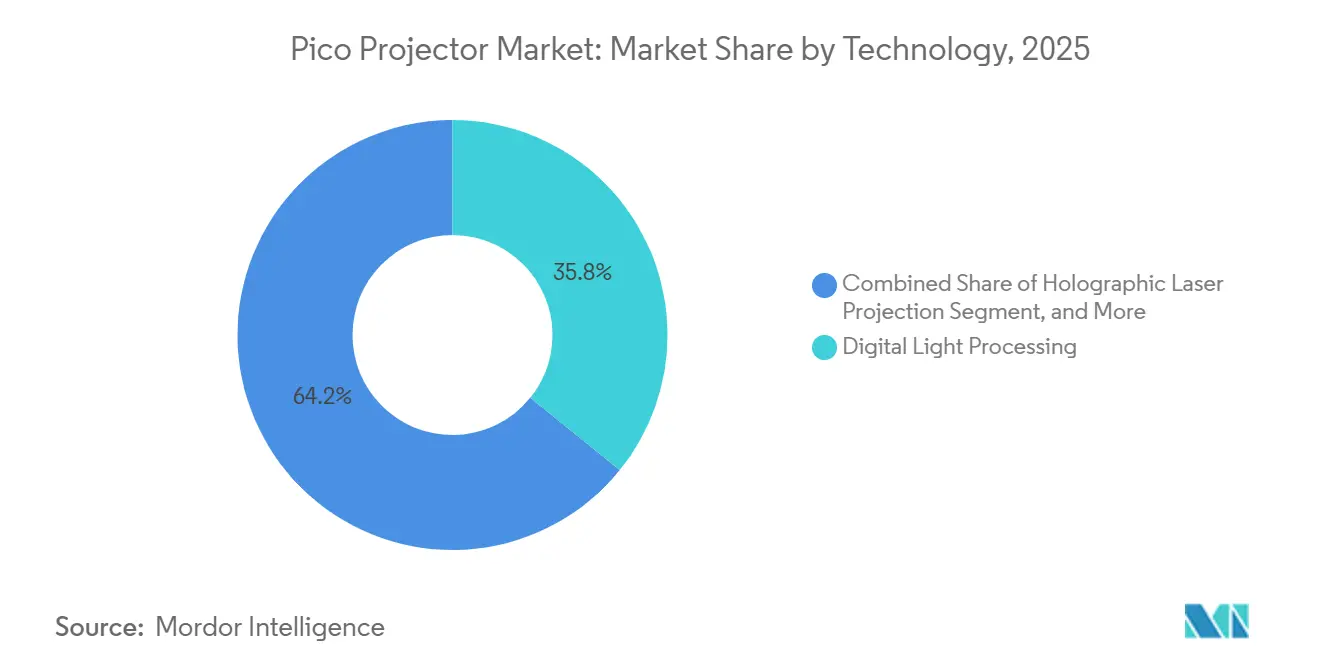
- By technology, Digital Light Processing led with 35.81% of pico projector market share in 2025, while Laser Beam Steering is forecast to accelerate at a 9.78% CAGR through 2031.
- By product type, stand-alone units accounted for 40.66% revenue share in 2025; embedded modules are poised to expand at a 10.11% CAGR through 2031.
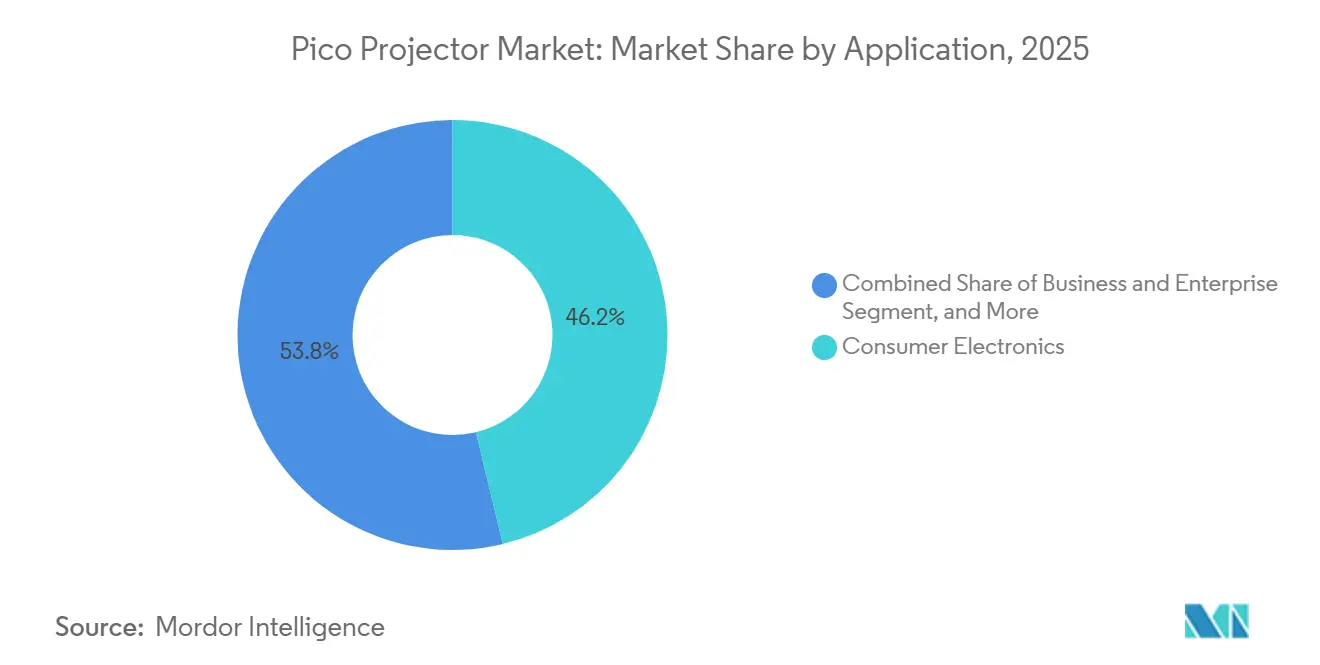
- By application, consumer electronics generated 46.24% revenue in 2025, and automotive head-up displays are on track for a 10.99% CAGR to 2031.
- By brightness, the 100-500 lumens band represented 44.73% of shipments in 2025, while the above-1,000-lumens segment is projected to grow at 9.12% during 2026-2031.
- By geography, North America retained 36.92% revenue share in 2025, but Asia Pacific is expected to log an 11.27% CAGR through 2031.
Note: Market size and forecast figures in this report are generated using Mordor Intelligence’s proprietary estimation framework, updated with the latest available data and insights as of January 2026.
Global Pico Projector Market Trends and Insights
Drivers Impact Analysis*
| Driver | (~)% Impact on CAGR Forecast | Geographic Relevance | Impact Timeline |
|---|---|---|---|
| Integration Into Smartphones and Wearables | +1.8% | Global, with early adoption in Asia Pacific (China, South Korea) and North America | Medium term (2-4 years) |
| Rise of Hybrid Work and Mobile Presentations | +1.5% | North America and Europe, spill-over to APAC urban centers | Short term (≤ 2 years) |
| Advances in Solid-state Light Sources (LED/laser) | +2.1% | Global | Long term (≥ 4 years) |
| Growth of Outdoor/Home Entertainment Culture | +1.2% | North America, Europe, urban APAC | Medium term (2-4 years) |
| Automotive HUD and AR Windscreen Adoption | +1.6% | Europe, North America, China (premium vehicle segments) | Long term (≥ 4 years) |
| Subsidies for Digital Classrooms in Emerging Markets | +0.9% | Asia Pacific (India, ASEAN), Africa, South America | Medium term (2-4 years) |
| Source: Mordor Intelligence | |||
Integration Into Smartphones and Wearables
Smartphone brands integrate compact DLP or LBS modules to escape feature parity in mature handset lines. Samsung prototypes and Xiaomi’s Smart Projector L1 convert a foldable phone into a 100-inch viewing surface without external hardware. Meta’s photonic-integrated-circuit display, published in January 2025, achieved 10,000 nits in a wafer-scale form factor, outlining a path for true eyewear projection.[1]Meta, “Flat-Panel Laser Display Using Photonic Integrated Circuits,” nature.com XREAL and Qualcomm combine beam steering with 5G to overlay repair manuals onto machinery, trimming downtime for field engineers. Falling component costs and rising battery energy density should make always-on projection a default flagship feature before 2028.
Rise of Hybrid Work and Mobile Presentations
Portable, USB-C-powered projectors replace fixed conference-room rigs as companies embrace flexible office footprints. Anker’s Nebula Capsule 3 Laser, launched in September 2024, supplies 300 ANSI lumens for two-hour café meetings, while ViewSonic’s M2e delivers 1,000 ANSI lumens with instant keystone correction, eliminating IT setup friction. Departmental budgets now favor self-service devices that workers can carry between home and headquarters, driving double-digit unit growth in the sub-USD 700 bracket.
Advances in Solid-State Light Sources (LED/Laser)
LED and laser engines now have lifespans of over 30,000 hours, slashing lamp replacement costs by roughly 40% over five years. Texas Instruments’ DLPC8445 controller supports 4K/60 fps at under 50 W, enabling silent, fan-less designs. AAXA’s M8 Laser Projector pairs 1,200 laser lumens with a 15,000 mAh battery for untethered outdoor screenings. MEMS mirror modules from STMicroelectronics scan wide fields of view in millimeter-scale packages, small enough for camera bumps. These gains unlock brighter output without thermal penalties, a prerequisite for broad classroom adoption.
Automotive HUD and AR Windscreen Adoption
BMW’s panoramic iDrive system, unveiled at CES 2025, splashes navigation cues across the windshield, reducing eyes-off-road intervals. Continental and Visteon refine laser-scanned, 3-D arrows that appear to float above asphalt, guiding drivers through complex merges. The U.S. Department of Defense’s SBIR topic A244-011 calls for visor-mounted displays delivering 2,000 ft-L, underscoring dual-use demand. As electric-vehicle dashboards cede real estate to touchscreens, HUDs become the primary speedometer, anchoring a stable revenue stream for projection suppliers.
Restraints Impact Analysis*
| Restraint | (~)% Impact on CAGR Forecast | Geographic Relevance | Impact Timeline |
|---|---|---|---|
| Limited Brightness in Ultra-compact Form Factors | -0.7% | Global | Short term (≤ 2 years) |
| Photobiological Safety Compliance Costs (IEC 62471) | -0.5% | Global, with stricter enforcement in Europe and North America | Medium term (2-4 years) |
| Competition from Large OLED/mini-LED TVs | -0.6% | North America, Europe, urban APAC | Medium term (2-4 years) |
| Supply-chain Volatility for DLP and MEMS Chips | -0.4% | Global, with acute impact in APAC manufacturing hubs | Short term (≤ 2 years) |
| Source: Mordor Intelligence | |||
*Our forecasts treat driver/restraint impacts as directional, not additive. The impact forecasts reflect baseline growth, mix effects, and variable interactions.
Segment Analysis
By Technology: Laser Beam Steering Gains on DLP Incumbency
Digital Light Processing held 35.81% of 2025 revenue, sustained by Texas Instruments’ patent shield and single-chip reliability. Laser Beam Steering is projected to outpace at 9.78% CAGR as MicroVision’s PicoP modules eliminate color wheels and shrink optics to sub-3 cm³ footprints. The pico projector market size for Laser Beam Steering is expected to widen meaningfully as augmented-reality headsets enter mass production for enterprise maintenance crews. Liquid Crystal on Silicon remains a niche for high-contrast home theater, but the share is sliding as DLP achieves native 4K at a lower cost. Research prototypes from Meta hint that flat-panel silicon photonics could disrupt all incumbent approaches after 2028, a wildcard that vendors monitor closely.
Holographic techniques remain confined to concept cars and laboratories because they require coherent light and computationally intensive wavefront control. LED/laser hybrids blend long life with moderate brightness and dominate mid-priced consumer models. STMicroelectronics’ MEMS mirrors enable sub-milli-radian accuracy essential for AR overlays in military helmet visors, proving that precision scanning can coexist with rugged design. Overall, cross-licensing between chipset makers and projector brands drives a virtuous upgrade cycle that anchors the pico projector market even if one architecture ultimately prevails.



By Product Type: Embedded Integration Outstrips Stand-Alone Growth
Stand-alone devices commanded 40.66% of 2025 revenue as users valued plug-and-play simplicity. Yet embedded modules are forecast to post a 10.11% CAGR as phone and wearable vendors add projection to counter stagnating camera innovation. The pico projector market size attributed to embedded designs is therefore likely to climb faster than any other product class. Samsung prototypes demonstrate seamless casting of social-media feeds onto walls, while BMW plans rear-seat entertainment modules built directly into headrests. Meanwhile, rugged outdoor units like BenQ’s GS50 show that the stand-alone category can still expand if designs withstand dust and light rain.
Media-player variants and USB sticks now serve niche cases, such as field sales reps who rely on thumb-drive slide decks. Widespread USB-C display support, however, reduces their strategic relevance. Price compression favors embedded modules because they omit enclosures, batteries, and speakers, collapsing bill of materials below USD 30 at million-unit scale. That cost delta makes it hard for low-brightness plug-ins to remain attractive at retail.
By Application: Automotive HUD Disrupts Consumer Dominance
Consumer electronics generated 46.24% of 2025 spend as households sought cinema-size images without installing ceiling mounts. Automotive head-up displays, however, are on course for a 10.99% CAGR, signaling a structural shift in where unit volumes emerge. The pico projector market share for consumer electronics will likely erode as infotainment migrates from living rooms to vehicles. BMW’s panoramic windshield overlay anchors this pivot, and tier-1 suppliers already quote double-digit content growth per vehicle for 2027 platform launches.
Business and enterprise adoption benefited from hybrid work, but brightness ceilings still limit large-room presentations. Education ministries in India and Southeast Asia order tens of thousands of units to animate K-12 curriculum, packaging projectors with solar panels where grid supply falters. Healthcare visualization remains small but profitable; ETH Zurich’s laparoscopic prototype shows how structured-light projection can guide surgeons in real time. Aerospace and defense, buoyed by U.S. SBIR grants, demand rugged, daylight-readable modules, keeping average selling prices above USD 2,000.
By Brightness: Above 1,000 Lumens Races Ahead as Laser Costs Fall
The 100-500 lumens cohort shipped 44.73% of units in 2025, fitting hotel rooms and twilight backyard screenings. Yet above-1,000-lumens devices are forecast to register a 9.12% CAGR as laser diode prices decline. The pico projector market size for high-brightness models is thus set to close the gap with mid-tier bands by 2031. XGIMI’s Horizon S Max reaches 3,100 ANSI lumens in a lunch-box chassis, enabling lights-on boardroom use at USD 1,999.[2]XGIMI, “Horizon S Max 4K Laser Projector,” xgimi.com AAXA’s M8 shows that 1,200 lumens is now feasible on battery power, redefining portability thresholds.
Sub-100-lumen gadgets are fading as smartphones themselves exceed 800 nits. The 500–1,000 lumens tranche bridges consumer and enterprise demands; BenQ’s GV31 at 300 ANSI lumens remains popular for road-warrior slide shows, yet users increasingly pay a premium for daylight viability. Laser advances promise a 5,000-hour balance between battery life and brightness within five years, positioning portable projectors as true TV substitutes.
Geography Analysis
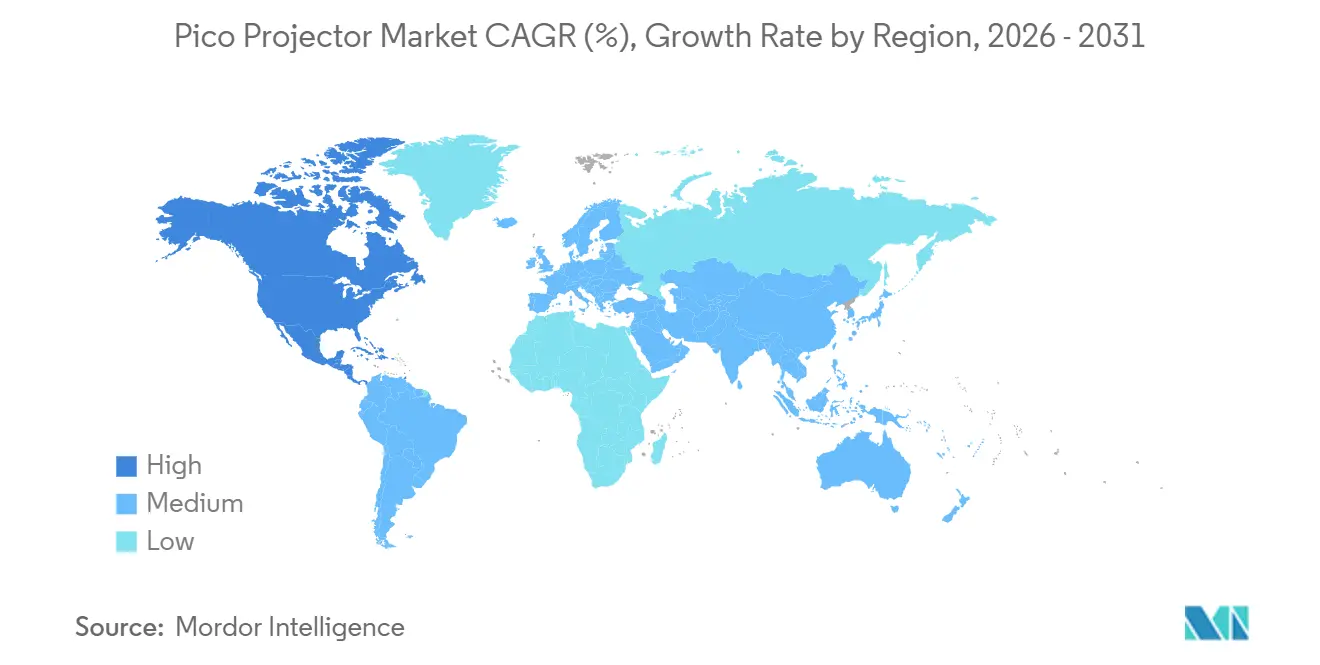
North America accounted for 36.92% of global revenue in 2025, driven by early enterprise adoption of USB-C portables and steady defense procurement of ruggedized displays for training ranges. Defense solicitations such as SBIR A244-011 guarantee baseline demand for U.S. suppliers over the forecast window. Corporate return-to-office policies emphasize small huddle spaces rather than large auditoriums, aligning perfectly with pico form factors. Consumer interest centers on outdoor movie nights and gaming, driven by affordable 4K streaming sticks that pair seamlessly via HDMI-ARC.
Asia Pacific is forecast to log an 11.27% CAGR, the fastest worldwide. India’s ICT Samagra Shiksha outlay of INR 6.40 lakh per school (USD 7,680) includes explicit projector line items and anchors predictable tenders through 2031. China’s middle-class buyers now view triple-laser 4K models under USD 2,000 as attainable luxuries. XGIMI’s July 2024 Hong Kong IPO, raising HKD 1.2 billion (USD 154 million), injects capital for regional channel expansion. Japan and South Korea upgrade to ultra-short-throw designs that suit compact apartments, with Epson and Sony defending share against aggressive Chinese entrants.
Europe trails in volume but enjoys premium ASPs because automotive head-up displays carry higher margins than consumer units. Continental’s and Visteon’s systems, validated on electric platforms, accelerate a localized supply chain for MEMS mirrors and laser diodes. Stricter enforcement of IEC 62471 pushes non-compliant imports out of mainstream retail, protecting domestic OEMs. Middle East governments channel petro-revenues into smart-city classrooms, while South America and Africa remain volume-starved yet strategically important for vendors offering solar-compatible batteries. Acer’s C250i, able to play five hours on a single charge, targets these off-grid deployments.[3]Acer, “C250i Portable LED Projector,” acer.com

Regulatory Landscape
Pico projectors and embedded projection modules face overlapping laser and photobiological safety requirements, which can affect time-to-market and SKU economics. In the United States, the FDA Center for Devices and Radiological Health (CDRH) allows certain laser-illuminated projectors to demonstrate conformance via IEC 60825-1 Ed. 3 (and related clauses referenced in Laser Notice No. 56) as an alternative pathway to portions of 21 CFR 1040.10 and 1040.11, shaping labeling, reporting, and design controls for laser-based pico projectors used in consumer and professional settings. In Canada, Health Canada oversight under the Radiation Emitting Devices framework reinforces hazard classification and safety expectations for laser products, adding compliance work for vendors shipping the same hardware across North America.
Trade compliance also influences sourcing and channel strategies. Pico projectors generally map to HS/HTS categories used for video projectors (for example HTS 8528.62.00 is commonly referenced for laser/LED projectors), and the duty profile can differ by origin even when the base classification aligns with WTO ITA principles. For outdoor and event use cases, organizer rules can add another operational layer: LDI published updated 2026 laser and laser-illuminated device safety requirements for its shows, including FDA certification expectations for laser display devices and projectors powered on at events. This pushes vendors toward tighter documentation and verification processes for professional deployments.
Value Chain Analysis
The pico projector value chain starts with core enabling components, including LED/laser diodes, optical elements, MEMS mirrors/microdisplays, and controller ICs, and then moves into optical engine assembly and final device integration. Texas Instruments anchors the DLP branch of the ecosystem through its chipset platform and licensing footprint. Laser beam scanning and beam steering architectures depend heavily on MEMS scanning and laser driver electronics (for example, Nisshinbo Micro Devices offers multi-channel laser diode driver ICs for laser scanning projectors). Upstream innovation in microdisplays is feeding new engine designs: suppliers such as JBD have been commercializing MicroLED-based projection modules and expanding manufacturing capability, while compact light-engine developers in Asia continue to push volume and size limits for embedded deployments.
Downstream, optical engine specialists and ODM/OEM assemblers integrate these subassemblies into stand-alone portable projectors, embedded modules for smartphones and wearables, and automotive-grade projection and HUD systems. Branding, software UX, and channel access shape route-to-market, with consumer electronics sold through retail and e-commerce, and automotive and defense programs moving through tier-1 and contract channels. The chain remains sensitive to single-source dependencies (notably DLP components), qualification demands for automotive use, and landed-cost variability where tariff frictions affect critical optical subassemblies, leading some vendors to adjust sourcing footprints and product configurations to manage risk.
Competitive Landscape
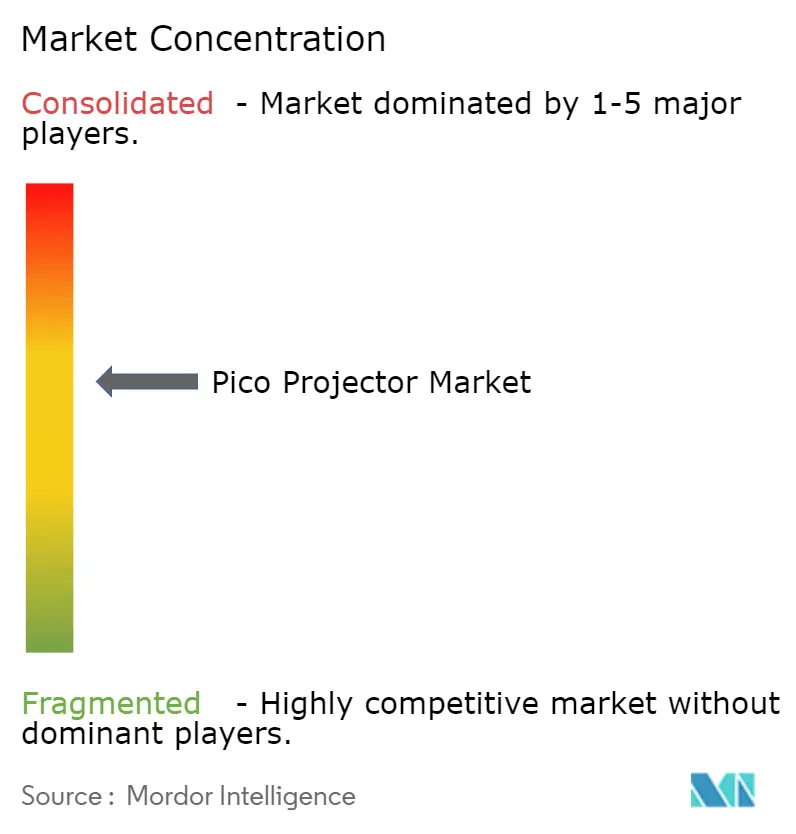
Pico projection is moderately fragmented. Legacy electronics giants such as LG, Sony, and Epson leverage decades of optical R&D and strong after-sales networks. Chinese specialists XGIMI, Dangbei, and JMGO compress costs by vertically integrating from laser diode to final assembly, enabling 3,000-plus-lumen 4K models at USD 1,999. Component gatekeepers Texas Instruments and MicroVision monetize intellectual property via licensing, shaping form factors and feature sets across the tier-two OEM pool. July 2024’s successful IPO arms XGIMI with fresh R&D funds to challenge Japanese incumbents in color accuracy and HDR certification.
Strategic divergence is visible: Sony pursues IMAX Enhanced badges and Dolby Vision support above USD 2,000, while Anker and AAXA chase sub-USD 600 portability with comparable resolution. Kopin’s October 2024 defense contract to develop daylight-readable helmet modules shows the high-margin path in rugged, specialized niches.[4]Kopin Corporation, “Daylight-Readable HUD Contract Award,” kopin.com Meta’s silicon-photonics breakthrough could erode both DLP and LCoS if mass production hits by 2028, an existential risk vendors now hedge by co-developing flat-panel prototypes.
Regulatory hurdles reinforce incumbent advantage. IEC 62471 testing stretches release timelines by up to half a year and can cost USD 50,000 per SKU. Established brands absorb this through multi-product labs, whereas startups must amortize expenses over smaller volumes. Supply-chain volatility for DLP and MEMS wafers occasionally lengthens lead times beyond 16 weeks, but multi-sourcing agreements mitigate stockouts for tier-one players. Collectively, these factors sustain medium concentration yet leave room for disruptive challengers.
Pico Projector Industry Leaders
Aaxa Technologies Inc.
Sony Corporation
XGIMI Technology Co., Ltd.
Anker Innovations Ltd.
BenQ Corporation
- *Disclaimer: Major Players sorted in no particular order

Market Opportunities and Future Outlook
A clear whitespace sits at the intersection of ultra-compact optical engines and integration into wearables, AR devices, and automotive-grade human-machine interfaces, where power, thermals, and module volume constrain deployment more than resolution does. In 2026, JBD introduced Roadrunner II, a polychrome 0.1-inch SVGA MicroLED projector module that emphasizes very low typical power consumption alongside a micro-scale pixel pitch. This reflects an active shift toward projection engines that can fit inside small form factors rather than relying on stand-alone housings. Separately, the component ecosystem is filling integration gaps for laser beam scanning designs: Nisshinbo Micro Devices markets multi-channel laser diode driver ICs intended for high-speed RGB/RGGB laser scanning projectors, supporting tighter electrical integration and more compact light-engine designs.
Commercialization paths are also expanding through new optics and wafer-level approaches that target bill-of-material and assembly simplification. In April 2026, a crowdfunding campaign highlighted an ultra-compact pico projector concept using Meta Optics Technologies metalens optics with an LBS architecture, signaling market appetite for thinner collimation stacks and differentiated portability even outside traditional tier-one launches. Taken together, MicroLED module roadmaps, laser beam scanning integration, and wafer-level optics point to near-term productization opportunities in embedded pico projection (phones, wearables, and rugged field tools) and in automotive HMI and HUD sub-systems, where qualification and reliability requirements tend to favor suppliers that can deliver repeatable, miniaturized optical engines at scale.
Recent Industry Developments
- April 2026: XGIMI opened orders for its TITAN Noir Series 4K projectors, highlighting a Dual Intelligent Iris System for dynamic light control and contrast management. The launch reinforces the shift toward premium image-processing and optical-control differentiation as compact projectors compete with large-screen TV alternatives in home entertainment.
- July 2025: Sony made the BRAVIA Projector 7 and BRAVIA Projector 9 available for purchase in India through authorized channels. Expanding availability in a large Asia-Pacific market supports broader regional penetration for high-end laser projection platforms and strengthens the BRAVIA ecosystem positioning across home cinema devices.
- September 2024: XGIMI unveiled multiple new home and portable projector models, including the MoGo 3 Pro, Elfin Flip, AURA 2, and the HORIZON S Series. The breadth of announcements emphasized portfolio segmentation across portability and performance tiers, helping accelerate replacement cycles and widen addressable use cases from travel-friendly viewing to living-room and dedicated home-theater setups.


Research Methodology Framework and Report Scope
Market Definition and Coverage
For this methodology, the pico projector market covers compact, portable projection devices and embedded projection modules that create an image for personal, education, or enterprise viewing, and are sold as finished hardware products.
Scope exclusions: We exclude fixed-installation projectors and large-venue projectors that are not positioned as pico or ultra-portable devices.
Segmentation Overview
- By Technology
- Digital Light Processing (DLP)
- Liquid Crystal on Silicon (LCoS)
- Laser Beam Steering (LBS)
- Holographic Laser Projection
- LED / Laser Hybrid Engines
- By Product Type
- USB Pico Projector
- Embedded Pico Projector
- Media-Player Pico Projector
- Stand-alone Pico Projector
- By Application
- Consumer Electronics
- Business and Enterprise
- Education and Training
- Automotive Head-Up Displays
- Healthcare Visualization
- Aerospace and Defense
- Industrial and Other Uses
- By Brightness
- Below 100 Lumens
- 100- 500 Lumens
- 500- 1000 Lumens
- Above 1000 Lumens
- By Geography
- North America
- United States
- Canada
- Mexico
- South America
- Brazil
- Argentina
- Rest of South America
- Europe
- Germany
- United Kingdom
- France
- Italy
- Spain
- Rest of Europe
- Asia-Pacific
- China
- Japan
- India
- South Korea
- ASEAN
- Rest of Asia-Pacific
- Middle East
- Saudi Arabia
- United Arab Emirates
- Rest of Middle East
- Africa
- South Africa
- Nigeria
- Rest of Africa
- North America
Data Sources, Market Sizing, and Validation
Desk Research
Desk research was used to build the starting market structure and to anchor assumptions around demand and supply signals that we can check using public data. We typically use sources such as US International Trade Commission trade statistics, UN Comtrade, OECD indicators, and national statistical offices, since these can show electronics output and price movement that influence device spending.
To keep scope practical, we also review company annual reports and investor presentations, product specification sheets, reputable press coverage, and industry association pages related to display and consumer electronics. A few paid database subscriptions are used selectively for company financials, patent lookups, and shipment level import and export checks where it helps validate direction and timing. The desk research sources listed above are illustrative only, and we also pull from additional public sources for data collection, validation, and research clarification.
Primary Interviews and Surveys
Primary work focused on interviews and structured surveys with people who touch the market from different angles, including device brands, component and optical engine stakeholders, distributors, and institutional buyers who procure portable projection. Because this is a global market, the outreach is spread across key consuming and manufacturing regions, and respondent input is used to confirm adoption drivers, realistic pricing bands, and how new use cases are turning into actual purchase decisions.
Distribution of primary research fieldwork respondents
| Company type | Respondent position | Region |
|---|---|---|
| Top tier: 36% | CXOs: 15% | APAC: 51% |
| Mid tier: 42% | Functional/Unit leaders: 28% | EMEA: 30% |
| Smaller Players: 22% | Managers: 57% | Americas: 19% |
Market-Sizing & Forecasting
Sizing starts with a top-down build where consumer electronics spending signals, portable display adoption, and regional device availability are used to reconstruct a realistic demand pool for pico projectors, and then converted into revenue using pricing bands. To keep the estimate grounded, we corroborate the result using selective bottom-up checks, such as sampled average selling price by brightness class multiplied by expected unit volume ranges discussed in channel checks, and then adjust when the two views do not line up.
Key inputs include brightness mix shifts (for example, movement from sub-100 lumens toward higher lumen classes), changes in light source preferences, the share of embedded versus standalone devices, average selling price progression by resolution and feature set, and region-wise penetration tied to education and enterprise buying cycles. Where a segment has limited public visibility, gaps are handled with conservative ranges that we tighten using interview feedback, then tested against trade flows and product launch cadence.
For forecasting, we use scenario analysis supported by a simple multivariate regression layer, with the key drivers refreshed annually and then moderated by what industry participants expect for pricing and adoption. In practice, we keep the forecast reproducible by using clear driver series and by documenting the small set of assumptions that drive the largest swings, so updates can be repeated with consistent logic.
Data Validation & Update Cycle
Validation is done through multiple passes where the model outputs are compared with independent signals, and variance checks are run at region and use case level so outliers are flagged early. If an assumption produces an unexpected jump in value, the driver is revisited, the math is rechecked, and follow-up questions are sent back to the relevant respondent type before sign-off.
Before publication, an additional analyst reviews the work, and we check the storyline so the numbers remain consistent with observed product and demand trends. Reports are refreshed annually, and interim updates are added when material events occur that can change supply, pricing, or adoption. Right before delivery, we complete a final pass so clients receive the newest updated view based on the latest public information.
Mordor Intelligence's Pico Projector Market Estimate Compared With Other Published Estimates
Published market sizes for pico projectors often look different because the scope boundaries are not always identical, and the pricing logic is applied in different ways. We also see variation when base years do not match, when some studies rely on aggressive growth cases, or when older assumptions are not revisited after changes in product mix.
In this market, the largest gap drivers usually come from whether embedded projection modules are counted the same way as standalone devices, how brightness and resolution upgrades are translated into average selling prices, and which applications are treated as real demand versus early-stage pilots. Currency conversion timing also plays a role, and refresh cadence matters too, since fast product cycles can make a one-year-old pricing set feel dated.
Benchmark comparison
| Source | Market Size | Gaps in Research Methodology |
|---|---|---|
| Mordor Intelligence | USD 3.45 B (2026) | |
| Global Consultancy A | USD 7.49 B (2025) | Uses a different base year and longer forecast window, and the implied pricing curve can inflate the near-term value when feature upgrades are converted into ASPs without tight checks by brightness and product type. |
| Industry Publisher B | USD 3.70 B (2023) | Anchors the market in an older year and can miss newer adoption pockets, and the coverage often differs by product categories and applications, which shifts the counted revenue pool even when the device definition sounds similar. |
Trade flow direction checks and observable shifts in brightness tier launches are the evidence points that keep Mordor Intelligence aligned to the realistic hardware revenue pool, and they also explain why some higher figures can appear stretched when pricing and scope are broadened too early. Overall, the spread in published values is mainly about timing and boundaries, and the most dependable way to read it is to map each number back to its product coverage, application cut, and pricing assumptions.


Key Questions Answered in the Report
How large is the pico projector market in 2026?
The pico projector market size stood at USD 3.45 billion in 2026 and is forecast to hit USD 5.23 billion by 2031.
Which technology leads current sales?
Digital Light Processing held 35.81% share in 2025, maintaining the lead through proven reliability and a broad patent portfolio.
What is the fastest expanding application?
Automotive head-up displays are projected to grow at 10.99% CAGR thanks to wider integration in premium and mid-tier electric vehicles.
Which region will post the highest CAGR?
Asia Pacific is on track for an 11.27% CAGR through 2031, buoyed by Indian education subsidies and rising Chinese consumer demand.
Are battery-powered units bright enough for daylight use?
High-brightness portables exceeding 1,000 ANSI lumens, such as XGIMI’s Horizon S Max, now deliver daylight-readable images without mains power.
Page last updated on:





