
Petroleum Liquid Feedstock Market Size and Share
Market Overview
| Study Period | 2021 - 2031 |
|---|---|
| Market Size (2026) | USD 357.89 Billion |
| Market Size (2031) | USD 449.42 Billion |
| Growth Rate (2026 - 2031) | 4.66 % |
| Fastest Growing Market | Asia-Pacific |
| Largest Market | Asia-Pacific |
| Market Concentration | Medium |
Major Players *Disclaimer: Major Players sorted in no particular order Image © Mordor Intelligence. Reuse requires attribution under CC BY 4.0. | |
Petroleum Liquid Feedstock Market Analysis by Mordor Intelligence
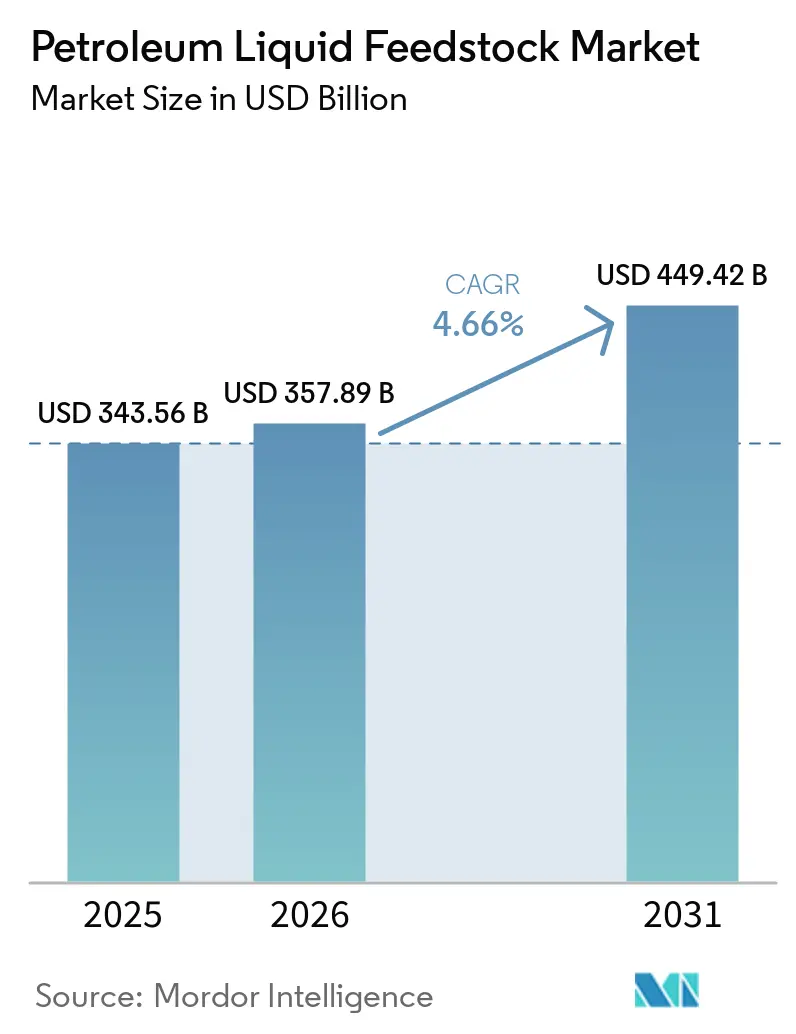
The petroleum liquid feedstock market size was valued at USD 343.56 billion in 2025 and is estimated to grow from USD 357.89 billion in 2026 to USD 449.42 billion by 2031, at a CAGR of 4.66% during the forecast period (2026-2031). Naphtha remains central to the petroleum liquid feedstock market because a single cracking process can produce ethylene, propylene, butadiene, and aromatics. Refinery and petrochemical integration in the Middle East and China is changing how producers secure feedstock and capture downstream value, while polymer demand in South and Southeast Asia continues to support consumption. Supply interruptions have encouraged buyers to diversify procurement routes, although the underlying need for liquid feedstock continues across the petrochemical value chain.
Key Report Takeaways
- By type, naphtha held 65.67% of the petroleum liquid feedstock market share in 2025 and is forecast to grow at a CAGR of 5.13% through 2031.
- By end product, ethylene held 45.13% of the petroleum liquid feedstock market share in 2025, while propylene is forecast to grow at a CAGR of 5.22% through 2031.
- By application, industrial solvents held 35.06% of the petroleum liquid feedstock market share in 2025 and are forecast to grow at a CAGR of 5.75% through 2031.
- By geography, Asia-Pacific held 42.69% of the petroleum liquid feedstock market share in 2025 and is forecast to grow at a CAGR of 5.67% through 2031.
Note: Market size and forecast figures in this report are generated using Mordor Intelligence’s proprietary estimation framework, updated with the latest available data and insights as of January 2026.
Global Petroleum Liquid Feedstock Market Trends and Insights
Drivers Impact Analysis*
| Drivers | (~) % Impact on CAGR Forecast | Geographic Relevance | Impact Timeline |
|---|---|---|---|
| Rising Demand for Olefins and Aromatics | +1.80% | Global, concentrated in Asia-Pacific, with secondary demand in the Middle East, Africa, and South Asia | Medium term (2-4 years) |
| Refinery-Petrochemical Integration | +1.00% | China, Saudi Arabia, the UAE, and Nigeria, with spillover demand effects in South Korea and India | Long term (≥ 4 years) |
| Polymer Demand from Packaging, Construction, and Automotive Applications | +1.20% | Global, with the highest incremental demand in South Asia, Southeast Asia, and Sub-Saharan Africa | Medium term (2-4 years) |
| Bio-Naphtha Adoption Driven by Renewable-Fuel Mandates | +0.30% | North America and Europe, with early-stage adoption in the Asia-Pacific | Short term (≤ 2 years) |
| Feedstock Flexibility and Digital Yield Optimization | +0.50% | Global, with early adoption in the Middle East, Europe, and China | Short term (≤ 2 years) |
| Source: Mordor Intelligence | |||
Rising Demand for Olefins and Aromatics
The petroleum liquid feedstock market continues to rely on naphtha-fed steam crackers, which remain the established commercial route for producing ethylene, propylene, butadiene, and benzene from a single feedstock stream. This product range gives the petroleum liquid feedstock market a durable role in base chemical supply. ExxonMobil began commercial operations at its 1.6 million tons per year Guangdong complex in Q2 2025 and procured naphtha from Middle Eastern suppliers, including Qatar's Ras Laffan refinery. Imports by major Asian petrochemical producers reached 86.6 million tons in 2025, reflecting the scale of the region's dependence on external feedstock supplies. The early-2026 disruption to Middle East flows reduced cracker activity, but also encouraged buyers to diversify supply routes to include the Americas, India, and Australia.
Refinery-Petrochemical Integration
Integrated sites refine crude oil and convert intermediate streams into petrochemicals, allowing producers to retain value across more stages of production. This model is a major investment focus in the petroleum liquid feedstock market because it gives operators greater control over feedstock availability and product placement. Aramco, Sinopec, and YASREF signed a Venture Framework Agreement in April 2025 for a Yanbu project with a 1.8 million tons per year mixed-feed cracker and a 1.5 million tons per year aromatics complex. Aramco has stated an ambition to convert up to 4 million barrels per day of crude oil into chemicals by 2030. PetroChina's Dalian project, with an investment of CNY 68.5 billion (USD 9.3 billion), is planned to include a 10 million tons-per-year refinery and a 1.2 million metric tons-per-year ethylene unit, with construction scheduled to start in 2026. Such projects reduce internal users' exposure to spot naphtha prices and can put more pressure on non-integrated buyers.
Polymer Demand from Packaging, Construction, and Automotive Applications
Packaging, construction, and automotive production support a broad, recurring need for polymer materials derived from petroleum-based feedstocks. The petroleum liquid feedstock market benefits when construction activity increases demand for polyvinyl chloride (PVC) pipes, polyethylene films, and polymer construction materials. European fleet carbon dioxide rules support vehicle lightweighting, which increases the use of engineering polymers, composite materials, and thermal management films. India's public infrastructure spending also supports demand for plastics used in pipes, film, and construction products. Electric vehicle systems use polymer-based battery encapsulants, separator films, and thermal interface materials, sustaining demand as vehicle designs change. Compliance requirements under European chemical rules and Indian standards favor narrower, higher-purity naphtha fractions, supporting refinery upgrades that improve product quality.
Bio-Naphtha Adoption Driven by Renewable-Fuel Mandates
The U.S. Environmental Protection Agency finalized Renewable Fuel Standard requirements for 2026 and 2027 on March 27, 2026, with the rule taking effect on January 1, 2027. The rule assigns renewable naphtha an equivalence value of 1.4 and provides a compliance route for qualifying renewable liquid feedstocks. Under the regulatory definition, renewable naphtha can be produced from hydroprocessed vegetable oils, agricultural residues, and used cooking oil. Current production economics and the premium over fossil naphtha limit adoption without direct incentives. Even so, the rule gives compliant renewable naphtha a source of demand that does not depend solely on crude oil price movements. European renewable fuel policy for maritime transport may provide a second demand pathway for bio-based intermediates by 2028.
Restraints Impact Analysis*
| Restraints | (~) % Impact on CAGR Forecast | Geographic Relevance | Impact Timeline |
|---|---|---|---|
| Crude Oil and Naphtha Price Volatility | -0.60% | Global, with a disproportionate effect on import-dependent Asia-Pacific markets, including Japan, South Korea, and Taiwan | Short term (≤ 2 years) |
| Substitution by Ethane, Liquefied Petroleum Gas (LPG), and Propane-Dehydrogenation Routes | -0.70% | North America, China, and selected Southeast Asian producers | Medium term (2-4 years) |
| Petrochemical Overcapacity and Margin Compression | -0.40% | China, South Korea, and Europe | Long term (≥ 4 years) |
| Source: Mordor Intelligence | |||
Crude Oil and Naphtha Price Volatility
Naphtha pricing remains closely tied to crude oil, which can rapidly increase costs for crackers when oil markets tighten. A supply disruption that began in late February 2026 sharply reduced Middle East naphtha flows to Asia and lowered Northeast Asian cracker utilization to 60% in March from 80% in February. Benchmark naphtha for May 2026 delivery reached USD 1,300 per ton in March 2026 during the disruption. By May 2026, Japanese buyers had secured 80% of their normal naphtha import volumes through alternative sources, including supplies from Algeria, Peru, the United States, and Central Asia. The petroleum liquid feedstock market, therefore, divides into spot buyers that absorb immediate volatility and integrated producers or long-term buyers that have greater protection. A Tokyo Shoko Research survey found that 85% of Japanese manufacturing companies reported constraints on naphtha and related solvent supplies in June 2026, indicating that shortages can extend beyond petrochemical plants.
Substitution by Ethane, LPG, and Propane-Dehydrogenation Routes
Low-cost ethane supplies give gas-based crackers a strong cost advantage in regions with abundant natural gas liquids. In July 2026, gross feedstock costs for ethylene at a U.S. Gulf ethane cracker were USD 2,320 per ton lower than at a South Korean naphtha cracker. SP Chemical announced plans to increase ethane cracking capability at its 600,000-ton-per-year Jiangsu cracker from 75% to 90%, while PTT Global Chemical secured 400,000 tons per year of U.S. ethane supply starting in 2029. China also scheduled three propane dehydrogenation plants with a combined capacity of 2 million tons per year for 2026, increasing competition for naphtha-derived propylene. Naphtha retains an important advantage because its cracking process yields propylene, butadiene, and aromatics in addition to ethylene. New flexible crackers that process naphtha, LPG, and ethane indicate that substitution is partial rather than a complete replacement of liquid feedstocks.
*Our forecasts treat driver/restraint impacts as directional, not additive. The impact forecasts reflect baseline growth, mix effects, and variable interactions.
Segment Analysis
By Type: Naphtha’s Co-Product Breadth Sustains Structural Dominance
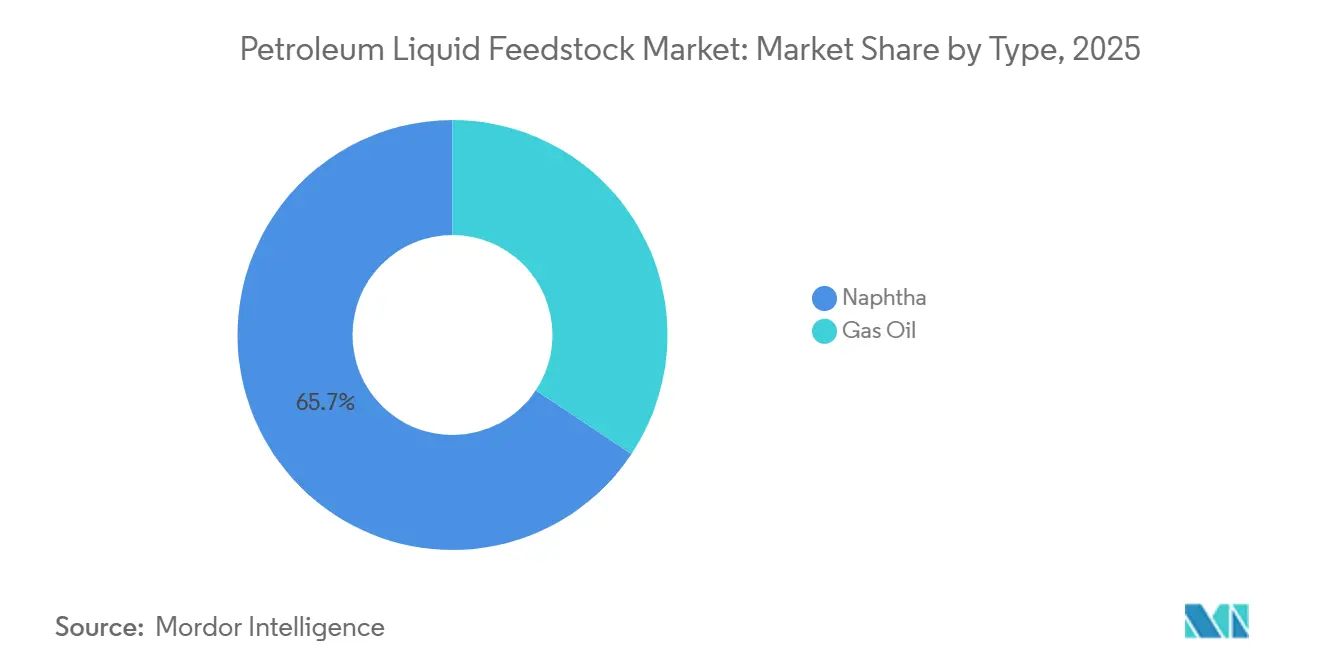
Naphtha held 65.67% of the petroleum liquid feedstock market share by type in 2025 and is projected to grow at a 5.13% CAGR through 2031. It serves both steam cracking for olefins and catalytic reforming for aromatics, giving it a broader yield profile than gas oil or gas-based feeds. China nearly doubled its 2025 naphtha import quotas, and imports reached 16.79 million tons. New integrated facilities in China and Saudi Arabia are designed to consume heavy naphtha, supporting segment growth. The value of propylene, butadiene, and aromatics can strengthen the economics of naphtha cracking when ethylene margins alone are weak.
Within the petroleum liquid feedstock market, gas oil acts as a complementary feedstock for heavy-feed crackers and provides an alternative during naphtha shortages. The market uses flexible feed systems to minimize disruption when a single input becomes unavailable or costly. The early-2026 supply disruption underscored the value of dual-feed operations for producers able to switch inputs. SABIC's Fujian complex and S-Oil's Shaheen Project both incorporate feedstock flexibility into their designs. This approach keeps gas oil relevant as a risk-management input within refinery-petrochemical complexes.

By End Product: Ethylene Anchors Demand While Propylene’s Supply Gap Widens
Ethylene held 45.13% of the petroleum liquid feedstock market share by end product in 2025. Its position reflects polyethylene demand from packaging, construction films, and consumer goods. China's ethylene capacity reached 66 million tons per year in 2025 and is forecast to reach 70 million tons per year by 2027. Benzene, hexane, and naphthalene have more specialized uses as chemical intermediates, food-processing extraction solvents, pharmaceutical solvents, concrete additives, and dyes. These end uses provide smaller but continuing demand streams for the petroleum liquid feedstock market.
Propylene is the fastest-growing end product, with the petroleum liquid feedstock market size for propylene projected to expand at a 5.22% CAGR through 2031. Ethane cracking produces less co-product propylene than naphtha cracking, creating a supply gap as ethane use increases. SABIC's Fujian mixed-feed cracker is designed to produce ethylene and propylene at scale, with start-up targeted for Q4 2026. The broader slate of naphtha co-products can offset higher procurement costs for liquid feedstock. European capacity rationalization may reduce regional naphtha use while creating opportunities for propylene supply from Asian and Middle Eastern exporters.
By Application: Industrial Solvents Leverage Independent Demand Vectors
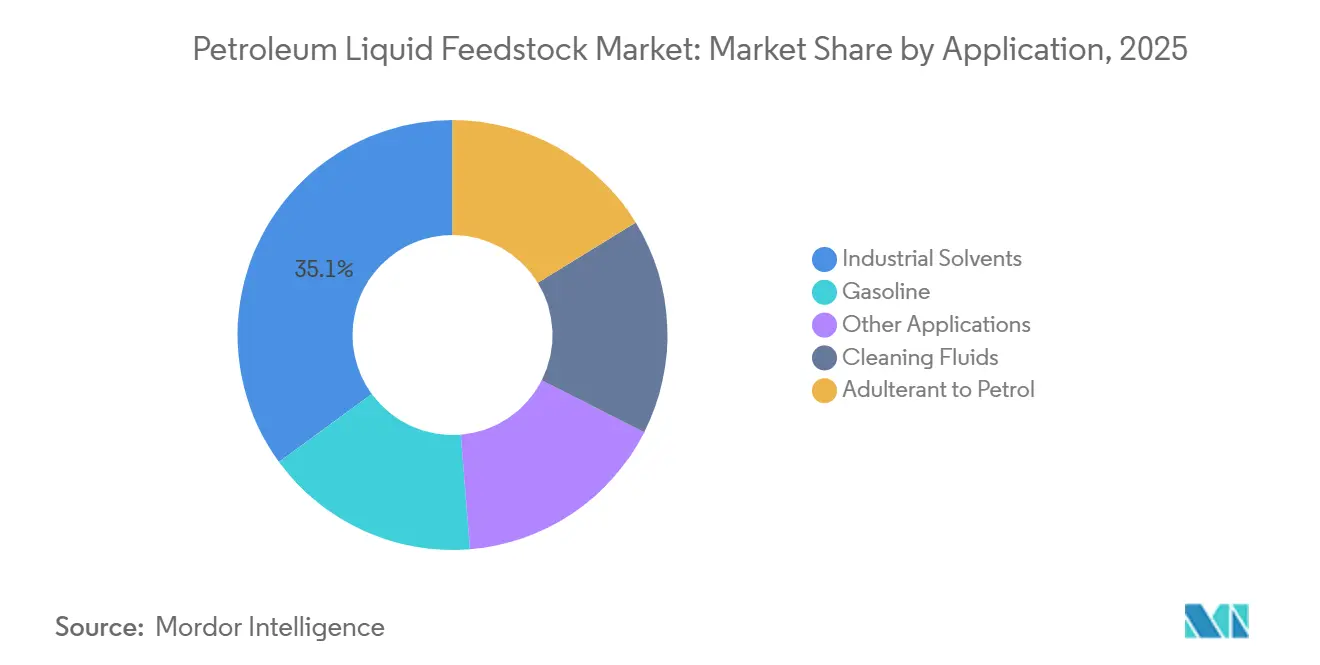
Industrial solvents held 35.06% of the petroleum liquid feedstock market share by application in 2025. These products use aromatic and aliphatic naphtha fractions in coatings, adhesives, metalworking fluids, electronics cleaning, and printing inks. Industrial solvents are also the fastest-growing application, with a 5.75% CAGR through 2031. Manufacturing expansion in South and Southeast Asia, along with growing electronics production, supports demand for higher-purity solvent grades. Regulations moving users away from chlorinated solvents further support consumption in this application.
Cleaning fluids remain an important application, as food processing, pharmaceutical packaging, and medical device production require controlled cleaning inputs. The petroleum liquid feedstock market also supplies gasoline blending and gasoline-adulterant uses in markets where refinery infrastructure remains uneven. Industrial solvent demand can remain firm when polymer margins weaken, and crackers reduce operating rates. Lower aromatic solvent output during these periods can tighten supply for coatings, electronics, and adhesive users. European chemical requirements and U.S. volatile organic compound rules are encouraging lower-aromatic and higher-specification solvent blends.
Geography Analysis
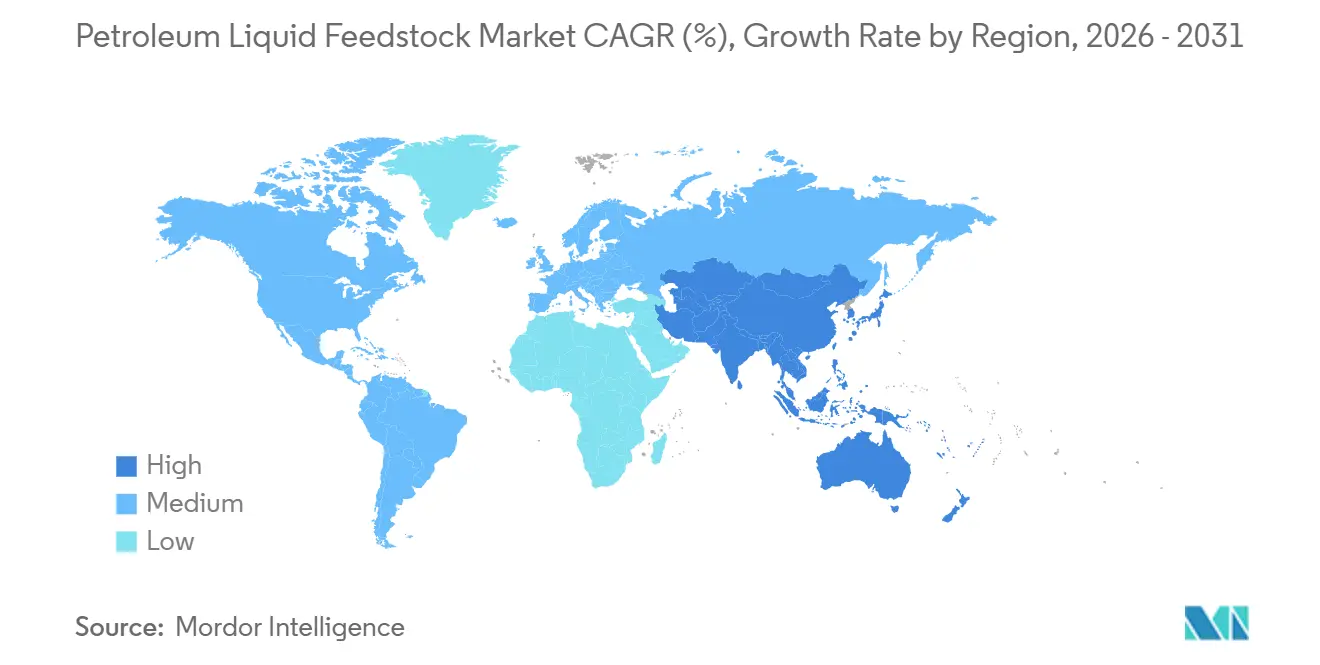
Asia-Pacific held 42.69% of the petroleum liquid feedstock market share in 2025 and is projected to grow at a CAGR of 5.67% through 2031. China's naphtha demand is forecast to grow 8.6% in 2026 as new cracker capacity increases consumption. The regional project pipeline includes ExxonMobil's Guangdong complex, HAPCO's Panjin unit, BASF's flexi-cracker, and new paraxylene capacity. China imported 16.79 million tons of naphtha in 2025, reflecting increased demand from crackers and the reduced competitiveness of some gas-based alternatives. South Korean producers agreed in August 2025 to reduce cracker capacity by 2.7 to 3.7 million tons amid competitive pressure, while Japan sourced 80% of its normal naphtha import quantities by May 2026 from alternative suppliers. India and Southeast Asia remain important growth areas as refiners and crackers seek greater feedstock diversity following the early-2026 disruption.
In North America, naphtha use is shifting away from steam cracking and toward aromatics, specialty intermediates, and blending, as ethane remains plentiful. ExxonMobil's Baytown reconfiguration, following its August 2025 final investment decision, reflects a focus on higher-value refining and chemical outputs. Europe faces high feedstock costs, excess chemical capacity, and pressure from Chinese exports. European naphtha prices rose 64% from pre-disruption levels to a late-April 2026 peak, then lost 80% of that gain by June 2026. INEOS is building its EUR 4 billion (USD 4.3 billion) Project ONE ethane-fed cracker in Antwerp, with a capacity of 1.45 million tons per year of ethylene[1]. The project reduces future European demand for naphtha as an ethylene feedstock while retaining demand for aromatics-grade material.
The Middle East is developing from a major naphtha exporter into a more integrated chemicals production base. The Yanbu venture between Aramco, Sinopec, and Yasref includes a mixed-feed cracker and aromatics complex that processes feedstock into higher-value chemical products. Saudi Arabia's feedstock allocation process gives the government influence over the pace of large petrochemical projects. In Africa, Dangote plans to expand the Lekki refinery to 1.4 million barrels per day by 2028 and add 750,000 tons per year of propylene capacity. Brazil leads South American consumption, while Argentina and Andean markets account for smaller quantities in the agrochemical, construction, and packaging value chains.
Competitive Landscape
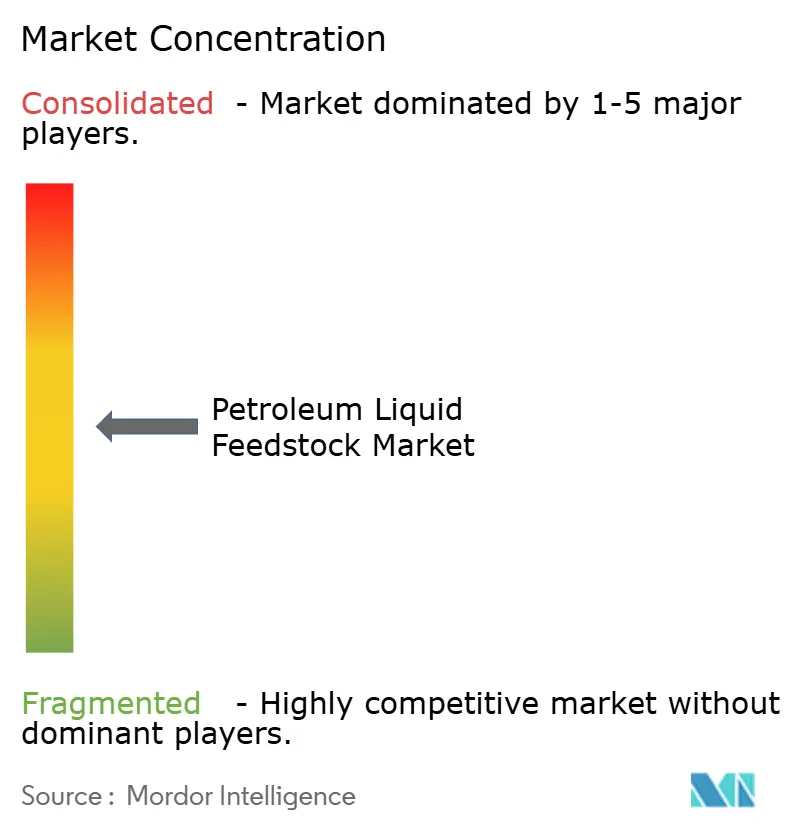
The petroleum liquid feedstock market is moderately fragmented. Saudi Aramco, SABIC, ExxonMobil, CNPC, PetroChina, and Shell hold strong positions by combining feedstock access with refining and chemical conversion capabilities. PTT Global Chemical, Reliance Industries, Formosa Petrochemical, and Kuwait Petroleum Corporation maintain regional positions based on access to local feedstock and processing assets. The market is dividing into expanding integrated producers, rationalizing high-cost operators, and new regional projects. Feedstock cost, asset integration, multiple chemical outputs, and operational flexibility define this competitive divide.
SABIC's Fujian project reached 98% completion in July 2026 and targets start-up in Q4 2026. The USD 6.4 billion project includes a 1.8 million tons-per-year mixed-feed steam cracker and 16 integrated units. LyondellBasell completed the divestiture of 4 European naphtha-cracking and polyolefins assets in Q2 2026, concentrating capital on more advantaged assets. Dangote is adding propylene and linear alkylbenzene capacity at Lekki through Honeywell UOP technology[2]. These actions reinforce the distinction between integrated conversion projects and stand-alone naphtha-cracking operations.
In the petroleum liquid feedstock market, digital optimization is increasingly relevant as operators seek improved feedstock blending, yield control, and margin management. ExxonMobil holds a U.S. patent covering an integrated naphtha-to-ethane-and-propane unit intended to increase olefin yield from liquid feedstock. Renewable naphtha remains an opportunity for integrated supply chains in North America and Europe, with the U.S. compliance framework set to begin in 2027.
Petroleum Liquid Feedstock Industry Leaders
-
Saudi Arabian Oil Co.
-
China Petrochemical Corporation
-
Exxon Mobil Corporation
-
Reliance Industries Limited
-
Shell plc
- *Disclaimer: Major Players sorted in no particular order
Recent Industry Developments
- September 2026: SABIC's subsidiary, Saudi Methanol Company (AR-RAZI), received approval from Saudi Arabia's Ministry of Energy to allocate petroleum liquid feedstock for a proposed 1.8 million tons per year methanol plant in Jubail.
- April 2026: Dangote Petroleum Refinery awarded Honeywell International a contract to supply UOP Oleflex process technologies and catalysts at its 650,000 barrels per day Lekki complex. The project added 750,000 tons per year of propylene capacity and 400,000 tons per year of linear alkylbenzene capacity.
Global Petroleum Liquid Feedstock Market Report Scope
A petroleum liquid feedstock is a liquid raw material, primarily composed of hydrocarbons, that is processed in refineries or petrochemical plants to produce energy, fuels, and chemical products. These feedstocks are derived from crude oil and include materials such as naphtha, gas oil, and residual fuel oil.
The petroleum liquid feedstock market is segmented by type, end product, application, and geography. By type, the market is segmented into naphtha and gas oil. By end product, the market is segmented into ethylene, benzene, propylene, hexane, naphthalene, and other end products. By application, the market is segmented into industrial solvents, cleaning fluids, adulterant to petrol, gasoline, and other applications. The report also covers market size and forecasts for petroleum liquid feedstock across 16 countries in major regions. The market sizes and forecasts are provided in terms of value (USD).
| Naphtha |
| Gas Oil |
| Ethylene |
| Benzene |
| Propylene |
| Hexane |
| Naphthalene |
| Other End Products |
| Industrial Solvents |
| Cleaning Fluids |
| Adulterant to Petrol |
| Gasoline |
| Other Applications |
| Asia-Pacific | China |
| India | |
| Japan | |
| South Korea | |
| ASEAN Countries | |
| Rest of Asia-Pacific | |
| North America | United States |
| Canada | |
| Mexico | |
| Europe | Germany |
| United Kingdom | |
| France | |
| Italy | |
| NORDIC Countries | |
| Russia | |
| Rest of Europe | |
| South America | Brazil |
| Argentina | |
| Rest of South America | |
| Middle East and Africa | Saudi Arabia |
| South Africa | |
| Rest of Middle East and Africa |
| By Type | Naphtha | |
| Gas Oil | ||
| By End Product | Ethylene | |
| Benzene | ||
| Propylene | ||
| Hexane | ||
| Naphthalene | ||
| Other End Products | ||
| By Application | Industrial Solvents | |
| Cleaning Fluids | ||
| Adulterant to Petrol | ||
| Gasoline | ||
| Other Applications | ||
| By Geography | Asia-Pacific | China |
| India | ||
| Japan | ||
| South Korea | ||
| ASEAN Countries | ||
| Rest of Asia-Pacific | ||
| North America | United States | |
| Canada | ||
| Mexico | ||
| Europe | Germany | |
| United Kingdom | ||
| France | ||
| Italy | ||
| NORDIC Countries | ||
| Russia | ||
| Rest of Europe | ||
| South America | Brazil | |
| Argentina | ||
| Rest of South America | ||
| Middle East and Africa | Saudi Arabia | |
| South Africa | ||
| Rest of Middle East and Africa | ||
Key Questions Answered in the Report
What is current market size of Petroleum Liquid Feedstock Market?
The petroleum liquid feedstock market size was valued at USD 343.56 billion in 2025 and is estimated to grow from USD 357.89 billion in 2026 to USD 449.42 billion by 2031, at a CAGR of 4.66% during the forecast period (2026-2031).
Why is naphtha the leading feedstock type?
Naphtha held a 65.67% share in 2025 because it can produce ethylene, propylene, butadiene, and aromatics from a single cracking process. Its broad output slate gives crackers more options than units designed around a single lighter feedstock.
Which end product is growing fastest?
Propylene is the fastest-growing end product, with a projected CAGR of 5.22% through 2031. Demand is supported by a supply gap that can widen when producers shift toward ethane cracking, which generates less co-product propylene.
Which application is expanding fastest?
Industrial solvents are expected to grow at a CAGR of 5.75% through 2031, supported by demand in manufacturing and electronics. Coatings, adhesives, metalworking fluids, electronics cleaning, and printing inks all use aromatic and aliphatic naphtha fractions.