
Pet Boarding Services Market Size and Share
Market Overview
| Study Period | 2020 - 2031 |
|---|---|
| Market Size (2026) | USD 8.87 Billion |
| Market Size (2031) | USD 12.46 Billion |
| Growth Rate (2026 - 2031) | 7.02 % |
| Fastest Growing Market | Asia Pacific |
| Largest Market | North America |
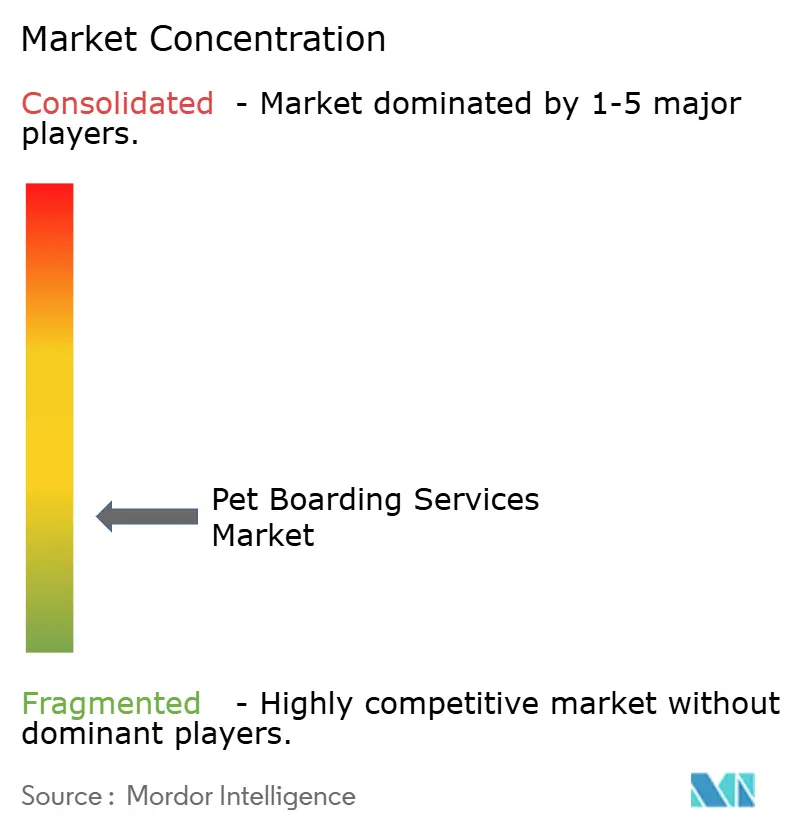
| Market Concentration | Low |
Major Players *Disclaimer: Major Players sorted in no particular order Image © Mordor Intelligence. Reuse requires attribution under CC BY 4.0. | |
Pet Boarding Services Market Analysis by Mordor Intelligence
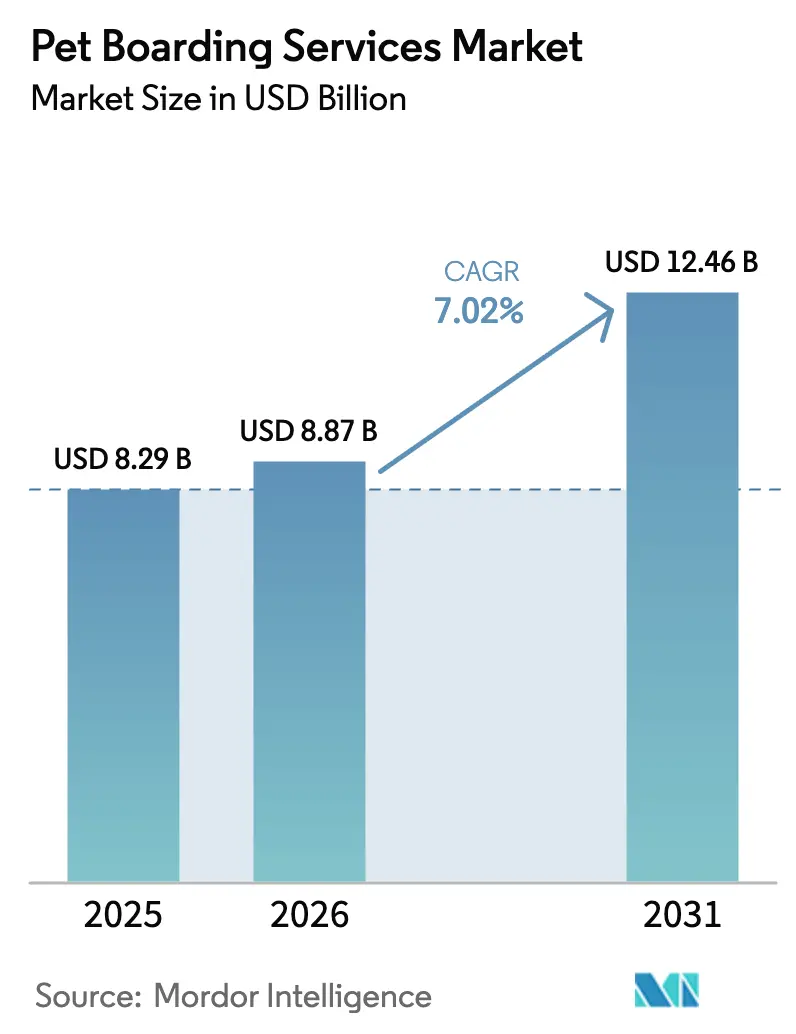
The pet boarding services market size is expected to grow from USD 8.29 billion in 2025 to USD 8.87 billion in 2026 and is forecast to reach USD 12.46 billion by 2031 at 7.02% CAGR over 2026-2031. Robust growth rests on the sector’s defensive attributes; pet owners continue to allocate discretionary income toward premium care even during economic slowdowns. Corporate pet-care stipends, subscription-based boarding credits, and the steady rise in dual-income travel are widening the customer base and smoothing revenue seasonality. Digital booking convenience is also reshaping competitive dynamics as facilities cultivate direct-to-consumer channels to trim marketplace commissions. Additionally, private-equity-backed franchise expansion is accelerating consolidation, while AI-enabled monitoring systems justify premium pricing and mitigate liability risks.
Key Report Takeaways
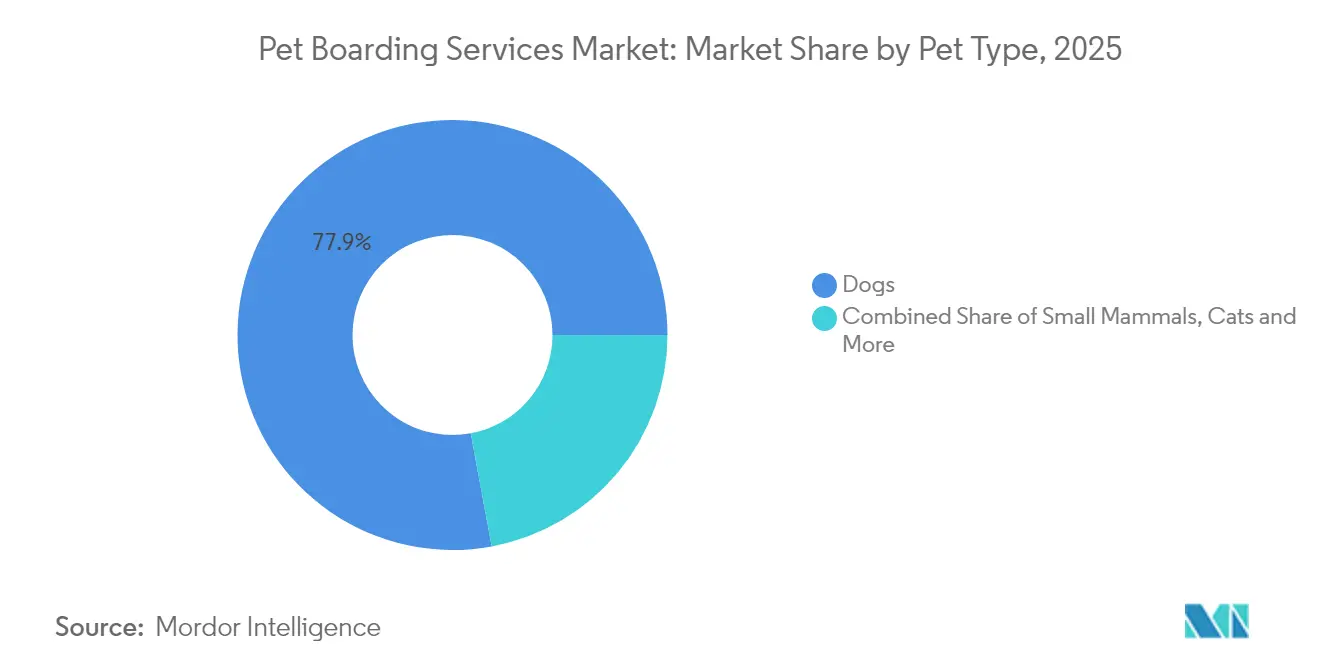
- By pet type, dogs led with a 77.92% share of the pet boarding services market in 2025; small mammals are projected to grow fastest at a 9.94% CAGR to 2031.
- By care duration, daycare services captured 51.98% of revenue in 2025, whereas extended stays are expanding at an 11.52% CAGR through 2031.
- By service type, group play sessions held 33.12% of the pet boarding services market share in 2025; medical and special-needs boarding will surge at a 13.31% CAGR to 2031.
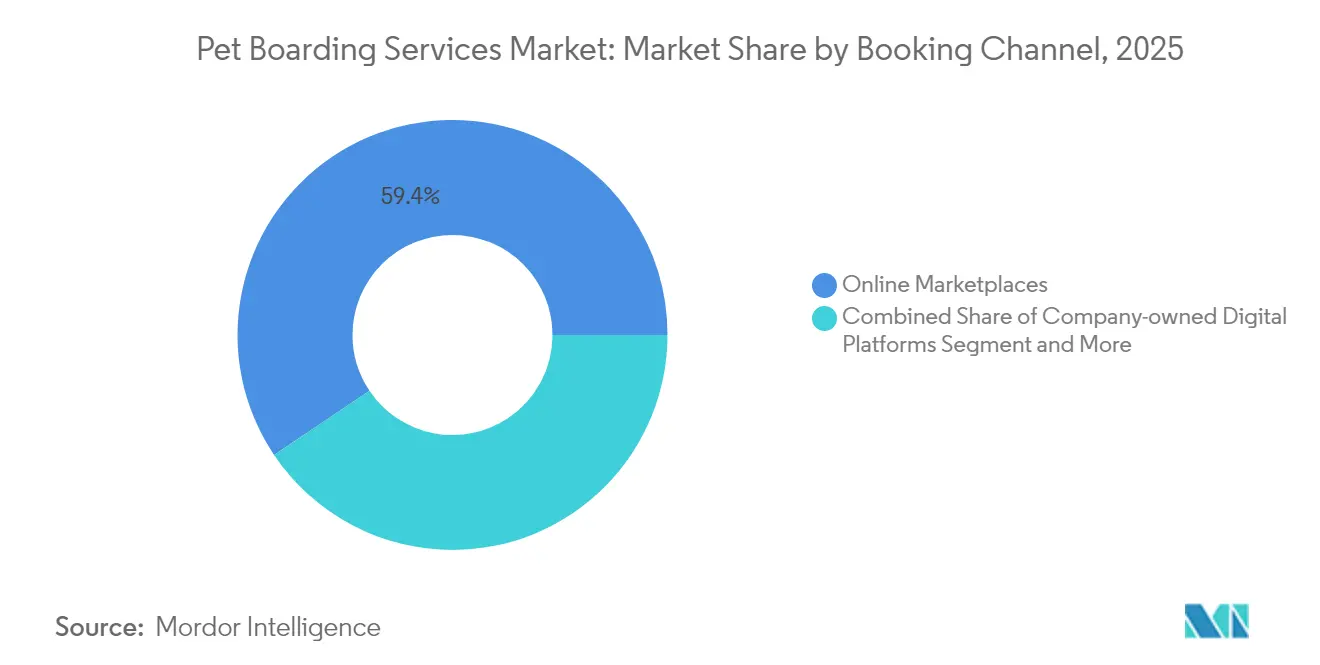
- By booking channel, online marketplaces held 59.42% share in 2025, but company-owned digital platforms are rising at a 12.31% CAGR to 2031.
- By facility type, home-based boarding captured 36.58% of revenue in 2025, while luxury pet resorts are projected to post a 13.29% CAGR through 2031.
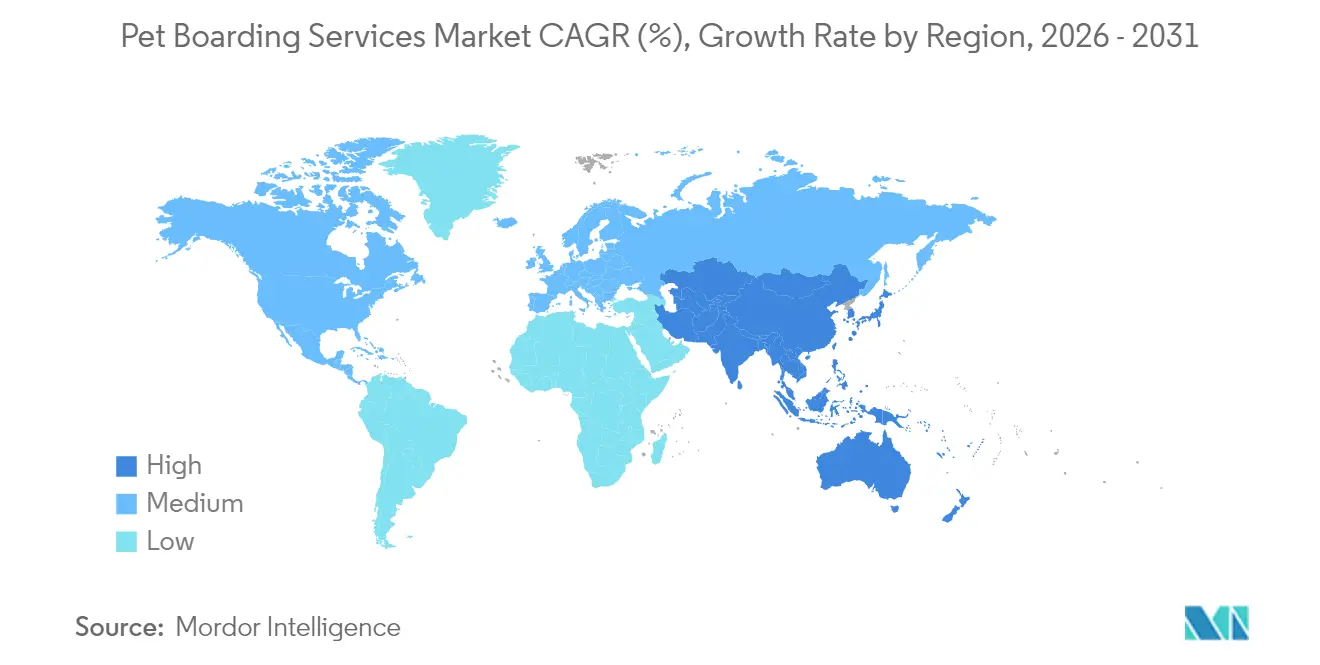
- By geography, North America commanded 41.05% of revenue in 2025; Asia-Pacific is the fastest-growing region at a 9.63% CAGR to 2031.
Note: Market size and forecast figures in this report are generated using Mordor Intelligence’s proprietary estimation framework, updated with the latest available data and insights as of 2026.
Market Trends and Insights
Drivers Impact Analysis of Pet Boarding Services Market*
| Driver | (~) % Impact on CAGR Forecast | Geographic Relevance | Impact Timeline |
|---|---|---|---|
| Rising pet-ownership & humanization | +1.8% | Global; strongest in North America & Europe | Long term (≥ 4 years) |
| Growth in dual-income travel frequency | +1.2% | North America & EU, expanding to APAC | Medium term (2-4 years) |
| Franchise expansion of pet-care chains | +0.9% | North America, international spill-over | Medium term (2-4 years) |
| AI-enabled real-time pet monitoring | +0.7% | Global; early adoption in tech-forward markets | Long term (≥ 4 years) |
| Subscription bundles incl. boarding credits | +0.6% | North America & EU | Short term (≤ 2 years) |
| Corporate pet-care stipends | +0.5% | North America & EU | Short term (≤ 2 years) |
| Source: Mordor Intelligence | |||
Rising Pet-Ownership & Humanization
Pet humanization now drives measurable premiumization. The American Pet Products Association found that 97% of owners consider pets family members, a perspective that supports higher willingness to pay for individualized boarding services. Luxury pet resorts are therefore expanding at a 13.87% CAGR as operators add aquatic daycare, spa grooming, and real-time webcam access that mimic human hospitality standards. Beyond North America, China’s pet sector is predicted to reach EUR 104.3 billion by 2025 as single-person urban households treat animals as family substitutes. Europe mirrors this pattern: half of households own pets and increasingly favor premium boarding for emotional assurance during travel. These attitudes underpin resilient demand across income brackets, shielding operators from macroeconomic volatility.
Growth in Dual-Income Travel Frequency
Pre-pandemic travel volumes have returned, but remote-work flexibility now extends average trip length, lifting demand for extended-stay bookings that are growing at an 11.85% CAGR. Corporate benefit trends amplify the effect: 39% of owners previously skipped trips due to care gaps, prompting employers to fund boarding stipends that cut price sensitivity. “Workations” blend leisure with business travel, often lasting multiple weeks and requiring facilities capable of administering medications and managing chronic conditions. Operators capturing this segment emphasize medical oversight, daily video updates, and structured enrichment programs.
Franchise Expansion of Pet-Care Chains
Private equity sees the pet boarding services market as defensive and scalable. Propelled Brands’ purchase of Camp Bow Wow added 200+ sites to a portfolio exceeding 1,300 locations. Standardized protocols, centralized purchasing, and shared booking technology cut costs and support rapid rollouts. Franchisees benefit from turnkey marketing and training, while consumers gain predictable service quality across geographies. Global expansion is accelerating as brands leverage proven U.S. models to enter APAC cities where pet ownership is climbing.
AI-Enabled Real-Time Pet Monitoring
IoT sensors maintain USDA-recommended kennel temperatures between 60 °F and 68 °F, flagging deviations instantly[1]Monnit, “Temperature Monitoring Systems for K9 Units & Pet Kennels,” monnit.com. Video analytics track activity levels, while AI chatbots streamline client communication and scheduling. These systems document care, reduce risk, and command premium rates. Owners gain transparency through mobile apps that deliver live feeds and daily health reports, heightening trust and enabling longer bookings.
Restraints Impact Analysis of Pet Boarding Services Market*
| Restraint | (~) % Impact on CAGR Forecast | Geographic Relevance | Impact Timeline |
|---|---|---|---|
| High cost of boarding services | -1.1% | Global; strongest in price-sensitive markets | Medium term (2-4 years) |
| Seasonal demand volatility | -0.8% | Global; peaks during holidays | Short term (≤ 2 years) |
| Stricter animal-welfare compliance costs | -0.6% | North America & EU | Long term (≥ 4 years) |
| Peer-to-peer sitters cannibalising kennels | -0.9% | Global urban markets | Medium term (2-4 years) |
| Source: Mordor Intelligence | |||
High Cost of Boarding Services
Average U.S. daily rates reached USD 44.99 in 2025, with upscale centers charging up to USD 180 per day[2]Goose, “Sneak Peek: 2025 Pet Boarding Prices,” goose.pet. Metropolitan disparities compound affordability issues; Washington D.C. averages USD 62.47, twice Mississippi’s USD 31.24. Seasonal surcharges push holiday prices to USD 60 nightly. Financing solutions such as Synchrony’s CareCredit installment program now extend across 60 Pet Paradise locations, but primarily benefit higher-income owners. Price-sensitive consumers may still opt for informal sitters, constraining addressable demand in cost-intensive cities.
Peer-to-Peer Sitters Cannibalising Kennels
Marketplace apps match owners with home-based caregivers at lower prices, capturing volume from traditional facilities. Yet quality incidents—including injuries and fatalities—have raised safety concerns. Rover data show 39% of owners struggle to secure care during peak periods, signaling capacity gaps. Medical boarding, exotic pet services, and extended stays remain difficult to replicate in peer homes, giving professional operators defensible niches. Many facilities now highlight insurance coverage, certified staff, and 24-hour veterinary access to differentiate from platform sitters.
*Our forecasts treat driver/restraint impacts as directional, not additive. The impact forecasts reflect baseline growth, mix effects, and variable interactions.
Pet Boarding Services Market Segment Analysis
By Pet Type:
Dogs Drive Volume, Small Mammals Accelerate GrowthDogs accounted for 77.92% of the pet boarding services market in 2025, supported by their social nature and exercise needs that make professional care preferable to in-home alternatives. This segment’s stability ensures predictable baseline demand, enabling facilities to optimize occupancy year-round. Small mammals—rabbits, guinea pigs, and ferrets—are advancing at a 9.94% CAGR. Urban apartment dwellers increasingly favor these compact companions, and specialized boarding suites featuring climate-controlled habitats cater to their unique welfare requirements. The U.S. Bureau of Labor Statistics reported that boarding contributed USD 2.3 billion, or 44% of total pet-care services revenue, with canine clients forming the majority.
Cats represent a sizable yet slower-growing cohort. Feline-only facilities are gaining popularity, reducing stress by eliminating canine interaction. Birds, reptiles, and fish remain niche but command premium fees due to specialized care and limited provider availability. Operators pursuing exotic segments invest in staff certification and bio-secure enclosures, driving differentiation and higher margins. The pet boarding services market size for exotic pets is projected to expand steadily as regulatory clarity and consumer education improve.



By Care Duration:
Daycare Dominates, Extended Stays SurgeDaycare held 51.98% share in 2025, reflecting return-to-office mandates that leave pets home alone for extended hours. Facilities monetize recurring weekday traffic through subscription passes, lowering per-visit costs while boosting utilization. Extended stays, however, are growing fastest at 11.52% CAGR. The pet boarding services market size tied to multi-week bookings is widening as remote professionals combine vacation with remote work. Longer durations require enrichment activities, rotating staff-to-pet ratios, and health monitoring protocols to ensure welfare across weeks rather than days.
Overnight boarding sustains consistent weekend demand but faces margin pressure from peer-to-peer alternatives. To remain competitive, operators bundle nighttime care with daytime group play and bath services, increasing perceived value. Balanced capacity management across half-day, full-day, and multi-week segments is emerging as a key profitability lever.
By Service Type:
Group Play Leads, Medical Boarding AcceleratesGroup play sessions captured 33.12% revenue in 2025, leveraging dogs’ social instincts while optimizing staff ratios. Rotational playgroups segmented by size and temperament lower injury risk and enhance customer perception of safety. Medical and special-needs boarding is expanding at 13.31% CAGR, driven by aging pet populations and rising chronic conditions such as diabetes and arthritis. The pet boarding services market share for medical boarding is expected to widen as owners seek facilities equipped with on-site veterinary technicians, medication-dispensing protocols, and emergency response capabilities.
Classic exercise add-ons—treadmill runs, swimming pools, agility courses—remain popular. Facilities also cross-sell grooming, training, and treat-manufacturing workshops to deepen customer engagement. A diversified service stack positions operators to capture greater wallet share and hedge against competitive incursions.
By Booking Channel:
Online Marketplaces Lead, Direct Platforms AccelerateOnline marketplaces controlled 59.42% of bookings in 2025, offering price transparency and instant comparison. Commission fees, however, erode facility margins. Consequently, company-owned portals are scaling at 12.31% CAGR as operators deploy SEO tactics, loyalty programs, and mobile apps to redirect traffic. Integrated CRM modules track vaccination records, send renewal reminders, and automate upsell offers, deepening lifetime value. The pet boarding services market size attributable to direct digital sales is projected to double by 2031 as data ownership becomes a strategic asset.
Offline walk-ins serve urgent needs and clients less comfortable with digital channels. Nevertheless, omnichannel experiences—allowing users to tour via video, reserve online, and pay contactlessly on-site—are becoming baseline expectations. AI chatbots cut response times, enhancing conversion rates and freeing staff for pet care duties.
By Facility Type:
Home-Based Boarding Leads, Luxury Resorts SurgeHome-based care claimed 36.58% revenue in 2025, favored by owners who perceive residential environments as less stressful. Operators often limit capacity to maintain personalized attention, commanding mid-tier pricing. Luxury pet resorts, growing at 13.29% CAGR, offer suites with climate control, memory-foam beds, and webcam access. Upscale add-ons—massage therapy, gourmet meals, and chef-crafted treats—cater to affluent owners seeking hotel-level amenities.
Traditional kennels are modernizing with noise-dampening materials, natural light corridors, and enrichment gardens to maintain relevance. Veterinary-clinic boarding combines medical expertise with housing, appealing to chronic-care and post-operative cases. Mobile and pop-up models—temporary kennels at events or in apartment complexes—address short-term spikes in demand but face scalability hurdles.
Geography Analysis
North America Pet Boarding Services Market
North America retained 41.05% of global revenue in 2025, underpinned by 66% U.S. household pet ownership and robust franchise penetration. Corporate pet benefits and private-equity-backed consolidation spur steady expansion. Updated USDA regulations mandating written veterinary-care programs raise compliance costs but reinforce consumer trust in professional operators. In Canada, import-rule adjustments for pet supplements signal tightening oversight that may boost domestic boarding demand. Mexico’s rapid urbanization and rising disposable incomes create white-space for value-oriented home-based providers.
Europe Pet Boarding Services Market
Europe exhibits heterogeneous regulation and cultural norms. Germany and France emphasize stringent welfare standards, while the United Kingdom’s post-Brexit travel paperwork encourages domestic boarding. EU animal-welfare directives raise operating costs but allow facilities to charge premiums for certified conditions. Cross-border franchise chains leverage standardized protocols to navigate diverse national frameworks, with consolidation expected to intensify.
APAC Pet Boarding Services Market
Asia-Pacific is the growth frontier at a 9.63% CAGR. Millennial pet parents in China, South Korea, and Japan treat animals as family, driving adoption of premium features. India and Southeast Asia present mixed income profiles; bundled daycare and vaccination packages resonate with middle-class segments. The region’s fragmented provider base offers acquisition targets for global chains seeking first-mover advantage. Local partnerships are critical as zoning laws, cultural attitudes, and veterinary-service availability vary widely among metropolitan areas.

Competitive Landscape
The pet boarding services industry remains fragmented; thousands of independents coexist with fast-scaling franchises and technology platforms. Private equity is consolidating mid-size chains to capture economies of scale. Webster Equity Partners’ acquisition of Best Friends Pet Care’s 42 centers exemplifies this trend. Acquirers integrate reservation software, loyalty programs, and bulk procurement to lift margins. Facility upgrades—HVAC improvements, noise-reduction architecture, and AI camera networks—form defensive moats.
Technology acts as both differentiator and disruptor. Togetherwork’s PetExec software now serves more than 7,000 facilities with integrated payments and CRM, facilitating smaller players’ digital transformation. Peer-to-peer platforms like Rover compete on price but struggle with capacity for medical and exotic cases. Many professional operators partner with veterinarians to embed health services, extending average revenue per pet.
Regulation is tightening. The Animal and Plant Health Inspection Service now requires boarders to maintain written veterinary programs, pushing up compliance expenditures but raising quality baselines. Massachusetts’ Ollie’s Law, effective December 2024, mandates injury reporting and safety standards, signaling U.S. states’ intent to strengthen oversight. Operators able to absorb costs should gain share as smaller centers exit.
Pet Boarding Services Industry Leaders
Camp Bow Wow
Dogtopia Enterprises
Urban Tails Pet Resort
We Love Pets
Rover, Inc. (Rover)
- *Disclaimer: Major Players sorted in no particular order
Pet Boarding Services Market Companies Covered in this Report
- Rover, Inc. (Rover)
- PetSmart LLC (PetsHotel)
- Camp Bow Wow
- Dogtopia Enterprises
- Wag! Group Co.
- PetBacker
- Fetch! Pet Care
- Holidog.com
- Urban Tails Pet Resort
- Paradise 4 Paws
- We Love Pets
- Puss 'n' Boots Boarding Cattery
- Wag Hotels
- Petbarn Pet Hotel
- K9 Resorts Daycare & Luxury Hotel
- Best Friends Pet Hotel
- Pet Palace Resorts

Recent Industry Developments in Pet Boarding Services Market
- December 2024: Togetherwork acquired PetExec to complement Gingr and Revelation Pets, serving over 7,000 pet-care businesses with integrated booking and payment tools.
- December 2024: Massachusetts Governor Maura Healey signed Ollie’s Law, adding reporting and safety requirements for boarding facilities.
- June 2023: the British Columbia Society for the Prevention of Cruelty to Animals (BC SPCA) developed companion animal services standards and resources for pet guardians and pet care businesses. BC SPCA aims to maintain the legal and standard protocols for animal care.


Global Pet Boarding Services Market Report Scope
As per the scope of the report, pet boarding services typically care for dogs, cats, and other small animals while their owners are away on holiday, for work, or special occasions. The Pet Boarding Services market is segmented By Pet Type (Dogs, Cats, and Others), By Care Type (Long Term, Short Term), By Service Type (Group Play Sessions, Exercise, Poolside Daycare, Pet Sitting, and Other Service Types), and Geography (North America, Europe, Asia-Pacific, Middle East and Africa, and South America). The market report also covers the estimated market sizes and trends for 17 different countries across major regions globally. The report offers the value (in USD) for the above segments.
| Dogs |
| Cats |
| Small Mammals |
| Birds |
| Others (Reptiles, Fish) |
| Daycare |
| Overnight |
| Extended Stay |
| Group Play Sessions |
| Exercise & Walks |
| Poolside / Aquatic Daycare |
| Pet Sitting / In-home Visits |
| Grooming Add-ons |
| Training Add-ons |
| Medical / Special-needs Boarding |
| Other Service Types |
| Online Marketplaces |
| Company-owned Digital Platforms |
| Offline Walk-ins & Telephone |
| Traditional Kennels |
| Home-based Boarding |
| Luxury Pet Resorts |
| Veterinary-clinic Boarding |
| Mobile / Pop-up Boarding |
| North America | United States |
| Canada | |
| Mexico | |
| Europe | Germany |
| United Kingdom | |
| France | |
| Italy | |
| Spain | |
| Rest of Europe | |
| Asia-Pacific | China |
| Japan | |
| India | |
| South Korea | |
| Australia | |
| Rest of Asia-Pacific | |
| Middle East and Africa | GCC |
| South Africa | |
| Rest of Middle East and Africa | |
| South America | Brazil |
| Argentina | |
| Rest of South America |
| By Pet Type | Dogs | |
| Cats | ||
| Small Mammals | ||
| Birds | ||
| Others (Reptiles, Fish) | ||
| By Care Duration | Daycare | |
| Overnight | ||
| Extended Stay | ||
| By Service Type | Group Play Sessions | |
| Exercise & Walks | ||
| Poolside / Aquatic Daycare | ||
| Pet Sitting / In-home Visits | ||
| Grooming Add-ons | ||
| Training Add-ons | ||
| Medical / Special-needs Boarding | ||
| Other Service Types | ||
| By Booking Channel | Online Marketplaces | |
| Company-owned Digital Platforms | ||
| Offline Walk-ins & Telephone | ||
| By Facility Type | Traditional Kennels | |
| Home-based Boarding | ||
| Luxury Pet Resorts | ||
| Veterinary-clinic Boarding | ||
| Mobile / Pop-up Boarding | ||
| Geography | North America | United States |
| Canada | ||
| Mexico | ||
| Europe | Germany | |
| United Kingdom | ||
| France | ||
| Italy | ||
| Spain | ||
| Rest of Europe | ||
| Asia-Pacific | China | |
| Japan | ||
| India | ||
| South Korea | ||
| Australia | ||
| Rest of Asia-Pacific | ||
| Middle East and Africa | GCC | |
| South Africa | ||
| Rest of Middle East and Africa | ||
| South America | Brazil | |
| Argentina | ||
| Rest of South America | ||


Key Questions Answered in the Report
What is the current size of the pet boarding services market?
The pet boarding services market is valued at USD 8.87 billion in 2026 and is projected to reach USD 12.46 billion by 2031.
Which region is expanding fastest in pet boarding?
Asia-Pacific is the fastest-growing region, forecast to post a 9.63% CAGR through 2031, driven by rising urban pet ownership and disposable incomes.
Why are extended-stay bookings rising?
Remote-work flexibility allows owners to combine work and leisure trips, lifting multi-week boarding demand, which is growing at an 11.52% CAGR.
How are corporate benefits influencing the market?
Employers increasingly offer pet-care stipends and subscription credits, reducing price sensitivity and creating steady demand streams for boarding facilities.
What technologies are reshaping pet boarding?
IoT temperature sensors, AI-driven video analytics, and integrated booking software improve pet welfare, operational efficiency, and customer transparency, supporting premium pricing.
Page last updated on:


 Your data is secure and never sold or shared.


