
Pediatric Wheelchairs Market Size and Share
Market Overview
| Study Period | 2020 - 2031 |
|---|---|
| Market Size (2026) | USD 2.19 Billion |
| Market Size (2031) | USD 3.08 Billion |
| Growth Rate (2026 - 2031) | 7.01 % |
| Fastest Growing Market | Asia Pacific |
| Largest Market | North America |
| Market Concentration | Medium |
Major Players *Disclaimer: Major Players sorted in no particular order Image © Mordor Intelligence. Reuse requires attribution under CC BY 4.0. | |
Pediatric Wheelchairs Market Analysis by Mordor Intelligence
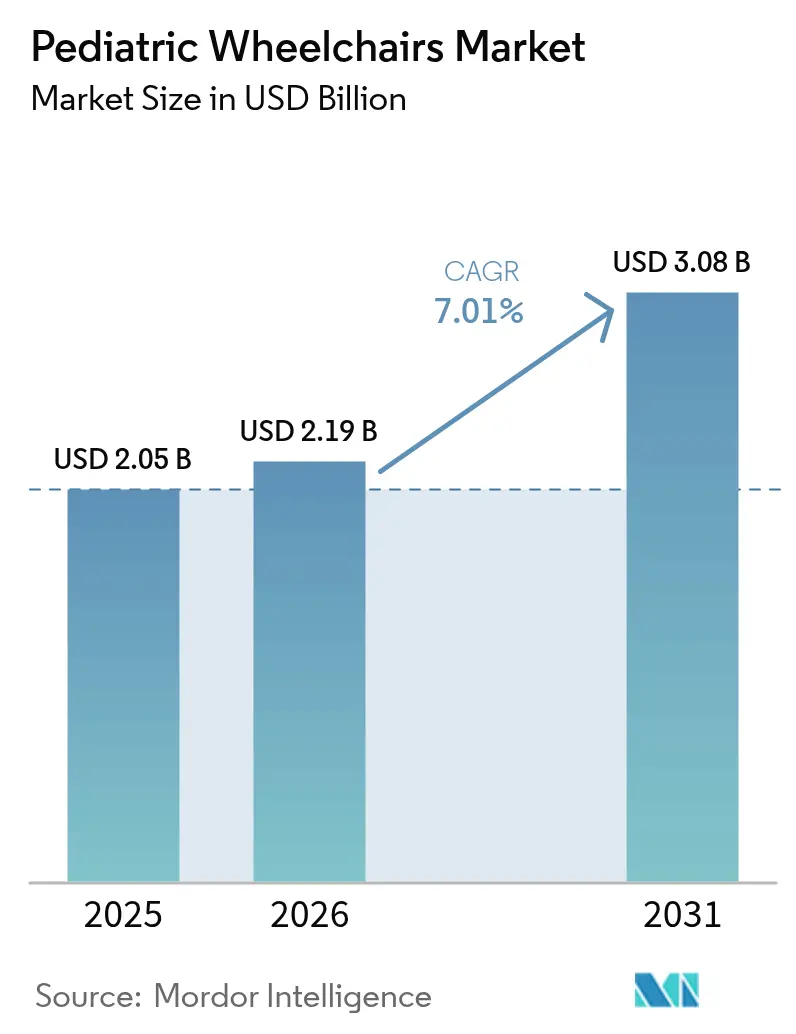
The Pediatric Wheelchairs Market size was valued at USD 2.05 billion in 2025 and estimated to grow from USD 2.19 billion in 2026 to reach USD 3.08 billion by 2031, at a CAGR of 7.01% during the forecast period (2026-2031).
Rapid identification of mobility-related disabilities, longer survival of premature and medically complex infants, and a clear shift toward home-based care are expanding the pediatric wheelchairs market. Suppliers are differentiating through advanced materials, digital connectivity, and modular designs that accommodate growth, while payers in high-income countries continue to widen reimbursement for custom devices. Online configuration platforms shorten lead-times, and 3D-printed seating helps clinicians meet individual anatomical needs without raising production costs. Persistent semiconductor shortages and rare-earth dependence, however, expose powered chair makers to supply volatility, prompting near-shoring and dual-sourcing strategies.
Key Report Takeaways
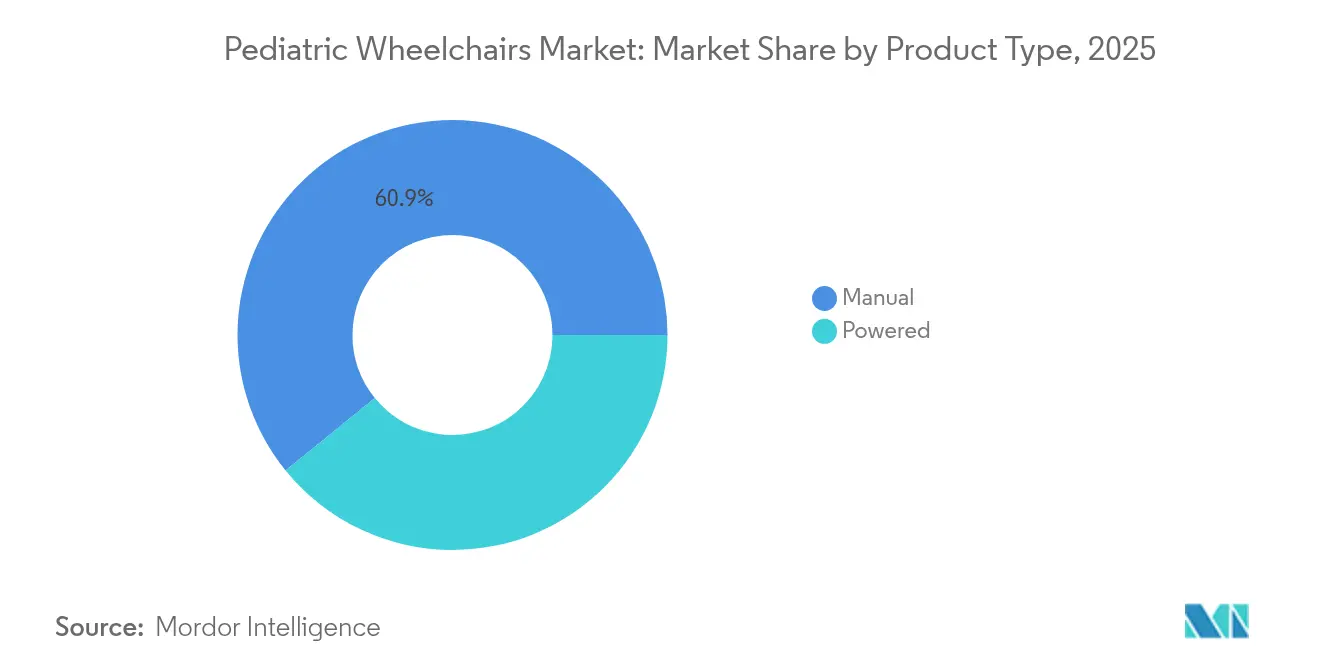
- By product type, manual wheelchairs led with 60.85% revenue share in 2025; powered wheelchairs are forecast to expand at a 9.18% CAGR to 2031.
- By frame type, foldable designs held 48.76% of the pediatric wheelchairs market share in 2025, while tilt-in-space systems are advancing at a 8.72% CAGR through 2031.
- By end user, homecare accounted for a 38.90% share of the pediatric wheelchairs market in 2025 and will grow at an 8.31% CAGR to 2031.
- By distribution channel, offline outlets held 72.65% share in 2025, whereas online sales are rising at an 11.10% CAGR to 2031.
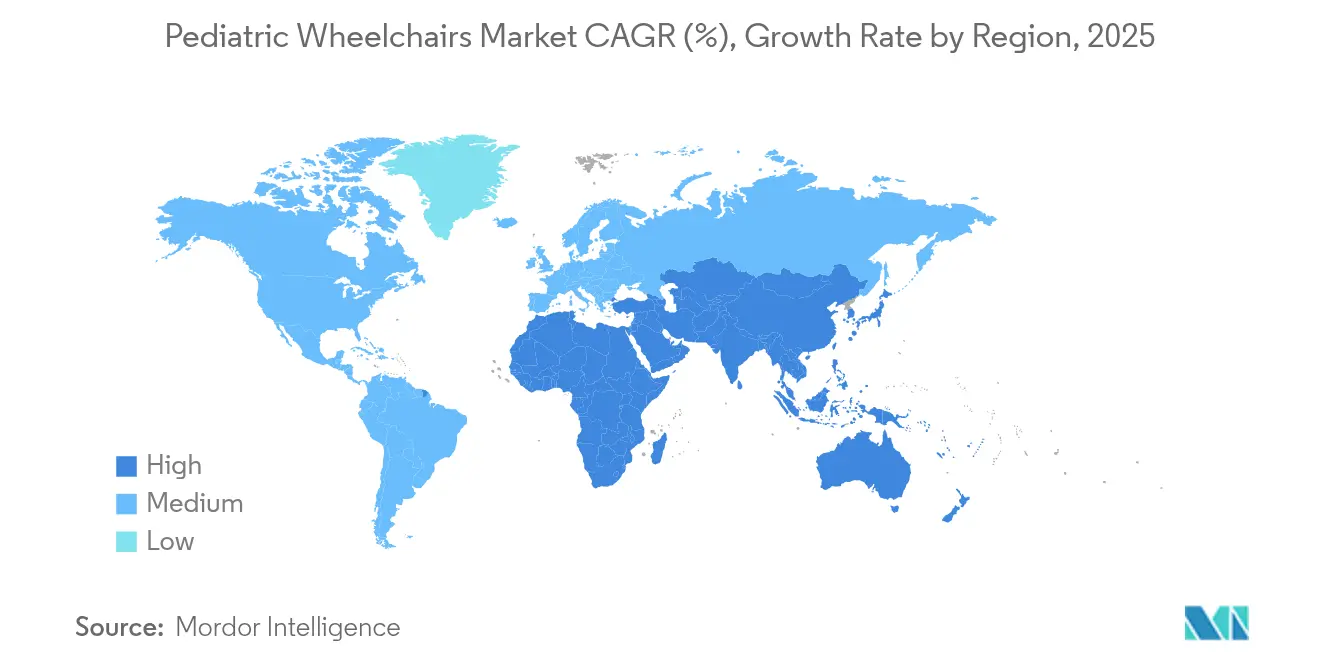
- By geography, North America commanded a 39.02% share in 2025; Asia-Pacific is set to grow fastest at 11.72% CAGR through 2031.
Note: Market size and forecast figures in this report are generated using Mordor Intelligence’s proprietary estimation framework, updated with the latest available data and insights as of 2026.
Market Trends and Insights
Drivers Impact Analysis of Pediatric Wheelchairs Market*
| Driver | (~) % Impact on CAGR Forecast | Geographic Relevance | Impact Timeline |
|---|---|---|---|
| Rising incidence of pediatric disabilities | +1.8% | Global, higher in developed markets | Long term (≥ 4 years) |
| Government funding programs for assistive technologies | +1.2% | North America & EU, expanding to APAC | Medium term (2-4 years) |
| Technological advances in lightweight & power-assist systems | +1.5% | Global, led by North America & Europe | Medium term (2-4 years) |
| Higher healthcare spending and home-based care adoption | +1.1% | APAC core, spill-over to MEA | Long term (≥ 4 years) |
| 3D-printed custom seating accelerating replacement demand | +0.9% | North America & EU, emerging in APAC | Short term (≤ 2 years) |
| Inclusive-school mandates requiring on-site mobility devices | +0.7% | Global, with regulatory variations | Long term (≥ 4 years) |
| Source: Mordor Intelligence | |||
Rising Incidence of Pediatric Disabilities
Improved neonatal care is enabling more extremely premature infants to survive, yet many develop cerebral palsy or neuromuscular conditions that require long-term mobility assistance. Earlier diagnosis now occurs during routine well-baby visits, allowing clinicians to prescribe wheelchairs sooner and extend total years of use. This demographic trend enlarges the pediatric wheelchairs market because multiple chair replacements are required as children grow. The National Academies underline that timely assistive technology improves activity participation and later employment prospects.
Government Funding Programs for Assistive Technologies
Federal mandates such as the Individuals with Disabilities Education Act ensure that qualified children receive mobility devices at no cost when listed in their Individualized Education Program. The 2024 update to Section 504 clarified provider obligations, strengthening coverage across Medicaid, school districts, and nonprofit lenders.[1]U.S. Department of Health and Human Services, “Final Rule Revising Section 504 of the Rehabilitation Act,” hhs.gov Forty-eight state assistive-technology programs additionally supply low-interest loans or equipment exchanges, lowering consumer out-of-pocket expenses. Expanded funding encourages adoption of higher-specification models, further stimulating the pediatric wheelchairs market.
Technological Advances in Lightweight & Power-Assist Systems
Carbon-fiber frames and titanium joints now trim chair weight by up to 30%, improving self-propulsion, while smart hubs store user profiles that optimize push effort in real time. Devices such as the Empulse R90 push-assist integrate with Bluetooth apps so therapists can fine-tune propulsion parameters remotely.[2]Sunrise Medical LLC, “Empulse Product Launch Announcement,” sunrisemedical.com University of Houston’s soft exoskeleton prototype pairs AI movement analysis with gentle actuation to aid gait training, signaling convergence of wheelchairs and wearables for pediatric rehabilitation.[3]University of Houston, “Soft Exoskeleton Prototype for Pediatric Gait Training,” uh.edu
Higher Healthcare Spending and Home-Based Care Adoption
Decentralization of care moves complex therapies into family settings, intensifying demand for chairs that maneuver through narrow doorways and fold into car trunks. Home-based monitoring modules now transmit riding posture and vitals to clinicians, cutting clinic visits and aligning with payer preference for lower-cost care. Growth is most pronounced in Asia-Pacific, where rising disposable income and public insurance schemes widen access. The pediatric wheelchairs market therefore benefits from shifted procurement budgets toward homecare equipment.
Restraints Impact Analysis of Pediatric Wheelchairs Market*
| Restraint | (~) % Impact on CAGR Forecast | Geographic Relevance | Impact Timeline |
|---|---|---|---|
| High price & limited insurance in emerging markets | -1.4% | APAC emerging, MEA, Latin America | Long term (≥ 4 years) |
| Complex hospital procurement regulations | -0.8% | Global, stronger in regulated markets | Medium term (2-4 years) |
| Rapid child growth shortening product lifecycle | -1.1% | Global | Short term (≤ 2 years) |
| Rare-earth motor supply volatility for powered models | -0.6% | Global, supply-chain dependent | Medium term (2-4 years) |
| Source: Mordor Intelligence | |||
High Price & Limited Insurance in Emerging Markets
A pediatric wheelchair can cost three to five times median monthly income in many lower-income countries, pushing families toward local, low-feature alternatives. Insurance gaps persist where disability support is not embedded in national health plans, limiting uptake of premium devices and tempering the pediatric wheelchairs market trajectory. The fragmented nature of funding sources requires families to navigate complex application processes across multiple agencies, creating delays and administrative burdens that can prevent timely access to mobility solutions. Price sensitivity in these markets has driven demand for simplified, locally-manufactured alternatives that may lack advanced features but provide basic mobility functionality at accessible price points.
Complex Hospital Procurement Regulations
Multilayer tender processes stretch purchase cycles beyond 12 months in large teaching hospitals, delaying replacement of outdated fleets. Manufacturers must navigate divergent coding, import tariffs, and local content rules, raising compliance costs and squeezing small entrants.The challenge is particularly acute for powered wheelchairs where the high initial investment must be amortized over a shorter usage period, creating resistance to adoption despite potential functional benefits. Manufacturers are responding with modular design approaches and adjustable components that can accommodate growth, but these solutions often add complexity and cost to base products while not fully addressing the fundamental challenge of rapid physical development in pediatric users.
*Our forecasts treat driver/restraint impacts as directional, not additive. The impact forecasts reflect baseline growth, mix effects, and variable interactions.
Pediatric Wheelchairs Market Segment Analysis
By Product Type:
Powered Chairs Gain Ground While Manual Remains CoreManual models generated 60.85% of 2025 revenue. They remain favored for affordability, ease of maintenance, and the therapeutic exercise they provide to children with sufficient upper-body strength. The segment’s large installed base sustains a steady aftermarket for cushions, wheels, and growth kits.
Powered wheelchairs, posting a 9.18% CAGR, address users with severe neuromuscular limitations. Recent releases offer proportional joystick, head-array, and sip-and-puff controls tailored to fine motor variability. Cloud telematics now logs mileage, battery health, and seating angles, allowing clinicians to adjust parameters remotely and schedule preventive service. After the 2024 correction of SmartDrive speed-dial faults, OEMs reinforced software validation and introduced redundant braking circuits, boosting caregiver confidence.
Innovation in compact lithium-iron-phosphate batteries cuts weight and extends range, making powered chairs viable for early-school children who previously relied on strollers. Over the forecast period, the pediatric wheelchairs market size for powered models is projected to compound faster than any other category, though reimbursement hurdles in some regions may temper penetration.



By Frame Type:
Tilt-in-Space Receives Clinical EndorsementFoldable frames controlled 48.76% sales in 2025 due to everyday portability. Updated quick-release cross-braces trimmed folding depth, letting families stow chairs in small sedans. Optional one-hand fold latches support caregivers managing multiple children.
Tilt-in-space systems, growing 8.72% annually, are prescribed for children at risk of pressure ulcers or respiratory compromise. Clinicians value 45-degree posterior tilt and 20-degree anterior tilt to facilitate feeding and engagement. Electronic actuators memorize common positions, helping teachers shift posture throughout the school day without manual effort. Despite higher price, clinical proof of reduced hospitalization is convincing payers. Consequently, the pediatric wheelchairs market share for tilt-in-space is expected to widen steadily through 2031.
By End User:
Homecare Dominates and AcceleratesHomecare environments generated 38.90% of 2025 sales and are expanding at an 8.31% CAGR. Families prefer managing therapy at home, where children participate in daily routines. Devices ship with a voice-guided setup that walks parents through seat adjustments. Tele-rehabilitation portals let therapists review ride data and recommend seating tweaks without in-clinic visits.
Hospitals retain importance for post-surgery mobility and initial evaluations, yet once a stable prescription is set, families transition to community use. Rehabilitation centers bridge the gap, offering gait labs and wheelchair skills clinics. These collaborating entities ensure consistent demand across the pediatric wheelchairs market.

By Distribution Channel:
Digital Platforms Scale QuicklyOffline specialists supplied 72.65% of units in 2025. They offer pressure-mapping mats, trial fleets, and insurance paperwork assistance. Nonetheless, the online growth of 11.10% CAGR signals acceptance of remote consults. Permobil’s virtual-fit tool models chair geometry using a smartphone LIDAR scan, prompting caregiver adjustments before checkout.
Repeat buyers increasingly order replacement upholstery, growth kits, and accessories through e-commerce after an initial in-person fit. Dealers that blend showrooms with digital portals capture cross-channel synergies, preserving service quality while reaching rural families. Expanding online reach thus injects fresh demand into the pediatric wheelchairs market.
Geography Analysis
North America Pediatric Wheelchairs Market
North America led with 39.02% revenue in 2025. Broad insurance coverage under Medicaid Early and Periodic Screening, Diagnostic and Treatment provisions and private payer parity laws sustain high penetration. ADA compliance drives schools and parks to purchase chairs that integrate with transfer lifts and accessible playground structures. Supply chain stress, however, has raised battery and semiconductor prices, nudging providers toward local sourcing.
APAC Pediatric Wheelchairs Market
Asia-Pacific posts the fastest 11.72% CAGR, bolstered by universal health scheme rollouts and aggressive disability inclusion policy in countries such as China, Japan, and Australia. National subsidies and tax credits helped middle-income households afford powered models, enlarging the pediatric wheelchairs market in urban hubs. Localization strategies, including assembly plants in Malaysia and Vietnam, lower tariff exposure and meet local content rules, aiding domestic uptake.
EMEA and South America Pediatric Wheelchairs Market
Europe shows steady, low-single-digit expansion. Social insurance covers high-cost tilt-in-space systems, but austerity in certain member states restrains premium upgrades. Continuous improvement to EU Medical Device Regulation keeps compliance costs elevated, yet also protects users through strict post-market surveillance. South America and the Middle East & Africa remain underpenetrated, though humanitarian organizations and emerging tele-rehab programs are laying groundwork for future growth.

Regulatory Landscape
In the United States, pediatric wheelchairs follow the same device framework as wheelchairs more broadly. Manual wheelchairs are commonly classified as FDA Class I devices under 21 CFR 890.3850 (often exempt from 510(k) while remaining subject to general controls), while powered wheelchairs are typically FDA Class II devices that require 510(k) clearance. When manufacturers make pediatric-oriented claims, they also align labeling and indications with FDA pediatric medical device guidance, shaping evidence packages and post-market expectations for products intended for children with complex mobility needs.
Internationally, compliance is anchored in consensus standards used for safety and performance testing. A key reference point is the ISO 7176 wheelchair standards series, including transit-related requirements such as ISO 7176-19, and material safety standards such as ISO 10993 for biocompatibility where applicable to patient-contact components. In Europe, the EU Medical Device Regulation (MDR) applies risk-based classification and conformity assessment pathways, and operational requirements such as UDI implementation add documentation and traceability burdens that feed into manufacturer quality systems (commonly aligned to ISO 13485) and distributor readiness in regulated markets.
Competitive Landscape
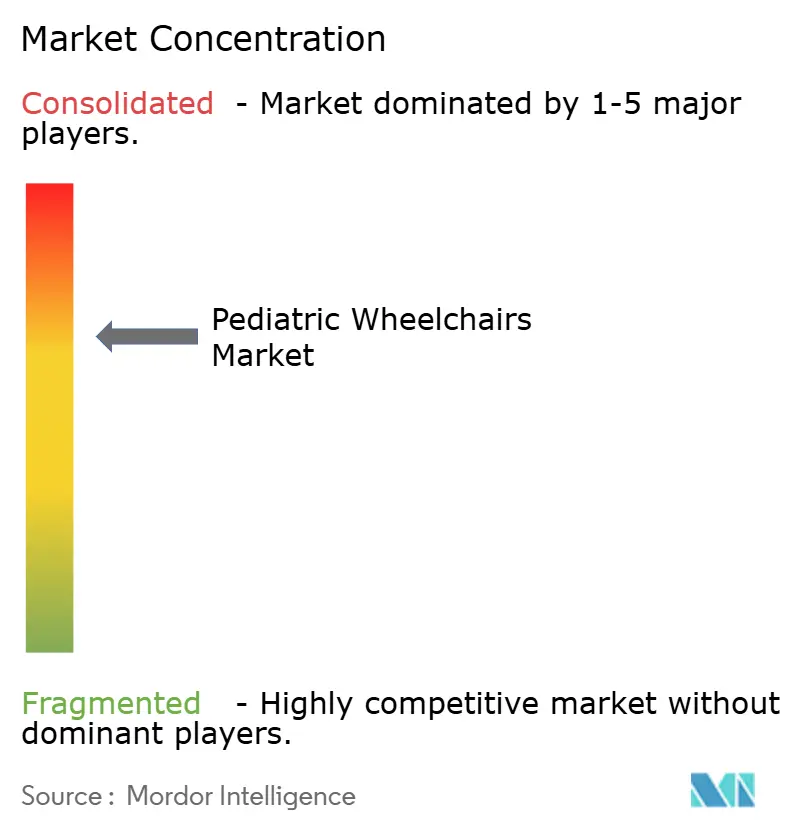
The market is moderately consolidated. Sunrise Medical, Permobil, and Invacare lead in global reach and R&D investment. MIGA Holdings’ 2024 purchase of Invacare’s North American unit signaled renewed capital infusion aimed at product refresh and customer service upgrades. Sunrise Medical’s Ride Designs purchase strengthened its differentiation in 3D-printed seating, accelerating bespoke fit cycles. Permobil opened a 14,000 m² innovation center featuring environmental chambers and automated test rigs, underscoring commitment to rapid prototyping.
Private equity roll-ups created scale economies but raised debt leverage at some distributors, pressuring service staffing. OEMs now pilot direct-to-consumer portals to safeguard brand experience and gather usage data for iterative design. Start-ups focusing on AI posture analytics collaborate with incumbent chair makers rather than compete head-on, highlighting a partnership-centric innovation model across the pediatric wheelchairs market.
Regulatory scrutiny has increased after isolated motor-control recalls. Leading brands therefore invest in redundant safety circuits and cybersecurity audits for connected wheels. Competitive advantage increasingly hinges on integration of hardware, software, and clinical services, rather than frame fabrication alone.
Pediatric Wheelchairs Industry Leaders
Ottobock
MEYRA GmbH
Sunrise Medical
SORG Rollstuhltechnik GmbH
Invacare
- *Disclaimer: Major Players sorted in no particular order
Pediatric Wheelchairs Market Companies Covered in this Report
- Sunrise Medical
- Invacare
- Permobil
- Ottobock
- Meyra
- Ki Mobility
- Leckey
- Drive DeVilbiss Healthcare
- R82 (Etac)
- SORG Rollstuhltechnik
- AKCES-MED sp. z o.o.
- Medline Industries
- VELA Medical
- Smirthwaite
- Motion Composites
- Panthera
- Karma Medical
- Nissin Medical
- Karma Mobility
- Momentum Healthcare

Market Opportunities and Future Outlook
Product architectures that reduce the number of full-chair replacements as children grow represent an identifiable whitespace area, particularly in settings with high payer scrutiny and frequent refits. Sunrise Medicals June 2026 launch of the Leckey BeMe Seating System, built around high component commonality and growth-accommodating features, underscores how modular seating platforms can reduce dealer inventory complexity while supporting longer clinical use across multiple mobility bases.
Therapy-integrated mobility is a second opportunity cluster, as R&D and clinical evaluation shift beyond transportation toward functional outcomes. In June 2026, a ClinicalTrials.gov study (NCT07290556) began evaluating a pediatric manual mobile standing wheelchair concept, and a 2026 protocol in Frontiers in Pediatrics outlined evaluation of stand-on ride-on power mobility devices for children with cerebral palsy. Together, these efforts point to demand for wheelchairs and power mobility designed around standing, balance, and strengthening objectives. At the same time, reimbursement and medical-policy documentation from US payers continue to constrain product design and act as a commercialization lever, creating openings for manufacturers that can document medical necessity and align features to covered mobility categories for pediatric users in homecare and school settings.
Recent Industry Developments in Pediatric Wheelchairs Market
- July 2026: DHCare formally launched following the combination of Invacare Europe and Asia-Pacific with Direct Healthcare Group. The launch created a single operating platform across mobility and post-acute care portfolios, supporting broader distribution reach and cross-selling potential for pediatric mobility and related pressure-care solutions in multiple countries.
- July 2025: Sunrise Medical acquired Made for Movement, expanding into neurorehabilitation devices such as Innowalk Pro and NF-Walker. The deal broadened Sunrises pediatric-facing therapy ecosystem beyond wheelchairs, strengthening its position with clinicians and rehabilitation providers that influence wheelchair prescriptions and complementary equipment selection.
- June 2024: Platinum Equity announced an agreement to acquire Sunrise Medical. The transaction positioned Sunrise Medical for further investment-led scaling in product development and global commercial execution, which can influence competitive intensity in pediatric manual and seating categories where Sunrise is active.


Pediatric Wheelchairs Market Report Scope and Research Methodology
Market Definition and Coverage
This market covers revenue generated from pediatric wheelchairs that are purpose-built for children and adolescents, including both manual and powered options, sold through offline and online channels for home and care settings.
Scope exclusions: We exclude adult wheelchairs that are simply downsized for pediatric use and standalone rehab seating components sold without a wheelchair mobility base.
Segments Covered in This Report
- By Product Type
- Manual
- Powered
- By Frame Type
- Rigid
- Foldable
- Tilt-in-Space
- By End User
- Hospitals
- Homecare Settings
- Rehabilitation Centers
- Other End Users
- By Distribution Channel
- Offline
- Online
- By Geography
- North America
- United States
- Canada
- Mexico
- Europe
- Germany
- United Kingdom
- France
- Italy
- Spain
- Rest of Europe
- Asia-Pacific
- China
- Japan
- India
- Australia
- South Korea
- Rest of Asia-Pacific
- Middle East & Africa
- GCC
- South Africa
- Rest of Middle East & Africa
- South America
- Brazil
- Argentina
- Rest of South America
- North America
Data Sources, Market Sizing, and Validation
Desk Research
Desk research is used to set the foundation for the model and to keep assumptions tied to real world mobility needs in children. We review public health and disability indicators, reimbursement cues, and assistive technology guidance from sources such as the World Health Organization, UNICEF, the US Centers for Disease Control and Prevention, and national health ministry portals.
To translate need into demand signals, we also refer to sources such as government procurement notices, trade and customs statistics (where wheelchairs are tracked under relevant HS codes), and peer reviewed clinical or rehabilitation journals on pediatric mobility usage and fitting practices. Company annual reports, investor presentations, and reputable press are used to understand product mix shifts such as manual versus powered, plus channel movement between offline fitting and online replenishment. Where available, we also use paid database subscriptions for company financials and intelligence, patent lookups, and shipment-level import and export records to sanity-check scale and pricing direction. These desk research sources are illustrative only, and additional public and internal references are used for data collection, validation, and clarification.
Primary Interviews and Surveys
Primary work is used to confirm what is being purchased in practice, how pricing behaves across standard versus customized configurations, and how demand differs by care setting. We speak with a mix of wheelchair manufacturers and distributors, rehabilitation clinicians and seating specialists, and purchasing stakeholders across major regions so desk assumptions can be corrected where they drift from field reality.
Distribution of primary research fieldwork respondents
| Company type | Respondent position | Region |
|---|---|---|
| Top tier: 29% | CXOs: 14% | APAC: 38% |
| Mid tier: 52% | Functional/Unit leaders: 27% | EMEA: 35% |
| Smaller Players: 19% | Managers: 59% | Americas: 27% |
Market-Sizing & Forecasting
Sizing starts with a top-down build where pediatric disability prevalence, access to mobility aids, and the care-setting mix are used to reconstruct a realistic demand pool. That pool is then translated into annual unit needs and value. To keep the model practical, we rely on a short set of inputs that can be traced and refreshed, such as the split of manual versus powered chairs, the share of homecare versus institutional use, typical replacement cycles as children grow, and the offline versus online purchase share.
Once the demand pool is formed, average selling price ranges are applied by configuration, then adjusted for regional reimbursement intensity and mix of standard versus customized frames (including tilt-in-space usage). Selective bottom-up approximations are used as a cross-check, including supplier and distributor roll-ups in key countries, sampled ASP times volume checks by channel, and a review of public tender values where they are available. If visibility is limited in smaller countries, we handle gaps through proxy indicators like pediatric population, healthcare spend direction, and channel availability, followed by a conservative normalization so totals do not overstate reach.
For forecasting, we primarily use scenario analysis supported by short trend lines on the same variables, since policy and reimbursement shifts can change adoption quickly. Assumptions are then aligned to what interviewees expect on powered penetration, online growth, and pricing progression for pediatric-specific features.
Data Validation & Update Cycle
Validation is done in layers so the final number does not rely on any one data point. Model outputs are checked against independent signals like regional channel shares, end-user splits, and observed pricing bands, and then variances are reviewed until the drivers are clearly explained.
Outliers are flagged when growth or share movements look inconsistent with known reimbursement changes, procurement activity, or product availability, and then the assumptions are revisited. When needed, respondents are re-contacted for clarification. Before sign-off, a second analyst reviews the calculation steps, inputs, and unit-to-value bridges to make sure the logic is repeatable. Reports are refreshed annually, with interim updates when material events occur, and a final pre-delivery pass is completed so clients receive the latest updated view.
Mordor Intelligence's Pediatric Wheelchairs Market Sizing Compared With Other Published Estimates
Published market sizes for pediatric wheelchairs can vary even when the topic sounds identical, because underlying boundaries and counting rules are not always the same. The biggest differences usually come from what gets included as a pediatric product, how end users and channels are treated, and whether the current-year value is anchored to measurable demand signals or mainly extended from a prior base.
By tracking core demand indicators, pricing bands by configuration, and channel mix assumptions with interview-led refreshes, the Mordor Intelligence model stays focused on pediatric-specific wheelchairs rather than adjacent mobility products, which is where spreads in reported totals often begin.
Benchmark comparison
| Source | Market Size | Gaps in Research Methodology |
|---|---|---|
| Mordor Intelligence | USD 2.19 B (2026) | |
| Global Research Publisher A | USD 2.10 B (2023) | Uses an earlier base year and can understate recent price and mix changes, especially where powered penetration and online ordering have accelerated after the base period. The scope discussion is less explicit on separating pediatric-specific configurations from broader wheelchair value that can be reported under general mobility aids. |
| Global Research Publisher B | USD 2.44 B (2025) | Applies a broader end-user framing that can blend pediatric demand with wider disability and age-related consumption, which tends to lift the total. Product grouping also appears to include stroller-style mobility products, which shifts the counted basket compared with a wheelchair-only definition. |
Looking across the table, the spread is explained more by scope and base-year choices than by the headline growth rate. When inclusion rules stay tight around pediatric wheelchairs, and when pricing and mix are refreshed using field checks, the resulting market size is easier to trace back to clear variables and repeatable steps.


Key Questions Answered in the Report
What is the current size of the pediatric wheelchairs market?
The pediatric wheelchairs market is valued at USD 2.19 billion in 2026 and is forecast to reach USD 3.08 billion by 2031.
Which region leads the pediatric wheelchairs market?
North America holds the largest share at 39.02% thanks to robust insurance coverage and strict accessibility mandates.
Which product segment is growing fastest?
Powered wheelchairs post the highest growth with a 9.18% CAGR to 2031, driven by lighter batteries and smart control interfaces.
Why are tilt-in-space frames gaining popularity?
Clinical studies show that tilt-in-space improves pressure relief and respiratory function, supporting a 8.72% CAGR for this frame type.
How is 3D printing influencing pediatric wheelchair design?
Additive manufacturing enables precise, rapid production of custom seating, reducing lead-times from eight weeks to three and encouraging more frequent replacements.
What challenges could slow market growth?
High device prices in emerging markets, rapid child growth requiring frequent replacements, and rare-earth motor supply volatility could temper the market’s 7.01% CAGR outlook.
Page last updated on:


 Your data is secure and never sold or shared.


