
Paraffin Inhibitors Market Size and Share
Market Overview
| Study Period | 2021 - 2031 |
|---|---|
| Market Size (2026) | USD 0.8 Billion |
| Market Size (2031) | USD 1.04 Billion |
| Growth Rate (2026 - 2031) | 5.33 % |
| Fastest Growing Market | Asia-Pacific |
| Largest Market | North America |
| Market Concentration | Medium |
Major Players *Disclaimer: Major Players sorted in no particular order Image © Mordor Intelligence. Reuse requires attribution under CC BY 4.0. | |
Paraffin Inhibitors Market Analysis by Mordor Intelligence
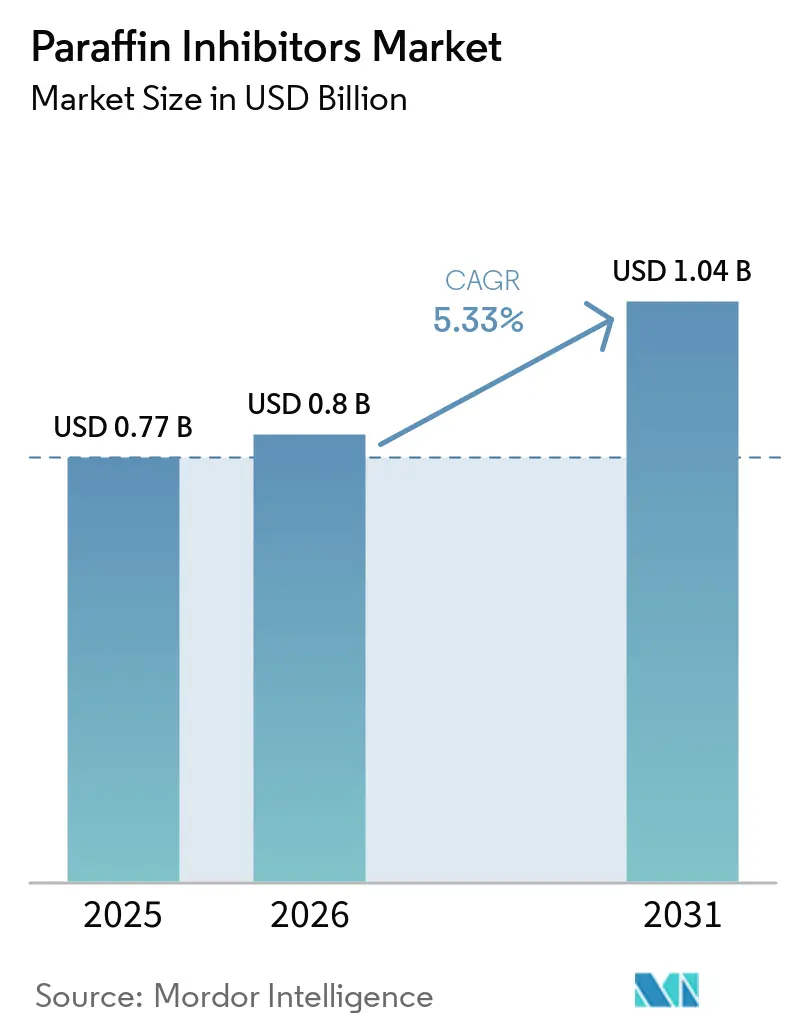
The Paraffin inhibitors market size is projected to expand from USD 0.77 billion in 2025 and USD 0.80 billion in 2026 to USD 1.04 billion by 2031, at a CAGR of 5.33% between 2026 and 2031. Deepwater developments are increasing the need for continuous wax control because long subsea lines, risers, and export systems cool below wax appearance temperatures before fluids reach processing infrastructure, while remote locations limit the practical use of mechanical response methods. Shale, tight oil, and mature fields also require recurring treatment as changing water cuts, pressure conditions, fluid velocity, and pipe conditions raise deposition risk through the producing life of an asset and across a larger installed base of producing wells. Suppliers are combining chemical formulations with monitoring hardware, remote intervention, and dosing systems to protect production uptime while reducing avoidable chemical use, which shifts some procurement decisions toward service capability and away from the delivered volume of chemicals. Environmental rules are shifting product development toward lower-solvent and aqueous dispersions, while also increasing the testing and reformulation burden for suppliers that serve different offshore and onshore regions. These conditions favor providers that can support field-specific testing, reliable delivery, integrated technical service, and compliance across several operating regions in the paraffin inhibitors market.
Key Report Takeaways
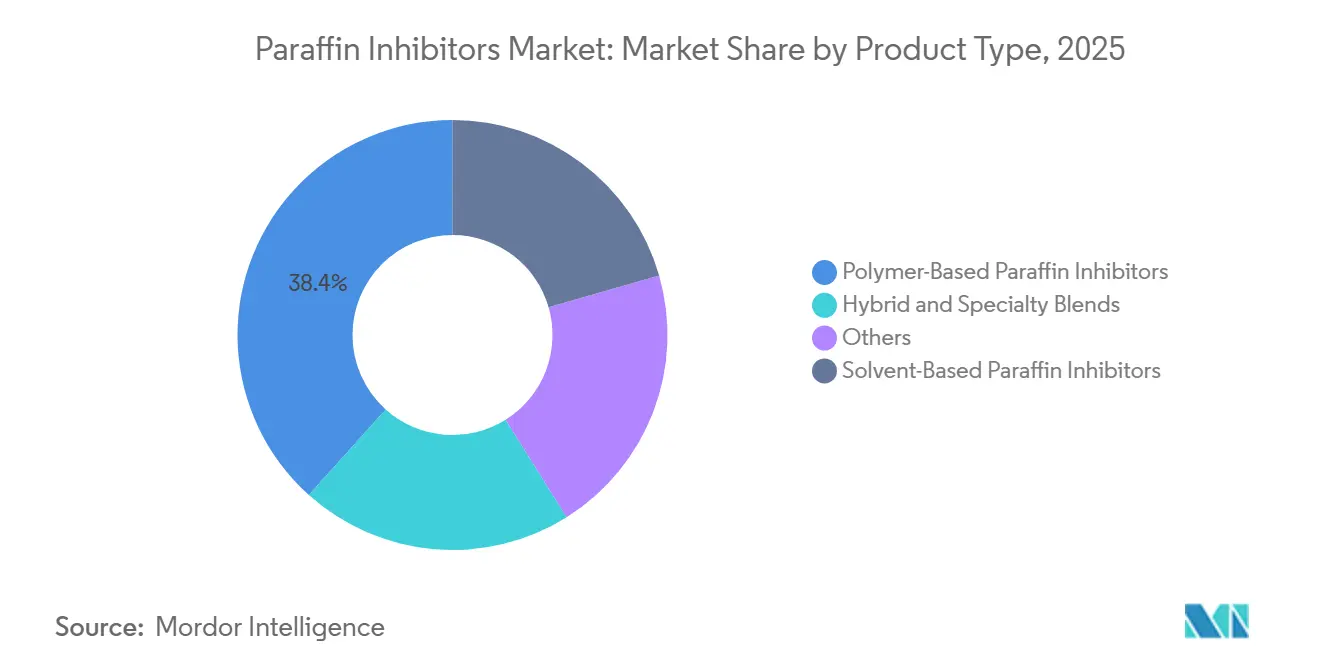
- By product type, polymer-based paraffin inhibitors held 38.36% revenue share in 2025, while hybrid and specialty blends are forecast to grow at a CAGR of 5.78% through 2031.
- By chemistry, modified polycarboxylate held 41.13% revenue share in 2025 and recorded the highest projected CAGR of 5.94% through 2031.
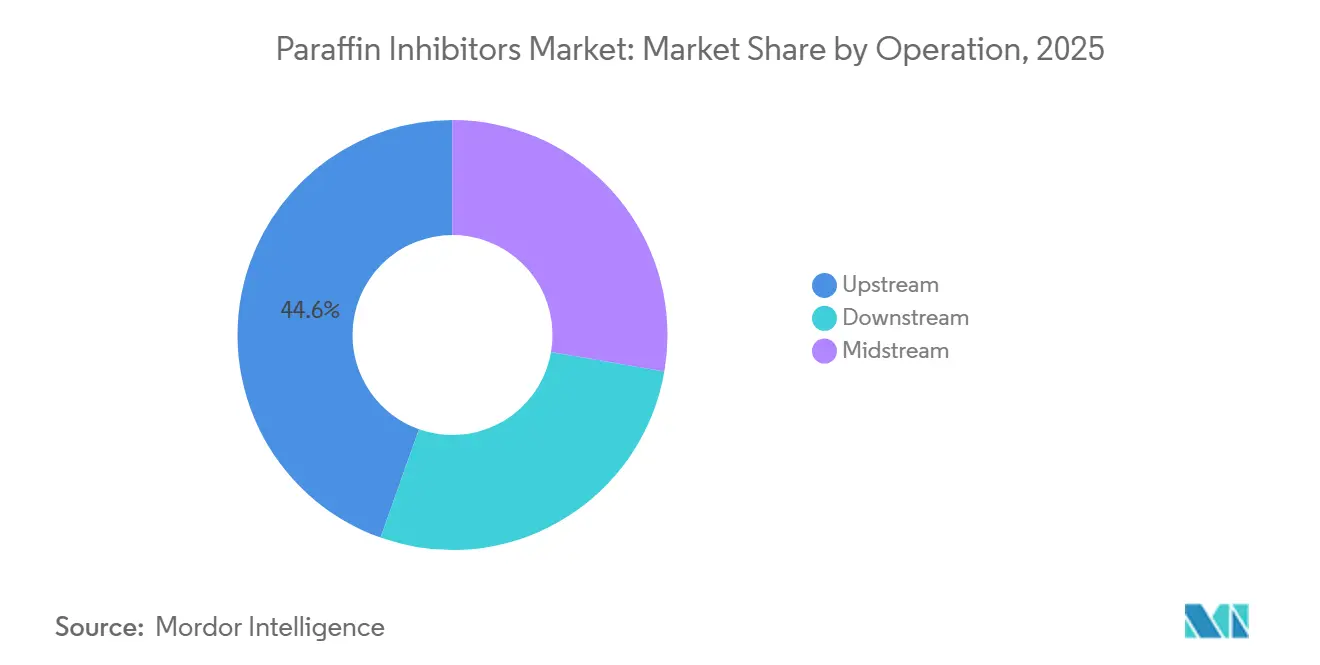
- By operation, upstream held 44.57% revenue share in 2025, while downstream is projected to grow at a CAGR of 6.06% through 2031.
- By application, production tubing and wellbore treatments held 36.25% revenue share in 2025, while flowlines and gathering networks are forecast to grow at a CAGR of 6.13% through 2031.
- By end user, oil and gas held 75.83% revenue share in 2025, while chemicals industry is projected to grow at a CAGR of 6.36% through 2031.
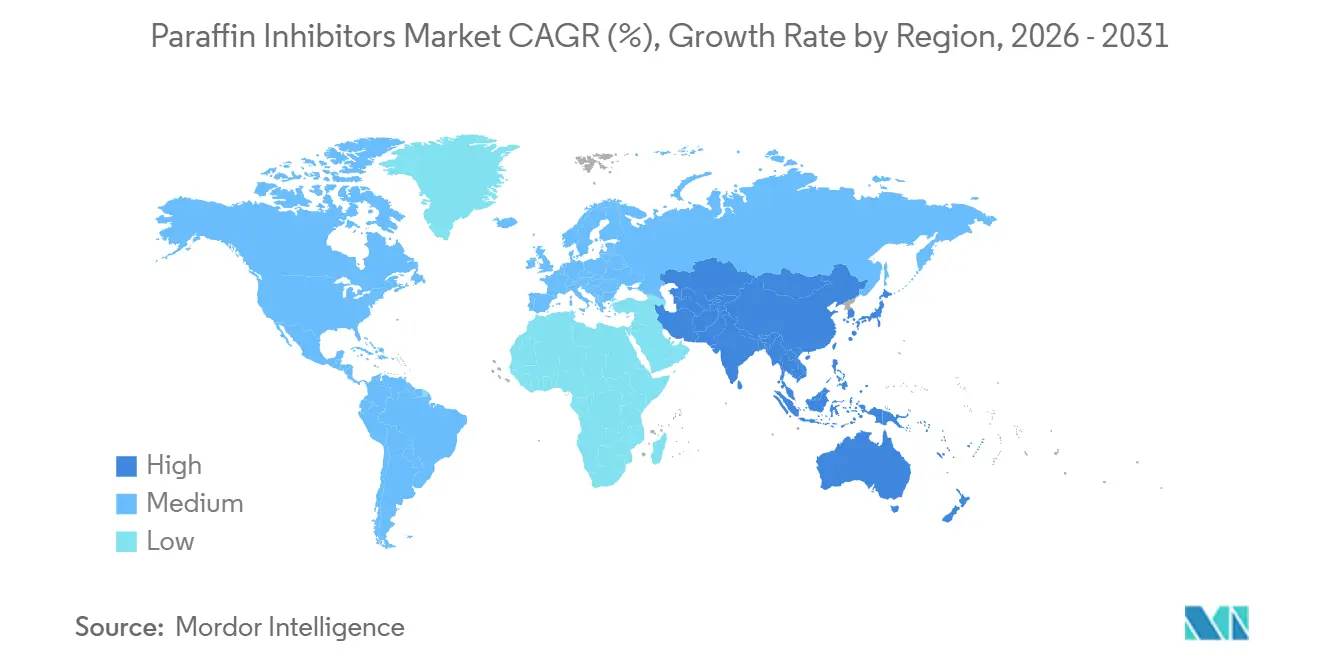
- By geography, North America held 35.91% revenue share in 2025, while Asia Pacific is expected to be the fastest growing market with a CAGR of 6.19% through 2031.
Note: Market size and forecast figures in this report are generated using Mordor Intelligence’s proprietary estimation framework, updated with the latest available data and insights as of January 2026.
Global Paraffin Inhibitors Market Trends and Insights
Drivers Impact Analysis*
| Driver | (~) % Impact on CAGR Forecast | Geographic Relevance | Impact Timeline |
|---|---|---|---|
| Increasing Deepwater And Ultra-Deepwater Production | +1.4% | Global, North America, South America, and Asia-Pacific | Long term (≥ 4 years) |
| Expansion Of Shale, Tight-Oil, And Mature-Field Production | +1.2% | North America, South America, and mature fields globally | Medium term (2-4 years) |
| Rising Flow-Assurance Requirements For Waxy Crudes | +1.0% | Global, with relevance in West Africa, South America, and Asia-Pacific | Medium term (2-4 years) |
| Replacement Of Mechanical Wax Removal With Continuous Chemical Treatment | +0.8% | Global, especially mature basins and long-distance pipeline networks | Short term (≤ 2 years) |
| Digital Injection Optimization And Predictive Wax-Deposition Monitoring | +0.6% | North America, Europe, and Asia-Pacific | Short term (≤ 2 years) |
| Source: Mordor Intelligence | |||
Increasing Deepwater And Ultra-Deepwater Production
Deepwater production requires dependable wax management because cold seawater quickly reduces fluid temperatures in flowlines, risers, and export systems far from processing infrastructure. The Gulf of America produced 1.87 million barrels per day in early 2026, supported by Whale, Ballymore, Dover, Shenandoah, and Leon-Castile, which began production during 2025.[1]U.S. Energy Information Administration, “Short-Term Energy Outlook,” U.S. Energy Information Administration, eia.gov. Brazil’s pre-salt fields averaged 3 million barrels per day in 2025 and accounted for 80% of national output. Subsea developments can require inhibitor selection before first production because line length, seabed temperatures, crude composition, and restart conditions affect wax behavior. Long tiebacks require chemical programs from startup because passive cooling can trigger wax deposition before production stabilizes. Suppliers also need to maintain injection reliability across remote offshore assets where intervention options are limited. The paraffin inhibitors market benefits when deepwater projects move from development into sustained production, since treatment becomes an operating requirement rather than an optional intervention.
Expansion Of Shale, Tight-Oil, And Mature-Field Production
Shale and tight-oil wells need regular treatment as water cuts rise, reservoir pressure declines, and produced-fluid conditions move closer to wax onset windows. U.S. crude output reached 13.6 million barrels per day in 2025, while Permian tight-oil output reached 6 million barrels per day during December 2025. Large numbers of rod-pump wells and gathering lines create a broad treatment requirement across the Permian, Bakken, and Eagle Ford. In Argentina, the Vaca Muerta Sur project has supported pipeline investment intended to move rising shale output. Mature assets in Western Siberia and the North Sea also face rougher pipe walls, weaker insulation, lower flow rates, and longer residence times. These conditions make paraffin control a continuing maintenance need rather than a sporadic remedial expense. The paraffin inhibitors market, therefore, has recurring demand beyond new drilling activity and remains linked to the management of producing assets.
Rising Flow-Assurance Requirements For Waxy Crudes
Waxy crudes require specialized treatments when pour points remain above operating temperatures or when their wax fractions crystallize across a wide thermal range. A Society of Petroleum Engineers study reported viscosity reductions of 57% to 76% at 30°C for biodegradable pour point depressants tested in Indian crude oil. The same study reported pour point suppression of 15°C at a 600-ppm dosage. Research in Energy & Fuels found that methane saturation can affect wax deposition in a non-linear pattern under pressure, which complicates inhibitor qualification for live-oil systems. SLB developed a deepwater pour point depressant for ONGC’s KG-DWN-98/2 project to support flow at seabed temperatures and anticipated production above 35,000 barrels per day. Waxy crude complexity makes formulation performance, laboratory testing, and field validation more important than standard product supply. These operating conditions increase the value of crude-specific formulation work in the paraffin inhibitors market.
Replacement Of Mechanical Wax Removal With Continuous Chemical Treatment
Many subsea tiebacks, multilateral horizontal wells, and rod-lift systems cannot rely on conventional pigging because they lack the necessary access or handling infrastructure. Continuous injection can prevent deposits before they restrict production, damage equipment performance, or require physical removal. ChampionX deployed its ParaClear continuous injection system across rod-lift wells in the Denver-Julesburg Basin during March 2025 using solar-powered delivery infrastructure.[2] SLB, “New Pour Point Depressant Enables Deepwater Production,” SLB, slb.com. The deployment documented a 39% production uplift, showing the operational value of maintaining flow rather than responding after deposition occurs. Offshore gathering systems also avoid the capital cost and operational complexity associated with pig launchers and receivers. Continuous programs create recurring chemical requirements and closer supplier involvement in field operations. This operating shift supports predictable demand in the paraffin inhibitors market.
Restraints Impact Analysis*
| Restraint | (~) % Impact on CAGR Forecast | Geographic Relevance | Impact Timeline |
|---|---|---|---|
| Volatile Crude Oil And Chemical Feedstock Prices | -0.7% | Global | Short term (≤ 2 years) |
| Environmental Restrictions On Aromatic Solvents And Persistent Chemistries | -0.5% | North America and Europe, with spillover to Asia-Pacific and Middle East and Africa | Medium term (2-4 years) |
| Crude-Specific Formulation And Treatment-Validation Complexity | -0.4% | Global, especially Africa, Asia-Pacific, and deepwater operations | Long term (≥ 4 years) |
| Source: Mordor Intelligence | |||
Volatile Crude Oil And Chemical Feedstock Prices
Crude price movements can reduce spending on noncritical chemical programs at the same time that higher feedstock prices raise costs for formulators. Paraffin inhibitor polymers, including ethylene-vinyl acetate copolymers, poly acrylates, and modified polycarboxylates, use petrochemical feedstocks and respond to crude oil and natural gas liquids price changes. Operators assess chemical spending against production economics, the urgency of the deposition risk, and the cost of a potential intervention. Lower price conditions can lead operators to defer treatment in applications with less immediate plugging risk. Small suppliers can face more pressure when they do not have long-term feedstock contracts or diverse service revenue. Larger integrated providers can offset chemical margin pressure through wider field-service activity. The paraffin inhibitors market remains more resilient in production tubing and flowlines because a wax plug can interrupt output and require costly intervention.
Environmental Restrictions And Crude-Specific Validation Complexity
Aromatic carrier solvents face closer scrutiny, which increases the development and qualification work required for lower-solvent formulations. OSPAR added PFAS to its List of Chemicals for Priority Action in August 2024, which affected offshore chemical discharge requirements in UK waters. BASF expanded Basoflux capacity to support aqueous dispersions with lower solvent content. Each crude also requires testing because wax behavior changes with carbon distribution, asphaltene content, pressure, temperature, and flow conditions. An SPE study found that complete wax prevention required formulation-specific dosing across concentrations from 500 to 1,800 ppm. Cold finger tests, pour point measurements, rheological profiling, and flow-loop work can extend product qualification before field adoption. These requirements lengthen commercial cycles and favor providers with testing resources, field knowledge, and reformulation capability in the paraffin inhibitors market.
*Our forecasts treat driver/restraint impacts as directional, not additive. The impact forecasts reflect baseline growth, mix effects, and variable interactions.
Segment Analysis
By Product Type: Polymer-Based Products Lead While Hybrid Blends Gain Use
Polymer-based paraffin inhibitors held 38.36% of the paraffin inhibitors market size in 2025. Their comb-shaped structures co-precipitate with wax crystals, disrupt lattice growth, and help maintain crude flowability across a broad temperature range. They are used from rod-pump wells in the Permian Basin to subsea tieback systems in the Gulf of America. This operating range provides a geographically diverse demand base across wells, gathering systems, and long-distance export infrastructure. Product selection depends on crude composition, expected wax appearance temperature, injection equipment, chemical compatibility, and the operating conditions expected during normal flow, shutdown, restart, and emergency response. Polymer formulations can be adjusted for these variables, while solvent-based products still support rapid wax dissolution during pipeline clearance and emergency work, although environmental rules are constraining aromatic carrier use.
Hybrid and specialty blends are forecast to grow at a CAGR of 5.78% through 2031. These products combine polymer families where crude wax fractions crystallize at different temperature thresholds and a single chemistry cannot cover the complete carbon distribution. The blends can be designed to respond across several crystallization points, which is especially relevant for heterogeneous crudes and live-oil systems that experience changing pressure and temperature conditions. Suppliers are seeking lower-dose formulations that maintain effectiveness during variable flow conditions without creating handling, compatibility, or environmental challenges for operators. Bio-based options are also under evaluation for environmentally sensitive applications. The paraffin inhibitors industry is extending beyond conventional solvent-heavy products as technical and environmental requirements increase.



By Chemistry: Modified Polycarboxylate Combines Scale With Growth
Modified polycarboxylate held 41.13% of the paraffin inhibitors market share in 2025. Its comb-shaped structure contains alkyl side chains that interact with wax crystal surfaces under high-pressure and high-temperature conditions. This chemistry is important in deepwater crude systems in the Bay of Bengal, offshore West Africa, and Brazil’s pre-salt fields. It can suppress high-melting paraffins above C35 that complicate subsea transport, particularly when cooling and depressurization occur along long flowlines. Its performance helps suppliers support initial qualification, routine dosing, restart planning, and long-term chemical treatment programs in settings where flow interruption is difficult to resolve. These features underpin its leading position among chemistry types.
Modified polycarboxylate is also forecast to grow at a CAGR of 5.94% through 2031. The same chemistry therefore serves major existing applications and newer deepwater deployments, linking established demand with the requirements of new subsea projects. EVA acrylate copolymers and poly acrylates retain established positions in onshore production and midstream gathering applications, where crude properties and operating temperatures can be more clearly characterized. Hyperbranched polyester chemistry is attracting research interest for high-pressure deepwater duties because its three-dimensional structure provides several potential wax-crystal interaction sites. Research in Processes identified persistent limits in applying wax-deposition models across diverse crude types, reinforcing the practical need for iterative testing rather than reliance on generalized predictions. The paraffin inhibitors market needs several chemistry options because no single formulation suits every crude, fluid blend, production profile, or transport condition.
By Operation: Upstream Use Remains Largest As Downstream Demand Rises
Upstream operations held 44.57% of revenue in 2025. Wax onset risk is highest near the wellbore and wellhead as produced fluids cool from formation conditions and pass through tubing, rod-lift strings, and early flowline sections. Production tubing and rod-lift equipment are often the first assets exposed to deposition, particularly in cold-climate fields and offshore developments where temperature loss can occur quickly. These assets need frequent treatment because interrupted production creates immediate operating costs and can require a workover, mechanical cleaning, or other physical intervention. Upstream programs commonly include continuous injection, squeeze treatment, or solid inhibitors placed at depth, with the appropriate approach depending on well pressure, access, and production equipment. Upstream activity, therefore, remains the main operational base for the paraffin inhibitors market.
Downstream operations are forecast to grow at a CAGR of 6.06% through 2031. Refineries handling waxier unconventional and pre-salt feedstocks need treatment at heat exchangers and crude preheat trains, where fouling can limit throughput, increase energy consumption, and disrupt planned processing schedules. Midstream activity also remains important for transmission pipelines, pump stations, and gathering manifolds that move crude across low-temperature corridors or store it during periods of limited movement. Baker Hughes signed a multiyear preferred-provider agreement with Marathon Petroleum in February 2026. The agreement covers chemical technologies and digital monitoring across 12 refineries and 2 renewable fuel facilities. Integrated contracts can increase the role of oilfield chemical suppliers in refinery treatment programs and can consolidate procurement, technical support, and performance monitoring across multiple sites.
By Application: Wellbore Treatment Anchors Demand While Flowlines Grow Faster
Production tubing and wellbore treatments held 36.25% revenue share in 2025. The segment includes downhole paraffin squeeze treatments, continuous tubing-injection programs, and solid stick inhibitors deployed at pump depth, each selected according to well design and the duration of protection required. A wax-plugged well is rarely left untreated because lost production, intervention requirements, and equipment damage can quickly exceed the cost of regular chemical treatment. This makes demand more stable than in some discretionary midstream applications that can be deferred during commodity-price pressure. The segment serves thousands of producing wells across tight-oil fields, mature conventional assets, and offshore systems where access, flow rate, and fluid composition differ materially. The paraffin inhibitors market size for wellbore treatment is supported by recurring maintenance needs and the operational priority placed on keeping wells flowing.
Flowlines and gathering networks are forecast to grow at a CAGR of 6.13% through 2031. Longer subsea tiebacks are increasing exposure to low temperatures, pressure changes, and variable flow regimes across distances that can exceed 20 kilometers, making deposition control important from startup through routine operating periods. A 2025 Fuel study found that crystal-modifier effectiveness declined under turbulent flow conditions. Dosing plans must account for changing conditions during flowing, shut-in, restart, and low-velocity periods rather than use a fixed treatment rate, since the risk profile can change considerably through a production cycle. Clariant supported wax, hydrate, and asphaltene control at the Shenandoah field during its early operating period. Transportation pipelines, storage tanks, and terminals also need treatment in cold-climate corridors where crude can remain static for long periods.
By End User: Oil And Gas Leads As Chemical Processing Expands
Oil and gas represented 75.83% of revenue in 2025. Producers use paraffin inhibitors in well services, gathering systems, subsea flowlines, transportation pipelines, and export operations where wax deposition can restrict the movement of crude. This end-user group has the broadest exposure to wax deposition because its assets cover the full production and transport chain. Large supplier combinations can rapidly alter account coverage, service capacity, and access to treatment data in this segment. Operators also value products that can be matched to local crude properties and field operating conditions. The paraffin inhibitors industry remains closely tied to upstream and midstream operating activity.
The chemicals end-user segment is forecast to grow at a CAGR of 6.36% through 2031. Refineries and petrochemical plants can face similar deposition issues when processing high-wax crude feedstocks or wax-bearing natural gas liquids. Heat exchangers, crude preheat trains, and distillation overhead systems can require chemical treatment to reduce fouling, preserve throughput, and avoid extra energy use. The others category includes marine fuel terminal operators, industrial wax processors, and power generation facilities. These users encounter related problems when paraffinic fuels or heat-transfer fluids lose flowability during storage, transfer, or changing temperatures. The paraffin inhibitors market has room to extend into these adjacent processing settings as operators apply established flow-assurance practices beyond upstream production.
Geography Analysis
North America held 35.91% of the paraffin inhibitors market share in 2025. The paraffin inhibitors market in the region combines the world’s most active shale production base with a deepwater portfolio in the Gulf of America that is entering a high-output phase. U.S. crude production reached 13.6 million barrels per day in 2025, and Gulf of America output reached 1.87 million barrels per day in early 2026. The Permian’s concentration of rod-pump wells supports recurring wellbore treatment, while Canada’s oil sands-derived heavy blends need flowability additives for cold-temperature pipeline transport. SLB reported USD 4.4 million in chemical savings from a Permian field optimization program, showing how digital dosing can strengthen the value proposition in high-density producing regions.
Asia-Pacific is forecast to grow at a CAGR of 6.19% through 2031. The paraffin inhibitors market in Asia-Pacific is expanding with offshore development in several high-wax crude environments. Parts of the region have a smaller legacy base of continuous chemical programs than established North American fields. SLB’s custom DS-73063 treatment supports ONGC’s KG-DWN-98/2 production in the Bay of Bengal, where seabed temperatures create a direct flow-assurance challenge. Indonesia is expected to add more subsea wells between 2026 and 2032, while Vietnam has documented continuous inhibitor dosing for the Nam Rong-Doi Moi system. South Korea and Japan add stable refinery demand for waxy feedstock treatment.
Europe, South America, and the Middle East and Africa represent the remaining regional demand in the paraffin inhibitors market. Europe is moving toward aqueous and biodegradable formulations under offshore environmental requirements, which reduces the role of conventional solvent-based products. Brazil produced 3.8 million barrels per day in 2025, with pre-salt output averaging 3 million barrels per day, while Argentina’s Vaca Muerta adds a cold-climate transport requirement as volumes enter new pipelines. West African offshore fields produce high-wax Atlantic-type crudes that need specialized treatment, whereas the Arabian Peninsula has more demand in produced water and scale-management applications.

Competitive Landscape
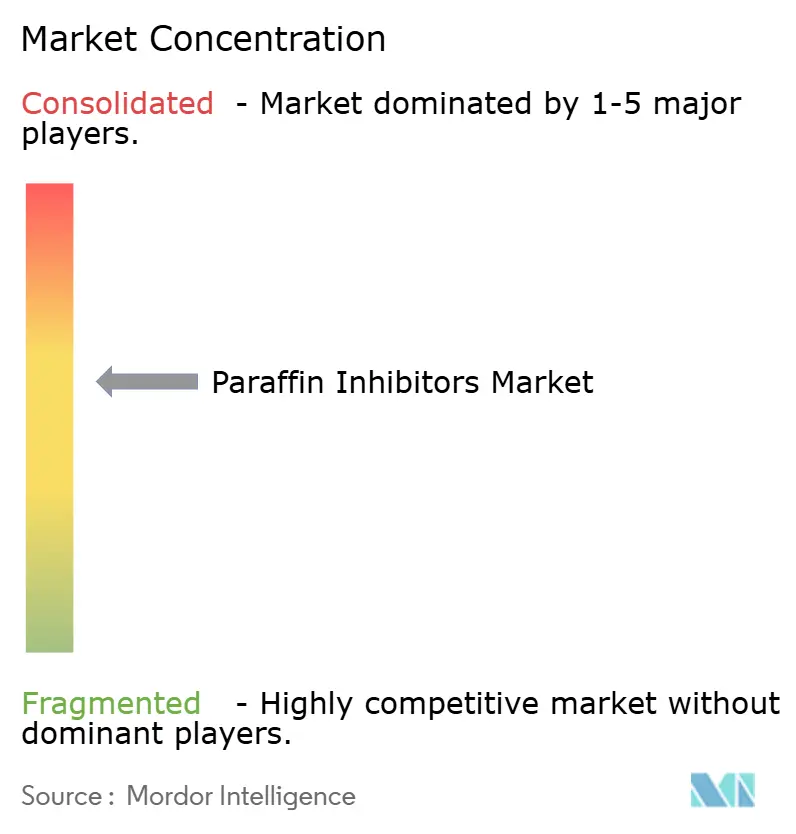
The paraffin inhibitors market is moderately consolidated among major oilfield service providers. In the paraffin inhibitors market, SLB, Baker Hughes, and Halliburton combine chemical products, field service, artificial-lift knowledge, and digital dosing capabilities that are difficult for smaller suppliers to match across several regions. BASF, Clariant, Nouryon, Evonik, Croda, Dorf Ketal, and Innospec compete through formulation expertise, application-specific qualification, and regional technical service. Product qualification, testing capability, supply reliability, and field service coverage are important competitive factors in the paraffin inhibitors market. Suppliers with subsea certification can better serve projects with demanding pressure, temperature, and environmental requirements.
BASF expanded Basoflux capacity at Tarragona to support lower-solvent aqueous dispersions in response to reformulation needs. Nouryon opened an oilfield-focused Innovation Center in Houston during June 2025 for co-development, demulsification, scale inhibition, and stimulation testing.
Innospec launched its LaZuli product line for deepwater subsea production during March 2025. The product line passed API 17TR5 and API 17TR6 certification testing for high-pressure and high-temperature conditions. Sustainable formulations, subsea qualification, and digital dosing remain the main areas of supplier differentiation in the paraffin inhibitors market. Bio-based products and nano-enhanced treatments are emerging areas of technical work, while smaller regional chemical companies can gain early evaluation opportunities where local service and environmental certification influence procurement decisions.
Paraffin Inhibitors Industry Leaders
SLB
Baker Hughes Company
Halliburton
ChampionX
BASF
- *Disclaimer: Major Players sorted in no particular order

Recent Industry Developments
- April 2026: ChampionX LLC, part of SLB, published PCT patent WO2026080368A1 for paraffin suppressant compositions using nanoparticulates with paraffin inhibitors and dispersants in a non-aqueous solvent dispersion. The disclosed formulation reported viscosity reductions of 5% to 50% and pour point reductions of 0.1°C to 5°C against conventional inhibitor systems at equivalent concentrations.
- June 2025: Nouryon opened its first oilfield-focused Innovation Center in Houston, Texas. The facility is Nouryon’s 15th global innovation location and provides testing in demulsification, corrosion, and scale inhibition, stimulation, sustainable chemistry research, and customer co-development.


Global Paraffin Inhibitors Market Report Scope
Paraffin inhibitors are specialized chemical additives used in oil and gas production to prevent wax crystals from forming, growing, and sticking to pipelines and wellbores.
The paraffin inhibitors market is segmented by product type, chemistry, operation, application, end-use industry, and geography. By product type, the market is segmented into polymer-based paraffin inhibitors, solvent-based paraffin inhibitors, hybrid and specialty blends, and others. By chemistry, the market is segmented into EVA acrylate copolymer, poly acrylate, modified polycarboxylate, hyperbranched polyester, and others. By operation, the market is segmented into upstream, midstream, and downstream. By application, the market is segmented into production tubing and wellbore, flowlines and gathering networks, transportation pipelines, storage tanks and terminals, and others. By end-use industry, the market is segmented into oil and gas industry, chemicals industry, and others. By geography, the market is segmented into Asia Pacific, North America, Europe, South America, and the Middle East and Africa. The report also covers the paraffin inhibitors market size and forecasts for the paraffin inhibitors market in 15 countries across major regions. For each segment, the market sizing and forecasts have been done on the basis of value (USD).
| Polymer-Based Paraffin Inhibitors |
| Solvent-Based Paraffin Inhibitors |
| Hybrid and Specialty Blends |
| Others |
| EVA Acrylate Copolymer |
| Poly Acrylate |
| Modified Polycarboxylate |
| Hyperbranched Polyester |
| Others |
| Upstream |
| Midstream |
| Downstream |
| Production Tubing and Wellbore |
| Flowlines and Gathering Networks |
| Transportation Pipelines |
| Storage Tanks and Terminals |
| Others |
| Oil and Gas Industry |
| Chemicals Industry |
| Others |
| Asia-Pacific | China |
| India | |
| Japan | |
| South Korea | |
| ASEAN Countries | |
| Rest of Asia-Pacific | |
| North America | United States |
| Canada | |
| Mexico | |
| Europe | Germany |
| United Kingdom | |
| France | |
| Italy | |
| NORDIC Countries | |
| Rest of Europe | |
| South America | Brazil |
| Argentina | |
| Rest of South America | |
| Middle East and Africa | Saudi Arabia |
| South Africa | |
| Rest of Middle East and Africa |
| By Product Type | Polymer-Based Paraffin Inhibitors | |
| Solvent-Based Paraffin Inhibitors | ||
| Hybrid and Specialty Blends | ||
| Others | ||
| By Chemistry | EVA Acrylate Copolymer | |
| Poly Acrylate | ||
| Modified Polycarboxylate | ||
| Hyperbranched Polyester | ||
| Others | ||
| By Operation | Upstream | |
| Midstream | ||
| Downstream | ||
| By Application | Production Tubing and Wellbore | |
| Flowlines and Gathering Networks | ||
| Transportation Pipelines | ||
| Storage Tanks and Terminals | ||
| Others | ||
| By End User | Oil and Gas Industry | |
| Chemicals Industry | ||
| Others | ||
| By Geography | Asia-Pacific | China |
| India | ||
| Japan | ||
| South Korea | ||
| ASEAN Countries | ||
| Rest of Asia-Pacific | ||
| North America | United States | |
| Canada | ||
| Mexico | ||
| Europe | Germany | |
| United Kingdom | ||
| France | ||
| Italy | ||
| NORDIC Countries | ||
| Rest of Europe | ||
| South America | Brazil | |
| Argentina | ||
| Rest of South America | ||
| Middle East and Africa | Saudi Arabia | |
| South Africa | ||
| Rest of Middle East and Africa | ||


Key Questions Answered in the Report
What is the current and forecasted market size of the paraffin inhibitors market and the growth rate through 2031?
The market is expected to grow from USD 0.80 billion in 2026 to USD 1.04 billion in 2031 at a CAGR of 5.33% through 2031.
Which product type led revenue in 2025?
Polymer based paraffin inhibitor product type led with 38.36% revenue share in 2025.
Which chemistry is growing fastest?
Modified polycarboxylate is forecast to grow at a CAGR of 5.94% through 2031.
Which region is growing fastest?
Asia-Pacific is forecast to grow at a CAGR of 6.19% through 2031, supported by offshore development and subsea activity.
Page last updated on:


 Your data is secure and never sold or shared.


