
Pakistan Tubular Battery Market Size and Share
| Study Period | 2019 - 2030 |
| Forecast Data Period | 2025 - 2030 |
| Historical Data Period | 2019 - 2023 |
| Market Size (2025) | USD 84.34 Million |
| Market Size (2030) | USD 138.01 Million |
| CAGR (2025 - 2030) | 10.35% |
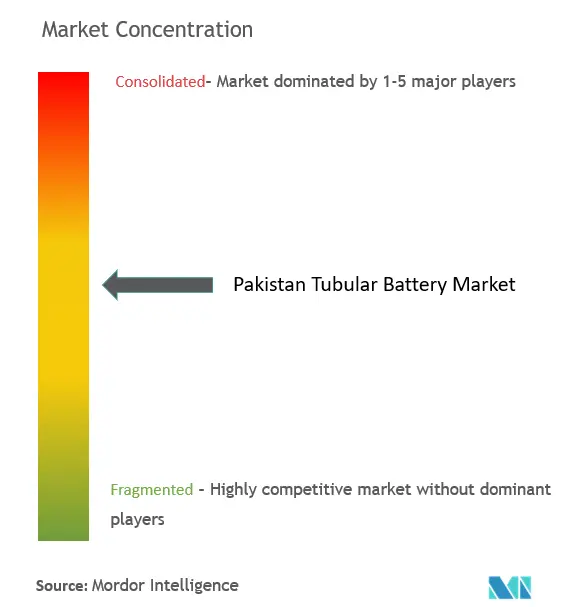
| Market Concentration | Medium |
Major Players *Disclaimer: Major Players sorted in no particular order |
Pakistan Tubular Battery Market Analysis by Mordor Intelligence
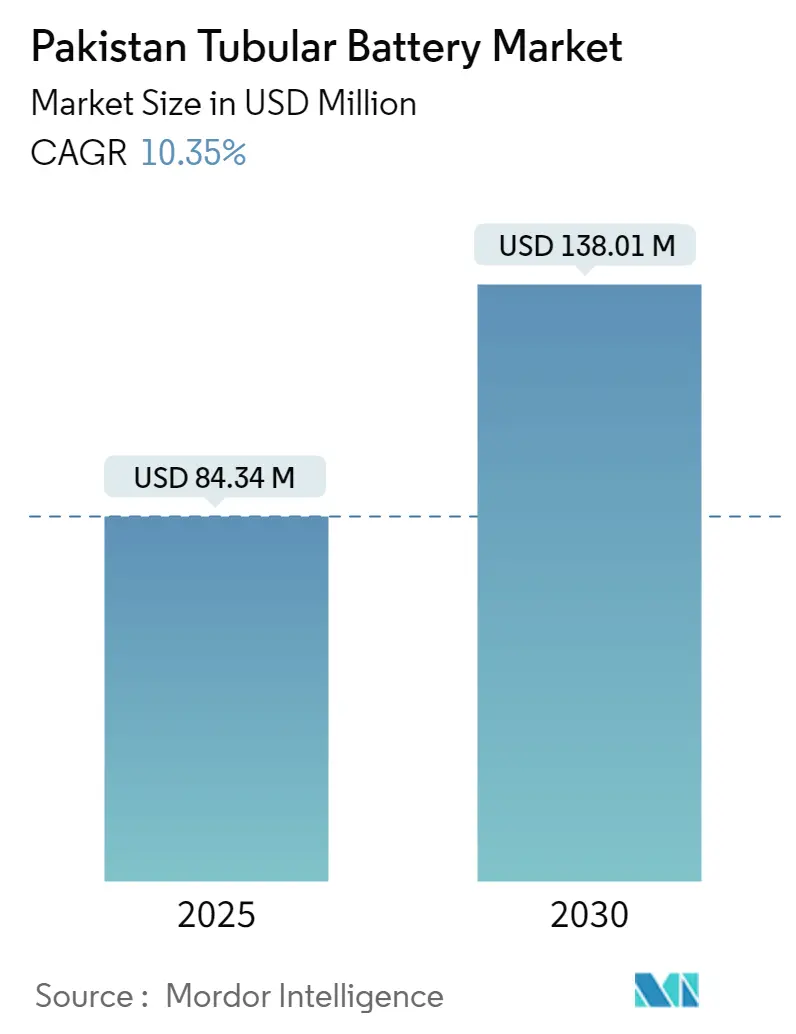
The Pakistan Tubular Battery Market size is estimated at USD 84.34 million in 2025, and is expected to reach USD 138.01 million by 2030, at a CAGR of 10.35% during the forecast period (2025-2030).
- Over the medium term, the unstable power supply in the country looking for alternative options for backup and rising solar energy adoption across the region is expected to drive the demand for tubular batteries in the market during the forecast period.
- On the other hand, alternative options like lithium-ion batteries for power backup are expected to restrain the growth of the Pakistani tubular batteries market.
- Nevertheless, technological innovations in tubular batteries, such as refining the design of tubular batteries to enhance their performance and longevity, are expected to create significant growth opportunities in the electric vehicle VRLA batteries market in the near future.
Pakistan Tubular Battery Market Trends and Insights
Unstable Power Supply in the Country Leading to Looking for Alternative Options for Backup
- Pakistan, with an area of 796,095 sq. km, is the fourth most populous country in Asia-Pacific and fifth in the world, with a population of 245.21 million in 2023, according to the United Nations Department of Economic and Social Affairs. The population growth rate in Pakistan is around 2% per year. Due to population growth, there has been an unprecedented increase in energy demand during the last decade.
- The power generation industry in the country has been struggling with the Pakistani government's inability to pay for the electricity that is produced. Like in many other developing countries, Pakistan experiences frequent power outages. Inverters are among the country's common backup options. Since tubular batteries play a vital role in inverters, the country's unstable power supply is likely to promote the use of tubular batteries.
- Further, the increasing reliance on solar energy in Pakistan, combined with the country's unstable power supply, has significantly boosted the demand for tubular batteries for energy storage. Tubular batteries are well-suited for solar applications due to their longer life, deep discharge capability, and ability to handle frequent and prolonged power outages. As solar production rises, more households and businesses in Pakistan are adopting these batteries to ensure a reliable power supply, especially during peak demand or when the grid fails.
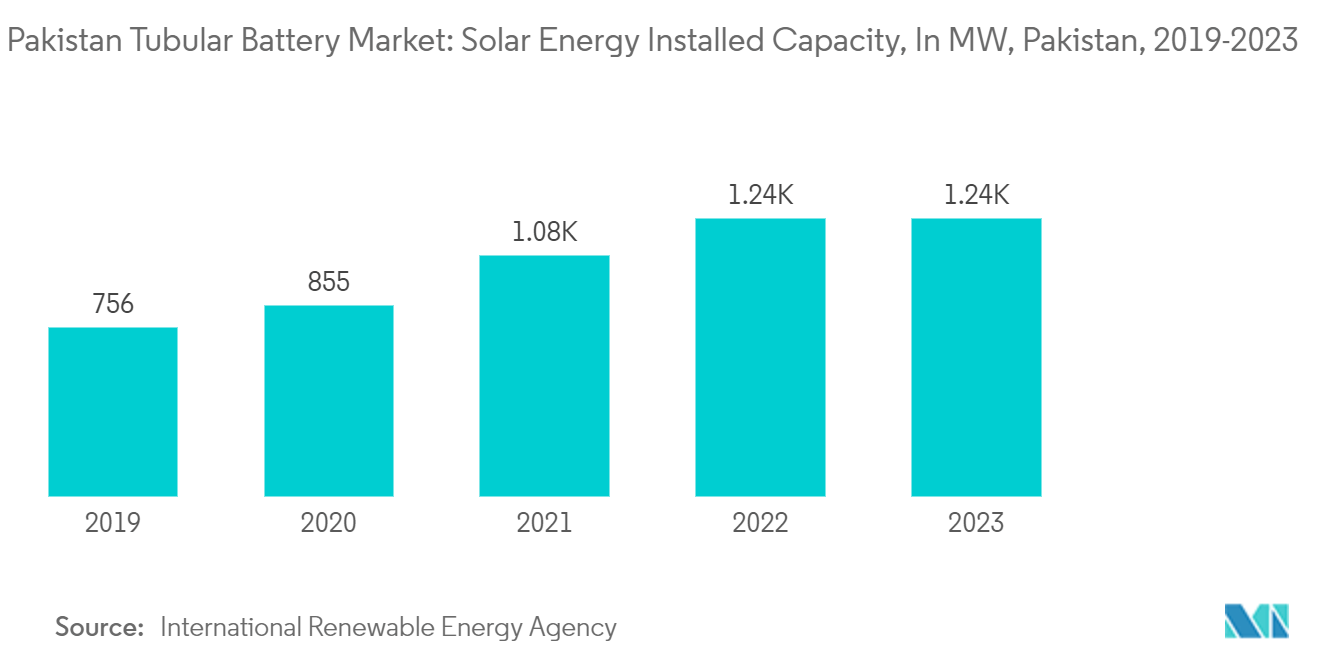
- For instance, according to the International Renewable Energy Agency (IRENA) data, in 2023, the solar energy generation in Pakistan was 1,244 MW, which remained steady compared to 2022 but increased by 64.55% compared to 2019. The capacity is expected to rise significantly in the coming year as the government introduced several projects to enhance the solar capacity to counter the country's unstable power supply. Hence, this substantially increases the demand for tubular batteries for energy storage across the region.
- Additionally, in recent years, Pakistan has witnessed increased solar energy installations. The solar energy initiative in the country would help government buildings, different sectors, and tube wells shift from diesel to solar power. The power plants operating on diesel and furnace oil will be partially replaced.
- For instance, as of 2023, the Pakistani government approved the National Solar Energy Initiative to produce 10 GW of electricity through solar energy projects in the following months. The initiative aims to reduce the import bill of costly diesel and furnace oil, thus creating demand in the country's utility sector. Therefore, tubular batteries will be vital in providing a reliable power source and storing solar energy across the city in the coming years.
- Hence, such projects are likely to provide alternative power solutions across the region and the rising demand for tubular batteries during the forecast period.
Renewable Energy Application Type to Witness Significant Growth
- The Pakistani government aims to generate 30% of its electricity from renewable sources by 2030, excluding hydroelectricity. Investments and projects in solar, wind, hydroelectric, and emerging technologies like tidal and geothermal energy are expected to grow in 2024.
- The country has been harnessing solar energy to power homes and businesses. As the cost of traditional electricity continues to rise, more and more people in the country are turning to renewable energy sources such as solar energy. A 25-kW solar system with battery backup is expected to provide a reliable source of energy that not only reduces electricity costs but also helps reduce carbon emissions.
- Further, the tubular battery market in the country is experiencing steady growth, driven by the increasing demand for reliable and efficient power backup solutions. Pakistan faces frequent power outages and load shedding due to a mismatch between electricity demand and supply.
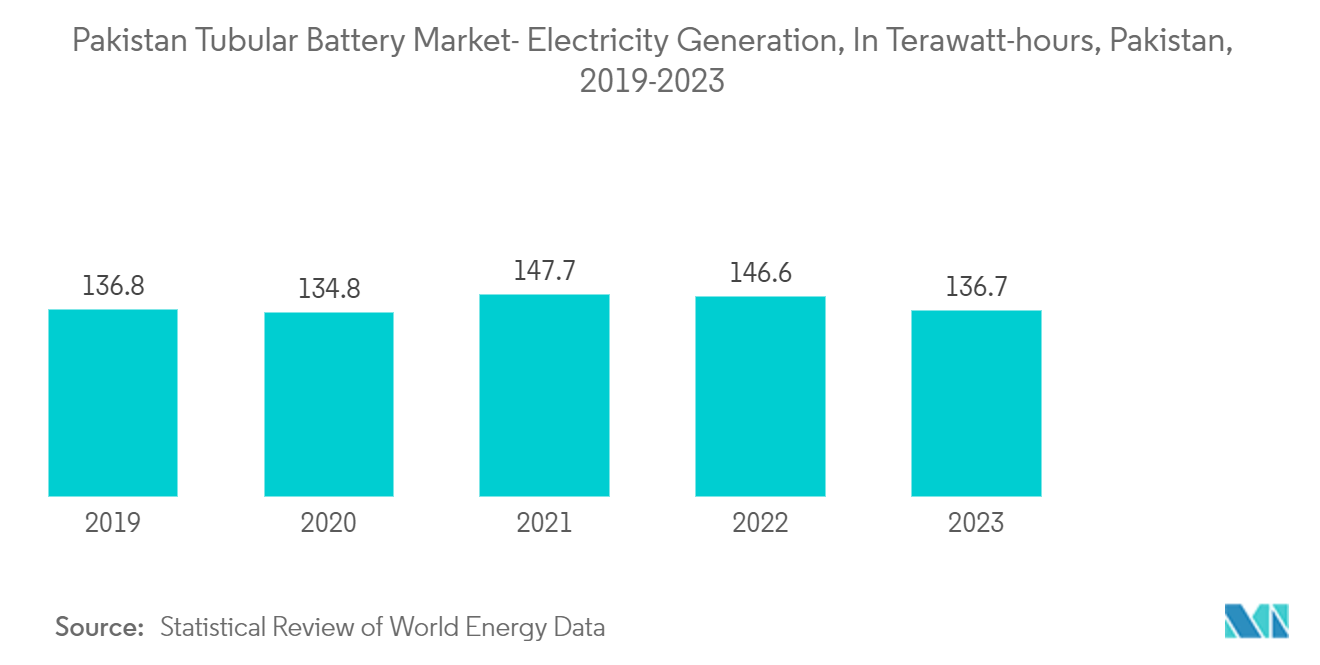
- Pakistan is experiencing a substantial deficit in electricity supply. According to the Energy Institute Statistical Review of World Energy, the electricity supply experienced a shortfall of 6.7% from 146.6 TWh in 2022 to 136.7 TWh in 2023. As a result of the current deficit, power cuts have become increasingly common nationwide. Rural regions undergo 8 to 10 hours of outages, urban areas experience approximately 6 hours, and locations with high line losses endure 12 to 14 hours of interruptions. Such power outages are likely to raise the demand for alternative power sources like renewable energy and increase demand for tubular batteries in the coming years.
- Additionally, off-grid solar systems offer a promising solution in Pakistan, wherein sunlight is abundant, and energy access can be challenging, especially in remote areas and agricultural setups. These systems have numerous benefits, including installing off-grid solar systems that free users from relying on the national electricity grid, allowing them to generate their own electricity and become self-sufficient.
- Moreover, manufacturers in Pakistan are incorporating advanced safety features into tubular batteries to enhance renewable energy storage capability, such as improved venting mechanisms and short-circuit protection, to enhance user safety and protect the battery from damage. For instance, as of 2023, Fuze’s tubular batteries stood out due to their latest technological advancements tailored for storage use. Overall, the increasing technological innovation in tubular batteries is expected to be a vital opportunity for the growth of the Pakistani tubular battery market in the renewable energy industry during the forecast period.
Competitive Landscape
The Pakistani tubular batteries market is moderated. Some of the key players (not in particular order) are Exide Pakistan Limited, Hyundai Batteries, Pakistan Accumulators (Pvt.) Ltd, Zhejiang Narada Power Source Co. Ltd, and Treet Corporation Limited.
Pakistan Tubular Battery Industry Leaders
-
Exide Pakistan Limited
-
Hyundai Batteries
-
Pakistan Accumulators (PVT.) Ltd
-
Zhejiang Narada Power Source Co. Ltd
-
Treet Corporation Limited
- *Disclaimer: Major Players sorted in no particular order
Recent Industry Developments
- May 2024: Oracle Power, an international project developer, and China Electric Power Equipment and Technology collaborated to develop and construct a 1.3GW project in Pakistan that combines solar, wind, and battery energy storage system (BESS) technology. Tubular batteries are a significant part of this project. Therefore, such developments are expected to boost the demand for tubular batteries in Pakistan.
- April 2024: Treet Battery Ltd, a Pakistan-based lead-acid battery manufacturer, entered a joint venture with Hexing Energy (Private) Limited, a subsidiary of Hexing Electrical Co. Ltd. Such developments are expected to boost the demand for lead-acid batteries, including tubular batteries, especially in the solar energy industry.
Pakistan Tubular Battery Market Report Scope
A tubular battery is an excellent inverter for areas with extended and irregular power cuts. It is suggested for individuals with large residences. This type of battery has a complex design and extended lifespan (6 to 12 months, as per supplier responses received). It is most suitable for long backups and heavy application usage.
The Pakistani tubular batteries market is segmented into application. By application, the market is segmented into data centers, renewable energy, and other applications (automotive, industrial, etc.). The report offers the market size and forecasts in revenue (USD) for all the above segments.
Key Questions Answered in the Report
How big is the Pakistan Tubular Battery Market?
The Pakistan Tubular Battery Market size is expected to reach USD 84.34 million in 2025 and grow at a CAGR of 10.35% to reach USD 138.01 million by 2030.
What is the current Pakistan Tubular Battery Market size?
In 2025, the Pakistan Tubular Battery Market size is expected to reach USD 84.34 million.
Who are the key players in Pakistan Tubular Battery Market?
Exide Pakistan Limited, Hyundai Batteries, Pakistan Accumulators (PVT.) Ltd, Zhejiang Narada Power Source Co. Ltd and Treet Corporation Limited are the major companies operating in the Pakistan Tubular Battery Market.
What years does this Pakistan Tubular Battery Market cover, and what was the market size in 2024?
In 2024, the Pakistan Tubular Battery Market size was estimated at USD 75.61 million. The report covers the Pakistan Tubular Battery Market historical market size for years: 2019, 2020, 2021, 2022, 2023 and 2024. The report also forecasts the Pakistan Tubular Battery Market size for years: 2025, 2026, 2027, 2028, 2029 and 2030.
Pakistan Tubular Battery Market Report
Statistics for the 2025 Pakistan Tubular Battery market share, size and revenue growth rate, created by Mordor Intelligence™ Industry Reports. Pakistan Tubular Battery analysis includes a market forecast outlook for 2025 to 2030 and historical overview. Get a sample of this industry analysis as a free report PDF download.