
Market Overview
| Study Period | 2021 - 2031 |
|---|---|
| Forecast Data Period | 2026 - 2031 |
| Base Year Market Size (2025) | USD 3.40 Billion |
| Market Size (2026) | USD 3.59 Billion |
| Market Size (2031) | USD 4.78 Billion |
| Growth Rate (2026 - 2031) | 5.85 % |
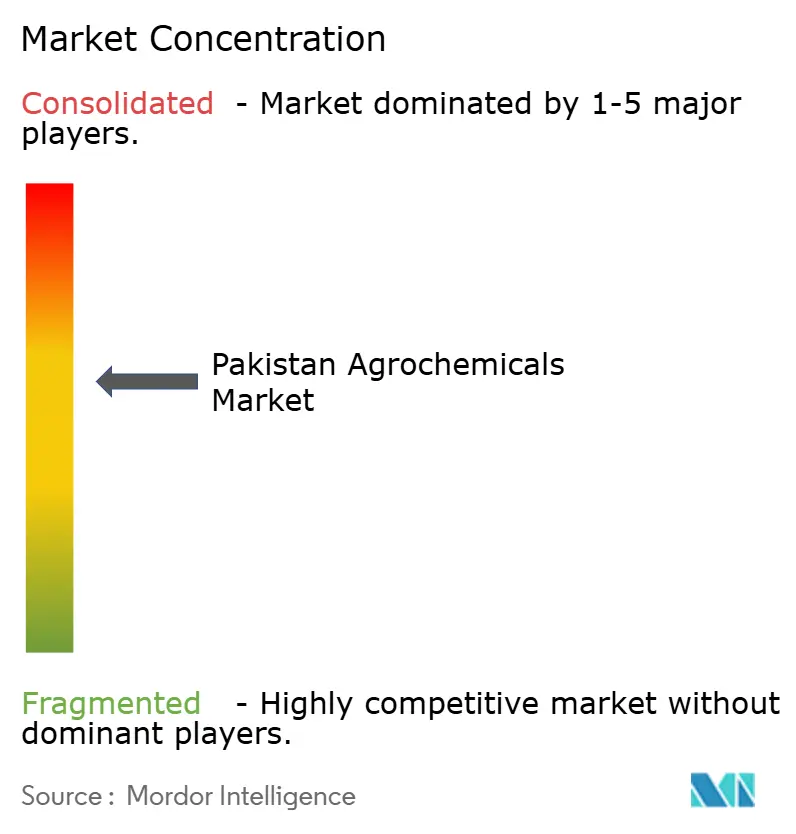
| Market Concentration | Medium |
Major Players *Disclaimer: Major Players sorted in no particular order Image © Mordor Intelligence. Reuse requires attribution under CC BY 4.0. | |
Pakistan Agrochemicals Market Analysis by Mordor Intelligence
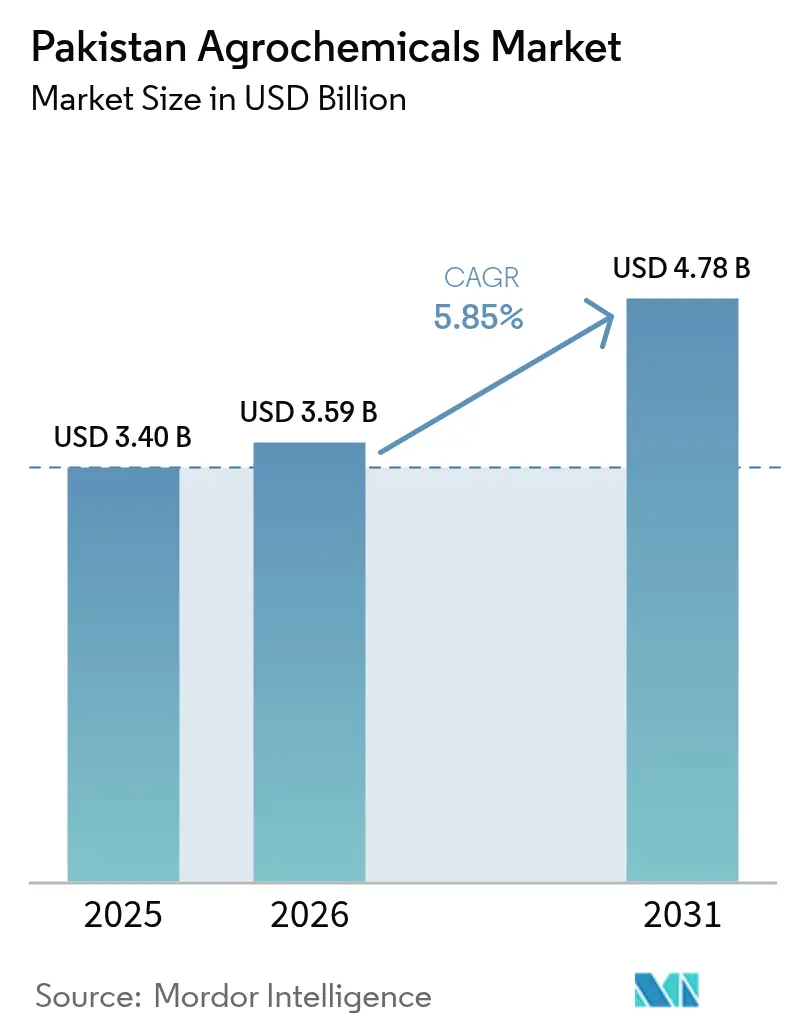
Pakistan agrochemicals market size in 2026 is estimated at USD 3.59 billion, growing from 2025 value of USD 3.40 billion with 2031 projections showing USD 4.78 billion, growing at 5.85% CAGR over 2026-2031. Changes in fertilizer usage, adoption of efficient irrigation systems, and digital agriculture platforms are transforming farming practices. Frequent pest outbreaks maintain the demand for crop protection products. Government subsidies support smallholder farmers' purchasing ability for agricultural inputs, while companies increase investments in contract farming and advisory services. For instance, in 2021, the government introduced the Kisaan Card Programme, which directly subsidizes pesticides for farmers. This program is a segment of a larger effort to dispense USD 0.061 billion in direct subsidies to farmers. Online sales channels are gaining market share from traditional retail stores by offering transparent prices and quicker delivery.
Key Report Takeaways
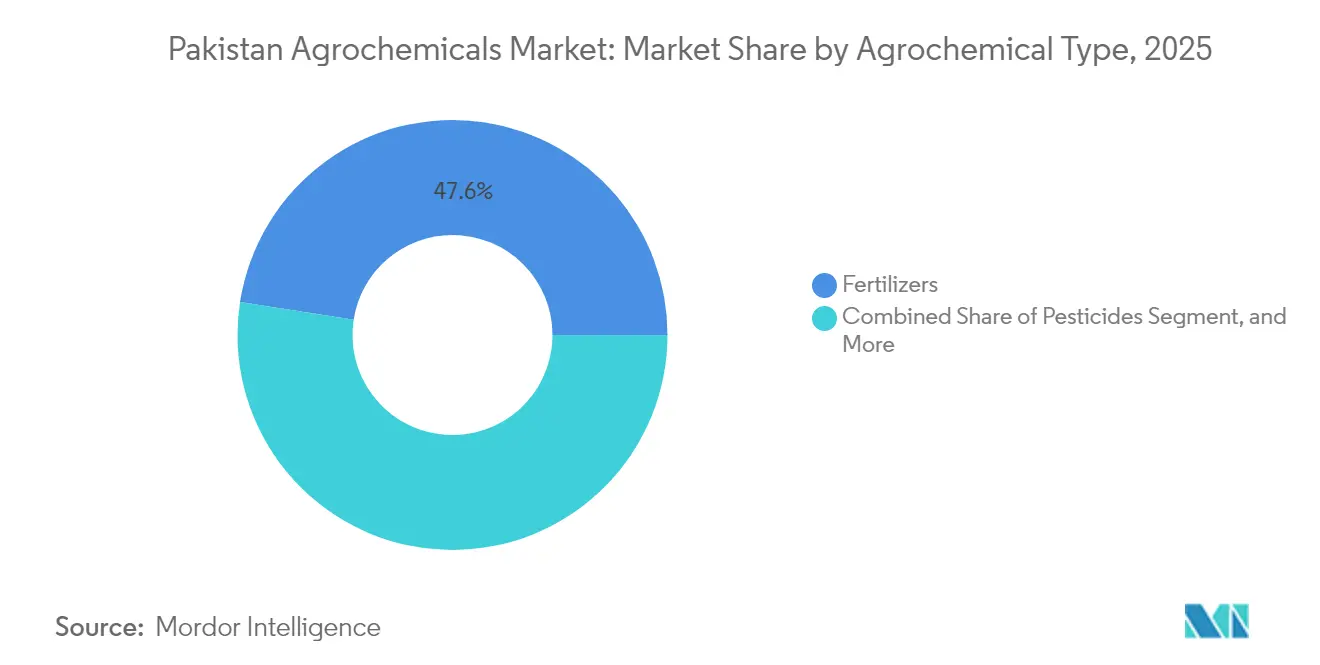
- By agrochemical type, fertilizers dominate the Pakistan agrochemicals market share, accounting for 47.55% in 2025, while pesticides are growing at the fastest rate, with a 6.28% CAGR through 2031.
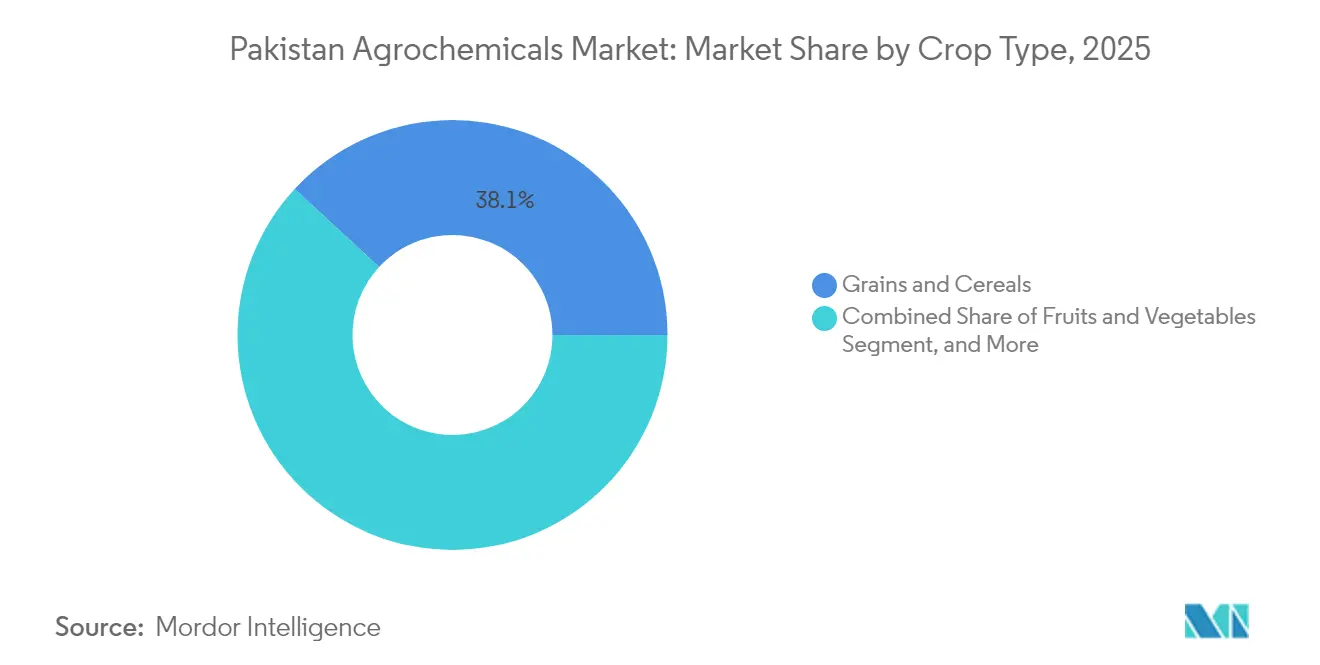
- By crop, grains and cereals accounted for a 38.12% share of the Pakistan agrochemicals market size in 2025, and fruits and vegetables are advancing at a 5.32% CAGR through 2031.
Note: Market size and forecast figures in this report are generated using Mordor Intelligence’s proprietary estimation framework, updated with the latest available data and insights as of 2026.
Pakistan Agrochemicals Market Trends and Insights
Drivers Impact Analysis*
| Driver | (~) % Impact on CAGR Forecast | Geographic Relevance | Impact Timeline |
|---|---|---|---|
| Recurring Pest and Disease Outbreaks | +1.2% | Punjab and Sindh cotton belts | Short term (≤ 2 years) |
| Rising Food Security Pressure and the Yield Gap | +1.8% | National wheat and rice zones | Medium term (2-4 years) |
| Government Fertilizer Subsidy Realignment | +1.0% | National smallholder segments | Medium term (2-4 years) |
| Expansion of High Efficiency Irrigation Systems | +0.8% | Punjab, Sindh, and extending to Balochistan | Long term (≥ 4 years) |
| Growth of Contract Farming and Agricultural Services | +0.9% | Commercial crop areas nationwide | Medium term (2-4 years) |
| Integration of Digital Agronomy Platforms | +0.6% | Progressive districts nationwide | Long term (≥ 4 years) |
| Source: Mordor Intelligence | |||
Recurring Pest and Disease Outbreaks
Frequent outbreaks of crop-damaging pests and diseases have increased insecticide and fungicide usage across major agricultural regions. Cotton, rice, and fruit crops have experienced significant losses, compelling farmers to implement intensive protection measures.[1]Source: U.S. Department of Commerce, “Pakistan: Demand Grows for Insecticides, Pesticides,” commerce.gov In June 2025, mango orchards in Sindh faced severe malformation and hopper infestations, while September 2023 saw whitefly attacks devastate cotton fields in Punjab. Export-related chemical residue regulations have driven manufacturers to develop precise, cleaner formulations. Extended pest breeding seasons due to higher temperatures necessitate multiple treatments, particularly in high-value orchards. These shifting dynamics are prompting greater investment in scouting technologies and predictive pest modeling to optimize spray timing. Additionally, growers are increasingly adopting rotation strategies and integrated pest management to reduce dependency on chemical interventions while maintaining crop health.
Rising Food Security Pressure and the Yield Gap
Pakistan's agricultural sector must address yield gaps to ensure food security. Wheat and rice yields remain below global standards, increasing the need for enhanced nutrient inputs and crop protection methods. Government programs promote balanced fertilization and integrated pest management through focused farmer support initiatives. Quality maintenance has become crucial as export volumes increase, particularly for rice and cotton. Farmers show increased interest in specialty nutrients like zinc and boron, demonstrating greater awareness of soil health and testing requirements. To further support productivity, agricultural extension services are expanding mobile advisory platforms that deliver region-specific guidance on input use, pest control, and irrigation scheduling directly to farmers.
Government Fertilizer Subsidy Realignment
The fertilizer subsidy system has transformed through digital platform implementation, improving targeting accuracy and reducing distribution inefficiencies. Domestic fertilizer manufacturers maintain stable production through consistent input supply. In October 2024, Pakistan's government collaborated with Engro Fertilizers to launch the UgAi app, a digital agri-commerce platform enabling farmers to purchase fertilizers directly at official prices, access satellite crop monitoring, and receive tailored recommendations. Current policies promote advanced formulations and precision agriculture methods, shifting from conventional broad application approaches. Site-specific blends and micronutrient-enhanced products have gained importance in the market. These modernization efforts support efficient nutrient utilization, higher crop yields, and lower environmental impact.
Expansion of High Efficiency Irrigation Systems
Modern irrigation technology adoption is changing agricultural water management practices. Drip and sprinkler systems demonstrate economic benefits, particularly in water-scarce areas.[2]Source: Amar Razzaq et al., “An Economic Analysis of High Efficiency Irrigation Systems in Punjab, Pakistan,” Sarhad Journal of Agriculture, researcherslinks.com These systems enable precise fertilizer and pesticide application through fertigation. Large farms are investing in advanced irrigation infrastructure, including moisture sensors and automated chemigation systems, driven by government incentives and increased water costs. This technological advancement improves input efficiency and crop productivity while minimizing waste. Farmers are integrating mobile-controlled irrigation platforms that allow real-time adjustments based on weather forecasts and soil data, further enhancing resource conservation and operational flexibility.
Restraints Impact Analysis*
| Restraint | (~) % Impact on CAGR Forecast | Geographic Relevance | Impact Timeline |
|---|---|---|---|
| Escalating Environmental Compliance Costs | -0.8% | Export-oriented provinces | Short term (≤ 2 years) |
| Mounting Antimicrobial Resistance Concerns | -0.6% | Integrated crop-livestock systems | Medium term (2-4 years) |
| Export Restrictions on Key Ingredients | -0.5% | Import-dependent producers | Short term (≤ 2 years) |
| Smallholder Affordability Constraints | -0.9% | Rain-fed and marginal zones | Long term (≥ 4 years) |
| Source: Mordor Intelligence | |||
Escalating Environmental Compliance Costs
Enhanced environmental regulations require pesticide companies to modify product formulations and restrict specific active ingredients. Additional compliance requirements stem from international agreements and trade protocols, particularly regarding residue limits and prohibited substances. These requirements increase operational expenses and benefit companies with established quality control systems. Testing and certification requirements challenge smaller companies, resulting in industry consolidation. The demand for environmentally safe inputs influences farming methods, with increased adoption of safer alternatives and precise application techniques.
Mounting Antimicrobial Resistance Concerns
The increasing concerns about antimicrobial resistance have led to stricter regulatory oversight in Pakistan's agrochemical market. The regulatory authorities now mandate comprehensive documentation for pesticide usage, with specific restrictions on broad-spectrum chemicals in sensitive applications.[3]Source: Khyber Pakhtunkhwa Agriculture Extension, “Plant Protection,” agriext.kp.gov.pk These regulatory requirements create compliance challenges for producers and distributors, particularly those serving export markets with strict pesticide residue standards. While the transition to responsible chemical management is necessary, it increases operational complexities and drives companies to implement targeted crop protection approaches.
*Our forecasts treat driver/restraint impacts as directional, not additive. The impact forecasts reflect baseline growth, mix effects, and variable interactions.
Segment Analysis
By Agrochemical Type: Fertilizers Retain Scale while Pesticides Surge
Fertilizers held 47.55% of the Pakistan agrochemicals market size in 2025, maintaining dominance due to the nutrient requirements of wheat and rice cultivation. These crops depend on nitrogenous inputs like urea and ammonium, while phosphatic fertilizers maintain steady demand in cotton and sugarcane production. Potassium-based products are increasing in usage as soil testing reveals deficiencies. Micronutrients, particularly zinc and boron, are seeing increased adoption among farmers focused on improving yields and crop resilience.
Pesticides are experiencing the highest growth at a 6.28% CAGR, driven by increased pest challenges and export quality standards. Herbicide use is increasing in mechanized cereal farming due to labor shortages. Fungicide application is growing in fruit cultivation, especially in citrus and mango orchards, targeting exports. Plant growth regulators and spray adjuvants are seeing increased adoption alongside precision spraying equipment that enables efficient application rates.



By Crop Type: Cereal Core, Horticulture Accelerator
Grains and cereals consumed 38.12% of the Pakistan agrochemicals market share in 2025, reflecting Pakistan's focus on wheat and rice production. These crops require substantial fertilizer and herbicide inputs, particularly in mechanized farming areas. Cotton and sugarcane maintain significant demand for phosphatic and nitrogenous fertilizers. Pulses and oilseeds are receiving increased policy support, driving demand for micronutrient blends and selective herbicides.
The fruits and vegetables segment is growing at a 5.32% CAGR, driven by export markets and domestic consumption patterns. These crops require specific fungicides and pesticides to meet quality standards. Commercial orchards are implementing professional spray services and strict harvest protocols, increasing demand for high-quality inputs. The turf and ornamental segment remains profitable despite its smaller size, supported by urban development.
Geography Analysis
Punjab leads the Pakistan agrochemicals market due to its extensive irrigated cultivation of wheat, rice, and cotton. The region's dual crop cycles create high demand for nitrogen fertilizers and require multiple pesticide applications. Sindh ranks second, where cotton and sugarcane farming face salinity and pest issues, driving consistent demand for micronutrients and insecticides. Khyber Pakhtunkhwa's high-altitude fruit and vegetable production requires specialized disease management and fertigation-compatible nutrients. Balochistan shows growth potential as canal expansion and corporate farming initiatives increase agrochemical usage.
Punjab and Sindh implement strict residue testing protocols due to their export focus, encouraging farmers to use low-residue formulations. Water accessibility influences input selection, with canal-fed areas preferring quick-release urea, while rain-fed regions use slow-release and drought-tolerant products. Climate changes affect pest patterns across provinces, extending infestation periods and increasing the need for adaptable pesticide formulations.
Central Punjab's infrastructure supports digital scouting tools and drone spraying implementation, advancing precision agriculture adoption. Northern regions' challenging terrain limits mechanization, maintaining demand for small-pack pesticides for manual application. The agricultural industrial park in Sindh improves logistics efficiency, reducing delivery times to southern farmers and expanding market reach. These geographic factors influence agrochemical distribution, adoption, and regulation throughout Pakistan.
Regulatory Landscape
Pakistan’s agrochemical regulation for pesticides is anchored in the Agricultural Pesticides Ordinance (APO), 1971, and the Consolidated Agricultural Pesticides Rules, 1973. The Department of Plant Protection (DPP) under the Ministry of National Food Security and Research acts as the federal authority for registration, import permissions, and compliance, while provincial agriculture departments enforce use-level controls following devolution. This creates a dual-layer system that affects product stewardship, inspections, and retail oversight across provinces.
Recent tightening has raised compliance and documentation thresholds for registrants. SRO 231(I)/2024 (dated 21-02-2024) introduced mandatory international accreditation or Apostille certification for pesticide registration data, and it also set out a clearer registration pathway for biopesticides aligned with FAO codes of conduct. In March 2025, the government enforced a complete ban on 12 toxic pesticides to align with environmental and trade standards. In February 2026, Ministry of National Food Security and Research public statements highlighted full digitalization of pesticide registration to improve transparency and processing efficiency, with import and export processing also being streamlined through online systems such as the Pakistan Single Window interfaces used for related permissions and certificates.
Competitive Landscape
The Pakistan agrochemicals market is moderately consolidated, with five major companies controlling a substantial portion of industry revenue. Bayer AG holds a prominent position through its broad-spectrum herbicides and fungicides that meet residue compliance standards. Syngenta Group maintains a strong presence with integrated seed treatment solutions and foliar protection programs targeting commercial and export-oriented growers. UPL Limited has established its market presence through post-patent actives, while domestic companies Engro Corporation and Evyol Group are expanding from nitrogen fertilizers to micronutrient blends.
The industry shows significant movement toward vertical integration and operational expansion. Bayer AG partners with local service providers to develop drone-ready formulations for improved field application efficiency. Syngenta Group has invested in a Punjab-based residue-testing facility to support export compliance and orchard crop management. Engro Corporation is developing new product lines and distribution methods to expand its specialty inputs presence. The industry structure may shift as domestic fertilizer companies engage in merger discussions, potentially affecting capacity use and market prices.
Companies are developing reduced-risk chemical solutions to address regulatory requirements. Syngenta Group continues to expand its digital platform, providing satellite imagery and agronomic guidance that combines crop protection with precision farming. BASF SE, Corteva Agriscience, and FMC Corporation maintain market presence by introducing new technologies and stewardship programs that focus on grower relationships and regulatory compliance. These firms are also investing in localized field trials to tailor product performance to Pakistan’s diverse agro-climatic zones. Collaborative training initiatives with extension services are helping farmers adopt safer application practices and improve agrochemicals efficiency.
Pakistan Agrochemicals Industry Leaders
BASF SE
FMC Corporation
Syngenta Group
UPL Limited
Bayer AG
- *Disclaimer: Major Players sorted in no particular order

Market Opportunities and Future Outlook
Opportunities in Pakistan agrochemicals are concentrated around formalized compliance, traceability, and higher-value formulations for export-oriented grains, cotton, and horticulture. The regulatory direction under SRO 231(I)/2024 (Apostille/international accreditation for registration dossiers and a defined biopesticide pathway), together with the March 2025 ban on 12 toxic pesticides, creates room for reduced-risk crop protection portfolios, residue-compliant programs, and biopesticides that fit the DPP registration track. The Punjab Agriculture, Food and Drug Authority Act 2025 adds a provincial testing and forensic capacity layer for fertilizers and pesticides, increasing the importance of quality assurance, authenticated distribution, and data-backed claims for both local manufacturers and importers.
On fertilizers, domestic specialization is visible in potash and micronutrient-linked strategies that reduce import reliance and address soil and crop needs, especially for chloride-sensitive and high-value crops. Barket Fertilizer commissioned a fourth production unit at Port Muhammad Bin Qasim in September 2025, adding 15,500 tons per year of sulfate of potash (SOP), and it communicated a move toward 64,500 tons per year capacity by end of Q1 2026. In parallel, digitized input access programs and platforms cited in the market context, including the UgAi app launched with Engro Fertilizers in October 2024 and subsidy delivery through the Kisaan Card program, support more transparent pricing and targeted product placement. This enables companies to bundle advisory services with specialty nutrients, fertigation-compatible products, and crop protection programs where pest pressure and export compliance shape on-farm decisions.
Recent Industry Developments
- January 2026: Syngenta Group CEO Jeff Rowe met Pakistan’s Finance Minister Senator Muhammad Aurangzeb at the World Economic Forum in Davos to discuss agricultural priorities and investment opportunities. The engagement signaled continued top-level focus on Pakistan within global agribusiness portfolios and kept attention on reforms and enabling conditions that shape input supply and technology deployment.
- June 2025: Bayer Pakistan (Pvt) Limited entered a strategic partnership with HBL Zarai Services Limited (HZSL) to improve smallholder access to crop protection products and seeds. The collaboration strengthened last-mile reach through an established agri-finance and service channel, supporting more structured distribution and advisory-linked selling in key farming districts.
- April 2024: Fauji Fertilizer Company (FFC) introduced Sona Boron DAP, described as Pakistan’s first boron-enriched DAP fertilizer, targeting micronutrient deficiency management. The launch expanded the availability of value-added, micronutrient-enhanced fertilizers and reinforced the shift from commodity fertilizers toward differentiated nutrient solutions aligned with soil health initiatives.


Research Methodology Framework and Report Scope
Market Definition and Coverage
For this study, the Pakistan agrochemicals market is defined as the value of crop protection products used to prevent crop loss from insects, weeds, and diseases, as sold for use in Pakistan across farm and commercial growing practices.
Scope exclusions: This sizing does not treat fertilizers, seeds, farm machinery, or irrigation inputs as part of this market.
Segmentation Overview
- By Agrochemical Type
- Fertilizers
- Nitrogenous
- Phosphatic
- Potassic
- Other Fertilizers (Calcium, Sulfur, Magnesium)
- Pesticides
- Herbicides
- Insecticides
- Fungicides
- Other Pesticides
- Adjuvants
- Plant Growth Regulators
- Fertilizers
- By Crop Type
- Grains and Cereals
- Pulses and Oilseeds
- Fruits and Vegetables
- Commercial Cash Crops (Cotton, Sugarcane)
- Turf and Ornamental
Data Sources, Market Sizing, and Validation
Desk Research
Desk research starts by building a fact base for Pakistan agriculture and crop protection demand drivers, and then it is used to sanity check the model outputs. We primarily lean on public sources such as Pakistan Bureau of Statistics releases, Ministry of National Food Security and Research publications, FAOSTAT crop area and yield tables, UN Comtrade trade statistics, and pesticide registration and related notifications from relevant national regulators.
In addition, company annual reports, investor presentations, and reputable press are reviewed to understand product mix shifts and pricing direction for commonly used chemistries. Where needed, we also use paid subscriptions for company financials and intelligence, patent databases, and shipment level import or export datasets to cross-verify trade flows and active ingredient trends. These sources are illustrative, and many other public and paid references were also consulted for data collection, validation, and clarification.
Primary Interviews and Surveys
Our Pakistan fieldwork includes interviews and surveys with agrochemical distributors, importers, formulators, agronomists, channel participants, and farm-input managers. Respondents help test secondary data, clarify informal trade and product use, and assess price, volume, crop, and regulatory assumptions before the market model is finalized.
Distribution of primary research fieldwork respondents
| Company type | Respondent position |
|---|---|
| Top tier: 30% | CXOs: 15% |
| Mid tier: 50% | Functional/Unit leaders: 30% |
| Smaller Players: 20% | Managers: 55% |
Market-Sizing & Forecasting
The sizing is built using a top-down approach where crop area, crop mix, and typical treatment intensity are used to reconstruct the addressable demand pool for crop protection in Pakistan, and then it is converted into value using category level pricing. Once the first totals are formed, they are checked with selective bottom-up approximations such as sampled price points across channels, importer and distributor throughput checks, and limited roll ups from available supplier disclosures.
Key inputs used in the model include cropped area trends for major crop groups, seasonal pest and disease pressure, changes in planting and harvesting cycles, import dependence for active ingredients and intermediates, and shifts in average selling prices caused by formulation mix and currency movement. When a variable is weak in one year, the gap is handled by carrying forward validated ratios (like dosage per hectare) and then re-basing the value using the latest verified price points. For forecasting, scenario analysis is used so demand, pricing, and adoption can be flexed within realistic bounds agreed during expert discussions, and the final curve is reviewed for consistency with expected crop production direction and affordability signals.
Data Validation & Update Cycle
Outputs are validated through triangulation across independent signals, and then variance checks are run so the model does not drift away from what trade, cropping, and pricing indicators can support. We also re-check outliers at the category level, and a second analyst review is completed before sign-off so calculation logic and assumptions remain consistent.
The report is refreshed annually, and interim updates are triggered when material events occur, such as major policy actions, sharp currency moves, or supply disruptions that can change pricing quickly. Before delivery, a final pass is completed so clients receive an updated view that aligns with the latest available public data and confirmed field feedback.
Mordor Intelligence's Pakistan Agrochemicals Market Size Measured Against Other Published Estimates
Published market numbers for Pakistan agrochemicals can look far apart, even when the topic label sounds the same. This usually happens because firms include different product buckets, treat trade and channel markups differently, and use different base years and currency timing.
Key gap drivers in this market are whether the estimate is limited to crop protection only or it adds adjacent inputs like fertilizers, how average selling prices are stepped forward during volatile FX periods, and whether demand is anchored to treated crop area versus broad agriculture spending. A second difference comes from refresh cadence, where older base years can miss recent price resets and changes in import availability.
Benchmark comparison
| Source | Market Size | Gaps in Research Methodology |
|---|---|---|
| Mordor Intelligence | USD 3.40 B (2025) | |
| Global Consultancy A | USD 1.60 B (2024) | This figure appears to use a broader agro-input scope that commonly includes fertilizers and plant growth regulators, which inflates definition coverage while using an earlier base year that can miss later pricing shifts. |
| Industry Publisher B | USD 0.30 B (2022) | This estimate aligns more with a narrow crop protection chemicals view and may rely on a tighter set of product types and older pricing, which can understate current value when import costs and formulation mix have moved. |
The table shows a wide spread, and in Mordor Intelligence's model the value is tied to crop protection pesticides used in Pakistan (by origin, type, and application) rather than folding in fertilizer spend or other adjacent farm inputs. When the scope is kept consistent and then checked against crop area signals, trade movement, and channel pricing feedback, the final number becomes easier to trace and repeat year after year.


Key Questions Answered in the Report
How large is the Pakistan agrochemicals market in 2026?
The Pakistan agrochemicals market size is at USD 3.59 billion in 2026 and is growing at a 5.85% CAGR toward USD 4.78 billion in 2031.
Which segment is growing quickest within the Pakistan agrochemicals market?
Pesticides are advancing at a 6.28% CAGR, the fastest among all major segments.
How concentrated is competition?
The Pakistan agrochemicals market exhibits moderate consolidation, with the top five companies capturing a substantial portion of industry revenue.
What policy measure supports smallholder input buying?
The Kisaan Card channels targeted subsidies directly to farmers, improving access to fertilizers and crop protection products.
Page last updated on:





