
Optical Transponder Market Size and Share
Market Overview
| Study Period | 2020 - 2031 |
|---|---|
| Market Size (2026) | USD 8.92 Billion |
| Market Size (2031) | USD 13.65 Billion |
| Growth Rate (2026 - 2031) | 8.88 % |
| Fastest Growing Market | Asia-Pacific |
| Largest Market | North America |
| Market Concentration | Medium |
Major Players *Disclaimer: Major Players sorted in no particular order Image © Mordor Intelligence. Reuse requires attribution under CC BY 4.0. | |
Optical Transponder Market Analysis by Mordor Intelligence
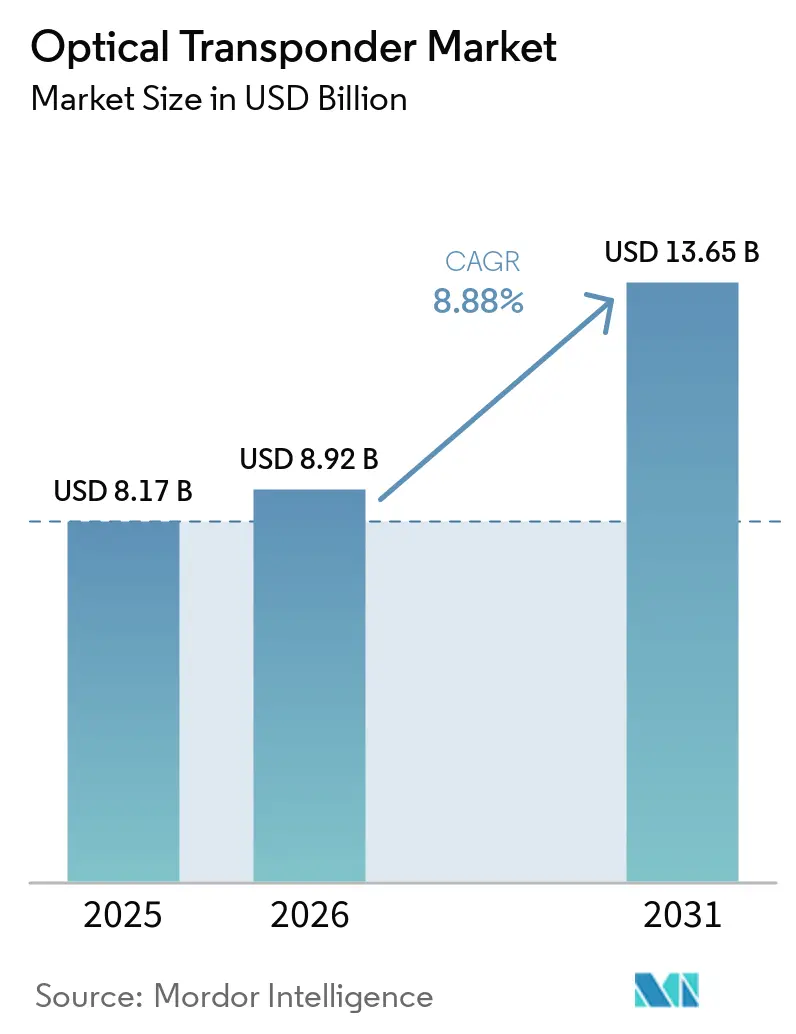
The Optical Transponder Market size is expected to grow from USD 8.17 billion in 2025 to USD 8.92 billion in 2026, and is forecast to reach USD 13.65 billion by 2031, at an 8.88% CAGR over 2026-2031. Artificial intelligence infrastructure is increasing traffic between data centers and is raising requirements for high-capacity optical links. The replacement of 100G systems with 400G, 800G, and 1.6T platforms is also supporting equipment demand. Submarine cable investment is creating additional requirements for shore-end DWDM equipment and transponder upgrades at new system landings, extending demand beyond short-lived data center construction cycles. Direct procurement by cloud providers is changing vendor relationships, while component supply constraints and in-house hyperscaler designs remain limiting factors for system vendors, module suppliers, and network operators. The optical transponder market, therefore, depends on suppliers that can support large web-scale deployments, established carrier networks, complex product qualification, and reliable component availability across increasingly constrained, highly global, and interconnected supply chains.
Key Report Takeaways
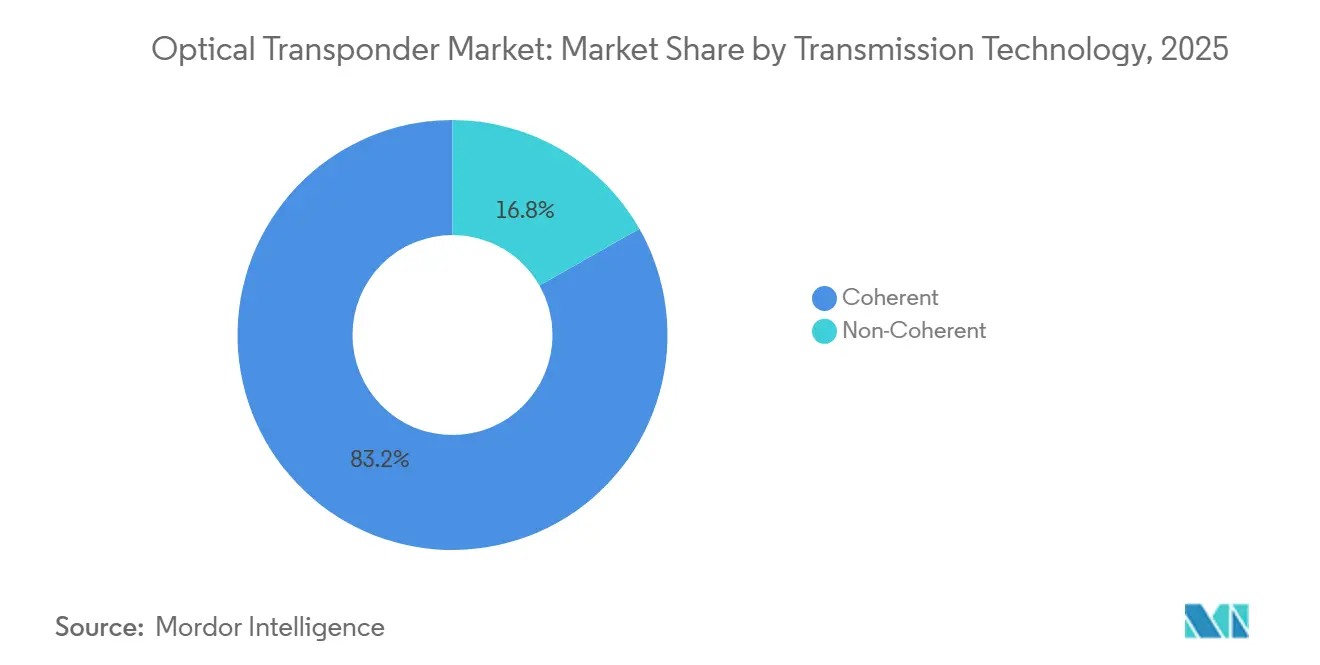
- By transmission technology, coherent transponders held 83.22% of the Optical Transponder Market share in 2025 and are projected to expand at a 9.65% CAGR through 2031.
- By data rate, the 100-400 Gbps tier accounted for 44.98% of the optical transponder market share in 2025, while the above-800 Gbps tier is projected to expand at a 12.21% CAGR through 2031.
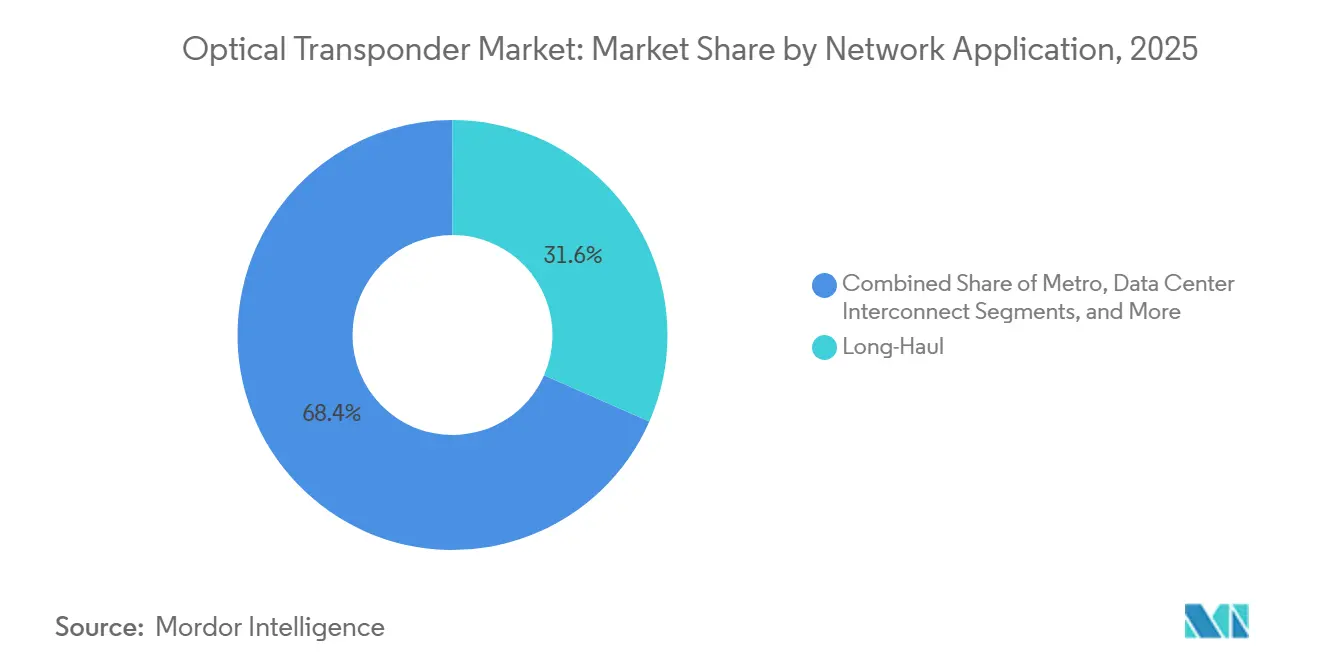
- By network application, long-haul networks held 31.58% of the optical transponder market share in 2025, while data center interconnect is expected to expand at an 11.31% CAGR through 2031.
- By end-user, telecommunication service providers held 57.89% of the optical transponder market share in 2025, while cloud and hyperscale data center operators are projected to expand at an 11.77% CAGR through 2031.
- By geography, North America held 35.98% of the optical transponder market share in 2025, while Asia-Pacific is projected to expand at a 10.58% CAGR through 2031.
Note: Market size and forecast figures in this report are generated using Mordor Intelligence’s proprietary estimation framework, updated with the latest available data and insights as of January 2026.
Global Optical Transponder Market Trends and Insights
Drivers Impact Analysis*
| Driver | (~) % Impact on CAGR Forecast | Geographic Relevance | Impact Timeline |
|---|---|---|---|
| AI Cluster and Hyperscale Data Center Interconnect Expansion | +2.8% | Global | Short term (≤ 2 years) |
| Migration from 100G to 400G, 800G, and 1.6T | +2.2% | Global | Medium term (2-4 years) |
| 5G Backhaul and Broadband Fiber Modernization | +1.3% | Asia-Pacific, North America, and Europe | Medium term (2-4 years) |
| Open and Disaggregated Optical Networking Adoption | +0.9% | North America and Europe | Long term (≥ 4 years) |
| Submarine Cable Buildout and Transoceanic Capacity Demand | +0.7% | Asia-Pacific and Global | Medium term (2-4 years) |
| Energy-Efficient Capacity Scaling per Fiber Pair | +0.5% | Global | Long term (≥ 4 years) |
| Source: Mordor Intelligence | |||
AI Cluster and Hyperscale Data Center Interconnect Expansion
AI training and inference workloads require many GPU-to-GPU connections to operate at full line rates. Copper alternatives cannot meet the required distance, throughput, and latency needs beyond short links. Cloud providers are redesigning links between nearby campuses to use 400G ZR and 800G ZR+ coherent pluggables, rather than simply adding ports to conventional transport architectures designed for earlier traffic patterns. This is creating a distinct demand category for the optical transponder market because these buyers procure equipment directly, set demanding technical requirements, and expect suppliers to align platforms with fast deployment schedules. Alphabet, Amazon, Meta, and Microsoft are directing major 2026 infrastructure spending toward AI capacity. NVIDIA announced a multiyear agreement with Coherent Corp. in March 2026, including a USD 2 billion equity investment and a purchase commitment for advanced optical products.[1]NVIDIA Corporation, “NVIDIA and Coherent Announce Strategic Partnership to Develop Optics Technology to Scale Next-Generation Data Center Architecture,” NVIDIA, investor.nvidia.com
Migration From 100G to 400G, 800G, and 1.6T
The transition to higher line rates changes the digital signal processor, modulation format, spectral efficiency target, and system integration approach at each generation, making it a broad architectural change rather than a routine equipment refresh. IEEE Std 802.3df-2024, approved in February 2024, established an 800G Ethernet framework that supported vendor qualification through 2025.[2]IEEE Standards Association, “IEEE Std 802.3df-2024,” IEEE Standards Association, standards.ieee.org Early 1.6T OSFP224 modules are shipping in volume in 2026 before the completion of IEEE P802.3dj. Each new coherent DSP generation requires 12-24 months of carrier and hyperscaler qualification before commercial volumes begin, as buyers evaluate reliability, interoperability, power use, and performance under operating conditions. This timeline means that technical introductions can produce meaningful revenue two to three years later. Marvell introduced COLORZ 1600 using its Electra 2 nm coherent DSP, while Ciena introduced a 2 nm silicon-designed 1600ZR/ZR+ pluggable in 2026.
5G Backhaul and Broadband Fiber Modernization
5G transport is extending optical upgrades beyond the radio access network into aggregation, regional transport, and long-haul layers, where each part of the network must accommodate higher volumes of mobile data. Dense urban small-cell deployments are using 100 Gbps wavelengths for new macro sites. Aggregated traffic from standalone 5G networks is raising peak-hour requirements above 25 Gbps per aggregation node. Microwave links cannot support this load and require fiber and coherent optical upgrades through regional and long-haul networks, linking access investments to broader transport capacity planning. China Mobile allocated USD 8.2 billion to fiber transport in its 2025 budget. Lightpath announced in May 2026 that it was connecting more than 2,400 macro cell tower locations across New York, Connecticut, Massachusetts, and New Jersey with 100 Gbps and 400 Gbps links.[3]Lightpath, “Lightpath Expands Its Dense NYC Metropolitan Fiber Infrastructure Network to Support Major National Wireless Service Providers Across More Than 2,400 Macro Cell Tower Locations,” GlobeNewswire, investor.wedbush.com
Open and Disaggregated Optical Networking Adoption
Open optical networking allows operators to buy transponders and optical line systems separately. This approach reduces dependence on a single system supplier and expands addressable opportunities for specialized vendors, while giving sophisticated buyers more control over component selection and network architecture. OpenROADM MSA released model version 19.0.0 in May 2026, its tenth release since January 2024. The OIF also published the results of an 800ZR interoperability study from an OFC 2025 plugfest. Multi-vendor integration is easier for tier-1 carriers and hyperscalers with dedicated engineering teams, while mid-tier operators can defer deployments or restrict their scope due to a lack of equivalent internal integration resources. The optical transponder market can therefore favor vendors that combine disaggregated products with strong integration capabilities.
Restraints Impact Analysis*
| Restraint | (~) % Impact on CAGR Forecast | Geographic Relevance | Impact Timeline |
|---|---|---|---|
| High Cost of Coherent DSPs, Photonic Engines, and Qualification | -2.1% | Global | Short term (≤ 2 years) |
| InP, Silicon Photonics, and Advanced Packaging Capacity Constraints | -1.6% | Global | Medium term (2-4 years) |
| Interoperability and MSA Fragmentation Across Network Layers | -0.8% | Global | Long term (≥ 4 years) |
| Hyperscaler Vertical Integration and Short-Reach Optical Substitution | -0.5% | North America and Asia-Pacific | Long term (≥ 4 years) |
| Source: Mordor Intelligence | |||
High Cost of Coherent DSPs, Photonic Engines, and Qualification Limits Adoption
Deploying a next-generation coherent transponder involves more than the cost of its DSP. A 400G or 800G system also requires an InP-based photonic front end, a precise optical subassembly, and extensive system testing. Qualification with tier-1 carriers and hyperscalers can take 12-24 months before commercial volume begins. Ciena's 2 nm platform and Nokia's four new DSPs announced at OFC 2026 are scheduled to begin sampling in mid-2027.[4]Nokia, “Nokia Launches Suite of Application-Optimized Optical Solutions for AI-Era Networks,” Nokia, nokia.com This indicates that coherent product development can require three to four years before volume revenue, which raises funding needs and creates greater execution risk for smaller technology suppliers. Smaller carriers and enterprise operators may continue to select gray optics for short-reach connections where coherent solutions remain expensive, and traffic volumes do not yet justify the capital intensity of full coherent optical transport.
InP, Silicon Photonics, and Advanced Packaging Capacity Constraints
Indium phosphide (InP), substrate, and wafer capacity are significant supply constraints for the optical transponder market in 2026. InP lasers remain necessary because silicon photonics can guide, modulate, and detect light, but cannot generate it. Demand for 800G and 1.6T modules is placing pressure on InP material and fabrication capacity. Coherent Corp. is scaling a six-inch InP platform in Sherman, Texas, Jarfalla, Sweden, and Zurich, Switzerland. The company expects this platform to produce more than 4 times as many devices per wafer at less than half the per-device cost of legacy three-inch lines, which may improve material availability as production volumes increase. Co-packaged optics also require precise chip-edge integration of silicon photonics circuits and high-power InP continuous-wave lasers, which create additional packaging capacity constraints and can slow the rate at which new capacity reaches customers.
*Our forecasts treat driver/restraint impacts as directional, not additive. The impact forecasts reflect baseline growth, mix effects, and variable interactions.
Segment Analysis
By Transmission Technology: Coherent Transponders Support Revenue Leadership
In the optical transponder market, coherent transponders accounted for 83.22% of revenue in 2025 and are expected to grow at a 9.65% CAGR from 2026 to 2031. This leading position developed as carrier and hyperscaler links increasingly exceeded 80 km, at which point coherent detection becomes commercially necessary. The optical transponder market size for coherent systems benefits from the replacement of older 100G equipment with 400G and 800G platforms. It also benefits from new data center interconnect and submarine cable installations. Coherent detection enables long-distance transmission, higher spectral efficiency, and large transport capacities. These functions keep the technology central to premium network deployments, where operators need predictable performance across demanding routes and seek to use scarce fiber capacity more efficiently. Coherent transponders remain the largest and fastest-expanding transmission category in the forecast period.
Coherent Corp., Ciena, Cisco, and Nokia introduced multi-rail photonic line systems at OFC 2026. The companies stated that these systems can increase transponder density by up to 75% compared with previous inline amplifier units. Density is becoming a key competitive factor alongside line-rate capacity. Non-coherent transponders continue to serve data center, campus, and access links over distances of 10-40 km. These applications often favor intensity-modulated direct-detection, IMDD, designs because of their lower cost. Nokia introduced a 3.2T coherent lite pluggable at OFC 2026 for lower-power short-reach use. Wider availability of 800G OSFP and 1.6T OSFP224 modules is expected to shift further short-reach demand toward coherent or hybrid designs.


By Data Rate: 400G Installations Lead While 800G and Higher Rates Advance
Within the optical transponder market, the 100-400 Gbps tier accounted for 44.98% of revenue in 2025. This installed base reflects 100G, 200G, and 400G deployments completed from 2019 through 2025. Operators continue to maintain these fleets and purchase equipment for replacement and targeted capacity additions. The above 800 Gbps segment is projected to expand at a 12.21% CAGR between 2026 and 2031. 800G ZR and ZR+ coherent pluggables are being deployed in hyperscale data center interconnect networks. Early 1.6T module deployments in AI infrastructure reinforce this demand, as GPU-dense facilities require greater capacity across computing sites without a proportional increase in fiber pairs.
Shipments of 800G- and higher-speed optical transceivers were projected to reach 24 million units in 2025. They were expected to reach nearly 63 million units in 2026 as AI cluster deployments moved into volume implementation. IEEE 802.3df-2024 supported qualification and carrier acceptance testing for 800G modules in 2025. IEEE P802.3dj is expected to be completed in late 2026, while initial shipments of 1.6T OSFP224 are already underway. The above 400 Gbps to 800 Gbps tier serves as a transition layer for operators updating their highest-traffic routes. The up to 100 Gbps tier remains relevant to access and enterprise connections, although its share is declining. Marvell's COLORZ 1600 supports 1.6T links up to 1,000 km and 800G regional links up to 2,000 km.
By Network Application: Long-Haul Networks Lead While Data Center Interconnect Gains Momentum
Within the optical transponder market, long-haul networks accounted for 31.58% of revenue in 2025. Dedicated transponder shelves remain necessary across amplification spans on interstate and intercontinental routes. The optical transponder market share of long-haul networks is supported by routes that need regeneration-free transmission over 2,000-6,000 km. ZR and ZR+ pluggables can change metro data center interconnect deployment, but they do not replace purpose-built platforms on these routes. 5G backhaul traffic and submarine cable landings continue to add capacity needs on long-distance links. Long-haul requirements therefore provide a durable base of demand for high-capacity systems, especially as network operators expand national backbone routes and connect new submarine cable landing points.
NEC and Nokia were selected in February 2026 to modernize Eletronet's optical backbone in Brazil. Eletronet invested BRL 157 million (USD 30.4 million) to add 8,000 km of fiber and extend its network to 26,000 km across 23 Brazilian states. The deployment uses Nokia 1830 PSS and 1830 GX platforms to support up to 1.2 Tb/s per optical channel. Data center interconnect is projected to expand at an 11.31% CAGR from 2026 to 2031. AI systems are increasing capacity requirements between facilities, which is changing the role of these links. Metro networks benefit from 5G aggregation and enterprise Ethernet needs, while submarine systems require shore-end DWDM upgrades.

By End-User: Telecommunications Providers Lead While Hyperscalers Set Demand Requirements
Within the optical transponder market, telecommunication service providers held 57.89% revenue share in 2025. Their position reflects the scale of 5G transport networks, 4G-to-5G upgrades, and long-haul backbone investments. Continuing subscriber data consumption and carrier capacity needs support the optical transponder market size for this group. Mature markets are moving toward maintenance spending with selective upgrades. This provides a stable revenue base but has a slower outlook than hyperscale demand. The segment remains important because telecom operators run much of the global transport infrastructure and continue to manage capacity across metro, regional, and long-haul routes.
Cloud and hyperscale data center operators are projected to expand at an 11.77% CAGR from 2026 to 2031. These customers are changing equipment specifications, procurement processes, and integration practices. They increasingly use OIF and OpenROADM MSA interface approaches and purchase disaggregated platforms. They also establish direct engineering relationships with DSP vendors such as Marvell and Broadcom. System vendors may increasingly act as integrators of components specified by hyperscalers, reducing their traditional influence over proprietary chassis designs and end-to-end technology selection. Enterprises, government, and defense users, and other end users, remain smaller but relevant for secure, low-latency transport connections.
Geography Analysis
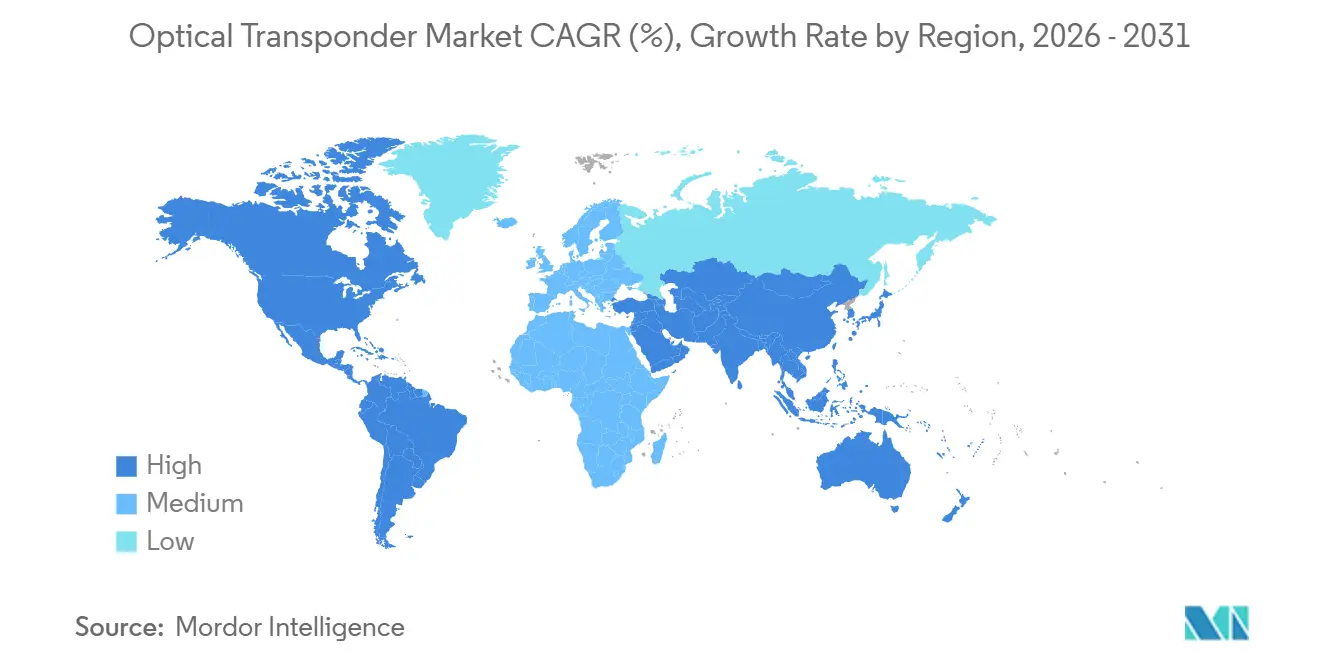
North America held 35.98% of the optical transponder market in 2025. The region has a high concentration of hyperscale AI infrastructure and data center interconnect spending, which supports demand for higher-capacity links between closely located facilities. The United States accounted for most regional demand through campuses in Northern Virginia, Silicon Valley, and Dallas-Fort Worth. These sites require high-capacity coherent links between facilities. Canada and Mexico added demand through carrier backbone modernization and cross-border connectivity.
Across the optical transponder market, Asia-Pacific is projected to expand at a 10.58% CAGR from 2026 to 2031. China is an important volume center because Alibaba, Tencent, Baidu, and state-owned telecom operators have supported data center construction. India is advancing network modernization through Reliance Jio fiber expansion, Bharti Airtel 5G transport upgrades, and BharatNet. Japan and South Korea add demand through OpenROADM-compliant deployments and continued 5G transport capacity programs. Southeast Asian countries are benefiting from edge data centers and intra-regional cable landings.
In the optical transponder market, Europe remains a stable, technically advanced demand base with carrier investment in 800G backbone modernization. Proximus selected Ekinops for its NEURON program, which will replace 700 optical nodes and more than 600 DWDM sites in Belgium. Germany, the United Kingdom, France, and the Netherlands support regional demand by upgrading carriers and deploying enterprise dark-fiber links. South America is emerging as an investment area, led by Brazil's BRL 157 million (USD 30.4 million) Eletronet modernization program. The Middle East and Africa remain smaller but are adding data centers and terrestrial fiber routes in Saudi Arabia and the UAE.

Competitive Landscape
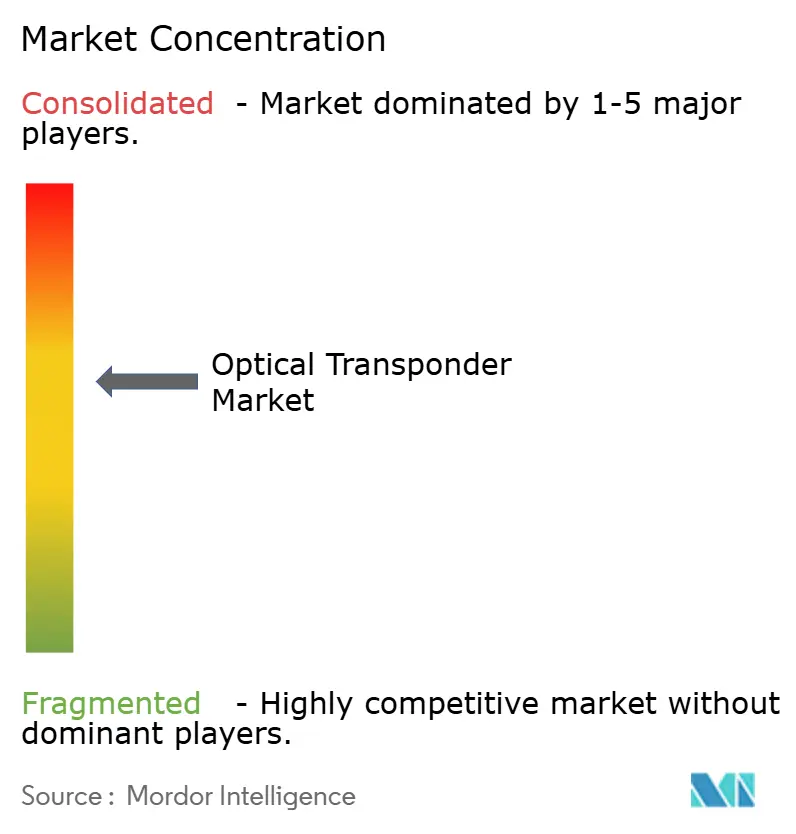
The optical transponder market is moderately concentrated at the system level. Huawei, Ciena, Nokia, ZTE, and Cisco are the main system vendors identified in the supplied competitive assessment. The optical transponder market component and module layer includes Coherent Corp., Lumentum Holdings, Marvell Technology, Broadcom, and Asia-based module vendors. Competition is shaped by line rate, power use, density, integration capability, and access to photonic components, with customer requirements differing sharply between carrier and cloud deployments. Large vendors are investing in integrated technology portfolios to serve both carrier and hyperscale buyers.
Nokia completed its acquisition of Infinera in February 2025 for USD 2.3 billion, bringing together expertise in photonic integrated circuits, DSP platforms, and long-haul systems. Nokia reported planned net comparable operating-profit synergies of more than EUR 200 million (USD 216 million) by 2027. Ciena agreed to acquire Nubis Communications for USD 270 million in September 2025 to expand its co-packaged and near-packaged optics capabilities. Coherent Corp., Ciena, Cisco, and Nokia introduced multi-rail photonic systems at OFC 2026 that can raise transponder density by up to 75%. These moves show that vendors are competing to combine higher density with higher capacity.
In the optical transponder market supply chain, NVIDIA announced USD 2 billion investments in Coherent Corp. and Lumentum Holdings in March 2026. Each investment included a multibillion-dollar purchase commitment for advanced laser and optical networking products. This positions NVIDIA as an important demand anchor in the component supply chain. Regional and enterprise operators may offer an opportunity for Adtran Networks, Ribbon Communications, and NEC at the 400G-800G metro and access tier. Accelink Technologies and Eoptolink Technology compete in the standard 400G QSFP-DD and 800G OSFP modules through domestic supply chain integration.
Optical Transponder Industry Leaders
Huawei Technologies Co., Ltd.
Ciena Corporation
Nokia Corporation
ZTE Corporation
Cisco Systems, Inc.
- *Disclaimer: Major Players sorted in no particular order

Recent Industry Developments
- July 2026: Proximus signed a framework agreement with Ekinops to deploy a nationwide 800G optical backbone across Belgium under its NEURON (Next generation Enhanced Uniform Reliable Optical Network) program, replacing approximately 700 optical network nodes and over 600 DWDM sites with infrastructure supporting more than 25 Tb/s per fiber pair, with the first commercial deployment scheduled to begin in the second half of 2026. The multi-year agreement includes capacity commitments for future 1.6T upgrades.
- May 2026: Lightpath announced a major network densification project spanning more than 2,400 macro cell tower locations across New York, Connecticut, Massachusetts, and New Jersey, delivering 100 Gbps and 400 Gbps aggregation links to leading national wireless operators as they scale their 5G standalone networks. The project adds 265 route miles of new fiber construction, extending Lightpath's total reach to over 12,100 route miles across 11 major US metro markets.
- March 2026: NVIDIA and Coherent Corp. announced a multiyear strategic agreement including a USD 2 billion NVIDIA equity investment in Coherent and a multibillion-dollar purchase commitment for advanced laser, co-packaged optics, and optical networking products. Separately, NVIDIA announced a concurrent USD 2 billion investment in Lumentum Holdings on the same terms, securing supply for next-generation AI infrastructure optics from two of the industry's leading InP and photonics manufacturers.
- February 2026: Ciena unveiled the Vesta 200 6.4T CPX at OFC 2026, described as the industry's highest-density, lowest-power pluggable CPO solution, designed to reduce power consumption by up to 70% for hyperscale and cloud operator AI workloads. Ciena also announced developments in hyper-rail photonics, claiming up to 32 times the density of current solutions at 128 fiber pairs per rack, 1600ZR/ZR+ pluggables based on 2 nm silicon design, and 800 Gb/s C-band and L-band coherent pluggables.


Global Optical Transponder Market Report Scope
The optical transponder market revenue is generated through the sale of optical transponders and related transponder-based transmission equipment across data rates ranging from 100 Gbps to above 800 Gbps, supplied to telecommunication service providers, cloud and hyperscale data center operators, enterprises, government and defense organizations, and other end users.
The optical transponder market report is segmented by transmission technology (coherent and non-coherent), data rate (up to 100 Gbps, above 100 Gbps to 400 Gbps, above 400 Gbps to 800 Gbps, and above 800 Gbps), network application (metro, long-haul, data center interconnect, submarine, and other network applications), end-user (telecommunication service providers, cloud and hyperscale data center operators, enterprises, government and defense, and other end-users), and geography (North America, South America, Europe, Asia-Pacific, Middle East, and Africa). The market forecasts are provided in terms of value (USD).
| Coherent |
| Non-Coherent |
| Up to 100 Gbps |
| Above 100 Gbps to 400 Gbps |
| Above 400 Gbps to 800 Gbps |
| Above 800 Gbps |
| Metro |
| Long-Haul |
| Data Center Interconnect |
| Submarine |
| Other Network Applications |
| Telecommunication Service Providers |
| Cloud and Hyperscale Data Center Operators |
| Enterprises |
| Government and Defense |
| Other End-Users |
| North America | United States |
| Canada | |
| Mexico | |
| South America | Brazil |
| Argentina | |
| Rest of South America | |
| Europe | Germany |
| United Kingdom | |
| France | |
| Italy | |
| Spain | |
| Rest of Europe | |
| Asia-Pacific | China |
| Japan | |
| India | |
| South Korea | |
| Australia and New Zealand | |
| Rest of Asia-Pacific | |
| Middle East | Saudi Arabia |
| United Arab Emirates | |
| Rest of Middle East | |
| Africa | South Africa |
| Nigeria | |
| Rest of Africa |
| By Transmission Technology | Coherent | |
| Non-Coherent | ||
| By Data Rate | Up to 100 Gbps | |
| Above 100 Gbps to 400 Gbps | ||
| Above 400 Gbps to 800 Gbps | ||
| Above 800 Gbps | ||
| By Network Application | Metro | |
| Long-Haul | ||
| Data Center Interconnect | ||
| Submarine | ||
| Other Network Applications | ||
| By End-User | Telecommunication Service Providers | |
| Cloud and Hyperscale Data Center Operators | ||
| Enterprises | ||
| Government and Defense | ||
| Other End-Users | ||
| By Geography | North America | United States |
| Canada | ||
| Mexico | ||
| South America | Brazil | |
| Argentina | ||
| Rest of South America | ||
| Europe | Germany | |
| United Kingdom | ||
| France | ||
| Italy | ||
| Spain | ||
| Rest of Europe | ||
| Asia-Pacific | China | |
| Japan | ||
| India | ||
| South Korea | ||
| Australia and New Zealand | ||
| Rest of Asia-Pacific | ||
| Middle East | Saudi Arabia | |
| United Arab Emirates | ||
| Rest of Middle East | ||
| Africa | South Africa | |
| Nigeria | ||
| Rest of Africa | ||


Key Questions Answered in the Report
What is the optical transponder market size?
The optical transponder market was valued at USD 8.17 billion in 2025, stands at USD 8.92 billion in 2026, and is forecast to reach USD 13.65 billion by 2031.
What is driving demand for optical transponders?
AI data center interconnect, higher line-rate upgrades, 5G transport modernization, and submarine cable deployment are supporting demand.
Which transmission technology leads optical transponder deployments?
In the optical transponder market, coherent transponders held 83.22% of revenue in 2025 and are projected to expand at a 9.65% CAGR through 2031.
Which data-rate category is expanding fastest?
The above 800 Gbps category is projected to expand at a 12.21% CAGR from 2026 to 2031, supported by AI infrastructure deployments.
Which end-users are increasing purchases fastest?
Cloud and hyperscale data center operators are projected to expand at an 11.77% CAGR through 2031.
Which region has the strongest outlook for optical transport equipment?
Asia-Pacific is projected to expand at a 10.58% CAGR through 2031, while North America held the largest regional share in 2025.
Page last updated on:





