
Market Overview
| Study Period | 2021 - 2031 |
|---|---|
| Forecast Data Period | 2026 - 2031 |
| Historical Data Period | 2021 - 2024 |
| Growth Rate | 6.43 % |
| Market Concentration | Medium |
Major Players.webp) *Disclaimer: Major Players sorted in no particular order Image © Mordor Intelligence. Reuse requires attribution under CC BY 4.0. | |
Oman Oil And Gas Pipeline Market Analysis by Mordor Intelligence
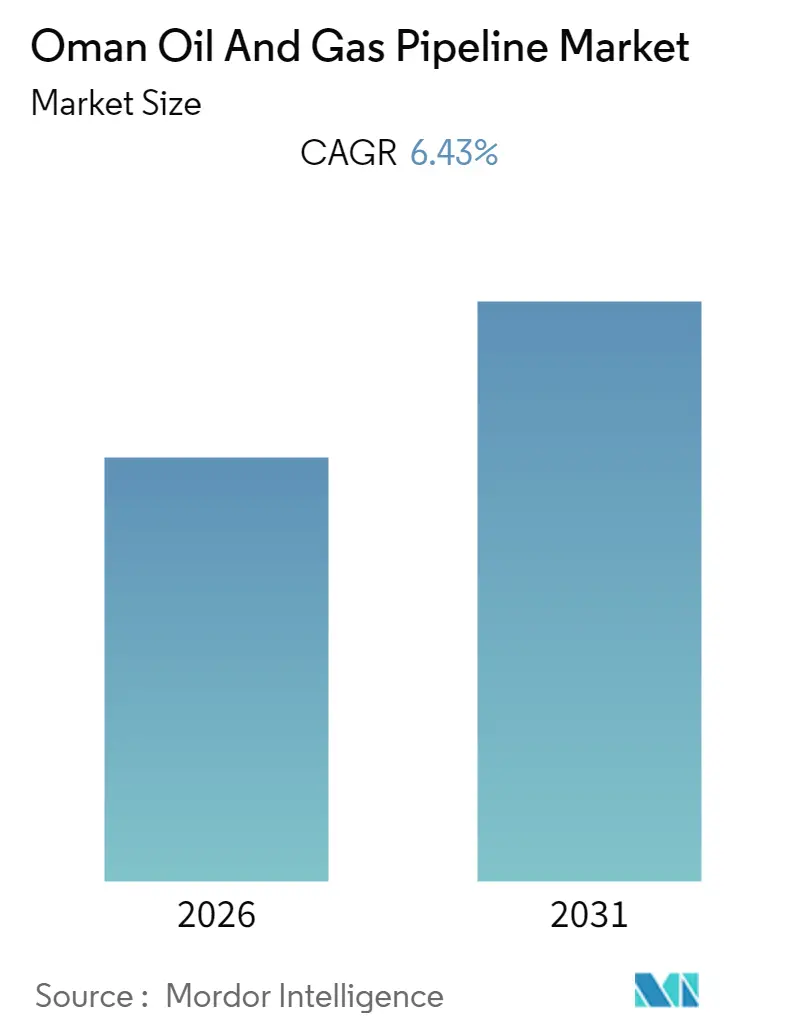
The Oman Oil and Gas Pipeline Market size is expected to register a CAGR of 6.43% during the forecast period.
- The gas pipeline line segment is expected to dominate the market during the forecast period. In the last few years, there has been a rise in awareness about carbon and greenhouse emissions, resulting in higher demand for natural gas, LPG, LNG, and other gasses in Oman and other countries. Thus, companies are investing more in the exploration and production of natural gas, which is expected to boost the oil and gas pipeline market in Oman in the forecast period.
- The Oman government is planning to increase oil & gas production in the country. For instance, Oman has identified a new oil field estimated to have 5 billion barrels of oil reserves. Therefore, the increasing number of oil & gas projects is expected to boost the Omani oil and gas pipeline market during the forecast period.
- Off late, the FDI in the oil and gas industry in Oman has witnessed a significant rise. For instance, China is expected to invest more than USD 10 billion in the oil & gas industry in Oman in the coming few years. Thus a significant rise in investment in the oil and gas industry provides a great opportunity in the oil and gas pipeline market.
Note: Market size and forecast figures in this report are generated using Mordor Intelligence’s proprietary estimation framework, updated with the latest available data and insights as of 2026.
Oman Oil And Gas Pipeline Market Trends and Insights
The Gas Pipeline Segment to Dominate the Market
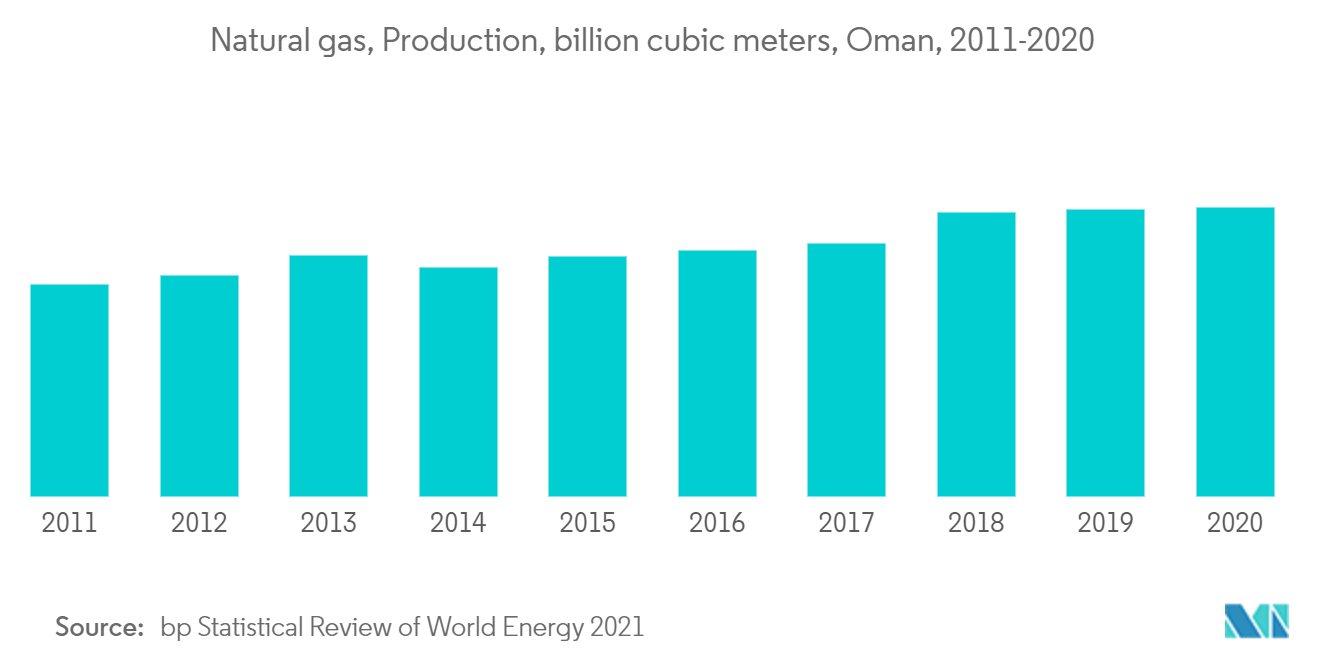
- In Oman, natural gas production has increased from 25 billion cubic meters in 2010 to 36.9 billion cubic meters in 2020. Furthermore, natural gas consumption also increased significantly over the last decade. In 2010 the natural gas consumption was 16.4 billion cubic meters, and in 2020 it was around 25.9 billion cubic meters.
- This increased focus on natural gas production and consumption is due to higher demand for natural gas from various end-users such as residential, commercial, and industrial. This trend is expected to continue in the coming years and is anticipated to boost investment in the gas pipeline infrastructure.
- Increased awareness about the negative effects of carbon and greenhouse gas emissions on the environment as well as humans is also propelling the investment in natural gas infrastructure in Oman.
- Oil & gas companies are more focused on the exploration of natural gas in Oman. For instance, in 2010, Oman had natural gas reserves of around 0.5 trillion cubic meters, and in 2020 the natural gas reserves were 0.7 trillion cubic meters, which is approximately 40% higher than in 2010.
- Thus rising investment in natural gas infrastructure coupled with higher demand from the end-users is expected to drive the gas pipeline segment in the Oman oil and gas pipeline market in the near future.
Government's Favorable Policies to Promote Oil and Gas Industry
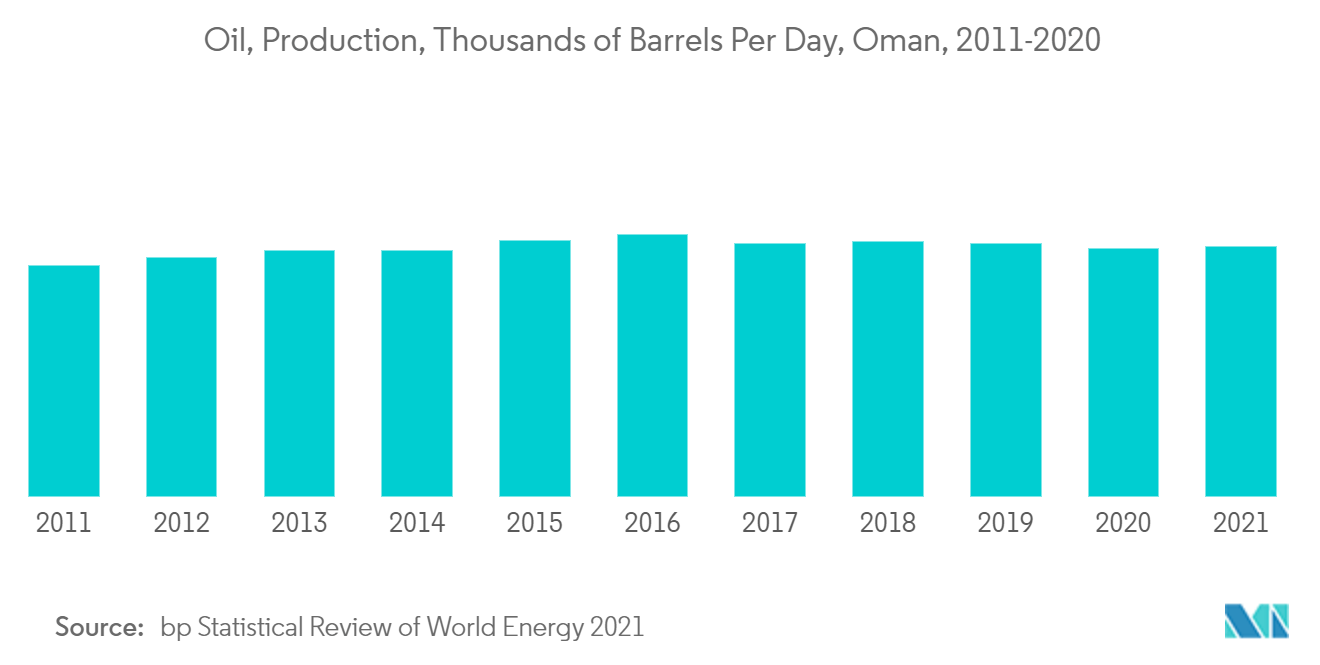
- Oman is one of the leading oil and natural gas producers in the Middle East outside the OPEC. The oil and gas industry is a critical part of its economic performance. In 2020, the oil and gas sector accounted for 26.2% of G.D.P. Furthermore, oil and gas exports represent about 60% of Oman's merchandise exports. Moreover, Oman's government derives around 70% of its annual budget from oil and gas industry revenues in the form of taxation, and the government also has joint ownership of some of the oil and gas fields which are located in the country.
- Thus the government of Oman is focusing on the development of the oil and gas industry in the country. The state-owned Petroleum Development Oman (P.D.O.) owns most of the country's oil reserves.
- In 2019, Oman created a state energy company named OQ. The company integrates various government-owned upstream, midstream, and downstream oil and gas entities. The companies that merged include the Oman Oil Company S.A.O.C. (O.O.C.), Oman Oil Refineries & Petroleum Industries Company (Orpic), Oman Oil Company Exploration & Production (O.O.C.E.P.), Oman Gas Company (O.G.C.), Duqm Refinery & Petrochemical Industries (D.R.P.I.C.), Salalah Methanol (S.M.C.), Oman Trading International (O.T.I.), Oxo intermediates and derivatives producer OXEA, and Salalah Liquefied Petroleum Gas. Furthermore, this group owns four producing blocks, one non-producing block, and five exploration blocks in onshore and offshore fields.
- Moreover, in December 2020, the government created Energy Development Oman to represent the government's stake in P.D.O. and raise financing for oil and gas projects for future development. Furthermore, the government is also aiming to expand its downstream oil capabilities, such as refining and petrochemicals.
- The government also introduce new laws to improve the business environment and investment climate and boost foreign direct investment in the country, particularly in the oil and gas industry. A few of the laws are as follows:-
- Foreign Capital Investment Law (Sultani Decree - 50/2019) (F.C.I.L.)
- Privatisation Law (Sultani Decree - 51/2019)
- Public Private Partnership Law (Sultani Decree - 52/2019)
- Bankruptcy Law (Sultani Decree - 53/2019)
- Due to these activities and reforms by the government, the oil and gas industry is expected to witness higher demand in the near future, which, the intern, would lead to leading the oil and gas pipeline market in the forecast period.
Regulatory Landscape
Oman's oil and gas pipeline sector is governed under the Oil and Gas Law (Royal Decree 8/2011), with the Ministry of Energy and Minerals (MEM) acting as the key sector regulator for licensing and operational permissions across midstream infrastructure. Under this framework, pipeline developers and operators must secure MEM permits and comply with route-protection requirements, including a 25-meter buffer zone on each side of a pipeline centerline.
National energy policy direction is set at the government level, with the Council of Ministers holding primary authority over national energy policy under Royal Decree 108/2020. Oman has also advanced investment-enabling frameworks such as the Foreign Capital Investment Law (Sultani Decree 50/2019) and the PPP and Privatization laws (Sultani Decree 52/2019 and 51/2019), which support private participation and financing structures for strategic infrastructure, including pipelines.
Value Chain Analysis
The value chain starts with upstream oil and gas production and gathering, then moves to processing (including gas/NGL handling where applicable) and transmission through onshore trunk pipelines to industrial and export nodes. A representative domestic flow is the linkage from producing areas such as Saih Nihayda toward downstream industrial corridors and export infrastructure around Duqm (including the Port of Duqm and associated industrial zones), where pipelines connect into storage, fractionation, and marine export logistics.
Project execution typically follows concept and studies/FEED, then progresses through EPC contracting, commissioning, and operations. Integrity management, inspection, and digital or automation layers support day-to-day performance. OQ, the integrated national energy group formed in 2019, spans upstream to downstream and influences midstream buildouts through FEED-to-EPC competitions and subsidiary delivery vehicles, including pipeline and transport entities, while Oman also uses PPP structures to bring in private finance, construction capability, and specialist services across the pipeline lifecycle.
Competitive Landscape
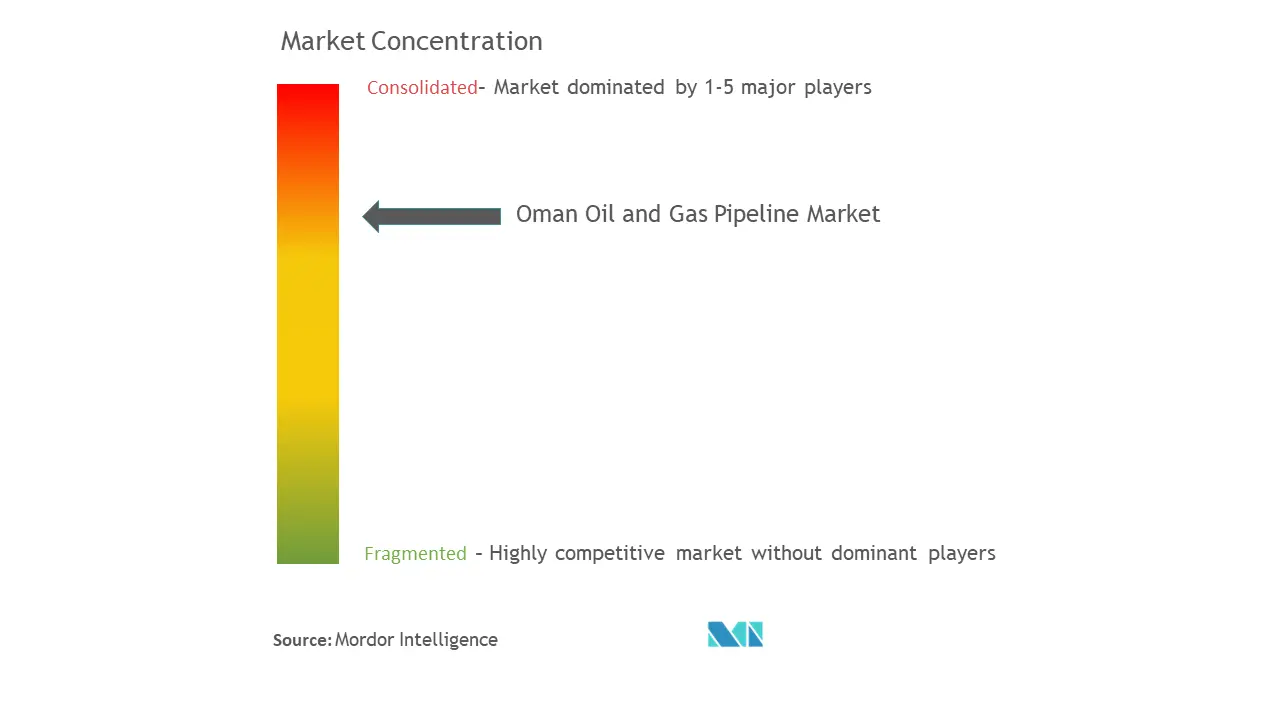
Oman oil and gas pipeline market s moderately fragmented. Some of the key players in the market include Pipelife Nederland B.V, PSC Teknologis, AVEVA Group plc, Mott MacDonald, and TMK Group.
Oman Oil And Gas Pipeline Industry Leaders
-
Pipelife Nederland B.V
-
PSC Teknologis
-
AVEVA Group plc
-
Mott MacDonald
-
TMK Group
- *Disclaimer: Major Players sorted in no particular order
Market Opportunities and Future Outlook
Large, defined midstream projects under study and procurement create clear headroom for line pipe, EPC, and pipeline services across Oman. OQ has advanced studies for the Nahada to Ras Markaz oil pipeline (reported in the range of roughly 360-440 km) as part of creating an additional crude export route linked to the Ras Markaz storage hub, with related preparations reported for a 48-inch crude pipeline of around 400 km to connect Ras Markaz into the national main pipeline network via an OQ transport subsidiary.
Opportunities also follow gas and NGL infrastructure buildouts around industrial hubs, including the reported 230 km, 16-inch NGL pipeline from Saih Nihayda to a new fractionation complex in Duqm, which ties pipeline demand to downstream industrialization. On the gas transmission side, contract awards and network expansion statements from OQ Gas Networks point to ongoing additions and upgrades to meet industrial and utility load centers, supporting demand for construction, integrity management, and digital operations solutions across the existing network footprint.
Recent Industry Developments
- May 2026: OQ conducting detailed studies for the Nahada - Ras Markaz Oil Pipeline (360-440 km) to create a secondary crude export route bypassing traditional terminals. The initiative strengthens Oman export-infrastructure optimization by diversifying routes and reducing terminal bottlenecks for crude transport.
- April 2026: OQ Gas Networks (OQGN) reported a 2025 year-end pipeline network length of 4,368 km and system capacity of 76.3 BCM. The expansion demonstrates substantial growth in Oman's gas-pipeline footprint and capacity utilization.
- September 2025: OQ Gas Networks announces national gas network expansion to 4,623 km by 2027. The expansion positions Oman’s gas-grid for higher throughput and potential hydrogen transport integration.
Research Methodology Framework and Report Scope
Market Definition and Coverage
This market covers spending and revenue tied to oil and gas pipeline assets in Oman, including pipeline development and related services for crude and natural gas lines across onshore and offshore environments.
Scope exclusions: This sizing excludes downstream refined product pipelines, terminal storage revenues, and broader oil and gas production or processing activities that sit outside pipeline transportation.
Segmentation Overview
- Location of Deployment
- Onshore
- Offshore
- Type
- Crude Oil Pipeline
- Gas Pipeline
Data Sources, Market Sizing, and Validation
Desk Research
Desk research is used to build a clean fact base on the Oman pipeline network and to set realistic ranges for the model before interviews start. We relied on public information such as Oman Ministry of Energy and Minerals releases, National Center for Statistics and Information datasets, OPEC annual statistical publications, and BP Statistical Review legacy series (where available for historical context).
To translate activity into market values, we also reviewed items like operator annual reports and investor presentations, project award announcements in reputed press, and technical references that help explain diameter, length, and service mix. When it improved consistency, our analysts also cross-checked company financials and intelligence tools, a global contracts and tenders database, and an import and export shipment-level database for selected equipment and material flows. These desk sources are illustrative only, and many other references were used for data collection, validation, and clarification.
Primary Interviews and Surveys
Primary work was used to confirm what is actually being built, refurbished, or operated in Oman, and to test assumptions on pricing, contracting structures, and timing slippages. We spoke with a mix of pipeline operators, EPC and construction participants, inspection and integrity specialists, and upstream and gas value chain stakeholders. The coverage was designed to reflect Oman-specific onshore and offshore realities.
Feedback from these discussions helped fill gaps left by public disclosures, for example how much of the plan is brownfield integrity work versus new-build. It also allowed us to adjust growth expectations when project schedules moved.
Distribution of primary research fieldwork respondents
| Company type | Respondent position |
|---|---|
| Top tier: 37% | CXOs: 19% |
| Mid tier: 41% | Functional/Unit leaders: 26% |
| Smaller Players: 22% | Managers: 55% |
Market-Sizing & Forecasting
Sizing starts from a top-down reconstruction of Oman pipeline activity, where the demand pool is built using network expansion cues, publicly stated capacity and throughput direction, and the likely split between crude and gas systems across onshore and offshore settings. Once this structure is in place, results are then checked with selective bottom-up approximations such as sampled project cost per km ranges, a small set of supplier and service revenue checkpoints, and channel checks on inspection and integrity workloads. These are used to correct over or under counting.
Key model inputs include planned and announced pipeline length additions, replacement and integrity cycles for aging lines, offshore tie-in and brownfield modification intensity, and oil and gas production and gas demand direction that drives transport needs. We also tracked unit cost movements influenced by steel and contracting rates. For forecasting, scenario analysis was used because project execution in Oman can shift with approvals, award timing, and operator capex cycles, and the final path was aligned to the consensus from primary inputs.
When bottom-up evidence was thin for smaller scopes, we used ranges and applied conservative penetration assumptions. We then pressure-tested totals against the implied pace of project activity that Oman can realistically execute in a given year.
Data Validation & Update Cycle
Outputs are validated through stepwise triangulation, where modeled totals are compared against independent signals such as major project timelines, publicly discussed network expansion plans, and the expected split of new-build versus integrity work. Variance checks are run across sub-views (type and deployment location) so unusual jumps can be traced back to a specific assumption, and then reviewed again before sign-off.
If a material mismatch appears, analysts re-check the source logic and, where needed, re-contact relevant experts to confirm whether the change is real or driven by timing, currency, or scope differences. Reports are refreshed annually, with interim updates when major awards, cancellations, or policy changes materially affect the outlook. Before delivery, a final analyst pass is completed so clients receive the latest updated view.
Mordor Intelligence's Oman Oil and Gas Pipeline Market Estimate Compared With Other Published Estimates
Published market sizes for Oman pipelines often do not align because the scope can move between pure crude and gas transmission versus broader midstream and downstream activities. Some studies also count multi-product and refined product lines. Differences also show up when one publisher counts only new capex while another blends in integrity, inspection, and ongoing services.
The biggest gap driver is whether refined product and multi-product pipelines are included. In this study Mordor Intelligence counts only crude oil and natural gas pipelines across onshore and offshore, which keeps the total tied to transportation lines rather than adjacent downstream networks. Estimates can also diverge due to base year choice, currency conversion timing, and how unit costs are escalated when steel and contracting rates move, especially if assumptions are not re-checked with Oman project participants close to award cycles.
Benchmark comparison
| Source | Market Size | Gaps in Research Methodology |
|---|---|---|
| Mordor Intelligence | USD 1.12 B (2025) | |
| Regional Consultancy A | USD 1.50 B (2024) | Uses a broader definition that explicitly includes refined product and multi-product pipelines and sometimes blends storage and distribution linkages, which inflates the value compared with a crude and gas-only view. |
| Trade Journal B | USD 0.86 B (2025) | Leans toward a capex-only snapshot focused on announced new-build projects, and it typically undercounts recurring integrity, inspection, and brownfield modification work that continues even in quieter award years. |
The table shows that the spread is mainly explained by what gets counted as a pipeline market in Oman, and whether the number reflects only new project awards or also the steady stream of integrity and upgrade work. By keeping scope rules clear and then testing assumptions through repeatable activity checks and interview validation, our approach lands on a practical estimate that can be traced back to understandable drivers.
Key Questions Answered in the Report
What is the current Oman Oil and Gas Pipeline Market size?
The Oman Oil and Gas Pipeline Market is projected to register a CAGR of 6.43% during the forecast period (2026-2031)
Who are the key players in Oman Oil and Gas Pipeline Market?
Pipelife Nederland B.V, PSC Teknologis, AVEVA Group plc, Mott MacDonald and TMK Group are the major companies operating in the Oman Oil and Gas Pipeline Market.
What years does this Oman Oil and Gas Pipeline Market cover?
The report covers the Oman Oil and Gas Pipeline Market historical market size for years: 2020, 2021, 2022, 2023, 2024 and 2025. The report also forecasts the Oman Oil and Gas Pipeline Market size for years: 2026, 2027, 2028, 2029, 2030 and 2031.