
Oligonucleotide API Market Size and Share
Market Overview
| Study Period | 2020 - 2031 |
|---|---|
| Market Size (2026) | USD 5.59 Billion |
| Market Size (2031) | USD 8.21 Billion |
| Growth Rate (2026 - 2031) | 7.98 % |
| Fastest Growing Market | Asia-Pacific |
| Largest Market | North America |
| Market Concentration | Medium |
Major Players *Disclaimer: Major Players sorted in no particular order Image © Mordor Intelligence. Reuse requires attribution under CC BY 4.0. | |
Oligonucleotide API Market Analysis by Mordor Intelligence
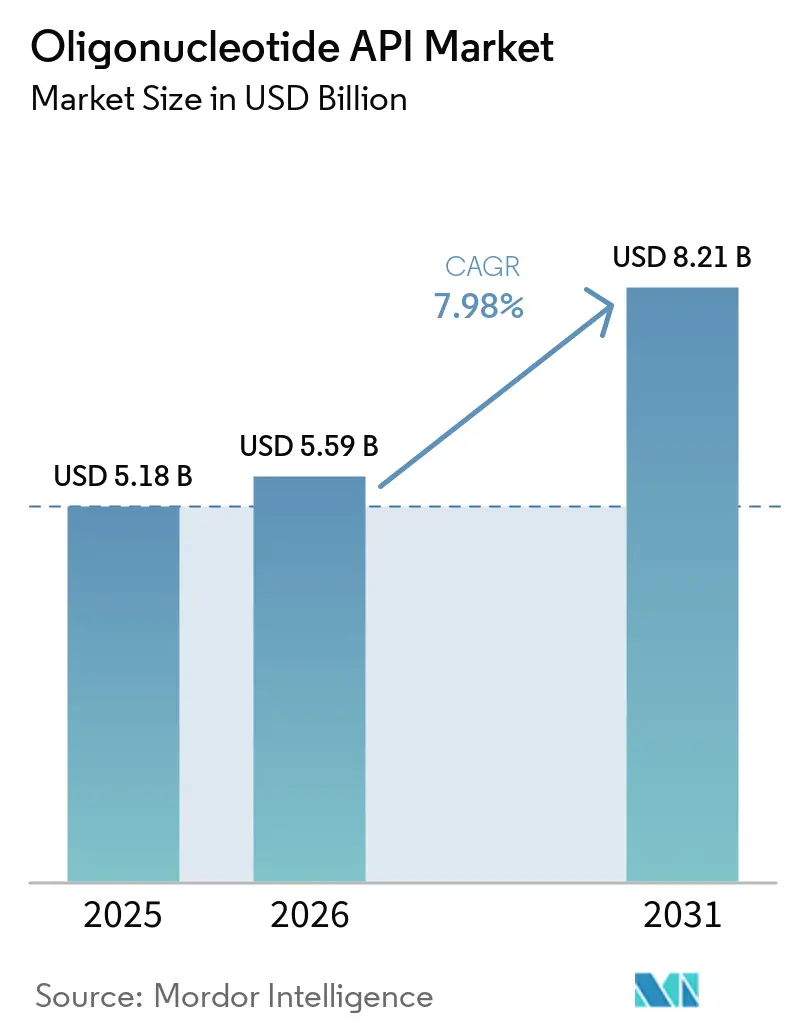
The Oligonucleotide API Market size was valued at USD 5.18 billion in 2025 and is estimated to grow from USD 5.59 billion in 2026 to reach USD 8.21 billion by 2031, at a CAGR of 7.98% during the forecast period (2026-2031).
The market is moving beyond its earlier focus on niche therapies as sequence-defined nucleic acid medicines gain commercial use. FDA approvals in 2024 and 2025 for olezarsen, fitusiran, donidalorsen, and plozasiran added demand for commercially manufactured material across antisense and siRNA platforms. Subcutaneous delivery is widening the practical use of GalNAc-linked therapies and supports recurring supply needs for chronic conditions. Manufacturers are responding with capacity investment, process development, and stronger control over critical inputs. The oligonucleotide API market also faces a difficult cost structure because synthesis, purification, solvent management, and analytical controls remain resource-intensive.
Key Report Takeaways
- By API type, antisense oligonucleotides held 55.31% revenue share in 2025, while small interfering RNA APIs are expected to record the highest CAGR at 10.65% through 2031.
- By manufacturing technology, solid-phase synthesis held 68.24% revenue share in 2025, while hybrid chemical-enzymatic synthesis is projected to have a CAGR at 13.42% through 2031.
- By application, rare and genetic diseases held 28.24% revenue share in 2025, while gene editing and gene regulation are projected to grow at an 11.52% CAGR through 2031.
- By development status, marketed APIs held 58.14% revenue share in 2025, while preclinical and discovery-stage APIs are projected to grow at an 11.42% CAGR through 2031.
- By end user, pharmaceutical companies held 42.84% revenue share in 2025, while CRDMOs are expected to record the highest CAGR at 10.22% through 2031.
- By geography, North America held 41.41% revenue share in 2025, while Asia-Pacific is projected to grow at a 10.25% CAGR through 2031.
Note: Market size and forecast figures in this report are generated using Mordor Intelligence’s proprietary estimation framework, updated with the latest available data and insights as of January 2026.
Global Oligonucleotide API Market Trends and Insights
Drivers Impact Analysis*
| Driver | (~) % Impact on CAGR Forecast | Geographic Relevance | Impact Timeline |
|---|---|---|---|
| Advancing Oligonucleotide Therapeutic Pipelines | +2.2% | Global, North America and Europe for IND-stage programs, Asia-Pacific for clinical supply | Short term (≤ 2 years) |
| Expansion of GMP Oligonucleotide CDMO Capacity | +1.6% | Global, North America, Europe, and APAC | Medium term (2-4 years) |
| Increasing Adoption of Precision Medicine and RNA-Based Therapies | +1.3% | Global, with early adoption in North America, Western Europe, and Japan | Medium term (2-4 years) |
| Rising Demand for Complex Conjugated Oligonucleotide APIs | +1.0% | North America and Europe, with spillover to APAC | Medium term (2-4 years) |
| Enzymatic and Hybrid Synthesis Platforms Improving Commercial Scalability | +0.5% | Global, led by the United States, Switzerland, and Japan | Long term (≥ 4 years) |
| Regionalization of Nucleic-Acid Manufacturing Supply Chains | +0.3% | APAC, with India and South Korea emerging | Long term (≥ 4 years) |
| Source: Mordor Intelligence | |||
Advancing Oligonucleotide Therapeutic Pipelines
The oligonucleotide API market draws much of its near-term demand from the progression of clinical programs into later development stages. A broader set of RNA therapeutic candidates requires clinical-grade material before commercial manufacturing begins. Early-stage programs can also establish supplier relationships well before pivotal trials, which gives capable manufacturers a longer view of future demand. The 2025 approvals of fitusiran, donidalorsen, and plozasiran, following olezarsen in 2024, showed that multiple oligonucleotide approaches can reach commercial use. The approved therapies cover different treatment settings and support demand across antisense and siRNA supply chains. This progression encourages developers to secure manufacturing expertise before the timeline for large-scale supply becomes tight.
Expansion of GMP Oligonucleotide CDMO Capacity
GMP capacity is expanding as sponsors seek dependable supply for development and marketed programs in the oligonucleotide API market. Bachem inaugurated Building K in Switzerland in April 2026 after investing CHF 332.6 million (USD 407.6 million) in 2025 and planning CHF 350 million (USD 428.9 million) to CHF 400 million (USD 490.2 million) of further investment for 2026. BioSpring is building a GMP facility in Germany that covers more than 15,200 m² and is scheduled for completion in 2027[1]. Nippon Shokubai announced a tenfold expansion of GMP-compliant nucleic acid drug API capacity in June 2025, with operations targeted for 2027. These programs broaden the number of qualified facilities that can support complex development and commercial work. They also make location, technology breadth, and regulatory experience more important in supplier selection.
Increasing Adoption of Precision Medicine and RNA-Based Therapies
The oligonucleotide API market benefits as RNA-based medicines address well-defined genetic and molecular targets. GalNAc-linked siRNA medicines have shown that infrequent subcutaneous dosing can support treatment beyond the earliest intravenous lipid nanoparticle products. This delivery profile makes RNA approaches more relevant for chronic conditions and dispersed patient populations. The approvals of fitusiran and plozasiran in 2025 reflected this wider use of targeted RNA modalities. Developers must still demonstrate sequence identity, impurity control, and consistent product quality as programs move through development. Those requirements favor suppliers with established process development, analytical, and GMP capabilities.
Rising Demand for Complex Conjugated Oligonucleotide APIs
Conjugated medicines are changing the technical requirements of the oligonucleotide API market. GalNAc remains important for liver targeting, while other targeting approaches include integrin-binding peptides, antibody-oligonucleotide conjugates, and extended nucleic acid modifications. These designs require careful control of both the oligonucleotide and the attached ligand or modified backbone. Hongene Biotech licensed technology from UMass Chan Medical School in August 2025 to produce exNA phosphoramidites, showing how new chemistries can increase upstream material needs. The added complexity increases the importance of process development at an early stage. It can also make a manufacturing partner harder to replace once the program reaches clinical supply.
Restraints Impact Analysis*
| Restraint | (~) % Impact on CAGR Forecast | Geographic Relevance | Impact Timeline |
|---|---|---|---|
| High Purification, Yield, and Impurity-Control Costs | -1.3% | Global, most acute in North America and Europe | Medium term (2-4 years) |
| Specialty Phosphoramidite and Modified-Monomer Supply Bottlenecks | -0.9% | Global, most acute in North America, Europe, and APAC | Short term (≤ 2 years) |
| High Solvent Intensity and Environmental Compliance Burden | -0.6% | Europe, North America, and Japan | Medium term (2-4 years) |
| Limited Manufacturing Standardization for Long and Highly Modified Sequences | -0.4% | Global, most acute for sgRNA and CRISPR-guide constructs | Long term (≥ 4 years) |
| Source: Mordor Intelligence | |||
High Purification, Yield, and Impurity-Control Costs
Purification remains a central constraint on the oligonucleotide API market because closely related failure sequences are difficult to remove. Solid-phase synthesis can produce molecules that differ by only 1 nucleotide, so manufacturers may need multiple ion-exchange or reverse-phase chromatography steps. Modified sequences are especially challenging because practical yields can remain below 50%. The process also creates substantial demands for buffers, testing, and documented control of each manufacturing stage. The International Society for Pharmaceutical Engineering noted that these requirements complicate scale-up and increase waste-management demands[2]. Higher production costs can limit access when developers target larger patient populations and need lower per-dose pricing.
Specialty Phosphoramidite and Modified-Monomer Supply Bottlenecks
The oligonucleotide API market depends on specialized phosphoramidites and modified monomers that have a more concentrated supply base than standard pharmaceutical inputs. Chemistries such as 2'-OMe, 2'-F, and locked nucleic acid require multistep production and specialized handling. A disruption in supply can delay process development, clinical manufacturing, or commercial replenishment. This exposure is most significant when a program depends on a customized sequence or proprietary modification. Manufacturers are therefore seeking greater control of upstream materials and a broader qualified supplier base. The effort to develop exNA phosphoramidites illustrates the upstream work needed to support emerging oligonucleotide designs.
*Our forecasts treat driver/restraint impacts as directional, not additive. The impact forecasts reflect baseline growth, mix effects, and variable interactions.
Segment Analysis
By API Type: ASO Leadership Supports a Faster-Growing siRNA Category
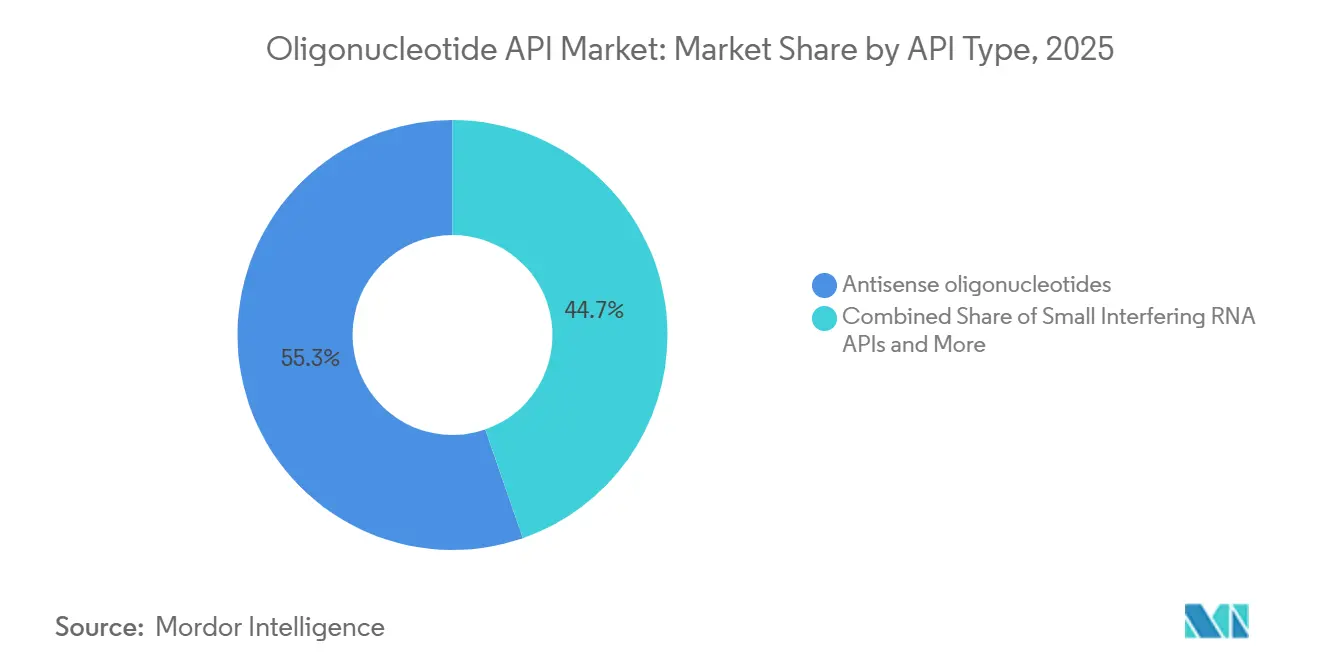
Antisense oligonucleotides accounted for 55.31% of the oligonucleotide API market share by API type in 2025. Their position reflects an established set of products in rare, neuromuscular, metabolic, and cardiovascular conditions. Antisense approaches remain important where intrathecal or intraocular delivery is required and systemic delivery alternatives have limited use. The installed base gives suppliers recurring experience with sequence design, process validation, and regulatory documentation. PMO APIs retain a specialized role in Duchenne muscular dystrophy exon-skipping programs. MicroRNA mimics and aptamer APIs have smaller commercial volumes but retain development potential in oncology and other therapeutic areas.
Small interfering RNA APIs are forecast to grow at 10.65% CAGR from 2026 to 2031 in the oligonucleotide API market. GalNAc conjugation supports durable gene silencing and less frequent subcutaneous dosing. Products such as Amvuttra and Leqvio show how this platform can support chronic treatment settings. These characteristics can increase annual API needs when compared with programs serving limited orphan populations. The category also raises demand for conjugation expertise and methods that preserve purity at larger scale. Suppliers that can handle both the oligonucleotide and the targeting ligand are positioned to support this shift.

By Manufacturing Technology: Solid-Phase Synthesis Remains the Current Base
Solid-phase synthesis held 68.24% of the oligonucleotide API market share by manufacturing technology in 2025. Its lead comes from long-standing process knowledge, installed GMP equipment, and regulatory precedent. The method remains widely used for established products and for many clinical programs. Its practical limits become more visible as commercial output rises because column size, solvent consumption, and waste treatment increase with scale. The International Society for Pharmaceutical Engineering reported that larger solid-phase batches can require extensive solvent handling, which complicates facilities intended for high annual volumes. These limitations are encouraging manufacturers to assess alternative methods without abandoning proven chemistry.
Hybrid chemical-enzymatic synthesis is projected to advance at 13.42% CAGR from 2026 to 2031. The approach combines chemically produced fragments with enzymatic ligation to build longer sequences. It can address the limits of single-column solid-phase production while retaining familiar phosphoramidite inputs. Fragment-based assembly may also produce impurity profiles that are more manageable than conventional shortmer failures. Liquid-phase methods are relevant for shorter modified sequences and can lower solvent use in some applications. Research on chemical ligation and liquid-phase approaches supports continued platform development for larger and more complex oligonucleotides[3].
By Application: Rare and Genetic Diseases Form the Commercial Base
Rare and genetic diseases accounted for 28.24% of oligonucleotide API revenue by application in 2025. Commercially validated mechanisms in spinal muscular atrophy, transthyretin amyloidosis, and familial hypercholesterolemia underpin this position. These programs have established the role of sequence-defined therapeutics in conditions where a clear molecular target is available. Neurological and neuromuscular disorders are another important group because intrathecal ASOs can address targets beyond the reach of many systemic therapies. The blood-brain barrier continues to shape both delivery choices and manufacturing requirements. The resulting portfolio creates demand for specialized sequence, backbone, and purity capabilities.
Gene editing and gene regulation are forecast to expand at 11.52% CAGR from 2026 to 2031. CRISPR programs increasingly need GMP-grade sgRNA APIs, often with sequences exceeding 100 nucleotides. These lengths make impurity control more difficult with conventional solid-phase methods. Longer products can accumulate shortmer impurities and require more intensive purification. The segment therefore gives greater weight to enzymatic, hybrid, and ligation-based approaches. Oncology and immuno-oncology remain earlier commercial applications, while personalized cancer vaccine components and CAR-T programs support preclinical demand for sgRNA material.
By Status: Marketed APIs Hold the Largest Revenue Position
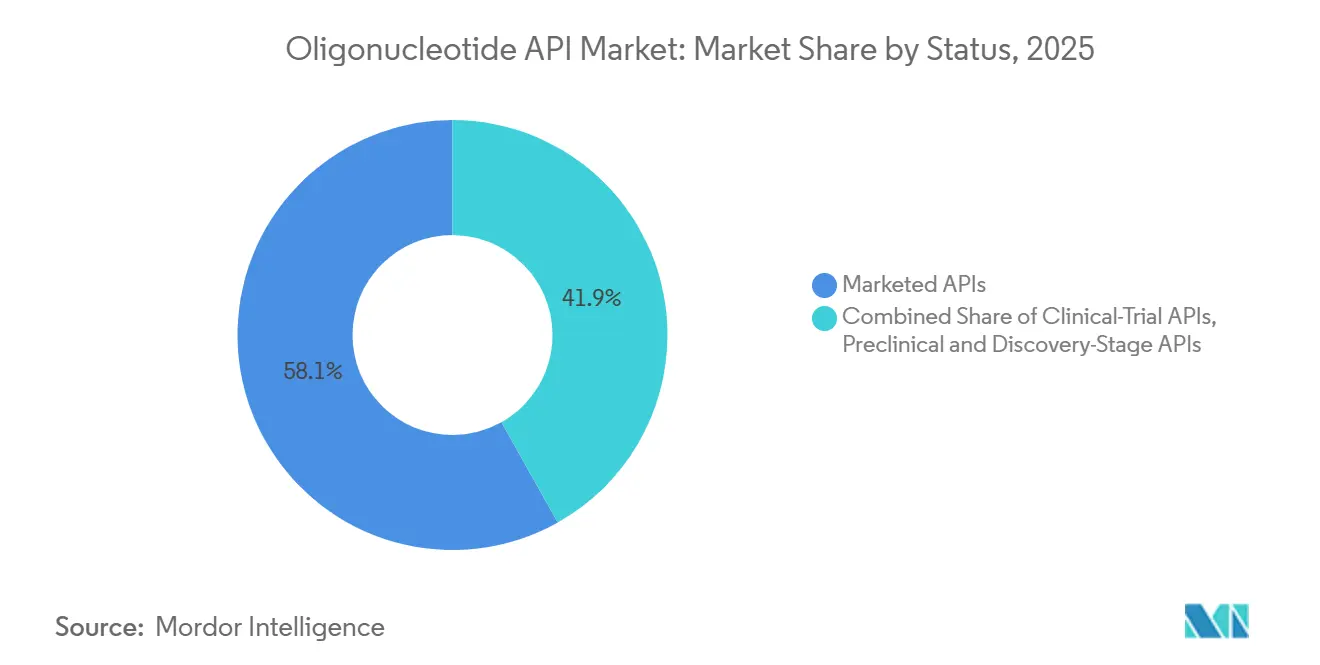
Marketed APIs represented 58.14% of oligonucleotide API market revenue by development status in 2025. This position reflects the premium GMP requirements of approved products and the high technical burden of commercial supply. Commercial programs need consistent output, extensive documentation, and resilient procurement of specialized raw materials. Clinical-trial APIs form an important secondary source of demand because Phase 3 programs need supply that is close to commercial quality. The approved RNA therapeutics landscape has expanded the number of programs that require those capabilities. The Oligonucleotide API industry therefore depends on both current marketed products and a steady conversion of clinical candidates.
Preclinical and discovery-stage APIs are forecast to grow at 11.42% CAGR from 2026 to 2031. The breadth of activity spans CNS, oncology, and gene-editing programs entering IND-enabling work. These projects often introduce extended sequences, new backbone modifications, and emerging targeting ligands. Their immediate volumes may be smaller than marketed programs, but they shape the process capabilities needed for later stages. Suppliers that work with developers at this stage can gain familiarity with methods and analytical requirements before commercial contracts are awarded. This relationship-based model makes early technical support important even when near-term revenue is limited.
By End User: Pharmaceutical Companies Remain the Largest Buyers
Pharmaceutical companies accounted for 42.84% of oligonucleotide API revenue by end user in 2025. Innovators such as Ionis Pharmaceuticals, Alnylam, and Arrowhead have long-term supplier relationships or internal manufacturing assets that influence commercial supply chains. Their programs require reliable GMP material as they move from clinical work to recurrent commercial production. Biotechnology companies remain an important customer group because their molecule portfolios are often concentrated and their dependence on external manufacturing can be high. Academic and research institutes generally access GMP-grade material through CRDMO catalog services for toxicology and mechanistic work. These early studies can become the starting point for future clinical programs.
CRDMOs are forecast to grow at 10.22% CAGR from 2026 to 2031. The service model is moving beyond straightforward manufacturing as providers add process development and chemistry, manufacturing, and controls support. This lets a provider remain involved from lead selection through development and commercialization. A partner that helps solve sequence, purification, and analytical challenges early can become more difficult to replace. The change also increases competition between pure-play CDMOs and broader development service providers. In the Oligonucleotide API industry, the ability to link early technical work with later GMP production is becoming a meaningful part of commercial positioning.
Geography Analysis
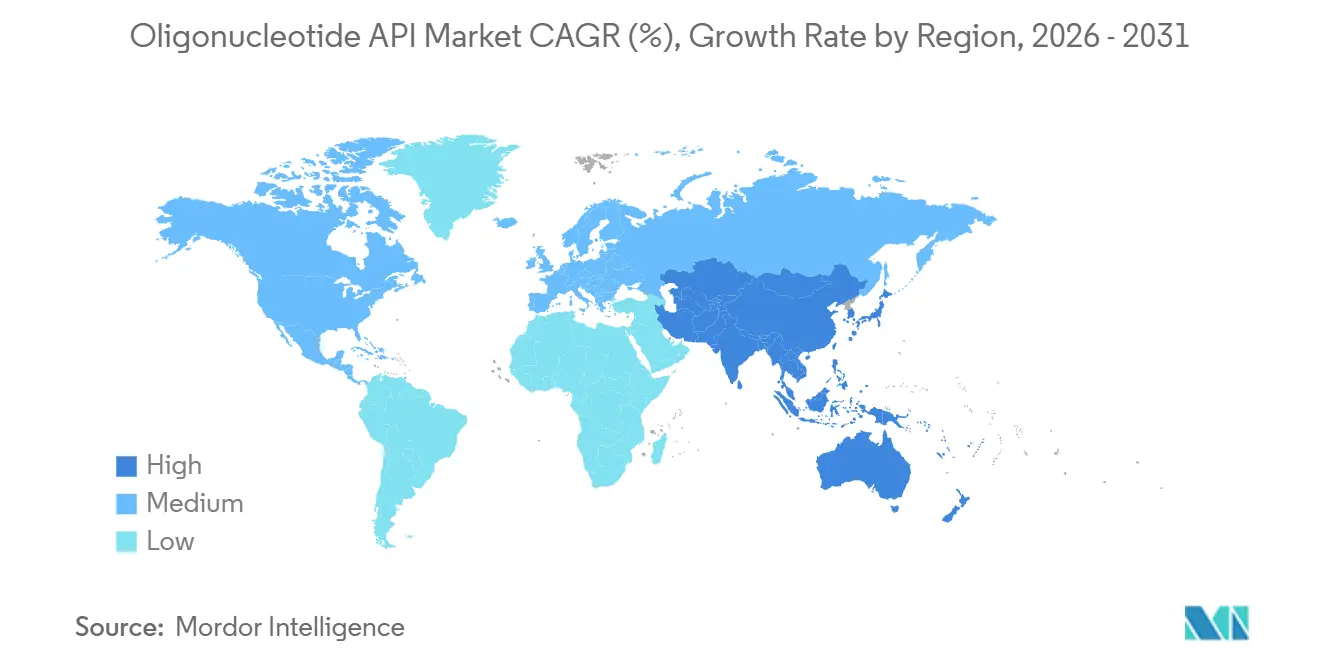
North America held 41.41% of oligonucleotide API revenue in 2025. The region combines FDA regulatory experience, a dense group of RNA-focused innovators, and established GMP facilities in Massachusetts, California, and North Carolina. This combination supports both development supply and commercial manufacturing. Regulatory precedent for oligonucleotide chemistry, manufacturing, and controls documentation is a practical advantage for suppliers serving United States-bound programs. Bachem is expanding its United States capacity through 2030 as part of its broader investment program. The oligonucleotide API market in North America also benefits from proximity between developers, analytical specialists, and manufacturing partners.
Europe is the second-largest regional base, with a technical cluster across Germany, Switzerland, and the United Kingdom. Its position is supported by experienced CDMOs and by being close to European regulatory expertise. BioSpring’s German facility is intended to add substantial manufacturing capability when it is completed in 2027. Germany and Switzerland remain important production centers because of their established technical infrastructure. The United Kingdom is also strengthening strategic biomanufacturing capacity under post-Brexit industrial priorities. These factors make Europe an important alternative supply base for sponsors seeking geographic diversity in the oligonucleotide API market.
Asia-Pacific is projected to be the fastest-growing region at 10.25% CAGR from 2026 to 2031. South Korea has become a significant production hub through ST Pharm’s manufacturing activity, while Nippon Shokubai’s planned tenfold expansion adds future capacity in Japan. Cohance Lifesciences announced an INR 230 million (USD 2.39 million) investment in a cGMP oligonucleotide facility in Hyderabad in August 2025. These investments support a wider regional manufacturing network for the oligonucleotide API market. South America, the Middle East, and Africa remain early-stage regions that rely more heavily on imports. Brazil’s pharmaceutical incentives and healthcare localization efforts in the Gulf Cooperation Council could support longer-term demand.
Competitive Landscape
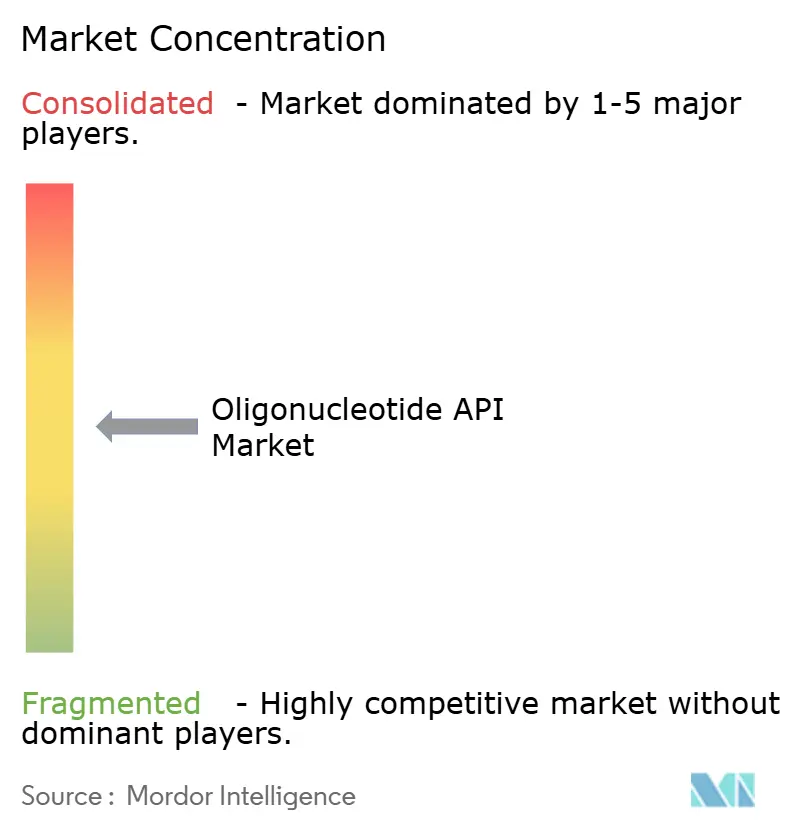
The oligonucleotide API market is moderately consolidated at the tier-1 level. Bachem, Lonza, BioSpring, ST Pharm, and Asymchem hold an important position in late-stage and commercial manufacturing, while a larger group of suppliers competes for research-grade and faster-turnaround work. Entry is constrained by the need for custom synthesizers, chromatography systems, solvent-handling infrastructure, and robust quality systems. Suppliers must also characterize complex impurity profiles and meet GMP documentation standards. These requirements make capital investment and technical experience central competitive factors. The oligonucleotide API market consequently favors companies that can provide consistent quality at multiple development stages.
Bachem’s Building K inauguration and continued investment program show a strategy built around increasing capacity across its manufacturing network. BioSpring’s planned German site shows a similar focus on expanding dedicated GMP infrastructure for nucleic acid APIs. Nippon Shokubai’s June 2025 plan for a tenfold GMP capacity expansion demonstrates the importance of scale in the oligonucleotide API market. Capacity alone is not sufficient because customers also need process development, analytical support, and dependable access to specialized monomers. Companies are therefore extending their work into conjugation technology and upstream material control. Geographic diversification is also becoming more relevant when sponsors seek to limit single-country supply exposure.
Oligonucleotide API Industry Leaders
-
WuXi AppTec Co., Ltd.
-
Nitto Denko Avecia Inc.
-
Bachem Holding AG
-
Agilent Technologies, Inc.
-
ST Pharm Co., Ltd.
- *Disclaimer: Major Players sorted in no particular order
Recent Industry Developments
- August 2026: Aurisco Pharmaceutical, a global manufacturer of oligonucleotide and peptide (TIDES) products, announced that its Yangzhou, China, facility passed a US FDA inspection, becoming the world’s first generic oligonucleotide API manufacturing site to do so.
- May 2026: ST Pharm signed an agreement valued at approximately USD 59.8 million to supply active pharmaceutical ingredients (APIs) for oligonucleotide therapeutics to a European pharmaceutical company.
Global Oligonucleotide API Market Report Scope
As per the scope of the report, an oligonucleotide API (active pharmaceutical ingredient) is a short, chemically synthesized strand of DNA or RNA designed to act on a specific genetic target. It may alter gene expression, block or modify RNA activity, or deliver genetic instructions.
The oligonucleotide API market is segmented by API type, manufacturing technology, application, status, end user, and geography. By API type, the oligonucleotide API market is segmented into antisense oligonucleotides, small interfering RNA APIs, phosphorodiamidate morpholino oligonucleotide APIs, microRNA mimics and inhibitors, aptamer APIs, and other emerging API types. By manufacturing technology, the market is segmented into solid-phase synthesis, liquid-phase synthesis, fragment condensation, enzymatic synthesis, and hybrid chemical-enzymatic synthesis. By application, the market is segmented into rare and genetic diseases, neurological and neuromuscular disorders, cardiovascular and metabolic diseases, oncology and immuno-oncology, infectious diseases and antiviral therapies, gene editing and gene regulation, and other applications. By status, the market is segmented into marketed APIs, clinical-trial APIs, and preclinical- and discovery-stage APIs. By end user, the market is segmented into pharmaceutical companies, biotechnology companies, contract research, development, and manufacturing organizations, academic and research institutes, and other end users. By geography, the market is segmented into North America, Europe, Asia-Pacific, the Middle East and Africa, and South America. The market report also covers the estimated market sizes and trends for 17 countries across major regions globally. For each segment, the market size and forecast are provided in terms of value (USD).
| Antisense Oligonucleotides |
| Small Interfering RNA APIs |
| Phosphorodiamidate Morpholino Oligonucleotide APIs |
| MicroRNA Mimics and Inhibitors |
| Aptamer APIs |
| Other Emerging Types |
| Solid-Phase Synthesis |
| Liquid-Phase Synthesis |
| Fragment Condensation |
| Enzymatic Synthesis |
| Hybrid Chemical-Enzymatic Synthesis |
| Rare and Genetic Diseases |
| Neurological and Neuromuscular Disorders |
| Cardiovascular and Metabolic Diseases |
| Oncology and Immuno-Oncology |
| Infectious Diseases and Antiviral Therapies |
| Gene Editing and Gene Regulation |
| Other Applications |
| Marketed APIs |
| Clinical-Trial APIs |
| Preclinical and Discovery-Stage APIs |
| Pharmaceutical Companies |
| Biotechnology Companies |
| Contract Research and Development Manufacturing Organizations |
| Academic and Research Institutes |
| Other End Users |
| North America | United States |
| Canada | |
| Mexico | |
| Europe | Germany |
| United Kingdom | |
| France | |
| Italy | |
| Spain | |
| Rest of Europe | |
| Asia-Pacific | China |
| Japan | |
| India | |
| Australia | |
| South Korea | |
| Rest of Asia-Pacific | |
| Middle East and Africa | GCC |
| South Africa | |
| Rest of Middle East and Africa | |
| South America | Brazil |
| Argentina | |
| Rest of South America |
| By API Type | Antisense Oligonucleotides | |
| Small Interfering RNA APIs | ||
| Phosphorodiamidate Morpholino Oligonucleotide APIs | ||
| MicroRNA Mimics and Inhibitors | ||
| Aptamer APIs | ||
| Other Emerging Types | ||
| By Manufacturing Technology | Solid-Phase Synthesis | |
| Liquid-Phase Synthesis | ||
| Fragment Condensation | ||
| Enzymatic Synthesis | ||
| Hybrid Chemical-Enzymatic Synthesis | ||
| By Application | Rare and Genetic Diseases | |
| Neurological and Neuromuscular Disorders | ||
| Cardiovascular and Metabolic Diseases | ||
| Oncology and Immuno-Oncology | ||
| Infectious Diseases and Antiviral Therapies | ||
| Gene Editing and Gene Regulation | ||
| Other Applications | ||
| By Status | Marketed APIs | |
| Clinical-Trial APIs | ||
| Preclinical and Discovery-Stage APIs | ||
| By End User | Pharmaceutical Companies | |
| Biotechnology Companies | ||
| Contract Research and Development Manufacturing Organizations | ||
| Academic and Research Institutes | ||
| Other End Users | ||
| By Geography | North America | United States |
| Canada | ||
| Mexico | ||
| Europe | Germany | |
| United Kingdom | ||
| France | ||
| Italy | ||
| Spain | ||
| Rest of Europe | ||
| Asia-Pacific | China | |
| Japan | ||
| India | ||
| Australia | ||
| South Korea | ||
| Rest of Asia-Pacific | ||
| Middle East and Africa | GCC | |
| South Africa | ||
| Rest of Middle East and Africa | ||
| South America | Brazil | |
| Argentina | ||
| Rest of South America | ||
Key Questions Answered in the Report
How large is the oligonucleotide API market?
It is projected to grow from USD 5.59 billion in 2026 to USD 8.21 billion by 2031 at a 7.98% CAGR.
Which API type has the largest revenue position?
Antisense oligonucleotides led API-type revenue with 55.31% in 2025, supported by use across rare, neuromuscular, metabolic, and cardiovascular conditions.
Which technology is growing fastest for oligonucleotide production?
Hybrid chemical-enzymatic synthesis is forecast to grow at 13.42% CAGR through 2031 because it can help address scale and purification limits for longer sequences.
Why are conjugated oligonucleotides important?
GalNAc and other conjugation approaches can improve tissue targeting and support subcutaneous dosing, but they also increase process-development and purity-control requirements.
Which region is expected to grow fastest through 2031?
Asia-Pacific is forecast to grow at 10.25% CAGR from 2026 to 2031, supported by manufacturing investment in South Korea, Japan, and India.
What are the main manufacturing barriers?
Purification costs, practical yield limits, specialized monomer supply, solvent intensity, and limited standardization for long sequences remain the key barriers.