
Oilseed Processing Market Size and Share
Market Overview
| Study Period | 2021 - 2031 |
|---|---|
| Market Size (2026) | USD 354.90 Billion |
| Market Size (2031) | USD 459.90 Billion |
| Growth Rate (2026 - 2031) | 5.32 % |
| Fastest Growing Market | Asia-Pacific |
| Largest Market | Asia-Pacific |
| Market Concentration | Low |
Major Players *Disclaimer: Major Players sorted in no particular order Image © Mordor Intelligence. Reuse requires attribution under CC BY 4.0. | |
Oilseed Processing Market Analysis by Mordor Intelligence
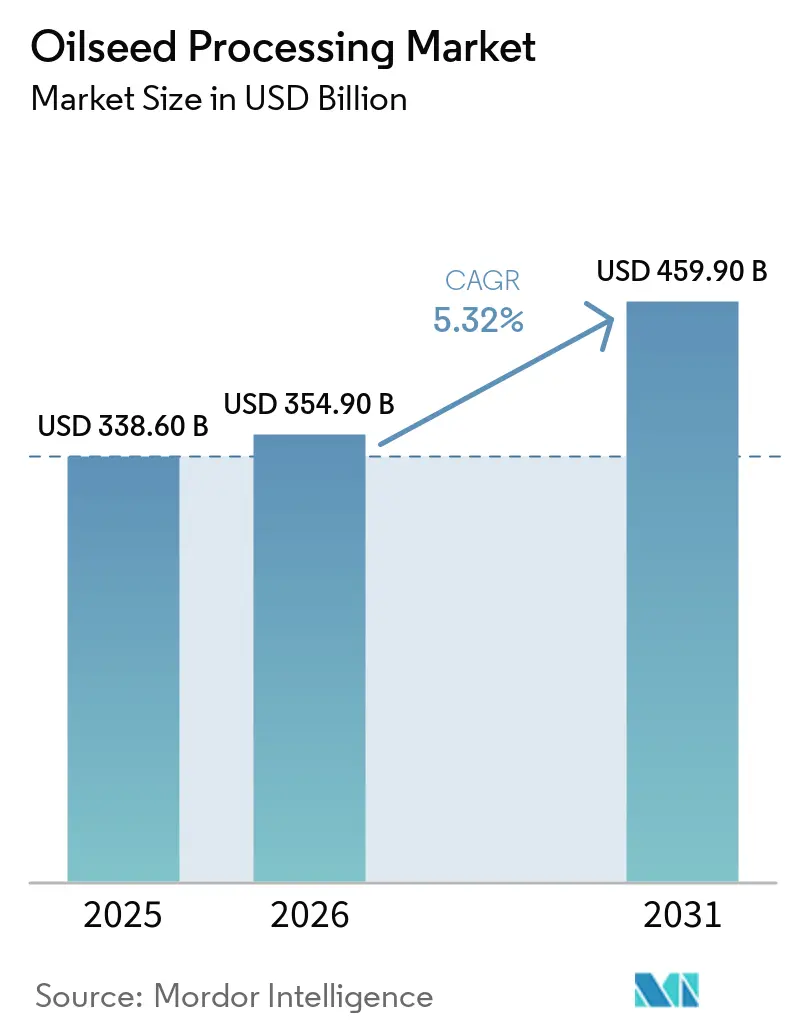
The oilseed processing market size was valued at USD 338.60 billion in 2025 and is estimated to grow from USD 354.90 billion in 2026 to reach USD 459.90 billion by 2031, at a CAGR of 5.32% during the forecast period (2026-2031). Demand for edible oils and protein meal continues to support processing volumes across major consuming regions. Renewable fuel policies are also increasing demand for vegetable oils as feedstocks for transport fuels. Integrated agribusinesses are adding crushing, refining, and logistics capacity in South America, Asia-Pacific, and North America. According to the United States Department of Agriculture, United States soybean crush capacity increased by more than 20% from the 2020/21 to 2025/26 marketing years, reaching more than 3 billion bushels. These investments indicate that processors are planning capacity around longer-term demand for food, feed, fuel, and specialty ingredients.
Key Report Takeaways
- By oilseed type, soybean accounted for 49.9% of the oilseed processing market share in 2025, while groundnut is forecast to grow at a CAGR of 7.4% from 2026 to 2031.
- By product, meal and cake accounted for 60.0% of the oilseed processing market size in 2025, while crude and refined oil are forecast to grow at a CAGR of 5.6% from 2026 to 2031.
- By application, food and beverages accounted for 46.6% of the market share in 2025, while animal feed is forecast to grow at a CAGR of 5.7% from 2026 to 2031.
- By geography, the Asia-Pacific accounted for 47.2% of the market share in 2025 and is forecast to grow at a CAGR of 6.0% from 2026 to 2031.
Note: Market size and forecast figures in this report are generated using Mordor Intelligence’s proprietary estimation framework, updated with the latest available data and insights as of January 2026.
Global Oilseed Processing Market Trends and Insights
Drivers Impact Analysis*
| Driver | (~) % Impact on CAGR Forecast | Geographic Relevance | Impact Timeline |
|---|---|---|---|
| Rising Edible-Oil, Protein-Meal, and Biofuel Demand | +1.3% | Global, especially China, India, Indonesia, and Brazil | Short term (≤ 2 years) |
| Expansion of Regional Crushing and Refining Capacity | +1.1% | Asia-Pacific, South America, and North America | Medium term (2-4 years) |
| Higher Value Capture From Oilseed Co-Products | +0.7% | North America, Europe, and Asia-Pacific | Medium term (2-4 years) |
| Low-Carbon Feedstock Demand for Renewable Diesel and Sustainable Aviation Fuel | +1% | North America and Europe, with early demand in Japan and South Korea | Short term (≤ 2 years) |
| Traceable Non-GMO, Organic, and Specialty Oilseed Products | +0.5% | Europe and North America, with demand emerging in Japan, South Korea, and Australia | Medium term (2-4 years) |
| Digital Optimization of Crush Margins, Energy Use, and Plant Utilization | +0.4% | Global, led by North America, Germany, and China | Long term (≥ 4 years) |
| Source: Mordor Intelligence | |||
Rising Edible Oil, Protein Meal, and Biofuel Demand
The oilseed processing market benefits from demand for edible oils, protein meal, and biofuel feedstocks. Rising incomes and urbanization are increasing the consumption of oils and protein-rich foods in Asia and sub-Saharan Africa. Biofuel mandates add demand that does not depend solely on food consumption cycles. The United States Environmental Protection Agency released the Set 2 rule in March 2026 with record Renewable Volume Obligations for 2026 and 2027. United States soybean oil use for biomass-based diesel is forecast to reach 17.8 billion pounds in the 2026/27 marketing year, 25% higher than the prior year.[1]U.S. Department of Agriculture Economic Research Service, “Oil Crops Outlook May 2026,” U.S. Department of Agriculture, ers.usda.govThe simultaneous expansion of demand for food, feed, and biofuels increases the number of end-use markets for processed oilseeds, supporting higher utilization of crushing capacity and creating sustained demand for edible oils, protein meal, and biofuel feedstocks.
Expansion of Regional Crushing and Refining Capacity
The oilseed processing market is attracting capacity investments as producers and processors seek to capture more value locally through crushing and refining rather than exporting raw oilseeds. According to the Brazilian Association of Vegetable Oil Industries (ABIOVE), Brazilian oilseed processors are projected to invest BRL 5.9 billion (USD 1.12 billion) in processing capacity in 2026, supporting an estimated expansion of 18,850 tonnes per day in installed capacity[2]Associação Brasileira das Indústrias de Óleos Vegetais, “ABIOVE Atualiza Projeções Do Complexo Soja Para 2026,” ABIOVE, abiove.org.br. The expansion of processing infrastructure, particularly in major oilseed-producing regions, can improve the efficiency of converting locally produced oilseeds into higher-value oils and protein meals, strengthening supply for food, feed, and biofuel applications and supporting growth in the oilseed processing market.
Higher Value Capture from Oilseed Co-Products
The oilseed processing market increasingly depends on revenues and efficiencies beyond crude oil and meal. Lecithin, phospholipids, hulls, glycerin, and specialty proteins give processors more ways to utilize each ton of feedstock. Pharmaceutical-grade phospholipids can serve drug delivery, infant nutrition, and specialized food applications, but these higher-value products require traceability, quality systems, and processing capabilities that commodity plants may lack. Cargill, Incorporated, is investing USD 150 million in its Saint-Nazaire, France, facility to expand sunflower processing and use sunflower hulls in a biomass boiler. The project is expected to reduce annual carbon dioxide emissions by 20,000 metric tons and natural gas use by more than 100 gigawatt-hours. By converting sunflower hulls, a processing co-product, into a biomass energy input, Cargill, Incorporated can derive additional utility from the same feedstock while reducing reliance on natural gas[3]Cargill, “Cargill Invests USD 150 Million To Expand Sunflower Processing In France,” Cargill, cargill.com. Such integrated utilization of co-products can improve processing economics, encourage investment in higher-value processing capabilities, and support greater value capture across the oilseed processing chain.
Low-Carbon Feedstock Demand for Renewable Diesel and Sustainable Aviation Fuel
Renewable diesel and sustainable aviation fuel are creating an additional demand channel for vegetable oils, linking oilseed processing more closely with the expansion of low-carbon fuel production. In the United States, renewable diesel operating capacity increased from 0.9 billion gallons in January 2021 to 5 billion gallons in December 2025, expanding the potential requirement for vegetable oil feedstocks. The United States Section 45Z Clean Fuel Production Credit, which is available for qualifying clean transportation fuel sold through December 2029, further supports this demand by linking the credit amount to the fuel's emissions factor, thereby creating an economic incentive for lower-carbon fuel production and feedstock choices. In addition, according to the United States Department of Agriculture, United States canola oil use for biofuel production reached 3.8 billion pounds in the 2025/26 marketing year, with the increase reflecting growing demand from biomass-based diesel production. Together, expanding renewable fuel capacity, carbon-linked incentives, and rising vegetable oil use in biofuels create an additional outlet for oilseed-derived feedstocks, strengthening demand for processed vegetable oils and supporting investment in oilseed crushing and processing capacity.
Restraints Impact Analysis*
| Restraint | (~) % Impact on CAGR Forecast | Geographic Relevance | Impact Timeline |
|---|---|---|---|
| Oilseed Commodity Price and Crush-Margin Volatility | -1.3% | Global, especially export-focused South America and import-dependent Asia | Short term (≤ 2 years) |
| Weather, Water Stress, and Crop-Yield Variability | -1% | South America, South and Southeast Asia, and sub-Saharan Africa | Medium term (2-4 years) |
| High Energy, Solvent, Compliance, and Logistics Costs | -0.8% | Middle East, Africa, Europe, and inland South American corridors | Medium term (2-4 years) |
| Deforestation, Land-Use, Traceability, and Carbon-Accounting Exposure | -0.6% | Europe, Brazil, Argentina, Indonesia, and Malaysia | Long term (≥ 4 years) |
| Source: Mordor Intelligence | |||
Oilseed Commodity Price and Crush-Margin Volatility
Crush margins change when feedstock costs and product prices move at different speeds, creating uncertainty in processor profitability. Abundant global grain and oilseed supplies pressured crop prices and processing margins for some processors in early 2026, despite relatively strong processing volumes. Energy and fertilizer supply disruptions also added to operating and input-cost pressures during the first quarter of 2026. The timing gap between oilseed procurement and revenue realization from refined oils, protein meal, and other co-products means that sudden commodity price changes can compress margins when product prices do not adjust at the same pace. This volatility can affect inventory levels, production schedules, and plant utilization, particularly for processors with limited pricing flexibility or working capital buffers. Multi-origin sourcing and adequate working capital can reduce exposure when trade conditions shift quickly. However, persistent volatility in feedstock and processing costs can make margins less predictable, increase financial risk, and constrain investment and capacity-utilization decisions across the oilseed processing market.
Weather, Water Stress, and Crop-Yield Variability
The oilseed processing market relies on consistent crop availability across several producing regions. Drought, changing rainfall patterns, and water stress can reduce oilseed yields and raise procurement costs. South American production is exposed to drought cycles and La Niña conditions, while South and Southeast Asian supply remains dependent on monsoon patterns. Sub-Saharan African production faces similar weather-related constraints in smaller local supply chains. Yield losses in major producing regions can tighten oilseed availability for processors, increasing competition for raw materials and putting upward pressure on feedstock prices. Weather-related disruptions can also reduce plant utilization when processors cannot secure sufficient volumes at economically viable prices. Processing plants may therefore need broader sourcing arrangements when local harvests are weaker than expected, increasing procurement and logistics complexity. As climate-related production variability affects both the availability and cost of oilseeds, processors face greater feedstock-price and capacity-utilization risks, which can constrain margins and limit the efficiency of processing operations.
*Our forecasts treat driver/restraint impacts as directional, not additive. The impact forecasts reflect baseline growth, mix effects, and variable interactions.
Segment Analysis
By Oilseed Type: Soybean Maintains Scale While Groundnut Expands
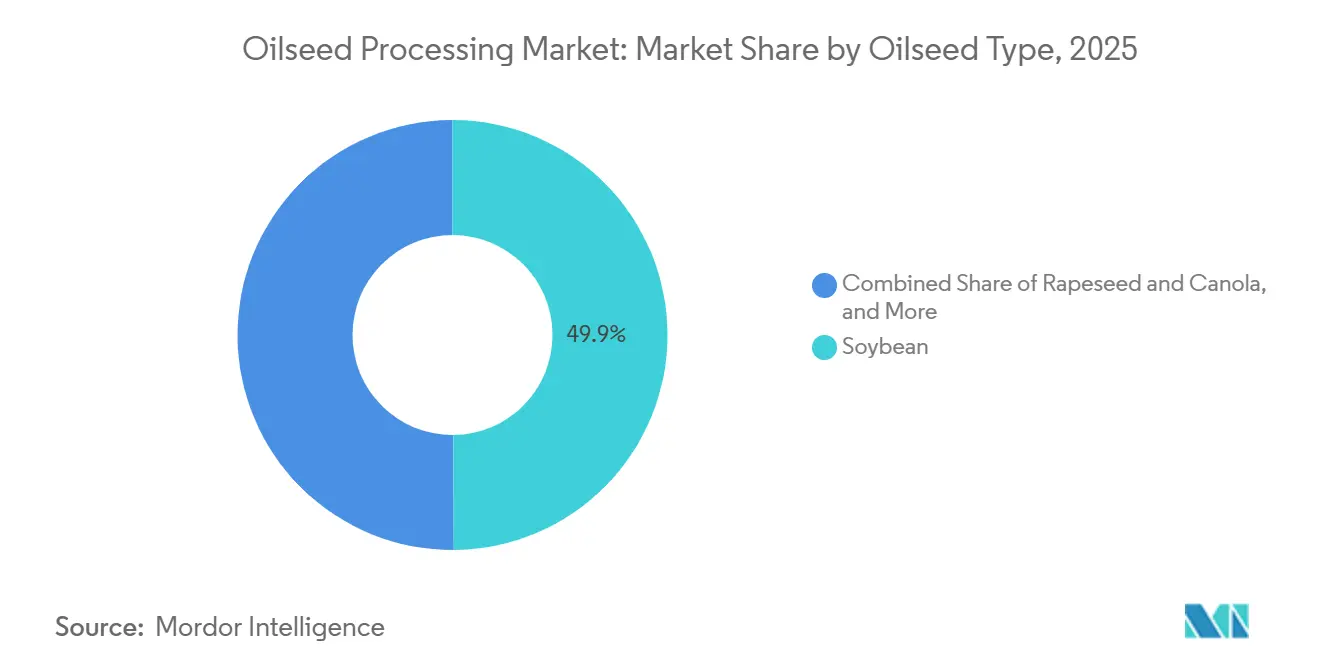
Soybean accounted for 49.9% of the market share in 2025, supported by extensive crushing, export, and meal-trading infrastructure. Dedicated crush plants and standardized meal specifications support its broad use in food, feed, and fuel. Rapeseed and canola play an important role in European renewable fuel supply chains. Sunflower seed supports edible oil markets in Eastern Europe, North Africa, and the Middle East. Palm kernel processing remains connected to tropical oil supply chains in Southeast Asia. Cottonseed, corn germ, and other specialty oilseeds serve smaller regional and integrated processing uses.
Groundnut is the fastest-growing oilseed type and is forecast to grow at a CAGR of 7.4% from 2026 to 2031. India's exports of raw peanuts to China were valued at approximately USD 54.3 million in 2025, according to United Nations Comtrade data, demonstrating an established bilateral trade channel without relying on the earlier half-year growth comparison. Demand for both oil and protein meal improves the economics of groundnut crushing, while groundnut oil also serves premium food applications. Dedicated groundnut processing lines allow processors to maintain product identity, meet quality requirements, and serve domestic and export buyers, supporting the expansion of groundnut processing capacity.



By Product: Meal and Cake Lead, While Crude and Refined Oil Gains from Fuel Demand
Meal and cake accounted for 60.0% of the oilseed processing market in 2025, supported by their large-scale production as co-products of oil extraction and sustained demand from poultry, swine, and aquaculture feed manufacturers. High-protein meal provides an important source of protein in compound feed formulations, while established trading and distribution networks support its use across major livestock-producing regions. Crude and refined oil is forecast to grow at a CAGR of 5.6% from 2026 to 2031, supported by renewable fuel mandates in North America and Europe and rising demand from renewable diesel and sustainable aviation fuel producers. Long-term supply agreements with fuel producers can provide crushers with greater demand visibility and support higher utilization of oilseed processing capacity. Meal and cake continue to provide relatively stable offtake alongside oil production, making the ability to manage oil and meal sales together important for processor economics.
Lecithin and phospholipids provide higher-value applications within the product mix, including food, animal nutrition, and pharmaceutical uses. In May 2025, Cargill, Incorporated announced that its Ponta Grossa, Brazil facility had started producing feed-grade lecithin for animal nutrition, particularly fish feed, while the facility already produced technical-grade lecithin. Hulls, fiber, and biomass can also be utilized as energy inputs, while glycerin from biodiesel production and specialty modification outputs provide additional product streams. These applications enable processors to extract greater value from oilseed inputs and support the development of more integrated processing complexes.
By Application: Food and Beverages Lead, While Animal Feed Is the Fastest-Growing Segment
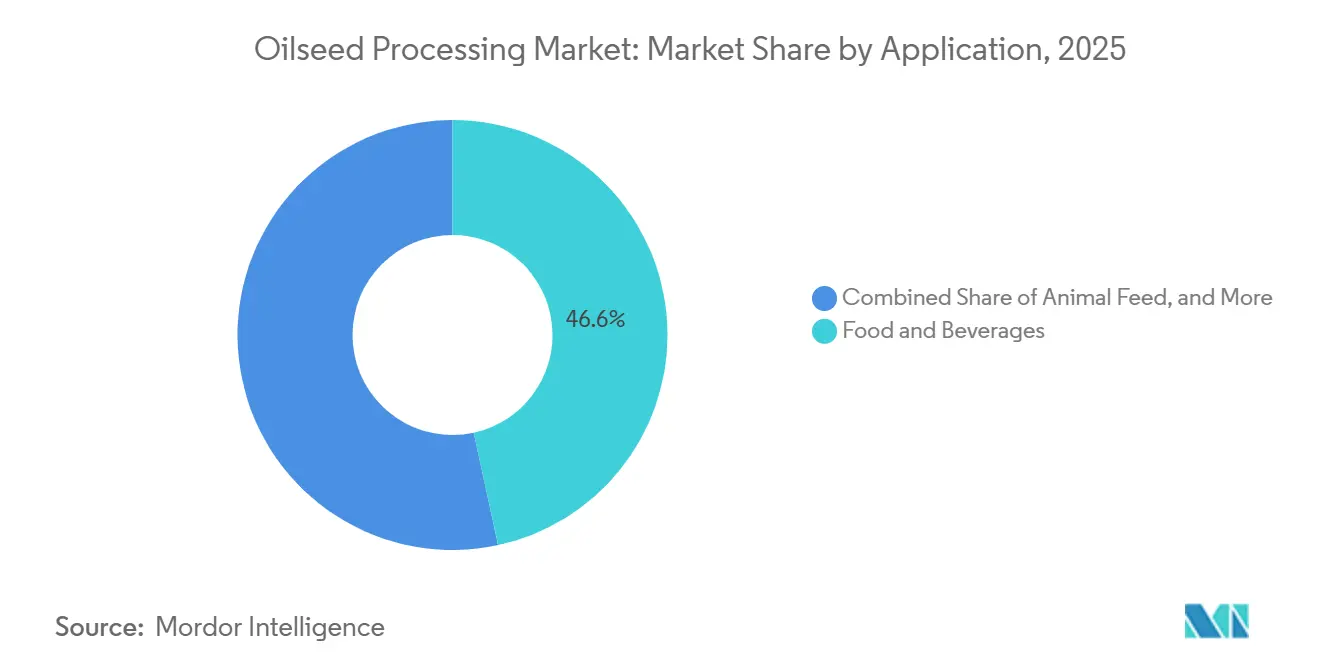
Food and beverages accounted for 46.6% of the market share in 2025. Cooking oils remain a staple input for households and food manufacturers. Packaged-food production is growing in parts of Asia and Africa as diets change. According to the United States Department of Agriculture Foreign Agricultural Service (USDA FAS), India’s food processing sector was valued at approximately USD 355 billion in 2024 and is projected to expand by about 22.7% by 2026 compared to 2024, while packaged-food demand reached an estimated USD 116 billion in 2025. This growth raises demand for refined oils, specialty fats, and lecithin ingredients. Specialty food applications include non-GMO oils, high-oleic varieties, and identity-preserved fats, which require consistent quality, separate handling, and can provide higher returns than undifferentiated bulk refined oil.
Animal feed is forecast to expand at a 5.7% CAGR from 2026 to 2031. Soybean meal, groundnut meal, and canola meal are key protein ingredients in feed rations, with poultry, swine, and aquaculture producers relying on these meals for cost-effective protein. Biofuel demand is more sensitive to policy decisions than food and feed demand. Indonesia implemented the B50 biodiesel mandate in July 2026, requiring a 50% palm-oil-based biodiesel blend in diesel. Oleochemicals and industrial uses add demand from personal care, lubricants, and bio-based polymers. The oilseed processing market serves these applications through refined oils and fatty-acid derivatives, broadening demand beyond food and feed uses.
Geography Analysis
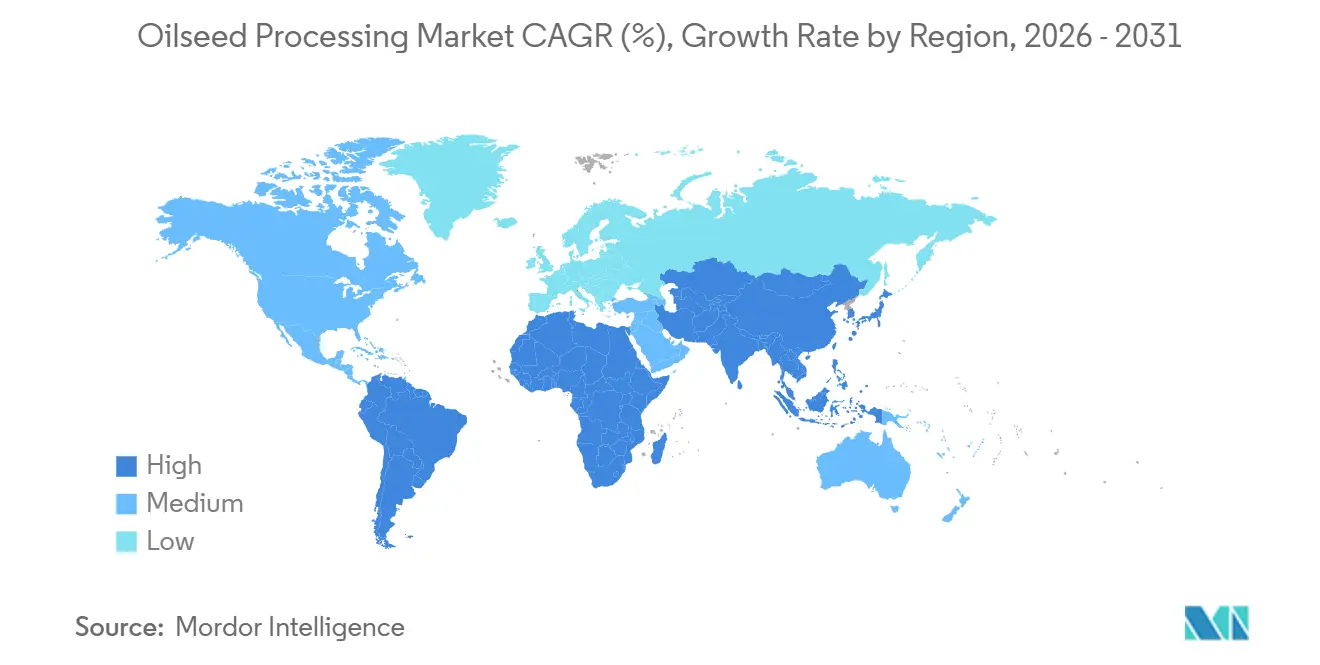
Asia-Pacific accounted for 47.2% of the market share in 2025 and is the fastest-growing region, with a CAGR of 6.0% from 2026 to 2031. China’s large soybean crushing industry and India’s extensive edible-oil refining base support the region’s dominant position. China’s soybean crush reached approximately 103 million metric tons in MY 2024/25, supported by its large feed industry and high soybean import volumes. India imported approximately 16.1 million metric tons of edible oils in 2024/25, highlighting the country’s continued dependence on imported oils and supporting domestic refining and processing activity. Vietnam, Indonesia, and Malaysia connect palm kernel, soybean, and copra supply chains, supporting the region’s role in oilseed processing and vegetable-oil production.
South America remains a major processing and export hub, led by Brazil and Argentina. According to the Brazilian Association of Vegetable Oil Industries (ABIOVE), Brazil’s oilseed processing capacity reached 76.4 million metric tons in 2025, while soybean crushing reached 58.5 million metric tons. Argentina also maintains a large soybean crushing industry linked to its meal and oil export markets. These processing bases allow South American producers to convert large domestic oilseed supplies into edible oils, protein meal, and biofuel feedstocks for both domestic and international markets. North America has an established oilseed processing base, supported by soybean and canola crushing industries. In Canada, total canola processing reached 11.6 million metric tons in 2025, producing approximately 4.9 million metric tons of canola oil and 6.8 million metric tons of canola meal. The region's processing infrastructure serves food, feed, and renewable fuel markets, while continued investment in domestic crushing supports greater utilization of locally produced oilseeds.
Europe has established rapeseed and sunflower crushing capacity, as well as specialty fat and lecithin processing capabilities. Germany and France support rapeseed processing for food and biodiesel applications. The Netherlands and Poland serve as distribution and further-processing centers for imported soy products. Russia supplies and processes sunflower seed to meet domestic edible oil demand. Saudi Arabia and the United Arab Emirates mainly refine and re-export imported crude vegetable oils. South Africa and Nigeria have established oilseed-processing sectors, while Egypt is adding local crushing and refining capacity. Wilmar International Limited commissioned a refinery and fractionation plant in South Africa in 2025. Morocco benefits from proximity to European specialty-oil buyers. Together, these regional processing and refining hubs connect major oilseed-producing areas with food, feed, biofuel, and industrial end-use markets, supporting the global expansion of oilseed processing.

Competitive Landscape
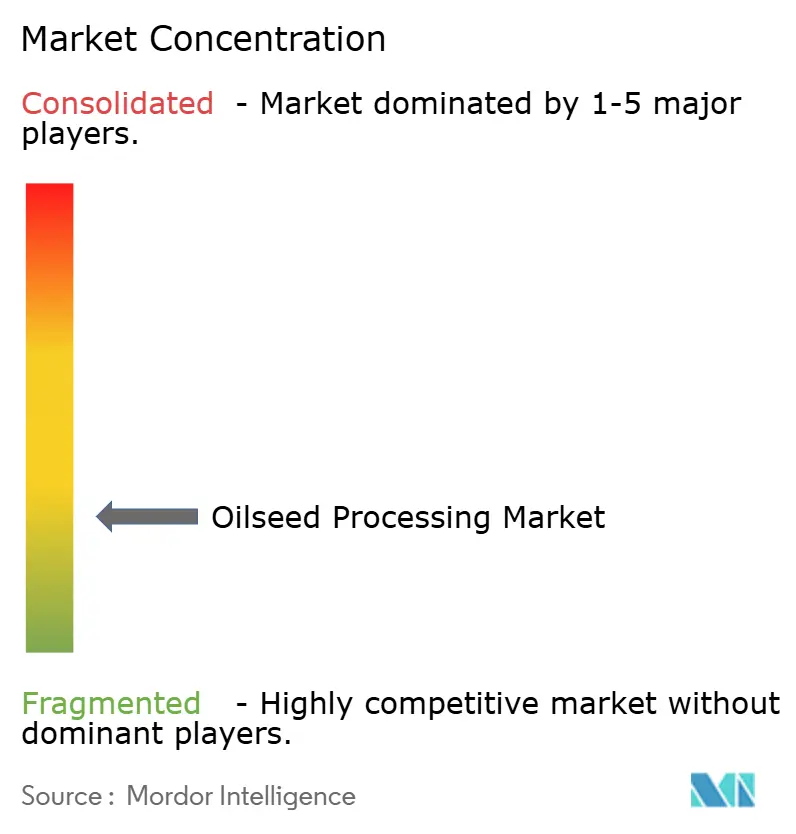
The oilseed processing market is moderately fragmented, with Archer Daniels Midland Company, Bunge Limited, Cargill, Incorporated, Wilmar International Limited, and Louis Dreyfus company B.V. among the key players. The remaining revenue is distributed among state-owned enterprises, farmer cooperatives, regional processors, and integrated consumer brands. Integrated companies can manage sourcing, crushing, refining, and distribution within a single operating system, reducing exposure to price swings that affect standalone crushers. Wilmar International Limited’s core net profit rose 10% in the first half of 2026, reflecting the value of broad operations across oilseeds, grains, processing, and distribution.
Bunge Limited completed its merger with Viterra in July 2025, adding grain-handling and export capacity to its processing network. The combined structure strengthens the company’s position from oilseed origination through processed-product distribution. Archer Daniels Midland Company announced USD 100 million of targeted investments at four United States crushing facilities in July 2026. The projects are designed to add 700,000 metric tons of annual crushing capacity. Cargill, Incorporated announced a USD 150 million sunflower-processing upgrade in France during April 2026. These moves show that major companies are expanding capacity while improving co-product recovery and energy efficiency.
AAK AB and Fuji Oil Holdings Inc. compete through specialty fats and soy-protein ingredients, with their product focus providing access to applications that require dedicated production lines and quality systems. Smaller processors can also compete through specialized products and local supply relationships. Enzyme-assisted extraction and predictive process control may be adopted through equipment suppliers and technology partners. Small modular crushing units can be relevant in oilseed-deficit regions where large solvent plants are not viable. Sub-Saharan Africa, parts of South Asia, and Central America have such local processing opportunities.
Oilseed Processing Industry Leaders
Archer Daniels Midland Company
Bunge Limited
Cargill, Incorporated
Wilmar International Limited
Louis Dreyfus Company B.V.
- *Disclaimer: Major Players sorted in no particular order

Recent Industry Developments
- July 2026: Archer Daniels Midland Company (ADM) announced targeted investments at 4 United States oilseed crush facilities in Frankfort, Indiana, Deerfield, Missouri, Lincoln, Nebraska, and Spiritwood, North Dakota. The projects are designed to add 700,000 metric tons of annual crush capacity at a cost of USD 100 million. They are expected to finish between mid-2028 and early 2029.
- March 2026: The United States Environmental Protection Agency released the Set 2 rule with Renewable Volume Obligations for 2026 and 2027. The rule reallocates 70% of small refinery exemptions and supports demand for domestic vegetable-oil feedstocks.
- December 2025: The Bunge Limited-Wilmar International Limited joint venture Vietnam Agribusiness Limited inaugurated a second soybean crushing line at its Phu My 1 Industrial Park facility. The project brought total capacity to 7,800 metric tons per day.


Global Oilseed Processing Market Report Scope
Oilseed processing is the conversion of oil-bearing seeds and other oil-rich feedstocks into crude and refined oils, protein-rich meals, and other co-products through processes such as mechanical pressing, solvent extraction, and refining. It enables the recovery and processing of valuable components from soybeans, rapeseed and canola, sunflower seeds, groundnuts, cottonseed, palm kernels, corn germ, and other oilseeds for use in food and beverages, animal feed, biofuels, oleochemicals, and other industrial applications.
The Oilseed Processing Market Report is Segmented by Oilseed Type (Soybean, Rapeseed and Canola, Sunflower Seed, Cottonseed, Groundnut, Palm Kernel, Corn Germ, and Other Oilseeds), by Product (Crude and Refined Oil, Meal and Cake, Hulls, Fiber, and Biomass, and Other Product), by Application (Food and Beverages, Animal Feed, Biofuels, Oleochemicals, and Industrial and Technical Uses), and by Geography (North America, South America, Europe, Asia-Pacific, Middle East, Africa). The Market Forecasts are Provided in Terms of Value (USD).
| Soybean |
| Rapeseed and Canola |
| Sunflower Seed |
| Cottonseed |
| Groundnut |
| Palm Kernel |
| Corn Germ |
| Other Oilseeds |
| Crude and Refined Oil |
| Meal and Cake |
| Lecithin and Phospholipids |
| Hulls, Fiber, and Biomass |
| Other Product |
| Food and Beverages |
| Animal Feed |
| Biofuels |
| Oleochemicals |
| Industrial and Technical Uses |
| North America | United States |
| Canada | |
| Mexico | |
| Rest of North America | |
| South America | Brazil |
| Argentina | |
| Colombia | |
| Rest of South America | |
| Europe | Germany |
| France | |
| Italy | |
| Spain | |
| United Kingdom | |
| Netherlands | |
| Poland | |
| Russia | |
| Rest of Europe | |
| Asia-Pacific | China |
| India | |
| Japan | |
| Indonesia | |
| Malaysia | |
| South Korea | |
| Australia | |
| Rest of Asia-Pacific | |
| Middle East | Saudi Arabia |
| United Arab Emirates | |
| Turkey | |
| Rest of Middle East | |
| Africa | South Africa |
| Egypt | |
| Nigeria | |
| Morocco | |
| Rest of Africa |
| By Oilseed Type | Soybean | |
| Rapeseed and Canola | ||
| Sunflower Seed | ||
| Cottonseed | ||
| Groundnut | ||
| Palm Kernel | ||
| Corn Germ | ||
| Other Oilseeds | ||
| By Product | Crude and Refined Oil | |
| Meal and Cake | ||
| Lecithin and Phospholipids | ||
| Hulls, Fiber, and Biomass | ||
| Other Product | ||
| By Application | Food and Beverages | |
| Animal Feed | ||
| Biofuels | ||
| Oleochemicals | ||
| Industrial and Technical Uses | ||
| By Geography | North America | United States |
| Canada | ||
| Mexico | ||
| Rest of North America | ||
| South America | Brazil | |
| Argentina | ||
| Colombia | ||
| Rest of South America | ||
| Europe | Germany | |
| France | ||
| Italy | ||
| Spain | ||
| United Kingdom | ||
| Netherlands | ||
| Poland | ||
| Russia | ||
| Rest of Europe | ||
| Asia-Pacific | China | |
| India | ||
| Japan | ||
| Indonesia | ||
| Malaysia | ||
| South Korea | ||
| Australia | ||
| Rest of Asia-Pacific | ||
| Middle East | Saudi Arabia | |
| United Arab Emirates | ||
| Turkey | ||
| Rest of Middle East | ||
| Africa | South Africa | |
| Egypt | ||
| Nigeria | ||
| Morocco | ||
| Rest of Africa | ||


Key Questions Answered in the Report
What is the oilseed processing market size in 2026?
The oilseed processing market is estimated at USD 354.90 billion in 2026 and is forecast to reach USD 459.90 billion by 2031, growing at a CAGR of 5.32% during the forecast period.
What is driving demand for oilseed processing?
Edible oils, protein meal, renewable diesel, sustainable aviation fuel, and capacity investments are supporting demand.
Which region leads global oilseed processing?
Asia-Pacific led with a 47.2% share in 2025, supported by China’s crushing base and India’s refining demand.
Which oilseed type is growing fastest?
Groundnut is forecast to grow at a 7.4% CAGR through 2031, supported by oil and protein-meal demand in India and China.
What is the leading application for processed oilseeds?
Food and beverages led with 46.6% of share in 2025, while animal feed is the fastest-growing application.
Page last updated on:





