
Occupational and Physical Therapy Services Market Size and Share
Market Overview
| Study Period | 2020 - 2031 |
|---|---|
| Market Size (2026) | USD 70.42 Billion |
| Market Size (2031) | USD 109.60 Billion |
| Growth Rate (2026 - 2031) | 9.25 % |
| Fastest Growing Market | Asia-Pacific |
| Largest Market | North America |
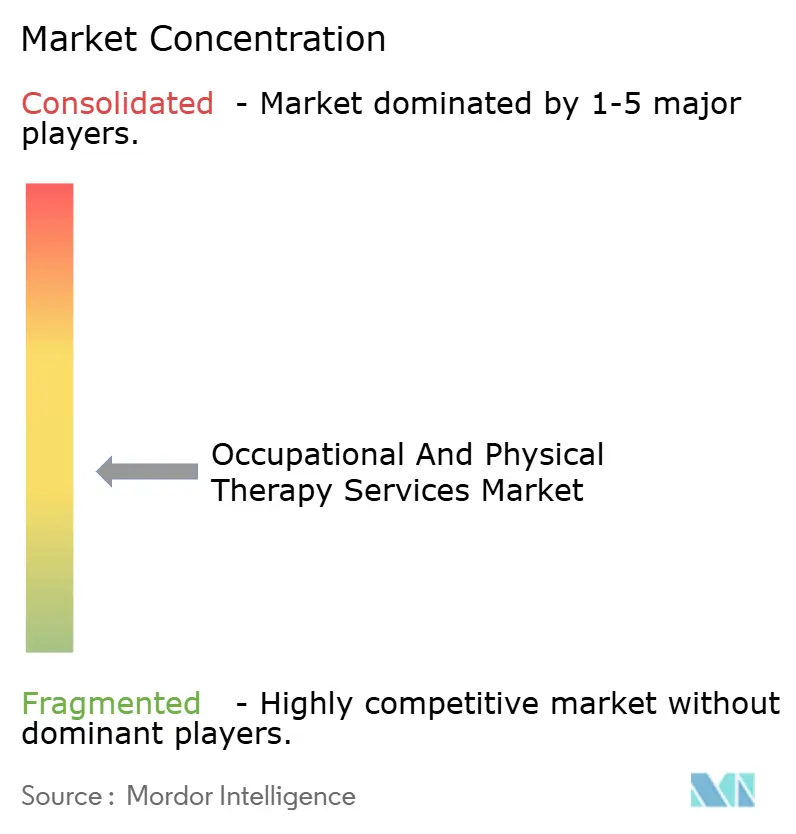
| Market Concentration | Medium |
Major Players *Disclaimer: Major Players sorted in no particular order Image © Mordor Intelligence. Reuse requires attribution under CC BY 4.0. | |
Occupational and Physical Therapy Services Market Analysis by Mordor Intelligence
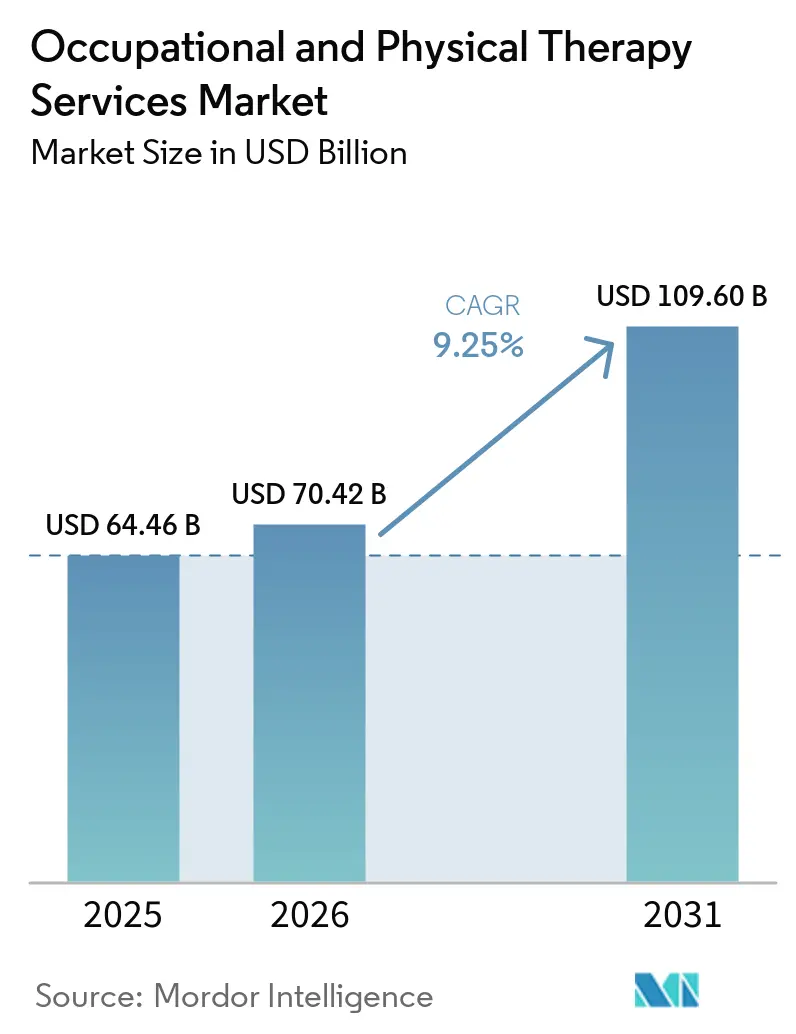
The Occupational And Physical Therapy Services Market size was valued at USD 64.46 billion in 2025 and is estimated to grow from USD 70.42 billion in 2026 to reach USD 109.60 billion by 2031, at a CAGR of 9.25% during the forecast period (2026-2031).
Structural spending is tilting toward preventive and rehabilitative care as payors try to curb downstream surgical costs, while permanent tele-rehabilitation reimbursement, artificial-intelligence triage, and employer-sponsored musculoskeletal programs keep the occupational and physical therapy services market on a fast-growth trajectory. The U.S. Bureau of Labor Statistics projects 14% employment growth for physical therapists and 11% for occupational therapists from 2023-2033, confirming that labor supply is expanding in tandem with demand. Hybrid care that blends in-person visits with virtual coaching is gaining traction after a 2025 randomized controlled trial showed non-inferior outcomes at 35% lower cost. At the same time, an aging population, rising sports-injury incidence, and rapid clinic expansion in Asia-Pacific position the occupational and physical therapy services market for durable, geographically balanced growth.
Key Report Takeaways
- By payor, public health plans captured 51.56% revenue in 2025, while private health insurance is advancing at a 10.25% CAGR through 2031, the fastest among funding sources.
- By application, orthopedic therapy led with 38.53% of occupational and physical therapy services market share in 2025; sports-injury therapy is on track for a 10.85% CAGR to 2031.
- By setting, outpatient clinics generated 45.63% revenue in 2025, but home-care venues are expanding at an 11.87% CAGR through 2031.
- By delivery mode, in-person therapy retained 68.33% revenue in 2025, yet tele-rehabilitation is scaling at a 16.7% CAGR to the end of the forecast period.
- By geography, North America contributed 40.13% revenue in 2025, whereas Asia-Pacific is projected to post the quickest regional CAGR at 10.51% through 2031.
Note: Market size and forecast figures in this report are generated using Mordor Intelligence’s proprietary estimation framework, updated with the latest available data and insights as of January 2026.
Market Trends and Insights
Drivers Impact Analysis of Occupational and Physical Therapy Services Market*
| Driver | (~) % Impact on CAGR Forecast | Geographic Relevance | Impact Timeline |
|---|---|---|---|
| Increasing occupational & physical-therapy workforce | +1.8% | Global, strongest in North America and Asia-Pacific | Medium term (2-4 years) |
| Growing reimbursement coverage for rehabilitative care | +2.1% | North America and Europe, expanding to Asia-Pacific | Short term (≤ 2 years) |
| Rising incidence of sports & recreation injuries | +1.3% | Global, concentrated in North America and Europe | Medium term (2-4 years) |
| Aging-population driven musculoskeletal burden | +2.4% | Global, most acute in North America, Europe, and Japan | Long term (≥ 4 years) |
| Hybrid in-person/virtual service models | +1.2% | North America and Europe, early adoption in urban Asia-Pacific | Short term (≤ 2 years) |
| AI-enabled personalized rehab protocols | +0.9% | North America and Europe, pilot deployments in Asia-Pacific | Medium term (2-4 years) |
| Source: Mordor Intelligence | |||
Increasing Occupational & Physical-Therapy Workforce
The pipeline of professionals is widening: 12,400 physical therapists and 8,200 occupational therapists graduated in 2024, a 6% and 5% year-over-year increase, respectively. States such as Texas and Florida opened a combined 30 new clinics in 2024, absorbing graduates faster than legacy coastal markets. India’s 2025 skills initiative to train 50,000 therapists by 2028 aims to cut the supply lag in tier-2 and tier-3 cities. These workforce gains directly expand addressable capacity, especially in rural and suburban areas where the occupational and physical therapy services market historically suffered staffing shortages. As supply rises, wait-times shrink, bolstering adherence and recurring revenue.
Growing Reimbursement Coverage for Rehabilitative Care
CMS made pandemic-era telehealth parity permanent in its 2024 physician-fee schedule, allowing therapists to bill virtual visits at the same rate as clinic sessions[1]. Private insurers have followed suit; UnitedHealthcare now covers up to 30 virtual sessions per year without prior authorization. Evidence supports that early, guideline-concordant therapy prevents costly surgeries: a Health Care Cost Institute study showed 28% lower lumbar-fusion rates when patients completed eight or more visits within 90 days of diagnosis. Employer adoption is also rising, with Amazon operating on-site therapy clinics in 25 fulfillment centers by 2025.
Rising Incidence of Sports & Recreation Injuries
Sports-related emergency visits climbed to 3.2 million in 2024, a 9% jump over 2023, with youth soccer and adult recreational basketball leading the surge[2]. ACL reconstructions rose 7% in the same period, extending rehabilitation cycles to 9-12 months. School districts now embed athletic trainers and therapists in 85% of U.S. high schools. Japan echoes the trend: its 2025 plan will place therapists in 10,000 community sports clubs by 2027, targeting middle-aged “weekend warriors”. This steady inflow of active patients reinforces year-round demand in the occupational and physical therapy services market.
Aging-Population Driven Musculoskeletal Burden
Adults aged 65+ in the United States will swell to 73 million by 2030. Arthritis prevalence already exceeds 58.5 million and is projected to top 78 million by 2040. Medicare Advantage sponsors see value in home-based therapy: Humana covered in-home services for 1.2 million members in 2024 and reported a 22% fall in hip-fracture hospitalizations. Comparable demographic waves in Europe and Japan sustain long-run tailwinds for the occupational and physical therapy services market.
Restraints Impact Analysis of Occupational and Physical Therapy Services Market*
| Restraint | (~) % Impact on CAGR Forecast | Geographic Relevance | Impact Timeline |
|---|---|---|---|
| Low awareness & limited access in emerging markets | -1.2% | Asia-Pacific (excluding Japan & Australia), Middle East & Africa, Latin America | Long term (≥ 4 years) |
| High out-of-pocket cost for long treatment cycles | -0.8% | Global; acute in U.S. high-deductible plans and emerging markets without universal coverage | Medium term (2-4 years) |
| Data-privacy concerns around tele-rehab platforms | -0.6% | North America and Europe; spillover to urban Asia-Pacific | Short term (≤ 2 years) |
| Fragmented outcome-tracking standards | -0.5% | Global, especially cross-border digital platforms and multi-state providers | Medium term (2-4 years) |
| Source: Mordor Intelligence | |||
Low Awareness & Limited Access in Emerging Markets
Only 15% of people in low-income nations who need rehabilitation actually receive it, versus 65% in high-income countries. Sub-Saharan Africa averages 0.04 physical therapists per 10,000 population, compared with 7.2 in North America. India maintains a 1-per-90,000 therapist-to-population ratio. Long travel distances, tuition bottlenecks, and narrow insurance benefits restrain penetration. Government workforce planning and benefit-design reforms are prerequisites for closing this gap, otherwise demand will remain latent.
High Out-of-Pocket Cost for Long Treatment Cycles
Patients in U.S. high-deductible health plans average 6.2 therapy visits per episode, versus 9.8 for low-deductible enrollees, even though guidelines call for 10-12 visits. In Brazil, a private session costs USD 40-60, or up to 20% of monthly minimum wage, curtailing adherence. Tele-rehab trims per-session fees but cannot replace hands-on manual techniques. California’s 2024 subsidy caps Medicaid co-pays at USD 10, a model other states may emulate.
*Our forecasts treat driver/restraint impacts as directional, not additive. The impact forecasts reflect baseline growth, mix effects, and variable interactions.
Occupational and Physical Therapy Services Market Segment Analysis
By Payor:
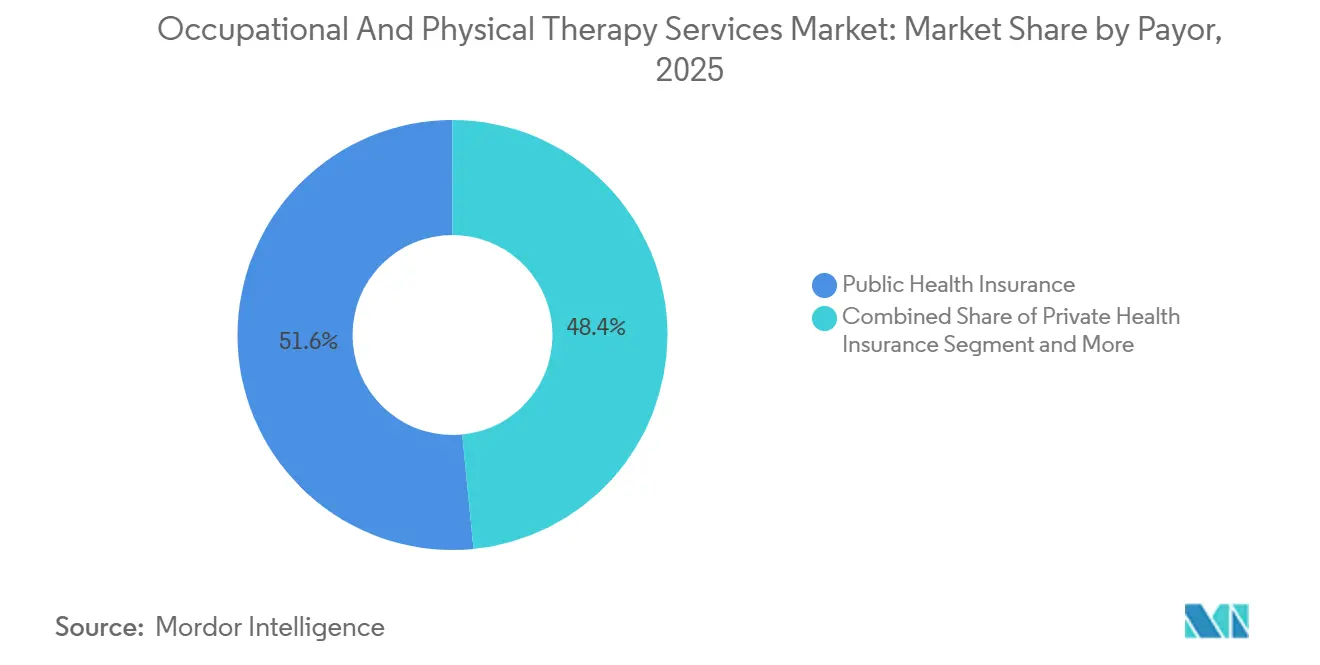
Public Plans Anchor, Private AcceleratesPublic coverage held 51.56% revenue in 2025, underpinned by Medicare and Medicaid utilization, yet private health insurance is forecast to expand at a 10.25% CAGR through 2031. This acceleration derives from employers bundling musculoskeletal benefits with primary care to mitigate absenteeism. A 2024 National Business Group on Health survey showed 68% of large employers offering virtual physical therapy as a standard benefit. Meanwhile, CMS launched the Rehabilitation Therapy Alternative Payment Model in 2024, enabling shared-savings contracts that reward cost control and functional-outcome gains.
Value-based contracting tilts the competitive field toward data-literate groups able to document functional gains using physical therapy software and patient-outcome tracking tools. Anthem now pegs 20% of therapy reimbursement to patient-reported outcome measures. This outcome-linked orientation favors larger platforms with robust analytics and positions the occupational and physical therapy services market for further consolidation.

By Application:
Orthopedic Dominates, Sports Injury SurgesOrthopedic therapy generated 38.53% of revenue in 2025, benefiting from 1.2 million knee and hip replacements that each trigger 8-12 weeks of rehab. Sports-injury therapy, bolstered by increasing youth participation, is projected to post a 10.85% CAGR through 2031. Neurological therapy gains momentum as hospitals adopt early-mobilization pathways; initiating therapy within 24 hours of stroke lowered average inpatient stay by 2.3 days.
Pediatric therapy growth follows rising autism diagnosis: 1-in-36 U.S. children required specialty services in 2024. Texas Medicaid now funds up to 40 early-intervention sessions yearly, expanding demand. Specialty niches such as pelvic-floor and vestibular programs are emerging add-ons that raise visit frequency and diversify the occupational and physical therapy services market.
By Setting:
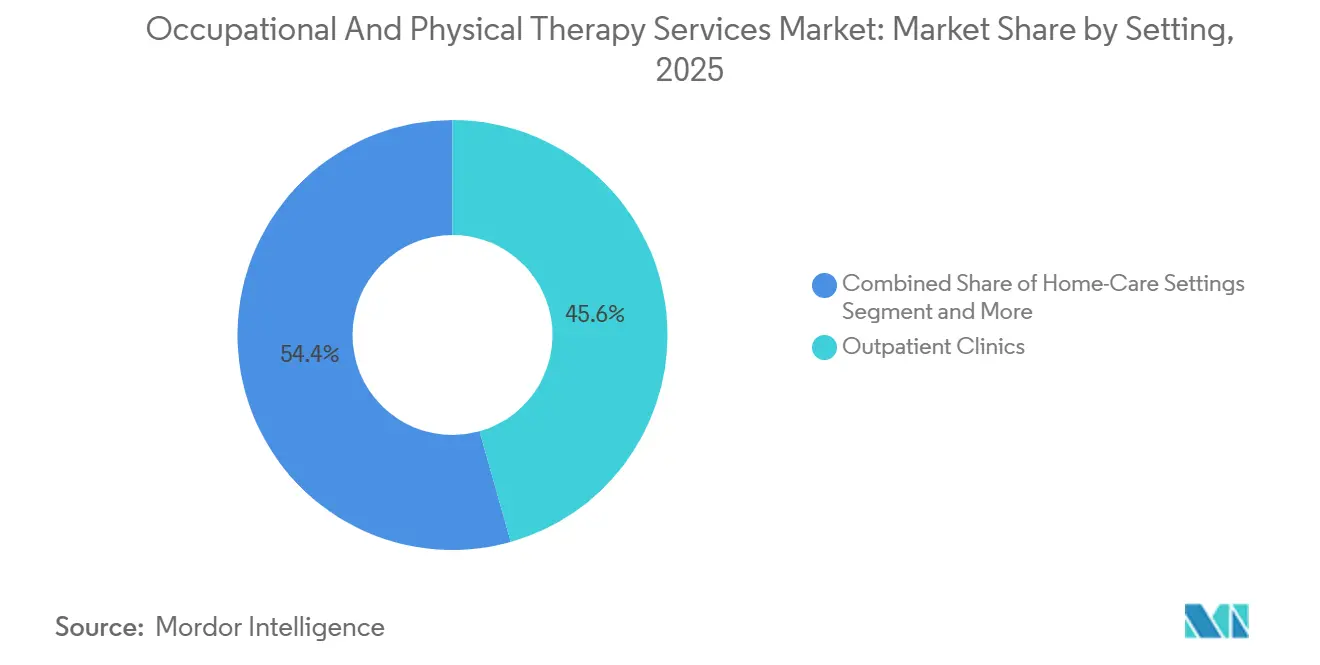
Outpatient Leads, Home Care GainsOutpatient clinics produced 45.63% of 2025 revenue thanks to convenient access and equipment breadth. Yet home-based therapy is slated for an 11.87% CAGR, buoyed by Medicare Advantage incentives and technology that enables remote supervision. MedPAC found home-based rehab following hip fracture costs 35% less per episode with comparable outcomes.
To defend share, major chains now dispatch mobile units; Athletico outfitted vans with portable ultrasound and e-stim devices in 15 metro areas by 2024. Hospitals gain some relief from the 3.2% reimbursement boost for complex therapy in the 2024 Outpatient Prospective Payment System rule.
By Service-Delivery Mode:
Virtual Scales, In-Person EnduresIn-person visits still commanded 68.33% revenue in 2025, underscoring the enduring need for manual techniques. Tele-rehabilitation, however, is tracking a 16.7% CAGR through 2031 after CMS locked in parity and interstate licensure compacts reduced regulatory friction. A 2024 BMJ Open meta-analysis of 42 trials confirmed non-inferior outcomes for chronic musculoskeletal cases managed virtually.
Hybrid therapy blends the best of both worlds: the American Physical Therapy Association endorsed hybrid pathways for low-back pain and knee osteoarthritis in its 2024 guidelines. As clinics optimize in-person-to-virtual ratios, the occupational and physical therapy services market is likely to shift toward outcome-priced episode bundles rather than visit-count billing.
Geography Analysis
North America Occupational and Physical Therapy Services Market
North America contributed 40.13% revenue in 2025, with Medicare spending on outpatient therapy hitting USD 9.8 billion, a 6.2% annual rise driven mainly by volume. Canada’s single-payer system covers post-surgical rehab but leaves chronic care largely out-of-pocket, fostering a parallel private clinic sector. Mexico’s federal clinics now provide basic therapy, yet most demand remains private, centered in affluent urban corridors. The U.S. Department of Veterans Affairs embedded therapists in 150 community clinics in 2024 to cut veteran wait times.
APAC Occupational and Physical Therapy Services Market
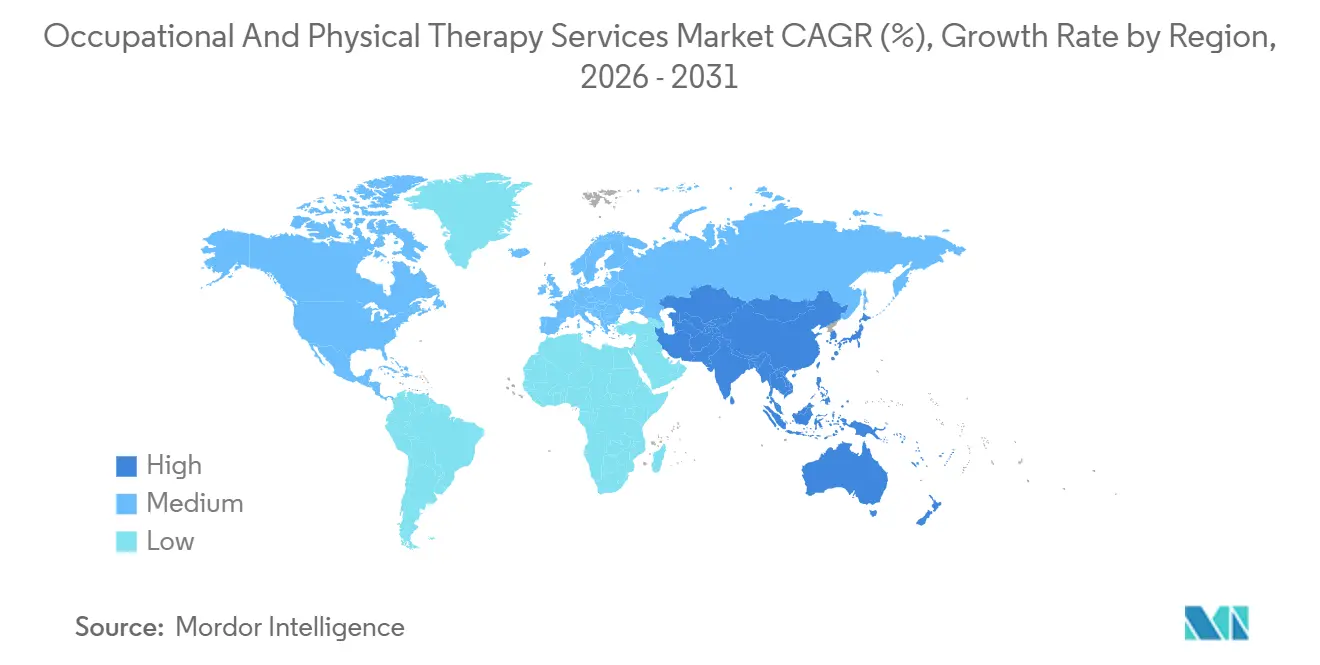
Asia-Pacific is projected to advance at a 10.51% CAGR through 2031, the fastest worldwide. China’s 2024 policy permits therapists to open independent practices, supporting rapid clinic proliferation. India’s Apollo Hospitals will introduce 50 rehabilitation centers across tier-2 cities by 2027. Japan confronts labor shortages as its therapist vacancy rate reached 15%, spurring investment in robotic-assist devices. Australia’s National Disability Insurance Scheme added AUD 2.1 billion in 2024 funding, enlarging pediatric and neuro-rehab capacity.
Germany and United Kingdom Occupational and Physical Therapy Services Market
Europe maintains steady growth. Germany’s statutory plans reimburse up to six sessions per prescription, underpinning predictable outpatient volumes. NHS England’s physiotherapy wait times stretched to eight weeks in 2024, propelling private digital alternatives.
Regulatory Landscape
In the United States, Centers for Medicare and Medicaid Services (CMS) policy remains a key reimbursement anchor for occupational therapy (OT) and physical therapy (PT) services. Under the CY 2026 Medicare Physician Fee Schedule final rule, CMS continued utilization controls through the KX modifier threshold set at USD 2,480 for PT and speech-language pathology services combined and USD 2,480 for OT services, and it maintained the assistant payment differential where services furnished by PTAs/OTAs are paid at 85% of the otherwise applicable Physician Fee Schedule amount.
CMS policy is also tightening around technology-enabled therapy definitions and compliance. Effective January 1, 2026, CMS designated multiple Remote Therapeutic Monitoring (RTM) codes (including 98975, 98976, 98977, 98979, 98980, 98981, 98984, and 98985) as sometimes therapy services, which can require furnishing under a therapy plan of care. This change affects documentation workflows for hybrid and tele-rehabilitation programs. At the state level, boards and Medicaid programs continue to update rules and manuals (for example, Texas and Ohio updates through 2025-2026), keeping multi-state providers focused on standardizing licensure, supervision, and coverage compliance across clinic and home-based settings.
Competitive Landscape
The market remains moderately fragmented: the top players control a significant percentage of outpatient revenue. Encompass Health operated 1,350 outpatient clinics and generated USD 1.8 billion in 2024 outpatient revenue, up 7.4% year-over-year[3]. Select Medical managed more than 1,900 clinics and booked USD 2.1 billion, aided by a 4.2% same-store visit rise. Both have built proprietary tele-rehab platforms to defend share and have begun partnering with retail pharmacies to co-locate services.
Digital entrants, empowered by permanent reimbursement and employer demand, are scaling quickly. One leading virtual provider secured long-term contracts with the U.S. Department of Veterans Affairs in 2024 to supply home-based musculoskeletal programs, widening its payer mix beyond commercial employers. Another AI-centric platform earned FDA clearance for motion-tracking software and is active in five European countries. Traditional chains are responding: Select Medical committed USD 25 million to a virtual-care build-out in 2024, and Encompass Health integrated AI-guided tools into its post-acute pathways in early 2025.
White-space expansion continues in pediatric therapy and rural outreach. Mobile units, franchise networks, and school-based contracts are proliferating. With technology reducing geographic barriers, the occupational and physical therapy services market is likely to see accelerated consolidation as investors favor companies that can document outcome superiority across modalities.
Occupational and Physical Therapy Services Industry Leaders
-
ATI Holdings, LLC
-
Athletico Physical Therapy
-
Encompass Health Corporation
-
Upstream Rehabilitation Inc.
-
Select Medical Corporation
- *Disclaimer: Major Players sorted in no particular order
Occupational and Physical Therapy Services Market Companies Covered in this Report
- Athletico Physical Therapy
- ATI Holdings LLC
- Concentra Inc.
- CORA Health Services Inc.
- Encompass Health
- FYZICAL Therapy & Balance Centers
- Genesis Rehab Services
- Hinge Health
- Kindred Healthcare
- Knight Health Holdings LLC
- Luna Physical Therapy
- NovaCare Rehabilitation
- PT Solutions
- Select Medical
- SWORD Health
- United States Physical Therapy Inc.
- Upstream Rehabilitation
Read Analysis of Occupational and Physical Therapy Services Companies
Market Opportunities and Future Outlook
CMS treatment of RTM codes as sometimes therapy services beginning January 1, 2026 is creating operational whitespace for hybrid models that combine in-person therapy with remote monitoring and virtual follow-ups, particularly where plan-of-care and documentation requirements can be standardized across sites. It also pushes providers and software vendors toward therapy-specific compliance features, which raises demand for protocol-driven documentation, utilization controls, and payer-ready reporting inside clinic operations.
Market expansion is also moving beyond fixed outpatient locations, supported by commercial network builds in home-based and mobile PT/OT services. In 2026, American Specialty Health expanded its network capabilities to include home-based and mobile PT/OT services, reflecting payer-network interest in alternative settings that can ease access constraints while supporting home-care growth. On the supply side, multi-site operators continue to rely on acquisitions and facility expansion to extend geographic coverage, while rehabilitation systems add inpatient capacity and clinical technology (for example, Encompass Health hospital openings and Brooks Rehabilitation adding mobility technology). Together, these moves support cross-referral pathways between inpatient rehab, outpatient clinics, and home-care settings.
Recent Industry Developments in Occupational and Physical Therapy Services Market
- June 2026: Athletico Physical Therapy agreed to a comprehensive recapitalization, securing USD 80 million in new financing and reducing net debt by about USD 750 million. The transaction improves balance sheet flexibility for clinic operations and service-line investments during ongoing consolidation in outpatient rehabilitation. The capital reset also supports continued development of hybrid care and multi-site growth programs.
- May 2026: Encompass Health opened the 50-bed Encompass Health Rehabilitation Hospital of Concordville in Pennsylvania. The new freestanding inpatient rehabilitation facility expands local post-acute capacity and can increase downstream demand for outpatient OT/PT through discharge planning and continuity-of-care pathways. The opening also reinforces joint-venture-led expansion as a route to add beds in targeted geographies.
- May 2025: Kelly added Children’s Therapy Center, a Minnesota-based pediatric occupational, physical, and speech therapy provider. The addition broadened Kelly’s developmental services footprint and expanded access to multi-discipline pediatric therapy offerings. Portfolio expansion into pediatric care aligns with rising demand for early-intervention and specialty therapy services across payor types.
Occupational and Physical Therapy Services Market Report Scope and Research Methodology
Market Definition and Coverage
This market covers paid services where licensed professionals deliver occupational therapy or physical therapy to help patients improve function, mobility, and daily living abilities across common care settings. Revenue is counted from therapy evaluation and treatment sessions, including provider-billed and patient-paid portions.
Scope exclusions: We exclude sales of therapy equipment and home-use devices, general fitness coaching, and non-therapy medical procedures that are billed outside occupational or physical therapy service codes.
Segments Covered in This Report
- By Payor
- Public Health Insurance
- Private Health Insurance
- Out-of-Pocket
- By Application
- Orthopedic Therapy
- Neurological Therapy
- Sports-Injury Therapy
- General Therapy
- Geriatric Therapy
- Pediatric Therapy
- Other Applications
- By Setting
- Hospitals
- Outpatient Clinics
- Home-Care Settings
- Other Settings
- By Service-Delivery Mode
- In-person Therapy
- Tele-rehabilitation / Virtual Therapy
- Hybrid Therapy
- By Geography
- North America
- United States
- Canada
- Mexico
- Europe
- Germany
- United Kingdom
- France
- Italy
- Spain
- Rest of Europe
- Asia-Pacific
- China
- India
- Japan
- Australia
- South Korea
- Rest of Asia-Pacific
- Middle East and Africa
- GCC
- South Africa
- Rest of Middle East and Africa
- South America
- Brazil
- Argentina
- Rest of South America
- North America
Data Sources, Market Sizing, and Validation
Desk Research
Desk research started with public healthcare utilization and spending context, then narrowed down to therapy signals that can be tracked consistently. We reviewed sources such as the US Centers for Medicare and Medicaid Services, the US Bureau of Labor Statistics, the OECD health statistics portal, the World Health Organization, and the World Bank demographic series to anchor population trends, aging, and care access patterns.
To connect those broad indicators to therapy services, we also used provider association publications (such as the American Physical Therapy Association and occupational therapy associations where available), peer-reviewed clinical and health economics literature, and country-level health ministry portals for policy changes. Company annual reports and investor presentations were used to understand service mix and pricing direction, while a paid subscription for company financials and a paid patent database were referenced selectively to cross-check capacity expansion themes and therapy modality adoption. These examples are not exhaustive, and we also relied on other public sources for data collection, validation, and clarification during the study.
Primary Interviews and Surveys
Primary work focused on validating how volumes, visit frequency, and pricing move by care setting and payer type, since these are the main revenue drivers for occupational and physical therapy services. We spoke with clinic operators, hospital rehab leaders, therapy staffing managers, and payer or network-facing roles across APAC, EMEA, and the Americas. The respondent input was used to confirm assumptions that were not fully recoverable from public statistics alone.
Distribution of primary research fieldwork respondents
| Company type | Respondent position | Region |
|---|---|---|
| Top tier: 26% | CXOs: 12% | APAC: 47% |
| Mid tier: 57% | Functional/Unit leaders: 41% | EMEA: 29% |
| Smaller Players: 17% | Managers: 47% | Americas: 24% |
Market-Sizing & Forecasting
Market size was built using a top-down and bottom-up approach, where therapy demand is reconstructed from the treated patient pool and expected visit intensity, then translated into revenue using typical charge and reimbursement patterns by payer. In practice, we start from population and condition prevalence signals, filter to the share that reaches therapy, and then apply average visits per episode and paid amount per visit across major care settings.
To keep the model practical and repeatable, we tracked a limited set of drivers consistently, including aging share of population, musculoskeletal and neurological condition burden, post-acute discharge trends into outpatient rehab, therapist employment and wage growth as a capacity proxy, and payer mix shifts between public, private, and out-of-pocket. Where country-level data granularity is limited, gaps were handled by applying region-specific benchmarks for utilization and pricing, then stress tested with interview feedback and publicly visible reimbursement updates.
For forecasting, we used scenario analysis supported by a light multivariate regression check, so demand growth is tied to observable variables like demographics, provider capacity, and policy or coverage changes. Outputs were corroborated through selective bottom-up approximations, such as sampled clinic-level revenue per therapist, volume per site, and pricing direction checks, and then adjusted when implied capacity or visit rates looked unrealistic for a given geography.
Data Validation & Update Cycle
Before final numbers are locked, results are triangulated across multiple independent signals, including workforce growth, utilization indicators, and payer or reimbursement changes that affect realized prices. Outliers are flagged, checked back to the underlying assumptions, and reviewed by another analyst so that a single input does not quietly shift the full model.
We also re-contact relevant respondents when a large variance shows up, for example if visit intensity changes suddenly, pricing moves sharply, or a policy update changes coverage. The report is refreshed annually, and interim updates are made when material events occur, followed by a final pre-delivery review so clients receive the most current view available at publication time.
Mordor Intelligence's Occupational and Physical Therapy Services Market Size Compared With Other Published Estimates
Published estimates for therapy services do not always line up because the market can be framed in different ways, and small changes in what gets counted can shift totals quickly. Differences usually come from what care settings are included, whether both occupational therapy and physical therapy are counted together, and how payer discounts and reimbursement are translated into final revenue.
The main gap comes from mixing provider receipts for clinic-based therapy with broader rehabilitation categories, where Mordor Intelligence counts only occupational and physical therapy service revenue and applies payer-weighted realized pricing rather than list charges. Other gaps show up when some studies treat home health therapy as fully comparable to outpatient visits, or when aggressive growth assumptions are used without checking therapist capacity and wage trends that constrain how fast volumes can expand.
Benchmark comparison
| Source | Market Size | Gaps in Research Methodology |
|---|---|---|
| Mordor Intelligence | USD 64.46 B (2025) | |
| Industry Publisher A | USD 70.00 B (2025) | A broader rehabilitation services scope appears to be used, which can pull in adjacent rehab programs and inflate the counted revenue beyond OT and PT only service lines. |
| Global Advisory B | USD 58.30 B (2024) | Uses an earlier base year and tends to rely on high-level healthcare spend splits, which can undercount outpatient volume growth and payer mix driven price realization changes. |
The spread in the table is mostly explained by scope and pricing treatment, not by a disagreement that demand is rising. When settings and services are clearly separated, and revenue is tied to visit volumes and payer realized rates that can be cross-checked, the resulting number becomes easier to audit and repeat year to year.
Key Questions Answered in the Report
What is the expected global value of occupational and physical therapy services in 2031?
Spending is projected to reach USD 109.60 billion by 2031.
How quickly is tele-rehabilitation revenue expanding through 2031?
Tele-rehabilitation is forecast to grow at a 16.7% CAGR, the fastest pace among delivery modes.
Which geographic region is anticipated to record the strongest growth through 2031?
Asia-Pacific is on track for a 10.51% CAGR, outpacing all other regions over the forecast period.
What share of 2025 revenue came from public health insurance plans?
Public payors accounted for 51.56% of global revenue in 2025.
Which application area is poised for the fastest growth over the next five years?
Sports-injury therapy is projected to expand at a 10.85% CAGR through 2031.