
North America Virtual Schools Market Size and Share
Market Overview
| Study Period | 2021 - 2031 |
|---|---|
| Forecast Data Period | 2026 - 2031 |
| Base Year Market Size (2025) | USD 21.40 Billion |
| Market Size (2026) | USD 23.30 Billion |
| Market Size (2031) | USD 36.40 Billion |
| Growth Rate (2026 - 2031) | 9.30 % |
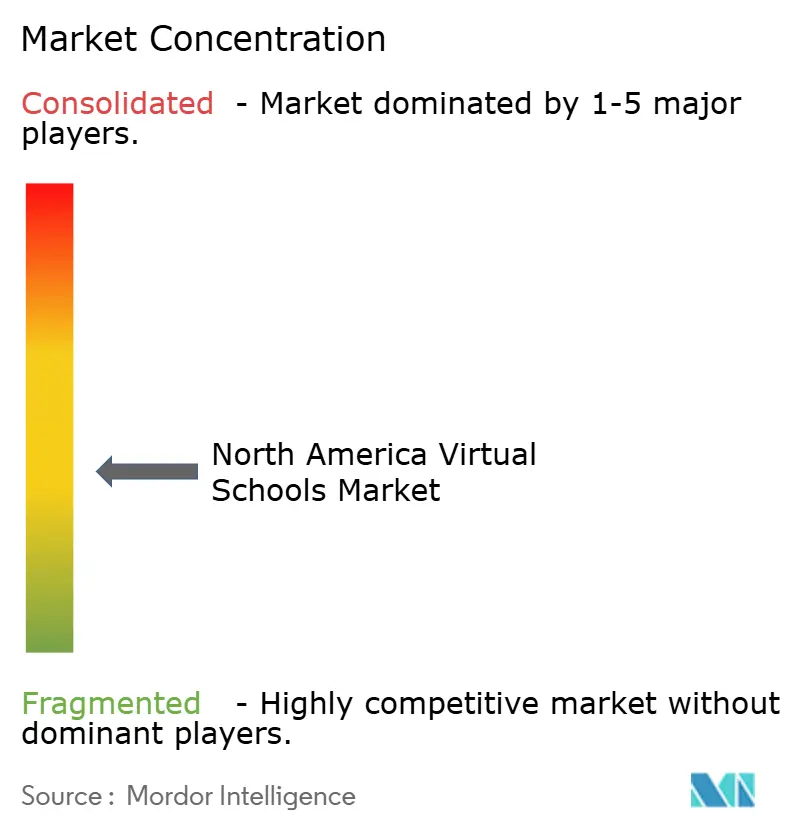
| Market Concentration | Medium |
Major Players *Disclaimer: Major Players sorted in no particular order Image © Mordor Intelligence. Reuse requires attribution under CC BY 4.0. | |
North America Virtual Schools Market Analysis by Mordor Intelligence
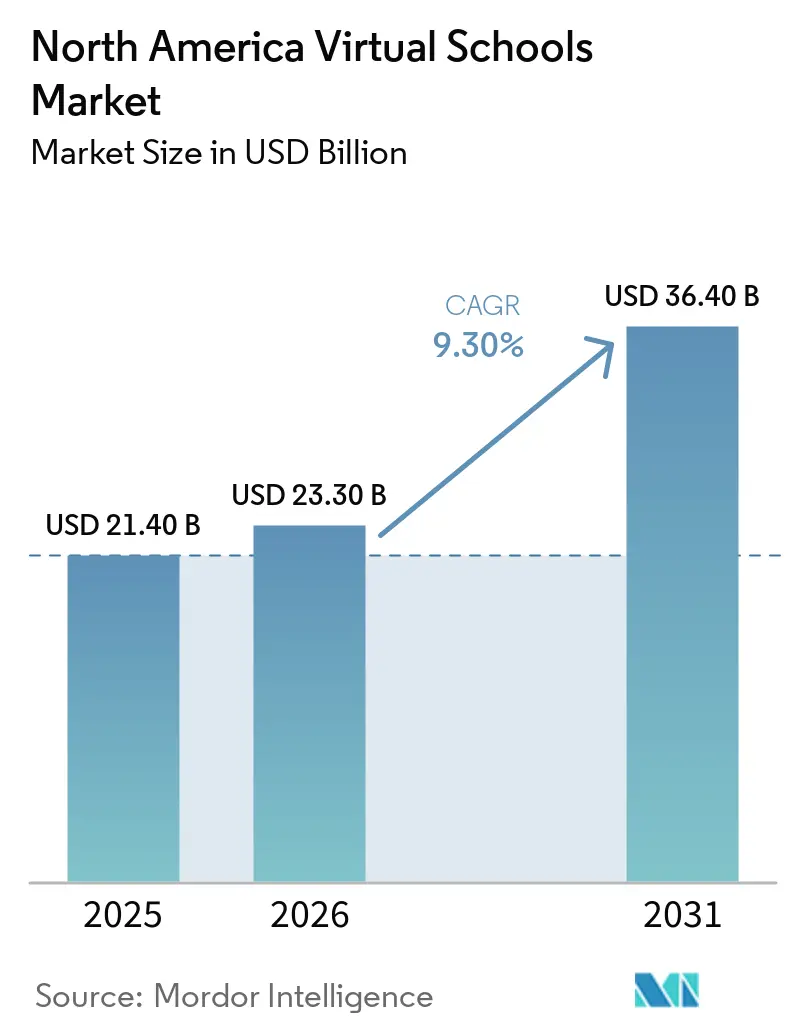
The North America Virtual Schools Market was valued at USD 21.4 billion in 2025 and estimated to grow from USD 23.3 billion in 2026 to reach USD 36.4 billion by 2031, at a CAGR of 9.30% during the forecast period (2026-2031). State policies now support virtual and hybrid education with clearer funding and governance frameworks. The United States Department of Education proposed a USD 2.0 billion state formula grant in its FY 2026 budget, allowing states to expand educational options[1]. Texas Senate Bill 569 introduced a formal attendance and funding mechanism for virtual and hybrid campuses for the 2025–2026 school year, while Florida Senate Bill 124 expanded revenue pathways for Florida Virtual School in April 2026. Demand for flexible credentials, stronger Career and Technical Education (CTE) integration, and adaptive learning tools is driving market growth. However, broadband gaps and stricter privacy standards limit full access. These challenges favor providers with robust compliance systems, broader state reach, and comprehensive curricula.
Key Report Takeaways
- By end user, High Schools held a 41.84% share of the North America Virtual Schools Market in 2025, while Adult Education is projected to grow at a 12.70% CAGR through 2031.
- By school type, Full-Time Virtual Schools held a 56.41% share of the North America Virtual Schools Market in 2025, while Hybrid Virtual Schools are forecast to grow at a 13.50% CAGR through 2031.
- By delivery mode, Asynchronous Learning held a 46.73% share of the North America Virtual Schools Market in 2025, while Blended Learning is expected to expand at a 14.20% CAGR through 2031.
- By geography, the United States accounted for an 85.68% share of the North America Virtual Schools Market in 2025, while Mexico is forecast to record the highest CAGR of 15.80% through 2031.
Note: Market size and forecast figures in this report are generated using Mordor Intelligence’s proprietary estimation framework, updated with the latest available data and insights as of January 2026.
North America Virtual Schools Market Trends and Insights
Drivers Impact Analysis*
| Driver | (~) % Impact on CAGR Forecast | Geographic Relevance | Impact Timeline |
|---|---|---|---|
| Rising Demand for Flexible Remote Education | +2.5% | Concentrated in United States and Canada | Short term (≤ 2 years) |
| State-Level Digital Infrastructure Funding | +1.7% | United States, federal and state programs | Medium term (2-4 years) |
| Personalized Learning Paths for Diverse Learners | +1.1% | North America, with early gains in suburban United States corridors | Medium term (2-4 years) |
| Career and Technical Education Integration in Virtual Schools | +1.5% | United States, with spillover to Canada | Medium term (2-4 years) |
| Parent-Coach Learning Models and Engagement Analytics | +0.8% | United States, suburban and rural corridors | Long term (≥ 4 years) |
| Expansion of Hybrid, Credit-Recovery, and Alternative Schooling Pathways | +1.3% | United States, with early adoption in Canada | Short term (≤ 2 years) |
| Source: Mordor Intelligence | |||
Rising Demand for Flexible Remote Education
Flexible learning remains a key driver for the North America virtual school’s market. An official report on Education indicated that 57% of returning adult learners considered online or hybrid access essential to their decision to re-enroll, with 33% specifically selecting hybrid programs. This demonstrates that online access has shifted from being a temporary alternative to a critical factor in enrollment decisions. The trend supports the growth of adult education, hybrid learning models, and outcome-focused online programs in the region. Providers offering both flexibility and recognized credentials are well-positioned to attract and retain learners managing work, family, and education simultaneously.
State-Level Digital Infrastructure Funding
State and federal funding initiatives are strengthening the foundation of the North America virtual school’s market. North Carolina has introduced grants to support districts implementing digital learning programs aligned with the state plan[2]. Similarly, Minnesota expanded online learning state aid eligibility to include students beyond traditional K-12 age groups. These developments enhance both the digital infrastructure and the pool of accessible learners. The simultaneous progress of funding and eligibility reforms is particularly impactful in rural and low-density areas, where demand exists but has been constrained by inconsistent digital access and limited funding coverage.
Personalized Learning Paths for Diverse Learners
Personalized learning has become a key factor in the North America virtual schools’ market as providers focus on improving student outcomes and retention. Edmentum introduced updates to its Courseware platform, integrating features such as unified course access, standards mastery diagnostics, multilingual text-to-speech, and academic integrity tools. A review by Stanford highlighted the potential of AI-assisted diagnostic and personalized instruction tools to enhance learning outcomes, particularly for students guided by less experienced educators[3]. Research published in Frontiers in Artificial Intelligence also demonstrated improved recall outcomes when learners used AI-powered interactive platforms with timely feedback. These advancements reflect a transition in the virtual schools’ market from basic online access to adaptive delivery models that cater to varied learning paces, language needs, and performance levels.
Career and Technical Education Integration in Virtual Schools
The integration of Career and Technical Education (CTE) is enhancing the appeal of the North America virtual schools’ market as families and districts increasingly focus on employability outcomes. Stride reported significant growth in Career Learning revenue, which accounted for a substantial portion of its total quarterly revenue. Edmentum introduced Edmentum Career, offering numerous online CTE pathways across various career clusters for middle and high school students. Florida's updated CAPE funding framework further strengthened the connection between certification funding and aligned CTE programs, emphasizing the importance of accredited virtual career content. These advancements create opportunities for providers that can deliver occupational pathways, align with industry certifications, and ensure post secondary relevance within a unified platform.
Restraints Impact Analysis*
| Restraint | (~) % Impact on CAGR Forecast | Geographic Relevance | Impact Timeline |
|---|---|---|---|
| Regional Broadband Gaps and Uneven Device Access | -1.2% | Rural United States, Northern Canada, rural Mexico | Medium term (2-4 years) |
| Complex State Accreditation and Teacher Certification Requirements | -0.5% | United States, state-by-state variation, and Canada, provincial variation | Long term (≥ 4 years) |
| Rising Cybersecurity, Data Privacy, and Compliance Costs | -0.9% | North America, with added pressure in cross-border operations | Short term (≤ 2 years) |
| District Budget Pressures and ROI Scrutiny for Virtual Programs | -0.5% | United States, especially suburban and rural districts | Short term (≤ 2 years) |
| Source: Mordor Intelligence | |||
Regional Broadband Gaps and Uneven Device Access
Broadband access remains a critical structural challenge for the North America virtual schools’ market. Reports indicate that students in remote rural areas have significantly lower fixed home broadband access compared to their suburban counterparts. Additionally, disparities in internet speeds persist across states and between urban and rural regions, as noted in recent studies. These connectivity issues undermine the reliability of live classes, video-based instruction, and scheduled assessments for students in less-connected areas. Consequently, the virtual schools’ market in North America faces limitations in expanding enrollment in regions where demand exists but household connectivity remains insufficient[4].
Complex State Accreditation and Teacher Certification Requirements
Regulatory differences continue to impede the growth of the North America virtual schools’ market, as operating requirements vary significantly across states and provinces. Recent legislative measures demonstrate efforts by governments to formalize virtual schooling frameworks, but disparities in funding rules, governance structures, and accountability standards persist across jurisdictions. Providers with an established presence in multiple states, such as Stride, benefit from their ability to align licensing, curricula, and operational systems across regions. In contrast, smaller operators face challenges in managing regulatory costs due to their limited learner base. This dynamic maintains market accessibility but slows and increases the cost of geographic expansion for providers without robust compliance infrastructure.
*Our forecasts treat driver/restraint impacts as directional, not additive. The impact forecasts reflect baseline growth, mix effects, and variable interactions.
Segment Analysis
By End User: High Schools Anchor Revenue While Adult Education Resets the Growth Ceiling
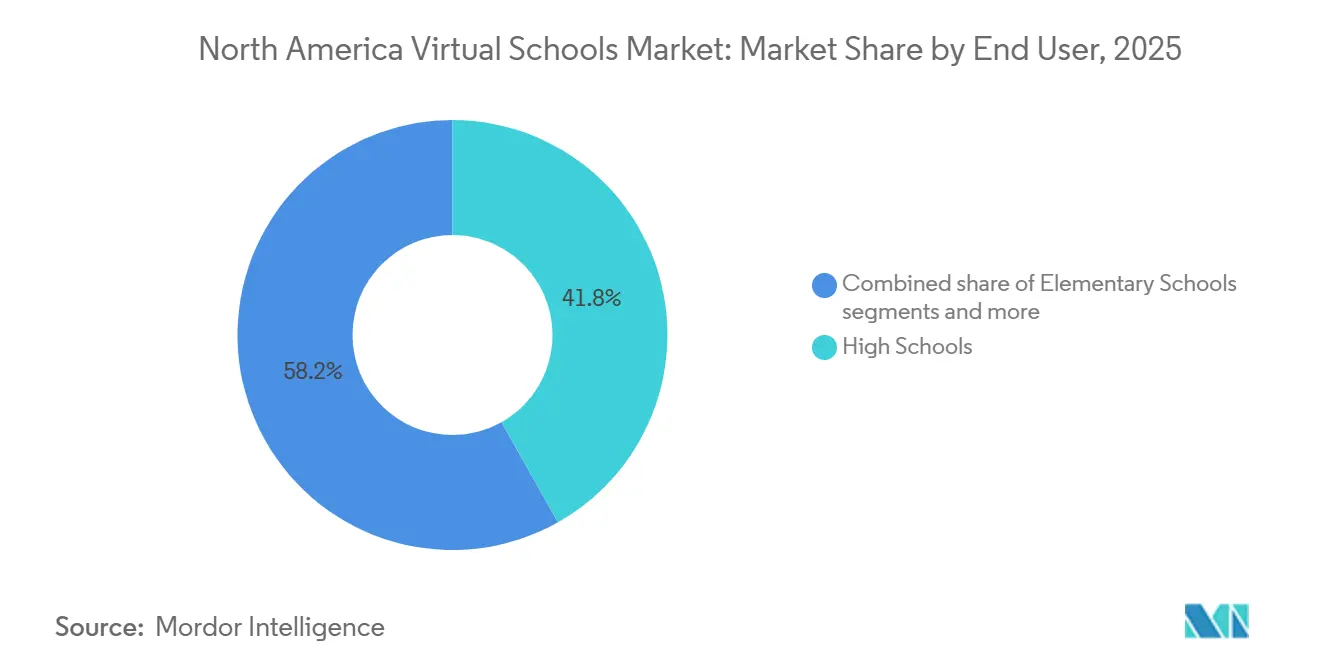
High schools held 41.84% of the North America virtual schools market share in 2025, making them the largest end-user segment. This reflects demand for credit recovery, dual enrollment, Advanced Placement access, and diploma pathways linked to career and technical education. The market relies on high school demand as a stable base, driven by older learners' needs for graduation timelines, course flexibility, and work-related options. Stride's operations across general education and career learning schools support this segment in several United States. High school demand also aligns with supplemental programs, allowing districts to add courses without fully transferring student enrollment. Middle and elementary school segments are smaller but significant due to the value of maintaining a single provider relationship across K-12 education. Edmentum's 2025 Courseware update, which unified K-5 curriculum and support tools, enhances providers' ability to serve younger learners through one platform.
Adult education is expected to grow at a 12.70% CAGR through 2031, making it the fastest-growing end-user segment in the North America virtual schools’ market. The 2026 ACE findings indicate that online and hybrid access has influenced re-enrollment decisions among returning adult learners. Providers serving both school-age and adult learners on a shared platform are likely to achieve a balanced enrollment mix as labor, policy, and demographic conditions evolve.

By School Type: Full-Time Operators Anchor Scale While Hybrids Capture New District Contracts
Full-Time Virtual Schools accounted for 56.4% of the North America virtual schools market size in 2025, maintaining their leading position. This is due to established public funding, state-authorized structures, and brand familiarity among families. Stride's FY2026 revenue guidance of USD 2.49 billion to USD 2.52 billion highlights the economics scale in this segment. Full-time models remain critical as they generate recurring revenue and support extensive systems for curriculum, compliance, and student services.
Supplemental and part-time models are also significant, helping districts address gaps in electives, hard-to-staff subjects, and intervention programs without replacing traditional schools. Hybrid Virtual Schools are projected to grow at a 13.5% CAGR through 2031, making them the fastest-growing segment. Legislative actions, such as Texas SB 569, have strengthened the framework for virtual and hybrid campuses, enabling districts to adopt mixed delivery programs. Florida SB 124 has further supported institutional virtual delivery through a major public operator. The shift toward hybrid programs benefits the market by supporting credit recovery, re-engagement, and flexible scheduling while maintaining structured oversight. This approach appeals to districts seeking flexibility without sacrificing accountability or in-person interaction.
By Delivery Mode: Asynchronous Delivery Maintains Market Breadth While Blended Learning Leads Growth
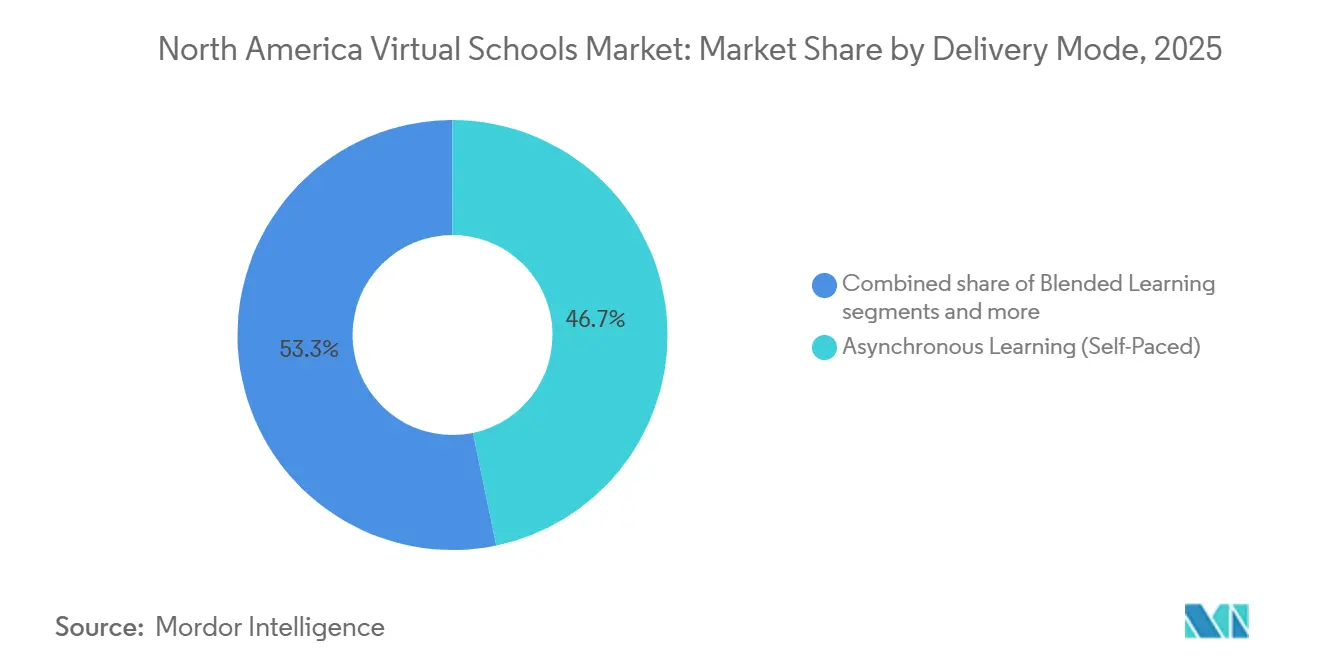
Asynchronous learning held 46.73% of the North America virtual schools market size in 2025, remaining the largest delivery mode by reach. It meets the needs of working adults, rural learners, and students requiring flexible, time-independent instruction. Providers benefit from distribution efficiency, as the same courseware serves learners across wide geographic areas without live scheduling. Edmentum's 2025 platform update introduced features like diagnostics, text-to-speech support, and academic integrity tools, enhancing asynchronous learning capabilities. This delivery mode remains the most accessible format, supporting scalability and scheduling flexibility in the North America virtual school’s market.
Blended learning is projected to grow at 14.20% CAGR through 2031, making it the fastest-growing delivery mode. A 2026 study reported improved recall outcomes in AI-powered interactive environments with timely feedback. Peel Virtual Secondary School’s full-day virtual model highlights the importance of structured synchronous interaction, where regular faculty contact enhances learning consistency. The market is increasingly adopting blended learning architectures that combine live support, self-paced content, and performance-based adjustments. This approach is particularly effective for subjects where feedback timing, supervision, and instructional continuity significantly impact learning outcomes.
Geography Analysis
The United States accounted for 85.68% of the North America virtual schools market share in 2025, driven by state-authorized virtual school development, public funding, and participation by large operators. Stride's FY2026 revenue guidance of USD 2.49 billion to USD 2.52 billion highlights the market's scale. Legislative measures such as Texas SB 569, Florida SB 124, and Minnesota HF 4332 reflect ongoing policy support. The market remains shaped by United States funding rules, state legislation, and multistate provider strategies.
Canada ranked as the second-largest geography in the market, supported by stable public-system backing for online learning. The K-12 State of the Nation 2024-2025 update reported 389,891 students in distance and online learning, representing 6.8% of the national K-12 population. Ontario's Peel Virtual Secondary School saw strong demand, opening 2026-2027 registrations earlier than the prior year. Privacy findings from Ontario and Alberta in October 2025 are tightening vendor expectations across school boards. Growth in Canada is shaped by provincial policies rather than a unified national framework. Mexico is projected to grow at a 15.80% CAGR through 2031, making it the fastest-growing geography in the market. Its smaller base compared to the United States and Canada allows for higher percentage growth. Expansion depends on improved connectivity, administrative execution, and locally tailored curricula. Providers aligning with these needs are better positioned as the market footprint expands.
Competitive Landscape
The North America virtual schools’ market is moderately fragmented, with a small group of providers holding a significant share. This structure reflects the presence of multistate operators, public virtual school systems, district-facing supplemental providers, and private online education platforms. Stride has established a strong position, supported by substantial revenue growth and guidance. While opportunities remain for niche and regional operators, achieving scale has become increasingly important due to the need for investments in curriculum, data systems, privacy controls, and compliance. Providers capable of funding platform upgrades and maintaining broad operations are better positioned in this competitive environment.
Strategic differentiation in the market is increasingly focused on AI capabilities, career and technical education (CTE), and improved learning workflows. Pearson has expanded partnerships to enhance workforce AI readiness and develop adaptive learning solutions. These efforts demonstrate how major education companies are integrating assessment, content, analytics, and AI infrastructure. This shift raises challenges for smaller providers relying on limited product offerings or third-party content models.
Edmentum and Penn Foster illustrate a focus on targeted product depth and support capacity. Edmentum has enhanced its CTE offerings by launching new programs and forming partnerships to include immersive trade simulations. Penn Foster has expanded its operational support base to strengthen its capabilities. Stride has also invested in curriculum development, reflecting a commitment to proprietary content. The market rewards providers that combine scale or specialization with sustained investments in content, delivery systems, and learner support infrastructure.
North America Virtual Schools Industry Leaders
-
Stride Inc.
-
Pearson Plc
-
Penn Foster
-
Edmentum Inc.
-
Sora Schools Inc.
- *Disclaimer: Major Players sorted in no particular order
Recent Industry Developments
- June 2026: The Federal Trade Commission finalized its order against Illuminate Education, requiring a data security program, limits on data collection and retention, and deletion of unnecessary student data. This follows a breach exposing personal records of 10.1 million students in US schools. The action is the FTC's first of this scale against an edtech provider, setting a compliance precedent for the industry.
- May 2026: Pearson Plc and Salesforce announced a strategic partnership to enhance AI readiness and workforce skills development. The collaboration integrates Pearson's learning and assessment content with Salesforce's enterprise learning infrastructure, supporting the global workforce.
- April 2026: Stride Inc. reported Q3 FY2026 revenue of USD 629.9 million, a 2.7% year-on-year increase, and raised its full-year FY2026 revenue guidance to USD 2.49–2.52 billion. Career Learning enrollment grew 11.6% to 110,100 students, with revenue per enrollment up 3.8% to USD 2,356, offsetting a 3.6% decline in General Education revenue.
- April 2026: The Florida Governor signed Senate Bill 124, enabling the Florida Virtual School to boost state funding through direct-support organization revenues. The bill also updates board oversight of technology-based education expenditures, enhancing the school's financial sustainability.
North America Virtual Schools Market Report Scope
| Elementary Schools |
| Middle Schools |
| High Schools |
| Adult Education |
| Full-Time Virtual Schools |
| Supplemental/Part-Time Virtual Schools |
| Hybrid Virtual Schools |
| Synchronous Learning (Live Classes) |
| Asynchronous Learning (Self-Paced) |
| Blended Learning |
| United States |
| Canada |
| Mexico |
| By End User | Elementary Schools |
| Middle Schools | |
| High Schools | |
| Adult Education | |
| By School Type | Full-Time Virtual Schools |
| Supplemental/Part-Time Virtual Schools | |
| Hybrid Virtual Schools | |
| By Delivery Mode | Synchronous Learning (Live Classes) |
| Asynchronous Learning (Self-Paced) | |
| Blended Learning | |
| By Geography | United States |
| Canada | |
| Mexico |
Key Questions Answered in the Report
What is the current size of the North America virtual schools market?
The North America virtual schools market size was USD 21.4 billion in 2025 and is forecast to reach USD 36.4 billion by 2031 at a 9.30% CAGR.
Which end-user group leads revenue generation?
High Schools led with 41.84% share in 2025 because demand remains strong for credit recovery, dual enrollment, and CTE-linked diploma pathways.
Which school type is growing the fastest through 2031?
Hybrid Virtual Schools are expected to grow at a 13.50% CAGR through 2031 as districts look for more flexible but still structured learning models.
Why does asynchronous delivery still lead by share?
Asynchronous Learning held 46.73% share in 2025 because it serves learners who need schedule flexibility, including working adults and students in lower-access areas.
Which country drives most of the regional value?
The United States accounted for 85.68% of regional value in 2025 because it has the most established funding pathways, legislation, and scaled operators.
What is the main operational challenge for providers?
Broadband gaps and rising privacy and cybersecurity costs remain the main constraints because they limit access in remote areas and increase operating burden across the region.