
North America Professional Indemnity Insurance Market Size and Share
Market Overview
| Study Period | 2020 - 2031 |
|---|---|
| Forecast Data Period | 2026 - 2031 |
| Base Year Market Size (2025) | USD 14.80 Billion |
| Market Size (2026) | USD 15.40 Billion |
| Market Size (2031) | USD 19 Billion |
| Growth Rate (2026 - 2031) | 4.30 % |
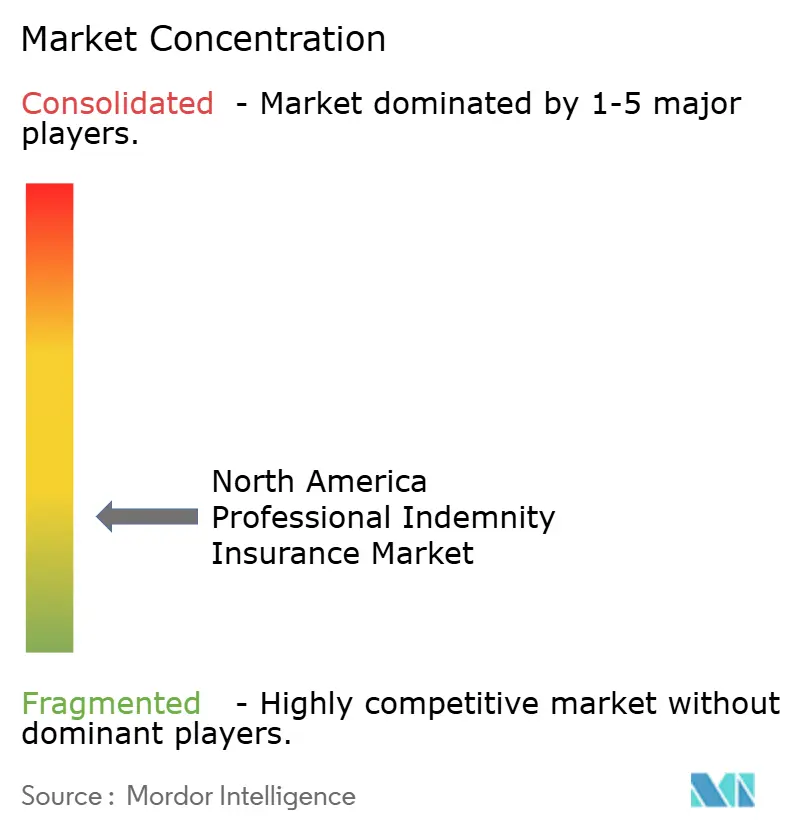
| Market Concentration | Low |
Major Players *Disclaimer: Major Players sorted in no particular order Image © Mordor Intelligence. Reuse requires attribution under CC BY 4.0. | |
North America Professional Indemnity Insurance Market Analysis by Mordor Intelligence
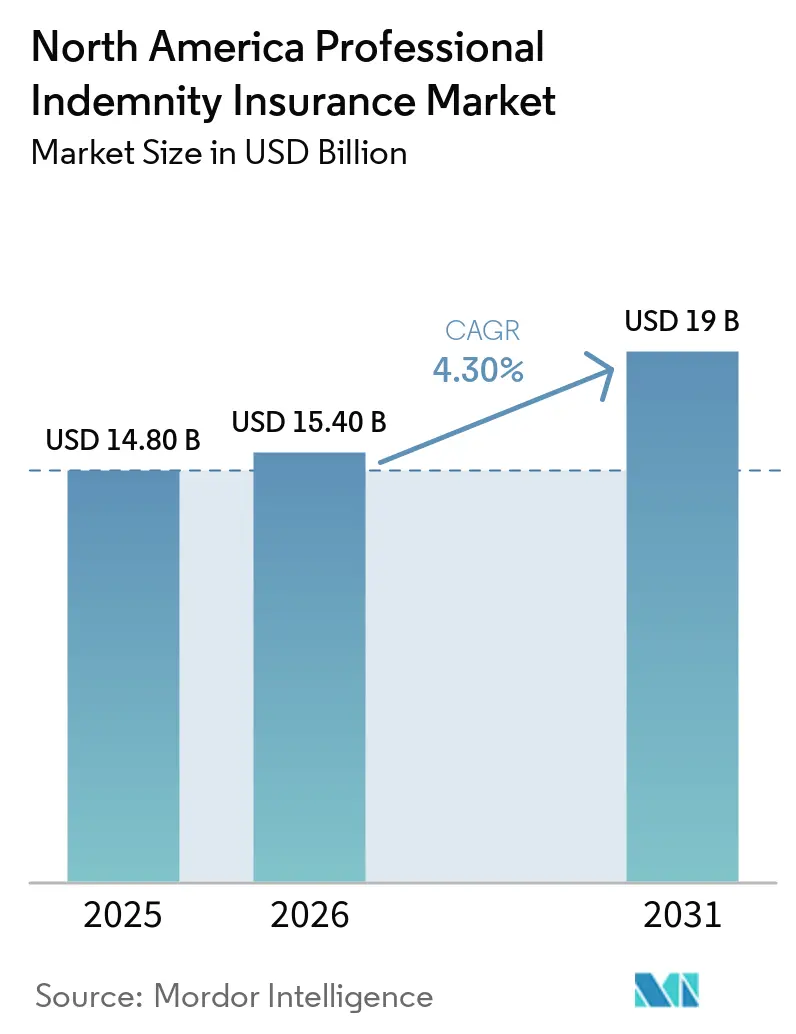
The North America professional indemnity insurance market size was valued at USD 14.8 billion in 2025 and is estimated to grow from USD 15.4 billion in 2026 to reach USD 19 billion by 2031, at a CAGR of 4.3% during the forecast period, 2026 to 2031.
Demand is supported by the wider use of professional services in legal, technology, financial advisory, engineering, and consulting work. Contract terms increasingly require vendors and advisers to maintain errors and omissions coverage, which supports recurring premium demand. The United States remains the main source of regional premium volume because of its large professional services base, litigation environment, and profession-specific insurance requirements. Price competition remains strong in standard lines, while underwriters continue to apply more selective terms to complex risks. The North America professional indemnity insurance market also offers scope for insurers that can provide clear technology, cyber, and professional liability protection in one policy.
Key Report Takeaways
- By product type, miscellaneous and general professional indemnity policies captured 38.8% of the North America professional indemnity insurance market share in 2025, while technology professional indemnity is projected to grow at a 6.6% CAGR through 2031.
- By profession of the insured, legal services professionals held 22.3% of the North America professional indemnity insurance market share in 2025, while information technology, software, software as a service, and managed services are forecast to grow at a 6.8% CAGR through 2031.
- By insured firm size, small and medium-sized enterprises captured 46.1% of the North America professional indemnity insurance market share in 2025, while sole practitioners are projected to grow at a 5.9% CAGR through 2031.
- By distribution channel, insurance brokers captured 67.2% of the North America professional indemnity insurance market share in 2025, while direct insurer distribution is projected to grow at a 7% CAGR through 2031.
- By policy structure, annual practice claims-made policies captured 74.6% of the North America professional indemnity insurance market share in 2025, while project-specific professional indemnity is projected to grow at a 6.1% CAGR through 2031.
- By geography, the United States captured 85.7% of the North America professional indemnity insurance market share in 2025, while Mexico is projected to grow at a 6.4% CAGR through 2031.
Note: Market size and forecast figures in this report are generated using Mordor Intelligence’s proprietary estimation framework, updated with the latest available data and insights as of January 2026.
North America Professional Indemnity Insurance Market Trends and Insights
Drivers Impact Analysis*
| Driver | (~) % Impact on CAGR Forecast | Geographic Relevance | Impact Timeline |
|---|---|---|---|
| Rising Liability Exposure from Complex Engagements and Litigation | +0.9% | United States dominant, significant in Canada, and emerging in Mexico | Medium term (2-4 years) |
| Professional Services Expansion and Small and Medium-Sized Enterprise Adoption | +0.7% | United States and Canada | Medium term (2-4 years) |
| Artificial Intelligence, Technology Consulting, and Digital Transformation Liability | +0.8% | The United States primarily, with early expansion into Canada and Mexico | Long term (≥ 4 years) |
| Mandatory and Contractual Professional Liability Coverage | +0.5% | North America, with province-level intensity in Canada | Short term (≤ 2 years) |
| Integrated Cyber, Privacy, and Professional Liability Demand | +0.6% | North America, with the United States leading adoption | Medium term (2-4 years) |
| Managing General Agent, Digital Brokerage, and Specialized Distribution Expansion | +0.5% | The United States primarily, with emerging in Canada | Short term (≤ 2 years) |
| Source: Mordor Intelligence | |||
Rising Professional Liability Exposures from Complex Client Engagements and Litigation
More complex client assignments are increasing both the frequency and cost of professional liability claims across North America. In a 2026 survey, 60% of insurers reported higher claim severity during 2025, compared with 53% in 2024 and 41% in 2023[1]. None of the surveyed insurers reported lower severity. The same survey found that 82% of respondents paid multimillion-dollar claims in 2025, including 13% that paid claims between USD 10 million and USD 19.9 million. Litigation funding adds pressure because it can support claims that would otherwise be difficult for plaintiffs to pursue. Higher potential losses encourage professional firms to reassess limits and coverage terms, which supports the North America professional indemnity insurance market.
Expansion of Professional Services and SME Insurance Adoption
Insurance take-up among small businesses increased as professional services firms faced more client coverage requirements. Professional liability insurance adoption among small businesses rose from 20% in 2023 to 31% in 2025[2]. The United States Small Business Administration reported that the United States had 33.3 million small businesses, leaving a large group of firms without professional indemnity protection. Enterprise buyers and government agencies increasingly request proof of coverage from suppliers and advisers before awarding contracts. NEXT Insurance launched NEXT Pro+ in October 2025 with broader coverage, higher limits, and simplified quoting for professional services businesses. Easier underwriting and digital distribution can make smaller accounts more practical for insurers and managing general agents to serve.
Increasing AI, Technology Consulting and Digital Transformation Liability
The use of artificial intelligence in professional work is changing the exposure faced by technology consultants, software providers, and managed service providers. An incorrect output may create a client loss for which the professional services firm, rather than the technology provider, is held responsible. CFC identified artificial intelligence as a major professional liability issue for 2026 and noted that existing wording may not address it clearly[3]. CFC later named model hallucinations, artificial intelligence-generated content, and model drift as covered exposures across 7 product lines. This clarification can help technology firms assess their protection while making coverage wording a competitive issue. The North America professional indemnity insurance market is therefore seeing technology E&O become a more central underwriting category.
Mandatory and Contractually Required Professional Liability Coverage
Mandatory insurance arrangements create recurring demand because coverage is linked to permission to practice or to bid for work. Legal, engineering, accounting, and financial services professionals may face professional-body rules or client contract requirements. Ontario's LAWPRO program provides mandatory coverage for more than 32,000 lawyers and paralegals in private practice in 2026. Engineers Canada also provides secondary professional liability insurance through a program available to eligible member engineers in participating jurisdictions[4]. These arrangements reduce reliance on voluntary risk awareness and support renewal-based premium flows. They also give insurers access to profession-focused programs with established eligibility rules.
Restraints Impact Analysis*
| Restraint | (~) % Impact on CAGR Forecast | Geographic Relevance | Impact Timeline |
|---|---|---|---|
| Abundant Capacity and Competitive Pricing Pressure | -1.5% | North America, most acute in the United States, standard market | Short term (≤ 2 years) |
| Escalating Defense Costs, Claim Severity, and Social Inflation | -0.8% | The United States, primarily, emerging in Canada, and early signals in Mexico | Medium term (2-4 years) |
| Limited Loss Data and Coverage Uncertainty for Generative Artificial Intelligence Risks | -0.5% | North America | Medium term (2-4 years) |
| Overlapping Cyber, Technology, and Professional Liability Exposures | -0.5% | North America | Medium term (2-4 years) |
| Source: Mordor Intelligence | |||
Abundant Capacity and Competitive Pricing Pressure
Available capacity is limiting rate momentum even as insurers face higher underlying loss costs. Ryan Specialty described the miscellaneous professional liability and errors and omissions business as extremely competitive in May 2026. New managing general agents have increased pressure on established carriers to match pricing and coverage terms for accounts with no major loss concerns. Financial and professional lines rates fell 5% globally in the first quarter of 2026. Conditions differ by risk type because complex or loss-affected accounts can still obtain firmer pricing. This split means the North America professional indemnity insurance market may show steady premium growth even as standard-account margins face pressure.
Escalating Defense Costs, Claim Severity and Social Inflation
Defense costs are rising across several professional liability classes and can increase severity before a claim reaches settlement. In 2026, 93% of insurers surveyed by Ames & Gough said defense costs were materially affecting claim severity. Respondents linked the cost increase to more aggressive plaintiff tactics, expanded use of eDiscovery and expert witnesses, longer disputes, and higher panel counsel expenses. The National Association of Insurance Commissioners identifies professional liability as a line affected by social inflation, including shifts in jury attitudes and litigation funding. These costs can weaken underwriting results when premium rates do not keep pace. They also reinforce the need for disciplined claims management and risk selection within the North America professional indemnity insurance market.
*Our forecasts treat driver/restraint impacts as directional, not additive. The impact forecasts reflect baseline growth, mix effects, and variable interactions.
Segment Analysis
By Product Type: Technology E&O Is Reshaping the Product Mix
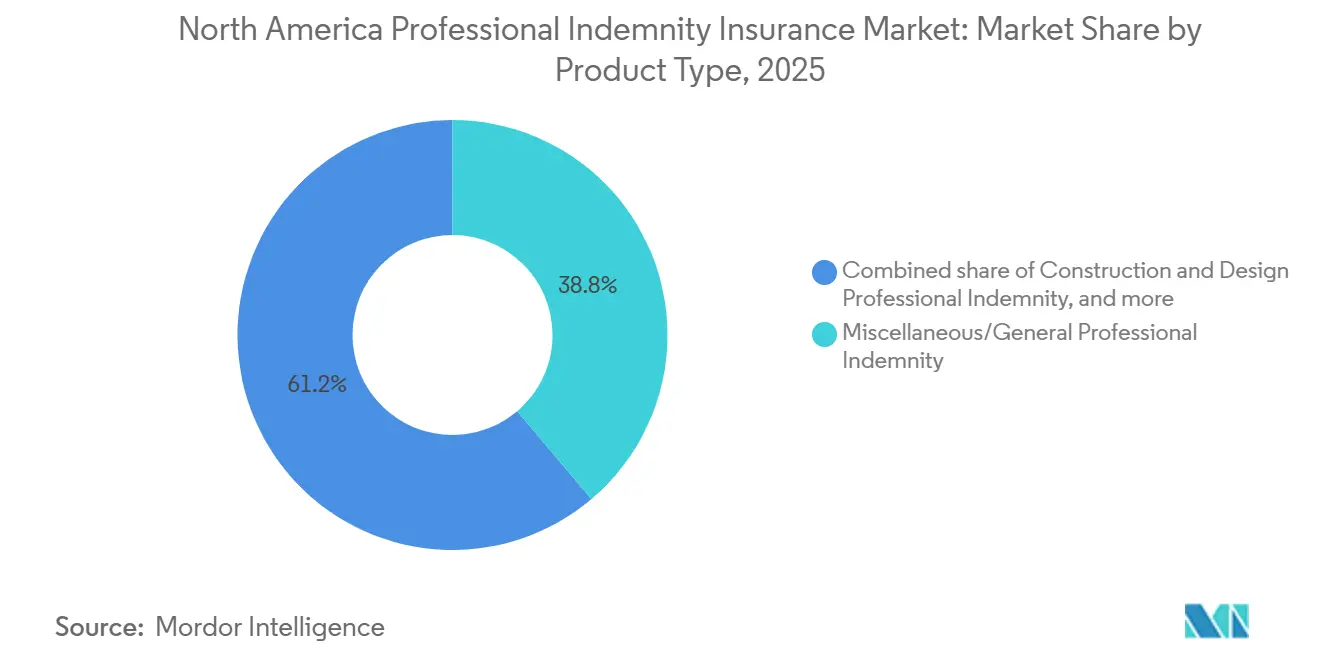
Miscellaneous and general policies accounted for 38.8% of the North America professional indemnity insurance market size in 2025. Their broad design serves management consultants, human resources advisers, media professionals, and other occupations without a dedicated specialist line. Construction and design coverage remains tied to lender and contract requirements on infrastructure and commercial projects. Financial professionals' E&O continues to support advisers and fund managers with substantial compliance obligations. Technology professional indemnity is the fastest-growing product type and is forecast to expand at a 6.6% CAGR through 2031. The segment reflects rising demand from software as a service developers, managed service providers, and businesses using artificial intelligence in client delivery.
Technology E&O insurers are adjusting terms as clients seek a clearer response to artificial intelligence-related losses. CFC's 2026 update named model hallucinations, artificial intelligence-generated content, and model drift among covered exposures in selected product lines. This approach gives buyers more visibility than policies that are silent on artificial intelligence. Ryan Specialty noted that technology E&O was more difficult than miscellaneous E&O and cyber for certain accounts in 2026. Copyright litigation involving major artificial intelligence platforms has increased underwriter caution around higher-hazard large language model accounts. The product mix, therefore, combines accessible pricing in broad miscellaneous lines with more selective conditions in technology risk.
By Profession of the Insured: Legal Services Lead While IT Expands Fastest
Legal services professionals held 22.3% of the North America professional indemnity insurance market share in 2025. Their position reflects mandatory coverage arrangements and the potential severity of legal malpractice claims. LAWPRO insured more than 32,000 Ontario lawyers and paralegals in private practice in 2026, with a base premium of CAD 3,250 (USD 2,385). Architecture, engineering, surveying, accountancy, financial advisory, and management consulting form other important profession groups. Real estate, property management, media, advertising, education, training, travel, and recruitment services remain smaller but relevant groups. Regulatory and contractual requirements remain an important route to coverage adoption among smaller professional firms.
Information technology, software, software as a service, and managed services are projected to grow at a 6.8% CAGR through 2031. This is faster than legal services because technology coverage is still developing relative to the liability created by technology-dependent client work. Insurers have moved from unclear artificial intelligence positions toward affirmative terms or exclusions since 2025. Firms without documented artificial intelligence governance can face tighter renewal discussions when coverage is sought. The North America professional indemnity insurance industry is responding with product language that addresses technology service, content, and model-performance issues. This process can increase both review activity and new policy placements among technology firms.
By Insured Firm Size: SMEs Lead, While Sole Practitioners Gain Access
Small and medium-sized enterprises held 46.1% of the North America professional indemnity insurance market size in 2025. Their scale reflects the large number of professional services businesses and the wider use of insurance requirements in customer contracts. Large firms remain the next major premium group because they buy higher limits and use layered coverage across multiple carriers. Ames & Gough found that 80% of professional liability insurers could offer limits above USD 5 million, while 40% could offer up to USD 10 million. Professional liability adoption among small businesses rose from 20% in 2023 to 31% in 2025. Digital underwriting helps insurers process these smaller accounts more efficiently.
Sole practitioners are forecast to grow at a 5.9% CAGR through 2031. Digital programs are making coverage easier to obtain for freelance and independent professionals. Pliable launched nationally in April 2026 for freelancers and consultants, offering packaged protection starting at USD 49 per month. The offering shows how a lower entry price and a simpler purchasing process can reach buyers outside traditional annual firm renewals. Coverage designed for individual advisers, consultants, and design professionals can improve access where conventional placement processes were too burdensome. This opportunity supports the North America professional indemnity insurance market as independent professional work expands.
By Distribution Channel: Brokers Remain Central as Direct Platforms Expand
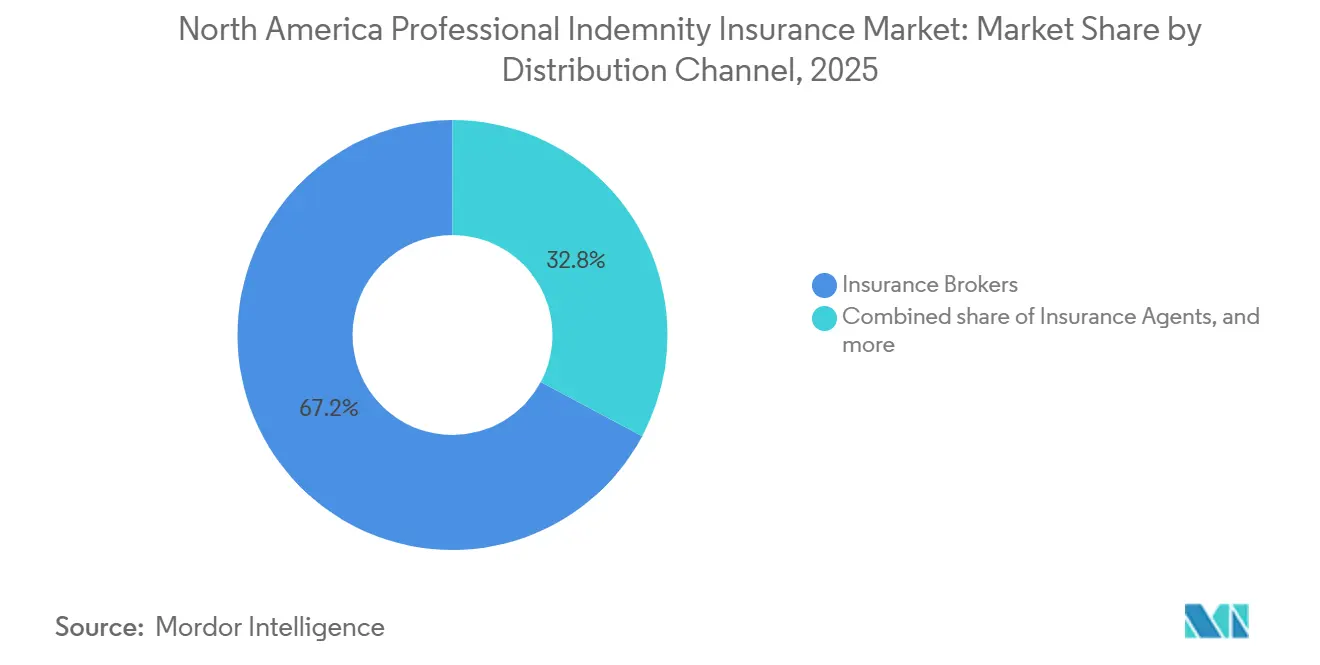
Insurance brokers held 67.2% of the North America professional indemnity insurance market share in 2025. Their role remains important for complex placements that require customized wordings, appropriate limits, and management of retroactive dates. Brokers also provide support during claims and can coordinate primary and excess layers for larger clients. Insurance agents remain relevant for captive, affinity, and professional-body programs. Engineers Canada's secondary professional liability insurance program is administered through Hub International for eligible member engineers in participating jurisdictions. Program administrators and managing general agent-led platforms also serve specialist professional groups.
Direct insurer distribution is projected to grow at a 7% CAGR through 2031. Online platforms can reduce quote-to-bind times for routine professional liability risks. AdvisorCovered.com launched in April 2026 to let registered investment advisers, financial planners, and insurance agents quote, apply, bind, and manage E&O insurance online. ALPS went live on OneShield Market Solutions for its LawyerCare program in August 2026. These changes show that established providers can operate direct and broker-supported models at the same time. The North America professional indemnity insurance market is likely to retain brokers for complex work while direct tools handle more standardized placements.
By Policy Structure: Claims-Made Policies Dominate While Project Cover Grows
Annual practice claims-made policies accounted for 74.6% of the North America professional indemnity insurance market size in 2025. This structure responds to claims reported during the policy period rather than to the date when the act occurred. It helps insurers price tail exposure and manage long reporting periods. Run-off and extended reporting period policies serve firms that are merging, closing, or leaving practice. LAWPRO has identified extended reporting period management as a relevant part of its program administration for departing lawyers. These policies can become more relevant as professional services firms consolidate and practitioner cohorts retire.
Project-specific professional indemnity is projected to grow at a 6.1% CAGR through 2031. The coverage dedicates limits to one named project during design, construction, and the agreed post-completion reporting period. This can protect project owners and design teams without drawing on limits needed for unrelated work. The National Society of Professional Engineers noted rising project-specific claims in aggressive design-build and public-private partnership arrangements. Victor Insurance offers project-specific professional liability for projects with construction values up to USD 300 million. Infrastructure and complex construction work are expanding the use of this policy structure.
Geography Analysis
The United States accounted for 85.7% of the North America professional indemnity insurance market size in 2025. Its scale reflects the size of its professional services economy, litigation environment, and varied state-based insurance rules. U.S. casualty rates rose 9% in the first quarter of 2026 as claim severity persisted in excess layers. State insurance departments oversee policy forms, rate filings, and insurer licensing. Professional requirements for lawyers, engineers, accountants, and financial advisers create varied demand across 50 state systems. California, New York, and Florida remain important risk centers because litigation frequency and social inflation are acute.
Canada has recurring premium demand from profession-specific insurance programs. LAWPRO provides mandatory protection for more than 32,000 Ontario lawyers and paralegals in private practice in 2026. Its CAD 3,250 (USD 2,385) base premium remained unchanged for a third year. Provincial engineering regulators participate in a secondary professional liability insurance program that provides automatic coverage without a deductible for eligible members. Quebec expanded its mandatory framework in November 2024, requiring engineers to show that their employers maintain coverage meeting prescribed standards.
Mexico is projected to grow at a 6.4% CAGR through 2031, making it the region's fastest-growing country segment. Courts are showing a greater willingness to award more serious civil damages and hold corporate actors personally accountable. Judicial changes implemented from June 2025 may reduce technical specialization in parts of the dispute resolution system. This can make legal outcomes less predictable for corporate service firms. Rising cross-border activity and the presence of North American professional services firms are supporting demand for locally tailored E&O products. The North America professional indemnity insurance market has a smaller Mexican base than in the United States and Canada, but the underlying liability environment is becoming more relevant.
Competitive Landscape
The North America professional indemnity insurance market has established participants such as Chubb, AIG/Lexington, AXA XL, Berkshire Hathaway Specialty Insurance, CNA Financial, and The Travelers Companies. These carriers compete across standard and specialist professional liability lines. Managing general agents are increasing competition in miscellaneous E&O, architects and engineers, and technology professional indemnity. Ryan Specialty reported pricing pressure on established carriers serving small and mid-sized firms in 2026. Markel identified the middle market as a major opportunity for carriers with strong data quality and risk-management capabilities. Competition is therefore strongest where coverage can be standardized and distributed efficiently.
Leading carriers are adjusting their product design to meet related professional, technology, and cyber risks. Chubb's Pro ERM combines professional liability, technology services, media, and cyber coverage in one policy. CFC updated its technology E&O terms in June 2026 to identify model hallucinations, artificial intelligence-generated content, and model drift as covered exposures. ALPS implemented OneShield Market Solutions for LawyerCare in August 2026, supporting its direct and broker-channel operating model. These actions show that wording clarity and distribution technology are important competitive tools. Insurers must still maintain discipline where complex claims create longer and more costly loss development.
Digital entrants target sole practitioners, small technology firms, and other buyers that may receive limited attention from traditional insurers. Hiscox agreed in August 2025 to acquire Corix Insurance Services and Vouch Insurance Company, expanding its access to specialist customer groups and digital broker technology. Regulatory requirements across the United States create a barrier because insurers need clearance across separate state insurance systems. These requirements slow scaling, but do not prevent well-capitalized insurtechs and Lloyd 's-backed programs from reaching a national customer base. The North America professional indemnity insurance industry remains competitive, with specialist expertise and distribution capacity shaping results.
North America Professional Indemnity Insurance Industry Leaders
-
Chubb Limited
-
The Travelers Companies, Inc.
-
AIG / Lexington
-
Berkshire Hathaway Specialty Insurance (BHSI)
-
CNA Financial
- *Disclaimer: Major Players sorted in no particular order
Recent Industry Developments
- August 2026: ALPS Property & Casualty Insurance Company went live on OneShield Market Solutions for its LawyerCare lawyers' professional liability program. The implementation supports ALPS's dual-distribution strategy following its 2025 acquisition of LawyerCare from ProAssurance, enabling the largest US direct writer of lawyers' malpractice insurance to operate both its traditional direct-distribution model and a newly acquired broker-channel book on a unified platform.
- June 2026: CFC Underwriting updated its technology E&O policy terms to affirmatively name model hallucinations, AI-generated content, and model drift as covered exposures across seven product lines. This marks a significant commercial wording development distinguishing CFC from insurers with silent or exclusionary AI positions, making governance documentation a condition of coverage response rather than merely a best practice.
- April 2026: Pliable, a Lloyd 's-backed E&O program administered by RVNA, a division of DOXA, launched nationally across all 50 states in the United States, targeting freelancers and consultants. The program packages 30 professional and specialty coverages into a single policy starting at USD 49 per month, representing an entry-point pricing model with no precedent in traditional North America professional indemnity distribution.
- October 2025: NEXT Insurance unveiled NEXT Pro+, an enhanced professional services offering featuring broader coverage, market-aligned pricing, higher limits, and simplified quoting for small business E&O clients. The launch followed NEXT Insurance's acquisition by Munich Re's ERGO Group, reinforcing the insurtech's digital-first distribution model with the financial backing of a major global reinsurer.
North America Professional Indemnity Insurance Market Report Scope
| Miscellaneous/General Professional Indemnity |
| Construction and Design Professional Indemnity |
| Financial Professionals and Intermediaries E&O |
| Technology Professional Indemnity |
| Legal Services |
| Architecture, Engineering, and Surveying |
| Accountancy and Corporate Secretarial Services |
| Financial Advisory, Fund Management, and Insurance Broking |
| Management, Strategy, and Human Resources Consulting |
| Information Technology, Software, SaaS, and Managed Services |
| Real Estate and Property Management |
| Media, Advertising, Public Relations, and Events |
| Education, Training, and Teaching Organizations |
| Travel, Recruitment, and Employment Services |
| Other Professional Services |
| Sole Practitioners |
| Small and Medium-Sized Enterprises |
| Large Firms |
| Insurance Brokers |
| Insurance Agents |
| Direct Insurer Distribution |
| Other Channels |
| Annual Practice Claims-Made Policies |
| Project-Specific Professional Indemnity |
| Run-Off and Extended Reporting Period |
| United States |
| Canada |
| Mexico |
| By Product Type | Miscellaneous/General Professional Indemnity |
| Construction and Design Professional Indemnity | |
| Financial Professionals and Intermediaries E&O | |
| Technology Professional Indemnity | |
| By Profession of the Insured | Legal Services |
| Architecture, Engineering, and Surveying | |
| Accountancy and Corporate Secretarial Services | |
| Financial Advisory, Fund Management, and Insurance Broking | |
| Management, Strategy, and Human Resources Consulting | |
| Information Technology, Software, SaaS, and Managed Services | |
| Real Estate and Property Management | |
| Media, Advertising, Public Relations, and Events | |
| Education, Training, and Teaching Organizations | |
| Travel, Recruitment, and Employment Services | |
| Other Professional Services | |
| By Insured Firm Size | Sole Practitioners |
| Small and Medium-Sized Enterprises | |
| Large Firms | |
| By Distribution Channel | Insurance Brokers |
| Insurance Agents | |
| Direct Insurer Distribution | |
| Other Channels | |
| By Policy Structure | Annual Practice Claims-Made Policies |
| Project-Specific Professional Indemnity | |
| Run-Off and Extended Reporting Period | |
| By Country | United States |
| Canada | |
| Mexico |
Key Questions Answered in the Report
What is driving demand for professional indemnity insurance in North America?
Larger professional services activity, contractual coverage requirements, higher claim severity, and technology-related liability are supporting demand.
How large is the North America professional indemnity insurance market?
The market size is estimated at USD 15.4 billion in 2026 and is forecast to reach USD 19 billion by 2031 at a 4.3% CAGR.
Which product type leads professional indemnity coverage in North America?
Miscellaneous and general policies led with 38.8% share in 2025 because they serve a broad group of professions without specialist product lines.
Which customer group is growing fastest for this insurance?
Sole practitioners are forecast to grow at a 5.9% CAGR through 2031 as digital programs make coverage more accessible.
Why are technology firms seeking more E&O protection?
Technology firms face greater exposure from software delivery, artificial intelligence outputs, content, and model-performance issues.
Which country is growing fastest for professional indemnity insurance in the region?
Mexico is forecast to grow at a 6.4% CAGR through 2031 as liability conditions and cross-border professional activity develop.