
Market Overview
| Study Period | 2020 - 2031 |
|---|---|
| Forecast Data Period | 2026 - 2031 |
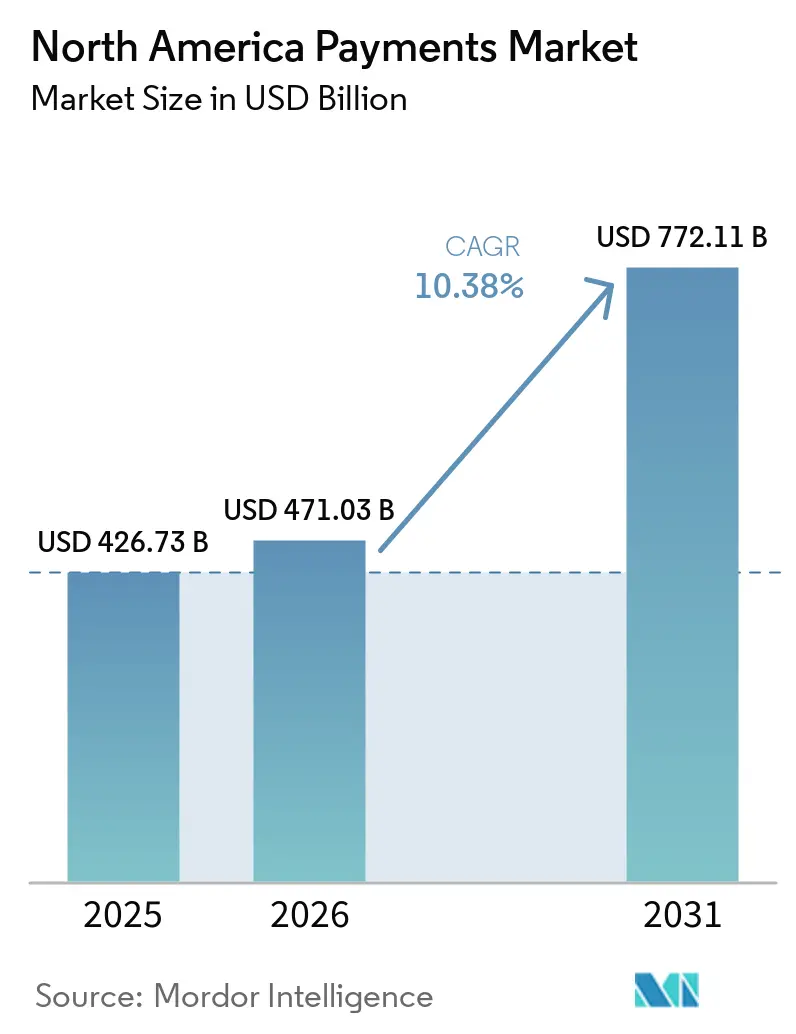
| Base Year Market Size (2025) | USD 426.73 Billion |
| Market Size (2026) | USD 471.03 Billion |
| Market Size (2031) | USD 772.11 Billion |
| Growth Rate (2026 - 2031) | 10.38 % |
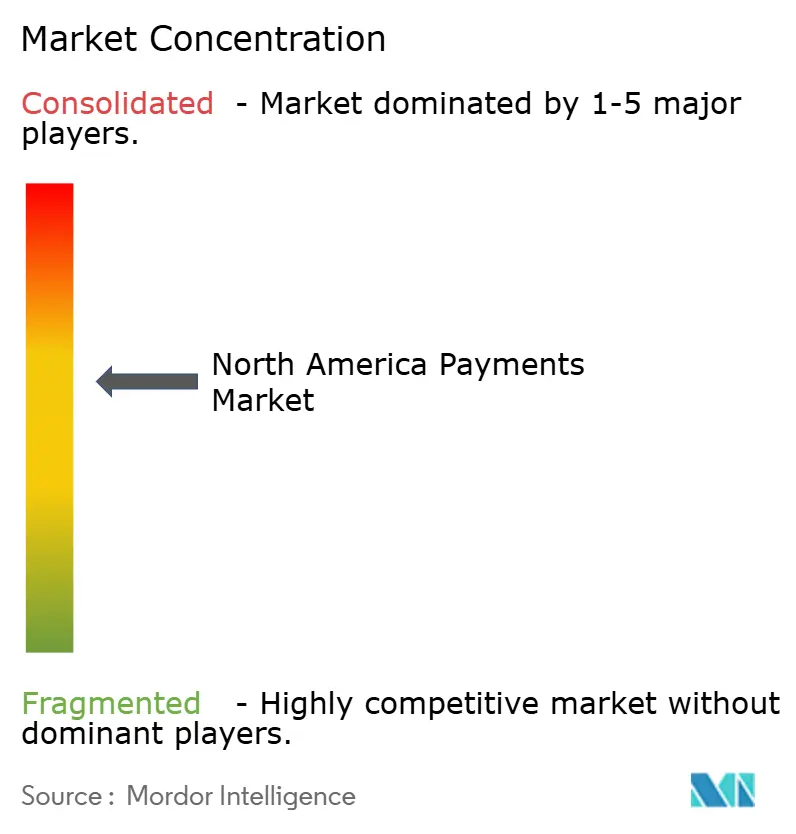
| Market Concentration | Medium |
Major Players *Disclaimer: Major Players sorted in no particular order Image © Mordor Intelligence. Reuse requires attribution under CC BY 4.0. | |
North America Payments Market Analysis by Mordor Intelligence
The North America payments market size was valued at USD 426.73 billion in 2025 and estimated to grow from USD 471.03 billion in 2026 to reach USD 772.11 billion by 2031, at a CAGR of 10.38% during the forecast period (2026-2031). Growth stems from the accelerated roll-out of real-time rails, particularly the FedNow Service, which processed 1.31 million transactions worth USD 48.6 billion in Q1 2025.[1] Regulatory actions such as the Truth in Lending Act’s extension to Buy Now, Pay Later (BNPL) providers from July 2024 reshape the region’s USD 100 billion BNPL segment.[2] Merchant demand for immediate settlement is steering volume toward online digital wallets and account-to-account transfers, while network tokenization has issued 11.5 billion tokens to reduce card-not-present fraud. Canada’s faster payment modernization, including 86% digital transaction share, supports regional scale-up. Ongoing interchange-fee litigation against Visa and Mastercard and a Department of Justice antitrust suit add uncertainty yet incentivize innovation in lower-cost rails.
Key Report Takeaways
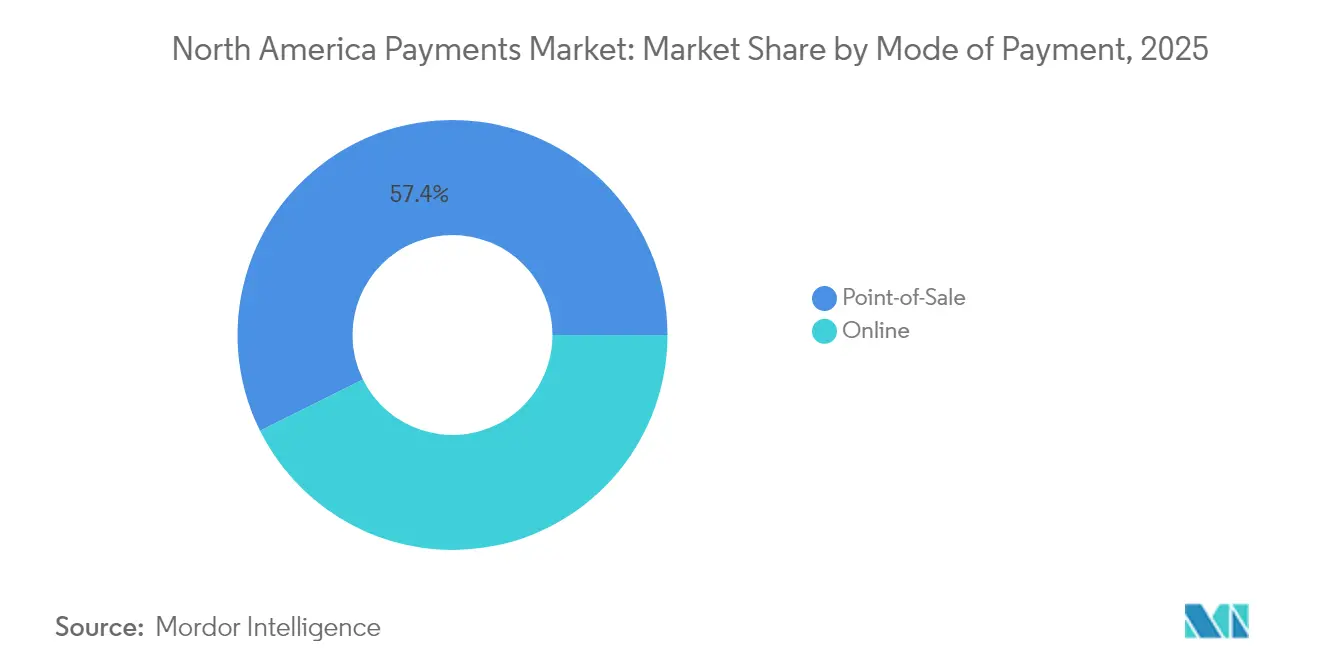
- By mode of payment, point-of-sale card transactions held 40.72% of the North America payments market share in 2025; online digital wallet and A2A transfers show the highest growth at 15.36% CAGR through 2031. Overall Point-of-Sale led with 57.35% revenue share.
- By interaction channel, point-of-sale retained 54.62% revenue share in 2025, whereas e-commerce and m-commerce are projected to register 13.01% CAGR to 2031.
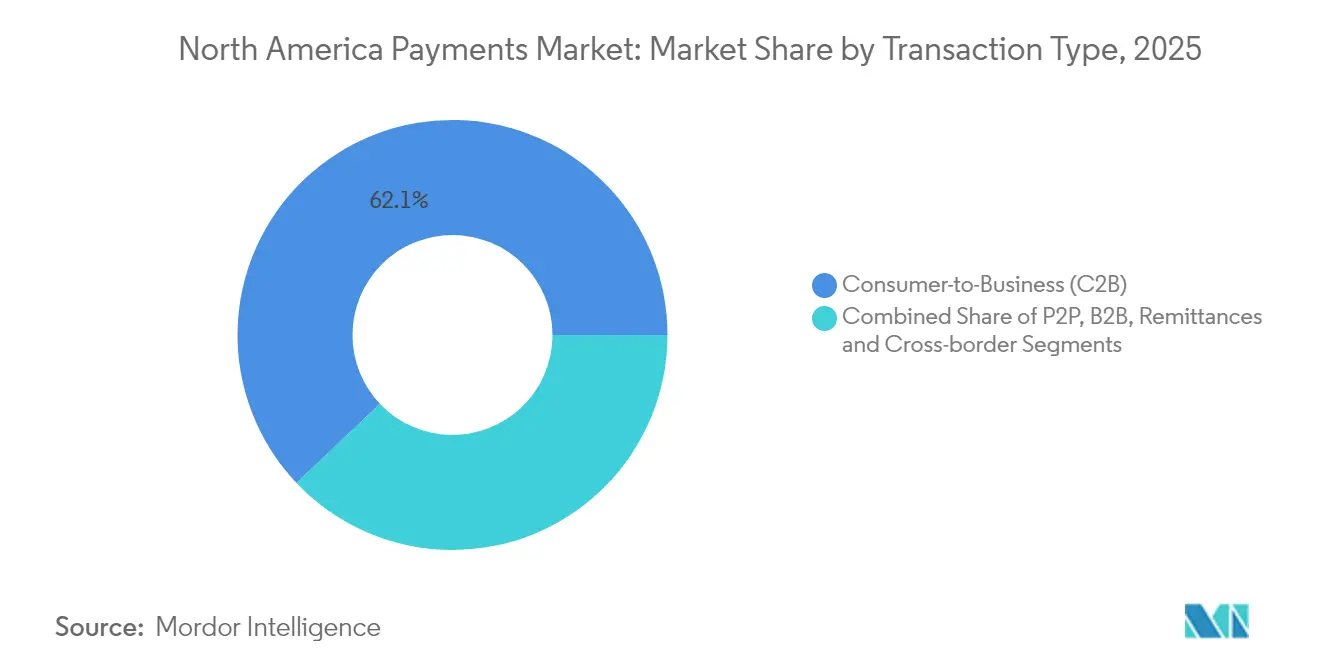
- By transaction type, consumer-to-business dominated with 62.08% share in 2025, while cross-border remittances expand at a 15.02% CAGR through 2031.
- By end-user industry, retail led with 38.15% revenue share in 2025; healthcare is the fastest-growing segment at 12.84% CAGR to 2031.
- By country, the United States accounted for 70.55% revenue share in 2025, whereas Canada is forecast to post the highest 11.62% CAGR through 2031.
Note: Market size and forecast figures in this report are generated using Mordor Intelligence’s proprietary estimation framework, updated with the latest available data and insights as of 2026.
Market Trends and Insights
Drivers Impact Analysis of North America Payments Market*
| Driver | (~) % Impact on CAGR Forecast | Geographic Relevance | Impact Timeline |
|---|---|---|---|
| Real-Time Rail Roll-out (FedNow, RTR) Accelerating Instant Payments Adoption | +2.1% | United States core, spillover to Canada & Mexico | Medium term (2-4 years) |
| BNPL Penetration Driving High-Ticket Online Transactions | +1.8% | North America, concentrated in urban centers | Short term (≤ 2 years) |
| Cross-Border Ecommerce Growth into Canada via US Platforms | +1.3% | US-Canada corridor, expanding to Mexico | Medium term (2-4 years) |
| Network Tokenization Reducing CNP Fraud & Boosting Card-on-File Volumes | +1.7% | Global, with North America leading adoption | Long term (≥ 4 years) |
| Tap-to-Pay on Mobile Unlocking SME Acceptance in U.S. & Canada | +1.5% | North America, rural and urban SME segments | Short term (≤ 2 years) |
| Corporate AP Automation Shifting B2B Spend to Virtual Cards | +1.9% | North America, enterprise and mid-market focus | Medium term (2-4 years) |
| Source: Mordor Intelligence | |||
Real-time rail roll-out accelerating instant payments adoption
FedNow expanded from 35 launch banks to more than 900 institutions by August 2024, with community banks representing 78% of participants. Businesses and consumers alike increased faster-payment use in 2023, setting the foundation for a regional shift away from legacy ACH in favor of irrevocable, immediate settlement. Early adopters such as MSU Federal Credit Union logged a 643% rise in volume year-over-year, underscoring strong demand among gig-economy workers. The resulting ubiquity of instant rails positions the market to compete internationally with systems such as PIX and UPI, improving liquidity management and supporting new treasury products.
BNPL penetration driving high-ticket online transactions
About 21% of Americans used BNPL by end-2022, and the product is projected to reach 12% of United States e-commerce sales by 2025.[3] Regulation Z now imposes credit card-style statements and dispute rights, raising compliance costs. Providers with adequate scale can internalize these costs, consolidating market share while smaller players likely seek partnerships. Mexico’s 32% projected BNPL CAGR through 2028 points to cross-border expansion potential, but capital-light entrants face heightened scrutiny on consumer debt transparency.
Cross-border e-commerce growth into Canada via US platforms
Canada processed USD 11.9 trillion in payments across 21.7 billion transactions in 2023, with e-commerce totaling USD 71.6 billion, or 5.7% of retail sales. Contactless now constitutes 53% of Canadian transactions, evidencing consumer readiness for faster online checkout. Harmonized real-time rails could strip out currency conversion lags that burden small merchants, creating share opportunities in corridors historically served by wire transfers.
Network tokenization reducing CNP fraud
Visa’s 11.5 billion tokens replaced primary account numbers for card-not-present use cases by end-2024. EMV tokenization enhances approval rates, fortifies merchant data storage, and mitigates breach fallout. Research by the Kansas City Federal Reserve confirms a continued decline in card-present fraud after EMV chip migration, with tokenization extending comparable safeguards to digital commerce. Token life-cycle management requires scale investments, thereby reinforcing incumbent network advantages.
Restraints Impact Analysis of North America Payments Market*
| Restraint | (~) % Impact on CAGR Forecast | Geographic Relevance | Impact Timeline |
|---|---|---|---|
| Increasing Interchange-Fee Litigation Risk | -1.4% | United States core, regulatory spillover effects | Long term (≥ 4 years) |
| Real-Time Fraud & Authorized Push-Payment (APP) Scams | -0.9% | North America, concentrated in instant payment corridors | Short term (≤ 2 years) |
| Processor & Core Modernization Cost Overruns for Mid-Tier Banks | -1.2% | United States and Canada, mid-tier financial institutions | Medium term (2-4 years) |
| Source: Mordor Intelligence | |||
Increasing interchange-fee litigation risk
A federal judge rejected Visa and Mastercard’s proposed USD 30 billion interchange settlement in June 2024, prolonging two decades of merchant litigation. The separate USD 5.54 billion class action covering 2004-2019 fees remains open to claims until February 2025. Annual interchange exceeded USD 100.8 billion in 2023, amplifying calls for fee caps and routing choice under the Credit Card Competition Act. Prolonged legal exposure diverts capital from innovation and could incentivize merchants to steer volume toward lower-cost real-time rails.
Real-time fraud and authorized push-payment scams
Irrevocable settlement elevates the risk of socially engineered transfers. FedNow’s rapid uptake enlarges the threat surface, forcing banks to deploy 24/7 behavioral analytics. Visa has invested USD 3 billion in artificial intelligence to counter emerging fraud vectors. Education campaigns and device-based risk scoring add friction for first-time payees, balancing convenience with security.
*Our forecasts treat driver/restraint impacts as directional, not additive. The impact forecasts reflect baseline growth, mix effects, and variable interactions.
North America Payments Market Segment Analysis
By Mode of Payment:
Digital Wallets Challenge Card DominancePoint-of-sale card payments accounted for 40.72% of the North America payments market share in 2025. Overall Point-of-Sale led with 57.35% revenue share. Online digital wallets and account-to-account alternatives are expanding at 15.36% CAGR through 2031 as merchants pursue faster funding cycles and lower fees. Federal Reserve data shows a 31% rise in business digital-wallet use during 2023. Contactless capability reached 69% of issued debit cards in 2024 and will reach near universality by 2027.
The convergence of wallet tokens with network security reduces the acceptance gap between cards and A2A rails. Cash volumes in Canada rose 15% in 2023 despite digital gains, illustrating consumer preference for optionality. Tokenization allows recurring subscription providers to store credentials securely, blending card utility with wallet convenience.

By Interaction Channel:
E-commerce Momentum AcceleratesPoint-of-sale transactions still generate 54.62% of revenue yet e-commerce and m-commerce are projected to grow at 13.01% CAGR to 2031. Canada’s USD 71.6 billion online spend in 2023 underlines cross-border scale as United States merchants deploy localized checkout flows through payment gateways. Contactless adoption (53% of Canadian transactions) reflects user comfort with proximity tech, smoothing the offline–online divide.
Consumers show clear appetite for omnichannel journeys. Seventy-four percent favor faster payments from their primary bank, yet large shares remain open to fintech alternatives. Tap-to-pay on mobile reduces hardware costs for small merchants and extends acceptance in rural geographies, bringing new users into the North America payments market.
By Transaction Type:
Cross-Border Remittances Outpace Domestic CommerceConsumer-to-business flows held 62.08% share in 2025, but cross-border remittances are growing at a 15.02% CAGR. Visa Direct processed nearly 10 billion payouts in 2024, linking 11 billion endpoints, and cross-border volume advanced 16% year-on-year. Real-time rails cut settlement windows, enabling payroll, gig-economy payouts, and diaspora remittances.
Corporate procurement is also digitizing. Citizens Bank finds 94% of midsize executives plan to adopt exclusively digital payments within five years. Virtual cards are forecast to reach USD 452 billion in US commercial spend by 2027, shifting business-to-business routines toward card-based automation.
By End-user Industry:
Healthcare Digitization Drives Cost ReductionRetail retained 38.15% of revenue in 2025 owing to scale, yet healthcare shows the fastest 12.84% CAGR. Electronic claim payments rose 8% in 2023 and could save USD 803 million annually if fully adopted. Integrated payer-provider models covering 75% of insured lives accelerate adoption of automated remittance and patient billing portals.
Other verticals such as entertainment and utilities maintain steady gains as subscription and invoice platforms normalize card-on-file and A2A options. Government agencies are modernizing legacy payment platforms under open-banking mandates, opening further use cases for instant settlement and identity-verified disbursements.
Geography Analysis
United States Payments Market
The United States leads with 70.55% share due to economic scale and dense issuer-acquirer connectivity. FedNow’s reach across more than 900 institutions elevates liquidity for businesses and households, driving wider adoption of instant payroll, bill-pay, and treasury products. Visa generated USD 35.9 billion in net revenue for fiscal 2024, consistently reinvesting in AI-led fraud tools to sustain approval rates and mitigate regulatory headwinds.
Canada Payments Market
Canada delivers the region’s highest growth trajectory as Real-Time Rail comes online and interlinks with global schemes. The nation cleared USD 11.9 trillion in payments in 2023, and contactless represents more than half of all consumer transactions. Banks and payment service providers position themselves to monetize cross-border flows through low-cost FX, reducing reliance on wire transfers.
Mexico Payments Market
Mexico remains a high-potential frontier characterized by cash dominance and fast fintech innovation. Projected digital-payments value of USD 167.85 billion by 2028 illustrates accelerating wallet adoption. Regulatory licensing under the 2018 fintech law channels competition toward well-capitalized firms, prompting global players to ally with local banks for distribution and compliance.
Regulatory Landscape
Regulation in North America is tightening around consumer protections while agencies continue to debate broader access and oversight for nonbank payment providers. In the United States, the Truth in Lending Act (Regulation Z) extension to BNPL from July 2024 continues to reshape disclosures and dispute-resolution obligations for installment products. Oversight of large nonbank payment apps also shifted after the November 2024 CFPB supervision rule for larger participants was overturned via a Congressional Review Act action (P.L. 119-11) in February 2025.
In 2026, policy attention moved toward fintech integration and payment-rail access. A May 2026 White House executive order directed federal financial regulators to review and streamline requirements tied to fintech integration within regulatory frameworks. An April 2026 bill (H.R. 8395, the PACE Act of 2026) was introduced to outline a registration and regulatory framework for payment service providers, including discussion of payments account access. In Canada, the Retail Payment Activities Act and its regulations continue to operationalize supervision, with operational risk management and funds safeguarding requirements coming into force in September 2025. The Bank of Canada also clarified in January 2026 that first annual reports for supervised payment service providers were due by March 31, 2026.
Value Chain Analysis
The North America payments value chain spans scheme and rail operators (card networks and real-time systems), issuers and acquirers, processors, gateways, and the merchant-facing distribution layer. On the acceptance side, merchant acquirers and processors (for example, Fiserv, Global Payments, and Worldpay) connect merchants to card networks and alternative rails. Gateways and orchestration platforms (such as Stripe and Adyen) route transactions and manage authentication, fraud tooling, and settlement reporting. Large commerce platforms (including Shopify and Amazon) and integrated software vendors also act as high-leverage channels by embedding payments into vertical SaaS and point-of-sale workflows, moving value toward platforms that control checkout, data, and merchant onboarding.
Upstream dependencies increasingly concentrate around identity, fraud, and compliance capabilities that can operate across instant and card rails. Network tokenization (with Visa reporting 11.5 billion tokens by end-2024) and AI-led risk scoring sit alongside bank treasury and settlement functions. Real-time payments also require 24/7 operations, fraud monitoring, and dispute or exception handling that differ from batch ACH. Cross-border value creation tends to concentrate among providers that combine local payment method coverage, FX and compliance, and payout reach, aligning with merchant demand for faster funding, lower costs, and simpler international checkout.
Competitive Landscape
The North America payments market is moderately concentrated, anchored by global card networks yet challenged by bank consortiums, big-tech entrants, and vertically focused fintechs. Visa captured USD 19.7 billion in net income on USD 35.9 billion revenue for fiscal 2024, funding the acquisition of Featurespace to embed real-time AI fraud prevention. Litigation risk combines with DOJ scrutiny to pressure interchange models, motivating network investment in secure tokens and value-added services that justify fees.
Fintech disruptors exploit niche use cases. BNPL providers seek to differentiate via omnichannel acceptance and credit bureau reporting enhancements to comply with Regulation Z. B2B platforms automate payables and integrate virtual cards to earn interchange while lowering client processing costs. Real-time payment orchestrators deliver application programming interfaces that abstract complexity across FedNow, ACH, and card rails, enabling software firms to embed payouts without direct bank integrations.
Incumbent banks respond through consortia such as Early Warning’s Zelle and by integrating FedNow gateways directly into core processors. Processor acquirers invest in point-of-interaction software that converts smartphones into tap-to-pay terminals, extending acceptance to micro-merchants and reinforcing network volume.
North America Payments Industry Leaders
-
PayPal Holdings Inc.
-
Visa Inc.
-
Mastercard Incorporated
-
Dwolla, Inc.
-
Amazon.com, Inc.
- *Disclaimer: Major Players sorted in no particular order
North America Payments Market Companies Covered in this Report
- Visa Inc.
- Mastercard Incorporated
- PayPal Holdings Inc.
- Fiserv Inc.
- Block, Inc.
- Stripe, Inc.
- Apple Inc.
- Google LLC
- Amazon.com, Inc.
- Interac Corp.
- Dwolla, Inc.
- Adyen N.V.
- Global Payments Inc.
- PaySafe Limited
- JPMorgan Chase and Co. (Chase Payment Solutions)
- Ant Group Co., Ltd. (Alipay North America)
- Toast, Inc.
- Shopify Inc. (Shopify Payments)
- Clover Network, Inc.
- Beacon Payments LLC
- Wells Fargo and Co. (Wells Fargo Gateway)
- Worldline SA
- Payoneer Global Inc.
Market Opportunities and Future Outlook
Real-time and account-to-account functionality remains a primary whitespace for merchant funding, bill pay, and payout use cases where card fees and batch settlement are pain points. FedNow scale-up offers a U.S. instant-rail anchor (1.31 million transactions worth USD 48.6 billion in Q1 2025), while Canada is formalizing Real-Time Rail readiness. Payments Canada set August 24, 2026 as the effective date for the RTR legal framework and rules ahead of a Q4 2026 launch window. Taken together, these developments support product rollouts in instant disbursements, payroll and gig payouts, and treasury liquidity tools, provided participants pair speed with controls for authorized push-payment scams.
Checkout modernization and embedded commerce stacks also open additional room in cross-border e-commerce and conversion optimization. Visa reported 120 million U.S. cards enrolled in Click to Pay in June 2026, with integrations across platforms such as Shopify, WooCommerce, and BigCommerce that support guest checkout without manual credential entry. Separately, Stripe began a phased rollout of an Adaptive Pricing Engine in June 2026 to localize currency, payment methods, and installment options at checkout, pointing to a shift toward software-led optimization rather than single-rail processing. Data-driven monetization is expanding alongside core payments, as shown by PayPal launching an advertising arm in May 2026 that uses transactional data from PayPal, Venmo, and Honey for deterministic measurement, creating new revenue streams tied to commerce activity.
Recent Industry Developments in North America Payments Market
- July 2026: PayPal expanded PayPal USD (PYUSD) distribution by launching the stablecoin on the Polygon blockchain. The move broadened on-chain compatibility for a payments-linked stablecoin and strengthened PayPal's options for cross-border and digital-asset-enabled settlement workflows.
- June 2026: PayPal cooperated with PPRO to add more than 30 local payment methods, expanding international checkout coverage for merchants. The added method breadth supports higher authorization and conversion in cross-border commerce, while reducing dependency on card-only acceptance in markets where local rails dominate.
- May 2024: Dwolla announced a collaboration with Visa to build a pay-by-bank experience, aligning account-to-account payments with mainstream acceptance and user experience patterns. The partnership highlights growing efforts to make bank payments competitive at checkout by combining A2A economics with familiar network-grade security and merchant reach.
North America Payments Market Report Scope and Research Methodology
Market Definition and Coverage
For this study, we define the North America payments market as the value of payments executed through common consumer and commercial payment modes across the region, counted on a consistent USD value basis and tied to identifiable payment use cases.
Scope exclusions: The sizing excludes online purchases of motor vehicles, real estate, utility bill payments, mortgage payments, loans, credit card bill payments, and purchases of shares or bonds.
Segments Covered in This Report
- Segmentation by Mode of Payment
- Point-of-Sale
- Card (Debit, Credit, Pre-paid)
- Digital Wallets (Apple Pay, Google Pay, Interac Flash)
- Cash
- Other POS (Gift-cards, QR, Wearables)
- Online
- Card (Card-Not-Present)
- Digital Wallet and Account-to-Account (Interac e-Transfer, PayPal)
- Other Online (COD, BNPL, Bank Transfer)
- Point-of-Sale
- Segmentation by Interaction Channel
- Point-of-Sale
- E-commerce/M-commerce
- Segmentation by Transaction Type
- Person-to-Person (P2P)
- Consumer-to-Business (C2B)
- Business-to-Business (B2B)
- Remittances and Cross-border
- Segmentation by End-user Industry
- Retail
- Entertainment and Digital Content
- Healthcare
- Hospitality and Travel
- Government and Utilities
- Other End-user Industries
- By Country
- United States
- Canada
- Mexico
Data Sources, Market Sizing, and Validation
Desk Research
Desk work starts by mapping the payment flows that can be tracked consistently, then aligning definitions across public datasets so the model does not mix unlike totals. We used publicly available sources such as the Federal Reserve (including payments studies and FedNow updates), the Bank of Canada (payments and modernization releases), and official trade and macro series from the US Bureau of Economic Analysis and the US Census Bureau to keep the regional demand context grounded.
To make the market inputs usable, we also reviewed materials from payments and banking associations and central bank publications (examples), and we cross-checked trend direction using company filings, earnings decks, and reputable business press coverage. In a few places, paid subscriptions for company financials and news intelligence were used to fill gaps in disclosure and confirm timing of key product or regulatory events. The sources listed here are illustrative, and many other public references were reviewed to collect, validate, and clarify the final assumptions.
Primary Interviews and Surveys
Primary work focused on validating what the value metric represents in day-to-day operations, and how fast key payment modes are shifting by country and use case. We spoke with payment service providers, banks, merchants, and ecosystem experts across the United States, Canada, and Mexico, so assumptions on adoption pace, pricing logic, and policy timing could be checked and adjusted before finalizing the model.
Distribution of primary research fieldwork respondents
| Company type | Respondent position |
|---|---|
| Top tier: 37% | CXOs: 15% |
| Mid tier: 41% | Functional/Unit leaders: 38% |
| Smaller Players: 22% | Managers: 47% |
Market-Sizing & Forecasting
Sizing starts with a top-down build where regional payments value is reconstructed using official payment statistics and payment-mode splits, and then shaped to match the report scope exclusions so adjacent spending pools do not inflate totals. The market total is subsequently corroborated with selective bottom-up approximations, such as sampled average value per payment type multiplied by estimated transaction activity, plus channel checks on how quickly point-of-sale and online payment shares are moving.
The inputs that matter most in this market are the relative share of point-of-sale versus online payments, the pace of digital wallet and account-to-account adoption, the rollout timing of real-time rails and modernization programs, the direction of fraud and tokenization activity (as a proxy for card-not-present friction), and how regulatory or legal actions affect fee structures. For the forecast, we used scenario analysis supported by expert consensus, because adoption and pricing can shift quickly after policy moves or infrastructure launches. Where bottom-up checks had disclosure gaps, we applied conservative ranges, documented the rationale, and then narrowed the range after primary feedback.
Data Validation & Update Cycle
Outputs are checked from multiple angles so totals do not drift away from observable payment signals. We run variance checks across countries and channels, review anomalies that break expected relationships (for example, an unrealistic jump in online share without a supporting demand signal), and then the model goes through multi-step analyst review before sign-off.
Reports are refreshed annually, and interim updates are triggered when material events occur, such as major regulatory changes, new payment-rail launches, or step changes in consumer payment behavior. Right before delivery, we do a final pass to incorporate the latest public releases and any new expert confirmation so clients receive an up-to-date view.
Mordor Intelligence's North America Payments Market Size Compared With Other Published Estimates
Different published market sizes for payments can look far apart because the underlying number being counted is not always the same, even when the title sounds similar. The biggest differences usually come from whether the estimate is based on payment value versus industry revenue, which geographies are strictly included, and how exclusions are applied to keep large adjacent spend pools from getting mixed in.
Payment-mode splits, country-level consistency checks, and explicit category exclusions are the evidence that keeps Mordor Intelligence tied to a comparable payments-value pool, rather than a broader ecosystem revenue or cross-border volume construct. When a model switches to revenue, or bundles extra payment use cases that are not part of day-to-day purchase flows, the total can rise sharply even if the real payment activity trend is similar.
Benchmark comparison
| Source | Market Size | Gaps in Research Methodology |
|---|---|---|
| Mordor Intelligence | USD 426.73 B (2025) | |
| Regional Consultancy A | USD 2.85 T (2026) | Uses a revenue framing and broad ecosystem segmentation, which can count platform and service revenues beyond a payments-value definition, and it also starts from a different base year and forecast window. |
| Trade Journal B | USD 431.00 B (2024) | Appears to use a broader POS and online bucket without stating the same explicit exclusions, and the base year choice can shift totals when fast-growing online share is being modeled. |
The comparison mainly shows that the spread comes from what is being counted, and how tightly the boundary is controlled. By keeping the unit consistent as payments value and applying stated exclusions, the baseline stays traceable to clear demand signals and can be repeated when new public statistics are released.
Key Questions Answered in the Report
What is the current size of the North America payments market?
The market stood at USD 471.03 billion in 2026 and is forecast to reach USD 772.11 billion by 2031.
Which payment mode is growing the fastest?
Online digital wallets and account-to-account transfers are expanding at a 15.36% CAGR through 2031, outpacing card growth.
Why is healthcare the fastest-growing end-user segment?
Healthcare payments benefit from electronic funds transfer mandates that can save USD 803 million annually, driving a 12.84% CAGR.
How will interchange-fee litigation influence market dynamics?
Ongoing lawsuits could compress card margins and accelerate merchant migration to real-time or wallet-based alternatives with lower fees.
What role does FedNow play in competitive strategy?
FedNow’s instant-settlement capability gives banks and fintechs a low-latency rail to develop new treasury, payroll, and disbursement products.
Which country is projected to grow the fastest in North America?
Canada is expected to register an 11.62% CAGR through 2031 thanks to digital-payment adoption and forthcoming Real-Time Rail integration.