
North America Metro Dense Wave Division Multiplexing (DWDM) Market Size and Share
Market Overview
| Study Period | 2020 - 2031 |
|---|---|
| Forecast Data Period | 2026 - 2031 |
| Base Year Market Size (2025) | USD 3.82 Billion |
| Market Size (2026) | USD 4.11 Billion |
| Market Size (2031) | USD 5.88 Billion |
| Growth Rate (2026 - 2031) | 7.43 % |
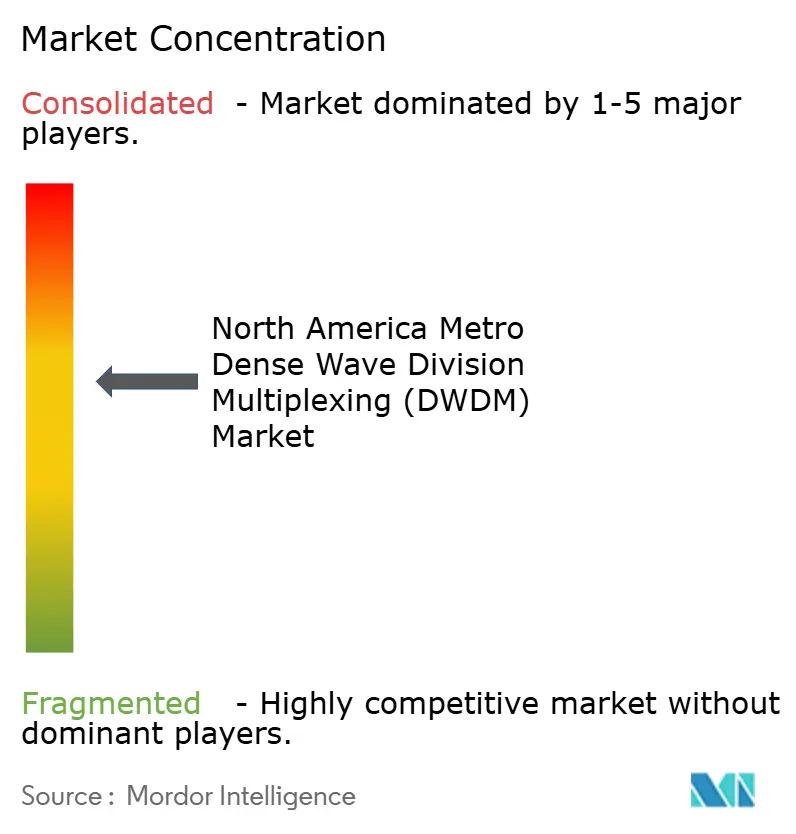
| Market Concentration | Medium |
Major Players *Disclaimer: Major Players sorted in no particular order Image © Mordor Intelligence. Reuse requires attribution under CC BY 4.0. | |
North America Metro Dense Wave Division Multiplexing (DWDM) Market Analysis by Mordor Intelligence
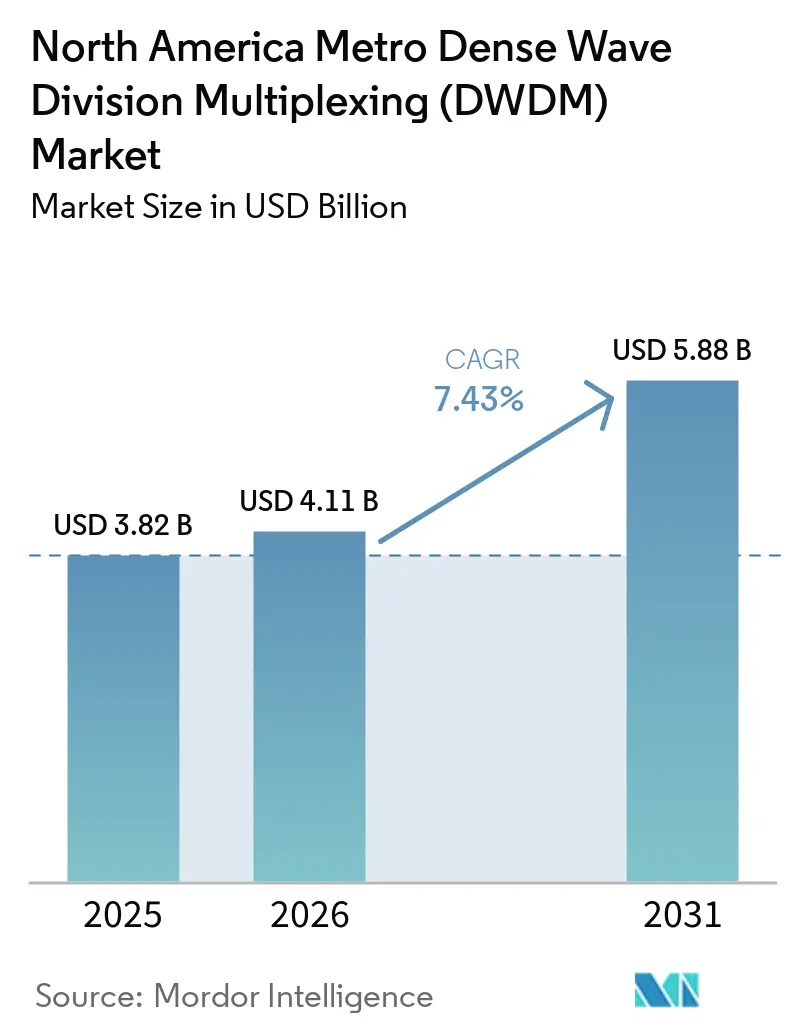
The North America Metro Dense Wave Division Multiplexing (DWDM) Market size is projected to be USD 3.82 billion in 2025, USD 4.11 billion in 2026, and reach USD 5.88 billion by 2031, growing at a CAGR of 7.43% from 2026 to 2031. Demand is being shaped by AI training clusters that operate across separate campuses and require very high-capacity links between facilities. The USD 42.45 billion BEAD program is extending fiber aggregation requirements into secondary US markets. The shift from 5G non-standalone networks to standalone networks is also raising transport needs at cell sites. These changes make the North America metro DWDM market more dependent on coherent optical systems, open line systems, pluggable modules, and network control software. Suppliers are responding by expanding optical component capacity, improving automation, and adapting their offerings to the needs of cloud operators and service providers.
Key Report Takeaways
- By component, hardware held 79.43% of the North America Metro Dense Wave Division Multiplexing (DWDM) Market in 2025, while software is projected to expand at a 10.87% CAGR through 2031.
- By transmission capacity, the 400 Gbps tier held 37.21% of the North America metro DWDM market in 2025, while the above-400 Gbps tier is projected to expand at a 12.41% CAGR through 2031.
- By application, data center interconnect accounted for 40.27% of the North America metro DWDM market in 2025 and is projected to expand at a 10.37% CAGR through 2031.
- By end-user, communication service providers held 46.83% of the North America metro DWDM market in 2025, while cloud and data center providers are projected to expand at a 10.43% CAGR through 2031.
- By country, the United States accounted for 86.37% of the North America metro-dense wavelength division multiplexing (DWDM) market in 2025, while Mexico is projected to expand at a 10.28% CAGR through 2031.
Note: Market size and forecast figures in this report are generated using Mordor Intelligence’s proprietary estimation framework, updated with the latest available data and insights as of January 2026.
North America Metro Dense Wave Division Multiplexing (DWDM) Market Trends and Insights
Drivers Impact Analysis*
| Driver | (~) % Impact on CAGR Forecast | Geographic Relevance | Impact Timeline |
|---|---|---|---|
| AI Cluster Scale-Across DCI Expansion | +3.5% | United States, Canada | Short term (≤ 2 years) |
| 400ZR and 800ZR Pluggable Adoption | +2.2% | United States, Canada | Short term (≤ 2 years) |
| BEAD-Funded Fiber Backhaul and Metro Aggregation | +1.0% | United States, rural and secondary metros | Medium term (2-4 years) |
| 5G Standalone Fronthaul and Backhaul Densification | +0.8% | United States, Canada, Mexico | Medium term (2-4 years) |
| Secondary-Metro Edge Interconnect for AI Inference | +0.5% | United States, Tier-2 and Tier-3 metros | Medium term (2-4 years) |
| Open-Line-System Procurement by Tier-2 Operators | +0.4% | United States, Canada | Long term (≥ 4 years) |
| Source: Mordor Intelligence | |||
AI Cluster Scale-Across DCI Expansion
Distributed AI training places parts of a single computing cluster across campuses because power and land constraints can limit a single site. These arrangements need to align with the bandwidth and latency characteristics previously associated with on-campus GPU networks. This places coherent DWDM systems closer to the center of AI infrastructure planning. Zayo is building more than 8,000 miles of new long-haul fiber in AI corridors through its partnership with NVIDIA.[1] It also secured a long-term Corning fiber supply agreement for a broader program covering more than 15,000 route miles through 2030. These projects support the transport foundation that the North America metro DWDM market needs as AI sites become more geographically distributed.
400ZR and 800ZR Pluggable Adoption
The Optical Internetworking Forum published the OIF-800ZR-01.0 Implementation Agreement in October 2024.[2] The agreement defines an interoperable 800G coherent interface for amplified DWDM links spanning 80-120 km. This framework supports wider use of 800G ZR and ZR+ pluggable modules without customized integration between suppliers. When transmission is placed directly in router and switch ports, hyperscalers can use IP-over-DWDM designs instead of relying only on integrated transponder shelves. Marvell launched the COLORZ 1600 1.6T ZR/ZR+ pluggable in March 2026, using a 2 nm coherent DSP and integrated MACsec encryption. The North America metro DWDM market is therefore moving toward a model in which more transmission value is delivered through pluggables and related control software.
BEAD-Funded Fiber Backhaul and Metro Aggregation
The USD 42.45 billion BEAD program has moved from program design into physical deployment. Fiber construction was underway in 28 US states in the first quarter of 2026, and 52 states and territories had signed grant agreements. Each new fiber-to-the-premises route requires aggregation capacity to connect it to an existing ring or point of presence. The USD 1 billion Middle Mile Grant program also directs funding toward the mid-network infrastructure that supports this aggregation layer. BEAD-funded networks must be capable of scaling to support 5G, successor wireless technologies, and other advanced services. This requirement supports coherent transport architectures across the North America metro DWDM market, especially where funded routes connect smaller communities to metro networks.[3]
5G Standalone Fronthaul and Backhaul Densification
The transition from 5G non-standalone to 5G standalone networks enables network slicing, ultra-reliable low-latency communications, and massive machine-type communications. These capabilities create dedicated transport requirements with strict timing and latency needs. Lightpath announced a 2026 network expansion covering more than 2,400 macro cell tower locations in Connecticut, Massachusetts, New York, and New Jersey. The project added 265 route miles and dedicated 100 Gbps and 400 Gbps aggregation links for national wireless providers. In open RAN networks, the eCPRI fronthaul may require DWDM multiplexing when fiber is constrained, and latency budgets are tight. These requirements extend the role of the North America metro DWDM market in urban 5G densification programs.
Restraints Impact Analysis*
| Restraint | (~) % Impact on CAGR Forecast | Geographic Relevance | Impact Timeline |
|---|---|---|---|
| High Metro Deployment and Integration Cost | -0.8% | United States, dense urban areas, Canada | Short term (≤ 2 years) |
| Skilled Fiber and Coherent-DSP Talent Shortage | -0.5% | United States, Canada, Ottawa cluster | Medium term (2-4 years) |
| Legacy SONET/SDH and Multi-Vendor Orchestration Friction | -0.3% | United States, Canada | Medium term (2-4 years) |
| InP Photonic-Integrated-Circuit Supply Concentration | -0.2% | United States | Short term (≤ 2 years) |
| Source: Mordor Intelligence | |||
High Metro Deployment and Integration Cost
Civil engineering, conduit permitting, and integration work can slow metro optical projects. These costs affect smaller operators most because they have less leverage in construction procurement. Open ROADM designs can reduce the cost per bit compared with proprietary systems. However, the associated savings can be offset by the labor needed to deploy controllers, develop adapters, and complete interoperability testing. A 2025 multi-vendor IP-over-DWDM testbed study recorded average end-to-end service creation times of 198 seconds per workflow under controlled conditions.[4] The North America metro DWDM market, therefore, continues to depend on professional and managed services, while some mid-sized operators face longer implementation schedules.
Skilled Fiber and Coherent-DSP Talent Shortage
The available pool of photonics and coherent DSP specialists has not kept pace with the 800G and 1.6T product cycles. Advanced deployments need people who understand semiconductor process integration, high-speed signal processing, and optical network design. This capability is particularly important when operators deploy SDN controllers and commission disaggregated optical nodes. The combined Ciena and Nokia research footprint in Ottawa remains an important source of coherent DSP expertise. Nokia's acquisition of Infinera may release 150-300 engineers into the wider talent market. However, differences between their skills and the most in-demand disciplines may limit the immediate impact on deployment capacity in the North America metro DWDM market.
*Our forecasts treat driver/restraint impacts as directional, not additive. The impact forecasts reflect baseline growth, mix effects, and variable interactions.
Segment Analysis
By Component: Hardware Holds Revenue While Software Changes the Margin Structure
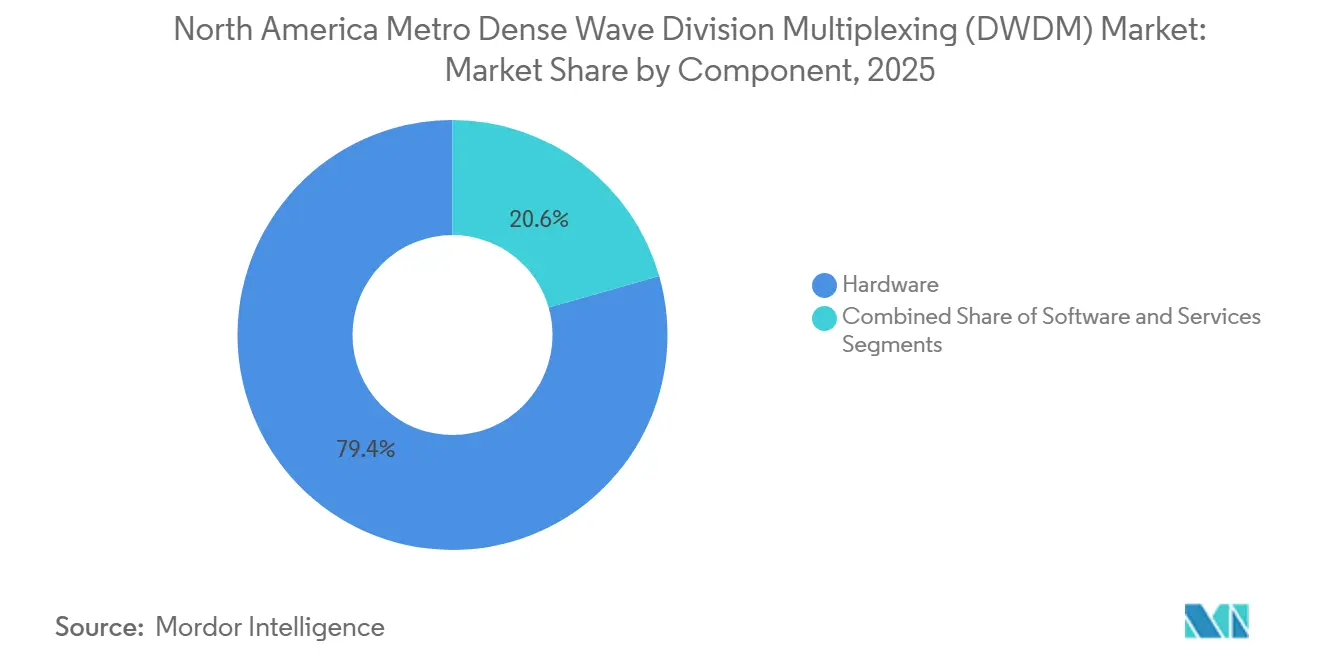
Hardware accounted for 79.43% of the North America metro DWDM market size by component in 2025. Initial network construction requires transponders, ROADMs, amplifiers, and passive optical components. Hardware demand also remains important during refresh cycles and metro expansion programs. The hardware position also reflects the capital-intensive nature of metro networks. Pluggable 800ZR and ZR+ modules can directly connect to router and switch ports. This can shift a portion of spending away from higher-value integrated line-system equipment. As shipped wavelengths increase, revenue per wavelength may still be under pressure. The component mix in the North America metro DWDM market is therefore changing, even where total capacity demand rises.
Software is projected to expand at a 10.87% CAGR from 2026 to 2031, the fastest component growth rate. SDN-based open line system controllers are becoming more relevant as networks include equipment from multiple suppliers. AI-enabled planning platforms and digital-twin validation tools are also gaining use among carriers and cloud operators. Ciena introduced telemetry-based assurance and automated routing agents at OFC 2026. These products show that the incumbents are using software to address hardware commoditization. Services also benefit from the complexity of disaggregated, open-line system platforms. Managed and professional services capture work that many operators cannot complete on their own. This supports a broader software-and-services role across the North America metro DWDM market.

By Transmission Capacity: Higher Speeds Change Metro Traffic Economics
The 400 Gbps tier accounted for 37.21% of the North America metro DWDM market by transmission capacity in 2025. It remains a high-capacity option for data center interconnect and 5G backhaul on a coherent amplified span of 80-120 km. Its supplier base is established, and OIF 400ZR standards support interoperability. Its cost per bit has also made it practical for Tier-2 operators upgrading metro rings. The up-to-100 Gbps segment remains relevant for enterprise and government access networks with fixed transport budgets. It is also used on BEAD-funded middle-mile routes where per-wavelength economics matter. The 200 Gbps tier continues to serve mobile aggregation and regional carrier interconnect requirements.
The above-400 Gbps tier is projected to expand at a 12.41% CAGR from 2026 to 2031. It includes 800 Gbps systems and the emerging 1.6 Tbps category enabled by the 800ZR standard and the 1600ZR roadmap. Hyperscalers are adopting 800ZR+ modules to connect AI campuses with purpose-built optical networks. Ciena, Nokia, and Marvell are bringing 1.6T products to the market. Nokia introduced application-optimized coherent solutions in March 2026 that use 4 new DSPs and optical front ends based on indium phosphide and silicon photonics. The earlier tiers are selected largely on cost per bit. Above 400 Gbps, performance per watt becomes more important because AI data center operations are constrained by energy density. This distinction changes purchasing priorities within the North America metro DWDM market.
By Application: Data Center Interconnect Leads Demand and Expansion
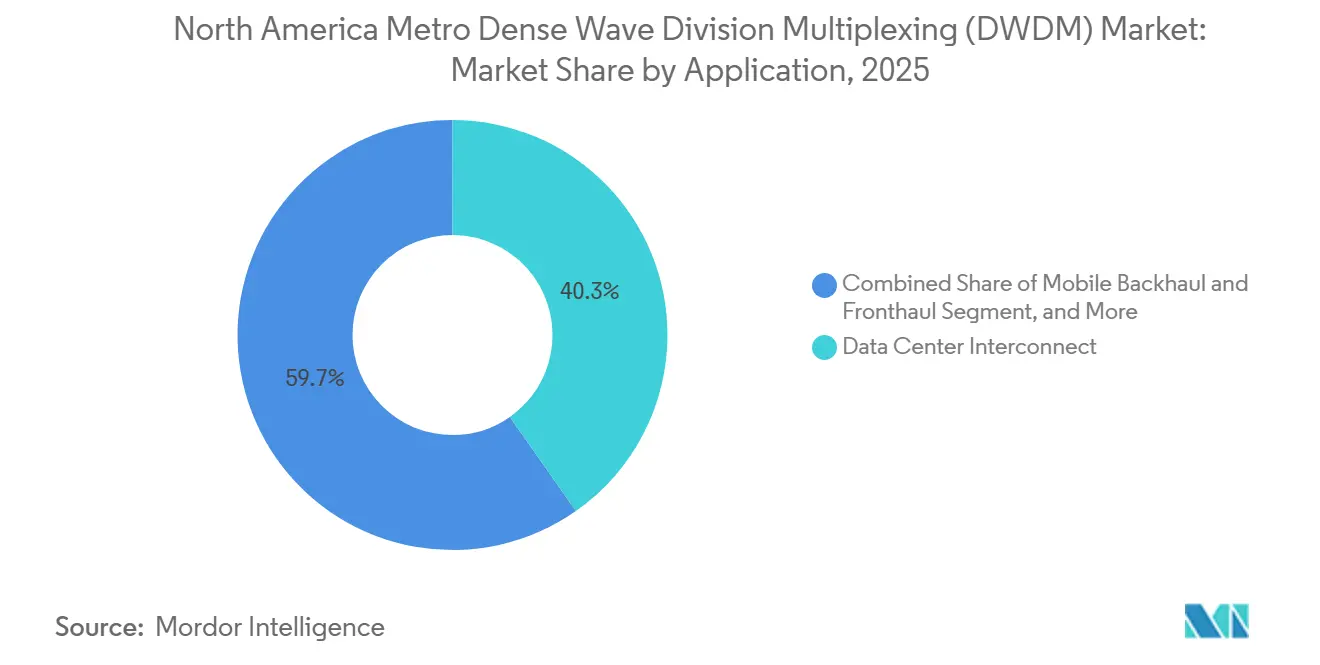
Data center interconnect accounted for 40.27% of the North America metro DWDM market size by application in 2025. It is the leading application because AI scale-across designs require large volumes of traffic to move between facilities. These links connect physically separate campuses that operate as parts of the same AI environment. The segment is projected to expand at a 10.37% CAGR from 2026 to 2031. Cloud providers are increasingly using networks that distribute training workloads across separate locations. This approach relies on dedicated optical capacity rather than general shared transport. Consequently, the North America metro DWDM market has a more direct connection to AI infrastructure investment cycles.
Mobile backhaul and fronthaul are the second-largest application categories. The 5G standalone transition increases per-site transport requirements from below 10 Gbps to 30 Gbps and above at C-band macro sites. Broadband and access aggregation are also gaining traction as BEAD construction activates middle-mile requirements in secondary US markets. That activity is expected to continue through 2028 as subgrant deployment reaches higher construction volumes. Government networks, utility fiber, and financial services dark fiber provide a stable base for other applications. These users value dedicated wavelengths for availability, security, and latency. They are unlikely to change the application hierarchy through 2031 because data center and 5G traffic have stronger capacity requirements. The application mix of the North America metro DWDM market, therefore, remains anchored by DCI and mobile transport.
By End-User: Service Providers Lead While Cloud Operators Set Product Demand
Communication service providers retained 46.83% of the North America metro DWDM market size in 2025. Their position reflects their broad metro ring networks and their role as providers of wholesale wavelengths and dark fiber. They also continue to upgrade 5G backhaul across cell-aggregation tiers. BEAD funding gives them an additional path to demand as eligible subgrantees and middle-mile providers. Large wholesale customers are increasing demand for OpenROADM compliance and open interfaces. This is encouraging more disaggregated procurement. The shift gives multi-vendor specialists opportunities alongside established system suppliers.
Cloud and data center providers are projected to expand at a 10.43% CAGR from 2026 to 2031. Their internal optical design capabilities are becoming more important as AI campuses need high-capacity links. This changes the buying center from carrier-led procurement toward cloud-led network planning. Financial services, healthcare, and media organizations use dedicated wavelengths where shared networks do not provide the required latency and security. Government and public sector customers remain a smaller but durable group, supported by federal modernization programs and state broadband authority investments. BEAD-related middle-mile procurements also support their near-term activity in 2026 and 2027. These patterns widen the buyer base for the North America metro DWDM market while leaving service providers in the leading position.
Geography Analysis
The United States held 86.37% of the North America metro DWDM market share in 2025. It has the region's deepest concentration of hyperscaler and colocation campuses. It also has the most extensive 5G standalone footprint and decades of investment in coherent metro rings. Zayo's partnership with NVIDIA supports more than 15,000 route miles of new and overbuilt infrastructure. Its Corning supply agreement is intended to secure fiber cable availability through 2030. BEAD construction in 28 states is extending aggregation demand into secondary and tertiary locations. These factors are expected to sustain US leadership through 2031.
Canada has a mature metro optical base centered on Toronto, Montreal, and Vancouver. Carrier-neutral data centers and continued fiberization of 5G tower backhaul support demand. Canadian carriers committed capital to fiber backhaul programs in 2025, particularly for C-band macro sites requiring peak capacities of 30 Gbps or higher. Ontario and British Columbia are primary locations for this infrastructure work. Ottawa remains an important, coherent DSP engineering center because of the research footprints of Ciena and Nokia. Carrier deployment cycles draw on the same engineering resource base used for platform development. Capacity scalability requirements linked to spectrum conditions create an ongoing incentive for metro transport upgrades.
Mexico is projected to expand at a 10.28% CAGR from 2026 to 2031, the fastest country rate in the region. Data center construction in Queretaro and Monterrey is putting pressure on existing intercity fiber capacity. C3ntro Telecom committed more than USD 100 million to install 10,000 kilometers of fiber in Mexico over 5 years. Mexico City, Guadalajara, and Monterrey are initial priorities. Arelion launched a second diverse DWDM route between Queretaro and Monterrey, and Nokia deployed 7 new DWDM routes for MX Fiber in southeastern Mexico. These deployments support up to 2.4 Tbps of throughput and strengthen the case for new carrier investment. Mexico's competitive broadband policies support entry by regional fiber operators.
Competitive Landscape
The North America metro DWDM market is moderately consolidated among system vendors. Ciena and Nokia hold leading positions in high-capacity metro and data center interconnect transport. Nokia strengthened its optical portfolio by acquiring Infinera for USD 2.3 billion. Cisco also maintains a significant position through router-integrated IP-over-DWDM systems and its ZR/ZR+ pluggable ecosystem. Large suppliers compete through research scale, integrated product portfolios, and the ability to support systems, modules, and custom components. OpenROADM, OpenConfig, OIF, and Telecom Infra Project frameworks are reducing hardware lock-in. This raises the importance of orchestration software for controlling distributed data center networks.
Ekinops and Smartoptics compete for disaggregated metro open line system projects among Tier-2 operators. 1Finity introduced the Ultra Optical System L1000/L2000 in February 2026 as an open, multi-vendor-designed platform for hyperscaler and service-provider deployments. The platform supports continuous C+L band operation and can scale from 1 to 16 degrees. This move addresses buyers that want open optical architectures without losing operational scale. Ciena also presented AI-driven assurance and automated routing capabilities at OFC 2026. The company is seeking to keep software relevant as pluggables reduce the role of some integrated hardware. These moves show that competition in the North America metro DWDM market is increasingly driven by control, automation, and interoperability.
Coherent, Lumentum, Marvell, and Broadcom supply components and modules that both support and compete with system vendors. The growth of IP-over-DWDM moves more optical intelligence into pluggables installed in hyperscaler-owned routers. NVIDIA made a USD 2 billion strategic investment in Coherent and committed to purchasing advanced laser and optical networking components. Lumentum announced a 240,000-square-foot facility in Greensboro, North Carolina, for indium phosphide CW and UHP lasers, with volume production expected from mid-2028. Marvell launched its COLORZ 1600 and related coherent DSPs for secure AI interconnects. Compact, high-density inline amplification for multiple fiber pairs remains an area where suppliers can develop differentiated products. The North America metro DWDM market remains competitive, but large system suppliers and component vendors have distinct positions across the value chain.
North America Metro Dense Wave Division Multiplexing (DWDM) Industry Leaders
-
Ciena Corporation
-
Nokia Corporation
-
Ekinops SA
-
Smartoptics Group AS
-
PacketLight Networks Ltd.
- *Disclaimer: Major Players sorted in no particular order
Recent Industry Developments
- August 2026: Quantum Corridor, Ciena, and Toshiba completed the world's first 1.6 Tb/s quantum-safe optical encryption trial on a live commercial network in the Midwest United States. The milestone combined Ciena's WaveLogic 6 Extreme high-speed encryption with NIST-certified post-quantum cryptography algorithms and Toshiba's quantum key distribution technology, demonstrating a commercially deployable pathway for quantum-safe metro DWDM transport at terabit speeds.
- May 2026: Lightpath announced a major metro network densification project connecting more than 2,400 macro cell tower locations across Connecticut, Massachusetts, New York, and New Jersey, adding 265 route miles of new fiber and delivering dedicated 100 Gbps and 400 Gbps aggregation links to support 5G SA scaling for multiple national wireless carriers. The expansion extended Lightpath's AI-grade fiber network to over 12,100 route miles across 11 U.S. metro markets.
- March 2026: NVIDIA announced a USD 2 billion strategic investment in Coherent Corp., accompanied by a multibillion-dollar purchase commitment for advanced laser and optical networking components. The partnership included a groundbreaking ceremony at Coherent's expanded manufacturing facility in Sherman, Texas, which scales production of indium phosphide wafers for AI optical interconnect applications.
- March 2026: Marvell Technology launched the COLORZ 1600, the industry's first 1.6T ZR/ZR+ pluggable for data center interconnect, powered by Marvell Electra, the industry's first 2 nm coherent DSP, alongside Libra, a 2 nm 800G ZR/ZR+ coherent DSP. Both products include MACsec encryption, targeting secure AI scale-across interconnects for hyperscale and cloud deployments.
North America Metro Dense Wave Division Multiplexing (DWDM) Market Report Scope
The North America Metro Dense Wavelength Division Multiplexing (DWDM) Market revenue is generated through the sale of DWDM hardware, software licenses and subscriptions, and associated deployment, integration, network management, maintenance, and support services provided to communication service providers, cloud and data center providers, enterprises, government organizations, and other end-users.
The North America metro dense wave division multiplexing (DWDM) market report is segmented by component (hardware, software, and services), transmission capacity (up to 100 Gbps, 200 Gbps, 400 Gbps, and above 400 Gbps), application (data center interconnect, mobile backhaul and fronthaul, broadband and access network aggregation, and other applications), end-user (communication service providers, cloud and data center providers, enterprises, and government and public sector), and country (United States, Canada, and Mexico). The market forecasts are provided in terms of value (USD).
| Hardware |
| Software |
| Services |
| Up to 100 Gbps |
| 200 Gbps |
| 400 Gbps |
| Above 400 Gbps |
| Data Center Interconnect |
| Mobile Backhaul and Fronthaul |
| Broadband and Access Network Aggregation |
| Other Applications |
| Communication Service Providers |
| Cloud and Data Center Providers |
| Enterprises |
| Government and Public Sector |
| United States |
| Canada |
| Mexico |
| By Component | Hardware |
| Software | |
| Services | |
| By Transmission Capacity | Up to 100 Gbps |
| 200 Gbps | |
| 400 Gbps | |
| Above 400 Gbps | |
| By Application | Data Center Interconnect |
| Mobile Backhaul and Fronthaul | |
| Broadband and Access Network Aggregation | |
| Other Applications | |
| By End-User | Communication Service Providers |
| Cloud and Data Center Providers | |
| Enterprises | |
| Government and Public Sector | |
| By Country | United States |
| Canada | |
| Mexico |
Key Questions Answered in the Report
What is the North America metro DWDM market size?
The North America metro DWDM market was valued at USD 3.82 billion in 2025 and is forecast to reach USD 5.88 billion by 2031 at a CAGR of 7.43%.
What is driving demand for metro DWDM in North America?
AI scale-across data center networks, 800ZR and ZR+ pluggables, BEAD-funded fiber aggregation, and 5G standalone transport needs are key demand factors.
Which component is expanding fastest through 2031?
Software is projected to expand at a 10.87% CAGR, supported by SDN-based open line system controllers, planning tools, and automation.
Which transmission capacity category is expanding fastest?
The above-400 Gbps category is projected to expand at a 12.41% CAGR as hyperscalers deploy 800G and emerging 1.6T coherent technologies.
Which application has the largest role in metro DWDM demand?
Data center interconnect held 40.27% of the application segment in 2025 and is projected to expand at a 10.37% CAGR through 2031.
Which country is projected to expand fastest in the region?
Mexico is projected to expand at a 10.28% CAGR through 2031, supported by fiber and data center investment in Querétaro, Monterrey, Mexico City, and Guadalajara.