
North America Metal Forming Equipment Market Size and Share
Market Overview
| Study Period | 2020 - 2031 |
|---|---|
| Forecast Data Period | 2026 - 2031 |
| Base Year Market Size (2025) | USD 3.46 Billion |
| Market Size (2026) | USD 3.60 Billion |
| Market Size (2031) | USD 4.18 Billion |
| Growth Rate (2026 - 2031) | 3.03 % |
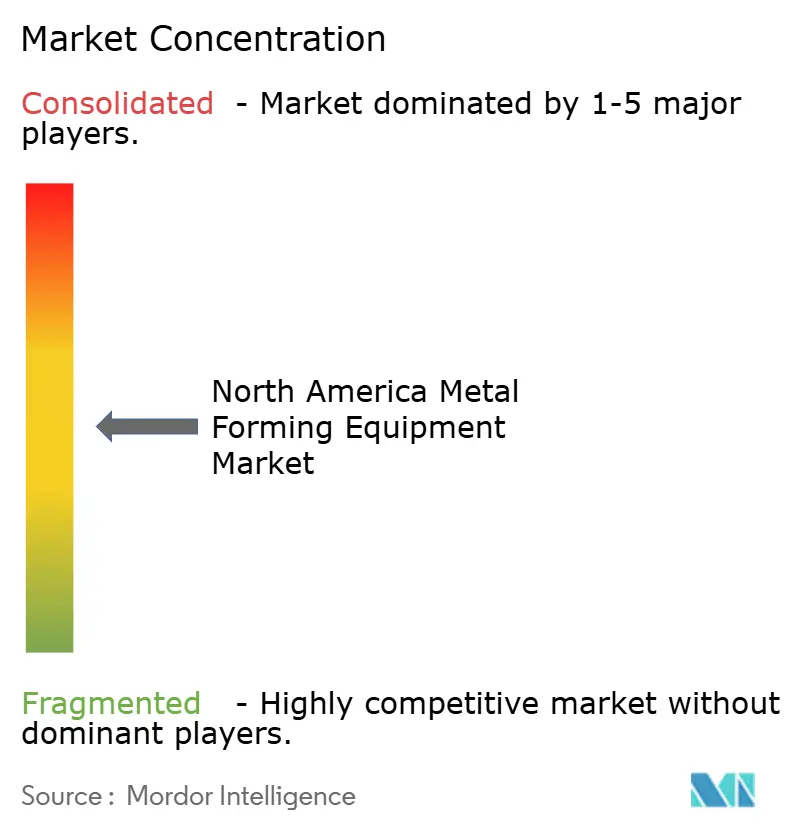
| Market Concentration | Medium |
Major Players *Disclaimer: Major Players sorted in no particular order Image © Mordor Intelligence. Reuse requires attribution under CC BY 4.0. | |
North America Metal Forming Equipment Market Analysis by Mordor Intelligence
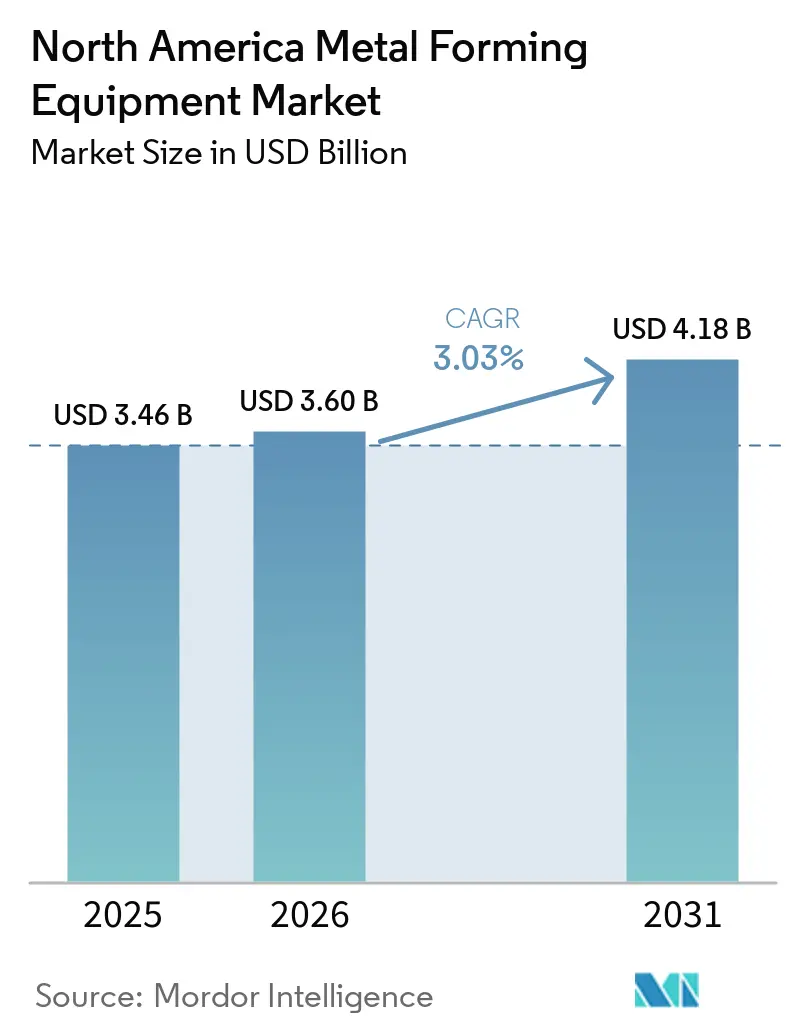
The North America Metal Forming Equipment Market size is projected to expand from USD 3.46 billion in 2025 and USD 3.60 billion in 2026 to USD 4.18 billion by 2031, registering a CAGR of 3.03% between 2026 and 2031.
Reshoring, battery-component production, and replacement of aging press fleets support equipment demand across the United States, Canada, and Mexico. United States manufacturing-related construction spending reached USD 233 billion in 2025, USD 40 billion higher than the prior year, supporting the facilities that use forming lines. Buyers are giving greater weight to servo systems, automation, lower energy use, and local service support when selecting equipment. These preferences can raise the value of each installation even when equipment volumes rise more gradually. The North America metal forming equipment market also faces financing, input costs, labor, and cybersecurity pressures that can delay purchases by smaller fabricators.
Key Report Takeaways
- By equipment type, press machines held 41.5% of North America metal forming equipment market size revenue in 2025, while servo presses are projected to grow at a 5.2% CAGR through 2031.
- By forming process, stamping and punching held 30.5% of North America metal forming equipment market share in 2025, while hydroforming is projected to grow at a 5.1% CAGR through 2031.
- By material formed, carbon and low-alloy steel held 46% of revenue in 2025, while aluminum and aluminum alloys are projected to grow at a 4.8% CAGR through 2031.
- By end-use industry, automotive and transportation held 35.5% of revenue in 2025, while aerospace and defense is projected to grow at a 5% CAGR through 2031.
- By geography, the United States held 81.6% of North America metal forming equipment market share in 2025, while Mexico is projected to grow at a 4.7% CAGR through 2031.
Note: Market size and forecast figures in this report are generated using Mordor Intelligence’s proprietary estimation framework, updated with the latest available data and insights as of January 2026.
North America Metal Forming Equipment Market Trends and Insights
Drivers Impact Analysis*
| Driver | (~) % Impact on CAGR Forecast | Geographic Relevance | Impact Timeline |
|---|---|---|---|
| Reshoring and Nearshoring of Metal-Intensive Manufacturing | +1.1% | United States, Mexico, Canada | Short term (≤ 2 years) |
| Electrification and Battery-Component Manufacturing | +0.9% | United States, Canada, Mexico | Medium term (2-4 years) |
| Demand for Lightweight and High-Strength Components | +0.7% | United States, Canada | Medium term (2-4 years) |
| Aging Press Fleet Replacement and Retrofit Demand | +0.5% | United States | Short term (≤ 2 years) |
| Automation to Offset Skilled Labor Shortages | +0.4% | United States, Canada | Medium term (2-4 years) |
| Traceable, Cybersecure, and Energy-Efficient Forming Lines | +0.2% | United States, Canada | Long term (≥ 4 years) |
| Source: Mordor Intelligence | |||
Reshoring and Nearshoring of Metal-Intensive Manufacturing
Reshoring is supporting capital spending on forming equipment in the region. The Reshoring Initiative reported 244,000 United States manufacturing jobs announced through reshoring and foreign direct investment in 2024. It also reported that fabricated metals announcements increased 19% in 2025.[1]Reshoring Initiative, “2024 Annual Report Including 1Q2025 Insights,” Reshoring Initiative, reshorenow.org Its 2026 survey found that 63% of responding OEMs plan United States capital investment in 2026 or 2027 for reshoring or domestic expansion. New facilities commonly require larger presses, material handling, and integrated controls than the equipment they replace. The North America metal forming equipment market benefits when greenfield projects specify higher levels of automation and documented quality controls from the start.
Electrification and Battery-Component Manufacturing
Battery-component projects are creating demand for precision forming lines. The Government of Canada committed CAD 70 million (USD 50.07 million) to Volta Energy Solutions Canada’s CAD 760.9 million (USD 544.28 million) copper foil facility in Granby, Québec. The plant is expected to produce 25,000 tonnes of battery-grade copper foil per year from 2027.[2]Government of Canada, “Government of Canada Invests $70 Million to Strengthen the EV Battery Supply Chain in Quebec,” Innovation, Science and Economic Development Canada, canada.ca Battery enclosures and related structures require deep drawing, controlled forming, and repeatable handling of thin materials. AIDA’s DPH Series Dedicated Former for rectangular storage battery cases received the 2025 Ten Greatest New Products Award for its single-stroke, multi-step forming capability. Such projects support the North America metal forming equipment market by adding demand for equipment that can form battery cases with fewer production stages.
Demand for Lightweight and High-Strength Components
Automotive and transportation buyers are increasing their use of materials that require more controlled forming. Hot-stamped components with tensile strengths above 1,500 MPa are used in pillars, roof rails, and intrusion beams. These components require reliable force monitoring and controlled ram-speed profiles. Aluminum battery trays also create demand for equipment that can handle materials with different forming characteristics. Existing mechanical presses may not deliver the same process control as newer servo equipment. The North America metal forming equipment market, therefore, has an opening for systems that can support high-strength steel and aluminum applications with fewer changes to the production line.
Aging Press Fleet Replacement and Retrofit Demand
Aging equipment remains an important reason for manufacturers to review capital purchases. Many plants continue to operate legacy presses because replacement can require significant capital, production downtime, tooling changes, and operator retraining. Older machines can be upgraded through control systems, servo drives, and safety retrofits. Modernization can also improve cycle control, repeatability, energy efficiency, and integration with automated material-handling systems without requiring a complete replacement. This route can reduce the initial expense and shorten the path to compliance compared with a complete replacement. OSHA requires point-of-operation guarding for mechanical power presses and maintenance records for those machines. As manufacturers prioritize safer production environments while extending the useful life of existing assets, demand is emerging for retrofit packages, controls modernization, hydraulic and electrical upgrades, and preventive maintenance services. Retrofit work gives the North America metal forming equipment market a recurring service opportunity alongside sales of new equipment.
Restraints Impact Analysis*
| Restraint | (~) % Impact on CAGR Forecast | Geographic Relevance | Impact Timeline |
|---|---|---|---|
| High Capital Intensity and Long Payback Periods | -0.8% | United States, Canada | Short term (≤ 2 years) |
| Steel, Servo-Drive, and Controls Cost Volatility | -0.6% | United States, Mexico | Medium term (2-4 years) |
| Shortage of Tool-and-Die and Commissioning Specialists | -0.4% | United States, Canada | Long term (≥ 4 years) |
| Cybersecurity Exposure in Connected Press Lines | -0.2% | United States, Canada | Medium term (2-4 years) |
| Source: Mordor Intelligence | |||
High Capital Intensity and Long Payback Periods
Servo transfer presses, automated material handling, and integrated quality controls can cost multiple millions of dollars per line. These costs make complete replacements difficult for small and mid-sized fabricators with limited financing access. Beyond the equipment purchase, buyers must account for tooling, facility modifications, electrical upgrades, software integration, operator training, and commissioning costs, increasing the total investment required for automation projects. The payback periods for automated lines are 3–5 years, compared with conventional 2–3 year ranges. Longer payback periods can make capital approval more difficult, particularly for job shops with variable order volumes and limited visibility into future production requirements. Commissioning also requires certified electricians and controls engineers, which can add 6–12 weeks before production begins. Extended installation periods can create temporary production losses, particularly when an existing press must be taken offline before the new line is operational. Higher interest rates in 2023 and 2024 raised borrowing costs for long-lived capital assets.[3]Board of Governors of the Federal Reserve System, “Monetary Policy Report,” Federal Reserve, federalreserve.gov As a result, some manufacturers may favor phased automation, retrofit programs, or selective upgrades rather than full-line replacement. These conditions can slow purchase decisions in North America.
Steel, Servo-Drive, and Controls Cost Volatility
Uncertain costs for steel, servo motors, and programmable controls complicate planning for equipment suppliers and their customers. The United States applies a 25% Section 232 tariff on covered imported steel products. Producer price data showed continued movement in steel mill product prices through 2024 and 2025. Because metal forming equipment is steel-intensive, changes in material prices can directly affect machine frames, tooling structures, hydraulic components, and fabricated assemblies. Suppliers may also face longer procurement cycles when imported electrical, automation, and motion-control components become more expensive or less readily available. Suppliers working under fixed-price contracts may have limited ability to pass higher input costs through quickly. These cost fluctuations can encourage suppliers to renegotiate quotations, shorten price-validity periods, or increase inventory buffers for critical components. This pressure can narrow supplier margins and make investment returns less predictable for North America metal forming equipment market buyers.
*Our forecasts treat driver/restraint impacts as directional, not additive. The impact forecasts reflect baseline growth, mix effects, and variable interactions.
Segment Analysis
By Equipment Type: Servo and Automation Content Drive Value Growth
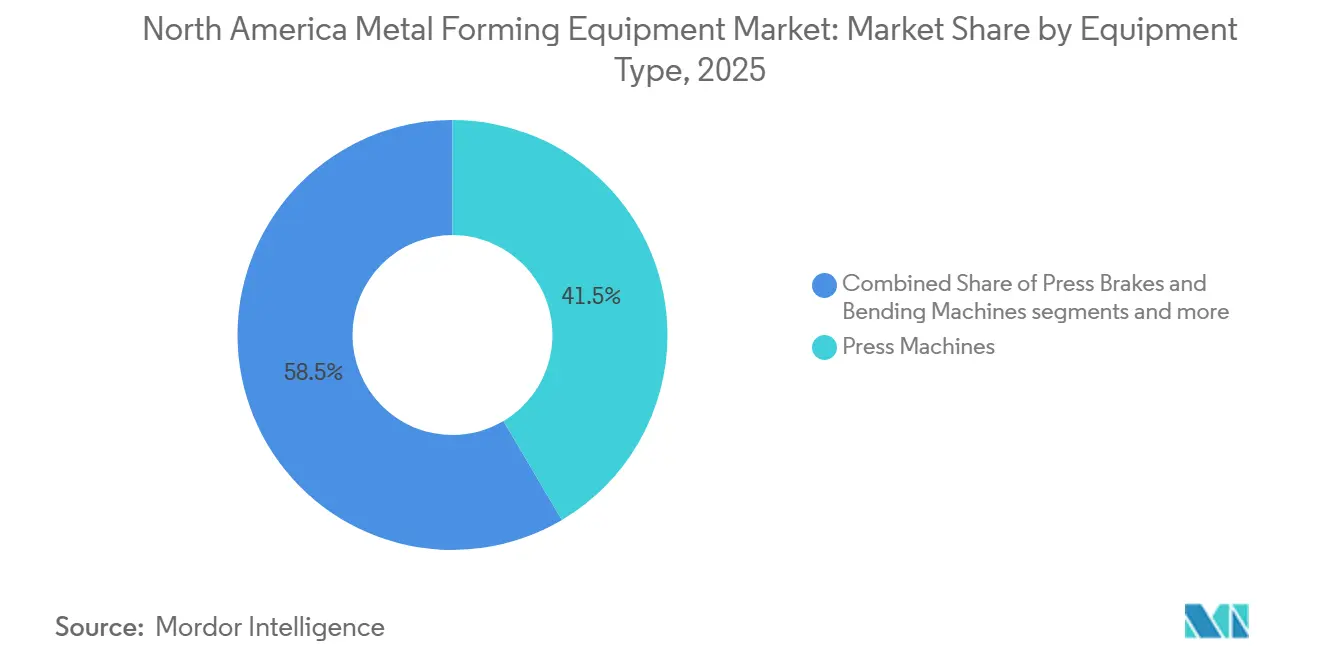
Press Machines held 41.5% of the North America metal forming equipment market in 2025. The category covers mechanical, hydraulic, servo, and general-purpose systems for blanking, progressive-die stamping, and related work. Its scale reflects use across many forming applications and end-use sectors. Demand is supported by automotive components, electrical and electronics parts, appliances, industrial machinery, and other high-volume manufacturing applications where consistent forming accuracy and cycle times are important. Buyers also value equipment that supports repeatable production, operational data capture, and higher levels of automation. These requirements favor suppliers that combine press hardware with controls and lifecycle services. Integration with automated feeding, robotic part handling, in-line inspection, and production-monitoring systems is also increasing the value of complete press solutions.
Servo Presses are projected to expand at a 5.2% CAGR through 2031. Buyers seek lower energy use and more precise motion control from these systems. Programmable slide motion also allows manufacturers to optimize forming profiles for different materials and tooling requirements, while supporting faster changeovers and improved process consistency. Servo spindle press platforms with shared DC-bus energy management can reduce energy use by 70–85% per stroke compared with conventional hydraulic systems. These efficiency benefits can become more relevant for facilities operating multiple presses for extended production cycles. Press Brakes and Bending Machines are the second-largest equipment group, while Forging, Roll Forming, Hydroforming, and Extrusion equipment serve distinct applications. The mix of technologies allows manufacturers to select equipment according to material thickness, component geometry, production volume, forming force, and required dimensional accuracy. TRUMPF began producing TruBend 3000 series press brakes at its Farmington, Connecticut, facility in 2026.



By Forming Process: Stamping Leads and Hydroforming Grow Fastest
Stamping and Punching held 30.5% of the North America metal forming equipment market in 2025. Automotive body production uses high-volume blanking and progressive-die lines across Michigan, Ontario, and northern Mexico. The growing use of lightweight vehicle structures and advanced high-strength steels is increasing requirements for higher press forces, tighter process control, and specialized tooling. Deep Drawing and Bending are important for fabrication and component production. These processes also support applications in appliances, HVAC systems, electrical enclosures, and industrial machinery, reducing dependence on automotive demand alone. Forging serves high-integrity powertrain and aerospace parts, while Rolling and Roll Forming benefit from construction-profile and solar-mounting demand. Automation through coil feeding, robotic transfer, in-line inspection, and die-change systems is further improving throughput in high-volume operations. This mix exposes the North America metal forming equipment market to several manufacturing investment cycles.
Hydroforming is projected to grow at a 5.1% CAGR through 2031. EV underbody assemblies and chassis frames use complex geometries that can reduce the number of welded joints. The process can support lightweight structural designs while maintaining required strength and dimensional consistency, making it relevant to vehicle weight-reduction programs. Schuler North America is adding a 5,000-ton press to its Canton, Michigan Hydroforming Production Center, alongside existing 3,500-ton and 8,500-ton equipment. Flexible lines that run advanced high-strength steel and aluminum through programmable controls remain a potential opportunity. Such flexibility can help manufacturers accommodate changing vehicle platforms and material specifications without investing in separate forming lines for every application. Much of the installed base requires setup changes to process both materials efficiently. This creates opportunities for upgraded controls, tooling optimization, automated setup systems, and process-monitoring solutions alongside new hydroforming equipment.
By Material Formed: Carbon Steel Anchors Volume and Aluminum Drives New Capital Spending
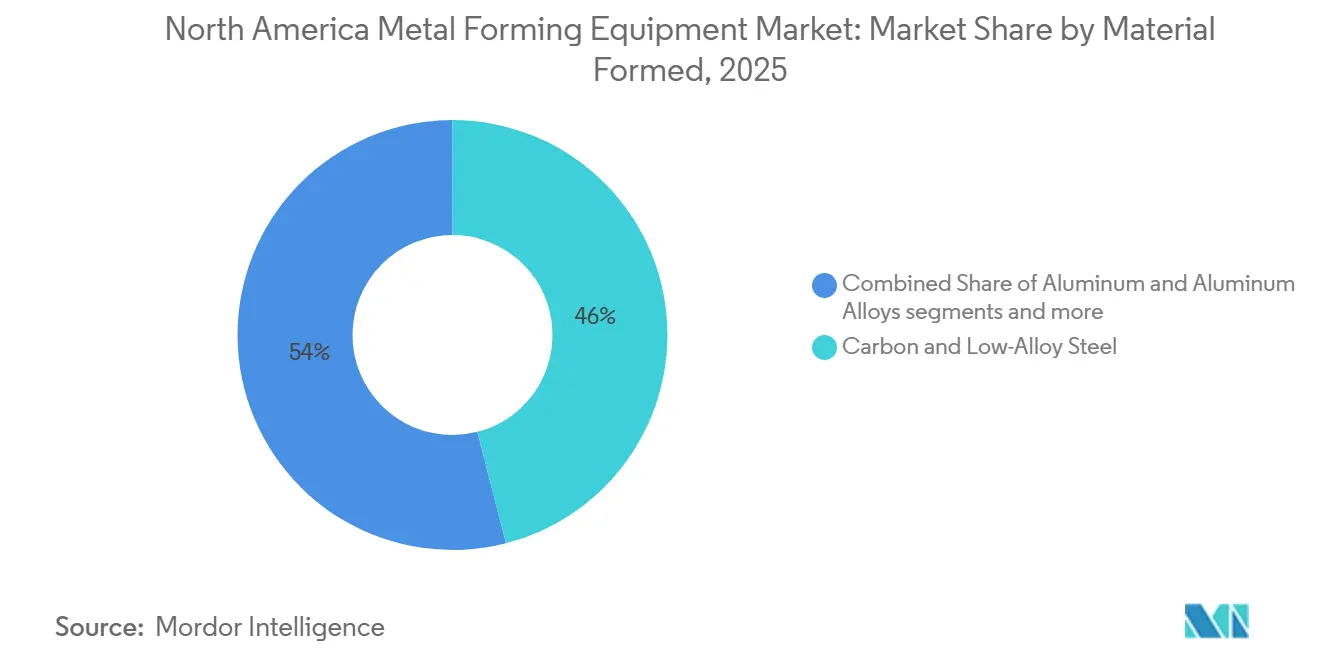
Carbon and Low-Alloy Steel held 46% of the North America metal forming equipment market in 2025. Its position reflects automotive use, a favorable cost profile, and compatibility with installed press fleets. Its widespread use across structural components, chassis parts, appliances, industrial machinery, and general fabrication also supports steady demand for conventional stamping, bending, forming, and roll-forming equipment. Its higher strength and corrosion resistance can require greater forming forces, specialized tooling, and tighter process control than standard carbon-steel applications. Carbon steel will remain important for high-volume production across the North America metal forming equipment market. Steel processing demand also exposes equipment buyers to material-cost and trade-rule changes. Changes in steel grades and increasing use of higher-strength materials can further require manufacturers to upgrade press capacity, tooling, and controls rather than relying entirely on existing equipment.
Aluminum and Aluminum Alloys are projected to expand at a 4.8% CAGR through 2031. Battery enclosures and body-in-white lightweighting need equipment configurations different from much of the existing carbon-steel fleet. Aluminum's lower density and different forming behavior can require tighter control of press speed, forming force, lubrication, and tooling to manage springback and surface-quality requirements. Copper and Copper Alloys serve EV busbar work, while Titanium, Nickel, and Other Non-Ferrous Metals support high-value aerospace and defense applications. These specialty materials generally involve smaller production volumes but can require higher-value equipment, precision tooling, and application-specific process controls. The North America metal forming equipment market size for this equipment mix is supported by separate investment needs for lightweight and specialty materials. Multi-material lines can address a clear limitation in existing equipment capabilities. Equipment capable of handling multiple material grades can provide manufacturers with greater production flexibility as product designs and material specifications continue to change.
By End-Use Industry: Automotive Anchors Revenue and Aerospace Gains Most Rapidly
Automotive and Transportation held 35.5% of the North America metal forming equipment market in 2025. Demand includes OEM body stamping, tier-1 structural-component work, and EV platform tooling. Traditional body-panel volumes are moderating as vehicle platforms are consolidated. EV structures and battery enclosures are creating replacement cycles with greater technical requirements. This keeps the North America metal forming equipment market closely tied to vehicle production investment.
Aerospace and Defense is projected to grow at a 5% CAGR through 2031. Narrowbody aircraft production, domestic procurement priorities, and titanium and nickel forging capacity support this outlook. Industrial Machinery, Metal Products and Fabrication, and Electrical and Electronics form a stable middle tier. Construction and Energy and Power benefit from domestic solar-profile manufacturing, while Medical and Precision Manufacturing require traceability and consistent process control. These applications broaden demand beyond vehicle production.
Geography Analysis
The United States dominated the North America metal forming equipment market in 2025. Its position reflects automotive OEMs, tier-1 stampers, aerospace and defense production, and independent fabricators across the Midwest, Southeast, and Gulf Coast. Federal procurement requirements for domestic content and traceability can favor suppliers with certified United States assembly operations. The Bureau of Labor Statistics expects tool and die maker employment to decline 11% by 2034, with replacement needs projected to create 34,200 openings each year.
Canada is a technically advanced part of the regional supply chain. The Detroit-Windsor-Oshawa corridor links Canadian producers closely with the United States automotive manufacturing. Government funding for the Granby copper foil facility supports a local battery-material supply chain and related processing demand. ISO 9001 and IATF 16949 requirements support quality-focused upgrades, and the North America metal forming equipment market benefits from cross-border production integration.
Mexico is the fastest-growing country through 2031. USMCA-linked nearshoring is directing automotive, metalworking, and advanced manufacturing activity toward Nuevo León, Coahuila, and Guanajuato. The industry association stated that Ternium’s Pesquería Industrial Center will target 2.6 million tonnes per year of automotive-grade steel from early 2027. It also identified a battery-component facility planned in Monterrey for mid-2027 completion. These investments support the North America metal forming equipment market share of Mexico within regional growth, although no country share figure was provided.
Competitive Landscape
The North America metal forming equipment market exhibits a medium level of market concentration. Global OEMs from Japan, Germany, Switzerland, and the United States have meaningful positions in different equipment categories. Schuler Group is active in tubular hydroforming and hot-stamping systems. TRUMPF and Bystronic are prominent in precision sheet-metal forming, while AIDA Engineering and Komatsu serve high-tonnage automotive stamping. This structure gives buyers a choice between multinational suppliers and specialized regional builders.
Suppliers are expanding local manufacturing, tooling, automation, and aftermarket services. TRUMPF announced a strategic partnership with Mate Precision Technologies in July 2026, expanding its tooling portfolio for sheet-metal fabricators. It also started North American production of TruBend 3000 press brakes in Connecticut in 2026. AIDA’s battery case former shows how suppliers are tailoring equipment for battery applications. These moves combine equipment sales with tooling, local production, and lifecycle services.
Cybersecurity, safety documentation, and flexible material handling are becoming more important areas of competition. NIST released its Cybersecurity Framework 2.0 Manufacturing Profile for operational technology environments in September 2025. Cincinnati Incorporated and Accurpress compete in fabrication and job-shop applications through domestic supply chains and shorter delivery windows. The North America metal forming equipment market has room for multi-material lines, retrofit cybersecurity kits, and digital commissioning services.
North America Metal Forming Equipment Industry Leaders
TRUMPF Group
AMADA Co., Ltd.
Schuler AG
JIER Machine-Tool Group Co., Ltd.
DMG MORI Co., Ltd.
- *Disclaimer: Major Players sorted in no particular order

Recent Industry Developments
- July 2026: TRUMPF announced the acquisition of Mate Precision Technologies (Anoka, Minnesota), a global leader in forming and punching tooling, significantly expanding TRUMPF's North American aftermarket portfolio and extending reach across customers using competing machine brands.
- July 2026: The Government of Canada committed CAD 70 million (USD 50.07 million) toward Volta Energy Solutions Canada's CAD 760.9 million (USD 544.28 million) copper foil facility in Granby, Québec, targeting 25,000 tonnes per year of battery-grade copper foil output from 2027, creating upstream forming demand for precision copper-strip processing lines.
- June 2026: TRUMPF began production of the TruBend 3000 series press brakes at its 55,800-square-foot Farmington, Connecticut facility, completing its "local for local" press brake manufacturing initiative for the North American market.
- January 2026: AIDA Engineering's DPH Series Dedicated Former for Rectangular Storage Battery Cases received the Nikkan Kogyo Shimbun 2025 Ten Greatest New Products Award, recognised for its single-stroke multi-step forming capability that reduces forming stages, energy consumption, and lubricant usage.


North America Metal Forming Equipment Market Report Scope
The North America Metal Forming Equipment Market is segmented by Equipment Type, (Press Machines, Forging Equipment and more), by Forming Process (Bending, Forging and more), by Material Formed (Carbon and Low-Alloy Steel, Stainless Steel and more), by End-Use Industry (Energy and Power, Aerospace and Defense and more), by Geography (United States, Canada, and Mexico). The Market Forecasts are Provided in Terms of Value (USD).
| Press Machines | Mechanical Presses |
| Hydraulic Presses | |
| Servo Presses | |
| Other General-Purpose Presses | |
| Press Brakes and Bending Machines | Hydraulic Press Brakes |
| Servo / Electric Press Brakes | |
| Mechanical Press Brakes | |
| Other Bending Machines | |
| Forging Equipment | Forging Presses |
| Forging Hammers | |
| Upsetting and Heading Machines | |
| Other Forging Equipment | |
| Roll Forming and Plate/Profile Rolling Equipment | Roll Forming Machines |
| Plate Rolling Machines | |
| Section and Profile Rolling Machines | |
| Other Secondary Rolling/Forming Equipment | |
| Wire, Tube and Profile Forming Equipment | Wire and Bar Drawing/Forming Equipment |
| Tube Forming and Bending Equipment | |
| Profile Forming Equipment | |
| Extrusion Presses | |
| Hydroforming Equipment | |
| Other Metal Forming Equipment |
| Stamping and Punching |
| Deep Drawing |
| Bending |
| Forging |
| Rolling and Roll Forming |
| Extrusion |
| Hydroforming |
| Other Forming Processes |
| Carbon and Low-Alloy Steel |
| Stainless Steel |
| Aluminum and Aluminum Alloys |
| Copper and Copper Alloys |
| Titanium, Nickel and Other Non-Ferrous Metals |
| Other Materials |
| Automotive and Transportation |
| Aerospace and Defense |
| Industrial Machinery and Capital Equipment |
| Metal Products and Fabrication |
| Electrical and Electronics |
| Construction and Infrastructure |
| Energy and Power |
| Consumer Appliances and Durable Goods |
| Medical and Precision Manufacturing |
| Other End-Use Industries |
| United States |
| Canada |
| Mexico |
| By Equipment Type | Press Machines | Mechanical Presses |
| Hydraulic Presses | ||
| Servo Presses | ||
| Other General-Purpose Presses | ||
| Press Brakes and Bending Machines | Hydraulic Press Brakes | |
| Servo / Electric Press Brakes | ||
| Mechanical Press Brakes | ||
| Other Bending Machines | ||
| Forging Equipment | Forging Presses | |
| Forging Hammers | ||
| Upsetting and Heading Machines | ||
| Other Forging Equipment | ||
| Roll Forming and Plate/Profile Rolling Equipment | Roll Forming Machines | |
| Plate Rolling Machines | ||
| Section and Profile Rolling Machines | ||
| Other Secondary Rolling/Forming Equipment | ||
| Wire, Tube and Profile Forming Equipment | Wire and Bar Drawing/Forming Equipment | |
| Tube Forming and Bending Equipment | ||
| Profile Forming Equipment | ||
| Extrusion Presses | ||
| Hydroforming Equipment | ||
| Other Metal Forming Equipment | ||
| By Forming Process | Stamping and Punching | |
| Deep Drawing | ||
| Bending | ||
| Forging | ||
| Rolling and Roll Forming | ||
| Extrusion | ||
| Hydroforming | ||
| Other Forming Processes | ||
| By Material Formed | Carbon and Low-Alloy Steel | |
| Stainless Steel | ||
| Aluminum and Aluminum Alloys | ||
| Copper and Copper Alloys | ||
| Titanium, Nickel and Other Non-Ferrous Metals | ||
| Other Materials | ||
| By End-Use Industry | Automotive and Transportation | |
| Aerospace and Defense | ||
| Industrial Machinery and Capital Equipment | ||
| Metal Products and Fabrication | ||
| Electrical and Electronics | ||
| Construction and Infrastructure | ||
| Energy and Power | ||
| Consumer Appliances and Durable Goods | ||
| Medical and Precision Manufacturing | ||
| Other End-Use Industries | ||
| By Geography | United States | |
| Canada | ||
| Mexico | ||


Key Questions Answered in the Report
What is the forecast for North America metal forming equipment through 2031?
The North America metal forming equipment market size is expected to reach USD 4.18 billion by 2031, from USD 3.60 billion in 2026, at a 3.03% CAGR. Reshoring, electrification, aging-fleet replacement, and a need for more automated lines support this outlook across the entire United States, Canada, and Mexico over the forecast period.
Which equipment category leads regional demand?
Press Machines held the leading position in 2025, serving applications from blanking to progressive-die stamping. Servo Presses are forecast to grow the fastest because buyers value motion control, lower energy use, and automated operation.
Why are servo presses gaining adoption in North America?
Buyers use servo presses for precise motion control, repeatable output, and lower energy consumption. According to industry association stated 70-85% energy savings per stroke for certain servo spindle systems compared with conventional hydraulic equipment.
Which end-use sector creates the greatest demand for forming equipment?
Automotive and Transportation was the largest end-use sectors in 2025. It includes OEM body stamping, tier-1 structural-component work, and EV platform tooling, while aerospace and defense are forecast to grow fastest.
Which country is growing fastest in the region?
Mexico is the fastest-growing country through 2031. USMCA-linked nearshoring supports automotive, metalworking, and advanced manufacturing investment, while new regional materials and battery-component capacity strengthen local equipment demand.
What limits investment in new metal forming lines?
High capital costs, 3-5 year payback periods for automated lines, volatile steel and control costs, labor shortages, and cybersecurity requirements can delay projects. These issues have a greater effect on smaller fabricators with limited financing capacity.
Page last updated on:





