
North America Industrial Press Machines Market Size and Share
Market Overview
| Study Period | 2020 - 2031 |
|---|---|
| Forecast Data Period | 2026 - 2031 |
| Base Year Market Size (2025) | USD 3.53 Billion |
| Market Size (2026) | USD 3.67 Billion |
| Market Size (2031) | USD 4.60 Billion |
| Growth Rate (2026 - 2031) | 4.62 % |
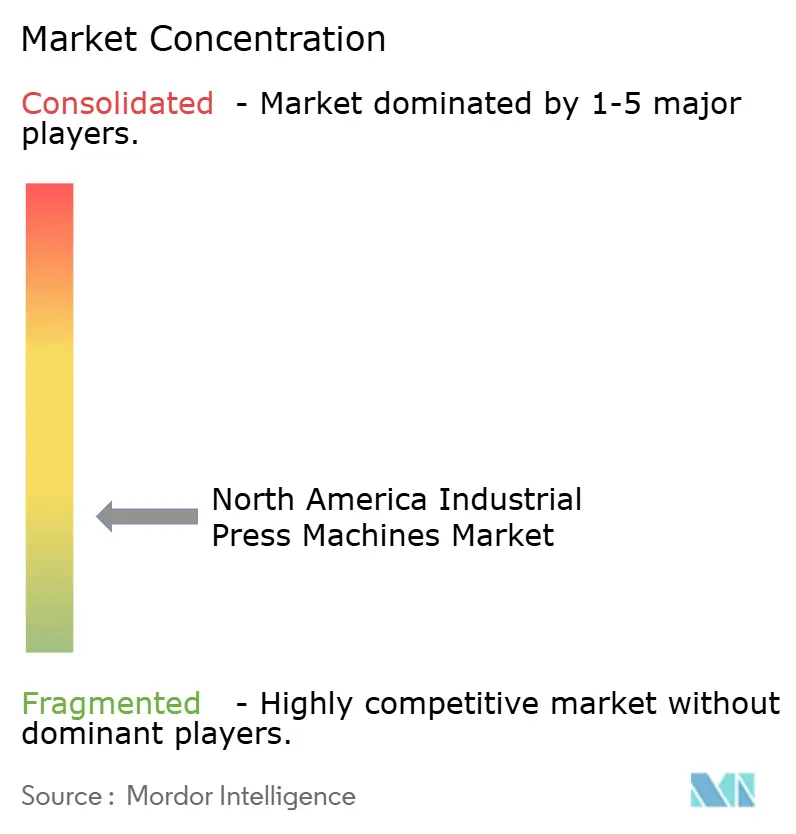
| Market Concentration | Low |
Major Players *Disclaimer: Major Players sorted in no particular order Image © Mordor Intelligence. Reuse requires attribution under CC BY 4.0. | |
North America Industrial Press Machines Market Analysis by Mordor Intelligence
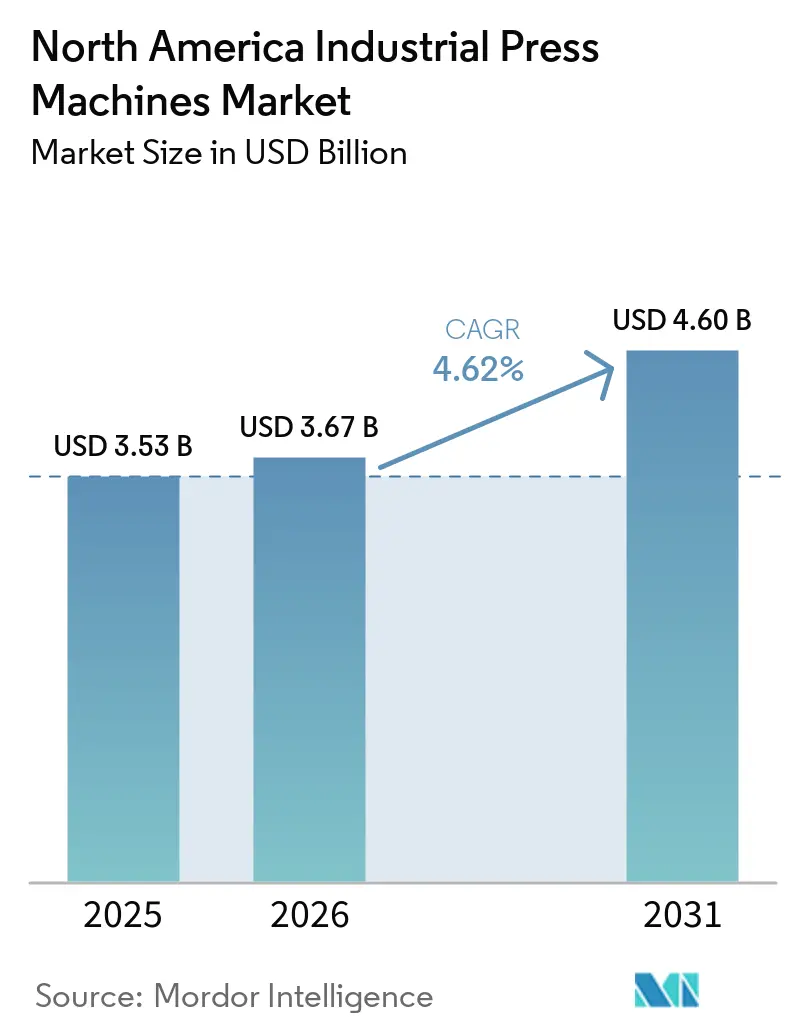
The North America industrial press machines market size was valued at USD 3.53 billion in 2025 and is estimated to grow from USD 3.67 billion in 2026 to reach USD 4.60 billion by 2031, at a CAGR of 4.62% during the forecast period (2026-2031).
Manufacturing investment accelerated depreciation for eligible production property, and regional sourcing rules are supporting equipment purchases across North America. Automotive investment remains a central source of demand because new electric vehicle facilities require stamping, forming, and joining capacity. Aerospace, defense, energy, and advanced manufacturing also require specialized press systems and skilled service support. Suppliers are responding with servo systems, digital monitoring, retrofit services, and regional maintenance networks. Higher steel costs, limited technical labor, long qualification processes, and connected-equipment security needs continue to slow some purchase and installation decisions.
Key Report Takeaways
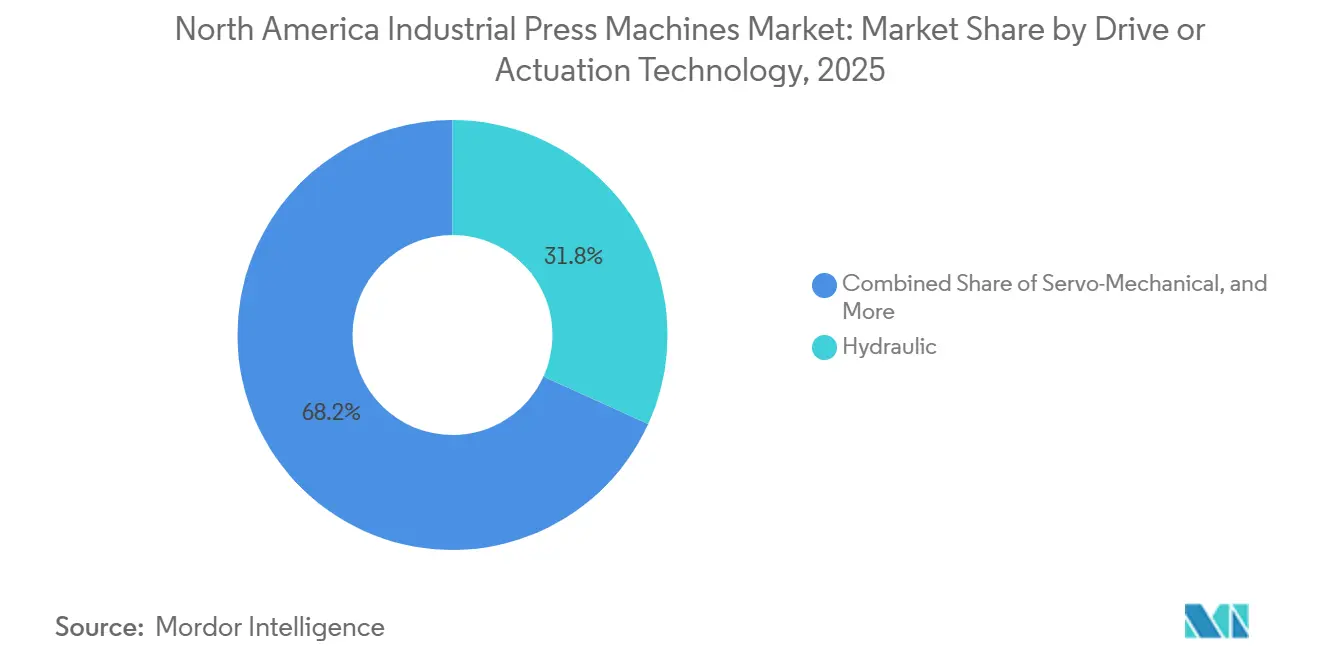
- By drive or actuation technology, hydraulic presses held 31.8% of the North America industrial press machines market share in 2025, while servo-mechanical presses are forecast to grow at an 8.25% CAGR through 2031.
- By press force or capacity, the 101-to-500-ton category held 33.4% of the North America industrial press machines market size in 2025, while presses above 2,000 tons are forecast to grow at a 5.55% CAGR through 2031.
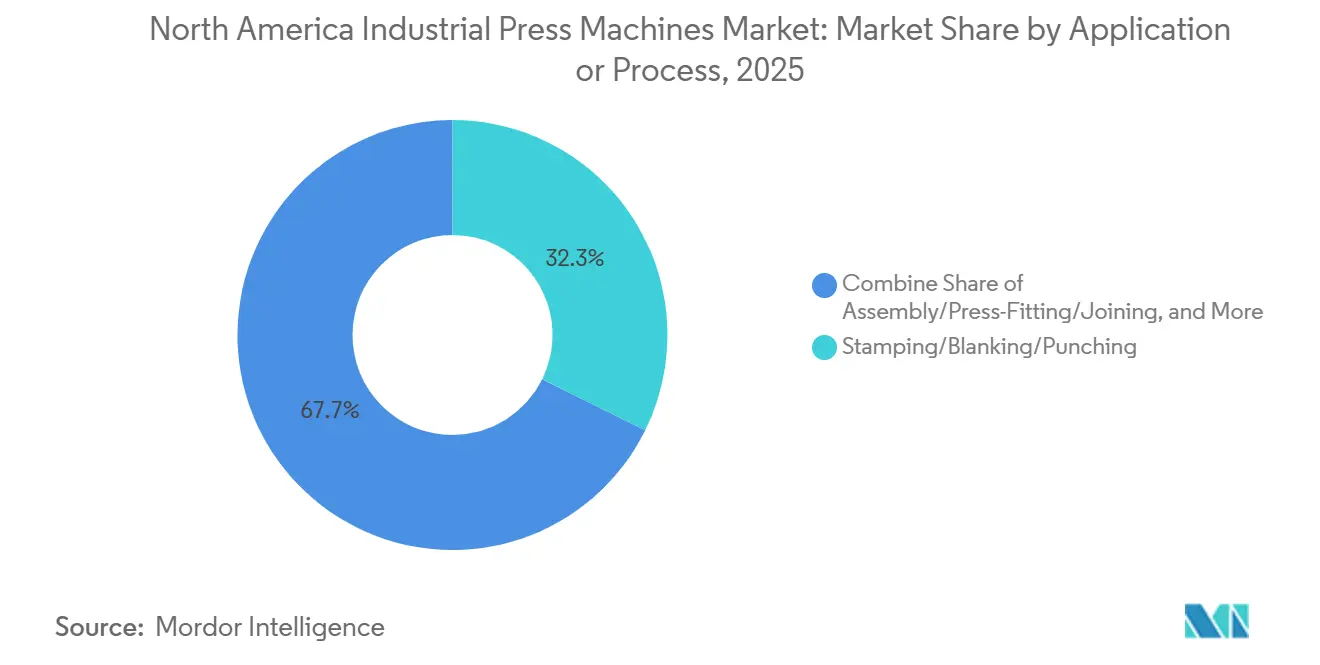
- By application or process, stamping, blanking, and punching accounted for 32.3% of the North America industrial press machines market share in 2025, while assembly, press-fitting, and joining are projected to expand at a 5.95% CAGR through 2031.
- By end-use industry, automotive and transportation held 37.9% of the North America industrial press machines market size in 2025, while aerospace and defense are projected to grow at a 6.25% CAGR through 2031.
- By geography, the United States accounted for 71.5% of regional demand in 2025, while Mexico is forecast to grow at a 6% CAGR through 2031.
Note: Market size and forecast figures in this report are generated using Mordor Intelligence’s proprietary estimation framework, updated with the latest available data and insights as of January 2026.
North America Industrial Press Machines Market Trends and Insights
Drivers Impact Analysis*
| Driver | (~) % Impact on CAGR Forecast | Geographic Relevance | Impact Timeline |
|---|---|---|---|
| Reshoring and Advanced Manufacturing Capital Expenditure | +1.4% | United States, with early gains in the Southeast, the Midwest, and Texas | Short term (≤ 2 years) |
| EV Battery, Body, and Structural-Component Production | +1.1% | United States Midwest and Southeast, Ontario, and Nuevo León | Medium term (2-4 years) |
| Aerospace Lightweighting and Defense Capacity Expansion | +0.8% | United States, particularly the Southeast, Pacific Northwest, and Mid-Atlantic | Medium term (2-4 years) |
| Servo, Robotics, and Industry 4.0 Retrofits | +0.6% | North American manufacturing belt | Medium term (2-4 years) |
| North American Supply-Chain Localization Under USMCA | +0.4% | The United States, Mexico, and Canada automotive corridor | Long term (≥ 4 years) |
| Battery-Metal, Renewable-Energy, and Composite Forming Demand | +0.3% | United States, including Sun Belt and Appalachian manufacturing clusters | Long term (≥ 4 years) |
| Source: Mordor Intelligence | |||
Reshoring and Advanced-Manufacturing Capital Expenditure
The North America industrial press machines market is benefiting from new domestic manufacturing investment. Manufacturing-sector foreign direct investment reached USD 121.8 billion in 2025, or 52.5% of new United States foreign investment, and primary and fabricated metals projects accounted for 16,400 associated jobs. New stamping, forging, and hydroforming facilities require press equipment and related service capability. A 100% first-year depreciation allowance applies to qualifying production property placed in service from July 4, 2025, to January 1, 2031, which can shorten the financial payback for replacements and new lines. The Department of Commerce reported USD 1.15 trillion in direct strategic investment and USD 850 billion in additional corporate investment during 2025 across semiconductor, pharmaceutical, and electric vehicle facilities. Suppliers with local commissioning, parts, training, and lifecycle support may be better placed to serve these projects.[1]Bureau of Economic Analysis, “New Foreign Direct Investment in the United States, 2025,” U.S. Department of Commerce, bea.gov
EV Battery, Body, and Structural-Component Production
Electric vehicle manufacturing needs presses for cell casings, battery components, body panels, and structural parts. Department of Energy loans included USD 9.6 billion for BlueOval SK, USD 7.5 billion for StarPlus Energy, and USD 6.6 billion for Rivian’s Georgia project. Automakers invested USD 190.5 billion in North American electric vehicle facilities from 2018 through 2025, including USD 144.9 billion in the United States, while suppliers invested another USD 74.9 billion. Progressive-die battery casing production requires close dimensional control, which supports the adoption of servo-mechanical equipment with variable slide velocity and dwell settings. NIST found that servo operation can improve forming performance, while 82.4% of sourcing changes from 2018 to 2025 were fully linked to USMCA origin compliance. These factors support sustained demand for regional tooling, stamping, and forming capacity as facilities advance through production ramp-up.[2]Office of the United States Trade Representative, “2026 USMCA Autos Report to Congress,” USTR, ustr.gov
Aerospace Lightweighting and Defense Capacity Expansion
Aerospace and defense programs require large tonnage presses for composite forming, titanium hot forming, and structural component production. The Department of Defense used Defense Production Act Title III agreements to support domestic material capacity, including a 2025 agreement with Arconic for aluminum plate used in missiles and munitions. NASA’s Hi-Rate Composite Aircraft Manufacturing project involved 22 organizations working to increase composite aircraft-part production and reduce costs. These programs support a multi-year need for specialized domestic press capacity. Titanium structural parts can require hot-forming temperatures above 850°C and systems with die cooling and process controls. The technical and qualification requirements favor suppliers with proven engineering, service, and compliance capabilities.[3]National Aeronautics and Space Administration, “Hi-Rate Composite Aircraft Manufacturing Project, 2025 Spring Review,” NASA, nasa.gov
Servo, Robotics, and Industry 4.0 Retrofits
Pressroom retrofits allow manufacturers to improve performance without replacing every production line. Servo actuation, robotic tending, and digital monitoring can improve formability and reduce friction-related production issues in difficult stamping operations. NIST identified 132 advanced manufacturing occupations and 235 related knowledge, skill, and ability requirements in 2025, which supports demand for suppliers offering commissioning, controls support, and training. The NIST Manufacturing Extension Partnership documented cases where connected monitoring and predictive maintenance recovered 8% to 15% of previously untracked downtime. Retrofit programs can extend asset life while adding data collection, controls, and maintenance functions. Established service organizations can compete for this work by combining mechanical rebuilds, controls upgrades, and maintenance support.
Restraints Impact Analysis*
| Restraint | (~) % Impact on CAGR Forecast | Geographic Relevance | Impact Timeline |
|---|---|---|---|
| High Capital Intensity and Long Qualification Cycles | -1.5% | North America, especially the automotive and aerospace supply chains | Medium term (2-4 years) |
| Skilled-Service and Controls-Integration Shortages | -0.9% | North America, especially the Midwest and Southeast manufacturing clusters | Long term (≥ 4 years) |
| Trade-Policy, Steel-Cost, and Imported-Component Volatility | -0.6% | United States, with effects in Canada and Mexico | Medium term (2-4 years) |
| Cybersecurity and Functional-Safety Burden in Connected Presses | -0.3% | North America, especially connected manufacturing sites | Long term (≥ 4 years) |
| Source: Mordor Intelligence | |||
High Capital Intensity and Long Qualification Cycles
Press equipment requires significant upfront investment before a facility begins production. Standard mechanical presses can cost USD 500,000, while a fully automated servo-hydraulic transfer line can exceed USD 15 million. These costs place purchasing decisions in multi-year planning cycles, especially for mid-sized manufacturers. The IRS assigns press equipment to 5-year or 7-year depreciation schedules, and buyers must consider when custom systems enter service for tax purposes. Aerospace, defense, and regulated applications also require qualification, while OSHA requires reliable controls, brake monitoring, and point-of-operation guarding for mechanical power presses. Flexible financing, phased payments, and lease-to-own models can reduce the barrier for customers with constrained capital budgets.[4]Internal Revenue Service, “Publication 946, How To Depreciate Property,” Internal Revenue Service, irs.gov
Skilled-Service and Controls-Integration Shortages
A limited supply of technicians and controls specialists can slow installations, repairs, and production ramp-up. The Manufacturing Institute projected 3.8 million manufacturing job openings by 2033, with 1.9 million positions at risk of remaining unfilled. Modern press systems require expertise in servo drives, programmable logic controllers, safety systems, mechanical maintenance, automation, mechatronics, robotics, and digital tools. NIST identified workforce capability as a leading factor in manufacturing competitiveness, while its competency analysis identified 235 knowledge, skill, and ability requirements across 132 advanced manufacturing occupations. Automation can offset some labor pressure, but it depends on workers who can operate and maintain the technology. Training, remote support, standardized controls, and security-aware system selection can help buyers manage this constraint.
*Our forecasts treat driver/restraint impacts as directional, not additive. The impact forecasts reflect baseline growth, mix effects, and variable interactions.
Segment Analysis
By Drive/Actuation Technology: Hydraulic Presses Lead in 2025; Servo-Mechanical Accelerates
Hydraulic presses held 31.8% of the North America industrial press machines market share in 2025. Their position reflects use in deep drawing, hydroforming, compression molding, automotive production, aerospace work, and industrial machinery. Programmable force across the stroke supports variable-depth applications that standard mechanical presses may not handle as effectively. Hydraulic designs can deliver consistent tonnage throughout the working stroke. These attributes keep them relevant across a broad range of forming work. The North America industrial press machines industry continues to use hydraulic systems where versatility and controlled force are decisive.
Servo-mechanical presses are the fastest-growing drive type, with an 8.25% CAGR forecast for 2026 to 2031. Their variable slide velocity, dwell settings, and pendulum motion can improve material flow, lower die wear, and raise production throughput. NIST found that servo operation can improve hole expansion performance in advanced high-strength steel stamping. This is important for electric vehicle body structures that require the precise forming of stronger materials. Conventional mechanical presses remain important in high-speed progressive-die work for vehicle and appliance enclosures. Their established tooling base and predictable motion support continued use where a full conversion to servo operation does not offer a sufficient return. Pneumatic presses serve lighter assembly and joining work in electronics and medical device production. Servo-hydraulic and electro-hydraulic designs are also used in retrofit programs. Research published in IEEE Transactions on Industrial Electronics reported that servo-hydraulic systems can reduce idle-state energy use by 50% to 60% compared with fixed-displacement hydraulic circuits.


By Press Force/Capacity: Mid-Range Tonnage Anchors Volume; Ultra-High-Force Opens New Frontiers
The 101-to-500-ton category accounted for 33.4% of the North America industrial press machines market size in 2025. This range is widely used in automotive stamping, appliance body forming, and fabricated-metal production. It has a large installed base of compatible tooling, dies, and coil-feed systems. Those existing systems support continued demand even as customers consider newer press designs. The category provides the operating range used by many North American press shops. Its broad application base keeps it central to production volume.
Presses above 2,000 tons are the fastest-growing capacity group and are forecast to expand at a 5.55% CAGR from 2026 to 2031. Demand comes from large electric vehicle body panels, naval structures, wind turbine components, and other heavy forming work. Presses up to 100 tons are used for electronics, medical devices, and smaller precision components. Servo-electric systems are becoming more relevant in these applications because they offer energy efficiency and cleaner operation. The 501-to-1,000-ton and 1,001-to-2,000-ton ranges support aerospace structures and defense armor production. These capacity classes also serve composite hot forming and titanium deep drawing. Such applications frequently require custom designs with integrated die-heating and cooling equipment. Customization can extend lead times and increase qualification needs. As a result, capacity selection depends on the part geometry, material, tooling, safety requirements, and planned production volume.
By Application/Process: Stamping Anchors Production Volume; Assembly Operations Scale with EV Investment
Stamping, blanking, and punching held 32.3% of demand in 2025. These processes are used in automotive body-in-white production, appliance enclosures, and electrical components. Their large share reflects high production volumes and frequent press use across regional manufacturing. Advanced high-strength steel and aluminum body panels can require equipment upgrades to meet higher tonnage and dimensional control requirements. Electric vehicle manufacturing supports the continued need for these capabilities. Stamping, therefore, remains the largest process category in the North America industrial press machines market.
Assembly, press-fitting, and joining are the fastest-growing applications and are projected to expand at a 5.95% CAGR from 2026 to 2031. Battery module assembly, power electronics, and electric motor joining are supporting this growth. Deep drawing and sheet forming serve fuel-system parts, aerospace nacelle skins, and appliance enclosures. Hydroforming is used for tubular structural components, including parts used in electric vehicle platforms. Forging supports drivetrain systems, landing gear, and defense components that often require more than 2,000 tons of force. Compression molding supports composite panels used in aerospace and defense. Powder compaction serves metal powder and advanced ceramics applications. The Department of Energy announced USD 500 million in 2026 for critical mineral and battery supply chains, supporting activities that can require controlled compaction equipment. Straightening, general forming, and other applications serve structural steel, service centers, and general fabrication.
By End-Use Industry: Automotive Anchors Demand; Aerospace and Defense Outpaces All Other Verticals
Automotive and transportation accounted for 37.9% of end-use demand in 2025. The segment uses progressive-die lines for body panels and hydroforming cells for chassis components. Electric vehicle platforms are adding demand for mixed-material body structures and battery enclosures. These applications may require new lines rather than only the replacement of conventional steel-stamping equipment. This can raise the equipment content of individual installations. Automotive production remains the main source of equipment demand in the North America industrial press machines industry.
Aerospace and defense are the fastest-growing end-use groups, with a 6.25% CAGR forecast from 2026 to 2031. The category benefits from defense industrial-base work and demand for composite airframes and titanium structures. Industrial machinery and equipment provide steady demand as domestic fabricators add capacity. Electrical and electronics production needs precision presses for connectors, lead frames, and heatsinks. Energy and power equipment is another source of demand because wind and solar equipment can require large structural components. NREL research identified advanced composite materials as relevant to domestic wind blade manufacturing. Medical and precision manufacturing use servo-electric presses where clean operating conditions and repeatable processes are important. Appliances, construction equipment, and general metal products provide a stable base for conventional and hydraulic equipment. Together, these end uses reduce reliance on any single production cycle.
Geography Analysis
The United States held 71.5% of the North America industrial press machines market share in 2025. Its position reflects automotive assembly plants, aerospace and defense producers, and metal fabrication clusters in Michigan, Ohio, Tennessee, Texas, and California. Manufacturing-sector foreign direct investment reached USD 121.8 billion in 2025, while primary and fabricated metals projects accounted for 16,400 associated jobs. The 100% bonus depreciation provision for qualifying property placed in service after July 4, 2025, can encourage earlier capital equipment orders. Higher Section 232 steel tariffs increased input costs for press frames and dies, but they also supported regional sourcing of components. Defense Production Act activity continues to support large-tonnage hydraulic, hot-forming, and composite press capacity.
Canada held the second-largest national position in 2025. Automotive assembly activity in Ontario supports ongoing demand from Tier 1 and Tier 2 suppliers. USMCA-linked investments in Canada totaled USD 46.8 billion between 2018 and 2025. Quebec and Ontario also have aerospace production clusters that use titanium and composite forming equipment. Canadian Standards Association requirements apply alongside ANSI B11 press safety protocols. This regulatory environment can favor suppliers with established Canadian engineering and service capabilities. Rising defense spending commitments may also support demand for forging and structural forming equipment.
Mexico is the fastest-growing national segment, with the North America industrial press machines market size projected to rise at a 6.0% CAGR from 2026 to 2031. Automotive investment in Mexico totaled USD 55.1 billion from 2018 to 2025, including investment in Nuevo León, Guanajuato, Coahuila, and Aguascalientes. Tighter regional-content rules are leading multinational suppliers to expand local press-shop capacity rather than import stamped components. United States and Mexican officials held technical discussions in March 2026 before the USMCA Joint Review scheduled for July 1, 2026. The discussions focused on manufacturing employment and limits on non-market inputs. Equipment suppliers need to address NOM workplace-safety requirements, USMCA origin rules, and the need for local service support.
Competitive Landscape
The North America industrial press machines market remains moderately fragmented. Global suppliers compete through tonnage range, servo technology, and after-sales coverage. Regional suppliers compete through application engineering, domestic delivery capability, and qualifications for defense work. OSHA requirements for mechanical power presses cover reliable controls, brake monitoring, and point-of-operation guarding. These requirements support demand for equipment that integrates safety and control functions. Suppliers that can support connected monitoring and predictive maintenance can strengthen their position in the installed base.
The ANDRITZ Schuler Group formation in March 2025 combined metal forming equipment with digitalization capabilities. The combined offering includes servo hardware and real-time production monitoring. This approach can make it more difficult for single-product suppliers to compete for complex projects. Suppliers are also extending servo-electric designs into force ranges that were traditionally served by hydraulics. Many are adding regional service locations to pursue rebuilds, retrofits, and maintenance contracts. Nidec Minster launched its MMC Titan gap-frame series in February 2026 with 35-to-315-ton models and Mitsubishi Automation Control as standard. The models were designed to offer shorter delivery availability for North American stamping customers.
Beckwood Press received the United States Army contract in May 2026 to supply a 1,000-ton hydraulic press with Active Leveling Control for ballistic composite compression molding. The company also received a 500-ton hot-form retrofit order from an aerospace manufacturer in October 2025 and established a service department for upgrades and third-party retrofits. In December 2025, Beckwood announced an order for a 1,500-ton four-post hydraulic press for defense and commercial vessel structures. These examples show continued competition around engineered systems, defense qualifications, and aftermarket support.
North America Industrial Press Machines Industry Leaders
ANDRITZ Schuler Group
AIDA Engineering, Ltd.
Komatsu Industries Corp.
AMADA CO., LTD.
STAMTEC, Inc.
- *Disclaimer: Major Players sorted in no particular order

Recent Industry Developments
- September 2026: Greenerd Press & Machine highlighted custom hydraulic presses at IMTS 2026 in Chicago, positioning defense industry modernization as a primary growth driver and targeting R&D-focused buyers from government aviation and military programs requiring specialized hydraulic forming systems with high force capacity and precision active leveling.
- September 2026: Fagor Arrasate and Butech Bliss announced a strategic partnership to strengthen coil-processing solutions in North America, broadening the combined service footprint across stamping and sheet-processing end markets and creating a more integrated press-and-coil-handling capability for North American customers.
- February 2026: Nidec Minster launched the MMC Titan Gap frame press series for the North American stamping market, with tonnages ranging from 35 to 315 tons, Mitsubishi Automation Control as standard, and stock-available models enabling immediate or short-term delivery, addressing end-customer lead-time constraints during the reshoring capital equipment surge.
- October 2025: Beckwood Press received a 500-ton hot-form retrofit order from a major aerospace manufacturer to improve titanium component forming performance, uptime, and part quality, a contract that also marked the formal launch of Beckwood's new Service Department for aftermarket press upgrades and third-party equipment retrofits.


North America Industrial Press Machines Market Report Scope
| Conventional Mechanical Presses |
| Servo-Mechanical Presses |
| Hydraulic Presses |
| Pneumatic Presses |
| Other and Hybrid Presses |
| Up to 100 Tons |
| 101–500 Tons |
| 501–1,000 Tons |
| 1,001–2,000 Tons |
| Above 2,000 Tons |
| Stamping, Blanking and Punching |
| Deep Drawing and Sheet Forming |
| Forging |
| Straightening and General Forming |
| Compression Molding |
| Powder Compaction |
| Assembly, Press-Fitting and Joining |
| Other Press Applications |
| Automotive and Transportation |
| Aerospace and Defense |
| Industrial Machinery and Equipment |
| Electrical and Electronics |
| Appliances and Consumer Durables |
| Construction and Heavy Equipment |
| Energy and Power Equipment |
| Metal Products and General Manufacturing |
| Medical and Precision Manufacturing |
| Other End-Use Industries |
| United States |
| Canada |
| Mexico |
| By Drive / Actuation Technology | Conventional Mechanical Presses |
| Servo-Mechanical Presses | |
| Hydraulic Presses | |
| Pneumatic Presses | |
| Other and Hybrid Presses | |
| By Press Force / Capacity | Up to 100 Tons |
| 101–500 Tons | |
| 501–1,000 Tons | |
| 1,001–2,000 Tons | |
| Above 2,000 Tons | |
| By Application / Process | Stamping, Blanking and Punching |
| Deep Drawing and Sheet Forming | |
| Forging | |
| Straightening and General Forming | |
| Compression Molding | |
| Powder Compaction | |
| Assembly, Press-Fitting and Joining | |
| Other Press Applications | |
| By End-Use Industry | Automotive and Transportation |
| Aerospace and Defense | |
| Industrial Machinery and Equipment | |
| Electrical and Electronics | |
| Appliances and Consumer Durables | |
| Construction and Heavy Equipment | |
| Energy and Power Equipment | |
| Metal Products and General Manufacturing | |
| Medical and Precision Manufacturing | |
| Other End-Use Industries | |
| By Geography | United States |
| Canada | |
| Mexico |


Key Questions Answered in the Report
What is the projected value of North American industrial press machines by 2031?
The sector is forecast to reach USD 4.60 billion by 2031, growing from USD 3.67 billion in 2026 at a 4.62% CAGR.
Which drive technology is growing fastest in North America?
Servo-mechanical presses are projected to grow at an 8.25% CAGR through 2031, supported by demand for controlled forming and electric vehicle production.
Which end-use sector buys the most industrial press equipment?
Automotive and transportation led demand with 37.9% in 2025, reflecting its use of stamping, hydroforming, and structural forming systems.
Why is Mexico important for press equipment suppliers?
Mexico is projected to grow at a 6.0% CAGR through 2031 because automotive investment and USMCA rules support local stamping and forming capacity.
What is the largest application for industrial presses in North America?
Stamping, blanking, and punching held 32.3% of demand in 2025, supported by automotive, appliance, and electrical component production.
What limits the adoption of advanced press systems?
High capital requirements, long qualification cycles, shortages of skilled technicians, steel-cost volatility, and cybersecurity needs can delay purchase and installation decisions.
Page last updated on:


 Your data is secure and never sold or shared.


