
Market Overview
| Study Period | 2021 - 2031 |
|---|---|
| Forecast Data Period | 2026 - 2031 |
| Base Year Market Size (2025) | USD 1.19 Billion |
| Market Size (2026) | USD 1.26 Billion |
| Market Size (2031) | USD 1.65 Billion |
| Growth Rate (2026 - 2031) | 5.58 % |
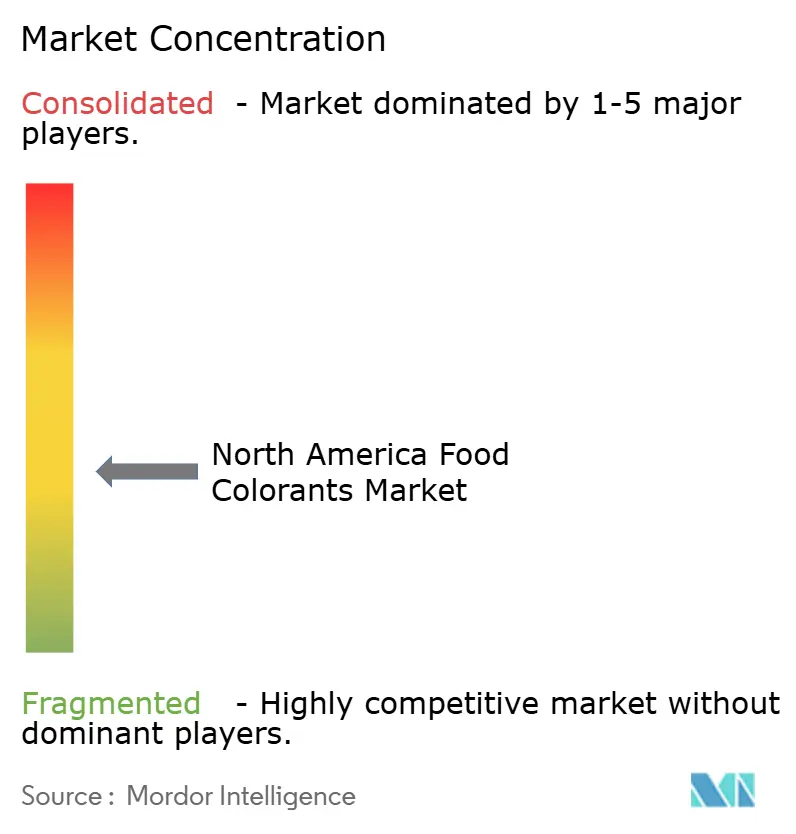
| Market Concentration | Medium |
Major Players *Disclaimer: Major Players sorted in no particular order Image © Mordor Intelligence. Reuse requires attribution under CC BY 4.0. | |
North America Food Colorants Market Analysis by Mordor Intelligence
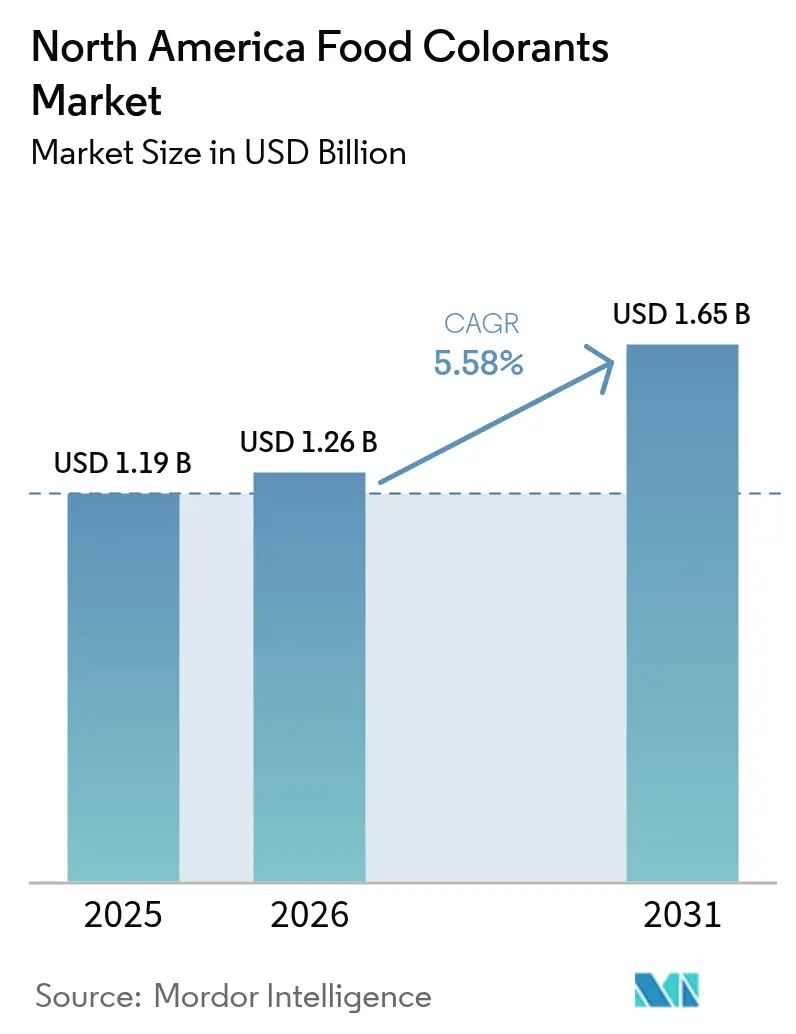
The North American food colorant market size was valued at USD 1.19 billion in 2025 and estimated to grow from USD 1.26 billion in 2026 to reach USD 1.65 billion by 2031, at a CAGR of 5.58% during the forecast period (2026-2031). This growth is primarily attributed to the FDA's mandate to phase out petroleum-based synthetic dyes by December 2026, which has shifted natural colorants from a niche segment to mainstream adoption[1]. Natural solutions market share is expected to increase as manufacturers secure long-term supply contracts to support reformulation efforts. Innovation in the sector is accelerating, with developments such as heat-stable spirulina blues, corn-derived anthocyanins, and fermentation-based pigments addressing historical performance limitations. These advancements are enabling broader applications across baked snacks, dairy products, and shelf-stable beverages. In this evolving competitive landscape, vertically integrated suppliers with control over crop inputs or proprietary microbial strains are well-positioned to benefit. Their strategic advantage allows them to capitalize on the expected price stabilization during the phase-out of synthetic dyes.
Key Report Takeaways
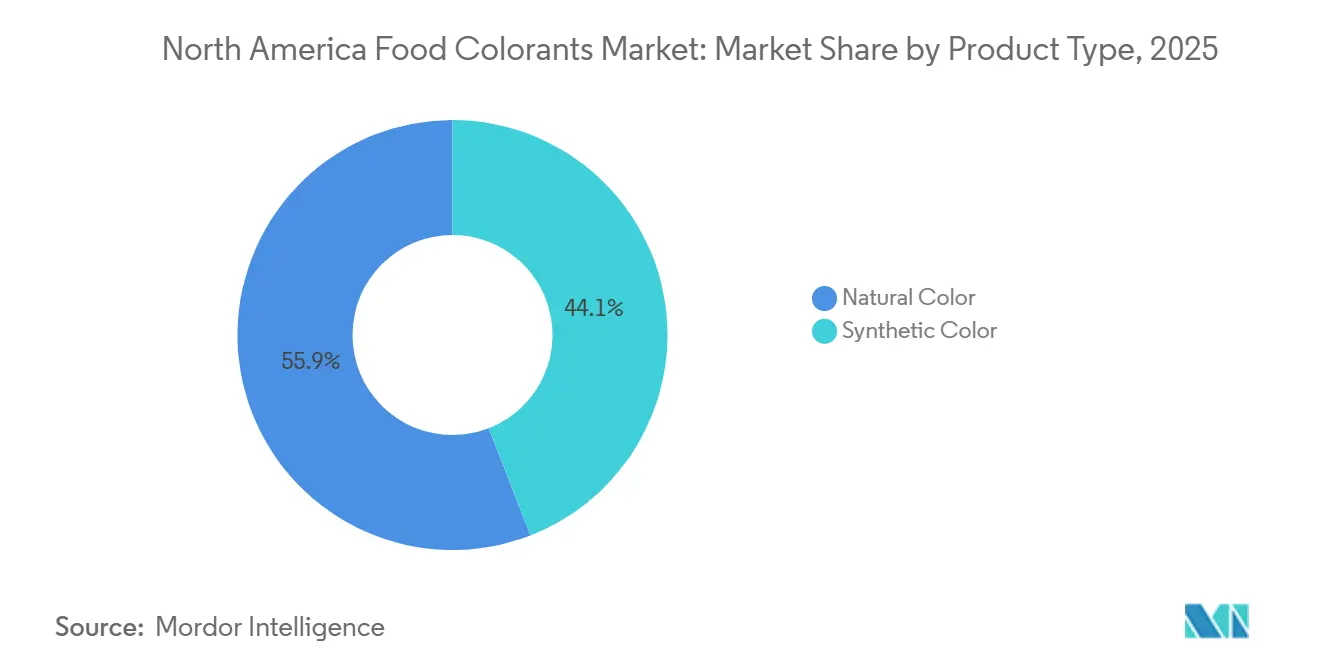
- By product type, natural colors led with 55.98% of the North American food colorant market share in 2025 and grew at a CAGR of 6.68% through 2031.
- By color, red pigments retained a 27.91% share of the North American food colorant market size in 2025, while blue registered the fastest 8.21% CAGR forecast to 2031.
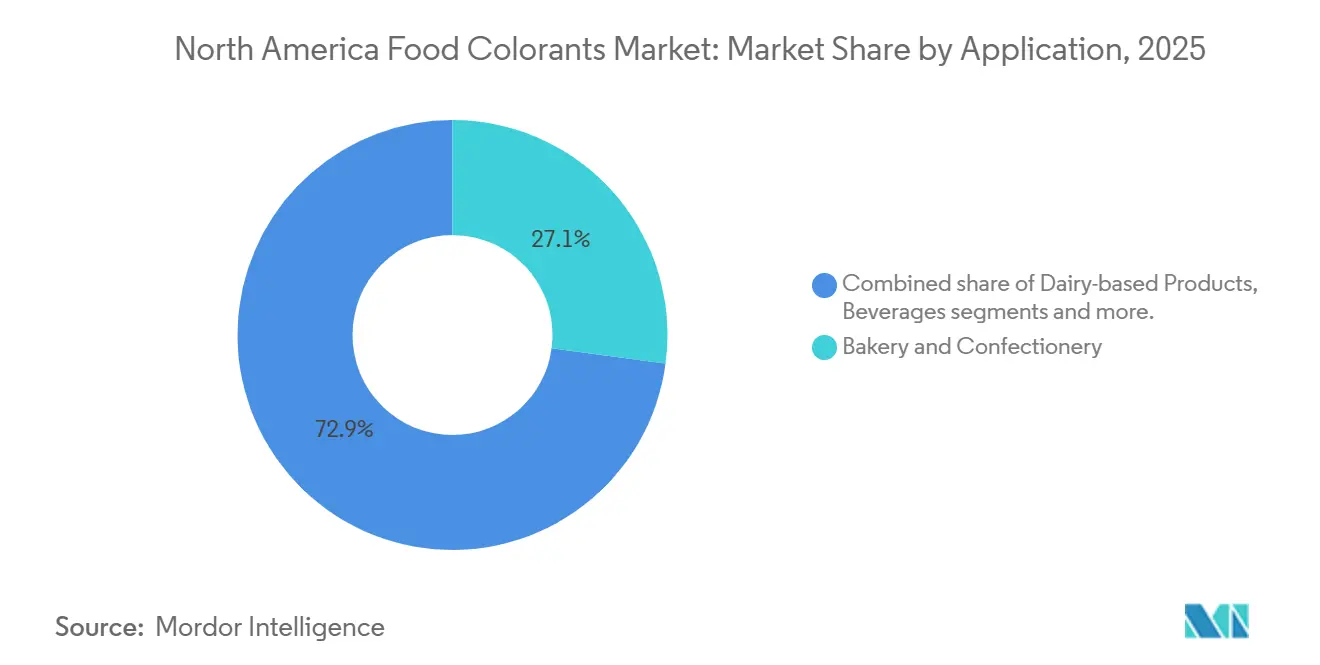
- By application, bakery and confectionery captured 27.12% of the North American food colorant market size in 2025; nutraceuticals are projected to grow at an 8.48% CAGR through 2031.
- By form, liquids accounted for 52.02% revenue share in 2025, with powders advancing at an 8.07% CAGR to 2031.
- By geography, the United States captured 72.18% of the market value in 2025, and Mexico is expected to post a 6.32% CAGR through 2031.
Note: Market size and forecast figures in this report are generated using Mordor Intelligence’s proprietary estimation framework, updated with the latest available data and insights as of 2026.
Market Trends and Insights
Drivers Impact Analysis of North America Food Colorants Market*
| Driver | (~) % Impact on CAGR Forecast | Geographic Relevance | Impact Timeline |
|---|---|---|---|
| Processed food industry driving market growth | +1.4% | United States, Mexico | Short term (≤ 2 years) |
| Increasing awareness of food aesthetics and appeal to boost the market | +1.2% | United States, Canada | Medium term (2-4 years) |
| Visual appeal of food products drives market growth | +0.8% | Region-wide | Medium term (2-4 years) |
| Regulatory shifts accelerating natural colorant adoption | +0.8% | Region-wide | Long term (≥ 4 years) |
| Rising demand for clean label products drives market growth | +0.8% | Region-wide | Short term (≤ 2 years) |
| Technological advancements in food colorant production boost market expansion | +0.6% | Region-wide | Medium term (2-4 years) |
| Source: Mordor Intelligence | |||
Processed Food Industry Driving Market Growth
The processed food sector in North America is experiencing significant growth, which is a major driver of the food colorant market. Manufacturers are increasingly recognizing the strategic importance of color in shaping consumer purchasing decisions. In 2024, ultra-processed foods accounted for a substantial share of the U.S. food supply. According to the International Food Information Council, nearly 79% of U.S. adults consider processed foods when making shopping decisions. This heightened focus on visual appeal is further amplified in the current social media-driven marketplace, where visually appealing food products gain a distinct marketing advantage. Leading companies, such as PepsiCo, are responding to this trend by reformulating their flagship products to incorporate natural colorants. For example, their Simply Ruffles Hot and Spicy chips now use tomato powder and red chile pepper as natural alternatives to synthetic red color, aligning with consumer preferences for cleaner and more natural ingredients.
Increasing Awareness of Food Aesthetics and Appeal to Boost the Market
Heightened consumer awareness of food aesthetics has elevated the role of color from a basic visual feature to a critical quality indicator, symbolizing freshness, flavor, and authenticity. In response to this evolving demand, manufacturers are increasingly prioritizing significant investments in premium-quality colorants to ensure their products exhibit consistent and visually appealing hues throughout their lifecycle. However, this trend is not limited to visual enhancement alone. Consumers are progressively favoring colorants derived from natural sources that also offer added nutritional benefits. For example, anthocyanins extracted from natural ingredients such as blueberries and purple carrots not only provide vibrant and attractive colors but also deliver antioxidant properties, aligning with the preferences of health-conscious consumers. This integration of aesthetic appeal and functional benefits is driving innovation in product development, with food manufacturers now adopting advanced colorant selection strategies that incorporate nutritional attributes alongside visual considerations.
Visual Appeal of Food Products Drives Market Growth
With the transformation of digital media in food marketing, the visual appeal of food products has become a crucial factor in gaining a competitive advantage. Companies are leveraging advanced colorant technologies to create distinctive and recognizable visual identities, thereby enhancing brand recognition and securing a strong position in premium market segments. Beyond mere aesthetics, the role of color extends to influencing consumer taste perceptions, making it a key element in the overall sensory experience. This connection between color and sensory appeal is driving significant advancements in the development of application-specific colorant formulations designed to retain their vibrancy and stability under a wide range of processing conditions. The market is also witnessing an increasing demand for customized color solutions tailored to meet the unique requirements of specific product categories. For example, companies such as Givaudan Sense Colour are at the forefront of innovation, developing natural colorants derived from sources like microalgae, anthocyanins, and beetroot. These solutions are engineered to deliver consistent and reliable performance, particularly in plant-based applications, where maintaining color integrity is critical.
Regulatory Shifts Accelerating Natural Colorant Adoption
Regulatory initiatives promoting transparency and clean labeling have significantly accelerated the adoption of natural colors in the food industry. With stricter requirements for ingredient sourcing disclosures, food manufacturers are transitioning from synthetic dyes to plant-derived, label-friendly alternatives such as beetroot red, turmeric, spirulina, and annatto. In January 2024, the FDA's ban on Red No. 3 marked a critical step toward removing synthetic dyes from the North American food supply. By April 2025, the FDA, in collaboration with the Health and Human Services, announced plans to phase out all petroleum-based synthetic dyes by the end of 2026. These regulatory developments are creating substantial market opportunities for natural colorant alternatives. At the state level, California and West Virginia have implemented bans on several synthetic dyes in school cafeterias, setting a regulatory precedent that could extend to other institutional sectors. This evolving regulatory environment is fostering innovation in natural colorant technologies. For instance, in January 2024, Phytolon partnered with Ginkgo Bioworks to scale up the production of fermentation-derived colors, addressing potential supply challenges as market demand grows.
Restraints Impact Analysis of North America Food Colorants Market*
| Restraint | (~) % Impact on CAGR Forecast | Geographic Relevance | Impact Timeline |
|---|---|---|---|
| Health concerns related to food color to restrain the market | -06% | Region-wide | Medium term (2-4 years) |
| Strict FDA regulations impacting the sales of food colorant market | -0.8% | United States | Short term (≤ 2 years) |
| High production costs and limited availability of natural ingredients | -0.4% | Region-wide | Short term (≤ 2 years) |
| Stringent labeling requirements hamper the market | -0.5% | United States | Medium term (2-4 years) |
| Source: Mordor Intelligence | |||
Health Concerns Related to Food Color to Restrain the Market
Health concerns associated with synthetic food colorants pose significant challenges to the market, as growing scientific evidence links these additives to negative health outcomes, particularly in children. A comprehensive review by the Office of Environmental Health Hazard Assessment of seven FDA-certified synthetic dyes identified potential neurobehavioral effects, further eroding consumer trust in artificial colorants[2]. Additionally, findings from the Environmental Working Group reveal that synthetic dyes are disproportionately used in products targeted at children, increasing scrutiny from parents and health-focused organizations. The market also faces obstacles due to the technical limitations of natural alternatives, which often require higher usage levels and specialized handling to deliver comparable visual performance. These limitations are especially evident in applications that require heat stability or extended shelf life, thereby restricting the adoption of natural ingredients despite growing consumer demand.
Strict FDA Regulations Impacting the Sales of Food Colorant Market
Manufacturers are encountering significant challenges due to the increasingly stringent regulatory frameworks for food colorants. The FDA's certification process for synthetic colors requires comprehensive safety evaluations and batch-specific testing, resulting in higher compliance costs and altering market dynamics. Additionally, fragmented state-level regulations require national brands to implement region-specific formulation strategies, further complicating compliance efforts. This regulatory fragmentation disproportionately impacts smaller manufacturers with limited research and development resources, potentially curbing innovation within the market. Furthermore, the FDA's concurrent efforts to accelerate approvals for natural colorants while phasing out synthetic dyes create a timing gap that may cause temporary supply disruptions. As manufacturers reformulate products to meet compliance deadlines, these challenges could affect short-term market growth trajectories.
*Our forecasts treat driver/restraint impacts as directional, not additive. The impact forecasts reflect baseline growth, mix effects, and variable interactions.
North America Food Colorants Market Segment Analysis
Product Type:
Natural Colors Lead Market TransformationNatural colors dominate the North American food colorant market with a 55.98% share in 2025 and are projected to grow at 6.68% CAGR from 2026-2031, substantially outpacing synthetic alternatives. This growth highlights a pivotal market shift driven by stricter regulatory frameworks and increasing consumer demand for clean-label ingredients. Technological advancements are rapidly overcoming historical performance challenges in the natural segment. For instance, in March 2024, Sensient Technologies introduced a heat-stable spirulina that retains vibrant blue hues even under processing conditions that previously degraded natural pigments.
Additionally, startups such as Phytolon and Michroma are leveraging fermentation technologies to develop fungal-derived pigments with superior stability and color intensity compared to traditional plant extracts. These innovations have the potential to close the performance gap with synthetic alternatives, transforming the economics of natural colorant production. Additionally, Consumers are increasingly opting for food products with natural coloring. The 2024 Food and Health Survey by the International Food Information Council revealed that 67% of consumers are willing to pay a premium for packaged products labeled as eco-friendly.
Color:
Red Dominates While Blue AcceleratesRed colorants maintain market leadership with 27.91% share in 2025, driven by widespread application across confectionery, beverages, and processed foods, while blue colorants are emerging as the fastest-growing segment at 8.21% CAGR (2026-2031). The FDA's ban on Red No. 3 and upcoming restrictions on Red No. 40 are driving significant changes in the red segment, creating notable reformulation challenges for manufacturers. This regulatory shift is fostering innovation in natural red alternatives. For instance, Givaudan Sense Colour is leveraging its Amaize line to develop corn-derived anthocyanins that match the performance of synthetic options.
Simultaneously, the blue segment is witnessing swift expansion, propelled by innovations in spirulina-derived colorants. Additionally, cutting-edge technologies harnessing butterfly pea flower extract granted FDA approval in 2025 are broadening the horizons of the natural blue color palette. Moreover, breakthroughs in extraction and processing techniques are bolstering this growth by enhancing the quality, stability, and cost-effectiveness of natural blue colorants.
Application:
Bakery and Confectionery Leads While Nutraceuticals SurgeBakery and confectionery applications lead the North American food colorant market with 27.12% share in 2025, while nutraceuticals emerge as the fastest-growing segment at 8.48% CAGR (2026-2031). The bakery segment's market leadership highlights the critical importance of color in visually driven categories, where product appearance heavily influences consumer perceptions of quality and freshness. However, the shift toward natural alternatives presents technical challenges, particularly in achieving heat stability during baking processes. Statistics Canada reported that Canada's bakery and tortilla manufacturing industry generated a monthly gross domestic product of CAD 4,501 million in 2023.
The nutraceutical segment's rapid growth is fueled by the dual functionality of natural colorants, which enhance visual appeal while offering potential health benefits through bioactive compounds such as anthocyanins and carotenoids. This alignment with the nutraceutical value proposition drives innovation, as colorants contribute to both product aesthetics and nutritional value. As ongoing research continues to validate the health benefits of natural pigments, this trend is expected to gain further momentum.

Form:
Liquid Dominates While Powder Gains MomentumLiquid colorants maintain market leadership with 52.02% share in 2025, valued for their ease of incorporation and consistent performance across diverse applications, while powder formats are growing at an accelerated 8.07% CAGR (2026-2031). The liquid segment's leadership is driven by its superior dispersion capabilities, ensuring consistent coloration, particularly in critical sectors like beverages and dairy, where uniformity is essential. Liquid colourants disperse more evenly and quickly in both water-based and some oil-based systems, ensuring consistent colour throughout the product.
Conversely, the growth of the powder segment is propelled by advancements in microencapsulation technologies, which improve stability, extend shelf life, and simplify handling processes for manufacturers. These innovative powder formulations deliver logistical benefits, including lower shipping costs, extended product longevity, and easier storage. Furthermore, the segment is gaining traction through the development of specialized powder systems tailored for complex applications, such as fat-based products, where liquid colorants face dispersion challenges. This expansion is unlocking new market opportunities for powder formats in previously constrained areas.
Geography Analysis
United States Food Colorants Market
The United States dominates the North American food colorant market, accounting for the largest regional share at 72.18% in 2025, while demonstrating a strategic pivot toward natural alternatives driven by regulatory developments and consumer preferences. The FDA's directive to phase out petroleum-based synthetic dyes by 2026 has accelerated this transition, reshaping the U.S. market landscape. State-level actions, such as bans on synthetic dyes in school cafeterias in California and West Virginia, are setting precedents that could extend to other institutional settings. Companies like California Natural Color are investing in expanding domestic production capacity for natural colorants to address potential supply shortages as synthetic options are phased out. Regional innovation clusters, particularly in California and the Midwest, are capitalizing on their proximity to agricultural inputs to develop vertically integrated production models for plant-based colorants.
Canada Food Colorants Market
Canada presents a distinct market dynamic within North America, characterized by a well-established regulatory framework and early adoption of natural alternatives. Health Canada's List of Permitted Food Colours has historically enforced stricter standards compared to U.S. regulations, positioning the Canadian market as a leader in natural colorant adoption. This regulatory advantage has enabled Canada to serve as a testing ground for natural colorant innovations, allowing manufacturers to validate product performance and consumer acceptance before broader North American rollouts. Additionally, Canada’s robust agricultural sector supports domestic production of plant-based colorants, with emerging vertical integration between agricultural producers and manufacturers enhancing supply chain efficiency and market competitiveness.
Mexico Food Colorants Market
Mexico demonstrates the highest growth potential in the North American food colorant market growing at a CAGR of 6.32% through 2031, driven by the rapid expansion of its processed food sector and increasing export alignment with U.S. and Canadian markets. Mexican food manufacturers are proactively adopting natural colorants to align with North American regulatory trends and maintain market access as synthetic restrictions tighten. The country’s rich agricultural biodiversity offers opportunities to develop unique natural colorants from indigenous plant sources, enabling differentiated product offerings in the broader North American market. Significant investments in production facilities for natural colorants are underway, leveraging Mexico’s lower manufacturing costs and proximity to agricultural inputs to establish competitive advantages. This strategic positioning is particularly critical as supply constraints for natural alternatives are expected following the FDA’s synthetic dye phase-out, positioning Mexico as a key supplier for the North American market during this transition.
Regulatory Landscape
In the United States, food colorants are regulated by the FDA under the color additive framework, distinguishing certified colors (synthetic dyes requiring batch certification) from colors exempt from certification (typically naturally derived). Recent actions have reinforced a shift toward natural alternatives, including the January 2024 ban on FD&C Red No. 3 and the HHS-FDA plan (announced in 2025) to phase out petroleum-based synthetic dyes by the end of December 2026. That timeline creates compliance pressure for reformulation and re-labeling across national brands.
In 2026, FDA rulemaking and orders reflected both momentum and timing risk for natural approvals: final orders were issued in February 2026 for broader use of beetroot red (21 CFR 73.39) and expanded uses of spirulina extract (21 CFR 73.530). The effective dates were stayed in March 2026 following objections, which is likely to complicate near-term ingredient adoption plans. Canada continues to operate through Health Canada and the Food and Drug Regulations with incorporated-by-reference Lists of Permitted Food Additives. The Government of Canada published SOR/2024-244 to modernize food additive and compositional standard regulations, followed by SOR/2025-14 amending the Marketing Authorization framework for colouring agents, reinforcing a structured, list-based pathway for permitted food colours.
Value Chain Analysis
The North American food colorants value chain begins with raw materials, including crop-based inputs such as beet, turmeric, spirulina, annatto, and specialty fruit and vegetable sources, alongside petrochemical feedstocks for certified dyes. It then proceeds through extraction or fermentation, purification and stabilization, and blending or formulation into liquid or powder systems, with application support for bakery, beverages, dairy, and nutraceuticals. Regulatory classification drives manufacturing economics: certified synthetic colors add ongoing costs and lead times from FDA batch certification and testing, while exempt colors place more weight on agricultural quality management, standardization, and stability technologies to hold color targets across pH, heat, and light.
Distribution and go-to-market commonly involve ingredient distributors (for example, Brenntag) and direct technical sales to food and beverage manufacturers, with application labs used to close the performance gap during reformulation. The supply chain is being re-optimized around conversion from synthetic dyes to naturals, pushing suppliers toward multi-sourcing, long-term contracts, custom forecasting, and inventory strategies (including ambient and cold storage) to manage weather and seasonality risks. Recent FDA actions to phase out petroleum-based synthetic dyes by end-2026 and to encourage acceleration around FD&C Red No. 3 deadlines have raised the value of traceability, redundancy, and high-throughput production of stable natural blues and reds.
Competitive Landscape
The North American food colorant market demonstrates moderate fragmentation, with key players such as Sensient Technologies Corporation, Oterra A/S, Archer Daniels Midland Company, and Givaudan SA competing alongside specialized natural colorant producers and emerging biotechnology firms. Regulatory changes are driving a shift from synthetic to natural colorants, presenting strategic growth opportunities for companies with advanced natural formulation expertise. The market is also experiencing consolidation as major players acquire niche natural colorant manufacturers to diversify their product portfolios. Additionally, significant opportunities exist in developing tailored natural colorant solutions for specific applications, particularly in challenging segments like baked goods and shelf-stable beverages, where synthetic options have traditionally been preferred due to their superior stability and performance characteristics.
Emerging players are increasingly adopting precision fermentation techniques to manufacture pigments, effectively reducing their reliance on traditional crop cycles and mitigating the risks associated with agricultural volatility. This innovative approach enables year-round production, ensuring a consistent supply of pigments regardless of external agricultural factors. Biotech entrants are strategically strengthening their foothold in the market by licensing microbial strains to contract manufacturers. This strategy allows them to accelerate their path to commercialization while avoiding the substantial capital expenditures typically required for building and operating extraction facilities.
Strategic acquisitions remain a key driver in refining and diversifying industry portfolios. In response to growing retailer demands for greater transparency in product sourcing, several suppliers have implemented blockchain-enabled traceability solutions. These technologies provide end-to-end visibility, allowing pigments to be tracked seamlessly from their origin, whether derived from farms or fermentation processes, to the final product. Collectively, these advancements signify a transformative shift in the competitive landscape, where success increasingly depends on a comprehensive offering that integrates resilient supply chains, state-of-the-art stabilization technologies, and verifiable sustainability credentials.
North America Food Colorants Industry Leaders
-
Sensient Technologies Corporation
-
Oterra A/S
-
Archer Daniels Midland Company
-
Givaudan SA
-
Dohler Group SE
- *Disclaimer: Major Players sorted in no particular order
North America Food Colorants Market Companies Covered in this Report
- Sensient Technologies Corporation
- Oterra A/S
- Archer Daniels Midland Company
- Givaudan SA
- Dohler Group SE
- BASF SE
- GNT Group B.V.
- DSM-Firmenich
- Kalsec Inc.
- Kerry Group plc
- ADAMA Agricultural Solutions
- San-Ei Gen F.F.I., Inc.
- Kanegrade Ltd.
- Roha Dyechem Pvt. Ltd.
- Flavorchem Corporation
- Colormaker Inc
- Prime Ingredients, Inc
- ColorKitchen, LLC
- Roquette Freres
- IFC Solutions
Market Opportunities and Future Outlook
The end-2026 U.S. phase-out plan for petroleum-based synthetic dyes is creating a conversion window where suppliers that can deliver consistent performance in challenging applications (heat-processed bakery, shelf-stable beverages, and acidic systems) can expand share through reformulation programs rather than greenfield demand. A clear gap remains in high-performance natural blues and reds that can tolerate processing stress, supported by the FDA pathway for expanding uses of exempt colors, including the May 2025 expanded use approval for butterfly pea flower extract. The February 2026 final orders for beetroot red and spirulina extract, though stayed in March 2026, still indicate active regulatory throughput for natural-color petitions.
On the supply side, capacity, application support, and compliance-enabled labeling are becoming key differentiators as brands pursue claims aligned with FDA policy. The February 2026 FDA action establishing enforcement discretion for voluntary "no artificial colors" labeling on products without petroleum-based synthetic dyes increases the commercial value of verified dye replacement by raising demand for documentation, traceability, and standardized color systems. This environment also supports fermentation-derived pigments and vertically integrated natural color networks that reduce reliance on crop cycles and help smooth quality variability, particularly for large-volume applications in snacks, beverages, and nutraceuticals where consistent shade and stability affect rework costs and line efficiency.
Recent Industry Developments in North America Food Colorants Market
- July 2026: Oterra launched liquid versions of its Jungle Blue and Arctic Blue natural color lines, adding liquid format options alongside existing powders. The move targets easier integration into beverage and other liquid-intensive formulations where dispersion and shade consistency are critical during natural-color conversions.
- May 2026: Oterra partnered with biotechnology company Debut to develop and scale a biotech-derived alternative to synthetic Red 40. The collaboration supports a broader natural red palette and strengthens supply resilience by reducing dependence on crop variability for certain red shades.
- September 2024: Givaudan Sense Colour launched its Amaize line of corn-derived anthocyanins positioned as a natural alternative to Red 40. The launch broadened the toolbox for reformulation programs in confectionery and beverage categories facing tighter scrutiny of synthetic reds.
North America Food Colorants Market Report Scope and Research Methodology
Market Definition and Coverage
This market covers food-grade color additives used to add or restore color in packaged foods and beverages sold in North America, measured in value terms at the point of first commercial sale (manufacturer level) across natural and synthetic options.
Scope exclusions: We exclude color cosmetics, textile and industrial dyes, and any non-food uses such as pharma-only coloration and animal feed coloration.
Segments Covered in This Report
- By Product Type
- Natural Color
- Synthetic Color
- By Color
- Blue
- Red
- Green
- Yellow
- Others
- By Application
- Bakery and Confectionery
- Dairy-based Products
- Beverages
- Alcoholic Beverages
- Non-alcoholic Beverages
- Nutraceuticals
- Snacks and Cereals
- Other Applications
- By Form
- Powder
- Liquid
- By Country
- United States
- Canada
- Mexico
- Rest of North America
Data Sources, Market Sizing, and Validation
Desk Research
Desk work started by mapping the regulatory and product boundary for food color additives used in the region, since labeling and permitted-use lists affect what gets counted. We used public sources such as FDA color additive listings and guidance, USDA food category references, Statistics Canada manufacturing data, and Mexico trade and statistics releases to anchor definitions and country coverage.
To build demand signals, we also reviewed import and export statistics, food and beverage production indicators, and public information such as company annual reports, investor presentations, and reputable press coverage of reformulations and clean-label shifts. In a few places, paid subscriptions for company financials and a shipment-level trade database were used to sanity check supplier exposure and cross-border flows. The sources listed here are illustrative only, and many other public documents and datasets were also used for data collection, validation, and research clarification.
Primary Interviews and Surveys
Primary work focused on validating how food colorants are priced and purchased in North America, and how mixes are shifting between natural and synthetic options across common food and beverage applications. We spoke with ingredient suppliers, formulators, distributors, and procurement or R&D contacts at food manufacturers. These inputs were used to confirm assumptions from desk research and close gaps where public data is thin.
Distribution of primary research fieldwork respondents
| Company type | Respondent position |
|---|---|
| Top tier: 32% | CXOs: 13% |
| Mid tier: 52% | Functional/Unit leaders: 34% |
| Smaller Players: 16% | Managers: 53% |
Market-Sizing & Forecasting
Sizing was built using a top-down and bottom-up approach. First, we used regional food and beverage manufacturing activity and trade flows to reconstruct the addressable demand pool for food-grade color additives. Then we split that total using practical shares informed by application mix and the adoption rate of natural colors versus synthetic colors, which tends to move with clean-label reformulations.
To keep the model grounded, a few recurring inputs were tracked and stress-tested, such as natural versus synthetic penetration by application, typical dosage intensity by product category, average selling price ranges by form (powder versus liquid), the share of imports in supply for each country, and the pace of reformulation announcements that change near-term consumption. Where granular volume data was not available, we used bounded ranges from interviews and applied conservative midpoints. We then checked the implied totals against supplier exposure and channel checks.
Forecasting relied mainly on scenario analysis, since regulatory scrutiny, reformulation timing, and pricing moves can shift the mix faster than a straight-line trend. Growth paths were selected after aligning expert views on food production outlook, clean-label adoption, and expected pricing progression, and then the results were reviewed for internal consistency across countries and major end-use categories.
Data Validation & Update Cycle
Outputs were validated through triangulation across independent signals, and then screened for unusual jumps in country totals, product-mix shifts, or price movements that did not match what we heard in interviews. If a variance was large, the assumptions were reopened and targeted re-contacts were triggered to confirm whether the change came from scope, timing, or a real market event.
Before sign-off, the work went through multi-step analyst review, including checks that totals reconcile across country splits and that forecast drivers remain consistent with observed demand indicators. Reports are refreshed annually, with interim updates when a material event affects pricing, regulations, or supply availability. Right before delivery, a fresh pass is completed so the latest view is reflected.
Mordor Intelligence's North America Food Colorants Market Size Compared Against Other Published Estimates
Published market sizes for North America food colorants often do not match, and the gap is usually created by differences in base years, category boundaries, and the point in the value chain where revenues are counted. Even when the same region is named, some estimates behave more like a food ingredients roll-up while others focus only on select color types.
Import and export colorant flows, country-level food manufacturing indicators, and interview-backed price bands are used to keep Mordor Intelligence's estimate tied to manufacturer-level food-grade color additive revenue, instead of mixing in adjacent ingredient categories or retail value.
Benchmark comparison
| Source | Market Size | Gaps in Research Methodology |
|---|---|---|
| Mordor Intelligence | USD 1.19 B (2025) | |
| Trade Journal A | USD 0.90 B (2023) | Uses a 2023 base and a shorter forecast window, and its type split includes caramel and nature-identical buckets that can undercount broader food colorant forms used across applications when aligned to a manufacturer-sales definition. |
| Industry Publisher B | USD 1.14 B (2025) | Keeps the same base year but appears to include additional use buckets like pet food and wider form factors, which can shift the boundary depending on whether non-human-food demand and indirect channels are counted in the total. |
Overall, the spread is mainly explained by the year used for the snapshot and by how each source draws the line around included uses and product types. By keeping the scope anchored to food-grade additive sales in North America and by cross-checking price and demand signals, the resulting number stays traceable to clear inputs and repeatable steps.
Key Questions Answered in the Report
What is the North American food colorant market size today and in 2031?
The market stands at USD 1.26 billion in 2026 and is forecast to reach USD 1.65 billion by 2031.
Why are natural pigments gaining North American food colorant market share?
Regulatory bans on synthetic dyes, clean-label consumer demand, and technological advances that improve natural pigment stability are driving adoption.
Which application segment will grow fastest through 2031?
Nutraceutical products, owing to pigments’ dual visual and antioxidant benefits, are projected to grow at an 8.48% CAGR.
What regulatory deadlines should manufacturers note?
All petroleum-based synthetic dyes must exit the U.S. food supply by 31 Dec 2026 under the FDA phase-out plan.