
Market Overview
| Study Period | 2021 - 2031 |
|---|---|
| Forecast Data Period | 2026 - 2031 |
| Historical Data Period | 2021 - 2024 |
| Growth Rate | 4.44 % |
| Market Concentration | High |
Major Players *Disclaimer: Major Players sorted in no particular order Image © Mordor Intelligence. Reuse requires attribution under CC BY 4.0. | |
North America Fans And Blowers Market Analysis by Mordor Intelligence
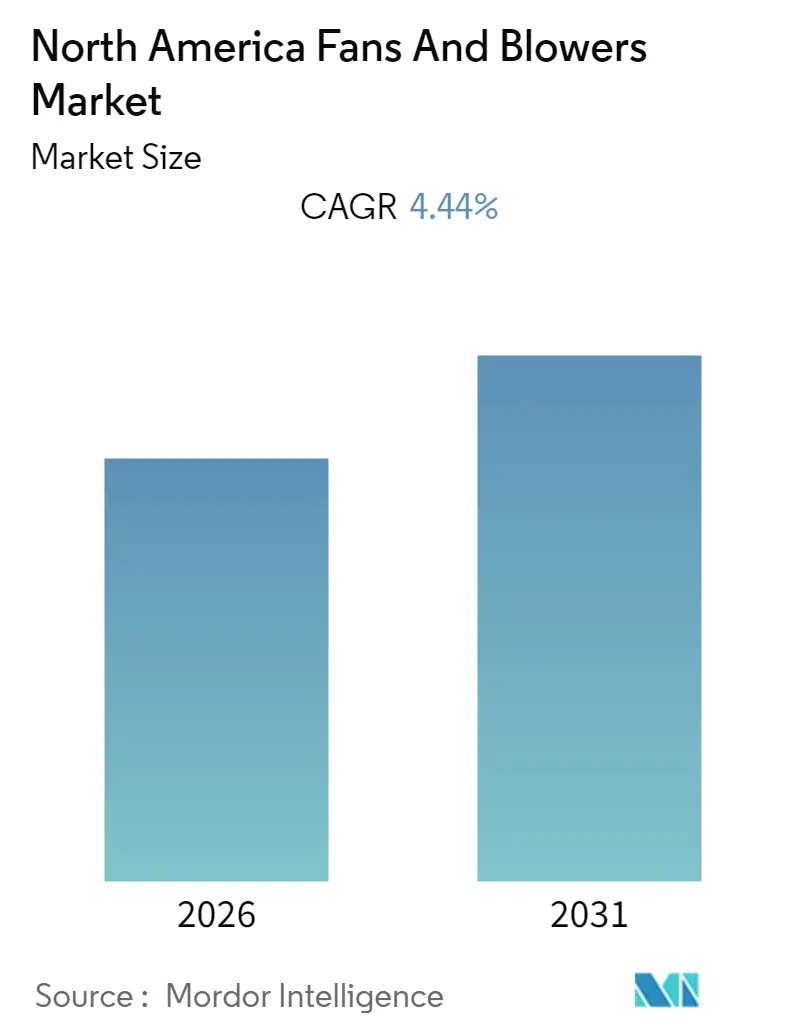
The North America Fans and Blowers Market size is expected to register a CAGR of 4.44% during the forecast period.
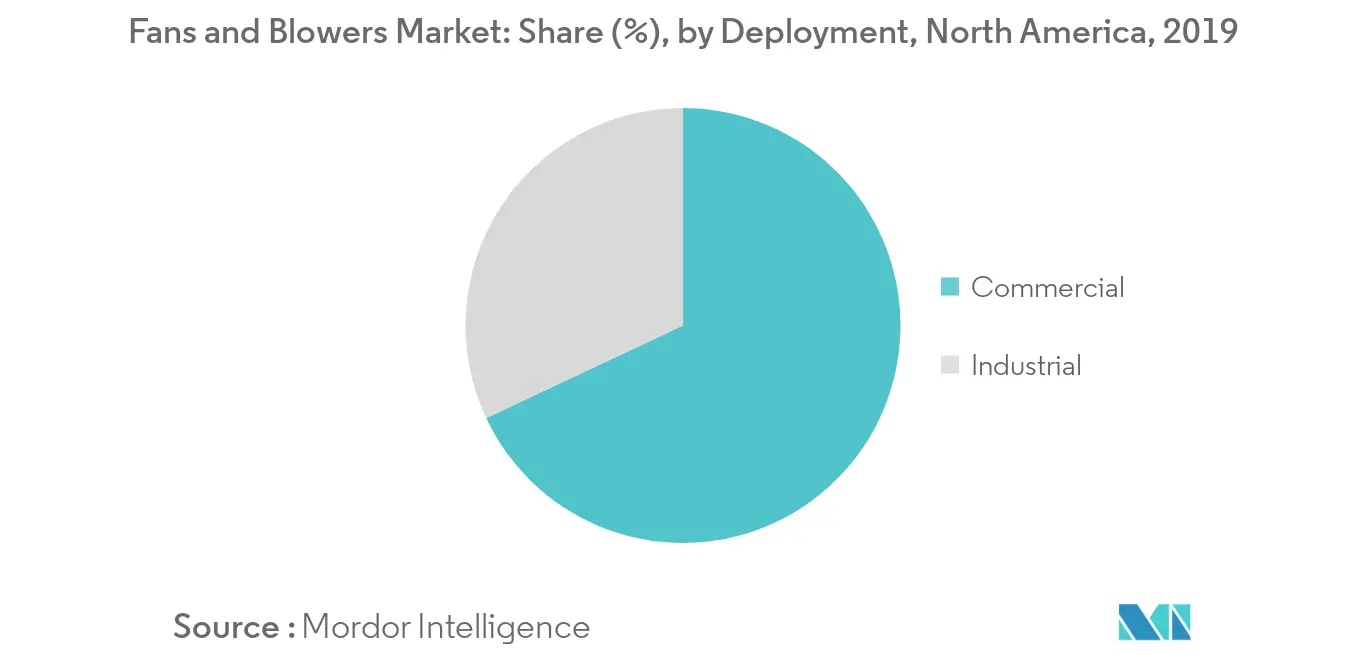
- The commercial sector is expected to account for the largest end-user sector in the North America fans and blowers market owing to increasing private and public investments on the construction of commercial buildings, especially the data centers infrastructure, for which fans are an integral part of the cooling system required in these commercial buildings.
- A new stream of investment in Mexico's oil and gas infrastructure is expected to create a significant opportunity for equipment, including fans and blowers in the coming years.
- The United States is expected to dominate the market over the forecast period owing to the growing demand from commercial and industrial sectors in the country.
Note: Market size and forecast figures in this report are generated using Mordor Intelligence’s proprietary estimation framework, updated with the latest available data and insights as of 2026.
North America Fans And Blowers Market Trends and Insights
Increasing Demand from Commercial Sector
- The commercial sector holds the majority share in the market and is expected to continue its dominance during the forecast period as well. Fans and blowers, in commercial applications, are typically deployed for supplying air at a constant pressure for ventilation, reducing the load on the building HVAC systems by replacing the make-up air and exhaust of smelly gases. Heat exchangers are the primary users of fans & blowers in the commercial sector.
- Commercial kitchens deploy the fans & blowers on a large scale to avoid the build-up of carcinogenic gases within the building, and thus, conditioning the indoor air. The air is continuously replaced in the building interiors with fresh air by using backward-curved blades.
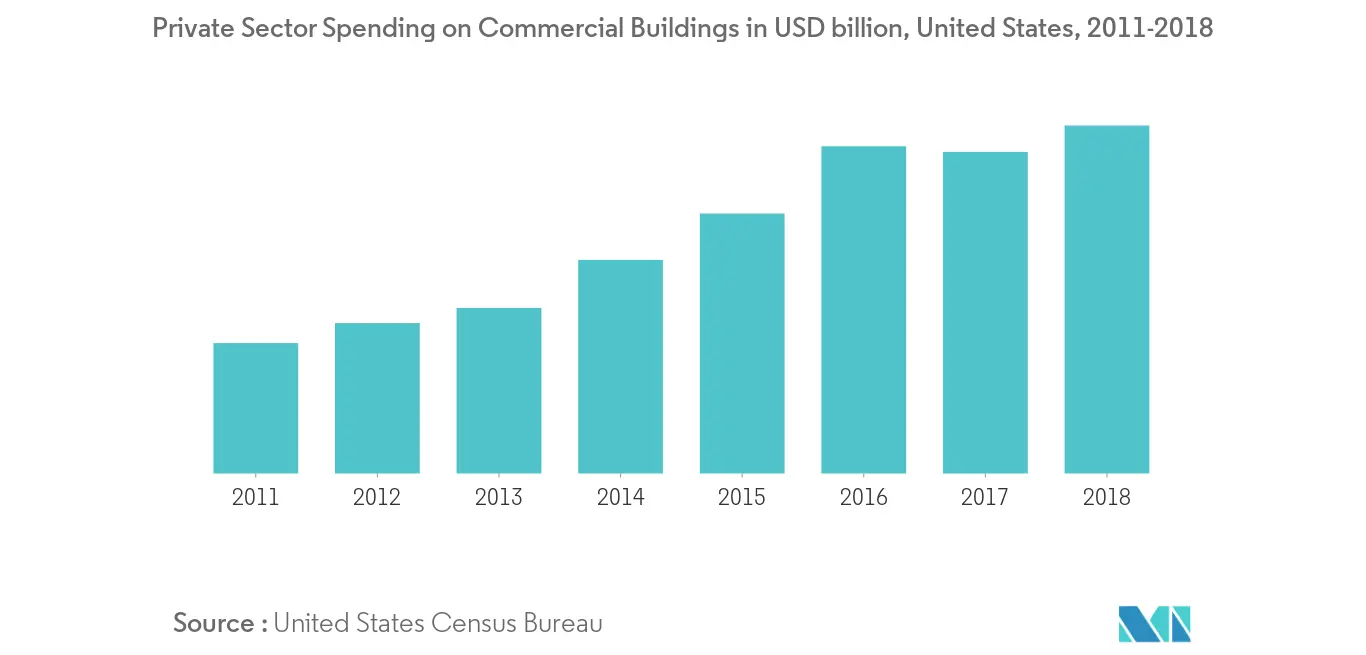
- In the United States, the public sector investments for construction of commercial buildings have steadily increased during 2014-2018, in turn, supporting the growth of the fans and blowers market.
- Apart from that, the internet penetration rate in North America is well above the world average. The internet usage per capita, and in turn, data traffic in the region is growing rapidly. As a result, the data center infrastructure in the region has come under pressure, particularly in the last three years. Hence, investments in building the new data center infrastructure as well as updating the existing data centers are growing at a significant rate.
- For data centers, cooling system infrastructure amounts to the largest share in capital spending for infrastructure building, and fans are an integral part of this cooling system. Hence, the growth of the data center industry is expected to be a major driver for demand of fans and blowers in the commercial sector.


United States to Dominate the Market
- The United States is expected to dominate the market in 2019 and the trend is expected to continue its dominance in the coming years.
- In the United States, the commercial sector is the largest sector for the demand for fans and blowers. The commercial sector is driven by new corporate offices and relocation, increased number of warehouses, and distribution center spending, driven by outdated facilities and technological and logistics needs. Further, the aging population and rising rate of chronic illness continue to drive outpatient facility investment.
- These factors have led to increased spending in the construction industry, and hence, an augmented demand for goods and raw materials required for the construction. This has translated into increased demand for ventilation systems in the new infrastructures.
- In the United States, the biggest market in North America, the private sector spending on commercial buildings declined post-2008 crisis but started a recovery in 2012. From 2012 to 2018, the private sector spending on commercial buildings has grown at a CAGR of over 15%. During the forecast period, due to the strong economic performance of the country, a similar trend is expected, in turn, driving the fans and blowers market in the commercial sector.
- In the industrial segment, uptake in the construction sector, increasing focus in natural-gas-fired power plants to replace the aging coal-fired ones, and expansion of oil and gas infrastructure have led to increased demand for fans and blowers, especially with explosion proof motors.
- The United States is currently generating 600 zettabytes of new data each year. This amounts to 200% more traffic than what current data centers can handle. To keep up pace with the growth in data generation, the data center industry needs to build about 4,000 new facilities by 2020.
- This upcoming infrastructure is expected to result in increased demand for the ventilation system, and hence drive the fans and blowers market growth.
Regulatory Landscape
In the United States, the U.S. Department of Energy (DOE) governs mandatory test procedures for fans and blowers under 10 CFR Part 431, Subpart J, with the uniform test method codified in Appendix A and aligned to AMCA 214-21 for determining and representing Fan Energy Index (FEI). The DOE finalized the relevant test procedure in May 2023, which anchors how manufacturers measure and market energy performance claims for covered fan and blower configurations.
The federal minimum energy conservation standards pathway for fans and blowers shifted in January 2025 when the DOE formally withdrew its proposed energy conservation standards rulemaking, originally published in January 2024. As a result, the regulatory burden is currently concentrated on test-procedure compliance and accurate representations rather than federally mandated minimum efficiency levels for this category. Any new standards would require a fresh notice-and-comment process under the Energy Policy and Conservation Act.
Value Chain Analysis
The North America fans and blowers value chain spans raw materials and components (carbon and stainless steel, aluminum, bearings, high-efficiency motors, and variable frequency drives), fabrication and assembly, testing, and distribution to commercial and industrial end users. In-region manufacturers and integrators such as New York Blower Company, Chicago Blower Corporation, IB International, and Fan Equipment Company support engineered-to-order designs through sheet metal fabrication, welding, balancing, and performance validation, often linked to accredited test capabilities used for product qualification and customer acceptance.
Downstream, sales routes commonly run through specialized independent representatives and OEM channels serving power generation, oil and gas, metals, paper, wastewater, and building ventilation applications. Recent supply-chain conditions have highlighted operational pinch points for custom industrial equipment, including longer lead times during Q2 2026 attributed to logistics delays at Gulf Coast ports, along with added friction around controlled components and specialty alloys. This reinforces the importance of domestic throughput, stocked subassemblies, and multi-sourcing for motors, drives, and critical rotating parts.
Competitive Landscape
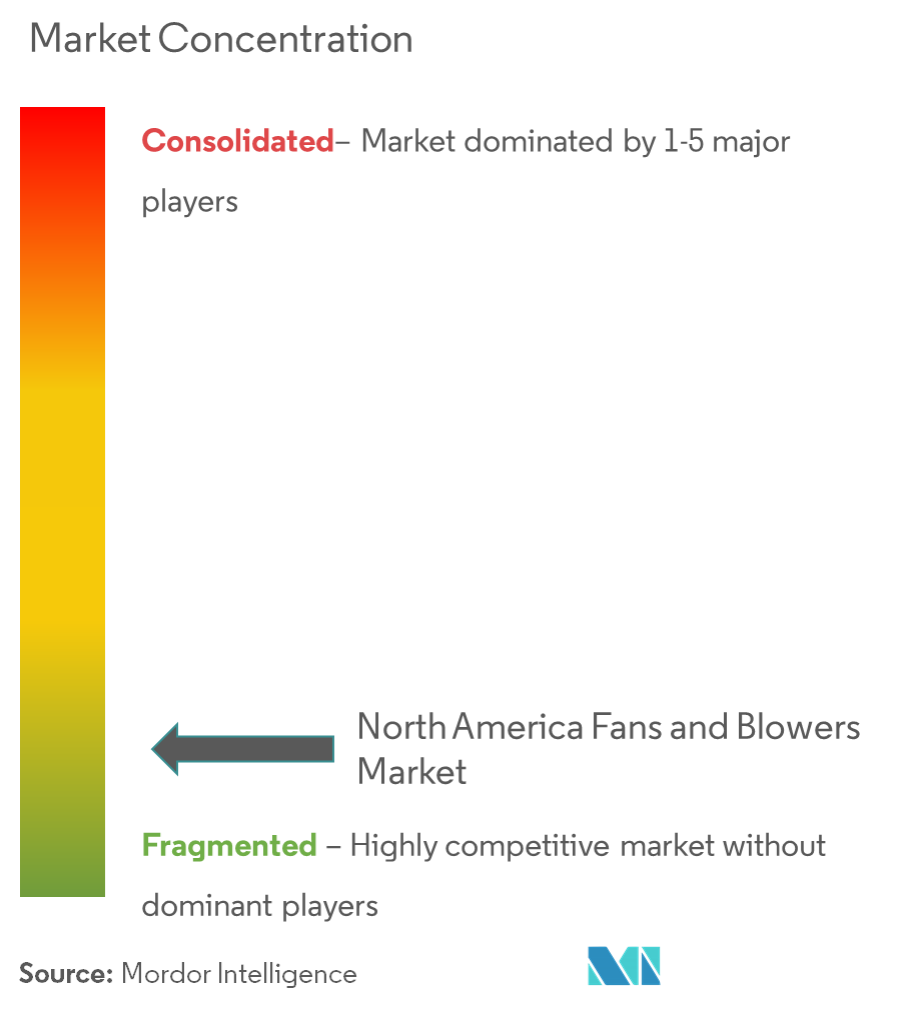
The North America fans and blowers market is fragmented with a large presence of both major and local players holding significant share in the market. Some of the key players in this market include Acme Engineering and Manufacturing Corp., Airmaster Fan Company Inc., Continental Blower LLC, and Fläkt Woods Group SA.
North America Fans And Blowers Industry Leaders
Acme Engineering and Manufacturing Corp.
Airmaster Fan Company Inc.
Continental Blower LLC
Fläkt Woods Group SA
- *Disclaimer: Major Players sorted in no particular order

Market Opportunities and Future Outlook
A near-term opportunity sits in energy-performance differentiation and compliance-ready documentation. Even after the January 2025 withdrawal of DOE-proposed energy conservation standards, U.S. manufacturers still operate under mandatory DOE test procedures (10 CFR Part 431, Subpart J) that require consistent FEI-based measurement and representation. This environment supports product and service offerings that simplify FEI testing, selection, and verification for end users and specifiers, particularly in commercial HVAC and industrial ventilation projects where procurement teams increasingly compare lifecycle energy and operating costs rather than first cost alone.
Another opportunity is the shift from standalone equipment to connected solutions in commercial and industrial deployments. Fans and blowers are being integrated with variable speed control, sensors, and analytics to support energy management and predictive maintenance, aligning with modernization programs in facilities such as data centers and process industries. Within the report scope, demand pull from commercial construction and data center cooling, alongside industrial upgrades and Mexico oil and gas infrastructure investment mentioned in the market context, creates whitespace for suppliers that bundle high-efficiency hardware with controls, commissioning support, and aftermarket service to reduce time-to-operation and unplanned downtime.
Recent Industry Developments
- June 2026: No sufficiently corroborated, in-scope 2026 company-level development was identified from the provided evidence sources for the key North America fans and blowers participants listed in the report context. The update cadence in available public channels for the referenced companies limits defensible inclusion of a major 2026 event without relying on unverified third-party claims.
- September 2025: Airmaster Fan Company completed the installation of a new laser cutting system at its Clarklake, Michigan facility to enhance production capability. The equipment upgrade improves fabrication throughput and supports faster turnaround for custom and replacement fan components, which can improve responsiveness for commercial and industrial orders.
- June 2025: Acme Engineering and Manufacturing Corp. received an Oklahoma Industrial Energy Program (OIEP) incentive via state entities to invest in new technology aimed at improving efficiency and reducing production bottlenecks. The incentive-backed investment supports domestic manufacturing competitiveness and helps expand capacity for fans and blowers supplied into regional building and industrial ventilation demand.


Research Methodology Framework and Report Scope
Market Definition and Coverage
This market covers revenue earned from fans and blowers supplied into North America, counted when equipment is sold for ventilation, air movement, and industrial process air handling across commercial and industrial use.
Scope exclusions: We exclude aftermarket services, installation labor, and standalone ducting, filters, and controls when they are sold separately from the fan or blower unit.
Segmentation Overview
- Technology
- Centrifugal
- Axial
- Deployment
- Commercial
- Industrial
- Power Generation
- Oil and Gas
- Mining, Metal Manufacturing, and Processing
- Cement Industry
- Other Industrial Deployments
- Geography
- United States
- Canada
- Rest of North America
Data Sources, Market Sizing, and Validation
Desk Research
For desk research, we map where demand is created in North America and how it shows up in public data. Helpful inputs are pulled from US Census Bureau manufacturing and construction series, Statistics Canada industrial data, US Energy Information Administration power indicators, and USGS outputs linked to metals and cement activity.
We also review standards and efficiency-related references, plus trade and import signals where available, and then add company filings, investor presentations, and association updates to understand product mix and pricing direction. When gaps appear, a paid subscription for company financials and intelligence is used to verify revenue exposure and regional splits for relevant manufacturers. The sources listed here are illustrative only, and many other public references were used to collect data, cross-check, and clarify assumptions.
Primary Interviews and Surveys
Primary work focuses on confirming what the market really counts as a fan or blower sale, then pressure-testing demand drivers by end use such as commercial buildings and heavy industry. We speak with manufacturers, channel partners, engineering and maintenance teams, and large buyers across the US, Canada, and the rest of North America so pricing moves, replacement cycles, and shipment timing are understood before totals are finalized.
Distribution of primary research fieldwork respondents
| Company type | Respondent position |
|---|---|
| Top tier: 37% | CXOs: 16% |
| Mid tier: 44% | Functional/Unit leaders: 37% |
| Smaller Players: 19% | Managers: 47% |
Market-Sizing & Forecasting
Sizing starts with a top-down build where commercial building activity and industrial output in North America are used to reconstruct the demand pool for air movement equipment, then allocated into fans versus blowers based on typical application fit. To keep totals realistic, we corroborate results with selective bottom-up approximations, such as sampled average selling price ranges multiplied by shipment proxies from channel feedback, followed by supplier roll-ups for the most visible product lines.
Key inputs in the model include nonresidential construction spending, industrial production trends in energy intensive sectors (such as cement and metals), power generation additions and maintenance cycles, HVAC and ventilation replacement cadence, and observed ASP movement tied to materials and motor efficiency requirements. Forecasting is run using scenario analysis, where the base case is anchored to macro indicators and then adjusted using interview-led views on lead times, backlog normalization, and capital spending intent. When company disclosures do not separate fans from adjacent equipment, the split is estimated using product mix cues and then rechecked through distributor and end user feedback.
Data Validation & Update Cycle
Validation is done in steps so unusual jumps are caught early and discussed. We compare modeled totals against independent signals like sector capex direction, construction momentum, and import patterns, and then review any variance that looks out of line with pricing or shipment reality.
Before sign-off, another analyst reviews the inputs, the unit logic, and the final output tables, and follow-up calls are triggered when a key assumption moves or when two sources conflict on the same indicator. Reports are refreshed annually, with interim updates when material events occur, and a final pre-delivery review is completed so clients receive the latest available view.
Mordor Intelligence's North America Fans and Blowers Market Estimate Compared With Other Published Estimates
Published market sizes for fans and blowers in North America can differ even when the topic label looks the same, since each publisher chooses its own product boundary, geography set, and base-year timing. Differences also come from how pricing is handled, whether the work leans more on industrial demand or commercial replacement, and how often assumptions are refreshed.
The biggest gaps usually show up around what gets grouped into "blowers," whether ventilation-only products are mixed with process air equipment, and how Mexico and smaller North American markets are treated. Some estimates also apply a single CAGR across the whole period without rechecking drivers like nonresidential construction cycles, heavy industry output, and efficiency-related upgrades, which can push totals up or down depending on the chosen scenario.
Benchmark comparison
| Source | Market Size | Gaps in Research Methodology |
|---|---|---|
| Mordor Intelligence | USD 1.58 B (2024) | |
| Global Consultancy A | USD 1.58 B (2024) | Uses a blower-only framing that can undercount fan-heavy commercial ventilation demand when it is treated as HVAC equipment rather than air-movement hardware. |
| Industry Publisher B | USD 1.30 B (2024) | Restricts coverage to commercial blowers and a narrower country set, which can exclude industrial deployments like cement and metals where larger process air systems are purchased. |
The table shows a noticeable spread driven mainly by scope boundaries rather than math errors, and in Mordor Intelligence's model the market is counted across both commercial and industrial deployments for the full North America set, which changes what is included in the revenue total. With demand drivers and pricing checked through repeatable indicators, the final number stays traceable to a clear demand pool and can be updated cleanly as construction and industrial cycles shift.


Key Questions Answered in the Report
What is the current North America Fans and Blowers Market size?
The North America Fans and Blowers Market is projected to register a CAGR of 4.44% during the forecast period (2026-2031)
Who are the key players in North America Fans and Blowers Market?
Acme Engineering and Manufacturing Corp., Airmaster Fan Company Inc., Continental Blower LLC and Fläkt Woods Group SA are the major companies operating in the North America Fans and Blowers Market.
What years does this North America Fans and Blowers Market cover?
The report covers the North America Fans and Blowers Market historical market size for years: 2020, 2021, 2022, 2023 and 2024. The report also forecasts the North America Fans and Blowers Market size for years: 2025, 2026, 2027, 2028, 2029 and 2030.
Page last updated on:


 Your data is secure and never sold or shared.


