
North America and Europe Agricultural Machinery Market Size and Share
Market Overview
| Study Period | 2021 - 2031 |
|---|---|
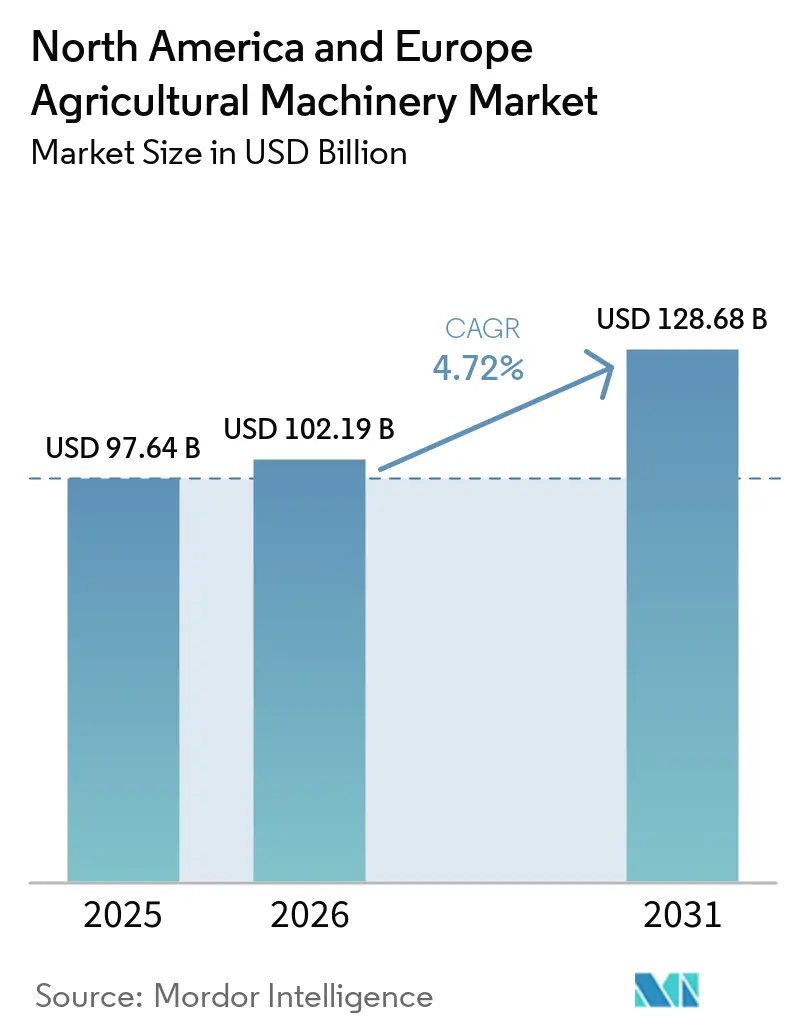
| Base Year Market Size (2025) | USD 97.64 Billion |
| Market Size (2026) | USD 102.19 Billion |
| Market Size (2031) | USD 128.68 Billion |
| Growth Rate (2026 - 2031) | 4.72 % |
| Fastest Growing Market | North America |
| Largest Market | Europe |
Major Players *Disclaimer: Major Players sorted in no particular order Image © Mordor Intelligence. Reuse requires attribution under CC BY 4.0. | |
North America and Europe Agricultural Machinery Market Analysis by Mordor Intelligence
The North America and Europe agricultural machinery market size in 2026 is estimated at USD 102.19 billion, up from the 2025 value of USD 97.64 billion, with projections to USD 128.68 billion in 2031, growing at a CAGR of 4.72% over 2026-2031. Persistent labor constraints are shifting farm investment toward machinery that can reduce dependence on seasonal workers, especially in specialty crops. Larger farms need greater field capacity, while smaller and mid-sized operators are weighing productivity benefits against the high costs of financing. Digital features are becoming more important because they support guidance, machine control, maintenance planning, and records management. Public support for precision and lower-emission equipment can accelerate purchases as deadlines approach. The North American and European agricultural machinery markets, therefore, face steady replacement demand, although income pressures and regulations can delay individual orders.
Key Report Takeaways
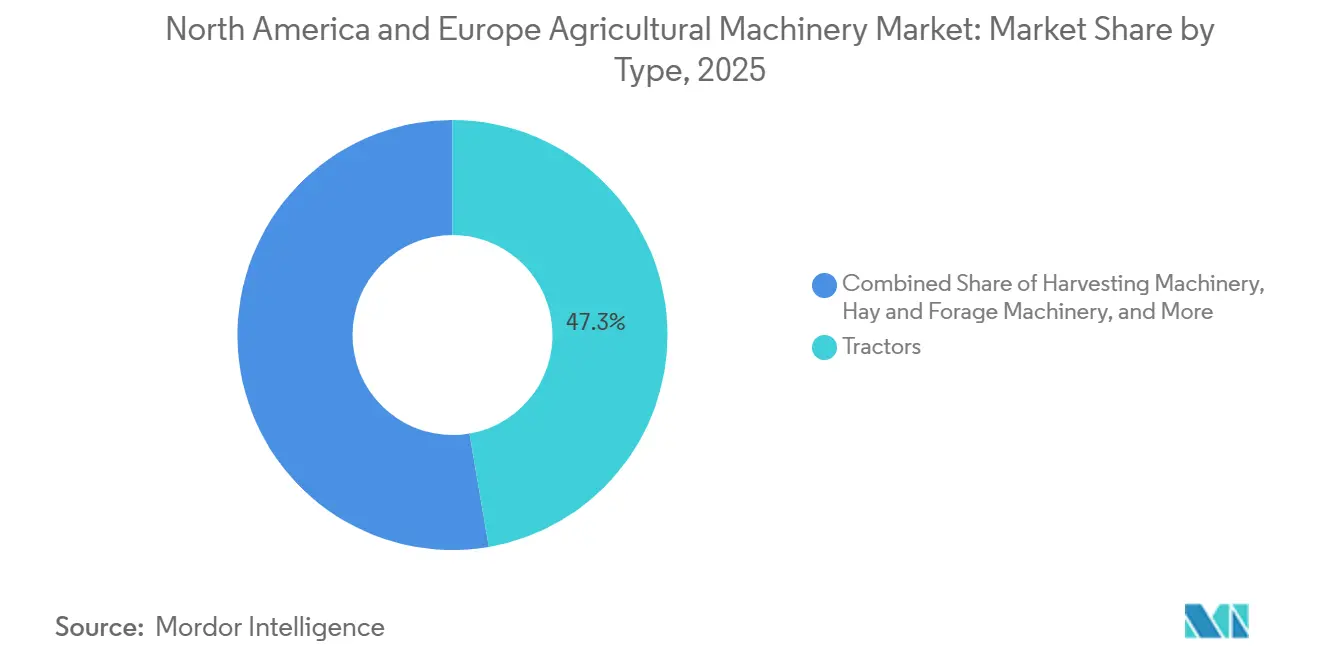
- By Type, tractors accounted for the largest share at 47.3% of the North America and Europe Agricultural Machinery Market Size in 2025, while irrigation machinery is forecast to grow at a CAGR of 6.4% from 2026 to 2031.
- By Automation Level, manual equipment accounted for the largest share at 46.0% of the North America and Europe Agricultural Machinery Market Share in 2025, while automatic equipment is forecast to grow at a CAGR of 6.2% from 2026 to 2031.
- By Geography, Europe accounted for the largest share at 53.8% in 2025, while North America is forecast to grow at a CAGR of 5.9% from 2026 to 2031.
Note: Market size and forecast figures in this report are generated using Mordor Intelligence’s proprietary estimation framework, updated with the latest available data and insights as of January 2026.
North America and Europe Agricultural Machinery Market Trends and Insights
Drivers Impact Analysis*
| Driver | (~) % Impact on CAGR Forecast | Geographic Relevance | Impact Timeline |
|---|---|---|---|
| Persistent Agricultural Labor Shortages | +1.2% | North America and Europe | Medium term (2-4 years) |
| Precision Agriculture and ISOBUS Integration | +0.9% | North America and Europe | Medium term (2-4 years) |
| Public Incentives for Climate-Smart Equipment | +0.7% | Europe core, spillover to North America | Short term (≤ 2 years) |
| Aging Fleet Replacement and Farm Consolidation | +0.8% | North America and Europe | Long term (≥ 4 years) |
| Retrofit Autonomy for Existing High-Value Fleets | +0.5% | North America core, early gains in Europe | Medium term (2-4 years) |
| Electrification of Compact and Specialty Machinery | +0.3% | Europe core in orchard and vineyard districts, North America growing | Long term (≥ 4 years) |
| Source: Mordor Intelligence | |||
Persistent Agricultural Labor Shortages
The United States reported approximately 2.4 million open agricultural jobs in 2024, while agricultural employment declined by about 155,000 positions during mid-2025[1]Source: Bureau of Labor Statistics, “Occupational Employment and Wages, Agricultural Workers,” U.S. Department of Labor, bls.gov. Row-crop farming has adopted mechanization for many field operations, yet labor-intensive activities in specialty crops still require substantial manual labor. Europe also faces persistent labor shortages and an aging farming workforce. In the European Union, agricultural labor volume declined by 0.9% in 2024, reflecting the continued contraction of agricultural labor input across the region and supporting demand for labor-saving machinery and automation. These labor constraints are accelerating demand for precision harvesters, targeted sprayers, mechanized transplanters, and other labor-saving equipment across the North America and Europe Agricultural Machinery Market, as timely field operations remain critical for maintaining crop quality, productivity, and overall farm efficiency.
Precision Agriculture and ISOBUS Integration
Equipment connectivity is moving from an optional feature to a practical requirement for many farms. ISOBUS supports communication among compatible tractors, implements, and digital systems, improving machine coordination across mixed fleets. The European Commission has placed greater emphasis on digitalization and precision approaches within the future direction of the Common Agricultural Policy[2]Source: European Commission, “The Next Chapter for the CAP,” European Commission, agriculture.ec.europa.eu. This direction supports replacement demand for equipment that can document operations and apply inputs more precisely. In 2024, Deere & Company continued investing in its digital platform and connected equipment capabilities, reporting 775,000 connected machines and 455 million engaged acres through its John Deere Operations Center ecosystem. AGCO Corporation also strengthened its precision agriculture strategy in 2024 by launching PTx Trimble, a mixed-fleet platform designed to support both factory-fit and retrofit applications. Operators can therefore evaluate whether a closed ecosystem or broader compatibility better fits their existing fleet. This platform choice can shape dealer relationships, service revenue, and upgrade decisions across the North America and Europe Agricultural Machinery Market because farms want useful digital tools without disrupting established equipment and service arrangements.
Public Incentives for Climate-Smart Equipment
European farm support is increasingly aligned with environmental, climate, and digital objectives. The European Commission adopted the Common Agricultural Policy (CAP) simplification package in May 2025, while approved CAP Strategic Plans continue to support farm modernization through investment measures, including digitalization and precision farming technologies. These investment incentives encourage farmers to adopt advanced machinery and improve operational efficiency. Similar policy initiatives in North America also promote agricultural modernization and resource-efficient farming practices. Together, these programs strengthen demand for precision and specialized equipment across the North American and European agricultural machinery markets. However, funding cycles and application windows can influence purchasing decisions, requiring manufacturers and dealers to manage production and inventory strategically.
Aging Fleet Replacement and Farm Consolidation
The United States recorded 1.865 million farms in 2025, a decline of 15,000 from 2024, while the average farm size increased to 469 acres, highlighting the ongoing trend of farm consolidation across the country [3]Source: U.S. Department of Agriculture Economic Research Service, “Ag and Food Statistics: Charting the Essentials, Farming and Farm Income,” U.S. Department of Agriculture, ers.usda.gov. In Europe, larger agricultural holdings continue to manage a significant share of utilized agricultural land, reinforcing the shift toward larger-scale farming operations. These structural changes increase demand for higher-capacity combines, more powerful tractors, and larger planters capable of covering greater acreage efficiently. Fleet replacement also supports the adoption of machinery compatible with advanced digital technologies, thereby strengthening demand across the North American and European Agricultural Machinery Market, particularly where weather variability and labor constraints require timely field operations.
Restraints Impact Analysis*
| Restraint | (~) % Impact on CAGR Forecast | Geographic Relevance | Impact Timeline |
|---|---|---|---|
| High Upfront Equipment and Financing Costs | -0.8% | Global | Short term (≤ 2 years) |
| Volatile Farm Income and Interest Rates | -0.7% | Global | Short term (≤ 2 years) |
| Cybersecurity and Data Ownership Uncertainty | -0.3% | North America and Europe | Medium term (2-4 years) |
| Stage V and Tier 4 Compliance Cost Escalation | -0.4% | North America and Europe | Medium term (2-4 years) |
| Source: Mordor Intelligence | |||
High Upfront Equipment and Financing Costs
Premium agricultural machinery has become increasingly difficult to finance for operators with limited cash flow, as modern high-horsepower equipment equipped with advanced technologies such as precision guidance, telematics, and emissions-compliant systems requires significantly higher upfront investment. Farmers also need to consider trade-in values, multi-year financing, and the cost of dealer service packages. These requirements can extend the sales process and increase dealer working capital needs. Smaller operators may postpone purchases when borrowing costs remain high, while larger commercial farms may place orders before funding deadlines. The North American and European agricultural machinery markets consequently show different demand patterns across farm-size groups, with finance-ready commercial operators better positioned to secure equipment that improves capacity, efficiency, and regulatory compliance, while smaller operations may preserve cash by extending the use of existing assets.
Cybersecurity and Data Ownership Uncertainty
Connected machinery collects operational data through sensors, telematics, guidance systems, and controllers. Farmers are increasingly focused on who can access this data and how it will be used across equipment platforms. The Association of Equipment Manufacturers (AEM) has outlined shared cybersecurity responsibilities for manufacturers, dealers, equipment owners, and technology providers across connected non-road equipment. ISO/DIS 24882, which covers product cybersecurity for agricultural machinery, remained under development during late 2025, reflecting the industry's growing focus on cybersecurity requirements. Meeting these evolving cybersecurity expectations requires continued software development, product validation, and dealer training. These considerations may slow the adoption of connected equipment across the North America and Europe Agricultural Machinery Market, as manufacturers and buyers evaluate cybersecurity responsibilities while dealers work to strengthen their capabilities to support secure equipment operation, software updates, and access management.
*Our forecasts treat driver/restraint impacts as directional, not additive. The impact forecasts reflect baseline growth, mix effects, and variable interactions.
Segment Analysis
By Type: Tractors Hold the Largest Position, While Irrigation Leads Growth
Tractors accounted for 47.3% of the North American and Europe agricultural machinery market size in 2025, making them the leading segment. This represented the largest agricultural machinery market share in North America and Europe among the stated equipment categories. Demand within tractors is divided between high-horsepower models for expanding farms and compact utility machines for specialty use. Farm consolidation supports the adoption of higher-capacity tractors because operators need to complete planting, cultivation, and harvesting within limited weather windows. Compact tractors also retain relevance in orchard, vineyard, and livestock settings. Soil preparation and cultivation equipment remained a standard capital need, including plows, harrows, cultivators, and tillers. Tillage equipment was among the few German production segments to outperform the wider equipment sector in 2025. Harvesting machinery maintained stable demand in grain-producing areas, although lower cereal returns weakened orders in some locations. The North America and Europe agricultural machinery market continues to require a broad equipment range because farm tasks and crop systems vary widely across the two regions.
Hay and forage equipment benefited from strong dairy and beef cattle prices in 2025, which partly offset weaker tractor and combine demand in pastoral areas of France, the United Kingdom, and Ireland. Irrigation machinery is projected to advance at a 6.4% CAGR from 2026 to 2031. Water stress in the western, southwestern, and central plains regions of the United States supports this North America and Europe agricultural machinery market size growth opportunity. Precision center-pivot and drip systems cost more than traditional flood irrigation, but they can improve water management. Federal and state programs can lower the cost of qualifying water-efficient systems. Planting and seeding equipment benefits from variable-rate practices and large-acreage demand. Deere & Company launched the C1450T air cart in July 2026 to support seeding productivity between refills. Spraying equipment, including drone-enabled systems, is also attracting interest as growers seek to reduce labor needs and meet precision application requirements. Equipment suppliers can address these needs by combining machines with controls, agronomic support, and practical service coverage.



By Automation Level: Manual Equipment Remains Largest, While Automatic Systems Gain Ground
Manual equipment accounted for 46.0% of the combined North America and Europe agricultural machinery market in 2025. The large installed base of conventional equipment explains the segment's continued leadership. Many farms still use machines without factory-installed automation, particularly where operating hours are limited or replacement budgets are constrained. New equipment introductions increasingly include assisted functions as standard or accessible options. Regulatory expectations for precision practices and the economics of common digital platforms encourage this shift. Semi-automatic equipment includes GNSS-guided steering, section control, and automated headland management. It represents the transition point for many current machinery purchases. Dealers report that precision technology renewal rates exceed 90% among second-year users, which indicates that these functions can become part of normal farm operations once adopted. The North America and Europe agricultural machinery markets are therefore likely to see automation progress through gradual fleet upgrades rather than a single, universal change in buying behavior.
Automatic equipment is projected to grow at a 6.2% CAGR from 2026 to 2031. This North America and Europe agricultural machinery market size outlook reflects demand for supervised autonomy, leader-follower configurations, and factory-ready autonomy architecture. In 2025, Deere & Company's 8R and 8RX range was introduced with designs prepared for supervised autonomy upgrades. AGCO Corporation's PTx Trimble platform addresses similar needs through mixed-fleet compatibility. Retrofit kits can add GPS guidance and basic automated functions to existing tractors and harvesters. This approach is especially relevant in Europe, where equipment is often held for longer periods. Automatic systems can expand without requiring every buyer to purchase a new machine, thereby broadening the addressable customer base. The North America and Europe agricultural machinery market can therefore see demand for automation from both new equipment buyers and owners of high-value existing machines.
Geography Analysis
Europe accounted for the largest share of the North America and Europe Agricultural Machinery Market, representing 53.8% of total revenue in 2025, supported by its established agricultural machinery manufacturing base, advanced mechanization, and widespread adoption of precision farming technologies. Germany continues to serve as the region's manufacturing hub, while France remains a major agricultural equipment market despite softer replacement demand. Italy maintains a strong demand for specialized machinery used in vineyards and orchards, reflecting the region's focus on high-value crop production and farm specialization.
North America is projected to be the fastest-growing regional market, registering a 5.9% CAGR during 2026-2031, supported by large-scale commercial farming, strong dealer networks, and increasing adoption of precision agriculture technologies. The United States remains the region's largest market, driven by extensive mechanization, digital farming solutions, and replacement demand. Canadian grain and oilseed producers continue to adopt GPS-guided equipment, variable-rate technologies, and high-capacity seeding systems, while Mexico is projected to contribute significantly to regional growth through the expansion of commercial horticulture, irrigation modernization, and improved access to agricultural financing.
Across the rest of Europe, agricultural modernization and structural changes continue to create opportunities for machinery adoption. The United Kingdom's environmental support programs are influencing the timing of machinery investments, while sanctions continue to affect equipment distribution and spare-parts availability in Russia. Poland, Romania, and the Czech Republic are witnessing gradual farm consolidation and ongoing equipment upgrades supported by agricultural investment programs, strengthening long-term demand for modern agricultural machinery across the region.
Competitive Landscape
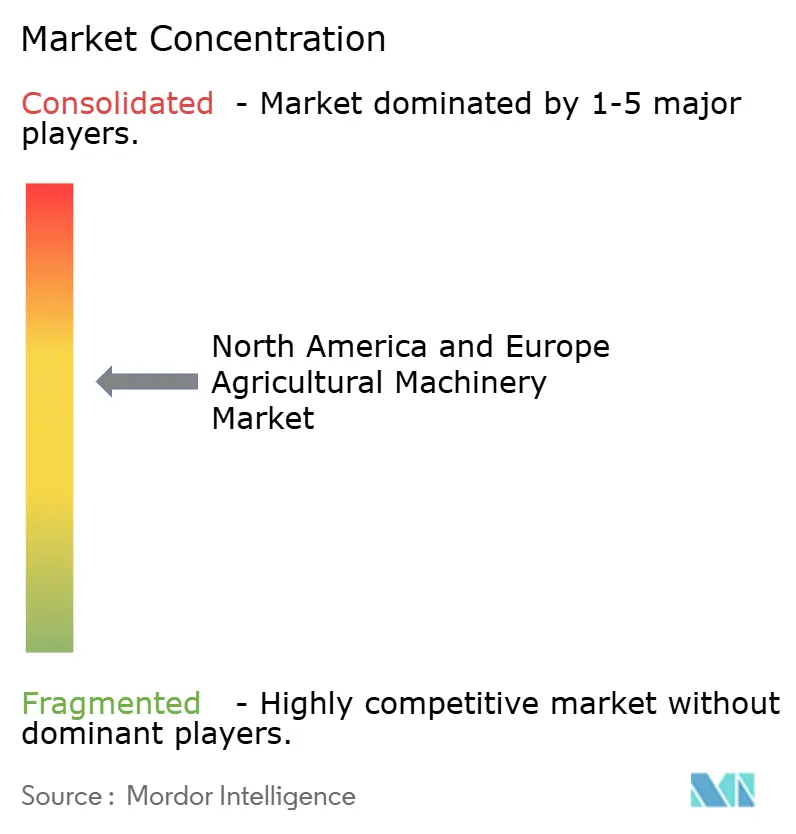
The North America and Europe agricultural machinery market is moderately concentrated in 2025, with Deere & Company, CNH Industrial N.V., and AGCO Corporation holding strong positions across tractors, combines, and precision agriculture systems. Deere & Company operates its Operations Center as a vertically integrated digital platform and acquired Sentera in May 2025 to strengthen aerial field scouting capabilities. Claas KGaA mbH, SDF Group, Argo Tractors S.p.A., Kubota Corporation, Mahindra & Mahindra Ltd., Yanmar Holdings Co., Ltd., ISEKI & CO., LTD., and Bucher Industries AG maintain competitive positions through specialized machinery portfolios, product innovation, and established dealer networks.
Competition is increasingly centered on digital platforms, connected services, and equipment upgrades rather than horsepower alone. Deere & Company leverages its integrated ecosystem to strengthen parts, service, and lifecycle support, while AGCO Corporation expanded mixed-fleet connectivity through its PTx business in 2025, including cloud-based and retrofit technologies that support equipment across multiple brands. The market also presents opportunities in retrofit autonomy, precision irrigation, and drone-enabled crop management. Valmont Industries, Inc., Lindsay Corporation, and Orbia Advance Corporation, S.A.B. de C.V. (Netafim Limited) maintain established positions in center-pivot and precision irrigation solutions, while Tractors and Farm Equipment Limited (TAFE) remains an established agricultural equipment manufacturer.
The development of ISO/DIS 24882 product cybersecurity requirements is increasing the complexity of connected machinery development and requires continued investment in software security, product validation, and technical support. Larger manufacturers are better positioned to distribute these costs across broader product portfolios. In March 2026, Deere & Company partnered with Tarter USA to manufacture Frontier Flex Wing Rotary Cutters in the United States, further strengthening its North American manufacturing capabilities and product portfolio.
North America and Europe Agricultural Machinery Industry Leaders
Deere & Company
CNH Industrial N.V.
AGCO Corporation
Kubota Corporation
Claas KGaA mbH
- *Disclaimer: Major Players sorted in no particular order

Recent Industry Developments
- June 2026: AGCO Corporation enhanced its AGCO Power engine and integrated powertrain technologies across Fendt, Massey Ferguson, and Valtra tractor portfolios. Independent Deutsche Landwirtschafts-Gesellschaft (DLG) PowerMix testing validated improved fuel efficiency and field performance, strengthening AGCO Corporation's agricultural machinery portfolio across Europe and North America.
- March 2026: Deere & Company partnered with Tarter USA to manufacture a new Frontier Flex Wing Rotary Cutter lineup in the United States. The collaboration strengthens North American agricultural machinery manufacturing by advancing production technologies and expanding domestic capacity.
- May 2025: Deere & Company acquired Sentera, a United States-based provider of aerial imagery solutions, integrating drone-based field scouting and remote sensing capabilities into the John Deere Operations Center to enhance precision agriculture across North America.


North America and Europe Agricultural Machinery Market Report Scope
Agricultural machinery encompasses mechanical equipment and tools utilized in farming activities, including land preparation, planting, irrigation, crop protection, and harvesting. These machines enhance operational efficiency, reduce labor dependence, boost productivity, and facilitate large-scale, modern agricultural practices across various crop systems.
The North America and Europe Agricultural Machinery Market Report is segmented by type (tractors, soil preparation and cultivation machinery, planting and seeding machinery, harvesting machinery, spraying and crop protection machinery, hay and forage machinery, and irrigation machinery), by automation level (manual, semi-automatic, and automatic), and by geography (North America and Europe). The market forecasts are provided in terms of value (USD).
| Tractors | By Horsepower | Less than 40 HP |
| 40 HP to 99 HP | ||
| 100 HP and Above | ||
| By Tractor Type | Compact Utility Tractors | |
| Utility Tractors | ||
| Row Crop Tractors | ||
| Orchard and Vineyard Tractors | ||
| Soil Preparation and Cultivation Machinery | Plows | |
| Harrows | ||
| Cultivators and Tillers | ||
| Planting and Seeding Machinery | Seed Drills | |
| Planters | ||
| Broadcast Spreaders | ||
| Transplanters | ||
| Harvesting Machinery | Combine Harvesters and Threshers | |
| Forage Harvesters | ||
| Specialty Crop Harvesters | ||
| Spraying and Crop Protection Machinery | Self-Propelled Sprayers | |
| Trailed and Mounted Sprayers | ||
| Aerial and Drone-Enabled Spraying Systems | ||
| Hay and Forage Machinery | Mower-Conditioners | |
| Balers | ||
| Rakes and Tedders | ||
| Irrigation Machinery | Sprinkler Irrigation | |
| Drip Irrigation | ||
| Mechanized Pivot Systems | ||
| Manual |
| Semi-Automatic |
| Automatic |
| North America | United States |
| Canada | |
| Mexico | |
| Rest of North America | |
| Europe | Germany |
| France | |
| United Kingdom | |
| Italy | |
| Russia | |
| Rest of Europe |
| By Type | Tractors | By Horsepower | Less than 40 HP |
| 40 HP to 99 HP | |||
| 100 HP and Above | |||
| By Tractor Type | Compact Utility Tractors | ||
| Utility Tractors | |||
| Row Crop Tractors | |||
| Orchard and Vineyard Tractors | |||
| Soil Preparation and Cultivation Machinery | Plows | ||
| Harrows | |||
| Cultivators and Tillers | |||
| Planting and Seeding Machinery | Seed Drills | ||
| Planters | |||
| Broadcast Spreaders | |||
| Transplanters | |||
| Harvesting Machinery | Combine Harvesters and Threshers | ||
| Forage Harvesters | |||
| Specialty Crop Harvesters | |||
| Spraying and Crop Protection Machinery | Self-Propelled Sprayers | ||
| Trailed and Mounted Sprayers | |||
| Aerial and Drone-Enabled Spraying Systems | |||
| Hay and Forage Machinery | Mower-Conditioners | ||
| Balers | |||
| Rakes and Tedders | |||
| Irrigation Machinery | Sprinkler Irrigation | ||
| Drip Irrigation | |||
| Mechanized Pivot Systems | |||
| By Automation Level | Manual | ||
| Semi-Automatic | |||
| Automatic | |||
| By Geography | North America | United States | |
| Canada | |||
| Mexico | |||
| Rest of North America | |||
| Europe | Germany | ||
| France | |||
| United Kingdom | |||
| Italy | |||
| Russia | |||
| Rest of Europe | |||


Key Questions Answered in the Report
What is the 2026 value of North America and Europe agricultural machinery?
The North America and Europe Agricultural Machinery Market was valued at USD 102.19 billion in 2026.
Which type of machinery holds the largest position?
Tractors held 47.3% of the North American and Europe agricultural machinery market size in 2025, making them the leading type segment.
Why are automatic farm machines gaining adoption?
Automatic equipment is forecast to grow at a 6.2% CAGR over 2026-2031 as farms adopt supervised autonomy, retrofit guidance, and automated field functions.
Which region has the strongest growth outlook?
North America is projected to be the fastest-growing regional market, registering a 5.9% CAGR during 2026-2031, supported by large-scale commercial farming, strong dealer networks, and increasing adoption of precision agriculture technologies.
Page last updated on:


 Your data is secure and never sold or shared.


