
North America Containerized Rail Freight Transport Market Size and Share
Market Overview
| Study Period | 2020 - 2031 |
|---|---|
| Forecast Data Period | 2026 - 2031 |
| Base Year Market Size (2025) | USD 18.33 Billion |
| Market Size (2026) | USD 19.21 Billion |
| Market Size (2031) | USD 24.01 Billion |
| Growth Rate (2026 - 2031) | 4.56 % |
| Market Concentration | High |
Major Players *Disclaimer: Major Players sorted in no particular order Image © Mordor Intelligence. Reuse requires attribution under CC BY 4.0. | |
North America Containerized Rail Freight Transport Market Analysis by Mordor Intelligence
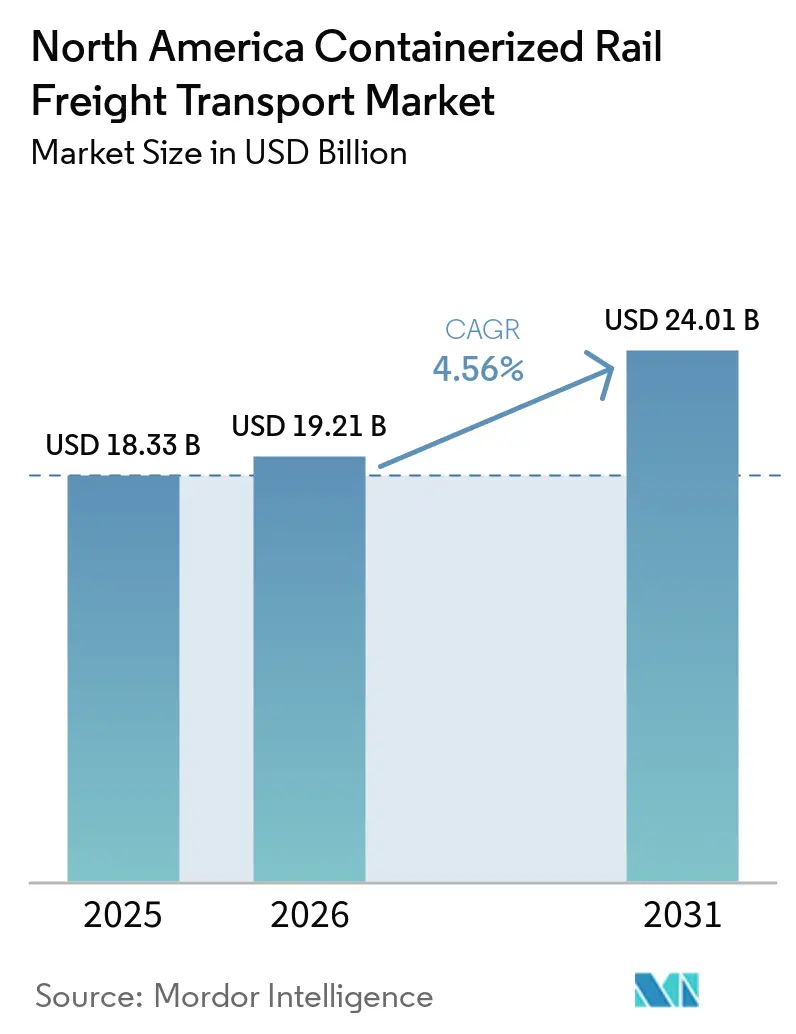
The North America containerized rail freight transport market was valued at USD 18.33 billion in 2025, and is estimated to grow from USD 19.21 billion in 2026 to reach USD 24.01 billion by 2031, at a CAGR of 4.56% during the forecast period (2026-2031).
The North America containerized rail freight transport market is supported by manufacturing activity moving closer to North American end markets. Rail carriers and logistics providers are concentrating their plans on routes that connect Mexican industrial centers with the United States demand centers. The North America containerized rail freight transport market also benefits when long-haul rail costs remain below truck costs on dense lanes. Investments in double-stack clearances and terminals can increase capacity without building a completely new rail route. Border operations, chassis availability, and congestion will determine how much of the opportunity turns into reliable service.
Key Report Takeaways
- By container size, 40-foot containers held 55.56% of the North America containerized rail freight transport market share in 2025 and are forecast to grow at a 6.55% CAGR through 2031.
- By container type, general containers held 84.53% of the North America containerized rail freight transport market size in 2025, while refrigerated containers are forecast to grow at a 7.69% CAGR through 2031.
- By shipment flow, domestic freight represented 80.28% of the North America containerized rail freight transport market share in 2025, while international/cross-border freight is forecast to grow at an 8.25% CAGR through 2031.
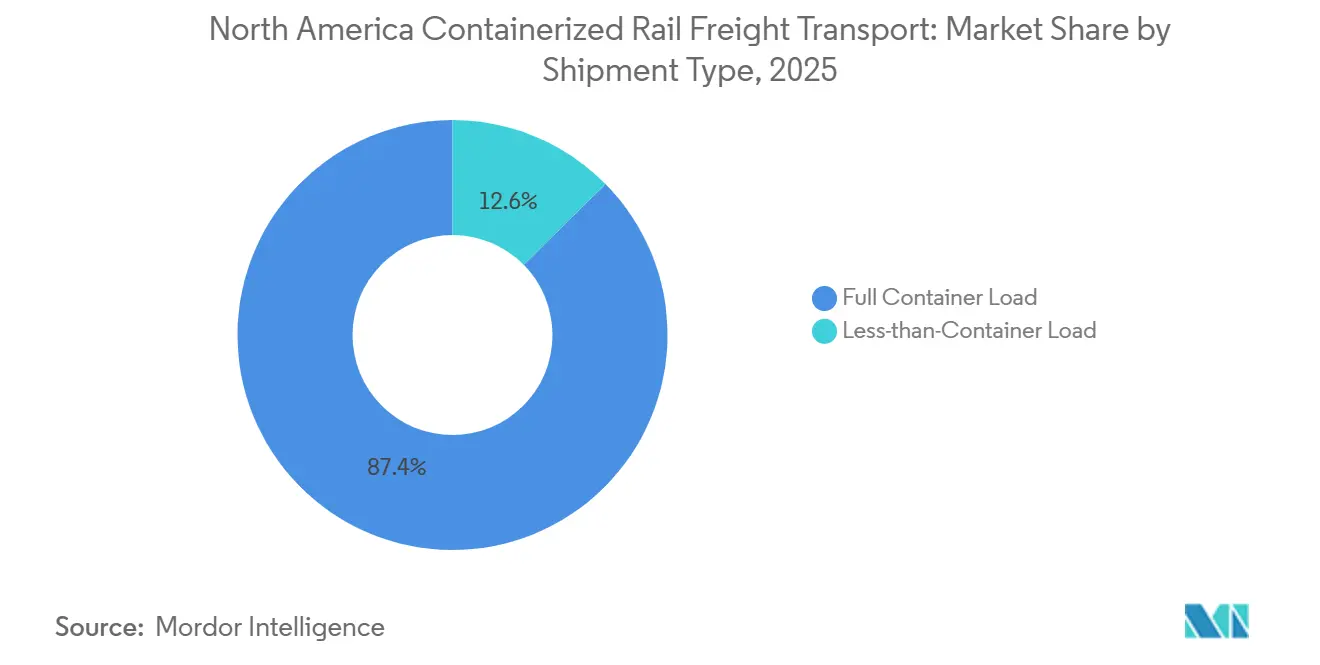
- By shipment type, full container load shipments represented 87.39% of the North America containerized rail freight transport market size in 2025, while less-than-container load shipments are forecast to grow at a 5.93% CAGR through 2031.
- By cargo type, manufacturing and automotive freight held 29.68% of the North America containerized rail freight transport market share in 2025, while healthcare and pharmaceuticals are forecast to grow at a 7.57% CAGR through 2031.
- By geography, the United States held 82.47% of the North America containerized rail freight transport market share in 2025, while Mexico is forecast to grow at a 5.22% CAGR through 2031.
Note: Market size and forecast figures in this report are generated using Mordor Intelligence’s proprietary estimation framework, updated with the latest available data and insights as of January 2026.
North America Containerized Rail Freight Transport Market Trends and Insights
Drivers Impact Analysis*
| Driver | % Impact on CAGR Forecast | Geographic Relevance | Impact Timeline |
|---|---|---|---|
| Cross-Border Nearshoring and North American Manufacturing Integration | +1.1% | United States-Mexico border corridors: Monterrey, Bajio, San Luis Potosi industrial zones | Medium term (2–4 years) |
| E-Commerce Replenishment Through Inland Intermodal Hubs | +0.8% | United States Midwest, Southeast, West Coast; Canada logistics corridors | Short term (≤ 2 years) |
| Double-Stack Corridor and Terminal-Capacity Expansion | +0.7% | National (United States); East Coast, Midwest, Southern California, Texas gateways | Medium term (2–4 years) |
| Rail Economics on Dense Long-Haul Lanes | +0.6% | Transcontinental United States lanes (Los Angeles–Chicago–Northeast); Mexico–United States corridors | Short term (≤ 2 years) |
| Cold-Chain and Temperature-Controlled Intermodal Adoption | +0.5% | CPKC corridor (Mexico–Kansas City–Canada); California pharma and produce lanes | Long term (≥ 4 years) |
| Single-Line Canada-United States-Mexico Connectivity | +0.4% | Canada–United States–Mexico via CPKC's approximately 20,000-route-mile network | Medium term (2–4 years) |
| Source: Mordor Intelligence | |||
Cross-Border Nearshoring and North American Manufacturing Integration
The North America containerized rail freight transport market is being shaped by manufacturing facilities located nearer to the United States customers. United States-Mexico merchandise trade reached USD 872.8 billion in 2025, showing the scale of the commercial relationship served by southern-border freight routes. Monterrey, Saltillo, San Luis Potosi, and the Bajio region sit close to major rail corridors. This alignment makes direct rail connectivity relevant to plant location and inventory planning. CPKC and CSX upgraded the Southeast Mexico Express with a dedicated intermodal train in May 2026. The service links the rail network with a route pattern used by shippers serving Mexico and the United States Southeast.
E-Commerce Replenishment Through Inland Intermodal Hubs
E-commerce replenishment supports rail demand when distribution networks need repeated moves into inland population centers. Norfolk Southern launched its East Edge double-stack service between Chicago and Ayer, Massachusetts, in January 2026[1].Alan H. Shaw, “Norfolk Southern Launches East Edge Double-Stack Service Connecting Chicago and New England,” Norfolk Southern, norfolksouthern.com The USD 64 million project supports 9,000-foot double-stacked trains and can handle 200,000 loads each year. This capacity improves the rail option for New England freight that previously relied more heavily on highways. The North America containerized rail freight transport market needs such corridor improvements because hub demand cannot be met by long-haul rail alone. Local drayage, terminal appointments, and warehouse placement remain part of the service equation.
Double-Stack Corridor and Terminal-Capacity Expansion
Double-stack projects can improve the North America containerized rail freight transport market by increasing the number of containers moved on a train. Norfolk Southern’s East Edge service created a new fully double-stack connection between Chicago and New England in early 2026. The project addresses a corridor where clearance limitations restricted intermodal capacity[2]C.H. Robinson, “Intermodal and U.S. Ports Freight Market Update,” C.H. Robinson, chrobinson.com. Clearance work can create capacity more quickly than a new terminal in locations with constrained land. Terminal investment remains necessary where lifts, parking, and gate capacity limit throughput. These projects matter most on lanes that already have large container volumes.
Rail Economics on Dense Long-Haul Lanes
Rail economics are a central reason for interest in containerized freight on longer routes. C.H. Robinson reported in April 2026 that intermodal demand growth was strongest on 550-mile to 1,500-mile lanes. Those distances give rail more opportunity to offset terminal handling with lower line-haul costs. The North America containerized rail freight transport market is therefore most exposed to dense long-haul corridors. Rail service becomes less attractive when drayage distances consume the savings achieved during the line-haul move. Price is important, but departure frequency and transit consistency also shape shipper decisions. The economic case is therefore specific to lane conditions rather than universal across all freight. Shippers compare total delivered cost, handling steps, expected transit time, and the consequences of a late arrival, which means lower rail line-haul costs need to be accompanied by a service design that can support normal supply-chain planning.
Restraints Impact Analysis*
| Restraint | % Impact on CAGR Forecast | Geographic Relevance | Impact Timeline |
|---|---|---|---|
| Terminal Congestion and Drayage-Distance Inflation | -0.8% | Southern California, Chicago gateway, Laredo, TX; United States-Mexico border crossings | Short term (≤ 2 years) |
| Chassis Imbalances and Equipment Availability | -0.5% | National (United States); acute at United States-Mexico border gateways (Laredo, Eagle Pass, El Paso) | Short term (≤ 2 years) |
| Service-Reliability Variability Versus Trucking | -0.4% | Eastern network corridors; cross-border lanes with variable border dwell | Medium term (2–4 years) |
| Border, Customs, and Interchange Complexity | -0.4% | United States-Mexico border gateways: Laredo, Ysleta, Otay Mesa | Medium term (2–4 years) |
| Source: Mordor Intelligence | |||
Terminal Congestion and Drayage-Distance Inflation
Terminal congestion can limit the North America containerized rail freight transport market even when line-haul rail capacity is available. Containers need to move through gates, yards, and local drayage networks before rail savings become useful. Longer drayage trips can reduce the value of rail on otherwise suitable routes. Chassis shortages create similar friction because a container cannot leave or enter a terminal without matching equipment. Southern California, Chicago, and southern-border gateways are especially sensitive because they combine heavy volumes with complex transfers. Service reliability suffers when terminal dwell or equipment availability becomes unpredictable.
Border, Customs, and Interchange Complexity
Border processes affect transit consistency on Mexico-United States container moves. United States-Mexico transborder rail freight reached USD 184.5 billion with Canada and Mexico combined in 2025, emphasizing the economic role of cross-border rail links[3] U.S. Bureau of Transportation Statistics, “Transborder Freight Data Annual Report 2025,” BTS, bts.gov. Inspection requirements, customs documentation, and interchanges can add dwell time to a route. Laredo handled 290,100 railcar equivalents in 2025, concentrating operational exposure at a major gateway. Delays have a greater effect on goods with narrow delivery windows or controlled-temperature requirements. The North America containerized rail freight transport market needs to make border performance more predictable, not simply faster.
*Our forecasts treat driver/restraint impacts as directional, not additive. The impact forecasts reflect baseline growth, mix effects, and variable interactions.
Segment Analysis
By Container Size: 40-Foot Units Lead Volume and Growth Simultaneously
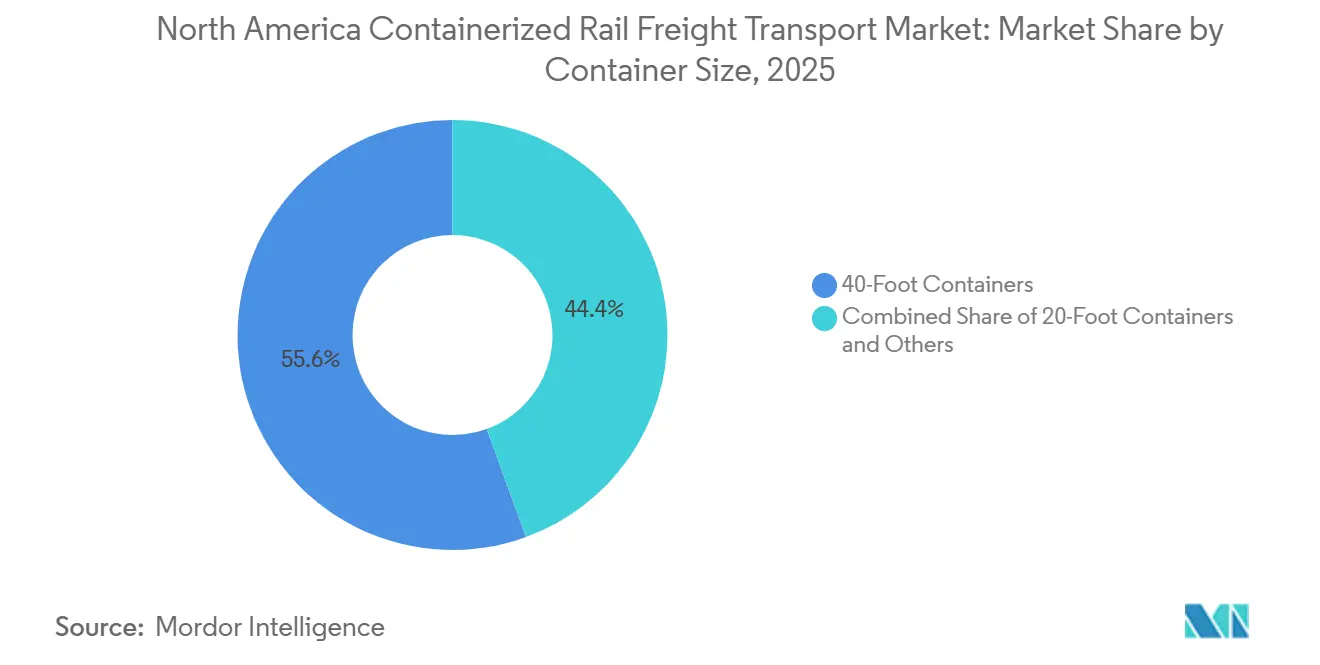
40-foot containers accounted for 55.56% of the North America containerized rail freight transport market size in 2025 and are forecast to grow at a 6.55% CAGR through 2031. Their position reflects their use in international trade and double-stack rail operations. They fit the operating model used on transcontinental and cross-border container lanes. These routes can support regular train schedules and high equipment utilization. Ocean-linked freight also supports demand for this format at major ports and inland gateways. The North America containerized rail freight transport market uses this standard size, where scale and stacking efficiency are important.
40-foot units are useful when shippers need a format compatible with port movements and inland rail distribution. Their role is strongest where rail terminals handle consistent volumes. Container availability and return patterns still influence equipment decisions. 20-foot containers continue to serve heavier or specialized freight. 45-foot and 53-foot containers are more relevant where domestic cubic capacity is the priority. The North America containerized rail freight transport market will retain several formats because shippers balance standardization, weight, and space needs.



By Container Type: Refrigerated Containers Redefine Cross-Border Logistics
General containers held 84.53% of the North America containerized rail freight transport market share in 2025, and refrigerated containers are forecast to grow at a 7.69% CAGR through 2031. They serve a broad range of dry manufactured goods, consumer products, and container-compatible materials. Their growth is linked to the demand for controlled transport of perishable and pharmaceutical goods. CPKC reported stronger intermodal revenue in the second quarter of 2026, with revenue per carload also increasing. The North America containerized rail freight transport market has scope for cold-chain services when transit quality meets product requirements.
Refrigerated intermodal requires containers, terminals, power access, inspections, and monitoring practices that are not needed for dry freight. This makes asset availability a meaningful constraint for the segment. Cross-border pharmaceutical logistics also requires reliable documentation and temperature control. Rail can become more suitable when service design reduces repeated border processes. General containers will remain the larger category because dry freight has a wider cargo base. The North America containerized rail freight transport market is likely to see refrigerated growth without a comparable shift in the overall container mix.
By Shipment Flow: Cross-Border Momentum Outpaces the Domestic Base
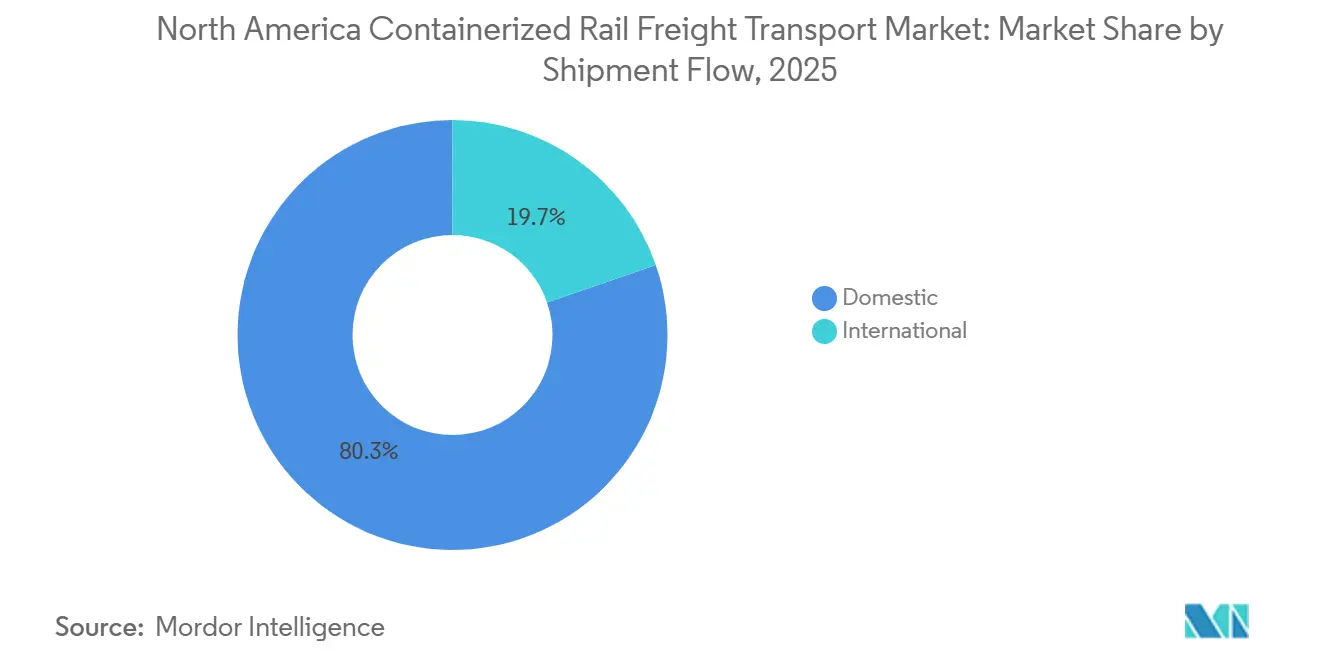
Domestic freight represented 80.28% of the North America containerized rail freight transport market size in 2025, while international/cross-border freight is forecast to grow at an 8.25% CAGR through 2031. This base reflects the United States intraregional distribution, transcontinental movements, and retail replenishment. The faster outlook follows the continued importance of United States-Mexico trade corridors. United States-Mexico merchandise trade reached USD 872.8 billion in 2025. The North America containerized rail freight transport market depends on domestic freight for scale and cross-border freight for incremental growth.
Cross-border traffic faces a different operating environment from domestic traffic. It requires customs coordination, consistent interchange performance, and equipment positioned on both sides of the border. Dedicated services can provide shippers with clearer schedules on these routes. CPKC and CSX announced that their upgraded Southeast Mexico Express reduced transit times on selected lanes in May 2026. Domestic traffic remains essential because it uses a much larger installed network. The North America containerized rail freight transport market will need both flows to maintain balanced terminal and equipment utilization.
By Shipment Type: FCL Anchors Revenue as LCL Builds Critical Mass
Full container load shipments accounted for 87.39% of the North America containerized rail freight transport market share in 2025, while less-than-container load shipments are forecast to grow at a 5.93% CAGR through 2031. FCL is suited to longer rail moves because one shipper controls a full container, and the freight can move with fewer consolidation steps. The format supports predictable turns when volumes are regular. It is common in manufacturing, retail, and cross-border supply chains. Its scale gives rail operators a foundation for scheduled intermodal services. The North America containerized rail freight transport market relies on these full loads for its principal revenue base.
LCL benefits from transload sites that combine smaller consignments into rail-compatible loads. E-commerce replenishment can create demand for such services when shipments are frequent and dispersed. LCL moves require more coordination than FCL and can be more sensitive to terminal delays. The economics improve when consolidation facilities sit near production or distribution sites. The North America containerized rail freight transport market can broaden its customer base if those facilities lower the minimum shipment density needed for rail.
By Cargo Type: Pharmaceutical Growth Challenges, Automotive's Historical Primacy
Manufacturing and automotive freight held 29.68% of the North America containerized rail freight transport market share in 2025, while healthcare and pharmaceuticals are forecast to grow at a 7.57% CAGR through 2031. The category is supported by production networks that connect assembly plants, suppliers, and distribution centers. Their outlook is tied to greater use of controlled-temperature intermodal options. The North America containerized rail freight transport industry needs to meet traceability and temperature-monitoring requirements before this freight can move at scale. That requirement distinguishes pharmaceutical traffic from many dry containerized goods.
Electronics and electrical equipment face tariff-related exposure that can affect cross-border shipment planning. FMCG and retail freight provide a steadier volume base, particularly when inland replenishment is active. Industrial chemicals and raw materials use intermodal services when container density and handling requirements fit rail operations. No single cargo category can replace the importance of manufacturing and automotive freight. Pharmaceutical growth nevertheless expands the range of cargo that rail providers can pursue. The North America containerized rail freight transport industry is becoming more dependent on service specialization as cargo requirements become more varied.
Geography Analysis
The United States accounted for 82.47% of the North America containerized rail freight transport market share in 2025. Its Class I rail network provides the main interchange base for continental traffic. Norfolk Southern opened the East Edge double-stack service in January 2026. Canada supports northern cross-border flows in automotive, grain, and forestry-linked supply chains. CPKC reported CAD 758 million (USD 549 million) in intermodal revenue in the second quarter of 2026.
Mexico is forecast to grow at a 5.22% CAGR in the North America containerized rail freight transport market through 2031. Its industrial centers include Monterrey, Saltillo, Queretaro, and San Luis Potosi. These locations connect production activity with the United States consumer and industrial demand. United States-Mexico merchandise trade reached USD 872.8 billion in 2025. Mexico, therefore, remains central to the growth case for cross-border intermodal services.
Mexico’s position depends on the quality of border operations and rail links. CPKC and CSX upgraded a dedicated Southeast Mexico Express service in May 2026[4]Tracy R. Robinson and Joseph R. Hinrichs, “CPKC, CSX Upgrade Southeast Mexico Express With Dedicated Train, Faster Transit Times,” CPKC and CSX, prnewswire.com. The service connects Mexico with major United States destinations through a scheduled product. Nearshoring can increase demand for these routes as more components and finished goods move north. The North America containerized rail freight transport market will also require sufficient terminals, chassis, and local drayage around Mexican industrial parks.
Competitive Landscape
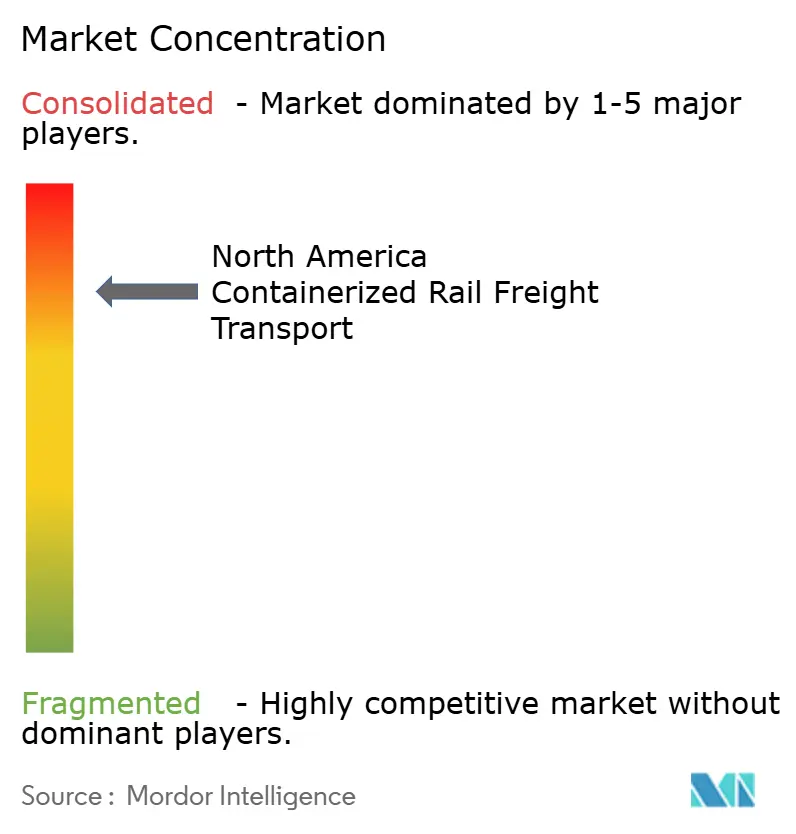
The North America containerized rail freight transport market is concentrated at the network-carrier level. Six Class I railroads control much of the physical rail infrastructure. The provider landscape is more fragmented among intermodal marketing companies and third-party logistics providers. This difference matters because railroads control network capacity while intermediaries shape customer access. The proposed Union Pacific and Norfolk Southern transaction remains an important source of competitive uncertainty. Its outcome could affect carrier relationships and service planning across long-haul routes.
Competition also centers on route design and operating consistency. CPKC and CSX upgraded the Southeast Mexico Express with a dedicated train in May 2026. The companies stated that the service reduced transit times on selected Southeast and Mexico lanes. Norfolk Southern’s East Edge service expanded double-stack connectivity between Chicago and New England in January 2026. These moves show how network improvements can change the available service options for shippers.
Technology and temperature-controlled operations are additional points of competition. CPKC reported year-over-year intermodal revenue growth in the second quarter of 2026. Refrigerated logistics requires specialized assets and robust operating procedures. That can favor providers with direct rail relationships and established cold-chain capabilities. The competitive field remains open for logistics companies that can combine cross-border services with transload and equipment management. The North America containerized rail freight transport market does not appear dominated by one operator across every part of the value chain.
North America Containerized Rail Freight Transport Industry Leaders
BNSF Railway Company
Union Pacific Railroad Company
Canadian National Railway Company
Canadian Pacific Kansas City Limited
CSX Transportation, Inc.
- *Disclaimer: Major Players sorted in no particular order

Recent Industry Developments
- August 2026: BNSF Railway and NFI Industries announced a strategic partnership at the planned Barstow International Gateway (BIG) in Southern California. The partnership combines BNSF's intermodal network with NFI's integrated supply chain expertise, transportation, warehousing, distribution, and transload to serve freight moving through the Ports of Los Angeles and Long Beach.
- May 2026: CPKC and CSX upgraded the Southeast Mexico Express with a dedicated intermodal train, cutting transit times by 20%-45%. Atlanta-Dallas takes 2 days, Monterrey-Atlanta takes 3 days, and central Mexico-Atlanta takes 4 days.
- November 2025: BNSF and CSX expanded their intermodal partnership to Midwest and Northeast CSX terminals, improving transit times by 22–52 hours on key lanes, including Los Angeles–Ohio Valley and Los Angeles–Northeast.
- August 2025: BNSF and CSX announced an initial intermodal interline service linking the United States Southwest and Southeast, capturing lanes previously handled by Norfolk Southern and converting over-the-highway loads.


North America Containerized Rail Freight Transport Market Report Scope
| 20-Foot Containers |
| 40-Foot Containers |
| Other Container Sizes |
| General Container |
| Refrigerated Containers |
| Domestic |
| Intenration / Cross-Border |
| Full Container Load (FCL) |
| Less-than-Container Load (LCL) |
| FMCG and Retail |
| Manufacturing and Automotive |
| Healthcare and Pharmaceuticals |
| Electronics and Electrical Equipment |
| Industrial Chemicals and Raw Materials |
| Others |
| Canada |
| Mexico |
| United States |
| Rest of North America |
| By Container Size | 20-Foot Containers |
| 40-Foot Containers | |
| Other Container Sizes | |
| By Container Type | General Container |
| Refrigerated Containers | |
| By Shipment Flow | Domestic |
| Intenration / Cross-Border | |
| By Shipment Type | Full Container Load (FCL) |
| Less-than-Container Load (LCL) | |
| By Cargo Type | FMCG and Retail |
| Manufacturing and Automotive | |
| Healthcare and Pharmaceuticals | |
| Electronics and Electrical Equipment | |
| Industrial Chemicals and Raw Materials | |
| Others | |
| By Country | Canada |
| Mexico | |
| United States | |
| Rest of North America |


Key Questions Answered in the Report
What is the forecast growth rate for North America's containerized rail freight transport?
The sector is forecast to grow at a 4.56% CAGR from 2026 to 2031, rising from USD 18.33 billion in 2025 to USD 24.01 billion by 2031. The outlook reflects manufacturing-linked cross-border demand, long-haul rail economics, and investment in routes that can handle double-stacked containers. Actual service adoption will depend on terminal performance, local drayage, equipment availability, and border reliability.
Which container format leads rail intermodal freight in North America?
40-foot containers led with 55.56% share in 2025 and are forecast to grow at a 6.55% CAGR through 2031. They fit the operating model used for international container flows and high-density double-stack rail services. Other formats remain relevant where cargo weight, domestic cubic capacity, or specialized shipment needs are more important than international standardization.
Why is Mexico important for containerized rail freight?
Mexico is forecast to grow at a 5.22% CAGR, supported by manufacturing locations and the United States-Mexico merchandise trade of USD 872.8 billion in 2025. Manufacturing clusters in Monterrey, Saltillo, Queretaro, and San Luis Potosi create demand for reliable connections with United States factories, distribution centers, and consumers. Border processes and the quality of terminal links will influence the pace of realized growth.
Which shipment flow is growing fastest through 2031?
International/cross-border freight is forecast to grow at an 8.25% CAGR, ahead of the domestic segment. Domestic shipments nevertheless represented 80.28% of the sector in 2025 and remain essential to network scale. Faster cross-border growth reflects the role of Mexican manufacturing, although customs coordination, interchange performance, and balanced equipment positions remain necessary for dependable service.
What is driving refrigerated rail container demand?
Pharmaceutical and perishable shipments need controlled-temperature transport, which supports a 7.57% forecast CAGR for refrigerated containers. This service requires more than a refrigerated container because terminal operations, power access, inspection practices, monitoring, and border procedures need to support cargo integrity. General containers remain much larger because they serve a wider set of dry freight movements.
What are the main operational barriers for intermodal rail freight?
Terminal congestion, longer drayage, chassis shortages, service reliability, and border processing can reduce transit consistency. These challenges can interact at high-volume gateways, where a delay at one part of the journey can affect terminal slots, local trucking, and equipment returns. Shippers therefore assess total delivery performance rather than comparing rail line-haul costs in isolation.
Page last updated on:





