
North America Built To Rent Residential Market Size and Share
Market Overview
| Study Period | 2020 - 2031 |
|---|---|
| Forecast Data Period | 2026 - 2031 |
| Base Year Market Size (2025) | USD 11.14 Billion |
| Market Size (2026) | USD 11.89 Billion |
| Market Size (2031) | USD 16.53 Billion |
| Growth Rate (2026 - 2031) | 6.81 % |
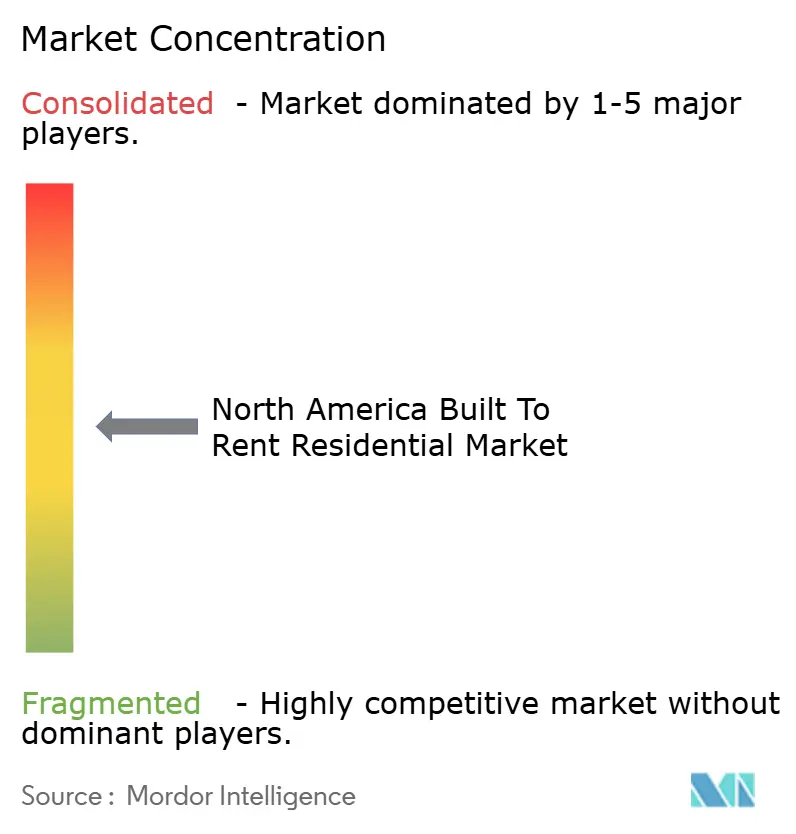
| Market Concentration | Medium |
Major Players *Disclaimer: Major Players sorted in no particular order Image © Mordor Intelligence. Reuse requires attribution under CC BY 4.0. | |
North America Built To Rent Residential Market Analysis by Mordor Intelligence
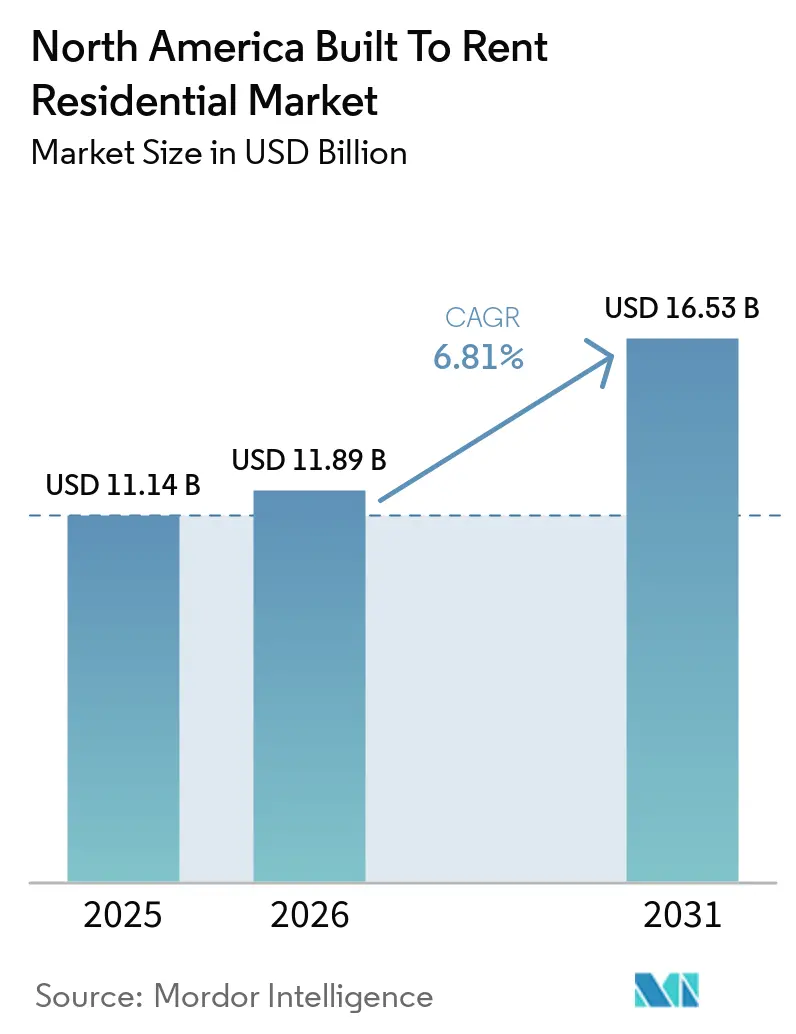
The North America Built To Rent Residential Market size is projected to be USD 11.14 billion in 2025, USD 11.89 billion in 2026, and reach USD 16.53 billion by 2031, growing at a CAGR of 6.81% from 2026 to 2031.
Renting a starter home remained less costly than buying across all 50 major United States metros in March 2026, with average monthly savings of USD 920, which keeps rental housing accessible for many households. Rental households supplied nearly 80% of the United States household growth in 2025, adding 898,000 net renter households and reaching 46.1 million. The North America built to rent residential market is adapting to a slower development cycle, as reduced construction activity should moderate the supply pressure that affected several Sun Belt locations. Large owners are adding development capacity, while smaller owners are using management partners and joint ventures to secure capital and operating support. Canada is expanding purpose-built rental supply through public financing, and Mexico is developing institutional rental investment structures, which broaden the regional opportunity.
Key Report Takeaways
- By type, multifamily built to rent held a 46.5% share of the North America built to rent residential market in 2025 and represented the largest segment, while single-family built to rent / built to rent communities recorded the highest projected CAGR of 8.4% through 2031.
- By management model, third-party operators accounted for 64.2% of the North America built to rent residential market share in 2025, representing the largest segment, while hybrid management is projected to record the fastest growth, with a CAGR of 8% through 2031.
- By price segment, mid-market accounted for a 47.9% share of the North America built to rent residential market in 2025 and represented the largest segment, while affordable & workforce housing recorded the highest projected CAGR of 8.5% through 2031.
- By geography, the United States accounted for 90.3% of the North America built to rent residential market size in 2025, representing the largest market, while Mexico is projected to record the fastest growth, with a CAGR of 9.2% through 2031.
Note: Market size and forecast figures in this report are generated using Mordor Intelligence’s proprietary estimation framework, updated with the latest available data and insights as of January 2026.
North America Built To Rent Residential Market Trends and Insights
Drivers Impact Analysis*
| Drivers | (~) % IMPACT ON CAGR FORECAST | Geographic Relevance | Impact Timeline |
|---|---|---|---|
| Housing Affordability Challenges Increase Rental Demand | +2.0% | North America-wide | Medium term (2-4 years) |
| Millennial and Gen Z Household Formation Expands Build-to-Rent Demand | +1.5% | The United States and Canada are primary, and Mexico is emerging | Long term (≥ 4 years) |
| Sun Belt Population and Employment Growth Accelerate Build-to-Rent Development | +1.2% | United States South and West core | Medium term (2-4 years) |
| Institutional Capital Expands Purpose-Built Rental Supply | +0.9% | The United States and Canada are primary, and Mexico is emerging | Medium term (2-4 years) |
| Baby Boomer Downsizing Supports Managed Rental Communities | +0.6% | United States and Canada | Long term (≥ 4 years) |
| Offsite Construction Improves Build-to-Rent Delivery Timelines | +0.4% | United States and Canada | Short term (≤ 2 years) |
| Source: Mordor Intelligence | |||
Housing Affordability Challenges Increase Rental Demand
Homeownership costs are extending the period during which households rent, which supports demand for professionally managed homes. Median monthly owner costs for mortgaged United States homeowners rose to USD 2,035 in 2024 from USD 1,960 in 2023, according to the United States Census Bureau[1]“The Cost of Homeownership Continues to Rise,” U.S. Census Bureau, census.gov.. The median age of first-time homebuyers reached 40 in 2025, while first-time buyers accounted for 21% of homebuyers, underscoring how difficult it has become for many renters to move into homeownership[2]“Highlights from the Profile of Home Buyers and Sellers,” National Association of Realtors, nar. realtor.. In the North America built to rent residential market, this pattern can lengthen occupancy because households that were once expected to buy within several years remain renters. Among renters surveyed in 2025 who intended to move within a year, 59% planned to keep renting. Owners who offer well-located homes and predictable resident services can therefore address demand that is based on affordability as well as convenience.
Millennial and Gen Z Household Formation Expands Built to Rent Demand
Delayed household formation leaves a large group of younger adults who may enter the rental market as their finances improve. An estimated 1.82 million millennial and Generation Z households were missing in 2025, based on historical household formation rates for adults aged 18 to 44. The income needed to purchase a median-priced United States starter home was USD 86,000 in 2025, placing ownership beyond the reach of many people in their 20s and early 30s. Headship among adults aged 25 to 34 fell to 43.7% in 2024, which indicates that this delay has continued beyond the immediate pandemic period[3]“Is the Decline in Young Adult-Led Households a Cyclical Slip or the New Normal?” National Association of Home Builders, nahb.org.. The North America built to rent residential market can serve these households through flexible leases, managed maintenance, and locations near employment centers. This demand is not limited to renters who cannot buy, since managed communities also appeal to younger residents who value flexibility and less responsibility for home upkeep.
Sun Belt Population and Employment Growth Accelerate Built to Rent Development
The United States South and West remain central to construction activity, although performance now differs sharply by metro area. The South had more than 37,400 built to rent units under construction in May 2026, accounting for 61% of the national pipeline. Phoenix had 7,300 units under construction, Dallas 3,700, Atlanta 3,500, Houston 3,000, and Charlotte 2,900. Austin and Phoenix experienced rent declines in the first quarter of 2026. In contrast, Louisville and New Orleans recorded rent gains, showing the effect of local supply rather than a uniform regional outcome. Active construction fell 58% year over year in Austin and 38% in Charlotte, which shows that capital is becoming more selective. Developers in the North America built to rent residential market are likely to favor locations where demand, construction timing, and available supply are better aligned.
Institutional Capital Expands Purpose-Built Rental Supply
Institutional investors are providing more capital for purpose-built rental communities across North America as build to rent becomes a recognized residential asset class. Large pension investors are increasingly using long-term partnerships with developers and operators to secure stable rental income and scale development pipelines. CPP Investments expanded its U.S. single-family build to rent joint venture with Greystar to USD 1.4 billion in August 2025, including USD 632 million in new equity. CPP Investments held a 95% equity interest, while Greystar managed development, daily operations, and property management. This structure combines institutional capital with specialist development and operating capabilities. It also shows why long-term investment partnerships are becoming an important source of funding for new rental homes.
Restraints Impact Analysis*
| Restraints | (~) % IMPACT ON CAGR FORECAST | Geographic Relevance | Impact Timeline |
|---|---|---|---|
| Higher Financing Costs Reduce Project Feasibility | -1.5% | North America-wide | Medium term (2-4 years) |
| Oversupply in Selected Markets Pressures Occupancy and Rental Growth | -0.8% | U.S. Sun Belt core | Short term (≤ 2 years) |
| Local Zoning and Entitlement Challenges Delay Low-Rise Rental Projects | -0.5% | U.S. suburban markets | Long term (≥ 4 years) |
| Policy Restrictions on Institutional Ownership Increase Investment Uncertainty | -0.4% | United States national | Short term (≤ 2 years) |
| Source: Mordor Intelligence | |||
Higher Financing Costs Reduce Project Feasibility
Higher debt costs have constrained the number of projects that can move from planning into construction. Senior construction lending has shifted from a maximum loan-to-cost ratio of 85% to 70%-75%, requiring developers to raise more costly equity or subordinated capital. Single-family built-for-rent starts totaled 62,000 in the four quarters ending in the first quarter of 2026, down 26% from 84,000 in the preceding four-quarter period. Better-capitalized operators can continue development when smaller developers pause projects. AMH allocated USD 550 million in disposition proceeds to fund 1,400 new wholly owned development homes in 2026. The North America built to rent residential market may therefore see a larger role for owners with established lender relationships and recycled capital.
Oversupply in Selected Markets Pressures Occupancy and Rental Growth
High delivery volumes in a limited group of Sun Belt submarkets have reduced occupancy and increased the use of leasing concessions. National built to rent occupancy declined to 91.9% in the first quarter of 2026 from 94.2% in early 2023. Average effective rents eased to USD 2,207 from a 2025 peak of USD 2,227. Austin and Phoenix experienced significant pipeline reductions, but projects already underway will continue to enter the market before the effect of lower starts becomes fully visible. Operators with exposure to San Antonio, Austin, Dallas-Fort Worth, and Phoenix must manage near-term rent pressure while new deliveries slow. The North America built to rent residential market may find steadier demand at Mid-Market and affordable price points, where renters have fewer alternatives.
*Our forecasts treat driver/restraint impacts as directional, not additive. The impact forecasts reflect baseline growth, mix effects, and variable interactions.
Segment Analysis
By Type: Multifamily Built to Rent Leads Market Share, While Single-Family Built to Rent / Built to Rent Communities Grows Faster
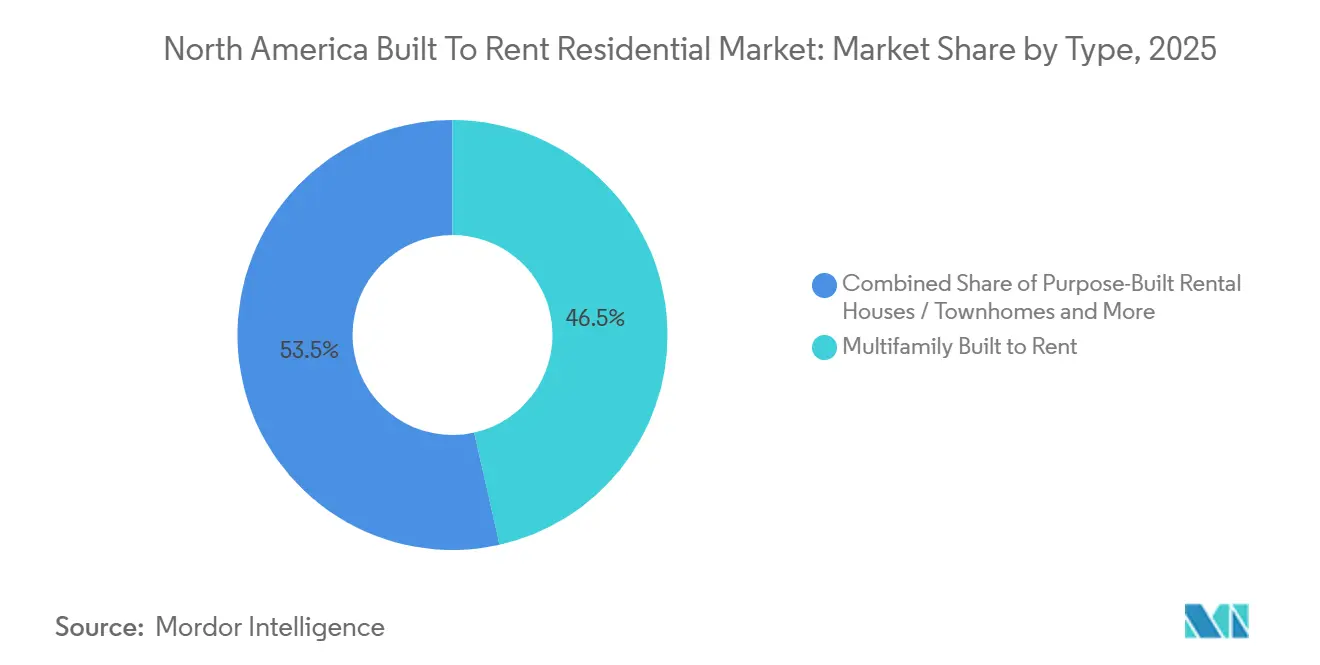
Multifamily built to rent held 46.5% of the North America built to rent residential market share in 2025, reflecting its ability to support larger portfolios and lower per-unit land costs. Purpose-built rental apartments serve higher-density urban residents, while purpose-built rental houses / townhomes provide more privacy and outdoor space in suburban settings. Single-family built to rent / built to rent communities are projected to grow at an 8.4% CAGR through 2031. This growth reflects continued household demand for detached homes, private yards, and shared community features. The North America built to rent residential market size for these homes is supported by households that seek the space of ownership but cannot purchase.
Operators are matching product design with local land costs and resident needs. Apartments can offer higher density in areas where land is scarce, while horizontal communities can serve families and households seeking more space. Offsite and modular construction can shorten multifamily timelines by 30% to 60% compared with traditional methods. Tricon Residential opened its Winchester community in Riverside County, California, with support from a USD 92 million investment from Blackstone Real Estate, demonstrating that purpose-built rental houses / townhomes can extend beyond traditional Sun Belt locations.



By Management Model: Third-Party Operators Lead Market Share, While Hybrid Management Grows Faster
Third-party operators held 64.2% of the North America built to rent residential market share in 2025, demonstrating the importance of specialized operating platforms. These operators can spread leasing, maintenance, resident technology, and compliance costs across several communities. They also provide an option for owners who do not have their own local property-management teams. Hybrid management is forecast to grow at an 8% CAGR through 2031, as owners combine internal portfolio oversight with third-party community management. This approach allows owners to retain decision-making control while leveraging specialist property management skills. AMH delivered 542 newly constructed homes to its wholly owned operating portfolio in the second quarter of 2026 and reported same-home Core Net Operating Income growth of 3.7% for the quarter.
Hybrid structures suit mid-sized owners that seek institutional operating practices without building a full internal platform. Forward-purchase agreements and construction lending arrangements require clear reporting, which can favor closer owner involvement. The National Multifamily Housing Council's 2025 Top Owners list shows a wide gap between the largest owners with proprietary systems and managers that serve diverse client portfolios. As technology and reporting requirements become more costly, smaller firms may need management partnerships to remain competitive.
By Price Segment: Affordable & Workforce Housing Gains Support
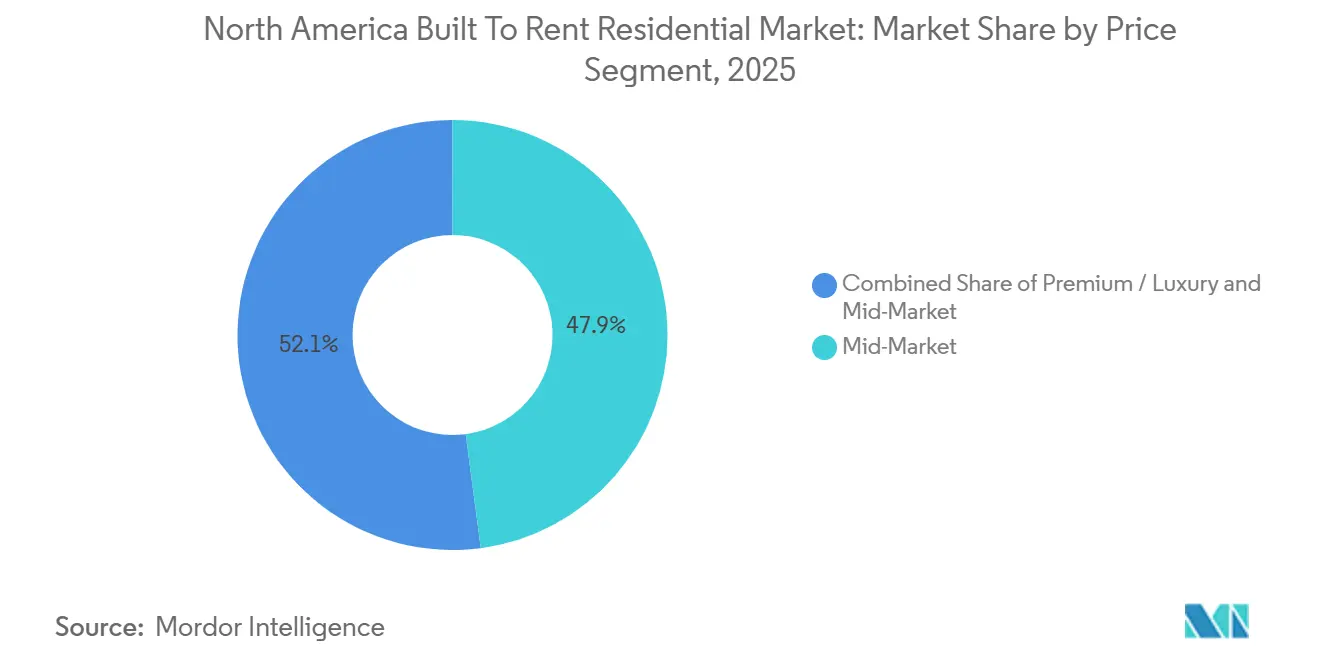
Mid-market held 47.9% of the North America built to rent residential market size in 2025, because it serves the largest group of income-stable renters who cannot meet home purchase costs. This category includes households that can afford well-located, professionally managed homes but face barriers to down payments and mortgage payments. Premium / luxury properties serve high-income mobile renters and some downsizing households. Affordable & workforce housing is projected to grow at an 8.5% CAGR through 2031. Its expansion reflects demand from households with limited options in many local housing markets. The North America built to rent residential market is gaining a broader demand base than one focused solely on higher-income renters.
The United States housing supply gap reached 4.03 million homes in 2025, with the shortage most acute at accessible price points. The 1.82 million younger households whose formation was delayed by affordability constraints form a large potential renter base for this segment. In Mexico, Infonavit, the National Workers' Housing Fund Institute, and Sociedad Hipotecaria Federal, the Federal Mortgage Society, are considering regulated institutional rental financing to support an accessible housing supply in secondary cities. Affordable and workforce homes may face less concession pressure than luxury homes during periods of high supply because their tenant base has fewer substitutes.
Geography Analysis
The United States accounted for 90.3% of the North America built to rent residential market share in 2025 and remains the region's main base for institutional development and operations. The United States housing supply deficit reached 4.03 million homes in 2025, including 1.62 million units in the South. Built to rent transaction volume exceeded USD 500 million in the first quarter of 2026, including transactions on Long Island, in suburban Chicago, and in Charlotte. Built to rent's share of new United States single-family construction was 3 times the historical average of 2.3% observed from 1992 to 2012.
Canada is the region's second-largest location for purpose-built rental investment and construction within the North America built to rent residential market. Rental unit starts were projected to reach 106,000 in 2025, the first year in which more purpose-built rental homes were under construction than condominiums or single-family homes. The Canada Mortgage and Housing Corporation's Apartment Construction Loan Program had committed USD 18.2 billion to more than 63,500 rental homes by mid-2025, and its lending capacity exceeded USD 40.1 billion, using the conversion basis provided in the input. In August 2026, the Government of Canada and the City of Toronto committed USD 2.7 billion to deliver more than 5,600 rental homes.
Mexico is the region's fastest-growing country segment, with the North America built to rent residential market size in Mexico forecast to expand at a 9.2% CAGR through 2031. Rental homes accounted for 16.4% of Mexico's housing stock, and fewer than 5% were institutionally managed in 2026. Housing prices increased by 8.5% annually from 2015 to 2025, pushing younger urban households toward renting. One in 4 homes in Mexico City was rented, representing 675,000 homes under formal contracts. Fibra Park Life became Mexico's first real estate investment trust focused on rental housing when it debuted in March 2026, raising USD 13.1 million and targeting a USD 488 million portfolio by 2028. Institutional vehicles can channel capital to a rental sector that remains less institutionalized than the United States market.
Competitive Landscape
Competition in the North America built to rent residential market is moderately consolidated among large institutional platforms and fragmented among smaller owners and developers. Large real estate investment trusts, homebuilder-linked brands, and global investment managers hold an important share of new development capacity. Invitation Homes acquired ResiBuilt Homes in January 2026 for USD 89 million, with up to USD 7.5 million in earn-out payments, adding in-house general contracting capability and options on 1,500 lots. AMH has focused on its internal development program rather than on broad-market acquisitions, as evidenced by the 542 homes it delivered in the second quarter of 2026. These strategies give the largest operators greater control over delivery schedules, construction standards, and the flow of homes into their portfolios.
Programmatic joint ventures are helping operators combine land, construction, and long-term capital. Greystar and CPP Investments expanded their U.S. single-family build-for-rent joint venture to USD 1.4 billion in August 2025, including USD 632 million in new equity. CPP Investments held a 95% equity interest, while Greystar managed development, operations, and property management. Taylor Morrison and Kennedy Lewis Investment Management agreed to a USD 3 billion land and construction financing facility for the Yardly build to rent brand in July 2025. These arrangements can give homebuilder-linked and institutional platforms more flexibility to acquire land, build homes, and decide when to sell or retain assets.
Technology, construction access, and local market knowledge are shaping competitive outcomes in the North America built to rent residential market. Larger owners use digital leasing, pricing systems, and smart-home features. At the same time, homebuilders such as Lennar and Taylor Morrison can pair land entitlement expertise with construction capacity. Smaller operators face pressure when they cannot match these levels of access to capital or operating scale. The 21st Century Road to Housing Act, enacted in July 2026, exempted qualifying build to rent programs from restrictions on institutional purchases of existing single-family homes, giving new-construction platforms clearer legal treatment.
North America Built To Rent Residential Industry Leaders
Invitation Homes Inc.
AMH
Progress Residential
FirstKey Homes
Tricon Residential Inc.
- *Disclaimer: Major Players sorted in no particular order

Recent Industry Developments
- February 2026: Fibra Park Life debuted on the Bolsa Mexicana de Valores, the Mexican Stock Exchange, as Mexico's first real estate investment trust focused on institutionally managed rental housing. It raised USD 13.1 million through an initial public offering and targeted a USD 488 million portfolio by 2028.
- January 2026: Invitation Homes Inc. acquired ResiBuilt Homes, LLC, a Southeast United States build to rent developer that had delivered more than 4,200 homes across Georgia, Florida, and the Carolinas since 2018. The USD 89 million transaction included up to USD 7.5 million in earn-out payments and added in-house general contracting capability and options on 1,500 lots.
- January 2026: Mill Creek Residential broke ground on Amavi Thornton, its first single-family build to rent community in Colorado, expanding the Amavi brand into the northern Denver metropolitan area.


North America Built To Rent Residential Market Report Scope
| Multifamily Built to Rent |
| Single-Family Built to Rent / Built to Rent Communities |
| Purpose-Built Rental Apartments |
| Purpose-Built Rental Houses / Townhomes |
| In-House Operator |
| Third-Party Operator |
| Hybrid Management |
| Premium / Luxury |
| Mid-Market |
| Affordable & Workforce Housing |
| United States |
| Canada |
| Mexico |
| By Type | Multifamily Built to Rent |
| Single-Family Built to Rent / Built to Rent Communities | |
| Purpose-Built Rental Apartments | |
| Purpose-Built Rental Houses / Townhomes | |
| By Management Model | In-House Operator |
| Third-Party Operator | |
| Hybrid Management | |
| By Price Segment | Premium / Luxury |
| Mid-Market | |
| Affordable & Workforce Housing | |
| By Country | United States |
| Canada | |
| Mexico |


Key Questions Answered in the Report
What is the value of the North America built to rent residential market?
The North America built to rent residential market size is estimated at USD 11.89 billion in 2026 and is forecast to reach USD 16.53 billion by 2031, growing at a 6.81% CAGR.
Which type leads built to rent housing in North America?
Multifamily built to rent led with a 46.5% share in 2025. Single-family built to rent / built to rent communities are projected to grow the fastest, at an 8.4% CAGR through 2031.
Why are more households choosing built to rent homes?
High homeownership costs, delayed household formation, and demand for managed homes are key factors. Renting a starter home saved households USD 920 per month on average across 50 major United States metros in March 2026.
Which country has the fastest built to rent growth in North America?
Mexico is forecast to grow fastest at a 9.2% CAGR through 2031, supported by low institutional ownership of rental homes and new investment vehicles.
What is the leading management model for built to rent communities?
Third-party operators held 64.2% share in 2025. Hybrid management is forecast to grow the fastest, at an 8% CAGR, because it combines owner oversight with specialist operating support.
How are higher financing costs affecting development?
Single-family built-for-rent starts fell 26% to 62,000 units in the four quarters ending in the first quarter of 2026, as developers faced tighter lending conditions.
Page last updated on:





