
North America Baseband Unit Market Size and Share
Market Overview
| Study Period | 2020 - 2031 |
|---|---|
| Forecast Data Period | 2026 - 2031 |
| Base Year Market Size (2025) | USD 5.49 Billion |
| Market Size (2026) | USD 6.01 Billion |
| Market Size (2031) | USD 10.71 Billion |
| Growth Rate (2026 - 2031) | 12.25 % |
| Market Concentration | Medium |
Major Players *Disclaimer: Major Players sorted in no particular order Image © Mordor Intelligence. Reuse requires attribution under CC BY 4.0. | |
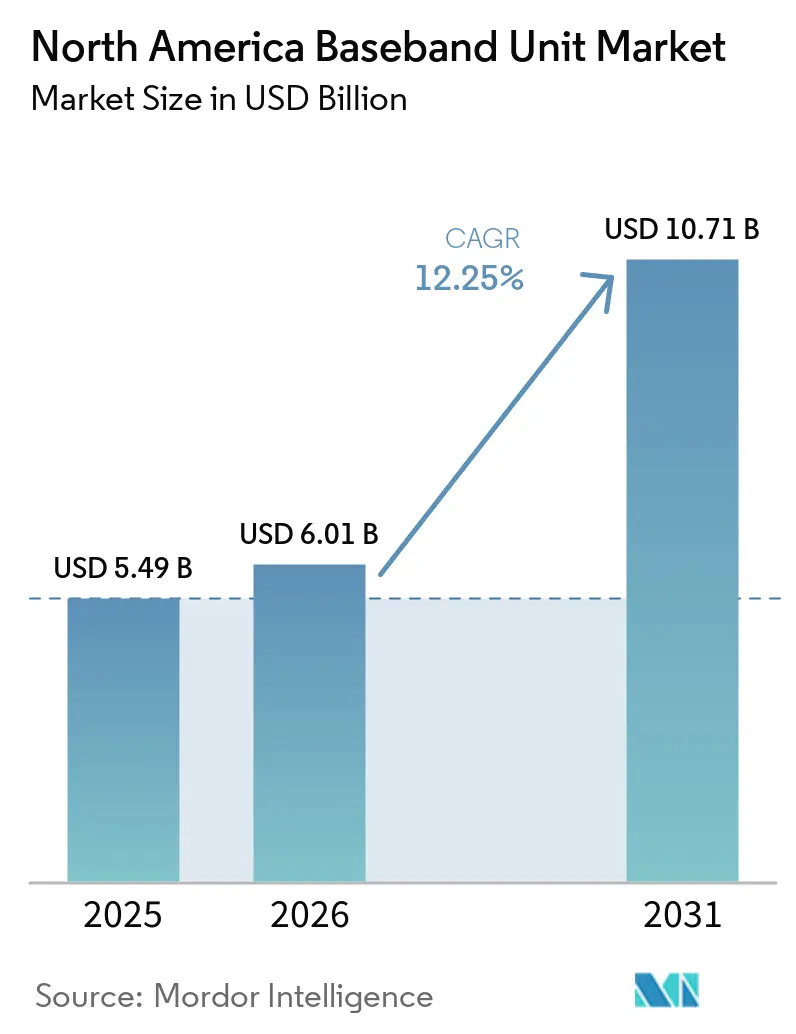
North America Baseband Unit Market Analysis by Mordor Intelligence
The North America Baseband Unit Market size was valued at USD 5.49 billion in 2025 and is estimated to expand from USD 6.01 billion in 2026 to reach USD 10.71 billion by 2031, at a CAGR of 12.25% during the forecast period 2026-2031. Standalone 5G rollouts are increasing demand for baseband equipment capable of supporting software upgrades and more complex network functions. Operators are also moving toward virtualized and cloud-native radio access networks, which increases the importance of software, integration, and managed support. Private industrial networks are creating a separate buyer base beyond major mobile carriers, particularly where reliable low-latency connectivity supports automation and edge computing. The competitive field remains centered on Ericsson, Nokia, and Samsung because Chinese suppliers face restrictions in the United States and Canada. This structure favors established suppliers, while Open RAN standards create openings for software and computing providers.
Key Report Takeaways
- By component, hardware accounted for 47.77% of revenue in 2025, while software is projected to expand at a 14.11% CAGR through 2031 in the North America Baseband Unit Market.
- By MIMO configuration, Massive MIMO accounted for 46.14% of the North America Baseband Unit Market share in 2025, while Massive Antenna Element is projected to expand at a 13.56% CAGR through 2031.
- By deployment, outdoor deployment accounted for 49.22% revenue share in 2025, while indoor deployment is projected to expand at a 14.32% CAGR through 2031.
- By network architecture, the standalone architecture held a 38.99% revenue share in 2025, while the non-standalone architecture is projected to expand at a 13.87% CAGR through 2031.
- By end user, telecom operators held 31.38% revenue share in 2025, while enterprises and private networks are projected to expand at a 13.99% CAGR through 2031 in the North America Baseband Unit Market.
- By geography, the United States held 56.77% revenue share in 2025, while Canada is projected to expand at a 14.55% CAGR through 2031.
Note: Market size and forecast figures in this report are generated using Mordor Intelligence’s proprietary estimation framework, updated with the latest available data and insights as of January 2026.
North America Baseband Unit Market Trends and Insights
Drivers Impact Analysis*
| DRIVER | (~) % IMPACT ON CAGR FORECAST | GEOGRAPHIC RELEVANCE | IMPACT TIMELINE |
|---|---|---|---|
| 5G Standalone Network Expansion | +3.0% | The United States and Canada are primary, and Mexico is emerging | Medium term (2-4 years) |
| Network Capacity and Low-Latency Demand | +2.5% | North America, with the highest intensity in the United States | Long term (≥ 4 years) |
| Private 5G and Industrial Network Growth | +1.8% | United States, Canada | Medium term (2-4 years) |
| Open RAN and Virtualized RAN Adoption | +1.5% | United States, Canada | Long term (≥ 4 years) |
| AI-Enabled Radio Resource Optimization | +0.8% | United States, Canada | Long term (≥ 4 years) |
| Edge Computing and Cloud-Native RAN Deployment | +0.6% | United States, Canada | Long term (≥ 4 years) |
| Source: Mordor Intelligence | |||
5G Standalone Network Expansion
Standalone 5G deployment is a central driver of demand for the North America Baseband Unit Market. These networks need baseband systems that can be updated through software and support functions unavailable in non-standalone configurations. AT&T had entered nationwide commercial deployment of standalone 5G and was moving subscribers to an architecture based on open, virtualized infrastructure.[1]AT&T, “AT&T 5G Standalone Nationwide,” 5G Americas, 5gamericas.org, 5gamericas.org This architecture allows operators to offer network slicing for latency-sensitive business uses without building separate physical networks. The Federal Communications Commission adopted rules in July 2026 to auction 160 MHz of Upper C-band spectrum by July 2027, supporting a later equipment cycle as licensees prepare for new capacity.[2]Federal Communications Commission, “Upper C-Band 3.98-4.2 GHz, Expanding Flexible Use of the 3.7 to 4.2 GHz Band,” Federal Register, federalregister.gov VTel Wireless selected Ericsson in March 2026 for a Vermont standalone 5G core and RAN deployment, indicating that the shift is also reaching regional and rural carriers.
Rising Demand for Network Capacity and Lower Latency
Traffic on 5G networks is increasing the need for baseband units with higher processing capacity. Augmented reality, industrial IoT, and fixed wireless access require sustained throughput and lower latency. Nokia extended its agreement with T-Mobile US in April 2025 to supply AirScale RAN equipment, including the Levante Ultra-Performance baseband products that use ReefShark system-on-chip technology.[3]Nokia Corporation, “Nokia Lands Strategic 5G RAN Deal with T-Mobile US to Enhance Nationwide Connectivity,” Nokia, nokia.com Baseband platforms are also being designed to handle computing workloads at the network edge alongside radio processing. Ericsson reported in 2026 that T-Mobile US was conducting field trials of an AI-native scheduler and that AT&T was deploying AI-native software on Cloud RAN infrastructure. Greater capacity produces more network data, which strengthens the case for further automated optimization.
Growth of Private 5G and Industrial Networks
Private 5G systems are giving the North America Baseband Unit Market an enterprise demand channel that does not depend on public-network replacement schedules. In February 2026, Cargill completed an NTT DATA private 5G deployment across 50 manufacturing and processing facilities globally, with most sites in the United States. The deployment supported robotics, automation, edge AI, and connected workforce applications. The United States' CBRS 3.5 GHz band provides enterprises with access to spectrum for private networks without purchasing auctioned licenses. This lowers entry barriers for manufacturers, logistics operators, and port authorities that need dedicated wireless coverage. TERAGO and Ericsson launched a private 5G network at McMaster Manufacturing Research Institute in May 2026 using Canadian industry spectrum.[4]TERAGO Inc., “TERAGO and Ericsson Launch Enterprise Private 5G Network at McMaster Manufacturing Research Institute,” TERAGO, terago.ca
Open RAN and Virtualized RAN Adoption
Open RAN and virtualized RAN are changing baseband procurement from closed equipment systems to more disaggregated software-defined architectures. AT&T's multi-year agreement with Ericsson includes Open RAN implementation and Cloud RAN architecture using Dell servers and Intel processors. Samsung supported 53,000 virtualized RAN sites globally at the end of 2025, with Verizon accounting for a meaningful share of that installed base. Established equipment suppliers now compete on software portability, energy use, and compatibility with general-purpose processors. Open interface standards lower the cost of changing suppliers over time. This gives software specialists and AI computing companies a route into value previously held by radio equipment vendors.
Restraints Impact Analysis*
| RESTRAINT | (~) % IMPACT ON CAGR FORECAST | GEOGRAPHIC RELEVANCE | IMPACT TIMELINE |
|---|---|---|---|
| Power Consumption and Thermal Management Requirements | -0.8% | North America | Long term (≥ 4 years) |
| Semiconductor Supply Concentration and Component Lead-Time Risk | -0.7% | North America, most acute for United States-based vendors | Short term (≤ 2 years) |
| Brownfield Integration Complexity | -0.5% | United States and Canada | Medium term (2-4 years) |
| Geopolitical Vendor Restrictions and Supply-Chain Fragmentation | -1.0% | United States, Canada, Mexico | Long term (≥ 4 years) |
| Source: Mordor Intelligence | |||
High Power Consumption and Thermal Management Requirements
A 5G baseband unit draws 2,000 watts, compared with 500 watts for a comparable 4G unit HUAWEI.COM. The difference becomes more significant when a site also uses 64T64R active antenna units that draw 1,000 to 1,400 watts each. Thermal control is therefore an operating concern across outdoor networks in varied North American climates. Research published in 2025 found that a 10°C rise in chip operating temperature increased equipment failure rates by 25%, increased bit error rates by 15%, and shortened hardware life by more than 30%. Research presented at USENIX NSDI 2025 showed that traffic prediction and power-state optimization can reduce the power consumption of virtualized RAN servers by more than 40%. Suppliers that integrate credible power management tools can therefore compete on operating cost as well as radio performance.
Semiconductor Supply Concentration and Component Lead-Time Risk
Baseband equipment depends on custom signal-processing ASICs, high-bandwidth DRAM, and advanced RF components. These components are primarily sourced from a limited group of Asian foundries operating at high utilization rates. Qualification of replacement parts can take 12 to 24 months because the equipment also requires operator interoperability testing. AI infrastructure expansion has increased demand for advanced memory and has added costs for RAN computing hardware. Vendors producing proprietary silicon have fewer alternatives when supply conditions tighten. Higher prices for critical board components add another layer of pressure to baseband manufacturing costs.
*Our forecasts treat driver/restraint impacts as directional, not additive. The impact forecasts reflect baseline growth, mix effects, and variable interactions.
Segment Analysis
By Component: Software Gains Ground Alongside Hardware Demand
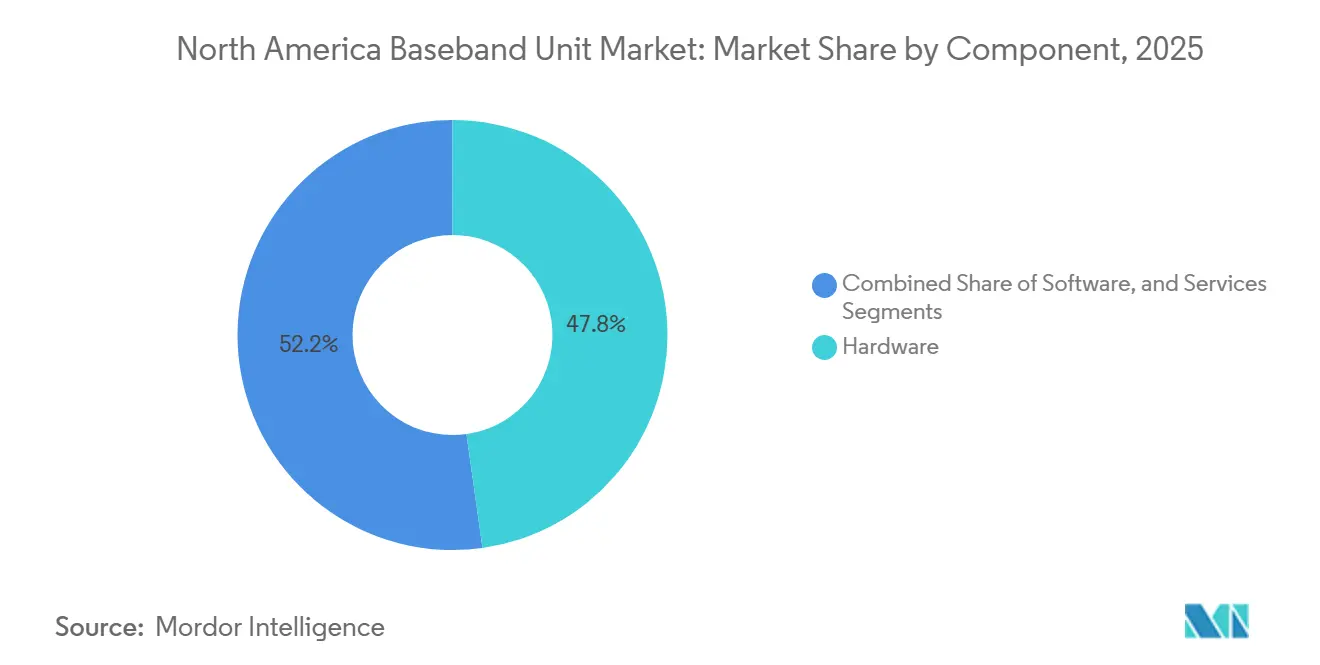
Hardware is projected to account for 47.77% of the North America Baseband Unit Market's regional revenue in 2025, making it the largest component category. This share reflects the replacement of 4G equipment with 5G-capable baseband and radio systems under multiyear carrier agreements. Nokia's 2025 contract with T-Mobile US is expected to include hardware, software, maintenance, and support. Levante ultra-performance baseband cards and Habrok Massive MIMO radios are expected to form an important part of the delivery scope. Hardware remains essential to the modernization of the North America Baseband Unit Market, even as the sources of value broaden. It also provides the installed base for software and service sales.
Software is projected to expand at a 14.11% CAGR from 2026 to 2031. Providers increasingly deliver cloud-native RAN platforms and AI-based network management tools through subscription licenses. This trend shifts a portion of baseband spending from one-time equipment purchases to recurring revenue. Services remain the smallest component category; however, managed service contracts are expanding as operators seek lifecycle support. Open RAN software can run on general-purpose x86 equipment, placing additional pressure on hardware margins. Consequently, the North America Baseband Unit Market is placing greater emphasis on software integration, energy management, and ongoing support.



By MIMO Configuration: Massive MIMO Supports Capacity Requirements
Massive MIMO is projected to account for 46.14% of the North America Baseband Unit Market by revenue in 2025. The segment benefits from mid-band 5G deployments that use 64-transmit, 64-receive antenna configurations. These systems improve spectral efficiency and support the traffic requirements of dense mobile networks. The Massive MIMO segment is projected to expand at a 13.56% CAGR from 2026 to 2031. Higher-order arrays support multi-user beamforming, carrier aggregation, and coordinated multipoint transmission. Their deployment increases the processing capacity required in each baseband unit.
GPU-accelerated distributed units demonstrate how software-defined Massive MIMO can operate on general-purpose computing equipment. These systems can deliver up to three times the spectral efficiency of conventional four-layer configurations. Non-Massive MIMO remains relevant for rural coverage in the United States, suburban networks in Canada, and initial small-cell deployments in Mexico. These applications prioritize lower site costs and simpler deployment. AmpliTech is expected to complete validation of a commercial-grade 64T64R CAT-B Massive MIMO radio at the O-RAN Global PlugFest in December 2025. Open fronthaul certification is becoming an important requirement for vendors pursuing larger Massive MIMO deployments.
By Deployment: Outdoor Networks Lead, While Indoor Sites Expand
Outdoor deployment is projected to account for 49.22% of regional revenue in 2025. Outdoor macro sites provide the coverage layer that supports standalone 5G networks. Carrier modernization programs are driving a significant share of outdoor procurement. AT&T's transition from Nokia to Ericsson equipment is expected to be 80% complete by mid-2026. The initiative covers the Northeast and western United States and supports a transition toward Open RAN architecture. Bell Canada is expected to activate advanced 5G+ outdoor macro coverage in Greater Toronto and Hamilton in March 2026, supporting the North America Baseband Unit Market.
Indoor deployment is projected to expand at a 14.32% CAGR from 2026 to 2031. Manufacturing plants, logistics warehouses, stadiums, and enterprise campuses require localized coverage and low latency. TERAGO and Ericsson are expected to deploy a private 5G network at the McMaster Manufacturing Research Institute in May 2026. These sites use specialized baseband designs that support low-latency fronthaul and edge computing integration. Distributed architectures centralize processing while remote radios provide coverage across the facility floor. Hybrid, aerial, and non-terrestrial configurations remain early-stage applications within the North America Baseband Unit Market.
By Network Architecture: Transition Demand Sustains Both Approaches
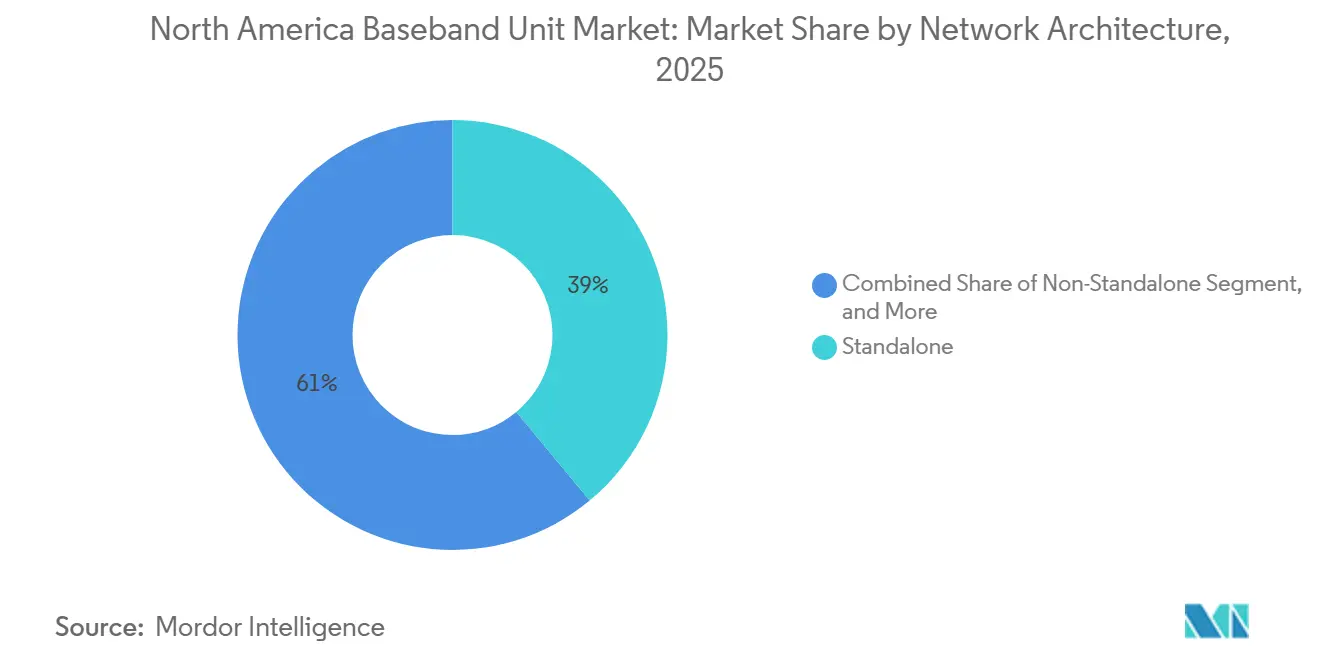
Standalone architecture is projected to account for 38.99% of the North America Baseband Unit Market in 2025. The United States and Canada have identified standalone 5G as their long-term network path. AT&T's nationwide standalone deployment provides a visible example of this commitment. Standalone systems use a full 5G core and can enable capabilities such as network slicing and native Voice over New Radio. They also require baseband equipment that supports more advanced software functions, sustaining investment in upgradeable platforms.
Non-standalone architecture is projected to expand at a 13.87% CAGR from 2026 to 2031. This growth reflects demand from operators and countries that are still transitioning from 4G to full standalone networks. AT&T Mexico is expected to activate a 5G non-standalone network at Estadio Akron in Guadalajara in June 2026, using 100 MHz of combined 2.5 GHz and 3.5 GHz spectrum. Telcel's 5G network is expected to cover 60% of Mexico's population by the end of 2025 and remain primarily non-standalone. Non-standalone units process 4G and 5G traffic over shared spectrum, increasing per-unit processing requirements. Other configurations include legacy LTE and mixed-generation installations used in coverage-extension areas.
By End User: Carrier Procurement Remains Largest, Enterprise Demand Widens
Telecom operators are projected to account for 31.38% of regional revenue in 2025. Large carriers in the United States and Canada remain the primary purchasers of baseband equipment. Their multiyear RAN modernization programs represent the largest procurement channel. These programs combine the replacement of existing equipment with the deployment of more advanced 5G network capabilities. Carrier requirements also shape product road maps for energy efficiency and Open RAN compliance. Their purchasing power keeps supplier relationships concentrated among a limited number of vendors.
Enterprises and private networks are projected to expand at a 13.99% CAGR through 2031. Industrial digitalization and CBRS-enabled private network deployments are supporting demand from logistics, manufacturing, and defense users. Cargill's deployment across 50 facilities demonstrates the scale of private 5G applications for robotics, edge AI, and connected workforces. Government and defense buyers place greater emphasis on supply chain provenance and trusted suppliers. Managed service providers are also gaining relevance as organizations outsource complex baseband lifecycle management. These buyer groups reduce the North America Baseband Unit Market's dependence on the largest mobile operators.
Geography Analysis
The United States accounted for 56.77% of regional revenue in 2025. AT&T, Verizon, and T-Mobile US are implementing parallel modernization programs that support substantial baseband procurement volumes. AT&T's agreement with Ericsson includes Open RAN and cloud RAN deployments. Verizon continues to expand its RAN infrastructure with Ericsson and Samsung, while T-Mobile US has extended supply agreements with Nokia and Ericsson for new baseband and radio equipment. The Federal Communications Commission's Upper C-band rules are expected to create future procurement opportunities as licensees prepare to launch services.
Canada is projected to grow at a CAGR of 14.55% from 2026 to 2031. In March 2026, Bell launched advanced 5G+ services using a standalone core across the Greater Toronto and Hamilton Area. The network offers theoretical peak speeds of up to 4.3 Gbit/s. In February 2026, TELUS acquired 3800 MHz licenses in British Columbia and Alberta for CAD 317.6 million (USD 231.8 million). Rogers activated 40 new 5G towers across 14 eastern Ontario communities between November 2025 and May 2026. Broader roaming regulations may also encourage regional carriers to invest in their own network infrastructure.
Mexico plays a smaller but relevant role in the North America baseband unit market. Telcel reported that its 5G coverage reached 60% of Mexico's population by the end of 2025. The company built its footprint primarily on non-standalone architecture. In June 2026, AT&T Mexico used 100 MHz of combined spectrum for a non-standalone deployment at Estadio Akron. Planned spectrum auctions in 2026 will influence the scale and timing of subsequent procurement. Until spectrum costs and standalone core investment plans become clearer, non-standalone network densification and premium venues will remain the primary near-term sources of demand.
Competitive Landscape
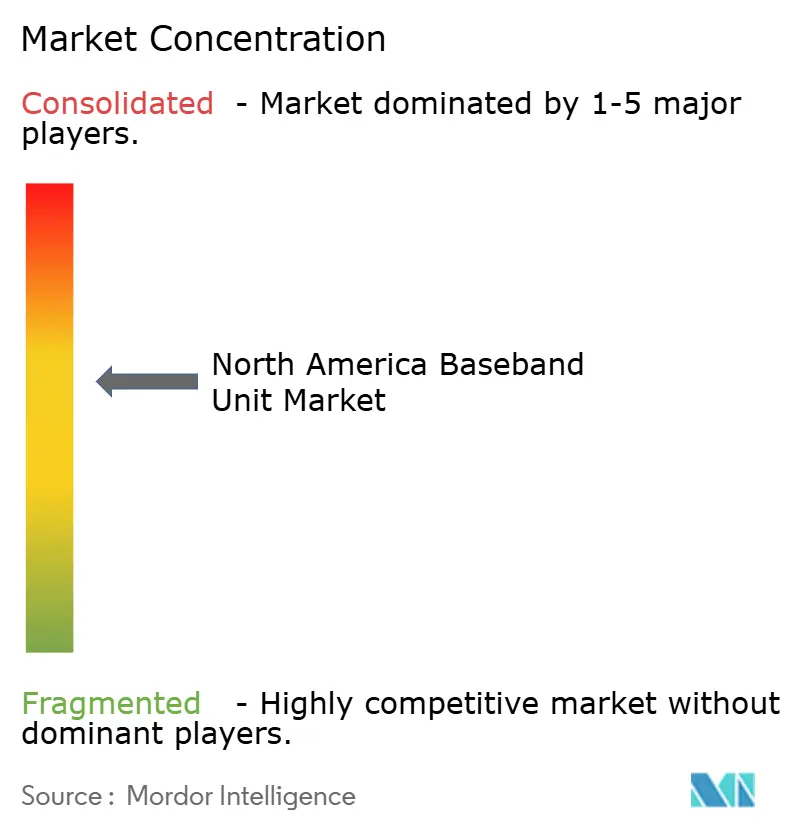
The North America baseband unit market is moderately concentrated, with Ericsson, Nokia, and Samsung as the leading suppliers. Their multiyear agreements with carriers give them a strong position in procurement across the United States and Canada. Ericsson serves as a primary baseband supplier to all three largest mobile operators in the United States. Nokia incorporates its ReefShark system-on-chip into its Habrok Massive MIMO and Levante baseband products. In April 2025, the company extended its 5G RAN agreement with T-Mobile US. Samsung's virtualized RAN footprint and baseband patents further strengthen its competitive position.
Suppliers increasingly compete through integrated silicon, energy efficiency, network automation, and software compatibility. Ericsson's 2026 initiatives with United States operators included AI-native scheduling trials with T-Mobile US and the deployment of AI-native software on AT&T's Cloud RAN. Nokia's agreement with T-Mobile US added its AI-powered MantaRay SON and AutoPilot optimization suite. NVIDIA's USD 1 billion commitment to Nokia for GPU-accelerated AI-RAN platforms indicates a potential role for computing suppliers in the market. This development may shift some baseband processing toward general-purpose GPU architectures. Suppliers that lack a software-defined or Open RAN migration path face a higher risk of customer switching.
Smaller companies are seeking market opportunities through Open RAN interoperability and software platforms. In December 2025, AmpliTech demonstrated a commercial-grade 64T64R radio during formal O-RAN testing. Mavenir, JMA Wireless, and Rakuten Symphony focus on software-defined Open RAN platforms and licensing models. Open interfaces can reduce operators' dependence on a single equipment supplier. However, established vendors continue to benefit from deep operator relationships and proven deployment scale. The three leading suppliers hold dominant positions with major carriers, while credible Open RAN and computing challengers remain active.
North America Baseband Unit Industry Leaders
Ericsson AB
Nokia Corporation
Samsung Electronics Co., Ltd.
Cisco Systems, Inc.
Huawei Technologies Co., Ltd.
- *Disclaimer: Major Players sorted in no particular order

Recent Industry Developments
- July 2026: The Federal Communications Commission adopted rules to auction 160 MHz of Upper C-band spectrum, 3.98-4.14 GHz, by July 2027, establishing a harmonized 440 MHz 5G mid-band super-band spanning 3.7-4.14 GHz. Licensees will be authorized to activate new spectrum capacity beginning December 2030 in the top 75 United States markets, directly driving the next wave of 5G BBU procurement from winning operators.
- July 2026: Ericsson announced scaling of AI-native network infrastructure across United States communications service providers, with T-Mobile US conducting commercial field trials of an AI-native scheduler to automate spectrum management, and AT&T deploying AI-native software onto its Cloud RAN architecture to modernize its hardware footprint. The initiative is supported by Ericsson's 300,000-square-foot 5G Smart Factory in Lewisville, Texas, which manufactures massive-MIMO arrays and RAN compute hardware at scale for United States operators.
- June 2026: AT&T Mexico activated a 5G Non-Standalone network at Estadio Akron in Guadalajara, using 100 MHz of combined 2.5 GHz and 3.5 GHz spectrum to deliver high-density connectivity for FIFA World Cup events. The deployment advances 5G baseband infrastructure investment in Mexico ahead of broader standalone network rollouts.
- May 2026: TERAGO Inc. and Ericsson Enterprise Wireless Solutions launched an enterprise-grade private 5G network at the McMaster Manufacturing Research Institute in Hamilton, Ontario. The deployment utilized recently released Canadian industry spectrum, providing secure, high-performance 5G connectivity for manufacturing research and next-generation application testing.


North America Baseband Unit Market Report Scope
TheNorth America Baseband Unit Market Report is Segmented by Component (Hardware, Software, and Services), MIMO (Non-Massive MIMO, Massive MIMO, and Massive Antenna Element), Deployment (Indoor, Outdoor, and Other Deployments), Network Architecture (Standalone, Non-Standalone, and Other Network Architectures), End User (Telecom Operators, Enterprises and Private Networks, Government and Defense, and Managed Service Providers), and Country (United States, Canada, and Mexico). The Market Forecasts are Provided in Terms of Value (USD).
| Hardware |
| Software |
| Services |
| Non-Massive MIMO |
| Massive MIMO |
| Massive Antenna Element |
| Indoor |
| Outdoor |
| Other Deployment |
| Standalone |
| Non-Standalone |
| Other Network Architectures |
| Telecom Operators |
| Enterprises and Private Networks |
| Government and Defense |
| Managed Service Providers |
| United States |
| Canada |
| Mexico |
| By Component | Hardware |
| Software | |
| Services | |
| By MIMO Configuration | Non-Massive MIMO |
| Massive MIMO | |
| Massive Antenna Element | |
| By Deployment | Indoor |
| Outdoor | |
| Other Deployment | |
| By Network Architecture | Standalone |
| Non-Standalone | |
| Other Network Architectures | |
| By End User | Telecom Operators |
| Enterprises and Private Networks | |
| Government and Defense | |
| Managed Service Providers | |
| By Country | United States |
| Canada | |
| Mexico |


Key Questions Answered in the Report
What is the size of the North America baseband unit market?
The North America Baseband Unit Market size is estimated at USD 6.01 billion in 2026 and is forecast to reach USD 10.71 billion by 2031, at a 12.25% CAGR.
What is driving baseband unit demand in North America?
Standalone 5G rollouts, higher capacity requirements, private 5G deployments, and cloud-native RAN adoption are supporting demand for baseband hardware, software, and services. These changes also increase the value of integration, lifecycle support, energy management, and network automation.
Which component leads baseband unit revenue in North America?
Hardware led with 47.77% revenue share in 2025. Software is projected to record the fastest component expansion at a 14.11% CAGR through 2031.
Why are private 5G networks important for baseband suppliers?
Private networks create demand from manufacturing, logistics, and enterprise locations. These buyers need reliable low-latency connectivity for automation, robotics, and edge AI.
Which country has the largest demand for North America Baseband Unit Market equipment?
The United States held 56.77% revenue share in 2025. Large carrier modernization programs and future spectrum capacity plans support its position as the region's main demand center.
Which deployment setting is expanding most quickly?
Indoor deployment is projected to expand at a 14.32% CAGR through 2031. Manufacturing, warehouses, stadiums, and campuses are adding specialized local 5G coverage, where distributed baseband systems can support local processing needs and reliable operational connectivity.
Page last updated on:





