
North America AIOps For Telecom Networks Market Size and Share
Market Overview
| Study Period | 2020 - 2031 |
|---|---|
| Forecast Data Period | 2026 - 2031 |
| Base Year Market Size (2025) | USD 1.60 Billion |
| Market Size (2026) | USD 1.82 Billion |
| Market Size (2031) | USD 3.43 Billion |
| Growth Rate (2026 - 2031) | 13.51 % |
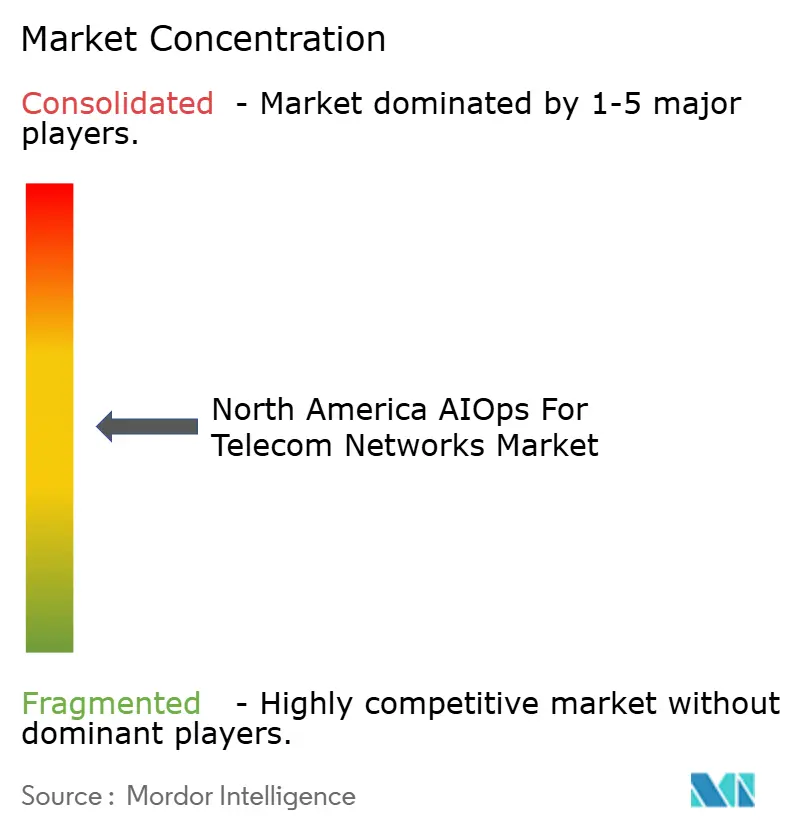
| Market Concentration | Medium |
Major Players *Disclaimer: Major Players sorted in no particular order Image © Mordor Intelligence. Reuse requires attribution under CC BY 4.0. | |
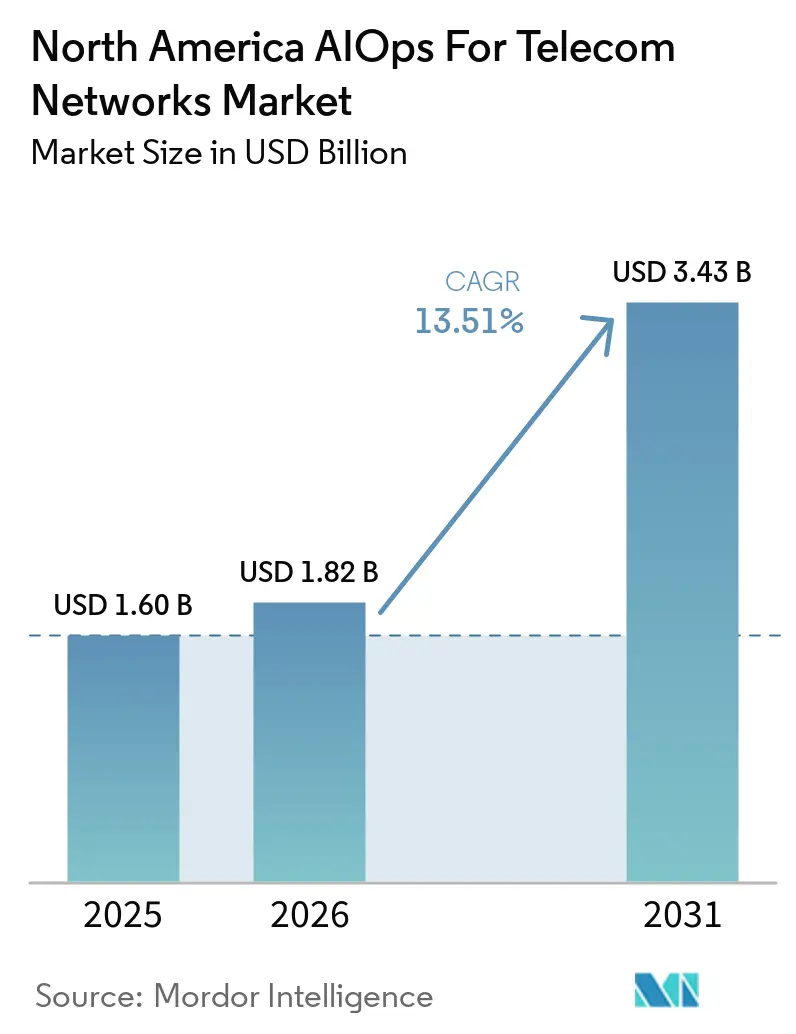
North America AIOps For Telecom Networks Market Analysis by Mordor Intelligence
The North America AIOps for Telecom Networks Market size is expected to grow from USD 1.60 billion in 2025 to USD 1.82 billion in 2026, and is forecast to reach USD 3.43 billion by 2031, at a 13.51% CAGR over 2026-2031. Network teams are managing denser 5G standalone deployments, new 5G-Advanced capabilities, and more distributed network functions. These changes increase the volume and variety of operational data that must be assessed quickly. Operators are also seeking to manage network expansion without matching increases in staffing at the network operations center. The North America AIOps for Telecom Networks market, therefore, favors tools that connect monitoring, diagnosis, and controlled remediation across radio, transport, and core domains. The shift toward more autonomous operations also places greater importance on reliable data pipelines, clear governance, and deployment models that fit regulated environments.
Key Report Takeaways
- By offering, platforms held 67.21% of the North America AIOps for Telecom Networks Market in 2025, while services are projected to expand at a 16.19% CAGR through 2031.
- By deployment model, cloud-based deployment accounted for 51.59% of the North America AIOps for telecom networks market in 2025, and is projected to expand at a 16.70% CAGR through 2031.
- By organization size, large enterprises accounted for 79.10% of revenue in 2025, while small and medium-sized enterprises are projected to expand at a 17.09% CAGR through 2031.
- By application, network performance management held 24.78% of the North America AIOps for telecom networks market in 2025, while fault and incident management is projected to expand at a 16.55% CAGR through 2031.
- By end-user, mobile network operators held 52.39% of the North America AIOps for telecom networks market in 2025, while integrated communication service providers are projected to expand at a 15.69% CAGR through 2031.
- By country, the United States held 83.13% of the North America AIOps for telecom networks market in 2025, while Mexico is projected to expand at a 16.87% CAGR through 2031.
Note: Market size and forecast figures in this report are generated using Mordor Intelligence’s proprietary estimation framework, updated with the latest available data and insights as of January 2026.
North America AIOps For Telecom Networks Market Trends and Insights
Drivers Impact Analysis*
| Driver | (~) % Impact on CAGR Forecast | Geographic Relevance | Impact Timeline |
|---|---|---|---|
| Rising 5G, Edge, and Network-Slicing Complexity | +3.8% | United States and Canada, primary. Mexico, emerging. | Medium term (2-4 years) |
| Demand for Real-Time Network Visibility and Predictive Assurance | +2.7% | United States, primary. Canada and Mexico, secondary. | Short term (≤ 2 years) |
| Pressure to Reduce NOC OPEX and Mean Time to Resolution | +2.5% | United States, primary. Canada, secondary. | Short term (≤ 2 years) |
| Growth of Cloud-Native, Multi-Vendor, and Hybrid Telecom Infrastructure | +1.8% | United States, primary. Canada and Mexico, emerging. | Medium term (2-4 years) |
| Telecom-Specific Digital Twins for Capacity and Incident Decisions | +0.9% | United States and Canada | Long term (≥ 4 years) |
| Deterministic Graph-Based Root-Cause Analysis for Alarm Storms | +0.6% | United States, primary. | Medium term (2-4 years) |
| Source: Mordor Intelligence | |||
Rising 5G, Edge, and Network-Slicing Complexity
5G standalone networks add operational complexity that was not present in earlier network generations. Each active slice can carry separate service-level thresholds, performance indicators, and fault-isolation boundaries. A slice-aware topology also changes the relationship between radio, transport, and core events. This makes event correlation more difficult for platforms trained mainly on flat-network data. The NGMN Alliance has recommended purpose-built reasoning agents for these environments in its work on agentic AI for autonomous mobile networks.[1] Nokia presented an agentic AI-powered 5G-Advanced network slicing solution with AWS at MWC 2026, linking MantaRay SMO to cloud-based AI capabilities for live network operations.[2]
Demand for Real-Time Network Visibility and Predictive Assurance
North American operators are moving beyond monitoring isolated performance indicators. They increasingly need to assess customer experience outcomes alongside control-plane and user-plane telemetry. The TM Forum framework places user experience degradation at the center of closed-loop remediation. That approach requires data collection systems that can ingest information from many network elements with limited delay. Deutsche Telekom reported that its MINDR platform, built with Google Cloud technologies, triggered more than 100 autonomous remediation actions in its first month of live operations after its November 2025 launch.[3] The company also reported that the platform reduced management time for major events from hours to 1 minute.
Pressure to Reduce NOC OPEX and Mean Time to Resolution
Network operations teams are under pressure to manage rising alert volumes without adding to manual triage work. This has made event correlation, alert prioritization, and guided remediation central requirements for operators. The practical value lies in directing engineers toward exceptions that need judgment rather than routine alarms. Autonomous operations can also reduce the time required to trace faults spanning the radio, transport, and core layers. The TM Forum autonomous networks program frames higher autonomy levels in terms of controlled decision-making, assurance, and operational trust. These priorities keep operational efficiency a major purchase consideration in the North America AIOps for Telecom Networks market.
Growth of Cloud-Native, Multi-Vendor, and Hybrid Telecom Infrastructure
Open RAN and cloud-native network functions create an operational gap that traditional element-management systems cannot fully address. Operators need correlation tools that can bring together data from equipment and software supplied by different vendors. The need is broader than 5G, as many carriers run containerized functions alongside legacy network systems. These environments often produce telemetry in different formats and use different operational interfaces. Amdocs introduced CES26 in March 2026 as an agent-driven suite intended to connect business support, operations support, and network functions.[4] This makes interoperability a lasting source of demand for the North America AIOps for Telecom Networks market.
Restraints Impact Analysis*
| Restraint | (~) % Impact on CAGR Forecast | Geographic Relevance | Impact Timeline |
|---|---|---|---|
| High Integration Costs Across Legacy OSS, BSS, and Network Domains | -1.8% | United States and Canada | Short term (≤ 2 years) |
| Data Quality, Interoperability, and Telemetry Standardization Gaps | -1.2% | North America core | Short term (≤ 2 years) |
| Shortage of Telecom AIOps, Data Engineering, and Automation Skills | -0.8% | United States, primary. Canada, secondary. | Medium term (2-4 years) |
| Risk of Automated Change Propagation Across Interdependent Network Layers | -0.5% | United States, primary. | Long term (≥ 4 years) |
| Source: Mordor Intelligence | |||
High Integration Costs Across Legacy OSS, BSS, and Network Domains
Legacy operations and business support systems remain a major obstacle to wider AIOps adoption. Many operators still rely on point-to-point integrations that become harder to manage when products, systems, or acquired assets are added. Migrating critical customer and network data also raises service continuity concerns. The TM Forum Open Digital Architecture provides a common direction, but moving from proprietary data models takes time and careful planning. AIOps projects can therefore face lengthy preparation before a unified telemetry stream is available for model training. The resulting delay is especially difficult for vendors that lack broad systems integration capabilities.
Data Quality, Interoperability, and Telemetry Standardization Gaps
Data-quality issues become more visible as networks add virtualized and containerized functions. Network functions can use different labels for slice identifiers, edge locations, and user-plane session data. This forces AIOps providers to maintain multiple adapters and update models as network designs change. The challenge is greater in multi-vendor radio environments, where implementations can differ even when they follow common architectural principles. RADCOM launched its Analytics Designer Module for the RADCOM ACE platform in June 2026, enabling analysts to define and deploy performance indicators and alarms without vendor involvement. Such tools can shorten change cycles, but they do not eliminate the underlying need for consistent, usable telemetry.
*Our forecasts treat driver/restraint impacts as directional, not additive. The impact forecasts reflect baseline growth, mix effects, and variable interactions.
Segment Analysis
By Offering: Platforms Anchor Revenue While Services Expand Fastest
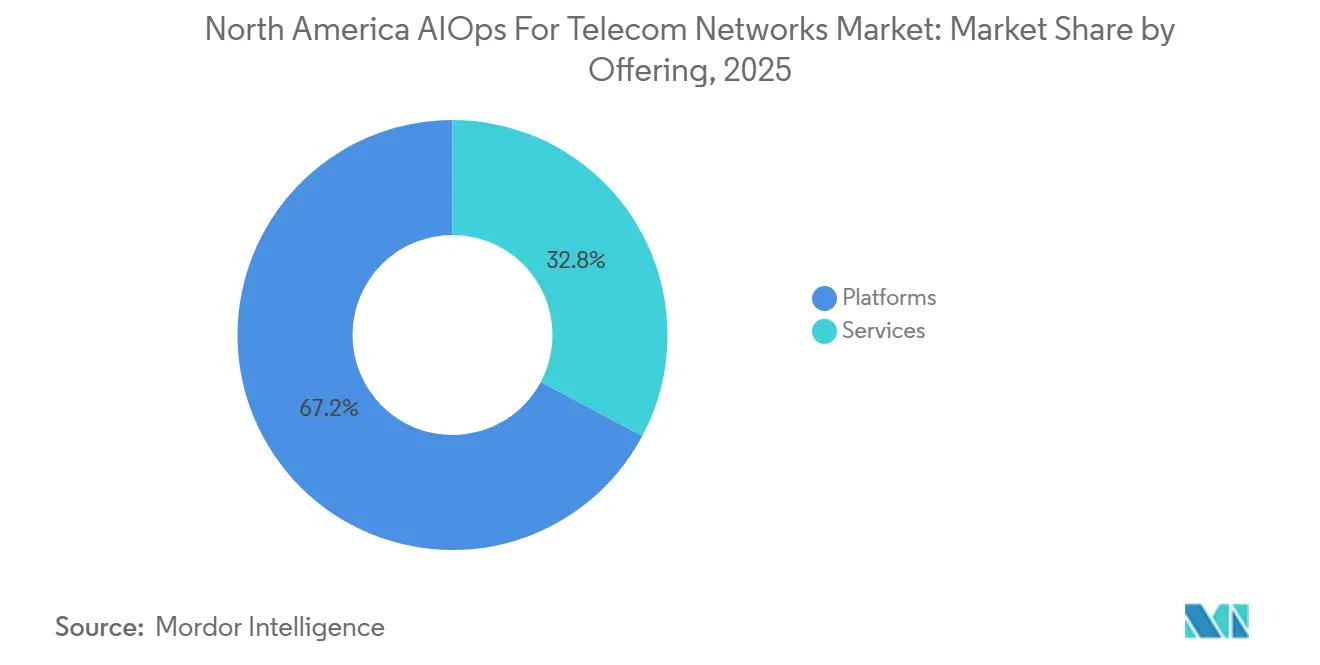
Platforms held 67.21% of regional revenue in 2025. Their lead reflects the needs of large carriers that require integrated ingestion, event correlation, topology awareness, and closed-loop automation. Replacing a correlation engine can be difficult when it has been trained on years of carrier-specific telemetry. That accumulated training data can reinforce switching costs for established providers. Platforms also include network-specific operating logic that general IT operations tools do not inherently provide. Nokia updated its Autonomous Networks Suite at DTW26 in June 2026 and released an Autonomous Networks Agent Library.
Services are projected to expand at a 16.19% CAGR from 2026 to 2031. It is the fastest-expanding offering type in the North America AIOps for Telecom Networks market. Operators increasingly procure managed support for defined activities such as fault resolution in 5G standalone core networks or predictive radio-frequency optimization. This model allows carriers to retain broader platform control while drawing on specialist support for model development and maintenance. It can also help organizations keep control of sensitive operational data. IBM and ServiceNow expanded their collaboration in June 2026 to combine AI, data, and automation capabilities for enterprise operations. The arrangement reflects demand for services that bring operational tools together without requiring every operator to build the full capability internally.
By Deployment Model: Cloud Deployment Outpaces On-Premises Growth
Cloud-based deployment accounted for 51.59% of regional revenue in 2025 and is projected to expand at a 16.70% CAGR from 2026 to 2031. It allows operators to scale model training and inference as telemetry volumes rise with denser 5G networks. This reduces the need to build and maintain dedicated on-premises computing capacity for every workload. Cloud environments can also support distributed data collection and faster software updates. These capabilities support near-real-time decisions for monitored network events. The North America AIOps for Telecom Networks market benefits when cloud tools can be used alongside established operational controls.
On-premises deployment remains relevant for federal networks and regulated carriers with data residency or network isolation requirements. Hybrid designs can keep sensitive processing and inference local while connecting suitable management functions to hosted environments. This approach helps operators avoid a hard transition from existing systems. Infovista introduced VistAI in January 2026 with cloud-hosted and on-premises deployment options for automated assurance and testing products. This flexibility allows the North America AIOps for Telecom Networks market to serve both cloud-focused and compliance-led deployment needs.
By Organization Size: Large Enterprises Lead While SMEs Accelerate Fastest
Large enterprises accounted for 79.10% of the North America AIOps for Telecom Networks market size in 2025. Tier-1 and Tier-2 carriers operate multi-domain and multi-generation network estates that generate extensive daily telemetry. For these organizations, AI-assisted correlation is increasingly a baseline operational requirement. It helps teams prioritize issues across radio, transport, core, and user-plane functions. Large enterprises also have the resources to manage complex data engineering and systems integration. Their established network scale explains the segment’s leading position.
Small and medium-sized enterprises are projected to expand at a 17.09% CAGR from 2026 to 2031. It is the fastest-expanding organization group in the North America AIOps for Telecom Networks market. Cloud-native delivery reduces the upfront infrastructure burden associated with traditional platforms. Regional operators, cable providers, and managed service providers can adopt tools on a usage-based model. Defined use cases, including customer experience and network security management, can make results easier to assess. This may shorten the time between deployment and operational use. Amdocs positioned its aOS Cognitive Core within CES26 as a service-oriented approach to agentic automation.
By Application: Fault Management Gains Ground on Performance Analytics
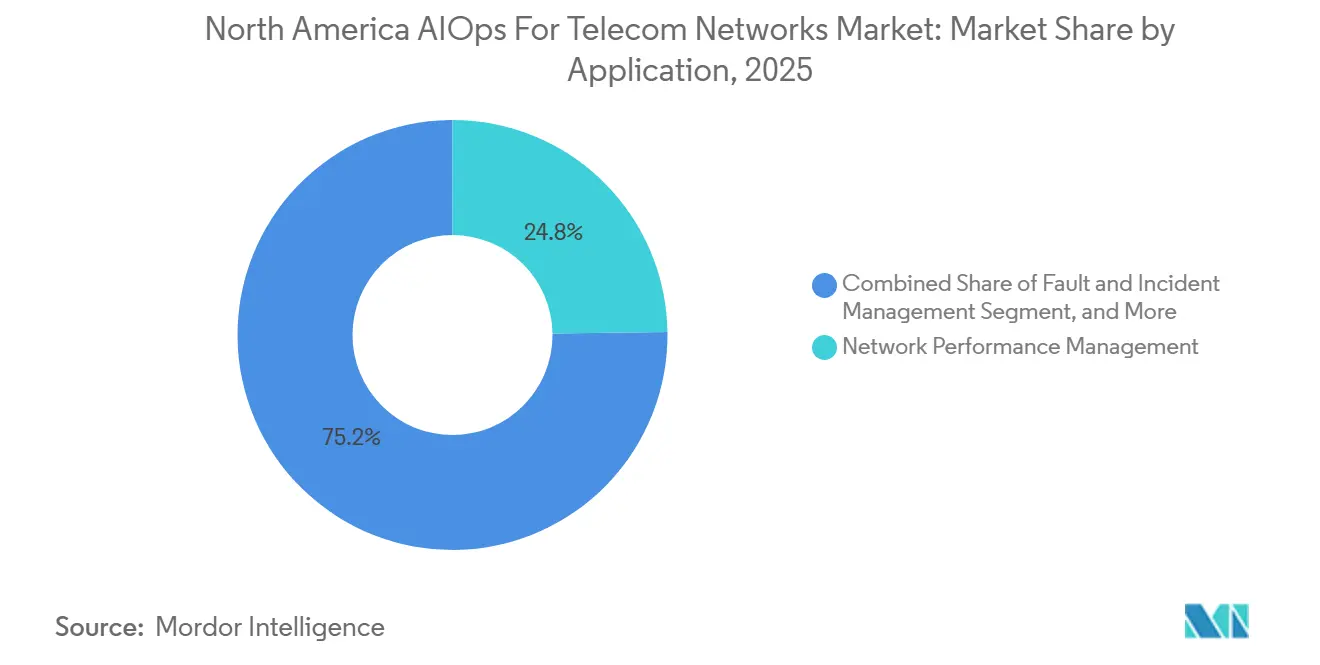
Network performance management held 24.78% of the North America AIOps for Telecom Networks market size in 2025. It remains the largest application because performance monitoring was among the earliest AIOps use cases adopted by regional carriers. Many operators had already deployed analytics tools during the LTE period. Performance data provides a practical foundation for wider automation because it is central to daily network assurance. RADCOM’s June 2026 Analytics Designer Module supports real-time performance indicators and alarm configuration. This supports the continued relevance of performance workflows as networks evolve.
Fault and incident management is projected to expand at a 16.55% CAGR from 2026 to 2031. In multi-domain 5G architectures, a misconfigured network function can affect multiple services and customer groups simultaneously. AIOps can help teams connect related alarms and identify a likely cause more quickly. The application also supports incident workflows that move from initial alert to assigned work. ServiceNow introduced Project Arc in May 2026 to aggregate alerts, logs, and diagnostics for autonomous network operations workflows. Network security, customer experience, infrastructure, and application performance functions add further demand because each depends on coordinated event analysis.

By End-User: MNOs Dominate While Integrated Operators Gain Momentum
Mobile network operators held 52.39% of regional revenue in 2025. They manage radio access, transport, core, and user-plane functions across wide geographic footprints. They also operate the 5G new radio and legacy LTE layers simultaneously. These radio technologies have different failure patterns, optimization controls, and alarm vocabularies. AI-assisted correlation helps operations teams assess these overlapping data streams. Verizon, AT&T, and T-Mobile have been active users of AIOps platforms for managing large dual-technology network estates.
Integrated communication service providers are projected to expand at a 15.69% CAGR from 2026 to 2031. Fixed-mobile convergence requires tools that can correlate events across mobile radio and fiber access networks. This need cannot be fully served by legacy mobile management tools or traditional fixed-line OSS platforms alone. Fixed and broadband operators also need capacity forecasting, quality-of-experience analysis, and proactive fault resolution as they broaden their virtual network services. NVIDIA presented secure agent runtimes for network operations automation at DTW Ignite 2026. These needs support a broader role for the North America AIOps for Telecom Networks market across converged operator environments.
Geography Analysis
The United States held 83.13% of regional revenue in 2025. Its position reflects the scale of national carrier operations and the depth of its technology supplier ecosystem. Nokia, Ericsson, Cisco Systems, IBM, and ServiceNow maintain major commercial and research activity in the country. U.S. operators are also adopting more open and multi-vendor network architectures. That raises demand for orchestration tools that can work across vendor boundaries. Federal and regulated carrier requirements further support on-premises and hybrid deployments.
Canada remains an important regional contributor because its operators continue to build 5G and fiber infrastructure. TELUS announced a CAD 66 billion (USD 48.01 billion) investment through 2030 to improve connectivity and AI infrastructure. The company’s 5G network reached more than 90% of Canada’s population by 2025. Its PureFibre network extended to 3.7 million households and businesses by 2025. Bell Canada and Rogers Communications are also advancing standalone 5G deployments.
Mexico is projected to expand at a 16.87% CAGR from 2026 to 2031, the fastest rate in the regional North America AIOps for Telecom Networks market. Policy support for connectivity, spectrum, public fiber, and network modernization can add operational complexity as networks expand. This increases the need for assurance, fault isolation, and capacity-management tools. OXIO’s planned acquisition of Movistar Mexico involved a USD 450 million transaction and a transition of more than 20 million subscribers to a cloud-native operating model. The transition creates demand for AIOps tools that can support cloud-native telecom environments. Mexico’s spectrum plans also support further 5G densification and associated operational management needs.
Competitive Landscape
The North America AIOps for Telecom Networks market is moderately concentrated, including network equipment providers, IT operations platforms, and specialist assurance vendors. Nokia and Ericsson compete alongside IBM and ServiceNow, while RADCOM and Infovista offer telecom-focused assurance capabilities. Competition is shaped by the ability to support open architectures and connect data from multiple suppliers. Vendors with established carrier platforms retain advantages in domain knowledge and installed relationships. At the same time, modular tools can appeal to operators seeking flexibility. This produces a competitive setting that is neither controlled by a single provider nor fully fragmented.
Nokia released its Autonomous Networks Agent Library and an updated Autonomous Networks Suite at DTW26 in June 2026. The company also announced work with Google Cloud on specialized agents for telecom operations. Amdocs launched CES26 in March 2026, featuring closed-loop assurance, unified orchestration, and intent-driven automation across the commercial and network layers. IBM and ServiceNow expanded their multiyear collaboration in June 2026 to focus on AI-ready data and autonomous infrastructure operations. These moves show that partnerships and interoperability are becoming important competitive tools.
Specialist providers compete by reducing dependence on proprietary network-function suppliers. RADCOM’s Analytics Designer Module enables operators to define and deploy new performance indicators without engaging the vendor. Emerging providers such as Selector AI and NetAI Inc. focus on AI-native analytics for multi-vendor environments. Vendors are also evaluating digital twins for pre-change validation and capacity planning. NVIDIA described a VIAVI demonstration that used RTX PRO Blackwell GPUs to improve TeraVM simulation throughput. The competitive opportunity extends from live-network observability to the validation of planned network changes.
North America AIOps For Telecom Networks Industry Leaders
-
Nokia Corporation
-
Telefonaktiebolaget LM Ericsson
-
IBM Corporation
-
ServiceNow, Inc.
-
Infovista SAS
- *Disclaimer: Major Players sorted in no particular order
Recent Industry Developments
- June 2026: IBM and ServiceNow announced an expanded multiyear collaboration to address barriers to AI-ready data and legacy application modernization, combining IBM’s AI, data, and automation capabilities with the ServiceNow AI Platform. Joint solutions covering legacy application scanning, enterprise data governance, and autonomous infrastructure operations are expected to be available in the second half of 2026.
- May 2026: ServiceNow and NVIDIA announced an expanded partnership at Knowledge 2026, introducing Project Arc, a general, self-evolving autonomous desktop AI agent for enterprise knowledge workers, secured by NVIDIA OpenShell and governed by ServiceNow.
- March 2026: Amdocs unveiled CES26 at MWC Barcelona, an end-to-end agent-driven BSS-OSS-network suite powered by the Amdocs aOS Cognitive Core. The platform introduces closed-loop assurance, unified orchestration, and intent-driven autonomy capabilities spanning commercial and network operational layers.
- March 2026: IBM and NVIDIA announced an expanded collaboration at GTC 2026, including plans to offer NVIDIA Blackwell Ultra graphics processing units on IBM Cloud in Q2 2026 for large-scale model training and high-throughput inference, integrated with Red Hat AI Factory and VPC servers and backed by enterprise-grade compliance controls.
North America AIOps For Telecom Networks Market Report Scope
The North America AIOps for telecom networks market revenue is generated through platform licensing and subscriptions, AI/analytics software usage, consulting and system integration, deployment, managed services, maintenance, and support provided to mobile network operators, fixed and broadband operators, integrated communication service providers, and other telecom end users across large enterprises and small and medium-sized enterprises in the region.
The North America AIOps for telecom networks market report is segmented by offering (platforms and services), deployment model (on-premises and cloud-based), organization size (large enterprises, and small and medium-sized enterprises), application (network performance management, fault and incident management, network security management, customer experience management, infrastructure management, application performance analysis, and other applications), end-user (mobile network operators, fixed and broadband operators, integrated communication service providers, and other end-users), and country (United States, Canada, and Mexico). The market forecasts are provided in terms of value (USD).
| Platforms |
| Services |
| On-Premises |
| Cloud-Based |
| Large Enterprises |
| Small and Medium-Sized Enterprises |
| Network Performance Management |
| Fault and Incident Management |
| Network Security Management |
| Customer Experience Management |
| Infrastructure Management |
| Application Performance Analysis |
| Other Applications |
| Mobile Network Operators |
| Fixed and Broadband Operators |
| Integrated Communication Service Providers |
| Other End-Users |
| United States |
| Canada |
| Mexico |
| By Offering | Platforms |
| Services | |
| By Deployment Model | On-Premises |
| Cloud-Based | |
| By Organization Size | Large Enterprises |
| Small and Medium-Sized Enterprises | |
| By Application | Network Performance Management |
| Fault and Incident Management | |
| Network Security Management | |
| Customer Experience Management | |
| Infrastructure Management | |
| Application Performance Analysis | |
| Other Applications | |
| By End-User | Mobile Network Operators |
| Fixed and Broadband Operators | |
| Integrated Communication Service Providers | |
| Other End-Users | |
| By Country | United States |
| Canada | |
| Mexico |
Key Questions Answered in the Report
What is the size of the North America AIOps for Telecom Networks market?
The market was valued at USD 1.82 billion in 2026 and is projected to reach USD 3.43 billion by 2031, at a 13.51% CAGR. The North America AIOps for Telecom Networks market reflects rising automation requirements across carrier systems today.
What is driving adoption of AIOps for telecom networks in North America?
Denser 5G networks, network slicing, multi-vendor operations, and the need for faster fault resolution are central factors. The North America AIOps for Telecom Networks market benefits from coordinated monitoring and controlled remediation. It also covers radio, transport, core, and user-plane operations.
Which deployment model is expanding fastest in AIOps for telecom networks?
Cloud-based deployment is projected to expand at a 16.70% CAGR from 2026 to 2031. It can support scalable model training and distributed data collection.
Which application is expected to expand fastest through 2031?
Fault and incident management is projected to expand at a 16.55% CAGR as operators manage more complex multi-domain networks. It helps connect related alarms and supports incident workflows.
Which end users account for the largest demand for AIOps platforms?
Mobile network operators held 52.39% of revenue in 2025 because they operate complex 5G and LTE estates. Their teams manage data from several connected network domains.
Which North American country is projected to expand fastest through 2031?
Mexico is projected to expand at a 16.87% CAGR, supported by network modernization and cloud-native telecom operations. Policy support for spectrum and connectivity is also relevant.