
North America 5G Technology Market Size and Share
Market Overview
| Study Period | 2020 - 2031 |
|---|---|
| Forecast Data Period | 2026 - 2031 |
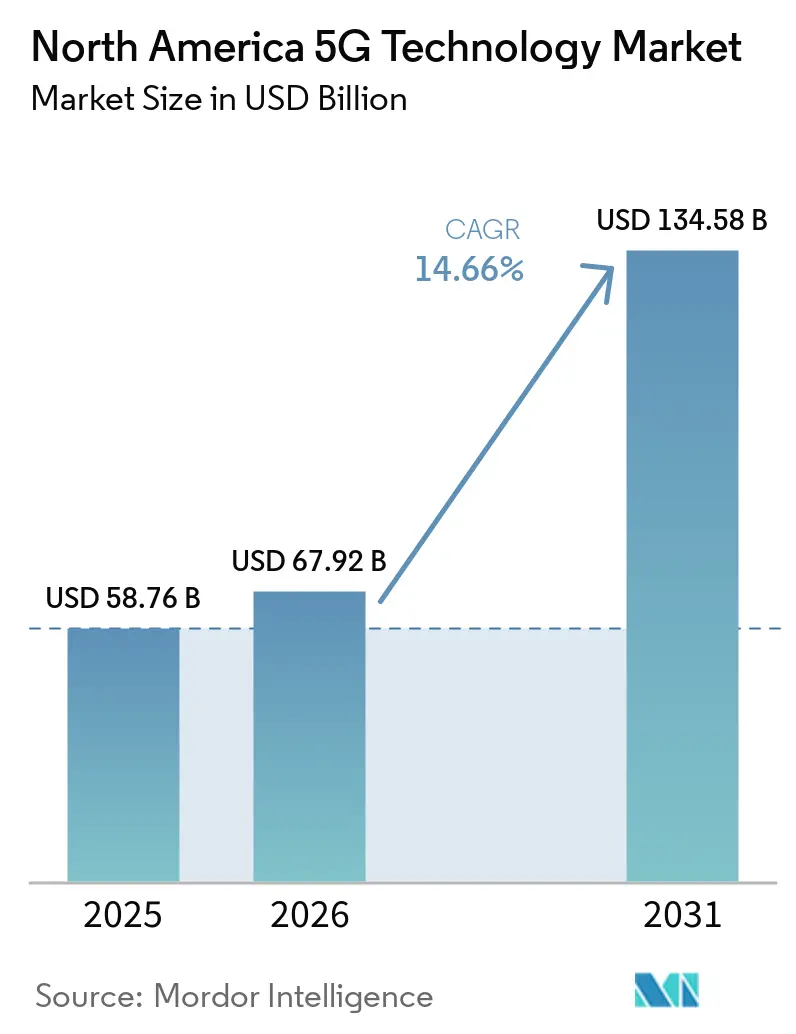
| Base Year Market Size (2025) | USD 58.76 Billion |
| Market Size (2026) | USD 67.92 Billion |
| Market Size (2031) | USD 134.58 Billion |
| Growth Rate (2026 - 2031) | 14.66 % |
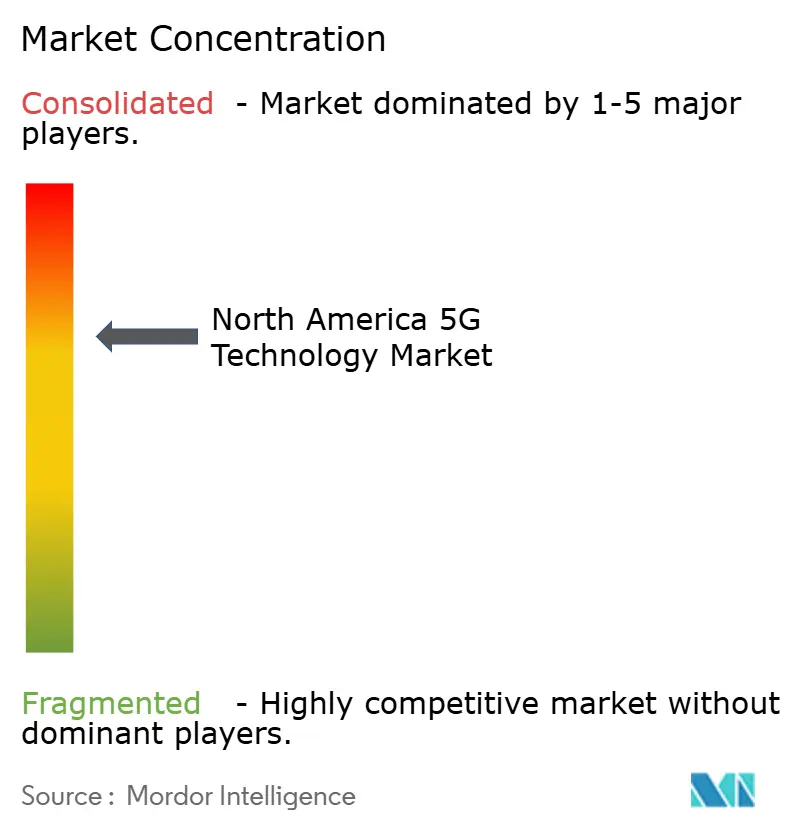
| Market Concentration | Medium |
Major Players *Disclaimer: Major Players sorted in no particular order Image © Mordor Intelligence. Reuse requires attribution under CC BY 4.0. | |
North America 5G Technology Market Analysis by Mordor Intelligence
The North America 5G Technology Market size is projected to be USD 58.76 billion in 2025, USD 67.92 billion in 2026, and reach USD 134.58 billion by 2031, growing at a CAGR of 14.66% from 2026 to 2031. Network densification, fixed wireless access, and private network programs are directing capital toward coverage, capacity, and enterprise connectivity. The North America 5G technology market is also moving toward enterprise contracts that place more value on reliable service levels than on subscriber additions alone for regional enterprise customers. Standalone networks can support differentiated service offers, including network slicing and low-latency connections. High spectrum costs and weaker economics in low-density areas continue to limit the pace of investment. Equipment suppliers, operators, integrators, and neutral-host providers are competing to capture the network modernization and private deployment opportunity.
Key Report Takeaways
- By component, hardware held 44.85% of revenue in the North America 5G Technology Market in 2025, while services are projected to expand at a 17.10% CAGR through 2031.
- By spectrum band, sub-6 GHz captured 56.35% of revenue in the North America 5G technology market in 2025, while hybrid configurations are projected to expand at a 17.65% CAGR through 2031.
- By application, enhanced mobile broadband (eMBB) accounted for 36.80% of revenue in the NA 5G technology market in 2025, while ultra-reliable low-latency communications (URLLC) is projected to expand at an 18.25% CAGR through 2031.
- By end-user industry, consumer industries accounted for 40.91% of revenue in the North America 5G technology market in 2025, while manufacturing is projected to expand at an 18.10% CAGR through 2031.
- By network architecture, NSA held 57.88% of revenue in the North America 5G technology market in 2025, while SA is projected to expand at a 19.05% CAGR through 2031.
- By country, the United States accounted for 87.20% of North America's 5G technology market revenue in 2025, while Mexico is projected to expand at an 18.50% CAGR through 2031.
Note: Market size and forecast figures in this report are generated using Mordor Intelligence’s proprietary estimation framework, updated with the latest available data and insights as of January 2026.
North America 5G Technology Market Trends and Insights
Drivers Impact Analysis*
| Driver | (~) % Impact on CAGR Forecast | Geographic Relevance | Impact Timeline |
|---|---|---|---|
| Rising Network Densification Needs Across Urban Cores and Enterprise Campuses | +3.2% | North America, United States urban metros, enterprise campuses, and indoor venues | Medium term (2-4 years) |
| Fast Expansion of Fixed Wireless Access as a Fiber Alternative | +2.6% | North America, United States suburban and rural areas, and early-stage Canadian deployments | Short term (≤ 2 years) |
| Private 5G Adoption in Manufacturing, Logistics, and Energy Operations | +2.1% | North America, United States and Canadian industrial hubs and energy corridors | Medium term (2-4 years) |
| Cloud-Native Core and Open RAN Modernization by Tier-1 Operators | +1.9% | North America, United States Tier-1 operators, and Canadian operators | Medium term (2-4 years) |
| Demand for Ultra-Low Latency in Industrial Automation and Connected Vehicles | +1.6% | North America, United States automotive corridors and manufacturing belts | Long term (≥ 4 years) |
| Public Sector and Defense Network Upgrades for Secure 5G Deployments | +1.2% | United States, with spillover to Canadian federal procurement | Long term (≥ 4 years) |
| Source: Mordor Intelligence | |||
Rising Network Densification Needs Across Urban Cores and Enterprise Campuses
Network densification remains a major capital priority as operators complete mid-band coverage in large cities. The Wireless Infrastructure Association reported 830,350 indoor small-cell nodes in the United States in 2025, up from 802,500 in 2024.[1]Wireless Infrastructure Association, “By the Numbers 2025,” Wireless Estimator, wirelessestimator.com This work supports distributed antenna systems, private CBRS networks, and in-building coverage at venues, hospitals, and offices. T-Mobile operates more than 85,000 macro sites and 57,000 small cells, and its 2.5 GHz spectrum covers nearly 70% more area per site than competing C-band deployments. The North America 5G technology market, therefore, has a broader base for indoor and campus services. Neutral-host deployments can also give building owners a larger role in selecting and funding indoor connectivity.
Fast Expansion of Fixed Wireless Access as a Fiber Alternative
Fixed wireless access is becoming a more established part of residential broadband delivery in the United States. T-Mobile ended 2025 with 8.5 million fixed wireless subscribers and raised its 2030 target to 15 million. Improved spectrum efficiency, additional customer-premises equipment options, and business eligibility support that target. Standalone networks can separate fixed wireless traffic from mobile traffic through policy-based capacity allocation. This can reduce congestion pressure and support speed-based service plans. Ericsson reported in June 2025 that more than 51% of communications service providers offering fixed wireless access had speed-based plans, compared with 40% 1 year earlier.[2]Ericsson, “June 2025 Ericsson Mobility Report Highlights 5G FWA Monetization Appeal,” Ericsson, ericsson.com The North America 5G technology market can therefore position fixed wireless as a broadband service with differentiated performance rather than solely as a lower-cost alternative.
Private 5G Adoption in Manufacturing, Logistics, and Energy Operations
Private 5G programs are moving into larger industrial deployments across the region. Hyundai Motor Group opened its USD 7.59 billion Metaplant America facility in Georgia in March 2025. The facility illustrates how private connectivity can support automated manufacturing operations. Samsung and Hyundai completed a private 5G RedCap trial in February 2025 that showed higher uplink capacity and lower device power use for industrial IoT connections. TERAGO and Ericsson also launched a private 5G network at McMaster Manufacturing Research Institute in Canada during May 2026.[3]TERAGO Inc., “TERAGO and Ericsson Launch Enterprise Private 5G Network at McMaster Manufacturing Research Institute,” TERAGO, terago.ca These deployments show that the North America 5G technology market is supporting industrial automation, robotics, and real-time operations.
Cloud-Native Core and Open RAN Modernization by Tier-1 Operators
Operators are adopting cloud-native cores and virtualized radio networks to make network operations more flexible. Samsung completed a commercial vRAN call in January 2026 using cloud-native software and an Intel Xeon 6700P-B system-on-chip server.[4]Samsung Electronics, “Samsung Achieves Industry-First Virtualized RAN Milestone,” Samsung Newsroom, news.samsung.com The result showed that a single commercial server could meet operator performance and reliability requirements. Videotron also deployed Samsung cloud-native 5G and 4G core technology on Dell servers with Red Hat OpenShift in 2026. These implementations reduce dependence on specialized baseband hardware and can change vendor procurement patterns. Open interfaces may allow software providers to participate more directly in radio network upgrades. The North America 5G technology market is consequently shifting some spending from purpose-built equipment toward software, cloud platforms, and managed services.
Restraints Impact Analysis*
| Restraint | (~) % Impact on CAGR Forecast | Geographic Relevance | Impact Timeline |
|---|---|---|---|
| High Spectrum Acquisition and Deployment Costs | -2.4% | United States, Canada, and Mexico | Short term (≤ 2 years) |
| Slow Monetization in Rural and Low-Density Markets | -1.7% | North America, including rural United States areas, rural Canada, and much of Mexico | Medium term (2-4 years) |
| Power Consumption and Site Acquisition Constraints for Dense Small-Cell Rollouts | -1.1% | North America, especially dense United States and Canadian urban areas | Medium term (2-4 years) |
| Device and Ecosystem Fragmentation Across Bands, Standards, and Use Cases | -0.7% | Global, with multi-band device certification complexity in North America | Long term (≥ 4 years) |
| Source: Mordor Intelligence | |||
High Spectrum Acquisition and Deployment Costs
Spectrum costs continue to constrain the investment capacity of regional operators. AT&T agreed in August 2025 to acquire EchoStar spectrum licenses for USD 23 billion across more than 400 United States markets. The licenses include nationwide low-band and mid-band spectrum that can support future coverage and capacity expansion. The Congressional Research Service stated that P.L. 119-21 directs the Federal Communications Commission to auction 300 MHz of spectrum. The legislation introduces an additional auction cycle that can put pressure on operators' capital budgets. Mexico also faces a smaller assigned spectrum base and a changing regulatory structure. These conditions make capital availability uneven across the North America 5G technology market.
Slow Monetization in Rural and Low-Density Markets
Rural deployment economics remain difficult because lower population density reduces revenue per site. Low-band 5G can extend coverage, but it does not always support a premium service proposition over 4G. Canada’s Universal Broadband Fund, CAD 3.22 billion (USD 2.35 billion), is an initiative for connectivity in rural and remote communities. Public funding can support fixed wireless and other connectivity projects where commercial returns are limited. Satellite direct-to-device services may also provide an alternative in areas where tower economics are unfavorable. Operators still need viable backhaul, power, and site arrangements after grant funding ends. This restraint limits the North America 5G technology market in locations that require significant infrastructure but have limited demand.
*Our forecasts treat driver/restraint impacts as directional, not additive. The impact forecasts reflect baseline growth, mix effects, and variable interactions.
Segment Analysis
By Component: Services Shift Operator Procurement Toward Recurring Delivery
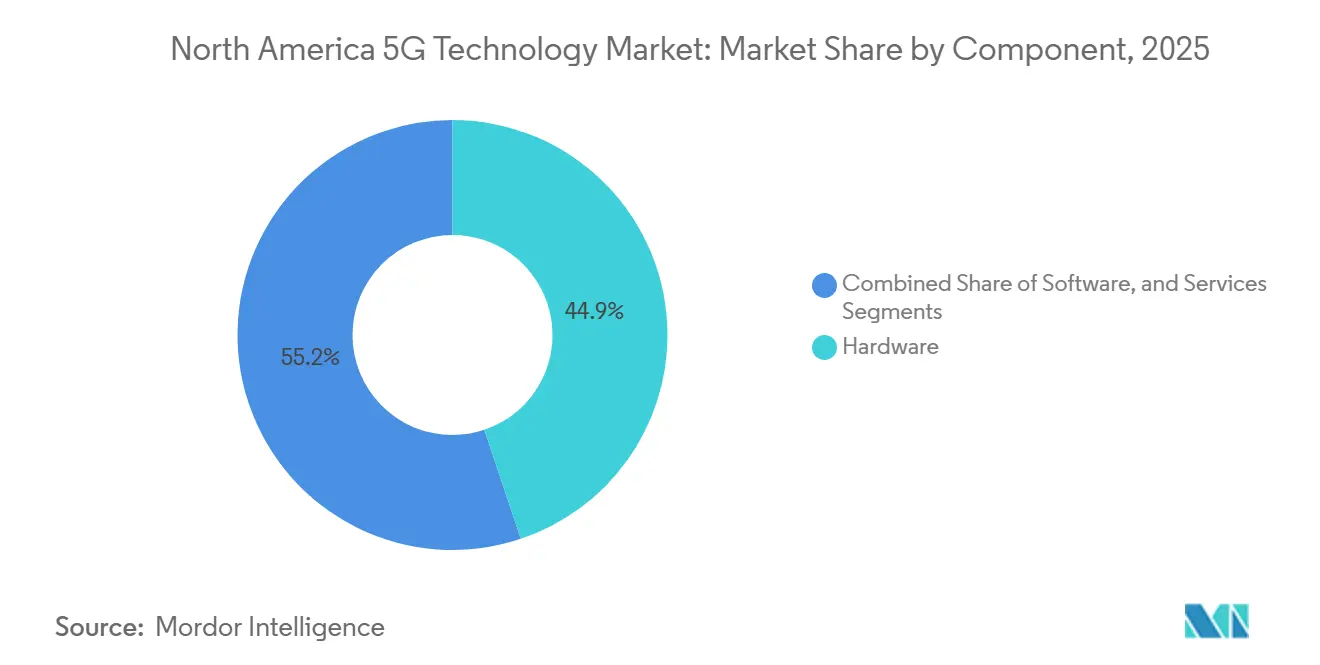
Hardware accounted for 44.85% of component revenue in 2025. This North America 5G technology market share reflected intensive spending on base stations, small cells, and radio access network upgrades. Massive MIMO antenna units, baseband modules, and site equipment supported the initial coverage buildout across the region. Software adoption is rising as operators introduce Open RAN tools, network slicing platforms, and RAN management applications. Hardware-centered purchasing models still constrained software revenue during 2025. Samsung’s January 2026 commercial vRAN call showed that cloud-native software can run on a single standard server. This approach can reduce the need for proprietary baseband hardware. It also gives operators greater flexibility when selecting infrastructure suppliers. The North America 5G technology market continues to require substantial hardware as coverage and capacity investments proceed.
Services are projected to expand at a 17.10% CAGR from 2026 to 2031. The services segment benefits from managed networks, private deployment support, and cloud orchestration subscriptions. Enterprise contracts increasingly combine design, integration, operations, and performance management. Ericsson and Future Technologies expanded their collaboration in March 2026 to support enterprise wireless deployments in energy, manufacturing, transportation, and logistics. These operating models create recurring service revenue rather than a one-time equipment sale. Standalone network slicing also enables contracts based on specified quality of service. This can strengthen the role of professional and managed services in operator and enterprise procurement. Software and services may capture a larger share of value as virtualized networks become more common.



By Spectrum Band: Sub-6 GHz Supports Coverage While Hybrid Networks Add Capacity
Sub-6 GHz accounted for 56.35% of the spectrum band revenue in 2025. This spectrum revenue share was anchored by C-band and 2.5 GHz deployments across the United States, Canada, and Mexico. Mid-band spectrum offers a practical balance of coverage and capacity for wide-area networks. AT&T’s EchoStar agreement supports that approach through nationwide licenses in the 3.45 GHz and 600 MHz bands. Verizon’s use of C-band in metropolitan deployments also shows the importance of mid-band capacity. mmWave remains relevant in dense venues, central business districts, and large enterprise sites. Its propagation limits reduce its effectiveness as a broad-coverage layer. RedCap devices can widen Sub-6 GHz use in sensors and wearables because they use less power than full-capability modems. These conditions retain Sub-6 GHz as the central spectrum tier for regional deployments.
Hybrid configurations are projected to expand at a 17.65% CAGR from 2026 to 2031. They combine broad Sub-6 GHz coverage with mmWave capacity in locations that need higher throughput. The approach lets operators use each band for the locations and traffic profiles where it performs best. Carrier aggregation improvements in 3GPP Releases 17 and 18 support the use of multiple component carriers across frequency ranges. 5G Americas identifies continued spectrum evolution and advanced capabilities as important elements of the regional 5G roadmap. Hybrid networks can improve performance in mixed urban, venue, and campus environments. They also allow operators to add localized capacity without replacing the wider mid-band layer. Device support remains important because customers need compatible radios and antennas. The North America 5G technology market can use hybrid band plans to match investment with local traffic conditions.
By Application: URLLC Extends 5G Into Time-Sensitive Operations
Enhanced mobile broadband (eMBB) accounted for 36.80% of application revenue in 2025. This application revenue share was supported by smartphone data use, fixed wireless access, and connectivity for campuses and event venues. Fixed wireless access operates within the eMBB layer, although operators increasingly manage it as a separate revenue category. Its customer economics and spectrum use differ from traditional mobile service. Massive machine-type communications support smart-city systems, agricultural IoT, and utility metering. These applications are building deployment volumes but have not reached full commercial scale. eMBB remains important because it supports a broad base of consumer and enterprise connectivity. Its scale also provides the foundation for operators to fund advanced network capabilities. The North America 5G technology market will continue to depend on eMBB revenues while newer applications develop.
URLLC is projected to expand at an 18.25% CAGR from 2026 to 2031. The application supports industrial automation, connected vehicles, remote robotics, and public safety systems that need reliable low-latency connections. IEEE research published in 2025 found that 5G URLLC achieved the lowest latency for autonomous vehicle applications among the communication protocols tested. Dedicated public-safety network programs show that the standalone architecture can support live video, voice communications, and body-camera uploads. This deployment moves URLLC from a technical capability to a service used in critical operations. Enterprise adoption depends on application integration, device availability, and clear service-level commitments. URLLC gives the North America 5G technology market a route to higher-value industrial and public-sector contracts.
By End-User Industry: Consumer Demand Provides Scale as Manufacturing Adoption Accelerates
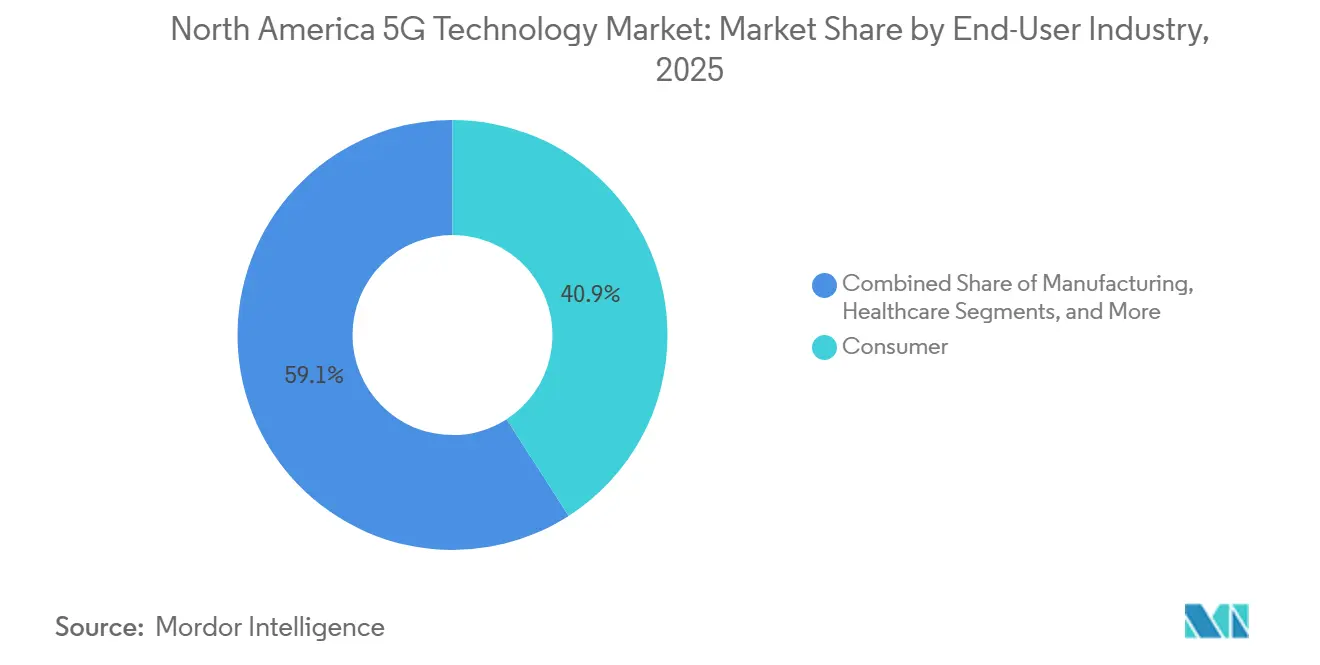
Consumer industries accounted for 40.91% of end-user revenue in 2025. This end-user revenue share came from handset-based broadband and the rising base of residential fixed wireless subscribers. Consumer demand gives operators the large traffic base needed to justify broad radio network investment. Healthcare organizations are using 5G for remote diagnostics, patient monitoring, and robotic-assisted procedures. Dedicated standalone slices can support protected connections for sensitive health data. Automotive facilities are also using private networks for automated production and quality control. Automotive facilities are using private networks to link robotics and quality-control systems. Energy and utility operators are evaluating 5G for grid management, pipeline monitoring, and inspection. Media, public safety, and defense users add demand for high-capacity and resilient connections.
Manufacturing is projected to expand at an 18.10% CAGR from 2026 to 2031. Private networks, edge computing, and AI-enabled automation are making connectivity a more direct production requirement. Manufacturing adoption is supported by the need to connect machines, robots, sensors, and inspection systems. TERAGO and Ericsson’s May 2026 network at McMaster Manufacturing Research Institute is designed for automation, robotics, and real-time data processing. RedCap devices can lower connectivity costs for large sensor installations. This helps manufacturers deploy more endpoints without using full-capability modem hardware for every device. Operators and integrators are offering managed private networks that reduce the operational burden on plant owners. Industrial customers will evaluate these projects against safety, productivity, and system reliability requirements. Manufacturing, therefore, provides a major growth path for enterprise-focused 5G services.
By Network Architecture: Standalone Networks Enable Advanced Service Models
Non-standalone (NSA) architecture accounted for 57.88% of architecture revenue in 2025. This architecture revenue share reflected early deployments that connected 5G radio access networks to existing 4G LTE cores. NSA accelerated initial launches and used operators’ existing core network investments. It also limited access to functions such as full network slicing and Voice over New Radio. The installed NSA base remains important because operators must maintain broad service continuity during migration. AT&T announced nationwide deployment of its 5G standalone core during October 2025. The move initiated a phased transition of commercial customers onto standalone infrastructure. Canadian operators are also investing in core modernization as they extend advanced 5G capabilities. NSA will remain in use during the transition, particularly where operators prioritize coverage expansion.
Standalone architecture is projected to expand at a 19.05% CAGR from 2026 to 2031. A standalone core supports network slicing, URLLC, Voice over New Radio, and cloud-native service exposure. These capabilities are important for applications that need predictable latency or dedicated service conditions. Samsung’s commercial vRAN demonstration supports the economics of software-defined radio deployments. VTel Wireless selected Ericsson in March 2026 for a standalone network that supports nationwide native 5G Voice over New Radio roaming. Standalone adoption can reduce dependence on legacy LTE functions for compatible services. It also gives operators a clearer platform for enterprise service differentiation. Migration still requires careful integration with devices, operational systems, and roaming arrangements. The North America 5G technology market is therefore moving gradually toward standalone networks while preserving existing coverage assets.
Geography Analysis
The United States accounted for 87.20% of regional revenue in 2025, representing the largest share of North America's 5G technology market. AT&T completed its EchoStar spectrum acquisition in July 2026, adding low-band and mid-band licenses across more than 400 US markets. Fiber expansion remains important because it provides the backhaul density needed for wireless capacity. These developments support further expansion of 5G and fixed wireless.
Canada is developing through competition among Bell, Rogers, and Telus, as well as continued rural network investment. Bell introduced 5G+ Advanced in the Greater Toronto and Hamilton Area in March 2026 with peak download speeds of up to 4.3 Gbps. Canadian operators are extending coverage to rural municipalities, Indigenous communities, and first responders.
Mexico is projected to expand at an 18.50% CAGR from 2026 to 2031, the highest growth rate among countries in the region. The National Radio Spectrum Program 2026-2030 targets 1,095 MHz of IMT spectrum by 2030, compared with 695 MHz in 2025. The planned total remains below the 1,280 MHz baseline identified in the program. Rural and Indigenous communities also face an 18.4% point internet connectivity gap relative to urban areas. These conditions make spectrum policy, affordability, and coverage obligations important to Mexico’s deployment path.
Competitive Landscape
The North America 5G technology market has moderately consolidated in the radio access infrastructure segment. Ericsson, Nokia, and Samsung compete for multiyear contracts covering radios, baseband equipment, and cloud-native core systems. AT&T’s transition from Nokia to Ericsson was substantially advanced in 2026, making Ericsson a principal radio supplier for the operator. Samsung strengthened its position through a commercial vRAN call using cloud-native software on a single Intel Xeon system-on-chip server. These vendors compete on network performance, integration capability, service support, and open cloud-based architectures.
Qualcomm supports consumer modem platforms, while Intel supports virtualized radio network compute workloads. Cisco and Juniper Networks participate in the packet transport and enterprise networking markets. Mavenir and Parallel Wireless are active in Open RAN software and private-network orchestration. Large operator modernization programs continue to require radios, baseband systems, and network automation tools. Open interfaces can broaden the supplier base, but operators still require proven integration and operational accountability.
Private 5G creates a separate competitive area for integrators, managed service providers, and neutral-host operators. Ericsson and Future Technologies expanded their North American collaboration in March 2026 to address industrial and critical infrastructure sectors. TERAGO and Ericsson’s Canadian deployment provides an example of a managed private network designed as an enterprise testbed. In August 2026, Aurora Towers agreed to acquire American Tower’s Canadian portfolio of 255 wireless sites, adding neutral-host infrastructure capacity.
North America 5G Technology Industry Leaders
Telefonaktiebolaget LM Ericsson (Ericsson)
Nokia Corporation
Samsung Electronics Co., Ltd.
Qualcomm Incorporated
Cisco Systems, Inc.
- *Disclaimer: Major Players sorted in no particular order

Recent Industry Developments
- August 2026: Lynk and Omnispace completed their merger into Elveo Mobile, combining globally coordinated high-priority spectrum rights across multiple frequency bands, patented multi-band satellite technology, and deep operator partnerships to deliver satellite-to-device 5G connectivity. The combined entity is positioned to extend mobile coverage into rural North American areas where the economics of terrestrial 5G buildouts are unfavorable.
- August 2026: Rogers Communications completed the Eastern Ontario Cell Gap project, building or upgrading 346 new wireless sites with state-of-the-art 5G equipment, delivering mobile services to rural municipalities, Indigenous communities, and first responders across Eastern Ontario.
- July 2026: AT&T completed its USD 23 billion acquisition of wireless spectrum licenses from EchoStar, adding 30 MHz of nationwide 3.45 GHz mid-band and 20 MHz of 600 MHz low-band spectrum across more than 400 US markets. Following close, AT&T selected Ericsson to supply 600 MHz dual-band radios that enable 8RX uplink-enhancing technology across the low-band spectrum for the first time, strengthening coverage for AI-driven connectivity services.
- July 2026: AT&T and the First Responder Network Authority activated a physically separate, purpose-built 5G Standalone core exclusively for U.S. first responders, enabling application-specific network slicing for live video feeds, mission-critical voice communications, and body camera uploads. The dedicated core removed first responders from shared commercial infrastructure for the first time.


North America 5G Technology Market Report Scope
The North America 5G technology market revenue is generated through the sale of 5G network hardware, software licenses and subscriptions, network deployment and integration, managed and professional services, maintenance, and other 5G connectivity solutions supporting eMBB, FWA, mMTC, and URLLC applications across consumer, manufacturing, healthcare, automotive, energy and utilities, media and entertainment, and public safety and defense sectors.
The North America 5G technology market report is segmented by component (hardware, software, and services), spectrum band (sub-6 GHz, mmWave, and hybrid (sub-6GHz and mmWave)), application (enhanced mobile broadband (eMBB), fixed wireless access (FWA), massive machine-type communications (mMTC), and ultra-reliable low-latency communications (URLLC)), end-user industry (consumer, manufacturing, healthcare, automotive, energy and utilities, media and entertainment, and public safety and defense), network architecture (stand-alone (SA) and non-stand-alone (NSA)), and country (United States, Canada, and Mexico). The market forecasts are provided in terms of value (USD).
| Hardware |
| Software |
| Services |
| Sub-6 GHz |
| mmWave |
| Hybrid (Sub-6 GHz and mmWave) |
| Enhanced Mobile Broadband (eMBB) |
| Fixed Wireless Access (FWA) |
| Massive Machine-Type Communications (mMTC) |
| Ultra-Reliable Low-Latency Communications (URLLC) |
| Consumer |
| Manufacturing |
| Healthcare |
| Automotive |
| Energy and Utilities |
| Media and Entertainment |
| Public Safety and Defense |
| Stand-Alone (SA) |
| Non-Stand-Alone (NSA) |
| United States |
| Canada |
| Mexico |
| By Component | Hardware |
| Software | |
| Services | |
| By Spectrum Band | Sub-6 GHz |
| mmWave | |
| Hybrid (Sub-6 GHz and mmWave) | |
| By Application | Enhanced Mobile Broadband (eMBB) |
| Fixed Wireless Access (FWA) | |
| Massive Machine-Type Communications (mMTC) | |
| Ultra-Reliable Low-Latency Communications (URLLC) | |
| By End-User Industry | Consumer |
| Manufacturing | |
| Healthcare | |
| Automotive | |
| Energy and Utilities | |
| Media and Entertainment | |
| Public Safety and Defense | |
| By Network Architecture | Stand-Alone (SA) |
| Non-Stand-Alone (NSA) | |
| By Country | United States |
| Canada | |
| Mexico |


Key Questions Answered in the Report
What is the North America 5G technology market size?
Regional 5G technology value is estimated at USD 67.92 billion in 2026 and is forecast to reach USD 134.58 billion by 2031.
What is driving 5G deployment across North America?
Network densification, fixed wireless access, private networks, and cloud-native modernization are supporting deployment.
Which component is expanding the fastest?
Services are projected to expand at a 17.10% CAGR through 2031 as managed networks and cloud-based orchestration gain adoption.
Which 5G application has the highest projected CAGR?
URLLC is projected to expand at an 18.25% CAGR through 2031, supported by automation, connected vehicles, and public safety use cases.
Which country is expanding the fastest in the region?
Mexico is projected to expand at an 18.50% CAGR through 2031 as spectrum availability and 5G coverage develop.
Why are standalone networks important for enterprise users?
Standalone architecture enables network slicing, URLLC, and Voice over New Radio, which support more defined service conditions.
Page last updated on:





