
North America 5G Services Market Size and Share
Market Overview
| Study Period | 2020 - 2031 |
|---|---|
| Forecast Data Period | 2026 - 2031 |
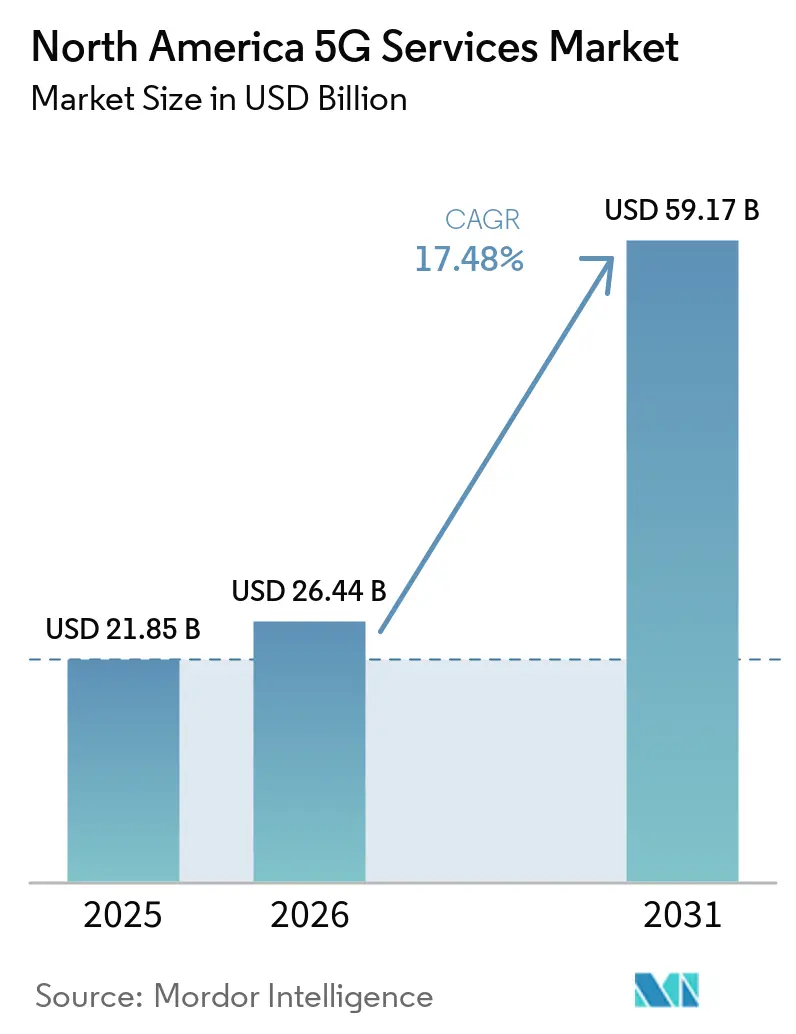
| Base Year Market Size (2025) | USD 21.85 Billion |
| Market Size (2026) | USD 26.44 Billion |
| Market Size (2031) | USD 59.17 Billion |
| Growth Rate (2026 - 2031) | 17.48 % |
| Market Concentration | Medium |
Major Players *Disclaimer: Major Players sorted in no particular order Image © Mordor Intelligence. Reuse requires attribution under CC BY 4.0. | |
North America 5G Services Market Analysis by Mordor Intelligence
The North America 5G Services Market size is expected to grow from USD 21.85 billion in 2025 to USD 26.44 billion in 2026 and is forecast to reach USD 59.17 billion by 2031 at 17.48% CAGR over 2026-2031.
Rising wireless data use, private-network adoption, and spectrum monetization support demand across consumer, enterprise, and infrastructure services. The North America 5G services market has moved beyond basic coverage expansion because mid-band coverage already reaches much of the population. Operators therefore have stronger reasons to focus on service quality, network slicing, and edge computing revenue. Fixed wireless access is widening broadband competition in urban and rural areas, while industrial users are seeking dependable connectivity for automation and public-safety applications. Investment plans differ sharply among carriers, which may create different network capability timelines and reinforce competition around coverage, capacity, and bundled offers.
Key Report Takeaways
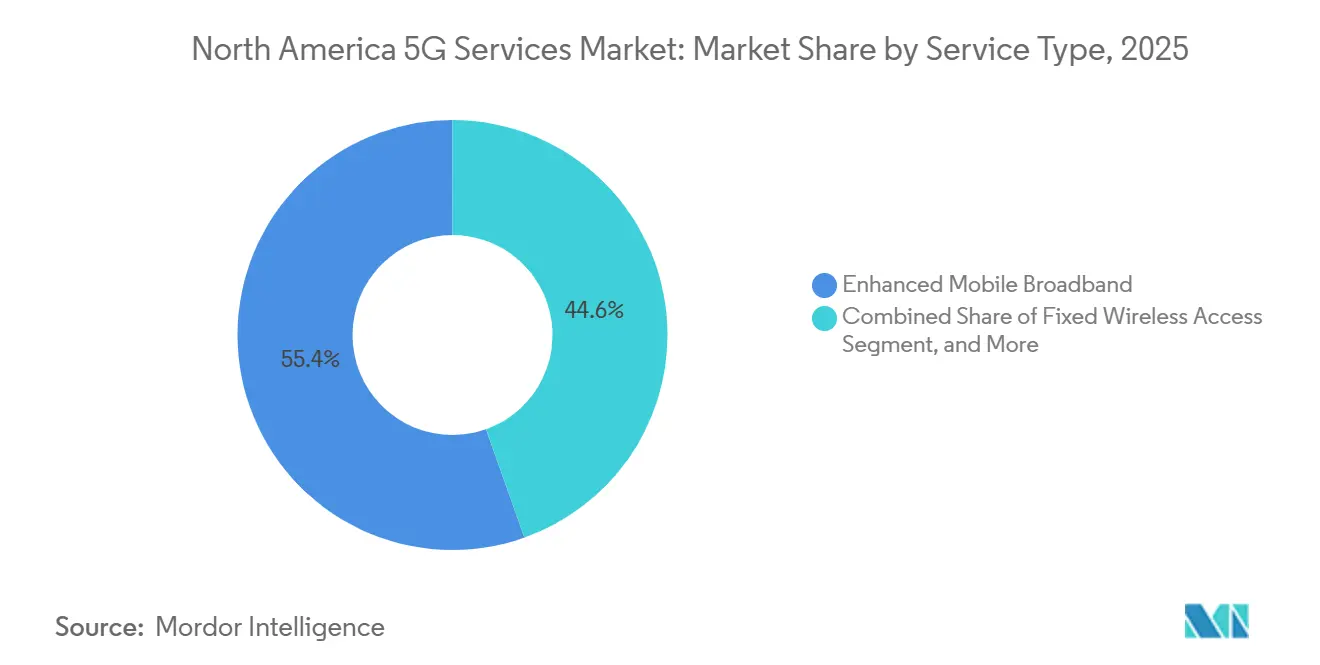
- By service type, enhanced mobile broadband held 55.43% revenue share of the North America 5G Services Market in 2025, while fixed wireless access is projected to expand at a 21.23% CAGR through 2031.
- By network architecture, non-standalone 5G held 65.27% share of the North America 5G Services Market in 2025, while standalone 5G is expected to expand at a 23.47% CAGR through 2031.
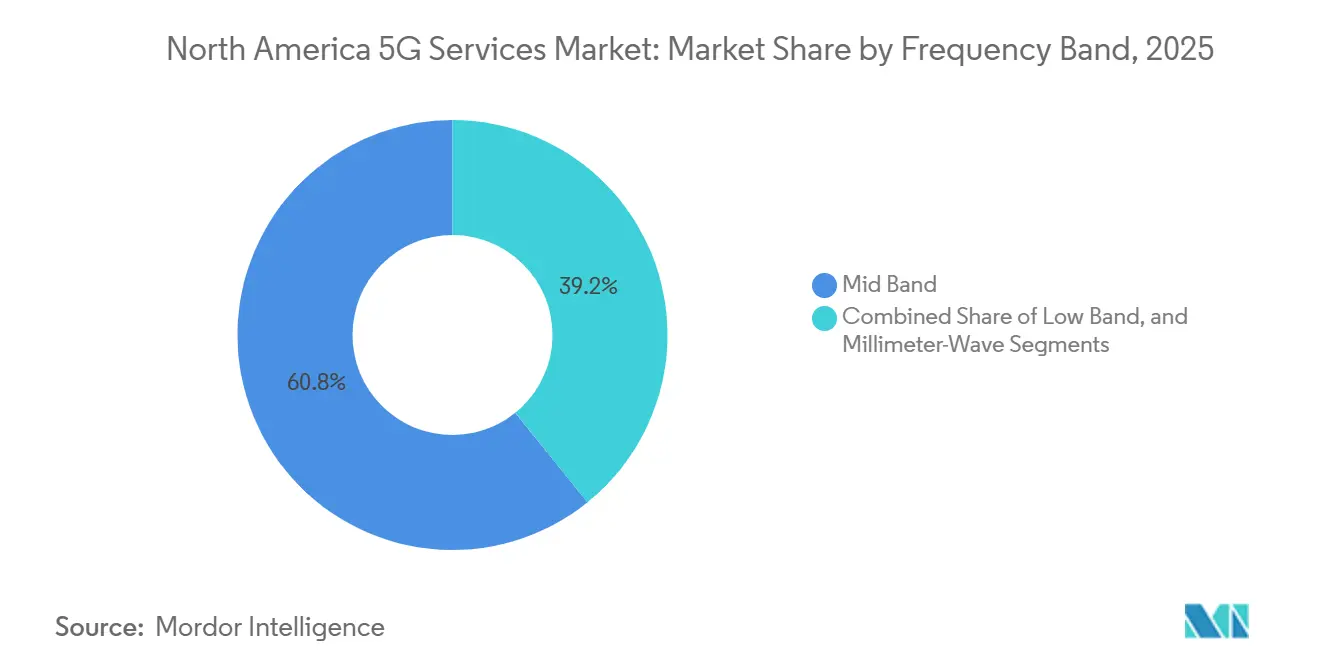
- By frequency band, mid-band held 60.81% share in 2025, while millimeter-wave is projected to expand at a 22.16% CAGR through 2031.
- By end-user industry, IT and telecom held 24.63% share in 2025, while automotive, mobility, and transportation is expected to expand at a 21.38% CAGR through 2031.
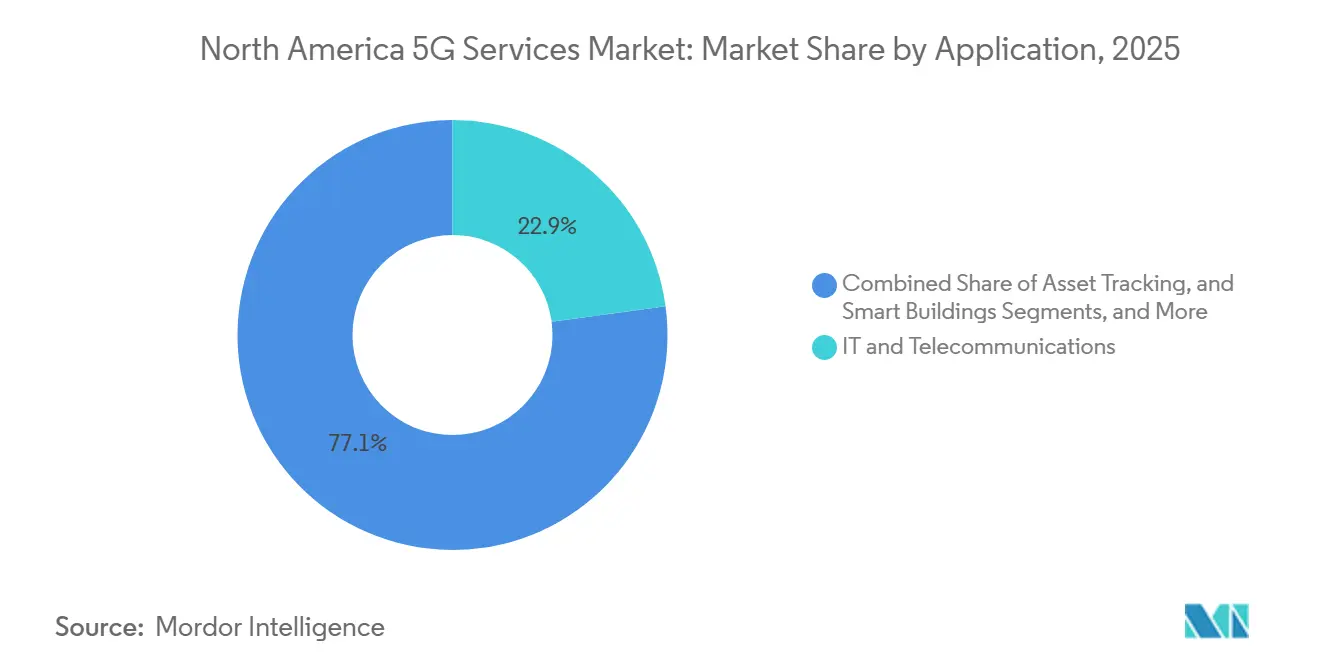
- By application, IT and telecommunications held 22.87% share in 2025, while autonomous vehicles and V2X is projected to expand at a 24.27% CAGR through 2031.
- By geography, the United States held 88.46% share in 2025, while Mexico is expected to expand at a 20.13% CAGR through 2031.
Note: Market size and forecast figures in this report are generated using Mordor Intelligence’s proprietary estimation framework, updated with the latest available data and insights as of January 2026.
North America 5G Services Market Trends and Insights
Drivers Impact Analysis*
| Driver | (~) % Impact on CAGR Forecast | Geographic Relevance | Impact Timeline |
|---|---|---|---|
| 5G Migration and Rising Data Consumption | +4.2% | North America, strongest in the United States and Canada | Short term (≤ 2 years) |
| Enterprise Industry 4.0 and Mission-Critical Connectivity | +3.5% | United States and Canada core, with spillover to Mexico | Medium term (2-4 years) |
| 5G Fixed Wireless Access Expansion | +3.1% | United States core, expanding to rural Canada and Mexico | Short term (≤ 2 years) |
| CBRS and Mid-Band Spectrum Liberalization | +2.6% | United States primarily, with early spillover to Canada | Medium term (2-4 years) |
| Standalone 5G, Network Slicing, and Edge Monetization | +2.3% | North America, strongest in the United States | Medium term (2-4 years) |
| AI-Native RAN and Cloud-Network Convergence | +1.8% | Global, led by the United States | Long term (≥ 4 years) |
| Source: Mordor Intelligence | |||
5G Migration and Rising Data Consumption
Americans used 132 trillion megabytes of wireless data in 2024, marking the third consecutive year of 35% growth. Mobile data traffic in North America increased 22% year over year in the first quarter of 2026. North America recorded 363 million 5G connections by the third quarter of 2025, covering close to 95% of the regional population.[1]5G Americas, “U.S. Nears Universal 5G Adoption as North America Leads the World,” 5G Americas, 5gamericas.org. Per-user monthly consumption is projected to increase from 25 GB in 2025 to 52 GB by 2031, requiring continued investment even after coverage reaches mature levels. The North America 5G services market can increasingly rely on differentiated data plans and enterprise service levels rather than subscriber additions alone.
Enterprise Industry 4.0 and Mission-Critical Connectivity
Private 5G adoption is moving from isolated pilots toward deployments across multiple operating sites. Hyundai’s USD 7.59 billion Metaplant America in Georgia uses a Nokia-supplied private 5G network for more than 200 autonomous mobile robots. More than half of U.S. manufacturers used AI in operations in 2025, and 61% expected AI investment to increase by 2027. Enterprise 5G transformation can span 5-7 years, which supports long-term managed-service relationships for operators that secure early contracts. In July 2026, AT&T and the First Responder Network Authority activated a nationwide standalone core for public safety that supports application-specific slicing.
5G Fixed Wireless Access Expansion
The 3 largest U.S. carriers in the North America 5G services market added nearly 1 million fixed wireless access connections in the first quarter of 2026. T-Mobile US ended 2025 with 8.5 million fixed wireless access connections and raised its 2030 target to 15 million. The FCC recorded 11.5 million licensed fixed wireless connections in the United States in June 2025, compared with 8.9 million in June 2024. Urban users accounted for 70% of fixed wireless access test samples in the second quarter of 2026, showing that competition with cable operators extends beyond rural broadband gaps. Providers in the North America 5G services market are using speed-based pricing more often as fixed wireless access becomes a mainstream broadband offer.
CBRS and Mid-Band Spectrum Liberalization
CBRS supports 75% of U.S. private 5G networks, with more than 420,000 base stations deployed nationally. Manufacturing, ports, campuses, and energy operations use this shared spectrum to support local wireless networks. Annual CBRS network investment was expected to reach USD 350 million in 2026, after USD 302 million in 2025. TELUS acquired 3800 MHz spectrum licenses in British Columbia and Alberta for CAD 317.6 million (USD 233.5 million) under Canada’s licensing framework. Mid-band population coverage in North America exceeded 90% by the end of 2024, supporting the economics of fixed wireless access and enterprise networks.
Restraints Impact Analysis*
| Restraint | (~) % Impact on CAGR Forecast | Geographic Relevance | Impact Timeline |
|---|---|---|---|
| High Capital Intensity and Extended Payback Periods | -2.1% | North America, most acute in the United States | Medium term (2-4 years) |
| Permitting Friction and Multi-Jurisdiction Deployment Delays | -1.7% | United States and Mexico, with some impact in Canada | Short term (≤ 2 years) |
| Weak Consumer Price Premium and ARPU Compression | -1.3% | United States and Canada | Medium term (2-4 years) |
| Cybersecurity Exposure and Vendor-Supply Restrictions | -0.9% | United States and Canada primarily | Long term (≥ 4 years) |
| Source: Mordor Intelligence | |||
High Capital Intensity and Extended Payback Periods
Network investment remains a major constraint for the North America 5G services market because revenue from advanced enterprise services develops over time. AT&T committed more than USD 250 billion over 5 years to U.S. connectivity infrastructure in March 2026.[2]AT&T, “AT&T Announces USD 250 Billion Commitment to Advance U.S. Connectivity,” AT&T, att.com. Verizon guided USD 16-16.5 billion of 2026 capital spending, while T-Mobile guided USD 10 billion. Small-cell and millimeter-wave deployments need long amortization periods, especially where operators are building capacity for dense urban services. Standalone cores, slicing platforms, and AI-native RAN software add costs beyond spectrum and radio infrastructure, extending payback periods for integrated upgrades.
Permitting Friction and Multi-Jurisdiction Deployment Delays
Municipal permitting, preservation rules, and antenna siting limits can delay small-cell deployment in U.S. urban areas. These delays can slow the shift from basic coverage toward the dense capacity required for enterprise-grade services. Mexico had not confirmed a replacement spectrum auction timetable by late 2025, and proposed accumulation limits prompted AT&T to signal reluctance to participate. Telcel had surpassed 60% population coverage by the end of 2025, but broader densification still depends on spectrum policy. The USD 42.5 billion BEAD program supports rural broadband, but it does not resolve local urban permitting barriers.
*Our forecasts treat driver/restraint impacts as directional, not additive. The impact forecasts reflect baseline growth, mix effects, and variable interactions.
Segment Analysis
By Service Type: Fixed Wireless Access Reshapes the Revenue Mix
Enhanced mobile broadband held 55.43% of the North America 5G services market share in 2025, supported by smartphone adoption and video traffic. Video represented 75% of global mobile data traffic, which sustained demand for high-capacity mobile services. Fixed wireless access is projected to expand at a 21.23% CAGR through 2031 because mid-band 5G can compete with cable and DSL broadband. Ultra-reliable low-latency communications supports public safety and industrial automation. Massive machine-type communications supports smart-city systems and logistics asset tracking.
Global 5G subscriptions are projected to reach 6.4 billion by the end of 2031, with 65% using standalone 5G. North American 5G subscription penetration is expected to approach or exceed 90%, which shifts commercial attention toward service differentiation. Speed-based tariffs appeared in 57% of fixed wireless access offers in 2026, compared with 40% in 2024. T-Mobile has bundled 5G and satellite connectivity in a managed business fixed wireless offer. This approach places service quality and resilience alongside access hardware in the North America 5G services market.



By Network Architecture: Standalone 5G Unlocks Enterprise Revenue Potential
Non-standalone 5G held 65.27% of the North America 5G services market size in 2025 because many carriers initially launched 5G on 4G LTE cores. Standalone 5G is expected to expand at a 23.47% CAGR through 2031. AT&T launched a nationwide standalone core in October 2025, and Verizon activated standalone 5G in June 2025. T-Mobile launched standalone 5G nationally in August 2020 and continued to expand its slicing portfolio.
Standalone architecture enables network slicing, enforceable quality of service, and distributed edge computing without LTE fallback. These capabilities are relevant to the highest-value enterprise uses where predictable performance is required. AT&T operates distributed edge computing zones across the United States with AWS and Microsoft Azure for latency-sensitive workloads. In Canada, Bell activated a standalone core using n77 spectrum in the Greater Toronto and Hamilton Area. TELUS is extending standalone coverage through western Canadian urban corridors. This architecture broadens the service categories that operators can offer enterprise customers in the North America 5G services market.
By Frequency Band: Mid-Band Holds the Volume Anchor, Millimeter-Wave Pursues Urban Value
Mid-band held 60.81% share in 2025 and remained the North America 5G services market’s main layer for consumer, fixed wireless, and private-network services. C-band at 3.45 GHz and CBRS at 3.55-3.7 GHz combine coverage and capacity for broadband substitution. Millimeter-wave is projected to expand at a 22.16% CAGR through 2031 in dense urban locations. The FCC allocated more than 4,600 MHz of high-band spectrum across 5 bands.[3]Federal Communications Commission, “Broadband Data Collection,” Federal Communications Commission, fcc.gov. This allocation supports a substantial U.S. commercial advantage in millimeter-wave services.
Verizon recorded 5.49 Gbps peak speeds in urban millimeter-wave testing in the fourth quarter of 2025. Its millimeter-wave footprint expanded from 75 metropolitan areas in early 2024 to 91 areas in the second half of 2025. Low-band services face limits where users require greater throughput and lower latency. Revenue can therefore shift toward mid-band and millimeter-wave service tiers during the forecast period. FDD massive MIMO can extend mid-band capacity without a new spectrum allocation.
By End-User Industry: Enterprise Diversification Across Verticals Accelerates
IT and telecom held 24.63% share in 2025 because the sector both consumes 5G services and integrates deployments for other verticals. Automotive, mobility, and transportation is expected to expand at a 21.38% CAGR through 2031. Hyundai uses private 5G at its Georgia facility to coordinate more than 200 autonomous mobile robots. Manufacturing, energy, and utilities benefit from CBRS-based private-network economics. The North America 5G services industry also requires standards-based interoperability in major manufacturing procurement.
CBRS supports 75% of U.S. private 5G networks, and close to 260 manufacturers were active in the ecosystem. Healthcare, government and defense, banking, financial services, insurance, and RegTech remain at earlier commercial stages. Standalone 5G slices can support uses that require reliable and deterministic performance. More than half of U.S. manufacturers used AI in operations in 2025. This link between AI adoption and connected operations provides a continuing basis for enterprise demand.
By Application: Autonomous V2X Anchors the Long-Term Revenue Frontier
IT and telecommunications held 22.87% share in 2025, reflecting enterprise use of 5G for cloud communications, collaboration, and data connectivity. Autonomous vehicles and V2X is projected to expand at a 24.27% CAGR through 2031. Atlanta became the first U.S. Day One Deployment District for C-V2X technology in September 2025. The Georgia Department of Transportation and 5GAA members installed permanent roadside C-V2X infrastructure. This installation marked a move from pilot activity toward production-grade vehicle communications.
Verizon’s Edge Transportation Exchange has users including the Arizona Commerce Authority, Delaware Department of Transportation, and Volkswagen Group of America.[4]Verizon, “Verizon, Qualcomm Ramp Up V2X Platforms,” Verizon, verizon.com. Smart cities, buildings, healthcare, Industry 4.0, utilities, asset tracking, immersive media, gaming, and public safety broaden the potential application base. AT&T activated a dedicated FirstNet 5G standalone core in July 2026 for public-safety use. Research published by IEEE identified 5G URLLC as an enabling architecture for robotic automation, predictive maintenance, and real-time vehicle coordination. These use cases extend the North America 5G services market beyond consumer mobility.
Geography Analysis
The United States held 88.46% of the North America 5G services market share in 2025, supported by its licensed 5G spectrum portfolio and large carrier investment cycle. Mobile 5G NR coverage at 35/3 Mbps reached 327 million people, or 95.2% of the U.S. population, in June 2025. AT&T’s USD 23 billion EchoStar spectrum acquisition received FCC approval in May 2026. This added 50 MHz of nationwide mid-band and low-band spectrum across nearly all U.S. markets. The FirstNet standalone core activated in July 2026 provides application-specific slicing for mission-critical users.
Canada’s 5G path is shaped by vendor transitions and Open RAN commitments. TELUS committed CAD 66 billion (USD 48.5 billion) through 2030 for connectivity and AI capacity. Its 5G coverage exceeded 90% of Canada’s population by the end of 2025, and it had more than 160 cell towers under construction in 2026. Rogers began phasing out 3G in August 2025 to free 850 MHz spectrum for 4G and 5G capacity. Bell activated a standalone core using n77 spectrum in the Greater Toronto and Hamilton Area.[5]Rogers Communications, “Rogers Expands 5G Service Along Highway 97 in British Columbia,” Rogers Communications, rogers.com.
Mexico is expected to expand at a 20.13% CAGR through 2031, making it the fastest-growing geography in the North America 5G services market. Telcel surpassed 60% population coverage by the end of 2025 and operated 5G services in more than 125 cities. AT&T Mexico covered 56 cities, while Movistar covered 38 cities. Mexico’s unresolved spectrum auction timetable may concentrate future densification in a single dominant operator. Integration with North American manufacturing supply chains can support private 5G demand in logistics and cross-border industrial automation when spectrum policy is resolved.
Competitive Landscape
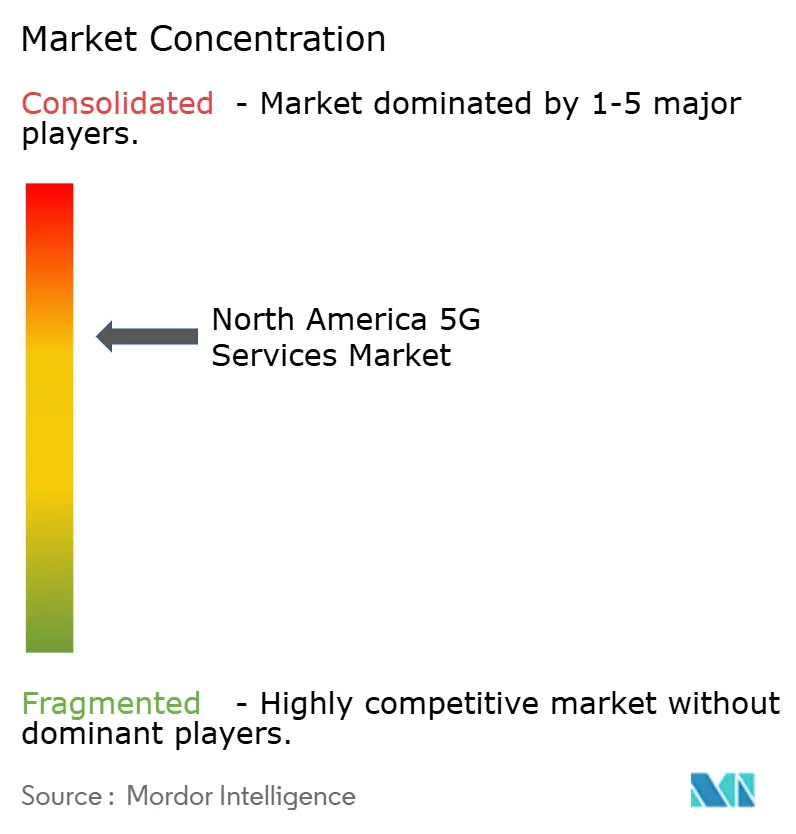
The North America 5G services market is moderately consolidated in carrier services, with 3 major U.S. operators, 3 Canadian incumbents, and a Mexican duopoly led by Telcel and AT&T. The infrastructure and software ecosystem remains more fragmented. Operators are combining fiber, fixed wireless access, and 5G wireless offers to reduce churn and strengthen household and enterprise relationships. AT&T, T-Mobile, and Verizon reached an agreement in principle in 2026 to establish a joint venture for dead-zone elimination and satellite connectivity pooling. This move shows that infrastructure collaboration can occur alongside service-level competition.
T-Mobile and Ericsson completed commercial trials of an AI-native RAN scheduler on live 5G Advanced traffic in May 2026. The trials reported 10% spectral efficiency gains and up to 15% faster downlink throughput. Nokia launched an AI-native RAN platform in July 2026 that supports open, multivendor deployments. These actions place AI-native RAN and 3GPP Release 18 and 19 capability at the center of infrastructure procurement.[6]Nokia, “Nokia Defines the Next Era of Radio with the Industry’s First AI-Native RAN Platform,” Nokia, nokia.com.
Mavenir supplies cloud-native Open RAN software, while Celona focuses on CBRS-based enterprise private networks. DISH Wireless continues to pursue a cloud-native Open RAN architecture despite commercial-scale challenges. Qualcomm’s acquisition of Autotalks strengthened its position in automotive connectivity, which is the fastest-growing application area. The FCC’s rip-and-replace program limits Huawei and ZTE participation in new U.S. deployments. This restriction supports demand for standards-certified Open RAN suppliers across the North America 5G services market.
North America 5G Services Industry Leaders
Verizon Communications Inc.
T-Mobile US, Inc.
AT&T Inc.
Rogers Communications Inc.
BCE Inc.
- *Disclaimer: Major Players sorted in no particular order

Recent Industry Developments
- August 2026: AT&T selected Ericsson to provide 600 MHz dual-band radios for deployment of newly acquired EchoStar spectrum, supporting improvements in wireless capacity, coverage, reliability, and performance, including in indoor and rural areas.
- July 2026: FirstNet, built with AT&T, launched a nationwide 5G Standalone core dedicated exclusively to public safety. The dedicated core is designed to provide first responders with greater reliability, security, control, faster uplink speeds, and improved responsiveness while supporting future application-specific capabilities for mission-critical communications and other public-safety applications.
- July 2026: Nokia launched a commercial AI-native RAN platform based on its anyRAN software and NVIDIA accelerated computing. The platform supports three hardware deployment paths, including an AI-accelerated upgrade for existing AirScale deployments, enabling operators to introduce AI-RAN capabilities while preserving existing infrastructure investments.
- May 2026: AT&T completed its acquisition of 50 MHz of EchoStar spectrum following FCC approval, comprising 30 MHz of mid-band and 20 MHz of low-band spectrum for USD 23 billion. The additional spectrum is intended to strengthen AT&T's 5G capacity and coverage, particularly in rural and underserved areas.


North America 5G Services Market Report Scope
The North America 5G Services Market Report is Segmented by Service Type (Enhanced Mobile Broadband, Ultra-Reliable Low-Latency Communications, Massive Machine-Type Communications, and Fixed Wireless Access), Network Architecture (Non-Standalone 5G, and Standalone 5G), Frequency Band (Low Band, Mid Band, and Millimeter-Wave), End-User Industry (IT and Telecom, Automotive, Mobility and Transportation, Manufacturing, Energy and Utilities, Healthcare and Life Sciences, Banking, Financial Services, Insurance and RegTech, Retail, Media and E-Commerce, Government, Defense, Education and Public Sector, and Other Industries), Application (Communication and Collaboration, Asset Tracking, Smart Cities, Smart Buildings, Autonomous Vehicles and Vehicle-to-Everything, Smart Healthcare, Industry 4.0, Smart Utilities, Immersive Media and Gaming, and Public Safety and Mission-Critical Communications), and Geography (United States, Canada, and Mexico). The Market Forecasts are provided in terms of Value (USD).
| Enhanced Mobile Broadband |
| Ultra-Reliable Low-Latency Communications |
| Massive Machine-Type Communications |
| Fixed Wireless Access |
| Non-Standalone 5G |
| Standalone 5G |
| Low Band |
| Mid Band |
| Millimeter-Wave |
| IT and Telecom |
| Automotive, Mobility and Transportation |
| Manufacturing, Energy and Utilities |
| Healthcare and Life Sciences |
| Banking, Financial Services, Insurance and RegTech |
| Retail, Media and E-Commerce |
| Government, Defense, Education and Public Sector |
| Other End-User Industries |
| IT and Telecommunications |
| Communication and Collaboration |
| Asset Tracking |
| Smart Cities |
| Smart Buildings |
| Autonomous Vehicles and Vehicle-to-Everything |
| Smart Healthcare |
| Industry 4.0 |
| Smart Utilities |
| Immersive Media and Gaming |
| Public Safety and Mission-Critical Communications |
| United States |
| Canada |
| Mexico |
| By Service Type | Enhanced Mobile Broadband |
| Ultra-Reliable Low-Latency Communications | |
| Massive Machine-Type Communications | |
| Fixed Wireless Access | |
| By Network Architecture | Non-Standalone 5G |
| Standalone 5G | |
| By Frequency Band | Low Band |
| Mid Band | |
| Millimeter-Wave | |
| By End-User Industry | IT and Telecom |
| Automotive, Mobility and Transportation | |
| Manufacturing, Energy and Utilities | |
| Healthcare and Life Sciences | |
| Banking, Financial Services, Insurance and RegTech | |
| Retail, Media and E-Commerce | |
| Government, Defense, Education and Public Sector | |
| Other End-User Industries | |
| By Application | IT and Telecommunications |
| Communication and Collaboration | |
| Asset Tracking | |
| Smart Cities | |
| Smart Buildings | |
| Autonomous Vehicles and Vehicle-to-Everything | |
| Smart Healthcare | |
| Industry 4.0 | |
| Smart Utilities | |
| Immersive Media and Gaming | |
| Public Safety and Mission-Critical Communications | |
| By Geography | United States |
| Canada | |
| Mexico |


Key Questions Answered in the Report
What is the size of the North America 5G services market?
The North America 5G services market size is estimated at USD 26.44 billion in 2026 and is projected to reach USD 59.17 billion by 2031 at a 17.48% CAGR.
What is driving demand for 5G services in North America?
Rising wireless data use, fixed wireless access, private 5G deployment, and demand for industrial automation are supporting adoption.
Which 5G service type is expanding fastest in North America?
Fixed wireless access is projected to expand at a 21.23% CAGR through 2031, ahead of the other listed service types.
Which network architecture has the highest projected CAGR?
Standalone 5G is expected to expand at a 23.47% CAGR through 2031 because it enables slicing, quality controls, and edge computing.
Which application has the highest projected CAGR for 5G services?
Autonomous vehicles and V2X is projected to expand at a 24.27% CAGR through 2031.
Which country is expanding fastest for 5G services in North America?
Mexico is expected to expand at a 20.13% CAGR through 2031, supported by manufacturing links and scope for private-network adoption.
Page last updated on:





