
North Africa Poultry Meat Market Size and Share
Market Overview
| Study Period | 2021 - 2031 |
|---|---|
| Forecast Data Period | 2026 - 2031 |
| Base Year Market Size (2025) | USD 8.49 Billion |
| Market Size (2026) | USD 8.83 Billion |
| Market Size (2031) | USD 11.40 Billion |
| Growth Rate (2026 - 2031) | 5.22 % |
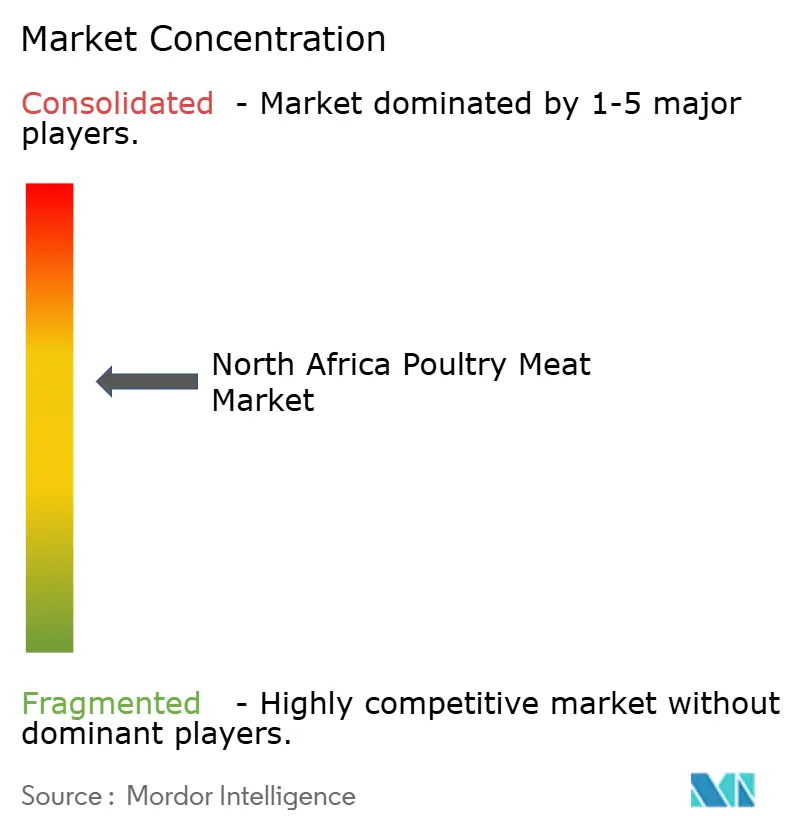
| Market Concentration | Medium |
Major Players
*Disclaimer: Major Players sorted in no particular order Image © Mordor Intelligence. Reuse requires attribution under CC BY 4.0. |
|
North Africa Poultry Meat Market Analysis by Mordor Intelligence
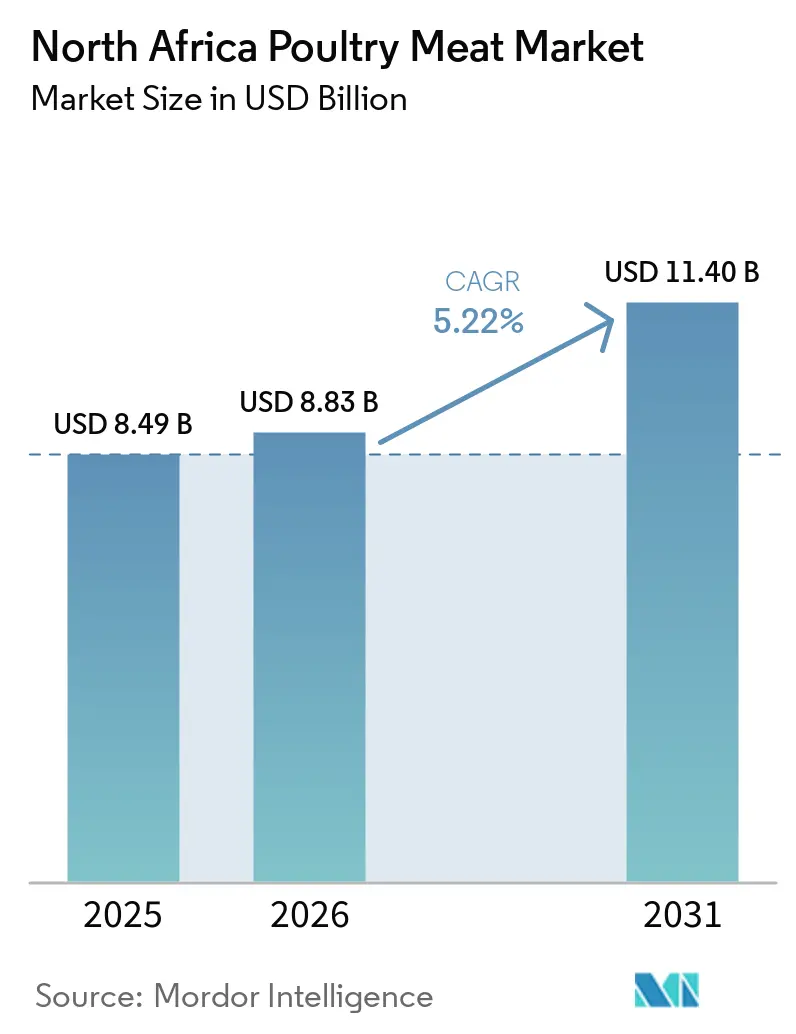
The North Africa poultry meat market size is expected to grow from USD 8.49 billion in 2025 to USD 8.83 billion in 2026 and is forecast to reach USD 11.40 billion by 2031 at a 5.22% CAGR over 2026-2031. The market is experiencing steady growth, driven by increasing consumer preference for poultry as an affordable source of animal protein, supported by population growth, urbanization, and changing dietary habits. Rising investments in poultry farming, processing facilities, cold-chain infrastructure, and production technologies are improving supply efficiency and availability of poultry products across retail and foodservice channels. However, the market faces challenges from feed cost fluctuations, dependence on imported feed ingredients, disease outbreaks affecting poultry flocks, and evolving food safety and animal health regulations, which continue to influence production costs and operational efficiency.
Key Report Takeaways
- By product type, chicken held 74.55% of revenue in 2025 across North Africa, while turkey is forecast to expand at a 6.05% CAGR through 2031.
- By form, fresh/chilled accounted for 58.46% share in 2025 across the region, while processed poultry is projected to grow at a 6.14% CAGR through 2031.
- By distribution channel, off-trade held 68.44% of the North Africa poultry meat market size in 2025, while on-trade is forecast to rise at a 6.29% CAGR through 2031.
- By geography, Egypt held 32.86% of the North Africa poultry meat market size in 2025, while Rest of North Africa is projected to advance at a 6.12% CAGR through 2031.
Note: Market size and forecast figures in this report are generated using Mordor Intelligence’s proprietary estimation framework, updated with the latest available data and insights as of January 2026.
North Africa Poultry Meat Market Trends and Insights
Drivers Impact Analysis*
| Driver | (~) % Impact on CAGR Forecast | Geographic Relevance | Impact Timeline |
|---|---|---|---|
| Growing consumption of affordable poultry protein | +1.4% | Regional, strongest in Egypt, Morocco, and Algeria | Short term (≤ 2 years) |
| Increasing investment in poultry farming technologies and production efficiency | +1.0% | Egypt first, with spillover to Morocco and Algeria | Medium term (2-4 years) |
| Expansion of modern retail and quick-service restaurant networks | +0.9% | Egypt and Morocco urban corridors, emerging in Algeria | Medium term (2-4 years) |
| Government support for domestic poultry production and food security | +0.6% | Regional, strongest in Egypt and Algeria | Long term (≥ 4 years) |
| Expansion of cold-chain infrastructure and poultry processing capacity | +0.7% | Algeria, Morocco, and Egypt | Medium term (2-4 years) |
| Strengthening food safety standards and supply chain formalization | +0.4% | Morocco, Egypt, and Algeria | Long term (≥ 4 years) |
| Source: Mordor Intelligence | |||
Growing Consumption of Affordable Poultry Protein
The growing preference for poultry as an affordable source of animal protein continues to support the North Africa poultry meat market, driven by its cost advantage and favorable nutritional profile compared to other meat types. According to the Organisation for Economic Co-operation and Development (OECD) and Food and Agriculture Organization (FAO) Agricultural Outlook 2025–2034, global poultry consumption is projected to increase by approximately 21% by 2034, the highest growth among all major meat categories[1]Source: Organisation for Economic Co-operation and Development, "OECD‑FAO Agricultural Outlook 2025‑2034",oecd.org. The Outlook further projects that poultry will account for 62% of the additional meat consumed globally over the forecast period. Africa's meat consumption is expected to increase by 33% over the next decade, reflecting sustained regional demand for animal protein, with poultry expected to remain a key beneficiary due to its affordability[2]Source: Organisation for Economic Co-operation and Development, "OECD‑FAO Agricultural Outlook 2025‑2034",oecd.org. Additionally, poultry is projected to provide 45% of all protein consumed from meat sources globally by 2034, reinforcing its position as the most accessible animal protein for consumers[3]Source: Organisation for Economic Co-operation and Development, "OECD‑FAO Agricultural Outlook 2025‑2034",oecd.org.
Increasing Investment in Poultry Farming Technologies and Production Efficiency
Growing investment in poultry farming technologies and production efficiency is supporting the growth of the North Africa poultry meat market by improving the productivity and competitiveness of commercial poultry operations. Producers are increasingly adopting climate-controlled poultry houses, automated feeding and watering systems, precision nutrition, and improved flock management practices to optimize production performance and reduce operational losses. Advancements in poultry genetics and modern production techniques are also contributing to improved feed conversion efficiency, bird health, and production consistency. These investments are enabling poultry producers to improve operational efficiency while meeting the region's rising demand for poultry meat.
Expansion of Modern Retail and Quick-Service Restaurant (QSR) Networks
The expansion of modern retail and quick-service restaurant (QSR) networks is contributing to the growth of the North Africa poultry meat market by increasing the availability and accessibility of poultry products. The growth of supermarkets, hypermarkets, convenience stores, and organized foodservice outlets has strengthened demand for fresh, chilled, frozen, and processed poultry products. Expanding QSR chains are also driving higher procurement of standardized poultry meat to meet consumer preferences for convenient and ready-to-eat meals. These developments are encouraging poultry producers and processors to improve product quality, packaging, and distribution capabilities to better serve organized retail and foodservice channels.
Government Support for Domestic Poultry Production and Food Security
Government initiatives to strengthen domestic poultry production and improve food security continue to support growth in the North Africa poultry meat market. Across the region, governments are implementing measures to improve livestock and poultry production, strengthen veterinary services, enhance disease surveillance, and encourage investment in commercial poultry farming. In July 2025, Egypt's Ministry of Agriculture announced that the country had achieved near-complete self-sufficiency in poultry as part of its broader food security strategy, supported by continued investments in animal health, veterinary services, and poultry sector development. These policy measures are improving the resilience of domestic poultry supply chains, supporting long-term growth, and reducing reliance on imported poultry products.
Restraints Impact Analysis*
| Restraint | (~) % Impact on CAGR Forecast | Geographic Relevance | Impact Timeline |
|---|---|---|---|
| Feed grain import dependence and cost volatility | -1.3% | Regional, most severe in Morocco and Algeria | Short term (≤ 2 years) |
| Avian influenza outbreaks and biosecurity challenges | -0.9% | Regional, with higher exposure in Egypt, Libya, and Morocco | Short term (≤ 2 years) and Medium term (2-4 years) |
| Power, water, and logistics constraints across poultry supply chains | -0.5% | Algeria, Morocco, and Egypt | Long term (≥ 4 years) |
| High dependence on imported breeding stock and veterinary inputs | -0.4% | Morocco and Algeria first, Egypt to a lesser extent | Medium term (2-4 years) |
| Source: Mordor Intelligence | |||
Feed Grain Import Dependence and Cost Volatility
Dependence on imported feed grains continues to restrain the growth of the North Africa poultry meat market by exposing producers to fluctuations in global commodity prices and supply chain disruptions. Poultry production in the region relies heavily on imported maize and soybean meal, which account for a significant share of overall production costs. Volatility in international feed grain markets can increase input costs, reduce producer margins, and create pricing uncertainty across the poultry value chain. These challenges are particularly significant for small and medium-sized producers with limited capacity to absorb rising feed costs or secure long-term supply contracts.
Avian Influenza Outbreaks and Biosecurity Challenges
Recurring avian influenza outbreaks and persistent biosecurity challenges continue to restrain growth in the North Africa poultry meat market by disrupting production and increasing operational risks. Disease outbreaks often lead to flock culling, movement restrictions, and temporary trade limitations, resulting in supply disruptions and financial losses for poultry producers. Maintaining effective biosecurity measures requires continuous investment in farm hygiene, disease surveillance, vaccination programs, and veterinary services, which increases production costs, particularly for small and medium-sized farms. These challenges continue to affect production stability and the resilience of poultry supply chains across the region.
*Our forecasts treat driver/restraint impacts as directional, not additive. The impact forecasts reflect baseline growth, mix effects, and variable interactions.
Segment Analysis
By Product Type: Chicken's Dominance Coexists with Turkey's Structural Growth
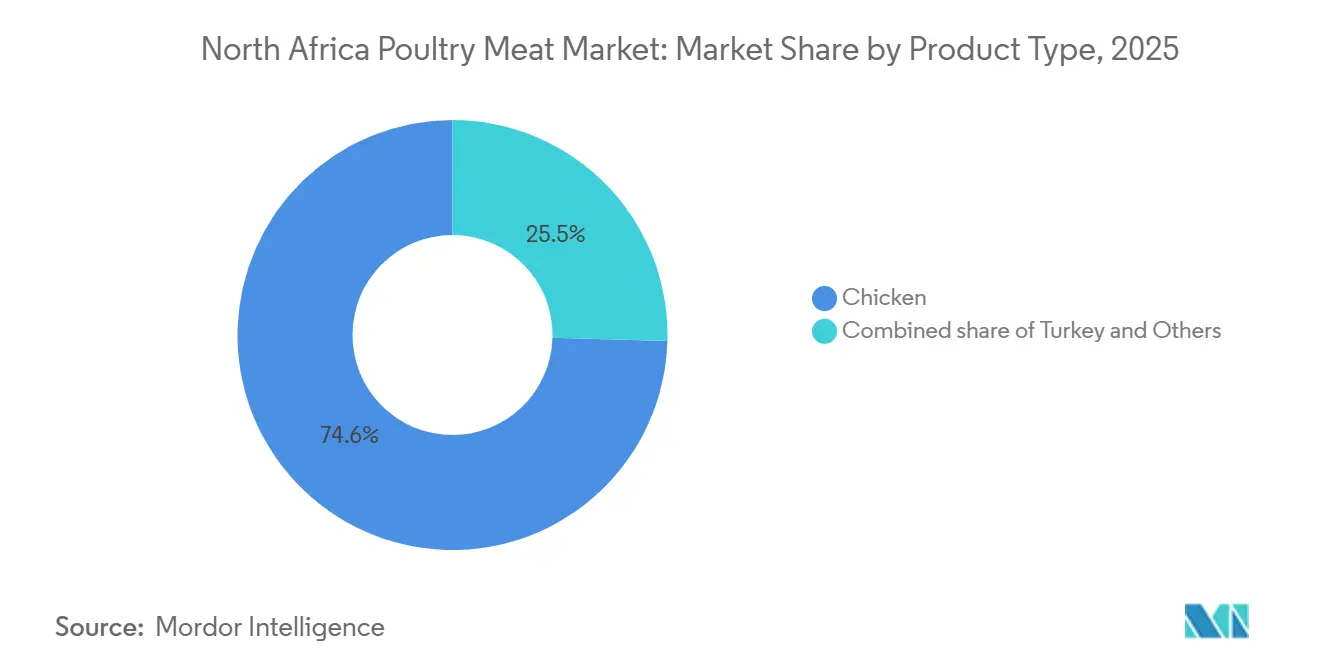
Chicken accounted for 74.55% of the North Africa poultry meat market by value in 2025, making it the largest product segment. This dominance is supported by its affordability, widespread consumer acceptance, and well-established production and distribution infrastructure across the region. Extensive commercial farming operations, integrated supply chains, and broad availability through retail and foodservice channels continue to strengthen chicken's market position. Its versatility across fresh, frozen, and processed product formats further contributes to sustained demand.
Turkey is projected to register the fastest CAGR of 6.05% during 2026–2031. Growth is supported by increasing consumer interest in diversified poultry products, expanding commercial turkey farming, and gradual improvements in breeding and production capabilities across the region. Government initiatives to strengthen domestic white meat production and investments in integrated poultry operations are also supporting the segment's expansion. Rising availability of turkey meat through organized retail and foodservice channels is expected to further drive market growth over the forecast period.



By Form: Fresh/Chilled Dominance Masks the Processed Segment's Strategic Value
Fresh/chilled poultry accounted for 58.46% of the North Africa poultry meat market by value in 2025, making it the largest form segment. This dominance is supported by strong consumer preference for freshly slaughtered poultry, widespread availability through traditional retail channels, and established domestic distribution networks. Fresh and chilled poultry remains the preferred choice for household consumption and foodservice applications due to its perceived freshness and quality. Its extensive availability across urban and rural markets further reinforces its market position.
Processed poultry is projected to register the fastest CAGR of 6.14% during 2026–2031. Growth is driven by increasing demand for convenient and value-added poultry products, including nuggets, sausages, marinated products, and ready-to-cook offerings. The expansion of organized retail, quick-service restaurant (QSR) chains, and modern food processing facilities is supporting the availability of processed poultry across the region. Strengthening food safety standards and ongoing investments in poultry processing and cold-chain infrastructure are also expected to contribute to the segment's continued growth.
By Distribution Channel: Off-Trade Breadth Meets On-Trade Momentum
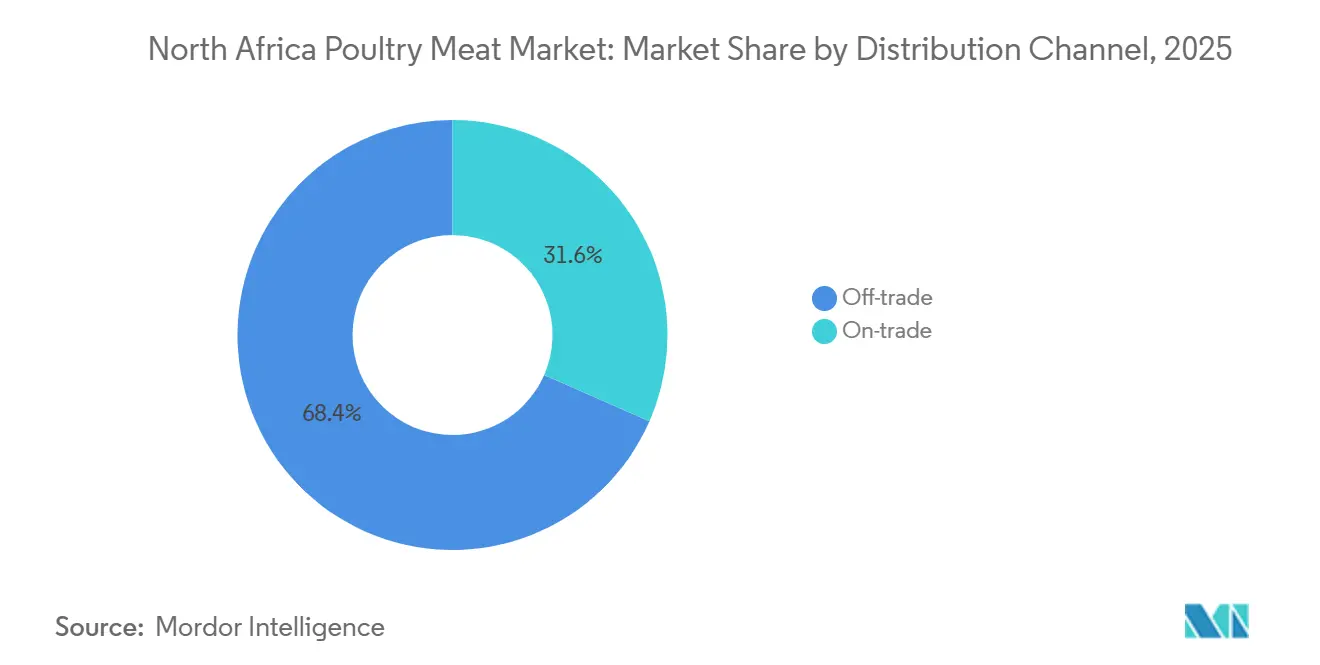
Off-trade channels accounted for 68.44% of the North Africa poultry meat market by value in 2025, making them the largest distribution channel. This dominance is supported by widespread consumer purchases through supermarkets, hypermarkets, traditional grocery stores, butcher shops, and other retail outlets. Strong accessibility, extensive product availability, and established retail networks continue to drive sales through off-trade channels. The growing presence of organized retail is also enhancing the availability of fresh, frozen, and processed poultry products across the region.
On-trade channels are projected to register the fastest CAGR of 6.29% during 2026–2031. Growth is driven by the expansion of hotels, restaurants, cafés, quick-service restaurants (QSRs), and catering services, which continue to increase poultry procurement volumes. Rising demand for convenient dining options and the growing preference for poultry-based menu offerings are supporting the segment's expansion. The increasing adoption of standardized sourcing practices and halal-certified poultry products by foodservice operators is further expected to contribute to the growth of the on-trade channel.
Geography Analysis
Egypt accounted for 32.86% of the North Africa poultry meat market by value in 2025, making it the largest regional market. This position is supported by a well-established commercial poultry industry, extensive production capacity, and an integrated value chain spanning hatcheries, feed production, farming, processing, and distribution. Government initiatives aimed at strengthening domestic poultry production and food security, along with strong consumer demand and an established retail network, continue to reinforce its dominant market position.
The rest of North Africa segment, comprising Tunisia, Libya, Mauritania, and Sudan, is projected to register the fastest CAGR of 6.12% during 2026–2031. Growth is expected to be driven by the increasing commercialization of poultry production systems and continued investments in processing, cold-chain infrastructure, and food safety standards. Ongoing efforts to improve domestic poultry production and supply chain efficiency are also expected to support market growth across these countries.
Morocco and Algeria hold significant positions in the North Africa poultry meat market alongside Egypt. Morocco benefits from a well-developed commercial poultry industry, strong domestic demand, and an established processing sector. Algeria continues to strengthen its poultry industry through government support and efforts to improve domestic production. Together, these two countries account for a substantial share of regional poultry production and consumption, contributing significantly to the overall development of the North Africa poultry meat market.
Competitive Landscape
The North Africa poultry meat market is moderately consolidated, with competition driven by a mix of large integrated poultry producers and established regional manufacturers. Major companies operating in the market include Cairo Poultry Company, Zalar Holding, Dakahlia Poultry, Mansoura Poultry Company, and Wadi Group. These companies compete on the basis of production capacity, product quality, distribution networks, vertical integration, and food safety standards, while maintaining their presence across fresh, frozen, and processed poultry product categories.
Leading market participants are focusing on expanding production capacity, enhancing processing capabilities, and strengthening vertically integrated operations to improve operational efficiency and secure raw material supply. Companies are also investing in modern poultry farming practices, processing facilities, cold-chain infrastructure, and product portfolio expansion to meet evolving consumer demand and comply with increasingly stringent food safety and quality standards. Strategic collaborations with modern retail and foodservice channels further support their competitive positioning.
The competitive landscape is also witnessing the emergence of regional poultry producers and specialized processors seeking to expand their market presence through product diversification, improved distribution networks, and enhanced production efficiency. Increasing emphasis on biosecurity, traceability, sustainability, and value-added poultry products is encouraging both established companies and emerging players to strengthen their market position and respond to evolving industry requirements.
North Africa Poultry Meat Industry Leaders
-
Zalar Holding
-
Cairo Poultry Company
-
Wadi Group
-
Dakahlia Poultry
-
Mansoura Poultry Company
- *Disclaimer: Major Players sorted in no particular order

Recent Industry Developments
- March 2026: Egypt’s Ministry of Agriculture and Land Reclamation issued 468 operating licenses for livestock, poultry, feed manufacturing, and milk collection activities during the first half of February 2026. The approvals included 22 new livestock and poultry facilities that received technical clearance after meeting preventive health and biosecurity requirements, supporting continued expansion of poultry production capacity in Egypt.
- October 2025: Cairo Poultry Company announced a USD 2.6 million investment in a new broiler production project in Egypt’s Sharqia Governorate. The facility is expected to add approximately 2.3 million birds to the company’s annual production capacity, strengthening its broiler production and supply capabilities in the Egyptian poultry market.
- November 2023: Mitsui & Co. acquired a stake in Wadi Poultry (part of Wadi Group), supporting the company's integrated poultry production and processing operations and its long-term expansion plans.


North Africa Poultry Meat Market Report Scope
The North Africa poultry meat market covers the production, processing, distribution, and sale of poultry meat products for retail, foodservice, and industrial applications across the region. The market is segmented by product type into chicken, turkey, and others; by form into fresh/chilled, frozen, canned, and processed; by distribution channel into on-trade and off-trade; and by geography into Morocco, Egypt, Algeria, and the Rest of North Africa. For each segment, the market sizing and forecasting have been done in value terms (USD billion) and volume (tons).
| Chicken |
| Turkey |
| Others |
| Fresh/Chilled | |
| Frozen | |
| Canned | |
| Processed | Nuggets |
| Deli Meats | |
| Sausages | |
| Tenders/Marinated | |
| Meatballs | |
| Others |
| On-Trade | Hotels |
| Restaurants | |
| Catering | |
| Off-Trade | Supermarkets/Hypermarkets |
| Convenience Stores | |
| Online Retail Channel | |
| Other Distribution Channel |
| Morocco |
| Egypt |
| Algeria |
| Rest of North Africa |
| By Product Type | Chicken | |
| Turkey | ||
| Others | ||
| By Form | Fresh/Chilled | |
| Frozen | ||
| Canned | ||
| Processed | Nuggets | |
| Deli Meats | ||
| Sausages | ||
| Tenders/Marinated | ||
| Meatballs | ||
| Others | ||
| By Distribution Channel | On-Trade | Hotels |
| Restaurants | ||
| Catering | ||
| Off-Trade | Supermarkets/Hypermarkets | |
| Convenience Stores | ||
| Online Retail Channel | ||
| Other Distribution Channel | ||
| By Geography | Morocco | |
| Egypt | ||
| Algeria | ||
| Rest of North Africa | ||


Key Questions Answered in the Report
What is the forecast value of North Africa poultry meat by 2031?
The North Africa poultry meat market is forecast to reach USD 11.40 billion by 2031, rising from USD 8.49 billion in 2025 at a 5.22% CAGR over 2026-2031.
Which product segment leads poultry meat demand in North Africa?
Chicken remains the leading product type, with 74.55% share in 2025, because it is the most affordable option and has the widest supply network across the region.
How are restaurant chains affecting poultry demand in the region?
Expanding chains such as Marrybrown and McDonald’s Egypt are increasing demand for standardized, halal-certified, chilled, and processed poultry products, which supports formal processors more than informal suppliers.
Which form of poultry meat is growing the fastest in North Africa?
Processed poultry is projected to expand at a 6.14% CAGR through 2031, supported by rising demand for convenience foods and better cold-chain coverage.
Page last updated on:


 Your data is secure and never sold or shared.


