
Non-Perishable Milk Market Size and Share
Market Overview
| Study Period | 2021 - 2031 |
|---|---|
| Market Size (2026) | USD 179.55 Billion |
| Market Size (2031) | USD 226.01 Billion |
| Growth Rate (2026 - 2031) | 4.71 % |
| Fastest Growing Market | Asia-Pacific |
| Largest Market | North America |
| Market Concentration | Low |
Major Players
*Disclaimer: Major Players sorted in no particular order Image © Mordor Intelligence. Reuse requires attribution under CC BY 4.0. |
|
Non-Perishable Milk Market Analysis by Mordor Intelligence
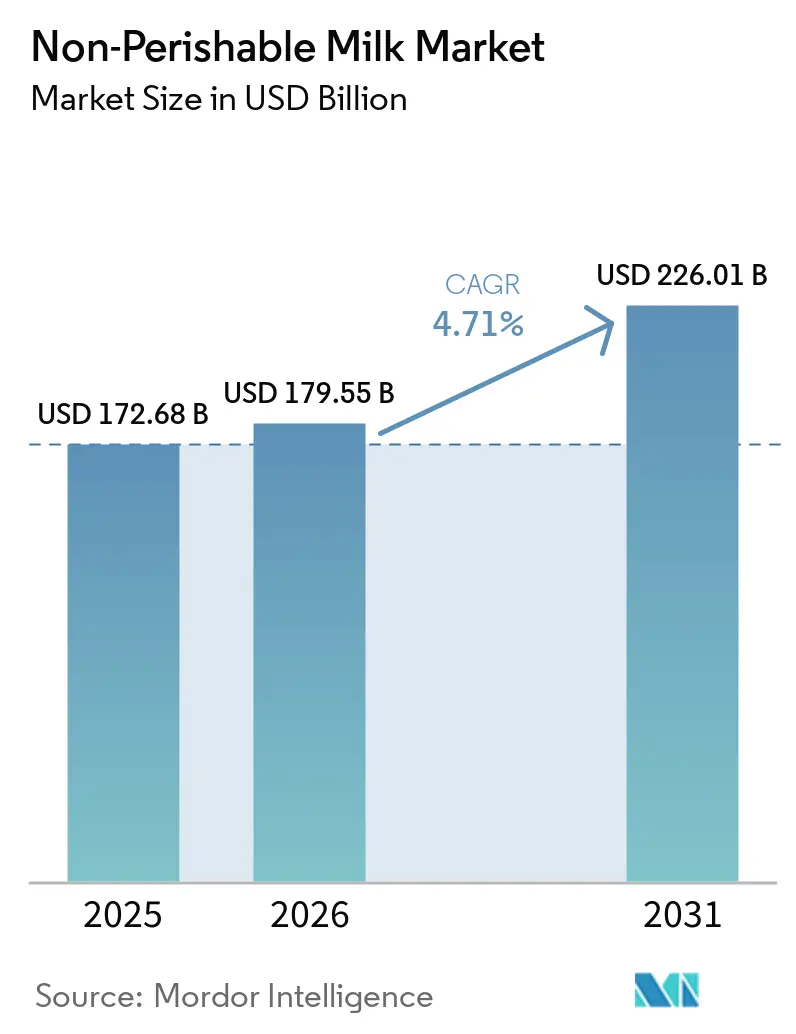
The non-perishable milk market size was valued at USD 172.68 billion in 2025 to reach USD 179.55 billion in 2026, and is forecast to reach USD 226.01 billion by 2031 at a 4.71% CAGR over 2026-2031. The non-perishable milk market serves retail, foodservice, and institutional buyers, where ambient storage helps address gaps in refrigerated distribution. Longer shelf life can reduce product losses, store-level replenishment requirements, and chilled display capacity costs. Processing and packaging improvements are making the non-perishable milk market more relevant to operational efficiency, product quality, and packaging sustainability. These factors create opportunities for processors to serve cross-border trade routes between dairy-surplus producers and import-dependent markets. However, the non-perishable milk market continues to face pressure from packaging input costs and consumers who prefer the taste of refrigerated fresh milk.
Key Report Takeaways
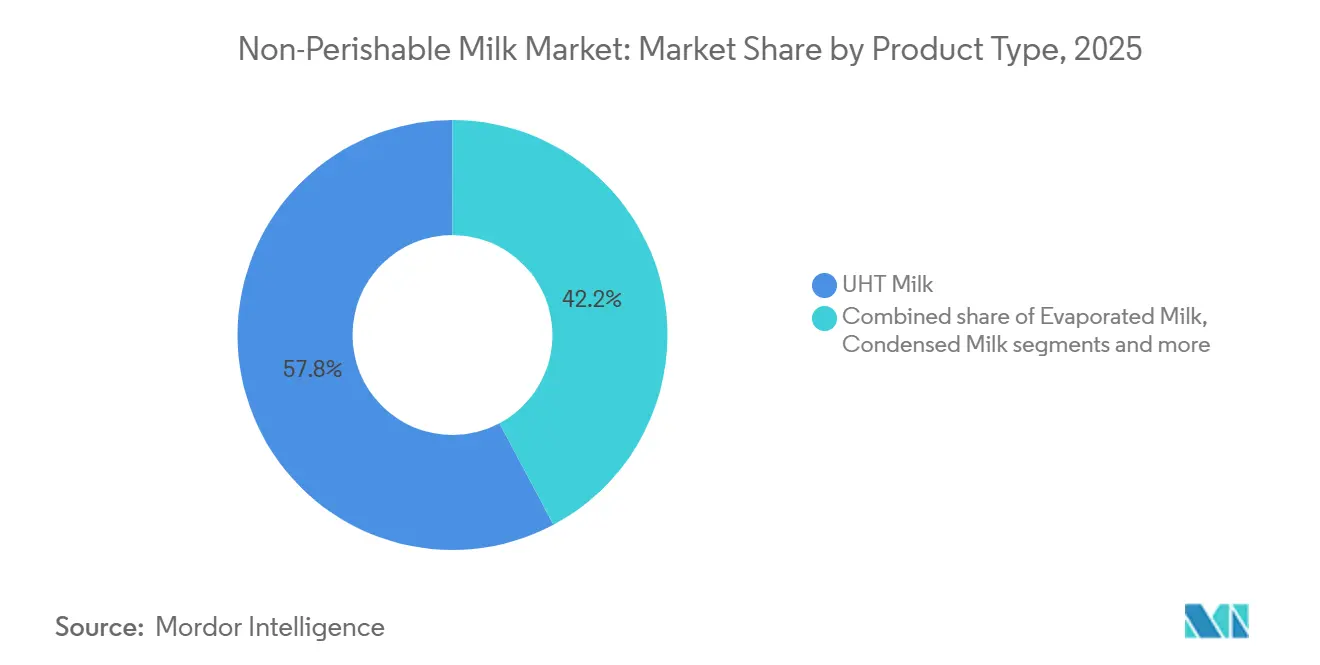
- By product type, UHT milk led the non-perishable milk market with a share of 57.78% in 2025, while condensed milk is anticipated to register the fastest CAGR of 6.83% during 2026-2031.
- By source, cow milk retained 67.95% share in 2025, whereas buffalo milk is forecast to expand at a 7.35% CAGR through 2031.
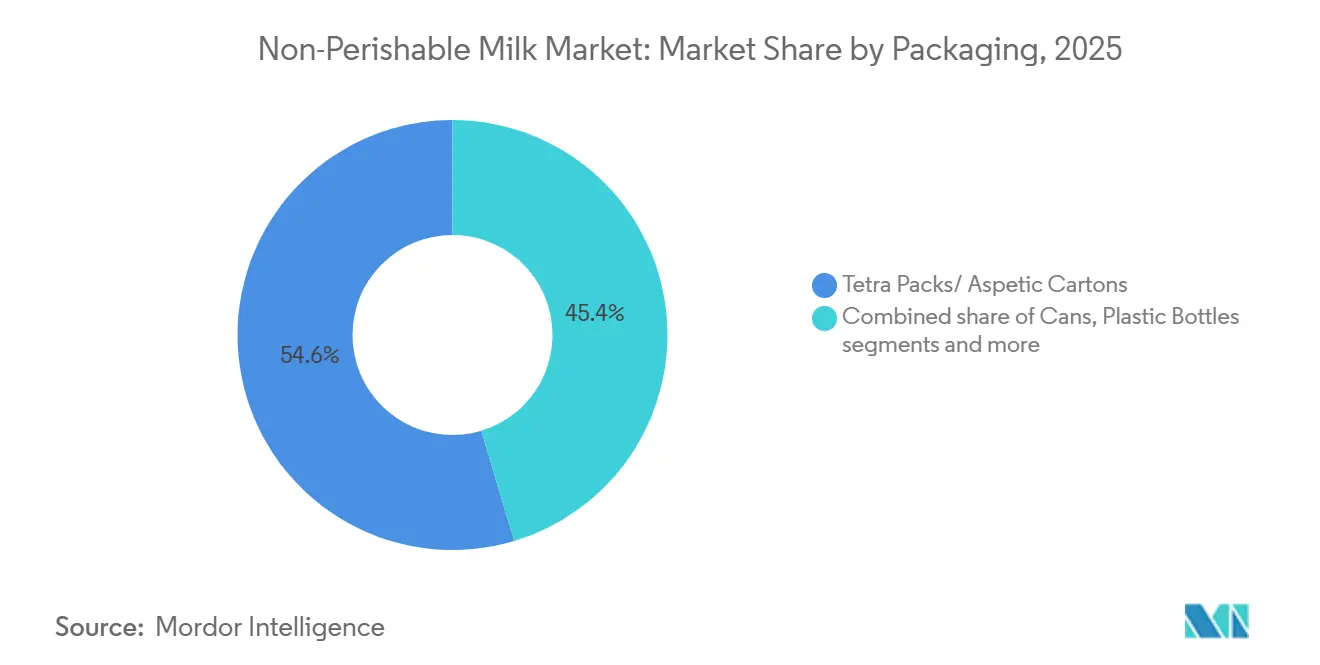
- By packaging, tetra packs/aspetic cans retained a 54.63% share in 2025, whereas pouches are forecast to expand at a 6.43% CAGR through 2031.
- By distribution channel, hypermarkets and supermarkets led the market with a share of 42.63% in 2025, while online retail is anticipated to register the fastest CAGR of 6.43% during 2026-2031.
- By geography, North America led the non-perishable milk market in 2025 with a 38.12% share, while Asia-Pacific is projected to advance at an 6.30% CAGR through 2031.
Note: Market size and forecast figures in this report are generated using Mordor Intelligence’s proprietary estimation framework, updated with the latest available data and insights as of January 2026.
Global Non-Perishable Milk Market Trends and Insights
Drivers Impact Analysis*
| Driver | (~) % Impact on CAGR Forecast | Geographic Relevance | Impact Timeline |
|---|---|---|---|
| Longer retail shelf life improving inventory economics | +1.0% | Global, concentrated in North America and Europe | Medium term (2-4 years) |
| Reduced dependence on cold-chain infrastructure | +0.9% | Asia-Pacific core, spillover to Middle East and Africa and South America | Long term (≥ 4 years) |
| Advancements in uht processing and aseptic packaging | +0.8% | Global, with early gains in North America, Europe, and China | Medium term (2-4 years) |
| Lower refrigerated storage and transportation requirements | +0.7% | Asia-Pacific core, spillover to Middle East and Africa and South America | Long term (≥ 4 years) |
| Growing household preference for longer grocery-storage cycles | +0.6% | North America and Europe | Short term (≤ 2 years) |
| Aseptic processing enabling cross-border and long-distance milk distribution | +0.8% | Global trade lanes, concentrated in Middle East and Africa and Southeast Asia | Medium term (2-4 years) |
| Source: Mordor Intelligence | |||
Longer Retail Shelf Life Improving Inventory Economics
Longer shelf life improves inventory economics by giving retailers more time to sell products before expiry, reducing the need for frequent replenishment, and minimizing potential product losses. In August 2024, the United States Department of Agriculture classified UHT-pasteurized milk as shelf-stable and suitable for storage without refrigeration before use[1]Source: United States Department of Agriculture, " Animal and Plant Health Inspection Service," usbiotechnologyregulation.mrp.usda.gov. This extended storage capability enables retailers to maintain larger inventory buffers, simplify stock rotation, and reduce pressure for rapid sell-through. It also supports centralized warehousing and distribution to geographically distant markets without continuous refrigerated storage, giving suppliers greater flexibility in managing inventory across different retail locations. The longer selling window can further reduce inventory losses associated with short shelf life and improve product availability across retail outlets.
Reduced Dependence on Cold-Chain Infrastructure
Cold-chain gaps continue to support demand in the non-perishable milk market across South Asia, Sub-Saharan Africa, and Southeast Asia. SIG’s aseptic carton plant in Gujarat become fully operational in 2025, reducing lead times for Indian dairy processors. Ambient formats support commercial dairy distribution in regions with limited refrigerated networks. They also enable longer storage and broader distribution without continuous refrigeration, allowing dairy processors to reach underserved markets where refrigerated logistics remain costly or difficult to maintain. These formats help processors meet hygienic packaging requirements without investing in fully refrigerated distribution systems. As a result, the non-perishable milk market remains relevant in cities where consumption is growing faster than cold-chain capacity.
Advancements In UHT Processing and Aseptic Packaging
Processing technology is becoming a key factor in product quality, operating costs, and carbon performance. SPX FLOW launched APV Infusion UHT with SteamRecycle in October 2025. The system is designed to recover steam in a closed loop. Tetra Laval’s direct UHT heating method, linked to a January 2024 United States patent record and a 2025 grant, further reflects this trend[2]Source: Tetra Laval Holdings, " UHT milk product by direct UHT heating," patentsgazette.uspto.go. These investments are shifting competition in the non-perishable milk market toward capital efficiency, sensory performance, and lifecycle credentials. More efficient processing systems can also help producers reduce resource consumption and improve production efficiency. This trend supports investment in UHT technologies that balance product quality with lower operating requirements.
Growing Household Preference for Longer Grocery-Storage Cycles
Households in mature economies continue to prefer fewer shopping trips and larger grocery baskets. Shelf-stable dairy products support bulk purchases and subscription-based retail because they do not require weekly fresh-dairy replenishment. Ambient products also eliminate the need for last-mile refrigeration during online delivery, improving delivery economics for retailers compared with chilled dairy. This format gives consumers greater flexibility to maintain milk supplies between shopping trips. Such convenience supports demand for shelf-stable milk through modern supermarkets and e-commerce channels. This trend creates an additional growth avenue for the non-perishable milk market beyond traditional store-based purchases.
Restraints Impact Analysis*
| Restraint | (~) % Impact on CAGR Forecast | Geographic Relevance | Impact Timeline |
|---|---|---|---|
| Perceived taste and sensory differences from fresh milk | -0.5% | North America, Western Europe, and urban Asia-Pacific | Short term (≤ 2 years) |
| High processing and aseptic packaging costs | -0.4% | Global, most acute in price-sensitive emerging markets | Medium term (2-4 years) |
| Limited premium positioning compared with fresh and specialty milk products | -0.3% | North America and Western Europe | Medium term (2-4 years) |
| Consumer preference for refrigerated fresh milk | -0.4% | North America, Japan, Australia, and Western Europe | Long term (≥ 4 years) |
| Source: Mordor Intelligence | |||
Perceived Taste and Sensory Differences from Fresh Milk
UHT processing at 135–150°C can alter flavor through Maillard browning and lactose degradation reactions. Pulsed electric fields, high-pressure processing, ohmic heating, and supercritical carbon dioxide remain expensive for broad commercial deployment. These limitations make it difficult for producers to improve sensory quality without significantly increasing processing costs. They can also raise the cost of achieving fresh-milk-like sensory characteristics while preserving the shelf-life advantages of UHT processing. As a result, standard UHT white milk is unlikely to fully close the sensory gap with fresh pasteurized milk through 2031. This issue is most relevant for premium ambient white milk in Japan, Australia, and the United Kingdom. Fresh milk can maintain an advantage in markets where shoppers are willing to pay for a familiar sensory profile.
High Processing and Aseptic Packaging Costs
Aseptic lines require clean-room construction, sterility validation, and specialized maintenance, creating higher entry barriers for smaller regional processors. Aluminum barrier layers also expose carton users to commodity and energy price volatility. Aluminum-free formats may reduce some material exposure over time. However, broad adoption will require filling-line adjustments, procurement changes, and retailer education across the non-perishable milk market. These requirements can increase upfront investment and operational complexity for manufacturers seeking to scale ambient milk production. As a result, processors with sufficient capital and established aseptic-processing capabilities may account for most technology upgrades.
*Our forecasts treat driver/restraint impacts as directional, not additive. The impact forecasts reflect baseline growth, mix effects, and variable interactions.
Segment Analysis
By Product Type: UHT Milk Anchors Volume and Condensed Milk Supports Application-Led Demand
UHT milk accounted for 57.78% of the non-perishable milk market size in 2025, making it the category’s volume anchor. Retail, foodservice, and institutional channels widely use UHT milk. Its long shelf life supports distribution in areas where refrigeration is costly or limited. Condensed milk is projected to be the fastest-growing product type, registering a CAGR of 6.83% from 2026 to 2031. Café culture and bubble tea formats in Southeast Asia rely on sweetened condensed milk as a core ingredient. Confectionery producers in India and the Gulf also use it in higher-value dessert products. As these applications expand, the category is moving beyond its traditional commodity role.
Evaporated milk remains relevant in baking, cooking, and institutional foodservice. Its concentrated protein content and two- to three-year ambient shelf life support export procurement and humanitarian supply chains. Cans are particularly suitable for buyers that require pressure resistance and extended storage. UHT milk remains central to retail volume because it supports functional positioning. Flavored and organic ambient milk are gaining traction in mature retail markets. In these markets, private-label fortified options can replace branded commodity UHT milk. As a result, product differentiation is becoming more important within the non-perishable milk industry.



By Source: Cow Milk Retains Scale and Buffalo Milk Gains Relevance in South Asia
Cow milk accounted for 67.95% of the non-perishable milk market size in 2025. Established milk-shed infrastructure and higher average yields support its leading position. Cow milk also benefits from regulatory familiarity across export markets. Goat milk and milk from other animals serve smaller specialty and health-oriented dairy categories. These products can command premium prices but represent a limited share of volume. Buffalo milk is the fastest-growing source, with a projected CAGR of 7.35% through 2031.
Buffalo milk suits condensed and evaporated products because of its average fat content of 7-8%. Cow milk typically contains 3.5-4% fat, creating a different input profile for concentrated formats. This difference gives buffalo milk a stronger role in application-led product categories. Herd growth in Uttar Pradesh, Rajasthan, and Haryana supports further supply expansion. This increase strengthens processing ecosystems in South Asia and Southeast Asia. Source choices will remain closely linked to regional milk availability, fat requirements, and local consumer preferences.
By Packaging: Aseptic Cartons Set the Standard and Pouches Lower Entry Costs
Tetra Packs and aseptic cartons accounted for 54.63% of the non-perishable milk market size in 2025. These formats provide oxygen and light barriers and support high-speed aseptic filling lines. Their stackability improves warehousing and transportation efficiency. Available formats range from 200 ml single-serve packs to 2-liter household units, supporting demand across both foodservice and retail channels. Cans remain important for condensed and evaporated milk, as they meet the requirements of export, military, and humanitarian buyers for durable 2-3-year storage. Packaging selection remains central to cost management, product protection, and distribution design in the non-perishable milk market.
Plastic bottles support ambient drinking milk but face increasing pressure from European recycled-content and recyclability requirements. These regulations are directing more investment toward paper-based carton formats. Tetra Pak introduced its first paper-based barrier for white milk in a 1-liter aseptic carton in Italy in April 2026. Pouches are the fastest-growing format, with a forecast CAGR of 6.43% through 2031. Their lower unit cost can support adoption in Sub-Saharan Africa, South Asia, and rural Southeast Asia. Glass and recyclable mono-material formats remain niche but are gaining attention in organic and specialty products.
By Distribution Channel: Hypermarkets Retain Scale and Online Retail Extends Access
Hypermarkets and supermarkets accounted for 42.63% of the total category value in 2025. Their broad product ranges support volume sales and private-label development. Ambient formats are easy to stock because they do not require refrigerated shelf space before opening. Convenience and grocery stores support top-up purchases in dense urban areas. Institutional procurement, military commissaries, and humanitarian supply chains also generate stable volume. These buyers often rely on canned condensed and evaporated products. This channel mix gives the non-perishable milk market access to a wide range of demand settings.
Online retail is the fastest-growing channel, with a forecast CAGR of 6.43% through 2031. Ambient milk avoids the complexity of last-mile refrigeration and can reduce delivery constraints. This advantage makes shelf-stable formats well suited to e-commerce grocery baskets. Quick-commerce platforms are extending their reach into Tier 2 and Tier 3 cities in emerging economies. This expansion can improve the availability of ambient dairy products for households beyond major urban centers. Online access can complement, rather than replace, stores that remain important for routine household purchases. Distribution strategies in the non-perishable milk industry must account for both physical range depth and fast local fulfillment.
Geography Analysis
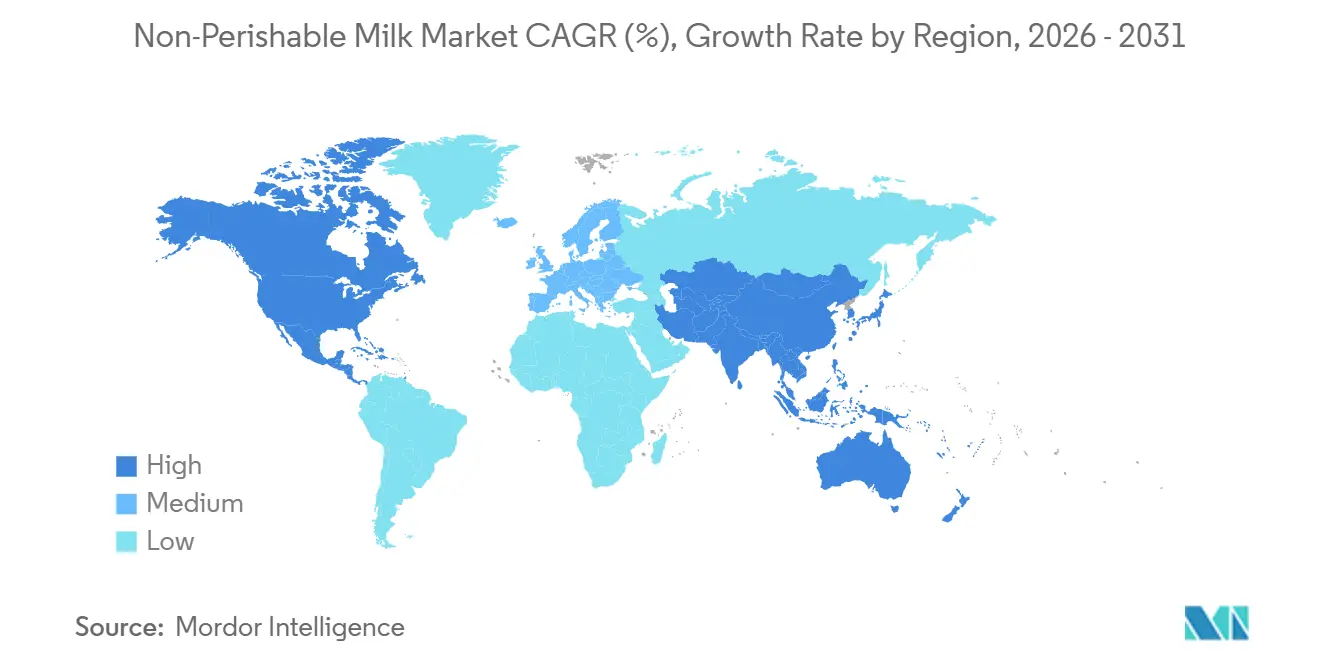
North America held 38.12% of the non-perishable milk market share in 2025. Advanced retail systems, institutional demand, and the availability of fortified, lactose-free, and organic UHT products support this position. The United States leads the region by volume. Mexico and Canada contribute to demand through informal retail, convenience stores, and value-oriented ambient dairy products. A comprehensive cold chain has not eliminated demand for UHT milk. Instead, it enables brands to position UHT milk as a pantry backup that can expand overall dairy shelf space.
Europe is the second-largest regional market for non-perishable milk. UHT milk is a mainstream grocery product across much of the region. Germany, Italy, Spain, and the Netherlands also report strong retail use of ambient milk. Poland and Belgium recorded faster growth as consumers seek value-oriented products. Arla's Lockerbie project demonstrates continued investment in large-scale UHT capacity in the United Kingdom. Packaging requirements are also influencing investment in recyclable and paper-based systems. Europe remains important to the non-perishable milk market because it combines established consumption with technology investment.
Asia-Pacific is the fastest-growing regional market through 2031 by having 6.30% CAGR. Urbanization is rising faster than cold-chain capacity in India, Indonesia, Vietnam, and Thailand. China has the largest regional ambient dairy consumption volume and is expanding distribution into lower-tier cities. Southeast Asian café and bubble tea consumption supports demand for condensed and evaporated milk. Demand in the Middle East and Africa follows two paths. Gulf consumers use ambient dairy in daily tea and coffee preparation, while African consumers use it in areas where cold chains remain limited.

Competitive Landscape
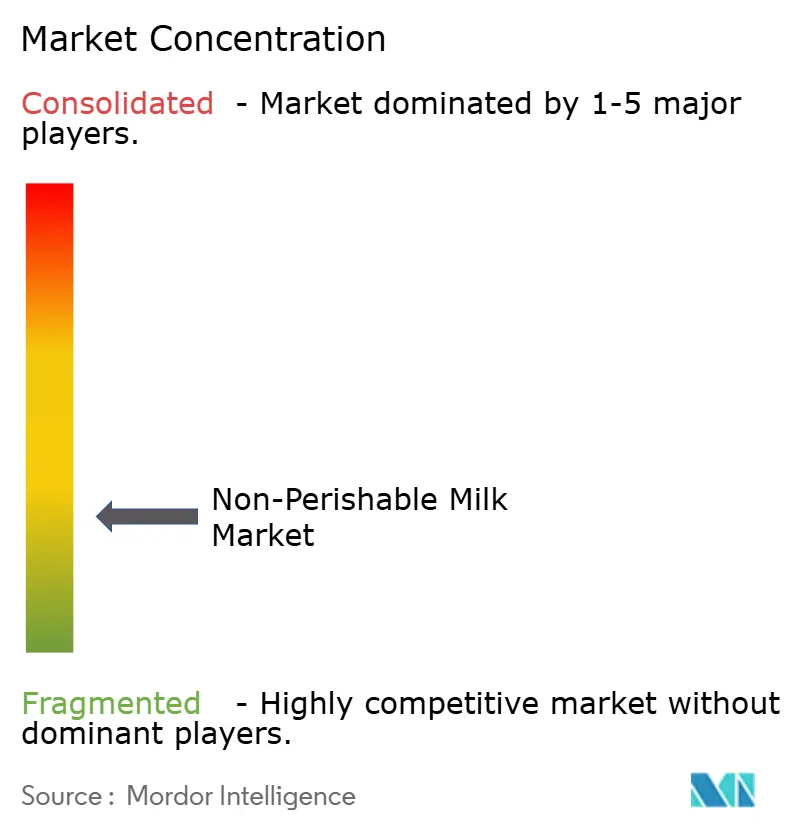
The non-perishable milk market remains moderately fragmented. Lactalis Group, Nestlé, Arla Foods, FrieslandCampina, and Danone hold meaningful positions, but they do not collectively control the category. Regional cooperatives and private-label producers continue to play important roles in their home markets. The United States Department of Agriculture forecast cited for November 2025 indicates that India’s fluid milk production reached 216.5 million metric tons in 2025/26, accounting for about 32% of global production[3]Source: United States Department of Agriculture, " Production- Fluid Milk," fas.usda.gov. European cooperatives maintain influence because they manage milk collection and UHT processing. Companies are concentrating assets in larger, more efficient facilities, as reflected in Arla’s proposed EUR 107.7 million investment in Lockerbie.
FrieslandCampina’s proposed merger with Milcobel, referenced for completion in January 2026, expanded its European collection network and added dairy farmers in Belgium and France. The company identifies milk, premium protein ingredients, and Asia as priority areas. Saputo’s referenced February 2026 agreement to divest an 80% stake in its Argentine dairy division to Grupo Gloria highlights ongoing portfolio management. These actions show that players are managing both portfolios and manufacturing capacity. Strategic choices will vary by regional supply position and the need to serve higher-value dairy formats.
Functional, lactose-free, and high-protein UHT products create opportunities for product development in the non-perishable milk market. These variants can command 25-40% retail premiums in European markets, although they remain less developed across Asia-Pacific and the Middle East and Africa. Smaller processors may benefit from modular aseptic filling equipment, which lowers minimum scale requirements. Quick-commerce platforms can also reduce delivery barriers for ambient dairy in South and Southeast Asia. Sustainability requirements and energy costs are encouraging companies to replace older indirect UHT systems. Therefore, the non-perishable milk market combines global scale with strong regional roles for cooperatives, private labels, and local processors.
Non-Perishable Milk Industry Leaders
-
Lactalis Group
-
Nestlé S.A.
-
Danone S.A.
-
Hochwald Foods GmbH
-
Royal FrieslandCampina N.V.
- *Disclaimer: Major Players sorted in no particular order

Recent Industry Developments
- August 2026: Danone and Arcor completed the formation of their dairy joint venture in Argentina, combining Danone Argentina SA, Mastellone Hermanos SA, La Serenísima, and their shared logistics subsidiary. The partnership leverages Danone’s global brand portfolio and Mastellone’s century-long Argentine dairy heritage to expand innovation capacity and commercial reach across the country’s dairy category.
- April 2026: Tetra Pak commercially introduced the first paper-based barrier for white milk in a 1-liter aseptic carton in Italy. The innovation reduces plastic content while maintaining full ambient shelf-life performance and aligns carton recyclability with the EU Packaging and Packaging Waste Regulation mandate.
- January 2026: FrieslandCampina completed its merger with Belgian dairy cooperative Milcobel and finalized the acquisition of Wisconsin Whey Protein, adding 1,250 new member dairy farmers across Belgium and France and a strengthened North American protein ingredients presence to its portfolio in a single month


Global Non-Perishable Milk Market Report Scope
Non-perishable milk refers to milk processed and packaged using technologies such as UHT treatment and aseptic packaging, allowing it to remain safe and stable at room temperature for an extended period without refrigeration. The non-perishable milk market is segmented by product type, source, packaging, distribution channel, and geography. By product type, the market is segmented into UHT milk, evaporated milk, condensed milk, and others. By source, the market is segmented into cow milk, buffalo milk, goat milk, and other animal milk. By packaging, the market is segmented into tetra packs/aseptic cartons, cans, plastic bottles, pouches, and others. By distribution channel, the market is segmented into supermarkets/hypermarkets, convenience/grocery stores, online retail, and other distribution channels. Based on geography, the market is classified into North America, Europe, South America, Asia-Pacific, and the Middle East and Africa. For each segment, the market sizing and forecasting have been done in value terms (USD billion).
| UHT Milk |
| Evaporated Milk |
| Condensed Milk |
| Others |
| Cow Milk |
| Buffalo Milk |
| Goat Milk |
| Other Animals Milk |
| Tetra Packs/ Aspetic Cartons |
| Cans |
| Plastic Bottles |
| Pouches |
| Others |
| Hypermarkets and Supermarkets |
| Convenience/Grocery Stores |
| Online Retail |
| Other Distribution Channels |
| North America | United States |
| Canada | |
| Mexico | |
| Rest of North America | |
| Europe | Germany |
| United Kingdom | |
| Italy | |
| France | |
| Spain | |
| Netherlands | |
| Poland | |
| Belgium | |
| Sweden | |
| Rest of Europe | |
| Asia-Pacific | China |
| India | |
| Japan | |
| Australia | |
| Indonesia | |
| South Korea | |
| Thailand | |
| Singapore | |
| Rest of Asia-Pacific | |
| South America | Brazil |
| Argentina | |
| Colombia | |
| Chile | |
| Peru | |
| Rest of South America | |
| Middle East and Africa | South Africa |
| Saudi Arabia | |
| United Arab Emirates | |
| Nigeria | |
| Egypt | |
| Morocco | |
| Turkey | |
| Rest of Middle East and Africa |
| By Product Type | UHT Milk | |
| Evaporated Milk | ||
| Condensed Milk | ||
| Others | ||
| By Source | Cow Milk | |
| Buffalo Milk | ||
| Goat Milk | ||
| Other Animals Milk | ||
| By Packaging | Tetra Packs/ Aspetic Cartons | |
| Cans | ||
| Plastic Bottles | ||
| Pouches | ||
| Others | ||
| By Distribution Channel | Hypermarkets and Supermarkets | |
| Convenience/Grocery Stores | ||
| Online Retail | ||
| Other Distribution Channels | ||
| By Geography | North America | United States |
| Canada | ||
| Mexico | ||
| Rest of North America | ||
| Europe | Germany | |
| United Kingdom | ||
| Italy | ||
| France | ||
| Spain | ||
| Netherlands | ||
| Poland | ||
| Belgium | ||
| Sweden | ||
| Rest of Europe | ||
| Asia-Pacific | China | |
| India | ||
| Japan | ||
| Australia | ||
| Indonesia | ||
| South Korea | ||
| Thailand | ||
| Singapore | ||
| Rest of Asia-Pacific | ||
| South America | Brazil | |
| Argentina | ||
| Colombia | ||
| Chile | ||
| Peru | ||
| Rest of South America | ||
| Middle East and Africa | South Africa | |
| Saudi Arabia | ||
| United Arab Emirates | ||
| Nigeria | ||
| Egypt | ||
| Morocco | ||
| Turkey | ||
| Rest of Middle East and Africa | ||


Key Questions Answered in the Report
What is the size of non-perishable milk market?
The non-perishable milk market was valued at USD 172.68 billion in 2025 and is projected to reach USD 226.01 billion by 2031, growing at a CAGR of 4.71% during 2026-2031.
Which product type held the largest share of the non-perishable milk market in 2025?
UHT (Ultra-High Temperature) milk was the leading product type, accounting for 57.78% of the market in 2025.
Which milk source dominated the market in 2025?
Cow milk was the dominant source segment, holding 67.95% of the market share in 2025.
Which packaging format accounted for the largest market share in 2025?
Tetra packs/aseptic cartons led the packaging segment with a 54.63% market share in 2025.
Which distribution channel generated the highest revenue in 2025?
Hypermarkets and supermarkets dominated sales, accounting for 42.63% of the market in 2025.
Which region held the largest share of non-perishable milk market in 2025?
North America led the market with a 38.12% share in 2025.
Page last updated on:


 Your data is secure and never sold or shared.


