
Non-Alcoholic Wine and Beer Market Size and Share
Market Overview
| Study Period | 2021 - 2031 |
|---|---|
| Market Size (2026) | USD 23.19 Billion |
| Market Size (2031) | USD 34.36 Billion |
| Growth Rate (2026 - 2031) | 8.18 % |
| Fastest Growing Market | Asia-Pacific |
| Largest Market | Europe |
| Market Concentration | Low |
Major Players
*Disclaimer: Major Players sorted in no particular order Image © Mordor Intelligence. Reuse requires attribution under CC BY 4.0. |
|
Non-Alcoholic Wine and Beer Market Analysis by Mordor Intelligence
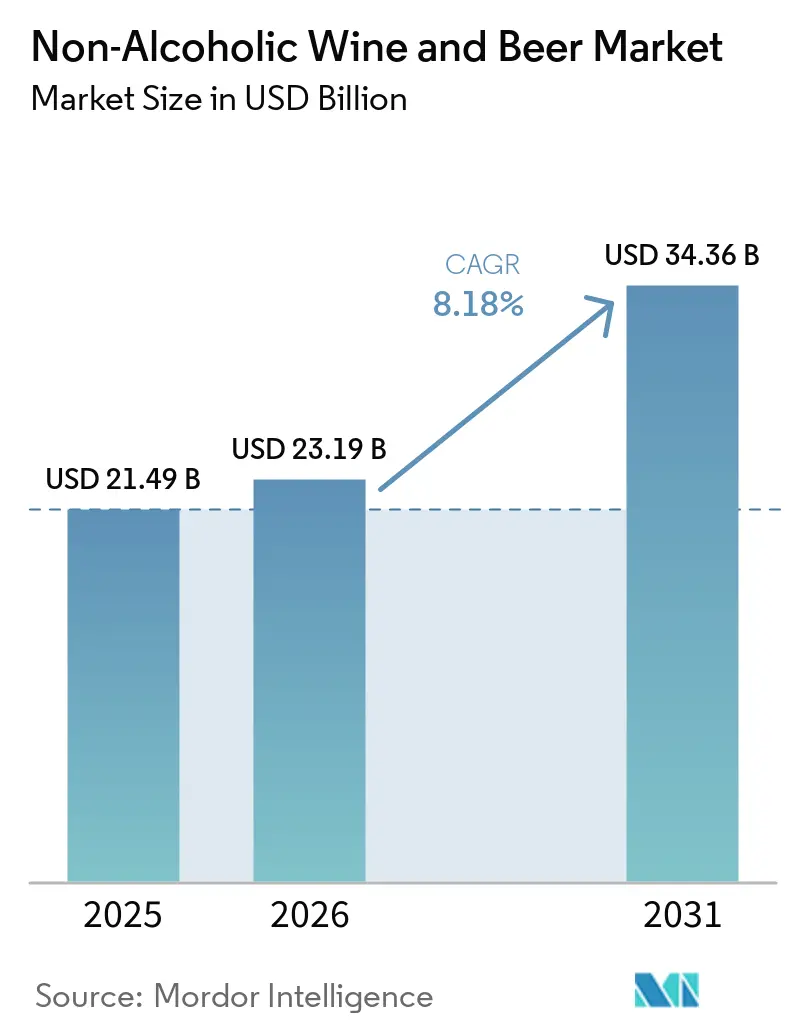
The non-alcoholic wine and beer market size is expected to grow from USD 21.49 billion in 2025 to USD 23.19 billion in 2026 and is forecast to reach USD 34.36 billion by 2031 at a 8.18% CAGR over 2026-2031. The market is evolving as consumers increasingly incorporate alcohol-free beverages into regular consumption occasions rather than limiting them to specific periods of abstinence. This shift is encouraging broader product availability across retail, hospitality, and online channels while increasing competition among established beverage companies and specialized producers. Product quality, taste, and overall drinking experience remain important factors in supporting repeat purchases and strengthening consumer acceptance. At the same time, producers are expanding their non-alcoholic portfolios and production capabilities to address a wider range of consumer preferences and consumption occasions.
Key Report Takeaways
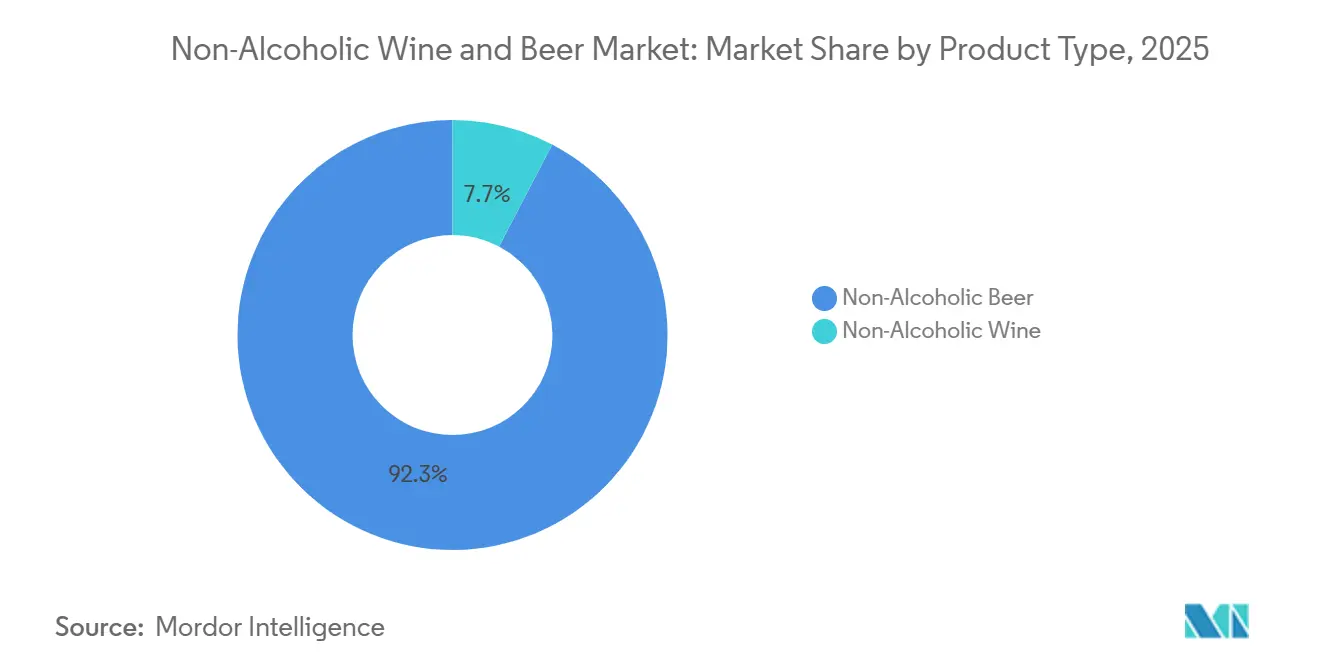
- By product type, non-alcoholic beer held 92.32% global market share in 2025, while non-alcoholic wine is forecast to grow at a 9.12% CAGR from 2026 to 2031.
- By packaging, cans held 45.46% global market share in 2025, while cartons are forecast to grow at a 9.78% CAGR from 2026 to 2031.
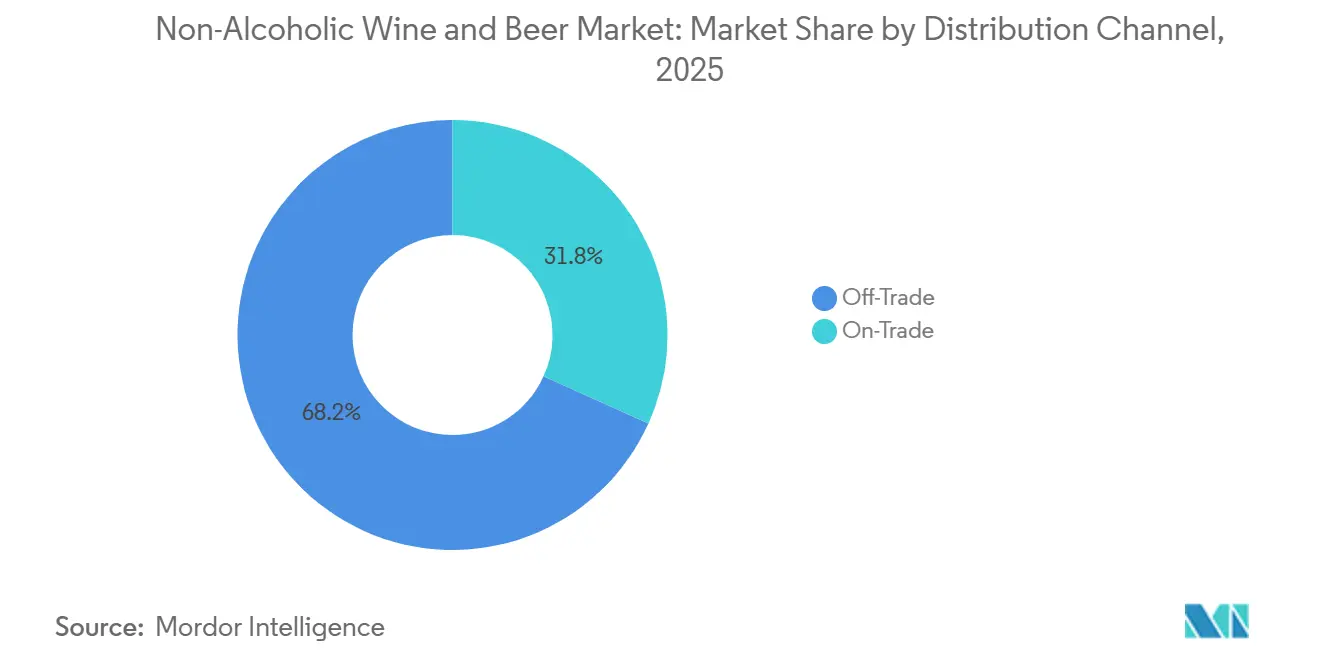
- By distribution channel, off-trade held 68.24% global market share in 2025, while on-trade is forecast to grow at a 9.84% CAGR from 2026 to 2031.
- By geography, Europe held 42.57% global market share in 2025, while Asia-Pacific is forecast to grow at a 10.46% CAGR from 2026 to 2031.
Note: Market size and forecast figures in this report are generated using Mordor Intelligence’s proprietary estimation framework, updated with the latest available data and insights as of January 2026.
Global Non-Alcoholic Wine and Beer Market Trends and Insights
Drivers Impact Analysis*
| Driver | (~) % Impact on CAGR Forecast | Geographic Relevance | Impact Timeline |
|---|---|---|---|
| Growing health and wellness focus on alcohol moderation | +2.1% | Global, with strongest concentration in North America and Europe | Short-term (≤ 2 years) |
| Mainstream adoption of sober-curious and mindful drinking | +1.7% | North America and Europe; emerging in Asia-Pacific | Short-term (≤ 2 years) |
| Improving product quality, taste, and premiumization | +1.4% | Global, led by Europe, North America, and Asia-Pacific premium markets | Medium-term (2-4 years) |
| Expanding retail, hospitality, and e-commerce availability | +1.0% | Global; e-commerce acceleration strongest in North America and Asia-Pacific | Medium-term (2-4 years) |
| Growing adoption of zebra striping and flexible alcohol consumption | +0.7% | North America and Europe | Short-term (≤ 2 years) |
| Expansion of health, fitness, and next-day performance occasions | +0.6% | Global, led by Northern Europe, Australia, and North America | Medium-term (2-4 years) |
| Source: Mordor Intelligence | |||
Growing Health and Wellness Focus on Alcohol Moderation
Growing consumer focus on health and wellness is prompting many to reconsider their alcohol consumption and adopt more moderate drinking habits. According to a January 2025 Beer Institute poll, 60% of Americans participating in Dry January reported that low- and no-alcohol beer helps them achieve their moderation goals, highlighting the role of alcohol alternatives in moderation-oriented consumption[1]Source: Beer Institute, "POLL: Beer Still King of Dry January", beerinstitute.org. Additionally, the International Food Information Council (IFIC)'s 2026 findings show that 56% of Americans consider healthfulness an influential factor in food and beverage purchasing decisions, even as convenience surpassed healthfulness as a priority for the first time[2]Source: International Food Information Council, "For The First Time In 21 Years, Convenience Outranks Health In Americans’ Shopping Carts", ific.org. This broader focus on healthier consumption supports interest in beverages that allow consumers to participate in social and everyday drinking occasions while reducing or avoiding alcohol. As a result, non-alcoholic wine and beer are increasingly positioned as practical options for moderation-oriented consumption.
Mainstream Adoption of Sober-Curious and Mindful Drinking
The growing emphasis on mindful drinking is encouraging consumers to reduce alcohol intake while still participating in social and recreational drinking occasions. The Centers for Disease Control and Prevention (CDC) states that drinking less alcohol lowers health risks and notes that about 178,000 people die from excessive alcohol use each year in the United States[3]Source: Centers for Disease Control, "Alcohol Use and Your Health", cdc.gov. The CDC also states that alcohol consumption is linked to several types of cancer and that the risk of some cancers increases with any amount of alcohol use. This growing awareness of alcohol-related health risks is supporting greater acceptance of moderation and alcohol-free choices, creating opportunities for non-alcoholic wine and beer to serve consumers seeking familiar drinking experiences without alcohol.
Improving Product Quality, Taste, and Premiumization
Improving product quality, taste, and overall drinking experience is strengthening the appeal of non-alcoholic wine and beer among consumers seeking alternatives that do not feel like compromises. Producers are refining formulations and production processes to improve flavor, aroma, mouthfeel, and balance while offering products that more closely resemble their alcoholic counterparts. The category is also expanding beyond basic offerings into more sophisticated styles, flavors, and product formats. Premium packaging, stronger brand positioning, and greater attention to ingredients are further helping elevate the perception of non-alcoholic beverages. These developments are supporting wider consumer acceptance and encouraging producers to compete increasingly on quality and experience rather than simply on the absence of alcohol.
Expanding Retail, Hospitality, and E-Commerce Availability
Expanding availability across retail, hospitality, and e-commerce channels is making non-alcoholic wine and beer more accessible to a broader consumer base. Greater presence in supermarkets, convenience stores, specialty retailers, restaurants, bars, and online platforms is improving product visibility and making it easier for consumers to discover and purchase these beverages. Wider distribution also allows brands to serve different consumption occasions, from at-home drinking to social and dining occasions. E-commerce further supports category access by providing consumers with a broader selection of brands, styles, and formats beyond what may be available in local stores. As distribution networks continue to develop, improved accessibility is expected to support trial, repeat purchases, and broader mainstream adoption.
Restraints Impact Analysis*
| Restraint | (~) % Impact on CAGR Forecast | Geographic Relevance | Impact Timeline |
|---|---|---|---|
| Sensory limitations compared with conventional wine and beer | -1.1% | Global, most pronounced in wine-dominant markets (Europe, South America) | Short-term (≤ 2 years) |
| Higher production and distribution costs | -0.9% | Global; more acute in emerging markets where non-alcoholic products lack scale economies | Medium-term (2-4 years) |
| ABV thresholds and labeling fragmentation across markets | -0.6% | Europe and cross-border trade; smaller impact in the Asia-Pacific | Medium-term (2-4 years) |
| Resource intensity of dealcoholization and aroma recovery | -0.7% | Global, particularly for smaller and mid-scale producers | Long-term (≥ 4 years) |
| Source: Mordor Intelligence | |||
Sensory Limitations Compared with Conventional Wine and Beer
Sensory limitations compared with conventional wine and beer can constrain consumer acceptance and repeat purchases in the non-alcoholic category. Removing or limiting alcohol can affect the balance of flavor, aroma, mouthfeel, body, and finish that consumers associate with traditional beverages. These differences may be more noticeable among consumers who are familiar with established wine and beer products and have specific expectations regarding taste and drinking experience. As a result, some non-alcoholic offerings may be perceived as less authentic or satisfying than their conventional counterparts. This can make consistent sensory quality an important challenge for brands seeking to encourage trial and build long-term consumer loyalty.
Higher Production and Distribution Costs
Higher production and distribution costs can limit the ability of non-alcoholic wine and beer brands to compete on price, particularly against conventional alcoholic beverages. The production process can involve additional stages, specialized handling, and tighter process controls, increasing the resources required to manufacture finished products. Distribution can also become more expensive when brands operate across fragmented markets with different product requirements and supply-chain arrangements. These cost pressures can reduce pricing flexibility and make it more difficult for smaller producers to achieve efficient operating scales. Consequently, elevated cost structures may restrict margins and slow expansion into more price-sensitive markets.
*Our forecasts treat driver/restraint impacts as directional, not additive. The impact forecasts reflect baseline growth, mix effects, and variable interactions.
Segment Analysis
By Product Type: Non-Alcoholic Beer Anchors the Market, Wine Accelerates
Non-Alcoholic Beer accounted for 92.32% of the market in 2025, making it the dominant product segment. Its leading position is supported by the established presence of non-alcoholic beer products across major markets, broader consumer familiarity, and the extensive portfolios offered by major brewers. The segment also benefits from the availability of multiple beer styles and formats, which allows producers to address a wide range of consumer preferences and consumption occasions. These factors have contributed to the relatively mature position of non-alcoholic beer within the overall market.
Non-Alcoholic Wine is expected to be the fastest-growing product segment, with a projected CAGR of 9.12% during 2026–2031. Growth is supported by increasing product development, improvements in flavor and sensory characteristics, and the expansion of non-alcoholic wine offerings across retail and hospitality channels. Producers are also introducing more premium and differentiated products, helping broaden the segment's appeal beyond consumers seeking basic alcohol-free alternatives. As product quality and availability continue to improve, non-alcoholic wine is expected to gain a larger share of the overall market during the forecast period.


By Packaging: Cans Lead on Convenience, Cartons Signal Affordability Expansion
Cans accounted for 45.46% of the Non-Alcoholic Wine and Beer Market in 2025, making them the leading packaging format. Their widespread use is supported by their portability, convenience, durability, and suitability for a broad range of consumption occasions. Cans are also commonly used across beer and other ready-to-drink beverage formats, giving non-alcoholic brands an established packaging option with broad retail acceptance. The format's suitability for single-serve products and multipacks further supports its use across both immediate-consumption and at-home occasions.
Cartons are projected to be the fastest-growing packaging segment, with a CAGR of 9.78% during 2026–2031. Their growth is supported by increasing interest in alternative packaging formats and their potential applications across different non-alcoholic beverage products. Cartons can also provide flexibility in product presentation, pack sizes, and storage, allowing producers to target varied consumer and retail requirements. As manufacturers expand their packaging options, cartons are expected to gain a greater role in the market during the forecast period.
By Distribution Channel: Off-Trade Commands Share, On-Trade Rewrites Category Discovery
Off-Trade accounted for 68.24% of the Non-Alcoholic Wine and Beer Market in 2025, making it the dominant distribution channel. Its leading position is supported by the broad availability of non-alcoholic products through supermarkets, hypermarkets, convenience stores, and other retail outlets. These channels provide consumers with convenient access to a wider range of brands, product types, and pack sizes while supporting routine household purchases. The established presence of non-alcoholic beverages across retail environments continues to strengthen the role of Off-Trade channels in overall market sales.
On-Trade is projected to be the fastest-growing distribution channel, with a CAGR of 9.84% during 2026–2031. Growth is supported by the increasing availability of non-alcoholic wine and beer in restaurants, bars, hotels, and other hospitality establishments. Greater inclusion of alcohol-free options on beverage menus allows consumers to choose these products during social and dining occasions, expanding their visibility beyond traditional retail settings. As hospitality operators broaden their beverage selections, On-Trade distribution is expected to gain importance throughout the forecast period.
Geography Analysis
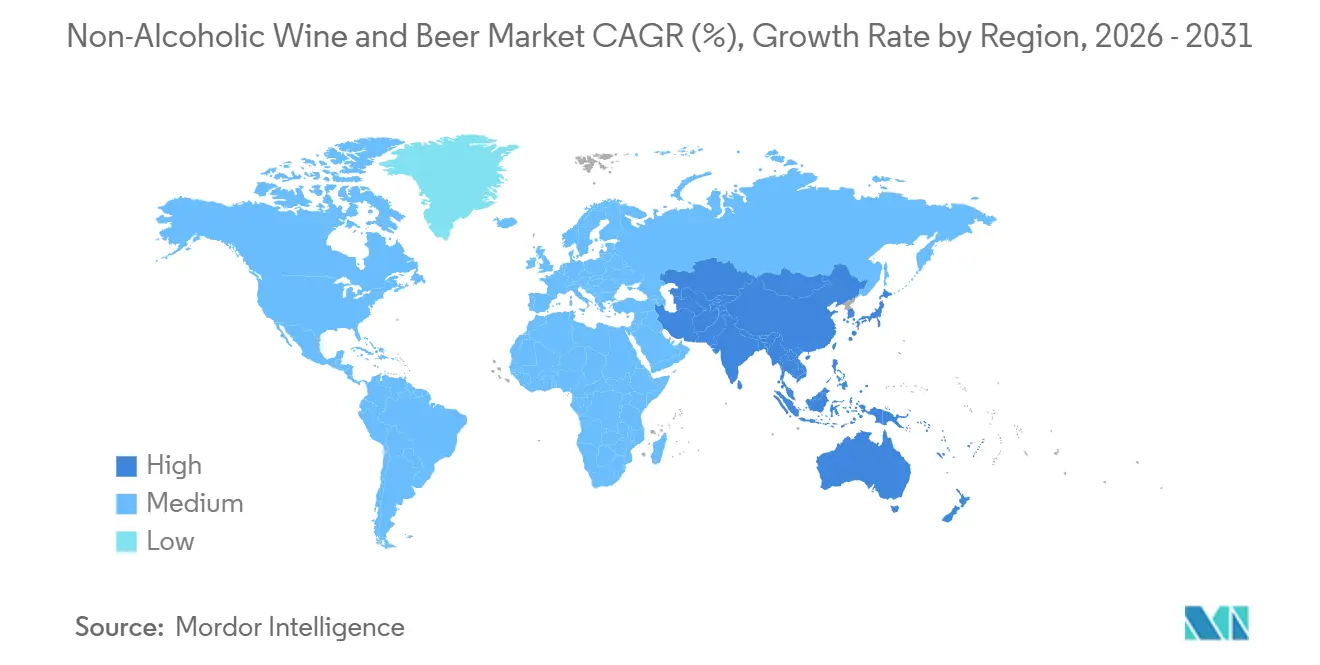
Europe accounted for 42.57% of the Non-Alcoholic Wine and Beer Market in 2025, making it the largest regional market. The region benefits from relatively established consumer acceptance of alcohol-free beverages, supported by broad product availability and strong participation from major beverage producers. Non-alcoholic beer has gained particular traction across several European markets, while non-alcoholic wine is also expanding as producers introduce more varied and premium offerings. The established retail and hospitality infrastructure across the region further supports consumer access and category development.
Asia-Pacific is projected to be the fastest-growing regional market, with a CAGR of 10.46% during 2026–2031. Growth is supported by increasing consumer awareness of alcohol-free alternatives, expanding product portfolios, and greater availability through modern retail and online channels. Japan represents a relatively established market, while China and other developing markets provide additional opportunities as consumer acceptance develops. Increasing investment by international and regional beverage producers is also expected to strengthen the category's presence across the region.
North America represents a substantial regional market, supported by growing consumer interest in alcohol moderation and the increasing availability of non-alcoholic beverages across retail, hospitality, and e-commerce channels. The United States remains the primary contributor to regional demand, with Canada also providing opportunities for category expansion. A broad presence of established beverage companies and specialized brands is strengthening product availability and consumer awareness. The region's developed distribution infrastructure and diverse consumption occasions are expected to support continued market expansion.

Competitive Landscape
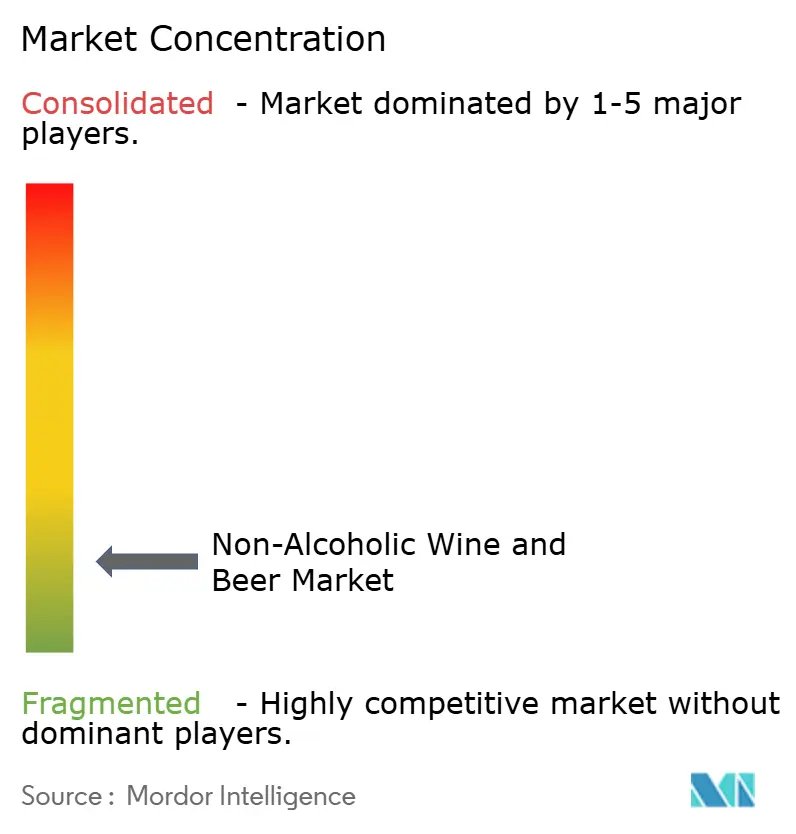
The Non-Alcoholic Wine and Beer Market is highly fragmented, with competition distributed among major global beverage companies and specialized non-alcoholic producers. The competitive landscape is shaped by differences in brand strength, product portfolios, distribution capabilities, and investment in non-alcoholic offerings. Major beverage companies are leveraging their established production and distribution networks, while specialized producers compete through focused portfolios and category-specific positioning. This combination creates a competitive environment in which companies are expanding product offerings and strengthening their presence across key consumer and distribution channels.
Diageo plc, Anheuser-Busch InBev, Carlsberg Breweries A/S, Heineken N.V., and Molson Coors Beverage Company are among the major companies considered in the market. These companies have established brand portfolios and distribution networks that support the expansion of non-alcoholic products across retail and hospitality channels. Their scale also enables them to introduce multiple product variants and extend existing brands into the non-alcoholic segment.
Competition is increasingly centered on portfolio expansion, product quality, brand positioning, and distribution reach. Companies are developing different styles and product offerings to address varied consumer preferences, while expanding availability across retail, hospitality, and e-commerce channels. Established players benefit from scale and existing market relationships, whereas specialized producers can differentiate through focused non-alcoholic offerings and category expertise. This mix of large beverage companies and specialized participants is expected to sustain competitive activity throughout the forecast period.
Non-Alcoholic Wine and Beer Industry Leaders
-
Diageo plc
-
Anheuser-Busch InBev SA/NV
-
Carlsberg Breweries A/S
-
Heineken N.V.
-
Molson Coors Beverage Company
- *Disclaimer: Major Players sorted in no particular order

Recent Industry Developments
- May 2026: Molson Coors launched Coors 0.0% in the United States Molson Coors introduced Coors 0.0%, its first fully 0.0% ABV beer under the Coors brand, in select Northeast United States markets in May 2026. A nationwide rollout is planned for 2027. The launch expands the company's existing non-alcoholic portfolio, which includes Blue Moon Non-Alcoholic, Peroni 0.0, and Coors Edge.
- May 2026: Krombacher Brauerei launched Krombacher 0.0% Pils in draught format, expanding the availability of its non-alcoholic beer into on-trade consumption. The move enables consumers to access the alcohol-free product in bars, restaurants, and other draught-serving venues, supporting the broader expansion of non-alcoholic beer beyond packaged retail formats.
- May 2026: Days Brewing partnered with Sunrise Beverages to accelerate the growth and distribution of its 0.0% beer portfolio across the United Kingdom. The partnership supports expansion across both retail and on-trade channels, with Days already distributed through more than 3,500 United Kingdom locations.


Global Non-Alcoholic Wine and Beer Market Report Scope
The non-alcoholic wine and beer market comprises beverages designed to replicate the taste and drinking experience of traditional wine and beer while containing little to no alcohol. The market includes both non-alcoholic beer and non-alcoholic wine across retail and foodservice channels. The non-alcoholic wine and beer market is segmented by product type into non-alcoholic beer and non-alcoholic wine, packaging into cans, glass bottles, plastic bottles, and cartons, distribution channel into on-trade and off-trade, and geography into North America, Europe, Asia-Pacific, South America, and Middle East and Africa. For each segment, the market sizing and forecasting have been done in value terms (USD billion) and volume (liters).
| Non-Alcoholic Beer |
| Non-Alcoholic Wine |
| Cans |
| Glass Bottles |
| Plastic Bottles |
| Cartons |
| On-Trade | |
| Off-Trade | Supermarkets/Hypermarkets |
| Speciality Stores | |
| Online Retail Stores | |
| Others Distribution Channel |
| North America | United States |
| Canada | |
| Mexico | |
| Rest of North America | |
| Europe | Germany |
| United Kingdom | |
| Italy | |
| France | |
| Spain | |
| Netherlands | |
| Poland | |
| Belgium | |
| Sweden | |
| Rest of Europe | |
| Asia-Pacific | China |
| India | |
| Japan | |
| Australia | |
| Indonesia | |
| South Korea | |
| Thailand | |
| Singapore | |
| Rest of Asia-Pacific | |
| South America | Brazil |
| Argentina | |
| Colombia | |
| Chile | |
| Peru | |
| Rest of South America | |
| Middle East and Africa | South Africa |
| Saudi Arabia | |
| United Arab Emirates | |
| Nigeria | |
| Egypt | |
| Morocco | |
| Turkey | |
| Rest of Middle East and Africa |
| By Product Type | Non-Alcoholic Beer | |
| Non-Alcoholic Wine | ||
| By Packaging | Cans | |
| Glass Bottles | ||
| Plastic Bottles | ||
| Cartons | ||
| By Distribution Channel | On-Trade | |
| Off-Trade | Supermarkets/Hypermarkets | |
| Speciality Stores | ||
| Online Retail Stores | ||
| Others Distribution Channel | ||
| By Geography | North America | United States |
| Canada | ||
| Mexico | ||
| Rest of North America | ||
| Europe | Germany | |
| United Kingdom | ||
| Italy | ||
| France | ||
| Spain | ||
| Netherlands | ||
| Poland | ||
| Belgium | ||
| Sweden | ||
| Rest of Europe | ||
| Asia-Pacific | China | |
| India | ||
| Japan | ||
| Australia | ||
| Indonesia | ||
| South Korea | ||
| Thailand | ||
| Singapore | ||
| Rest of Asia-Pacific | ||
| South America | Brazil | |
| Argentina | ||
| Colombia | ||
| Chile | ||
| Peru | ||
| Rest of South America | ||
| Middle East and Africa | South Africa | |
| Saudi Arabia | ||
| United Arab Emirates | ||
| Nigeria | ||
| Egypt | ||
| Morocco | ||
| Turkey | ||
| Rest of Middle East and Africa | ||


Key Questions Answered in the Report
How large is the non-alcoholic wine and beer category?
It is estimated at USD 23.19 billion in 2026 and is forecast to reach USD 34.36 billion by 2031 at an 8.18% CAGR.
Which product type has the largest share?
Non-alcoholic beer held 92.32% share in 2025, supported by mature brewing infrastructure and broad distribution.
Which packaging format is growing fastest?
Cartons are forecast to grow at a 9.78% CAGR from 2026 to 2031, reflecting their role in accessible and developing retail settings.
Which region is growing fastest?
Asia-Pacific is forecast to expand at a 10.46% CAGR from 2026 to 2031, ahead of other regions.
Page last updated on:


 Your data is secure and never sold or shared.


