
Non Alcoholic Spirits Market Size and Share
Market Overview
| Study Period | 2021 - 2031 |
|---|---|
| Market Size (2026) | USD 403.45 Million |
| Market Size (2031) | USD 611.24 Million |
| Growth Rate (2026 - 2031) | 8.66 % |
| Fastest Growing Market | Asia-Pacific |
| Largest Market | Europe |
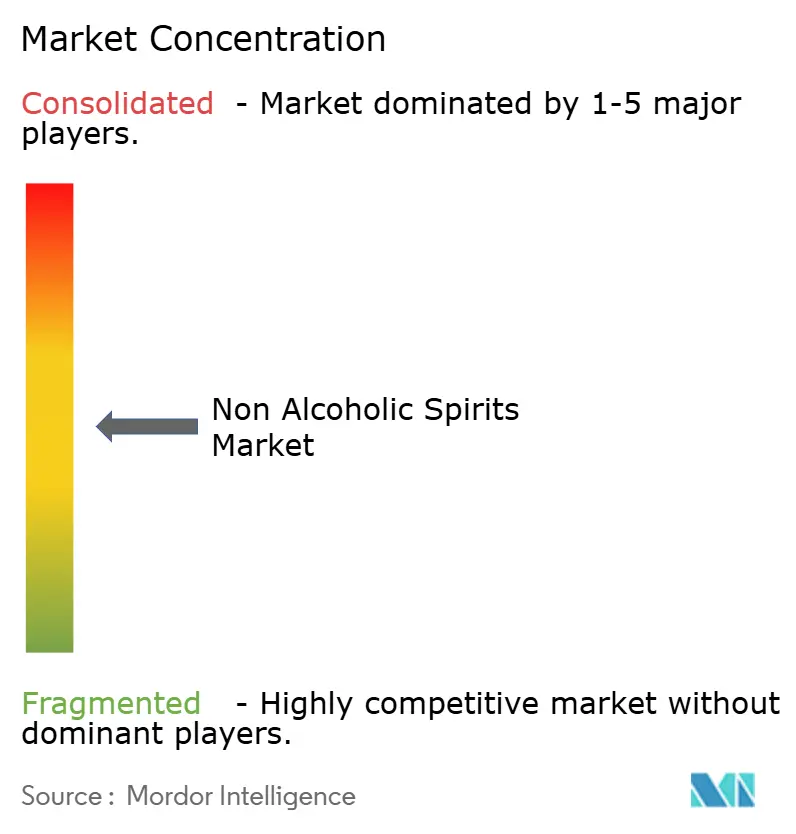
| Market Concentration | Medium |
Major Players
*Disclaimer: Major Players sorted in no particular order Image © Mordor Intelligence. Reuse requires attribution under CC BY 4.0. |
|
Non Alcoholic Spirits Market Analysis by Mordor Intelligence
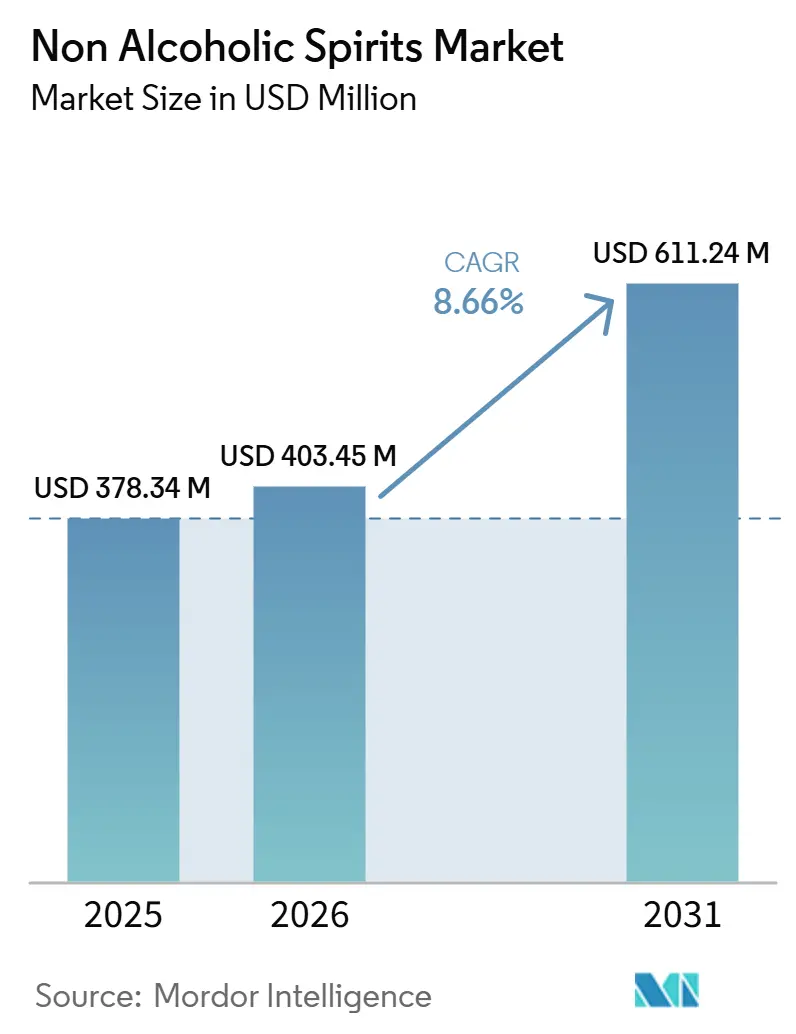
The non alcoholic spirits market size is expected to grow from USD 378.34 million in 2025 to USD 403.45 million in 2026 and is forecast to reach USD 611.24 million by 2031 at 8.66% CAGR over 2026-2031. The market is being driven by increasing consumer preference for alcohol-free lifestyles, particularly among Millennials and Gen Z seeking healthier beverage alternatives. Growing participation in wellness trends, including the sober-curious movement, is encouraging consumers to choose premium non-alcoholic spirits without compromising on taste or social experiences. Manufacturers are expanding their portfolios with gin, whiskey, rum, tequila, and vodka alternatives featuring botanical ingredients and sophisticated flavor profiles. The rapid expansion of e-commerce platforms, premium retail channels, and on-trade establishments such as bars and restaurants is improving product accessibility.
Key Report Takeaways
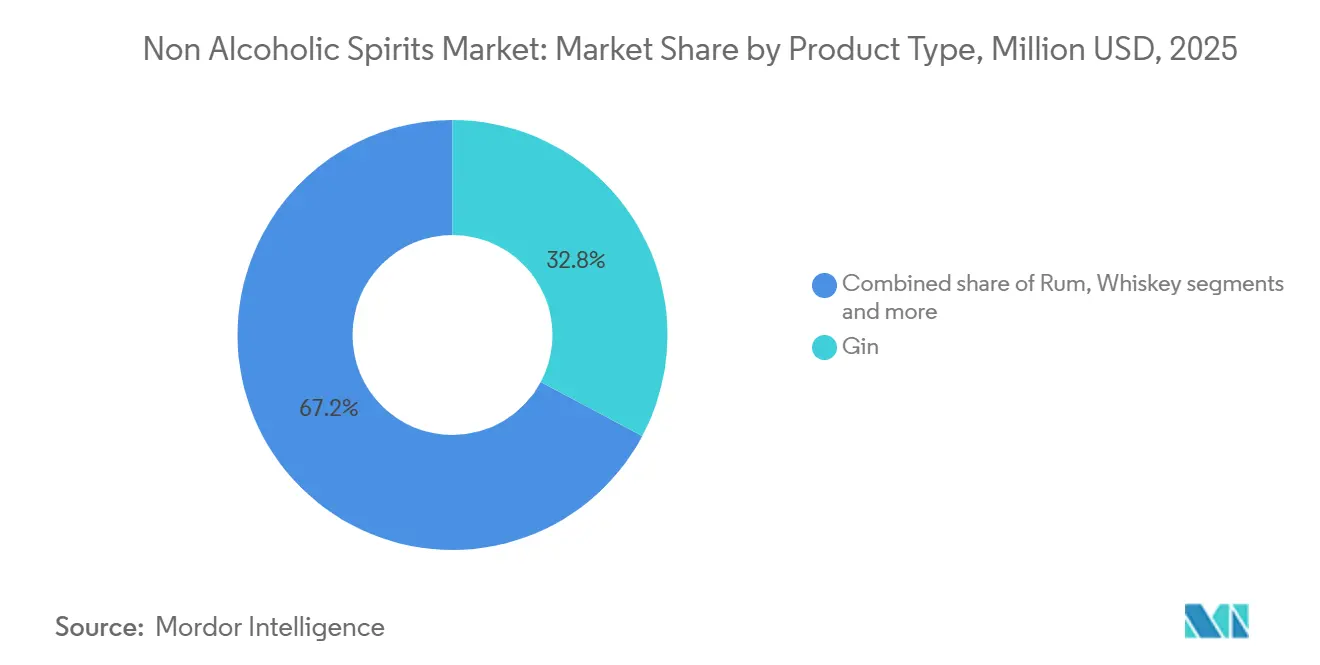
- By product type, gin held 32.78% of the non alcoholic spirits market share in 2025, while tequila is projected to record the highest CAGR of 10.22% through 2031.
- By flavor, herbal and botanical products accounted for 35.67% of the non alcoholic spirits market share in 2025, while spiced profiles are forecast to grow at a 9.78% CAGR through 2031.
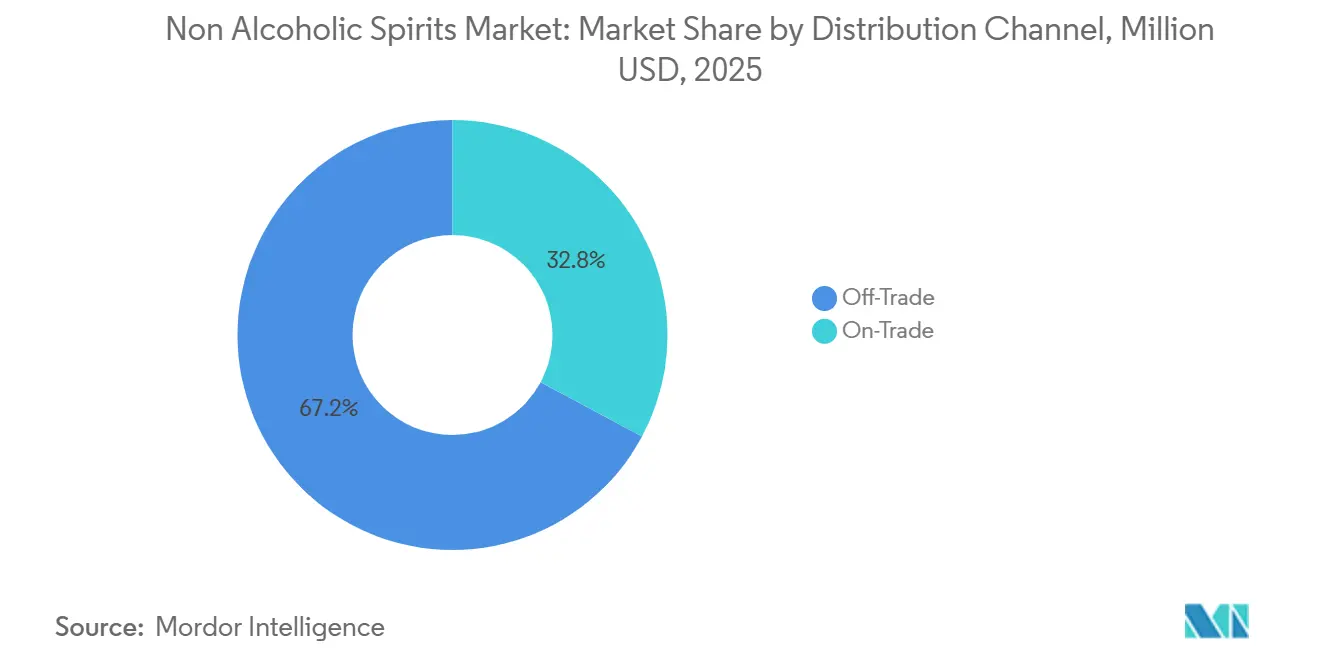
- By distribution channel, off-trade held 67.18% of the non alcoholic spirits market share in 2025, while on-trade is forecast to advance at a 10.12% CAGR through 2031.
- By geography, Europe accounted for 39.45% of the non alcoholic spirits market share in 2025, while Asia-Pacific is projected to grow at a 9.89% CAGR through 2031.
Note: Market size and forecast figures in this report are generated using Mordor Intelligence’s proprietary estimation framework, updated with the latest available data and insights as of January 2026.
Global Non Alcoholic Spirits Market Trends and Insights
Drivers Impact Analysis*
| Driver | (~) % Impact on CAGR Forecast | Geographic Relevance | Impact Timeline |
|---|---|---|---|
| Growing health consciousness and alcohol reduction trends | +2.8% | Global | Medium term (2-4 years) |
| Expanding demand for premium alcohol-free cocktails | +1.8% | Europe and North America, with spillover to Asia-Pacific | Short term (≤ 2 years) |
| Innovation in botanical and distilled non-alcoholic spirit formulations | +1.4% | Global, concentrated in the United Kingdom, Germany, and the United States | Medium term (2-4 years) |
| Increasing preference for low-calorie and clean-label beverages | +1.0% | North America and Europe | Short term (≤ 2 years) |
| Growth in alcohol-free social events and mindful drinking occasions | +0.7% | Global, with acceleration in North America and Europe | Medium term (2-4 years) |
| Government campaigns promoting responsible alcohol consumption | +0.3% | Europe, Australia, and parts of Asia-Pacific | Long term (≥ 4 years) |
| Source: Mordor Intelligence | |||
Growing health consciousness and alcohol reduction trends
Young millennials and Gen Z are changing how the non alcoholic spirits market is used in social settings, including routine meals, social events, and bar occasions where alcohol was once assumed. Moderation is increasingly treated as a normal part of social life rather than as a temporary form of abstinence, which makes alcohol-free choices more compatible with regular consumer routines. The Institute of Food Technologists reported in 2025 that young millennials generated nearly one-third of social media mentions of zero-proof cocktails, which points to strong cultural visibility for the occasion[1]Source: The Institute of Food Technologists, “That’s the (Zero-Proof) Spirit”, ift.org. The same shift includes consumers who alternate alcoholic and alcohol-free drinks during a single occasion, which broadens demand beyond people who avoid alcohol entirely and gives alcohol-free choices a role within mixed drinking groups. This pattern gives producers a reason to develop serves for regular bars, restaurants, and home entertaining rather than only for wellness-led occasions. The non alcoholic spirits market can therefore reach consumers who want flexibility without stepping away from cocktail culture or the social rituals that surround it.
Expanding demand for premium alcohol-free cocktails
Premium alcohol-free cocktails make the on-trade channel an important setting for consumer trial, as venues present the drink as a finished serve rather than an unfamiliar bottle. A KAM and Everleaf audit cited for 2026 indicates that alcohol-free spirits were available in 70% of the covered United Kingdom venues, compared with 47% in 2024. The audit also indicates that the average number of alcohol-free cocktails per venue increased from 1.9 to 3.2 during the same period. Improved menu availability allows consumers to taste products in a guided setting before purchasing a bottle in retail, while clear menu placement signals that these options are part of the standard offering. This link between the bar experience and later store purchases supports broader shelf presence for premium products. The non-alcoholic spirits market benefits when venues position zero-proof cocktails as part of the regular drinks list rather than as a limited alternative.
Innovation in botanical and distilled non-alcoholic spirit formulations
Product development is reducing the gap between conventional spirits and alcohol-free alternatives, particularly where brands focus on mouthfeel, aroma, bitterness, and the way a drink performs in a mixed serve. Botanical distillation has helped brands create aroma, texture, and heat that make mixed drinks more familiar to consumers. León Y Sol introduced NeQuila in 2025 as a non-alcoholic option made from real tequila through alcohol removal, showing how producers are trying to preserve the characteristics associated with an established spirit style. The Institute of Food Technologists also noted the growing presence of functional alcohol-free products that use botanical ingredients to create a different consumption proposition[2]Source: The Institute of Food Technologists, “That’s the (Zero-Proof) Spirit”, ift.org. These approaches give brands more scope to support premium pricing when the product provides a distinct taste and drinking experience, rather than relying on alcohol-free status alone. In the non alcoholic spirits market, formulation quality remains central because trial is more likely to become repeat buying when taste expectations are met.
Increasing preference for low-calorie and clean-label beverages
Ingredient transparency is becoming more important in North America and Europe, where consumers can compare product labels easily across grocery, specialty retail, and online shopping channels. Consumers increasingly check labels for ingredients that they recognize and view as more natural. This has encouraged producers to focus on botanical sourcing, extraction methods, and lower reliance on synthetic flavor systems, with the goal of making the product story as understandable as the drink itself. A cleaner ingredient profile can also support product positioning in grocery and specialty retail where buyers evaluate both the label and the serving occasion. The preference does not replace the need for a convincing flavor profile, because consumers still expect a product to work in a cocktail or as a standalone drink. The non alcoholic spirits market is therefore shaped by the combination of simple labels, credible botanical ingredients, and products that provide a satisfying serve.
Restraints Impact Analysis*
| Restraint | (~) % Impact on CAGR Forecast | Geographic Relevance | Impact Timeline |
|---|---|---|---|
| Premium pricing compared to conventional soft drinks | -1.5% | Global, most pronounced in Asia-Pacific, South America, and the Middle East and Africa | Short term (≤ 2 years) |
| Low consumer awareness in emerging markets | -1.2% | Asia-Pacific, South America, Middle East, and Africa | Medium term (2-4 years) |
| Limited appeal among traditional alcohol consumers | -0.9% | Europe and North America, with implications for global brands | Medium term (2-4 years) |
| Inconsistent regulations and labeling standards across countries | -0.8% | Global, particularly in emerging premium alcohol-free categories | Medium term (2-4 years) |
| Source: Mordor Intelligence | |||
Premium pricing compared to conventional soft drinks
Premium pricing remains a direct barrier to broader trial in the non-alcoholic spirits market. Many bottles are priced near or above mid-shelf conventional spirits, even though some shoppers compare them with soft drinks and do not yet recognize the formulation work or intended serving occasions that support the price. This comparison can make the category appear expensive before consumers understand the intended flavor, serving size, or social occasion, especially when they choose between a familiar single-serve drink and an unfamiliar full-size bottle. The issue is most acute among buyers who have not yet tried a premium alcohol-free cocktail in a bar or restaurant, where they can assess the product as a finished serve. Ready-to-drink products can lower the initial cash outlay and simplify the serving decision for consumers who are curious but cautious, while providing a practical entry point into the category. Brands that clearly explain quality, ingredients, and use occasions are better positioned to reduce the gap between interest and purchase.
Low consumer awareness in emerging markets
Consumer awareness remains lower in Asia-Pacific, South America, and the Middle East and Africa than in Europe and North America, where the category has had more time to expand across established retail and hospitality channels. Bars, restaurants, and retail staff often have limited familiarity with the category or lack a clear way to explain how consumers should serve alcohol-free spirits, which further reinforces this gap. Venue teams frequently guide consumers on premium drink choices; therefore, limited on-trade availability can slow consumer understanding and reduce opportunities to try products before purchase. In China and India, premium products are gaining attention in major cities, but the category remains in the early stages of adoption and closely tied to urban hospitality. Producers need sampling programs, visible retail displays, and communication strategies that reflect local tastes and occasions. These requirements place pressure on smaller brands that lack the distribution resources of large beverage groups, particularly when education and availability must develop simultaneously.
*Our forecasts treat driver/restraint impacts as directional, not additive. The impact forecasts reflect baseline growth, mix effects, and variable interactions.
Segment Analysis
By Product Type: Gin Retains Its Lead While Tequila Gains Momentum
Gin alternatives accounted for 32.78% of the global non-alcoholic spirits market in 2025, making them the leading product segment. Their dominance is primarily driven by the widespread popularity of alcohol-free gin among consumers seeking sophisticated, low- or no-alcohol beverages. Botanical ingredients such as juniper, citrus peels, herbs, and spices closely replicate the flavor profile of traditional gin, making these products highly suitable for mocktails and premium mixed drinks. The growing sober-curious movement and rising preference for healthier lifestyle choices have further strengthened demand for non-alcoholic gin alternatives. In addition, the extensive availability of these products across supermarkets, specialty stores, online platforms, bars, and restaurants has significantly supported market penetration.
Tequila alternatives are projected to register the highest CAGR of 10.22% during 2026–2031, making them the fastest-growing product segment in the non-alcoholic spirits market. Rising consumer interest in premium alcohol-free cocktails, including margaritas and other tequila-based beverages, is creating strong demand for non-alcoholic tequila substitutes. Manufacturers are investing in advanced botanical formulations and natural flavor extraction techniques to closely mimic the distinctive taste and aroma of traditional tequila. The expansion of alcohol-free menus across bars, restaurants, and hospitality venues is further accelerating product adoption.



By Flavor: Herbal and Botanical Profiles Lead While Spiced Options Grow
Herbal and botanical flavors accounted for 35.67% of the non-alcoholic spirits market share in 2025, making them the leading flavor segment. Their strong market position is driven by consumer preference for sophisticated, authentic flavor profiles that closely resemble traditional alcoholic spirits. Ingredients such as juniper, rosemary, basil, thyme, lavender, and citrus botanicals are widely used to create complex and refreshing taste experiences. These flavor profiles are particularly popular in alcohol-free gin alternatives and premium mocktails served in bars, restaurants, and home settings.
Spiced flavor profiles are projected to register the highest CAGR of 9.78% during 2026–2031, making them the fastest-growing flavor segment in the non-alcoholic spirits market. Consumers are increasingly seeking bold and distinctive taste experiences, driving demand for beverages infused with spices such as cinnamon, ginger, clove, cardamom, and black pepper. These flavors are gaining popularity in alcohol-free whiskey, rum, and specialty spirit alternatives due to their rich and warming sensory characteristics.
By Distribution Channel: Off-Trade Provides Scale While On-Trade Builds Demand
Off-trade distribution accounted for 67.18% of the non-alcoholic spirits market share in 2025, making it the dominant distribution channel. The segment's leadership is driven by the extensive availability of non-alcoholic spirits through supermarkets, hypermarkets, liquor stores, specialty retailers, and online platforms. Consumers increasingly prefer purchasing these products through retail channels due to greater product variety, competitive pricing, and the convenience of shopping for home consumption. The expansion of premium shelf space for alcohol-free beverages and increasing investments by retailers have further strengthened the off-trade segment.
The on-trade channel is projected to register the highest CAGR of 10.12% during 2026–2031, making it the fastest-growing distribution segment in the non-alcoholic spirits market. Increasing adoption of alcohol-free cocktails across bars, restaurants, hotels, and cafés is significantly boosting demand for premium non-alcoholic spirits. Hospitality operators are expanding their beverage menus to cater to consumers seeking sophisticated alcohol-free alternatives during social occasions. The growing popularity of the sober-curious movement and moderation trends is encouraging venues to offer a wider range of non-alcoholic spirit-based drinks.
Geography Analysis
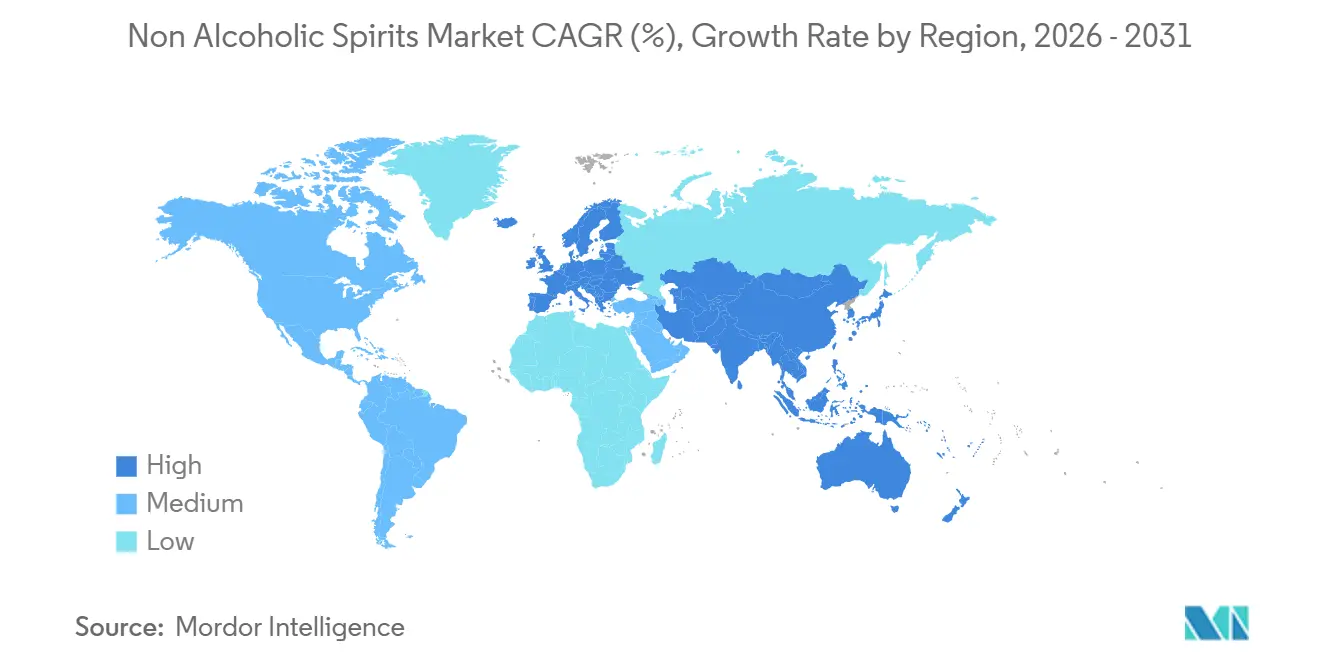
Europe accounted for 39.45% of the global non-alcoholic spirits market share in 2025, making it the largest regional market. The region's leadership is driven by the growing popularity of the sober-curious movement, increasing health consciousness, and strong consumer demand for premium alcohol-free beverages. Countries such as the United Kingdom, Germany, France, and Spain have witnessed rapid adoption of non-alcoholic spirits across both retail and hospitality channels. A well-established cocktail culture, coupled with the expansion of alcohol-free menus in bars, restaurants, and hotels, continues to support market growth. Leading manufacturers are actively launching innovative botanical spirits and expanding distribution networks throughout Europe.
Asia-Pacific is projected to register the highest CAGR of 9.89% during 2026–2031, making it the fastest-growing regional market. Rising disposable incomes, rapid urbanization, and changing consumer lifestyles are encouraging greater adoption of premium non-alcoholic beverages across the region. Currently, Asia is home to 54% of the global urban populace, translating to over 2.2 billion individuals. Projections indicate that by 2050, Asia's urban demographic will swell by another 1.2 billion, marking a 50% increase[3]Source: UN-Habitat, Asia and the Pacific Region", unhabitat.org. Growing health awareness among younger consumers, particularly in countries such as Japan, Australia, China, and South Korea, is fueling demand for alcohol-free spirits. The expansion of modern retail formats, e-commerce platforms, and premium hospitality establishments has significantly improved product availability.
North America represents a significant market, supported by strong demand for wellness-oriented beverages, premium product innovation, and the growing popularity of alcohol-free cocktails in the United States and Canada. South America is witnessing steady growth as consumer awareness of healthier beverage alternatives increases and modern retail channels continue to expand across major economies. Meanwhile, the Middle East & Africa is an emerging market where cultural preferences for non-alcoholic beverages, rising tourism, expanding hospitality infrastructure, and increasing availability of premium alcohol-free products are creating new growth opportunities.

Competitive Landscape
The non-alcoholic spirits market is fragmented, with competition involving established beverage companies, dedicated alcohol-free spirit producers, craft beverage brands, and emerging startups. Market participants compete primarily through product innovation, premium botanical formulations, flavor differentiation, and brand positioning rather than price alone. Companies are increasingly focusing on replicating the taste, aroma, and mouthfeel of traditional spirits using natural botanicals, herbs, spices, and advanced distillation techniques. Leading players such as Lyre's Spirit Co., Ritual Zero Proof, CleanCo, Seedlip (Diageo plc), and ISH Spirits ApS have established strong brand recognition through diverse product portfolios and premium offerings. The continuous introduction of new flavors and spirit alternatives has intensified competition across global markets.
Manufacturers are actively expanding their geographic presence through strategic partnerships, retail expansion, and collaborations with hospitality operators to strengthen market penetration. Premium supermarkets, specialty beverage retailers, online platforms, and on-trade channels have become important routes for increasing consumer reach. Companies are also investing heavily in marketing campaigns centered on mindful drinking, wellness, and the sober-curious lifestyle to attract younger consumers. For example, Lyre's Spirit Co. has significantly expanded its global distribution network.
Innovation remains the primary competitive strategy, with companies introducing new botanical blends, functional ingredients, and premium packaging to differentiate their products. Many manufacturers are expanding beyond traditional gin alternatives into alcohol-free whiskey, rum, tequila, vodka, and aperitif categories to capture a broader consumer base. Sustainability initiatives, clean-label formulations, and the use of natural ingredients have also become important competitive differentiators. Emerging brands continue to enter the market with region-specific flavors and craft-style offerings, further increasing competitive intensity.
Non Alcoholic Spirits Industry Leaders
-
Ritual Zero Proof Inc.
-
Lyre's Spirit Co Pty Ltd
-
CleanCo Ventures Limited
-
The Free Spirits Company LLC
-
Monday Distillery Pty Ltd
- *Disclaimer: Major Players sorted in no particular order

Recent Industry Developments
- June 2026: Lyre’s expanded its ready-to-drink portfolio with the launch of Classico Rosé RTD, a canned non-alcoholic sparkling rosé product. The 250 ml format was introduced to provide greater convenience for occasions such as outdoor events, travel, and celebrations.
- June 2026: Ritual Zero Proof expanded into the ready-to-drink (RTD) category by launching three canned non-alcoholic cocktails: Margarita, G&T, and Spritz. The products are based on Ritual’s existing Agave Spirit Alternative, Gin Alternative, and Aperitif Alternative portfolios and target consumers seeking convenient alcohol-free cocktail options.
- July 2025: Almave launched Almave Humo, a non-alcoholic mezcal-inspired spirit designed to replicate the smoky flavor profile of traditional mezcal. The product uses Espadín agave and expands Almave’s portfolio beyond its existing Blanco and Ámbar tequila-style alternatives, targeting consumers seeking premium zero-proof agave spirits.


Global Non Alcoholic Spirits Market Report Scope
Non-alcoholic spirits are beverages designed to replicate the flavor, aroma, complexity, and drinking experience of traditional distilled spirits such as gin, whiskey, rum, vodka, and tequila, while containing 0.0% alcohol or only trace amounts permitted under local regulations. The non alcoholic spirits market is segmented by product type, flavor, distribution channel and geography. Based on product type, the market is segmented into gin, rum, whiskey, tequila, vodka and other non alcoholic beverages. Based on flavor, the market is segmented into citrus, herbal and botanical, spiced, floral, fruity and other flavor profiles. Based on distribution channel, the market is segmented into off-trade and on-trade channels. By geography, the market is segmented into North America, Europe, Asia-Pacific, South America, and Middle-East and Africa. For each segment, the market sizing and forecasting have been done in value terms (USD billion) and volume (litres).
| Gin |
| Rum |
| Whiskey |
| Tequila |
| Vodka |
| Other Non-Alcoholic Spirits |
| Citrus |
| Herbal and Botanical |
| Spiced |
| Floral |
| Fruity |
| Other Flavor Profiles |
| On-Trade | |
| Off-Trade | Supermarkets and Hypermarkets |
| Specialty Stores | |
| Online Retail Stores | |
| Other Distribution Channels |
| North America | United States |
| Canada | |
| Mexico | |
| Rest of North America | |
| Europe | United Kingdom |
| Germany | |
| France | |
| Italy | |
| Spain | |
| Netherlands | |
| Sweden | |
| Belgium | |
| Poland | |
| Rest of Europe | |
| Asia-Pacific | China |
| Japan | |
| India | |
| South Korea | |
| Australia | |
| Indonesia | |
| Thailand | |
| Singapore | |
| Rest of Asia-Pacific | |
| South America | Brazil |
| Argentina | |
| Chile | |
| Colombia | |
| Peru | |
| Rest of South America | |
| Middle East and Africa | United Arab Emirates |
| South Africa | |
| Saudi Arabia | |
| Nigeria | |
| Egypt | |
| Morocco | |
| Turkey | |
| Rest of Middle East and Africa |
| By Product Type | Gin | |
| Rum | ||
| Whiskey | ||
| Tequila | ||
| Vodka | ||
| Other Non-Alcoholic Spirits | ||
| By Flavor | Citrus | |
| Herbal and Botanical | ||
| Spiced | ||
| Floral | ||
| Fruity | ||
| Other Flavor Profiles | ||
| By Distribution Channel | On-Trade | |
| Off-Trade | Supermarkets and Hypermarkets | |
| Specialty Stores | ||
| Online Retail Stores | ||
| Other Distribution Channels | ||
| By Geography | North America | United States |
| Canada | ||
| Mexico | ||
| Rest of North America | ||
| Europe | United Kingdom | |
| Germany | ||
| France | ||
| Italy | ||
| Spain | ||
| Netherlands | ||
| Sweden | ||
| Belgium | ||
| Poland | ||
| Rest of Europe | ||
| Asia-Pacific | China | |
| Japan | ||
| India | ||
| South Korea | ||
| Australia | ||
| Indonesia | ||
| Thailand | ||
| Singapore | ||
| Rest of Asia-Pacific | ||
| South America | Brazil | |
| Argentina | ||
| Chile | ||
| Colombia | ||
| Peru | ||
| Rest of South America | ||
| Middle East and Africa | United Arab Emirates | |
| South Africa | ||
| Saudi Arabia | ||
| Nigeria | ||
| Egypt | ||
| Morocco | ||
| Turkey | ||
| Rest of Middle East and Africa | ||


Key Questions Answered in the Report
What is the projected size of the non alcoholic spirits market by 2031?
The market is forecast to reach USD 611.24 million by 2031, rising from USD 403.45 million in 2026 at an 8.66% CAGR.
Which non-alcoholic spirit type is growing fastest?
Tequila alternatives are projected to grow at a 10.22% CAGR through 2031, the highest rate among the product categories provided.
Why are alcohol-free cocktails important for producers?
Bars and restaurants provide trial opportunities, and the number of alcohol-free cocktails in the KAM and Everleaf audit rose from 1.9 to 3.2 per venue between 2024 and 2026.
Which region has the strongest current position?
Europe held 39.45% of category revenue in 2025, supported by premium drinks culture and established moderation habits.
How concentrated is the competitive landscape?
The non alcoholic spirits market concentration score is 5 out of 10 because no single supplier has category-defining share, while large spirits groups and specialist brands both compete actively.
Page last updated on:





