
Non-Alcoholic Beer Market Size and Share
Market Overview
| Study Period | 2021 - 2031 |
|---|---|
| Market Size (2026) | USD 21.43 Billion |
| Market Size (2031) | USD 31.51 Billion |
| Growth Rate (2026 - 2031) | 8.02 % |
| Fastest Growing Market | Asia-Pacific |
| Largest Market | Europe |
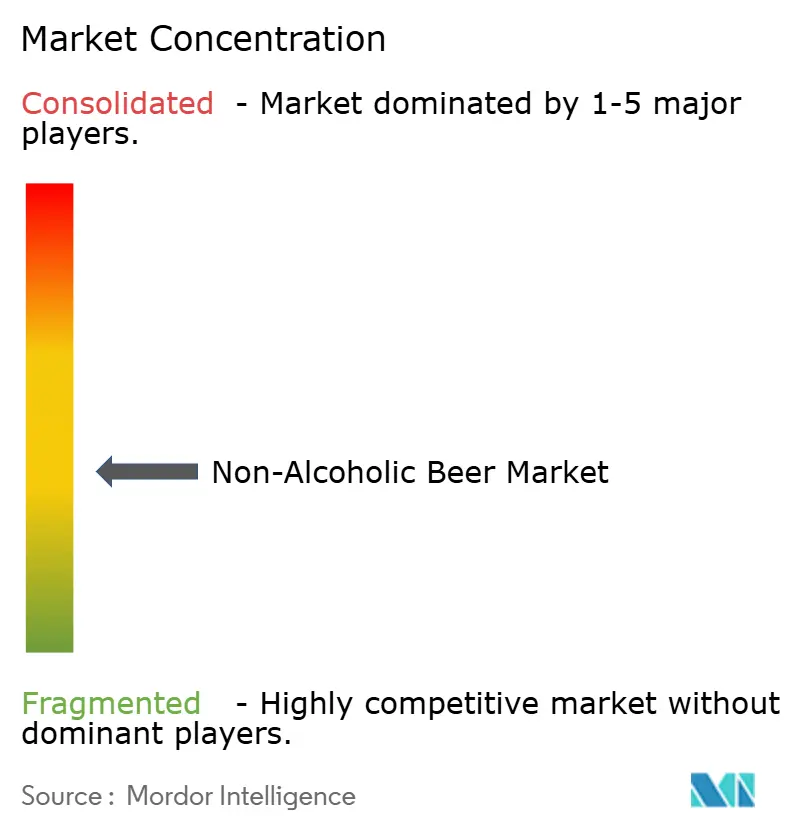
| Market Concentration | Medium |
Major Players
*Disclaimer: Major Players sorted in no particular order Image © Mordor Intelligence. Reuse requires attribution under CC BY 4.0. |
|
Non-Alcoholic Beer Market Analysis by Mordor Intelligence
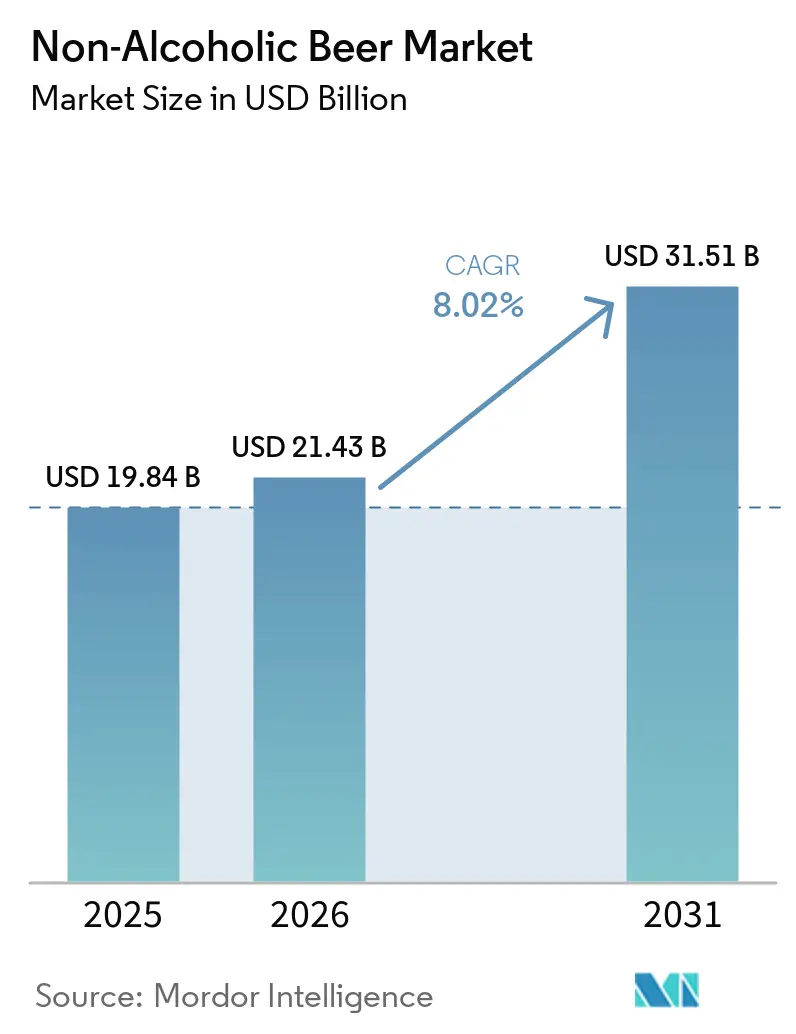
The non-alcoholic beer market size is expected to grow from USD 19.84 billion in 2025 to USD 21.43 billion in 2026 and is forecast to reach USD 31.51 billion by 2031 at a 8.02% CAGR over 2026-2031. The market is experiencing steady growth as consumers increasingly seek moderation, healthier drinking choices, and alternatives to traditional alcoholic beverages. Changing preferences among younger consumers, alongside the expansion of non-alcoholic product portfolios by major brewers and specialized producers, are supporting wider market adoption. Europe remains a key regional market, while Asia-Pacific is gaining momentum due to changing urban lifestyles and evolving beverage preferences. Lager continues to represent a major product category, while cans and off-trade channels remain important to overall sales. At the same time, product innovation, production costs, regulatory differences, and distribution requirements continue to influence competitive positioning and market development.
Key Report Takeaways
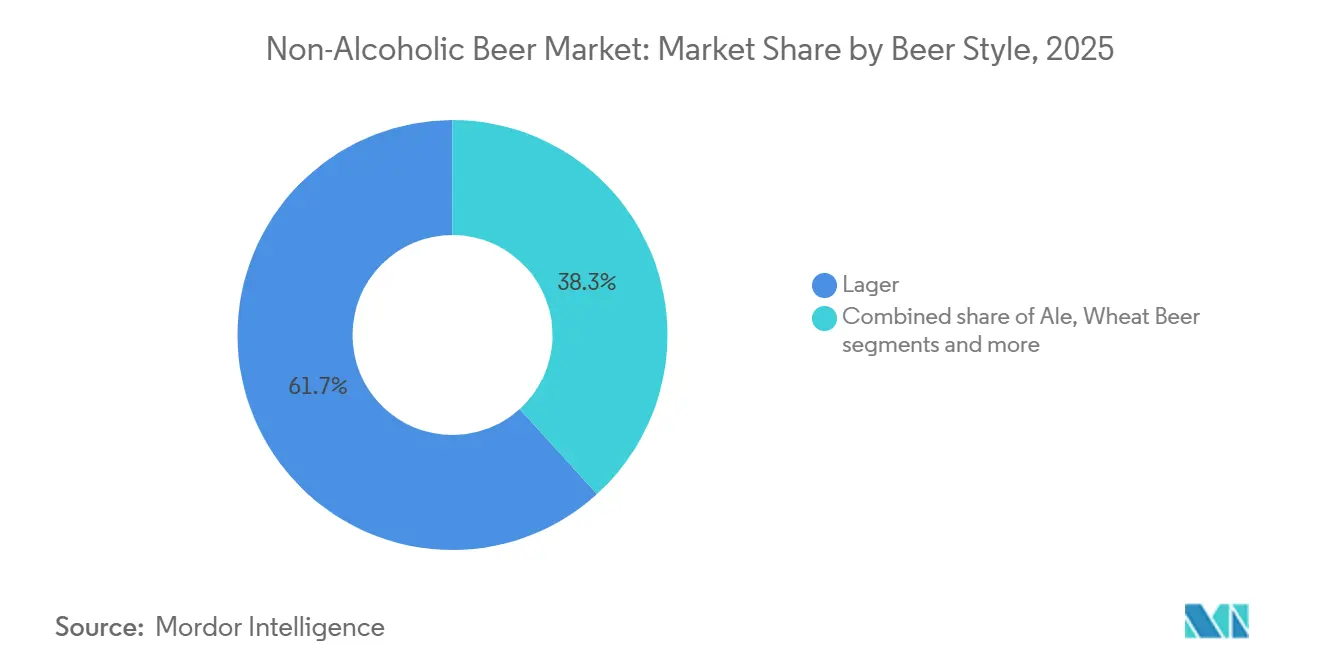
- By beer style, lager held 61.74% of the non-alcoholic beer market share in 2025, while ale is forecast to grow at a 9.43% CAGR from 2026 to 2031.
- By packaging, cans accounted for 65.83% of the non-alcoholic beer market share in 2025 and are the fastest-growing packaging format from 2026 to 2031.
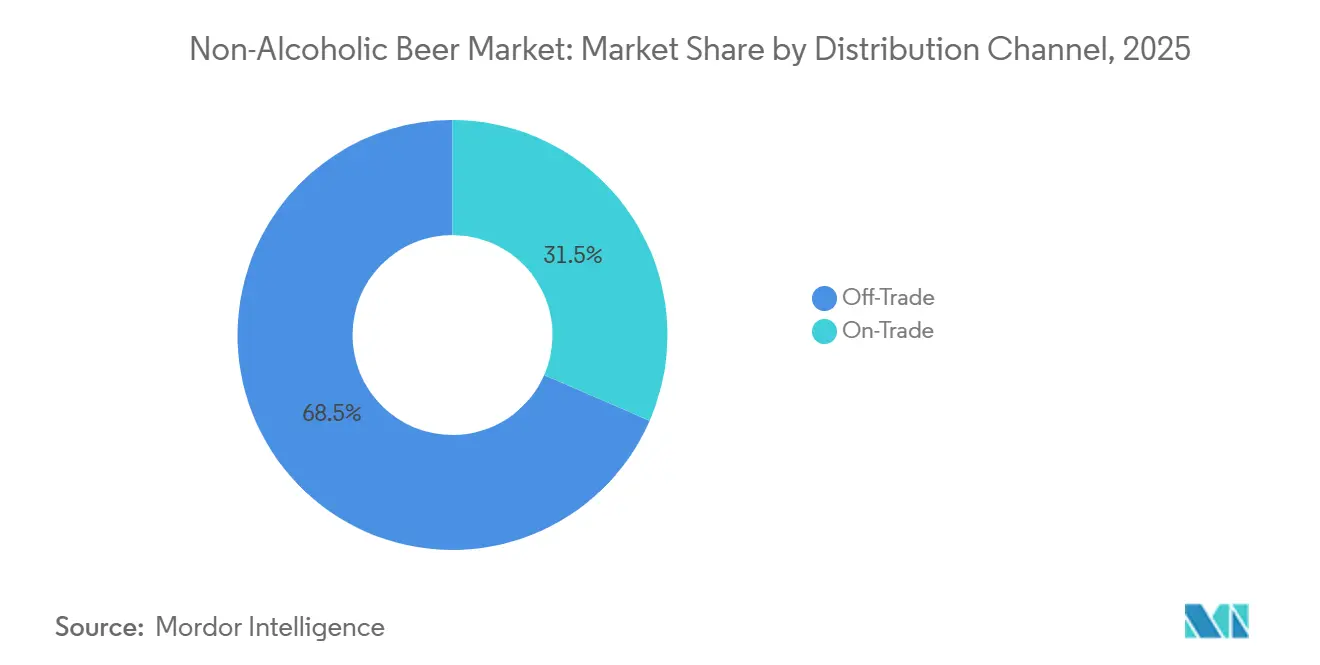
- By distribution channel, off-trade represented 68.47% of the non-alcoholic beer market share in 2025, while on-trade is forecast to expand at a 9.76% CAGR from 2026 to 2031.
- By geography, Europe held 42.68% of the non-alcoholic beer market share in 2025, while Asia-Pacific is forecast to grow at a 10.34% CAGR from 2026 to 2031.
Note: Market size and forecast figures in this report are generated using Mordor Intelligence’s proprietary estimation framework, updated with the latest available data and insights as of January 2026.
Global Non-Alcoholic Beer Market Trends and Insights
Drivers Impact Analysis*
| Driver | (~) % Impact on CAGR Forecast | Geographic Relevance | Impact Timeline |
|---|---|---|---|
| Moderation and sober-curious consumption | +2.8% | Global, with strongest pull in North America and Western Europe | Short term (≤ 2 years) |
| Health and wellness-driven alcohol reduction | +2.0% | Global, concentrated in North America, Western Europe and Asia-Pacific urban centers | Medium term (2-4 years) |
| Improving taste and sensory quality | +1.2% | Global | Medium term (2-4 years) |
| Mainstream brewer participation and expanded product availability | +0.8% | Global, accelerating in Asia-Pacific and South America | Short term (≤ 2 years) |
| Expansion into social and everyday drinking occasions | +0.5% | North America and Europe, with early gains in Asia-Pacific | Medium term (2-4 years) |
| Premiumization and product innovation | +0.4% | North America, Western Europe, and premium Asia-Pacific markets | Long term (≥ 4 years) |
| Source: Mordor Intelligence | |||
Moderation and Sober-Curious Consumption
Growing awareness of the health risks associated with excessive alcohol consumption is encouraging consumers to moderate their intake and consider alcohol-free alternatives. According to the Centers for Disease Control and Prevention (CDC), 2024, 17% of United States adults binge drink, while 6% drink heavily, indicating a substantial population exposed to excessive alcohol consumption[1]Source: Centers for Disease Control and Prevention, "Data on Excessive Alcohol Use", cdc.gov. The CDC also reported in 2024 that excessive alcohol use accounts for approximately 488 deaths per day in the United States, and that reducing alcohol intake can lower associated health risks[2]Source: Centers for Disease Control and Prevention, "What You Can Do to Lower Your Risk of Alcohol-Related Harms", cdc.gov. This is driving greater interest in moderation-oriented drinking occasions and creating opportunities for non-alcoholic beer, as consumers seek to participate in beer-drinking occasions while reducing or avoiding alcohol intake.
Health and Wellness-Driven Alcohol Reduction
The growing focus on health and wellness is encouraging consumers to evaluate beverage choices based on their fit with healthier lifestyles. According to the International Food Information Council (IFIC), 2025, 57% of Americans considered healthfulness an impactful factor in their food and beverage purchasing decisions, making it one of the leading considerations in beverage selection[3]Source: International Food Information Council, "2025 IFIC Food & Health Survey", ific.org. This continued emphasis on health-conscious purchasing supports opportunities for non-alcoholic beer to appeal to consumers seeking familiar beer experiences while reducing alcohol intake. As wellness considerations become more integrated into everyday consumption decisions, non-alcoholic beer can benefit from its positioning as an alternative to conventional alcoholic beer.
Improving Taste and Sensory Quality
Advancements in brewing and dealcoholization technologies are helping producers improve the taste, aroma, mouthfeel, and overall sensory profile of non-alcoholic beer. The Brewers Association notes that producing non-alcoholic beer can be challenging from a flavor standpoint because processes used to remove alcohol can also affect aroma compounds. Brewers are therefore increasingly refining fermentation methods, yeast selection, recipes, and processing techniques to better preserve the characteristics associated with conventional beer. Improvements in ingredient selection and process control are also enabling producers to develop more balanced flavor profiles across different non-alcoholic beer styles. These developments are helping narrow the sensory gap between alcoholic and non-alcoholic products, supporting greater consumer acceptance and repeat consumption.
Mainstream Brewer Participation and Expanded Product Availability
Greater participation from mainstream and established brewers is strengthening the presence of non-alcoholic beer across the wider beverage market. Major brewing companies are expanding their non-alcoholic portfolios and introducing new products across different beer styles, while established distribution networks help these offerings reach a broader range of retail and foodservice outlets. At the same time, growing participation from independent and craft brewers is increasing product variety and encouraging innovation within the category. This expanding producer base and wider product availability are improving consumer access to non-alcoholic beer and supporting its transition from a niche offering toward a more established part of the beer market.
Restraints Impact Analysis*
| Restraint | (~) % Impact on CAGR Forecast | Geographic Relevance | Impact Timeline |
|---|---|---|---|
| Consumer concerns over taste and mouthfeel | -1.5% | Global, most acute in price-sensitive and emerging markets | Short term (≤ 2 years) |
| Higher production costs and premium pricing | -1.2% | Global, especially severe for independent craft producers | Medium term (2-4 years) |
| Fragmented ABV definitions and labeling requirements | -0.6% | Global, particularly complex across Europe and Asia-Pacific multi-jurisdiction markets | Medium term (2-4 years) |
| Microbial stability and shelf-life constraints | -0.3% | Global, most impactful in on-trade keg and draught channel | Short term (≤ 2 years) |
| Source: Mordor Intelligence | |||
Consumer Concerns Over Taste and Mouthfeel
Consumer concerns regarding taste, mouthfeel, and overall sensory similarity to conventional beer remain a restraint for non-alcoholic beer adoption. The absence of alcohol can affect the body, balance, and complexity of the beverage, making it more difficult for some products to replicate the sensory characteristics consumers associate with traditional beer. The Brewers Association notes that non-alcoholic beers can have a flavor profile with less complexity and balance than beers containing alcohol, highlighting the technical challenge of maintaining sensory quality during production. Such differences can influence consumer acceptance and repeat purchases, particularly among consumers who expect non-alcoholic products to closely match the taste and drinking experience of conventional beer.
Higher Production Costs and Premium Pricing
Non-alcoholic beer can involve higher production costs than conventional beer because producers may require additional processing, specialized equipment, and tighter quality and stability controls. The Brewers Association notes that non-alcoholic beer can be produced through processes such as vacuum distillation, membrane filtration, and reverse osmosis, while also requiring additional preservation and quality-control considerations. These additional production requirements can increase manufacturing costs and contribute to premium pricing, which may discourage price-sensitive consumers and limit adoption where non-alcoholic beer is positioned significantly above conventional beer.
*Our forecasts treat driver/restraint impacts as directional, not additive. The impact forecasts reflect baseline growth, mix effects, and variable interactions.
Segment Analysis
By Beer Style: Lager Dominance Masks Accelerating Craft Complexity
Lager accounted for the largest share of the non-alcoholic beer market by value in 2025, at 61.74%, supported by its widespread familiarity and established presence across major beer markets. The style benefits from a broad consumer base that is already accustomed to its lighter and more refreshing flavor profile. Major brewers have also introduced non-alcoholic versions of established lager brands, increasing product visibility across retail and foodservice channels. The availability of these products through established distribution networks has further strengthened lager's position. As a result, lager continues to provide the category with a large and accessible base of consumers seeking familiar beer styles without alcohol.
Ale is projected to be the fastest-growing beer style in the non-alcoholic beer market through 2031, with a 9.43% CAGR, reflecting increasing diversification within the category. Ale-based offerings, including IPA, stout, porter, and other craft-oriented styles, provide consumers with alternatives to the dominant lager format. Product development in these styles is also enabling producers to target consumers seeking more distinctive flavor profiles and greater variety. The growing availability of craft-style non-alcoholic beers is expanding the category beyond traditional lager offerings. This diversification is expected to support faster growth for ale as producers broaden their non-alcoholic portfolios.



By Packaging: Cans Consolidating Structural Advantage on Multiple Vectors
Cans held the largest share of the non-alcoholic beer packaging segment in 2025, at 65.83%, and were also the fastest-growing packaging format, projected to expand at a CAGR of 8.61% between 2026 and 2031. Their leading position is supported by their practicality, portability, and suitability for packaged beverage distribution. The lightweight construction and ease of storage make cans well suited to retail channels, while their opaque packaging provides protection from light exposure. Cans also benefit from established filling, packaging, and distribution infrastructure across the broader beer industry. These advantages continue to support their widespread use in non-alcoholic beer and reinforce their position as the leading packaging format.
The continued expansion of canned non-alcoholic beer offerings is further supported by their suitability for different consumption occasions, including outdoor, social, and on-the-go use. Their recyclability also aligns with growing interest in more sustainable packaging options, while their compact format allows efficient transportation and retail display. Bottles retain relevance in established beer-drinking occasions, particularly where glass packaging has strong consumer or channel acceptance. Kegs and other formats remain relevant for selected foodservice and on-trade applications but account for a more limited portion of overall demand. The combination of established infrastructure, consumer familiarity, and expanding product availability is expected to sustain the growth of cans within the market.
By Distribution Channel: Off-Trade Scale Contrasts with On-Trade Strategic Priority
Off-trade channels accounted for the largest share of the non-alcoholic beer market in 2025, at 68.47%, supported by the broad availability of products across supermarkets, hypermarkets, specialist stores, and online retail platforms. Organized retail provides consumers with convenient access to a growing range of non-alcoholic beer brands and formats, while established shelf space and product visibility support category penetration. Online retail is also expanding product accessibility by allowing consumers to compare brands and discover products beyond their local stores. The combination of broad retail coverage, convenience, and increasing product variety continues to reinforce the leading position of off-trade channels.
On-trade channels are projected to be the fastest-growing distribution channel through 2031, with a CAGR of 9.76%, as non-alcoholic beer gains greater presence in bars, restaurants, hotels, and other social consumption venues. Wider availability in these settings is allowing consumers to choose non-alcoholic beer during social occasions where alcoholic beverages have traditionally been more prevalent. Restaurants and hospitality venues can also introduce consumers to new products through direct consumption experiences, supporting greater awareness of the category. Increasing availability across on-trade establishments is therefore expected to complement retail expansion and contribute to faster channel growth.
Geography Analysis
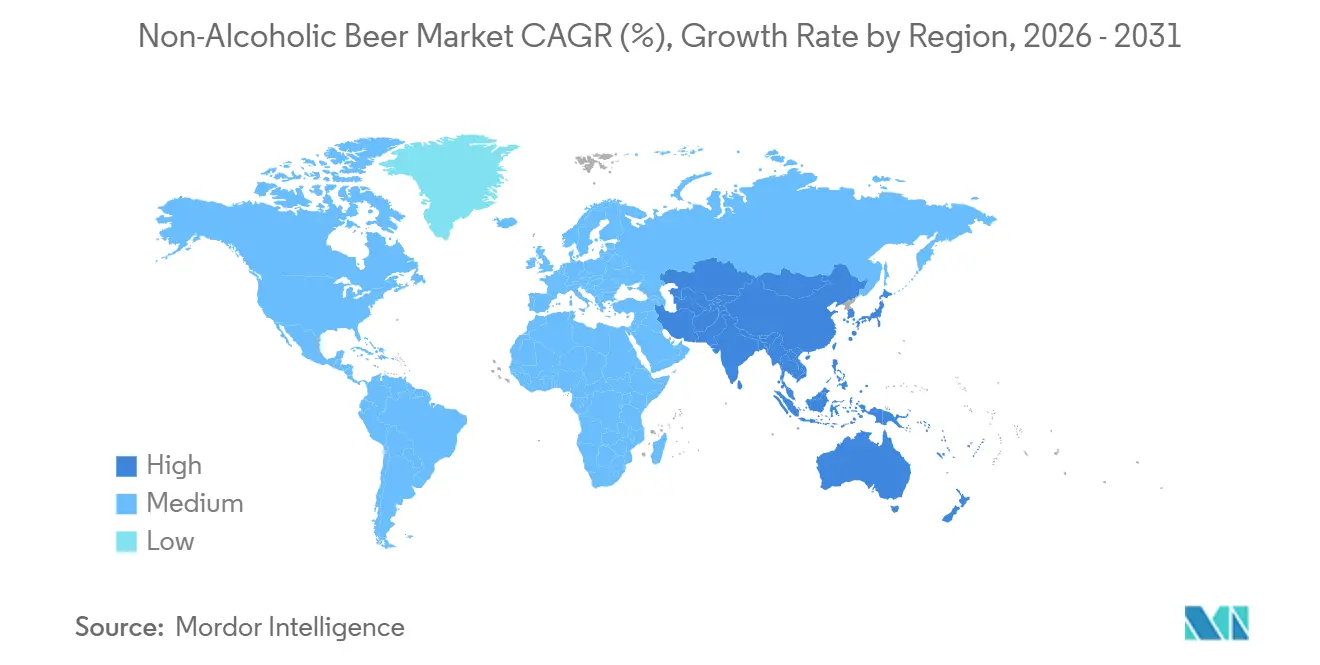
Europe accounted for the largest share of the global non-alcoholic beer market in 2025, at 42.68%, supported by established consumer familiarity and the widespread availability of non-alcoholic beer across major European markets. Germany represents a key market within the region, with non-alcoholic beer becoming an increasingly established part of the country's broader beer industry. The United Kingdom, Spain, Poland, the Netherlands, and Belgium also contribute to regional demand, although adoption levels vary across individual markets. The presence of established brewers, broad retail distribution, and increasing product variety continues to support the development of the European market. These factors are expected to maintain Europe's leading position over the forecast period.
Asia-Pacific is projected to be the fastest-growing regional market through 2031, with a CAGR of 10.34%, supported by changing beverage preferences, urbanization, and increasing availability of non-alcoholic beer. Japan represents one of the more established markets in the region, while China, India, South Korea, and Australia offer further growth opportunities as product availability expands. Major brewers are increasing their presence through new product launches, digital retail platforms, and partnerships that improve consumer awareness and access. The expansion of organized retail and e-commerce is particularly relevant in markets where non-alcoholic beer remains at an earlier stage of development. Increasing product visibility across both online and offline channels is therefore expected to support rapid regional growth.
North America, South America, and the Middle East and Africa represent additional markets with varying levels of non-alcoholic beer adoption. North America, led by the United States, has developed a relatively established category supported by expanding product portfolios and growing availability across retail and foodservice channels. South America remains an earlier-stage market, with Brazil and Argentina offering opportunities for wider product distribution through established brewing networks. The Middle East and Africa also present opportunities due to differences in alcohol consumption patterns and the availability of alcohol-free beverage options. Across these regions, further expansion of distribution networks, product launches, and consumer awareness is expected to support gradual market development.

Competitive Landscape
The non-alcoholic beer market is competitive, with major global brewers leveraging established brand portfolios, production capabilities, and distribution networks to strengthen their presence in the category. Key participants include Anheuser-Busch InBev SA/NV, Heineken N.V., Carlsberg Breweries A/S, Molson Coors Beverage Company, and Athletic Brewing Company LLC. Competition is shaped by differences in scale, portfolio breadth, and specialization. Large brewers benefit from their ability to introduce non-alcoholic variants through existing retail and distribution networks, while specialized players such as Athletic Brewing focus primarily on the non-alcoholic segment and differentiate through product development and brand positioning.
Product innovation is a key area of competition as companies seek to improve the taste, mouthfeel, variety, and overall quality of non-alcoholic beer. Major brewers have expanded their portfolios with established brand extensions and different beer styles, while specialized producers have focused on developing products specifically for non-alcoholic consumption occasions. Competition exists not only around product availability but also around the ability to deliver sensory quality and maintain consumer interest across different styles and occasions.
Competitive opportunities remain in areas such as premium non-alcoholic offerings, expanded on-trade availability, and greater product variety. Large brewers are positioned to benefit from their distribution reach and established consumer recognition, while specialized companies can compete through focused innovation and category-specific brand positioning. As the market develops, competitive differentiation is expected to depend increasingly on product quality, portfolio diversification, distribution coverage, and the ability to establish strong positioning within the non-alcoholic beer category.
Non-Alcoholic Beer Industry Leaders
-
Anheuser-Busch InBev SA/NV
-
Heineken N.V.
-
Carlsberg Breweries A/S
-
Molson Coors Beverage Company
-
Athletic Brewing Company LLC
- *Disclaimer: Major Players sorted in no particular order

Recent Industry Developments
- May 2026: Krombacher Brauerei launched its 0.0% Pils in draught format, expanding non-alcoholic beer beyond packaged retail into on-trade consumption. The move was positioned as a response to growing demand for non-alcoholic beer and provides consumers with a closer alternative to the conventional draught beer experience.
- May 2026: United Kingdom independent 0.0% beer brand Days Brewing partnered with Sunrise Beverages in May 2026, adding the brand to Sunrise's beverage portfolio to support further growth. The partnership highlights increasing activity around independent non-alcoholic beer brands and the use of strategic partnerships to expand distribution and scale.
- May 2026: United Kingdom independent 0.0% beer brand Days Brewing partnered with Sunrise Beverages, adding the brand to Sunrise's beverage portfolio to support further growth. The partnership highlights increasing activity around independent non-alcoholic beer brands and the use of strategic partnerships to expand distribution and scale.


Global Non-Alcoholic Beer Market Report Scope
The non-alcoholic beer market refers to beer-style beverages containing little to no alcohol that are produced using brewing processes similar to conventional beer while maintaining the taste, aroma, and characteristics associated with beer. The market is segmented by beer style into lager, ale, wheat beer, stout and porter, and others; by packaging into bottles, cans, kegs, and others; by distribution channel into on-trade and off-trade; and by geography into North America, Europe, Asia-Pacific, South America, and Middle East and Africa. For each segment, the market sizing and forecasting have been done in value terms (USD billion) and volume (liters).
| Lager |
| Ale |
| Wheat Beer |
| Stout and Porter |
| Others |
| Bottles |
| Cans |
| Kegs |
| Others |
| On-Trade | |
| Off-Trade | Supermarkets/Hypermarkets |
| Specialist Stores | |
| Online Retail Stores | |
| Others Distribution Channel |
| North America | United States |
| Canada | |
| Mexico | |
| Rest of North America | |
| Europe | Germany |
| United Kingdom | |
| Italy | |
| France | |
| Spain | |
| Netherlands | |
| Poland | |
| Belgium | |
| Sweden | |
| Rest of Europe | |
| Asia-Pacific | China |
| India | |
| Japan | |
| Australia | |
| Indonesia | |
| South Korea | |
| Thailand | |
| Singapore | |
| Rest of Asia-Pacific | |
| South America | Brazil |
| Argentina | |
| Colombia | |
| Chile | |
| Peru | |
| Rest of South America | |
| Middle East and Africa | South Africa |
| Saudi Arabia | |
| United Arab Emirates | |
| Nigeria | |
| Egypt | |
| Morocco | |
| Turkey | |
| Rest of Middle East and Africa |
| By Beer Style | Lager | |
| Ale | ||
| Wheat Beer | ||
| Stout and Porter | ||
| Others | ||
| By Packaging | Bottles | |
| Cans | ||
| Kegs | ||
| Others | ||
| By Distribution Channel | On-Trade | |
| Off-Trade | Supermarkets/Hypermarkets | |
| Specialist Stores | ||
| Online Retail Stores | ||
| Others Distribution Channel | ||
| By Geography | North America | United States |
| Canada | ||
| Mexico | ||
| Rest of North America | ||
| Europe | Germany | |
| United Kingdom | ||
| Italy | ||
| France | ||
| Spain | ||
| Netherlands | ||
| Poland | ||
| Belgium | ||
| Sweden | ||
| Rest of Europe | ||
| Asia-Pacific | China | |
| India | ||
| Japan | ||
| Australia | ||
| Indonesia | ||
| South Korea | ||
| Thailand | ||
| Singapore | ||
| Rest of Asia-Pacific | ||
| South America | Brazil | |
| Argentina | ||
| Colombia | ||
| Chile | ||
| Peru | ||
| Rest of South America | ||
| Middle East and Africa | South Africa | |
| Saudi Arabia | ||
| United Arab Emirates | ||
| Nigeria | ||
| Egypt | ||
| Morocco | ||
| Turkey | ||
| Rest of Middle East and Africa | ||


Key Questions Answered in the Report
What is the projected value of the non-alcoholic beer market by 2031?
The category is forecast to reach USD 31.51 billion by 2031, from USD 21.43 billion in 2026, at an 8.02% CAGR.
Which beer style leads non-alcoholic beer sales?
Lager led with 61.74% share in 2025, while ale is forecast to grow fastest at a 9.43% CAGR through 2031.
Which distribution channel is growing fastest?
On-trade is forecast to grow at a 9.76% CAGR from 2026 to 2031 as bars, restaurants, and sports venues expand alcohol-free choices.
Which region has the strongest growth outlook?
Asia-Pacific is forecast to grow at a 10.34% CAGR through 2031, supported by development in Japan, India, China, and South Korea.
Page last updated on:


 Your data is secure and never sold or shared.


