
Nigeria E-commerce Market Analysis by Mordor Intelligence
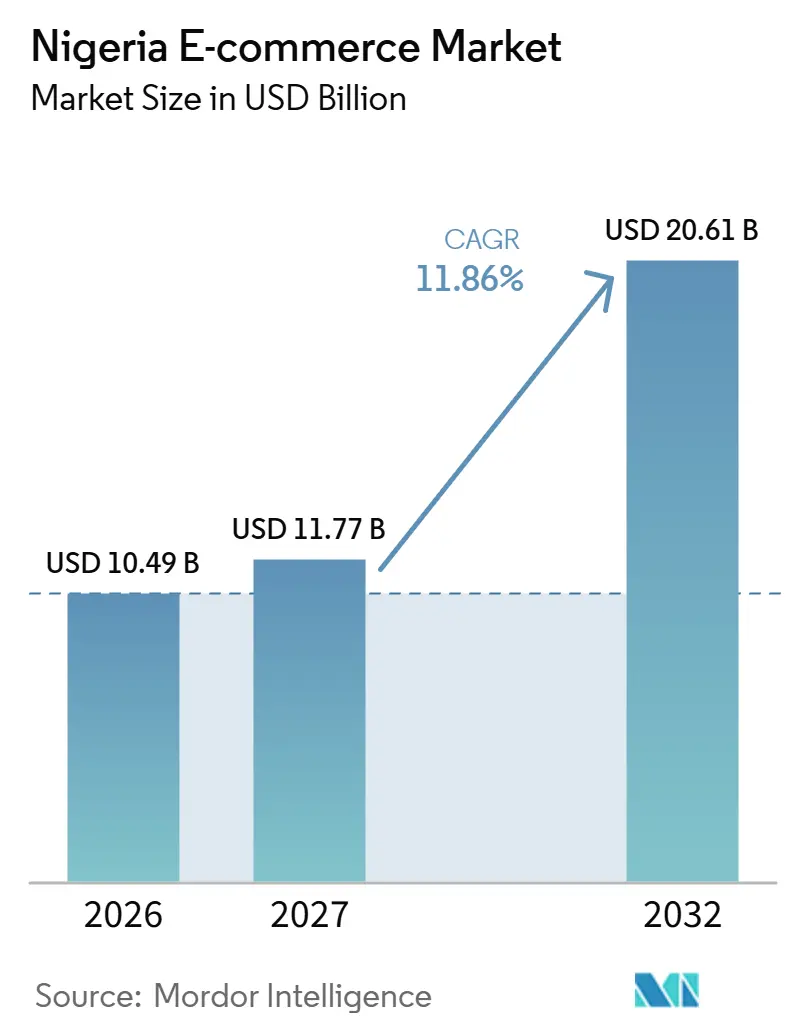
The Nigeria e-commerce market size is projected to expand from USD 10.49 billion in 2026 and USD 11.77 billion in 2027 to USD 20.61 billion by 2032, registering a CAGR of 11.86% between 2027 and 2032.
Broader connectivity and established social-business use create a larger potential audience for online retail in Nigeria. Capturing that opportunity depends on joining mobile ordering with reliable payment confirmation and local fulfillment. Platforms can extend their role through shared delivery services and lender-backed checkout options, while specialists can build a defined offer around goods such as skincare. Address uncertainty and disputed-payment exposure make completion costs central to how much of that wider reach becomes sustainable trading activity.
Key Report Takeaways
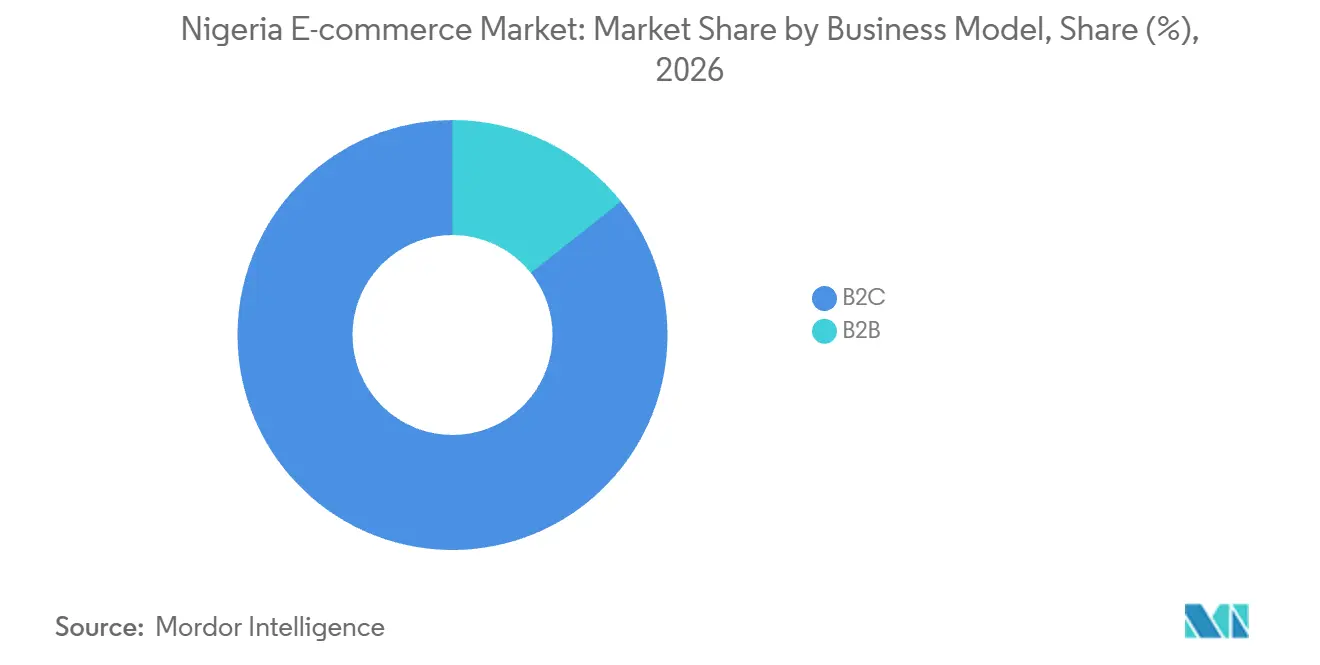
- Business models were led by B2C, with an 85.67% Nigeria e-commerce market share in 2026, while B2B is forecast to grow fastest at a 17.85% CAGR between 2027 and 2032.
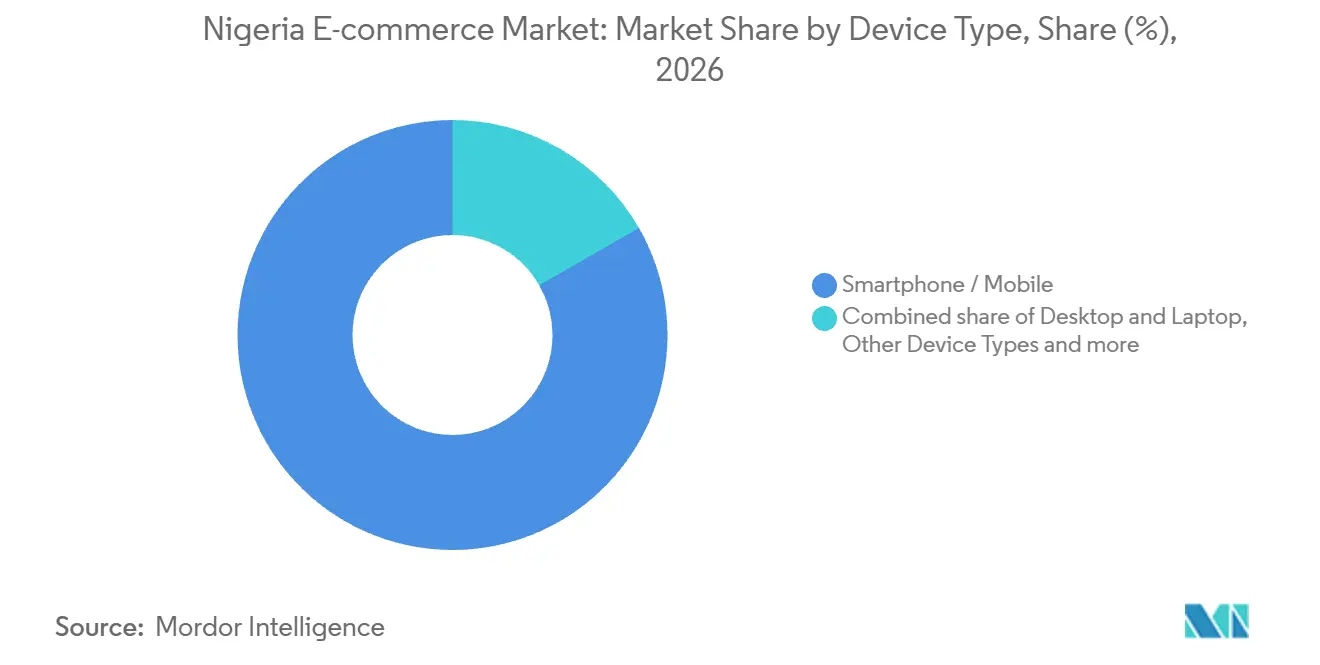
- By device type, smartphone / mobile held an 83.29% share of the Nigeria e-commerce market size in 2026 and is also forecast to grow fastest, at a 12.7% CAGR between 2027 and 2032.
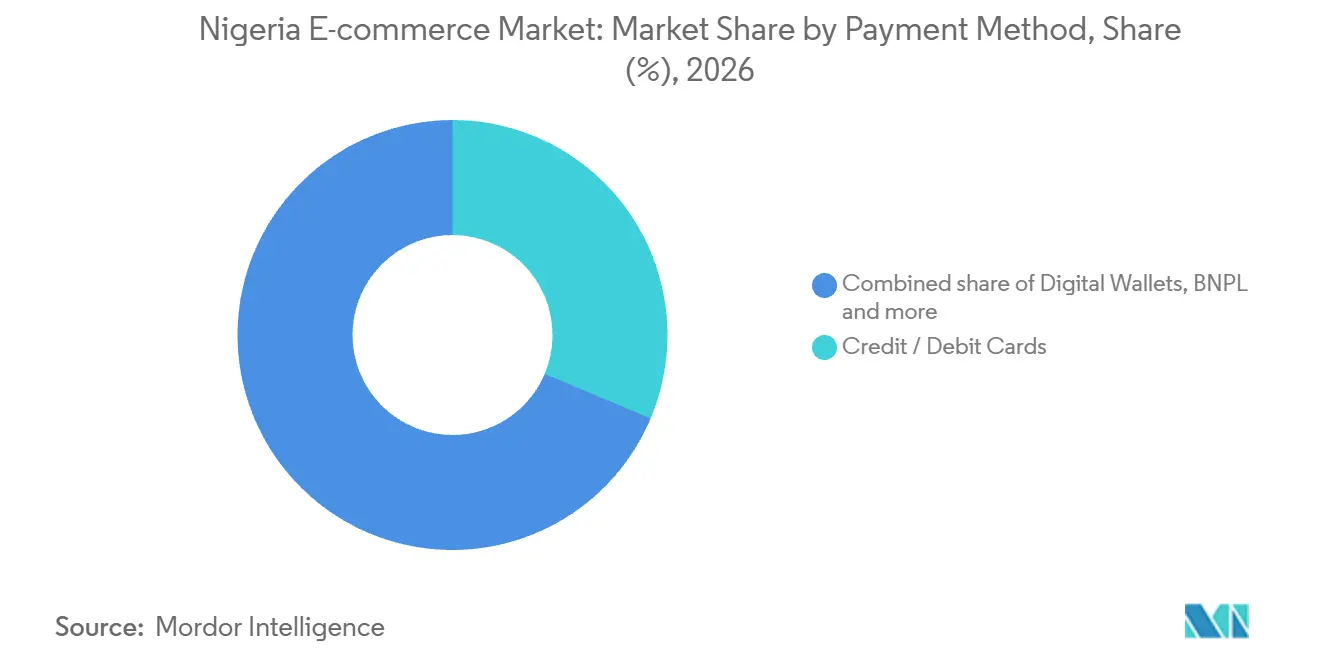
- Among payment methods, credit and debit cards led with a 31.34% share in 2026, while BNPL is forecast to grow fastest at a 27.9% CAGR between 2027 and 2032.
- Within B2C product categories, consumer electronics led with a 27.24% share of B2C e-commerce sales in 2026, while beauty and personal care is forecast to grow fastest at a 16.1% CAGR between 2027 and 2032.
- Geographically, Greater Lagos accounted for 38.96% of online orders in 2026, while the northern states are forecast to grow fastest at a 14.65% CAGR between 2027 and 2032.
Note: Market numbers in this report are based on Mordor Intelligence's proprietary estimation framework, which combines nine months of actuals with Q4 projections for base year 2026.
Market Trends and Insights
Drivers Impact Analysis of Nigeria E-commerce Market*
| Driver | (~) % Impact on CAGR Forecast | Geographic Relevance | Impact Timeline |
|---|---|---|---|
| Surge in Social Commerce Adoption via WhatsApp and Instagram | +4.1% | Nationwide | Short term (≤ 2 years) |
| Rapid Expansion of Mobile-Money Agent Network for Pay-on-Delivery Conversion | +3.5% | Nationwide | Medium term (2-4 years) |
| Government National Broadband Plan's 2025 Target of 70% Broadband Penetration Drives the Market | +3.3% | Nationwide | Long term (≥ 4 years) |
| Logistics Tech Start-ups Enabling Same-Day Fulfillment in Lagos and Abuja | +2.8% | Greater Lagos and Abuja | Short term (≤ 2 years) |
| Cross-border Marketplace Integrations (e.g., Jumia Global) Boosting SKU Depth | +1.4% | Nationwide | Medium term (2-4 years) |
| Rising Adoption of Buy-Now-Pay-Later Increasing Average Basket Size | +1.1% | Nationwide | Short term (≤ 2 years) |
| Source: Mordor Intelligence | |||
Surge in Social Commerce Adoption via WhatsApp and Instagram
Social-platform distribution offers smaller sellers an entry point into online commerce built around an established base of business users. About 14 million Nigerian small and medium enterprises used Meta applications in 2025 to establish, operate and expand their businesses. That scale gives commerce-service providers a substantial potential audience for ordering tools that extend a seller's business presence into transactions. For merchants already using these applications, an incremental ordering service can preserve the existing channel while giving customer interactions a defined path toward a purchase. Providers able to add commerce functions within an established business channel can make that channel the basis for acquiring and serving a merchant.
Rapid Expansion of Mobile-Money Agent Network for Pay-on-Delivery Conversion
More financial-service access points give online retailers a broader infrastructure base for offering electronic settlement to customers. SANEF onboarded 69,094 financial-service agents in Nigeria in the first half of 2025, bringing its total to 2.02 million. Mobile money operator payment-service transactions through agent touchpoints and technology reached 28.74 billion in 2025, compared with 17.34 billion in 2024. The combination of additional access points and greater transaction activity strengthens the case for merchants to connect payment confirmation with order release, including where customers choose to settle at delivery. Merchant-service providers can connect a network payment to retailer order records, turning financial access into a service tied to goods release.
Government National Broadband Plan's 2025 Target of 70% Broadband Penetration Drives the Market
An online storefront needs a network capable of supporting both customer access and activity throughout an order. The Nigerian Communications Commission's subscription series put broadband penetration at 45.61% in January 2025 and 56.11% in May 2026, below the plan's 70% target for 2025. By September 9, 2026, mobile network operators had deployed 8,526 of 12,179 committed coverage and capacity sites nationwide, approximately 70% of those commitments.[1] Coverage and capacity address different commercial constraints, extending access and supporting activity over the network. For merchants, that combination supports investment in product discovery and ordering services that can accommodate additional customer interactions. The opportunity extends beyond attracting a first visit to spreading the cost of serving an online customer across more usable interactions.
Logistics Tech Start-ups Enabling Same-Day Fulfillment in Lagos and Abuja
Rapid fulfillment depends on where a rider starts relative to the next order. On July 1, 2026, Shride reported entering Lagos from Yaba with a decentralized restaurant-delivery rider network positioned near demand zones to reduce waiting and travel distance. Kwik's app-based, B2B-focused service commits to delivery within 2 hours from pickup in Lagos and 1 hour in Abuja. Those pickup-based commitments let sellers in both cities offer same-day windows for online goods orders. Same-day availability gives time-sensitive buyers a reason to complete an online purchase, strengthening the seller's conversion proposition.
Restraints Impact Analysis of Nigeria E-commerce Market*
| Restraint | (~) % Impact on CAGR Forecast | Geographic Relevance | Impact Timeline |
|---|---|---|---|
| Urban Congestion and Poor Address Systems Inflate Last-Mile Costs | -1.8% | Greater Lagos urban districts | Long term (≥ 4 years) |
| High Card-Not-Present Fraud and Charge-backs Escalate Merchant Costs | -1.4% | Nationwide | Short term (≤ 2 years) |
| Naira Volatility Compressing Import-Heavy Category Margins | -0.7% | Nationwide | Short term (≤ 2 years) |
| Uncertain Digital Services Tax Framework for Foreign Sellers | -0.4% | Nationwide | Medium term (2-4 years) |
| Source: Mordor Intelligence | |||
Urban Congestion and Poor Address Systems Inflate Last-Mile Costs
Delivery density has limited commercial value when a courier cannot reliably locate the next customer or predict the route time. A September 2026 Nigerian urban-freight review identified congestion and address verifiability as constraints on last-mile performance. In a 2026 Lagos e-commerce customer survey, address verifiability scored lowest among 6 measured dimensions, averaging 2.818 on a 5-point scale. For delivery operators, uncertain locations can turn a geographically short route into a time-intensive service obligation. That friction limits how far vehicle and labor costs can be spread across completed deliveries, leaving Lagos sellers to carry the cost of time spent locating recipients.
High Card-Not-Present Fraud and Charge-backs Escalate Merchant Costs
A disputed online payment can reduce the cash available to a merchant after an order has already been processed. Paystack's Nigeria-market terms deduct the transaction value of accepted or auto-accepted disputes from the next settlement, except where a merchant accepts a dispute partially. Its processing fees are nonrefundable, although merchants are not charged merely for receiving or resolving a dispute. Paystack leaves dispute outcomes to the customer's bank and card networks. The same terms make merchants responsible for the full amount of chargebacks and fraud claims, so a retailer absorbs both the reversed sale and the nonrefundable processing fee once a dispute is accepted or auto-accepted.
*Our forecasts treat driver/restraint impacts as directional, not additive. The impact forecasts reflect baseline growth, mix effects, and variable interactions.
Nigeria E-commerce Market Segment Analysis
By Business Model:
Consumer Scale and Retailer Sourcing ExpansionB2C was the largest segment, accounting for 85.67% of online commerce in 2026. Jumia reported that its Nigeria marketplace GMV increased 36% year over year in Q2 2026.[2] Its consumer-facing marketplace connects sellers with shoppers, and this company-level increase is one example of B2C transaction demand. For consumer-facing platforms, additional merchandise throughput can spread the costs of a common commerce service across more traded goods. That gives B2C platforms a reason to recruit additional merchants into a shared consumer channel, extending household product choice without creating a separate retail platform for every seller.
B2B is the fastest-growing segment, with a projected 17.85% CAGR between 2027 and 2032. OmniRetail's 2026 Nigeria FMCG Industry Report recorded 72% willingness among retailers to buy online. It put online platforms at 6% of retailers' inventory sourcing. Recurring digital replenishment gives B2B operators a route to convert willing retailers into regular sourcing customers, linking stated interest to multiple transactions rather than a single registration.

By Device Type:
Mobile Scale and Device Access ConstraintsSmartphone / mobile represented an 83.29% Nigeria e-commerce market share in 2026 and is the fastest-growing segment, with a projected 12.7% CAGR between 2027 and 2032. KPMG and Orange Group's 2025 study of 13,251 respondents across 12 Nigerian cities measured Jumia penetration at 15% among surveyed smartphone users. For Jumia, the gap between smartphone access and use of its platform creates room to seek additional users within the connected audience, separating customer acquisition from new device adoption.
Desktop and laptop use faces a different access decision when the prospective shopper does not already have a computer. Desktop and laptop costs were identified as a barrier to e-commerce adoption in a 2025 Nigerian study using a convenience sample of 336 respondents. That constraint means improving a desktop storefront cannot by itself remove the expense of acquiring the device required to use it. Desktop conversion work therefore addresses the experience of customers with computer access, leaving hardware affordability as a separate limit on the segment's ability to acquire new users.
By Payment Method:
Card Acceptance and Lender-Backed InstallmentsCredit and debit cards accounted for a 31.34% share of the Nigeria e-commerce market size in 2026, making them the largest segment. AfriGO, Nigeria's domestic debit-card scheme, had issued over 1 million cards nationwide by September 24, 2025, according to the managing director and CEO of Nigeria Inter-Bank Settlement System Plc. For online retailers, this is a pool of domestically issued payment instruments that a card-acceptance offer can address. Payment-service providers can address the link between the card base and merchant checkout, competing on usable acceptance alongside card distribution.
BNPL is the fastest-growing segment, with a projected 27.9% CAGR between 2027 and 2032. In July 2026, Klump integrated installment financing into Jumia's Nigerian checkout, connecting eligible shoppers with financing offers from partner lenders. Those lenders assess applicants, fund loans and assume credit risk, while Klump supplies the technology connection. For a marketplace merchant, this arrangement separates the consumer-financing decision from the retail transaction, allowing checkout credit to be offered without making the technology connector the lender. Underwriting capacity, lender approvals and eligible purchases therefore limit commercial expansion separately from the decision to add the payment option.
By B2C Product Category:
Electronics Capacity and Focused Beauty ExpansionConsumer electronics was the largest B2C product category, with a 27.24% share of B2C e-commerce sales in 2026. SLOT Nigeria Limited opened a new store at Silverbird Galleria in Lagos on April 28, 2025, with smartphones, smartwatches, accessories and technology products. That opening establishes a physical alternative for the same products, qualifying the commercial advantage of leading the online B2C categories. Online electronics sellers therefore have to give buyers a delivery and return offer that justifies ordering remotely when an in-person store is available.
Beauty and personal care is the fastest-growing B2C product category, with a projected 16.1% CAGR between 2027 and 2032. The Body Shop launched a national e-commerce site in Nigeria in 2025. A national ordering channel can separate access to a beauty brand from proximity to one of its stores. For specialist retailers, this makes the reach of the online offer a distinct growth lever from expanding a physical branch network.
Geography Analysis
Greater Lagos E-commerce Market
Greater Lagos held the largest Nigeria e-commerce market share by order volume, accounting for 38.96% of online orders in 2026. At its May 2025 summit, on-demand delivery platform Glovo said Lagos drove most of its own activity across its 11 Nigerian cities. This places an active urban delivery channel within Lagos, providing a local operating example alongside the wider area's lead in online orders. Because Lagos carried most of Glovo's activity, with its other 10 Nigerian cities together carrying less, the platform's delivery supply was concentrated in Lagos, giving sellers there an active local fulfillment channel.
northern states E-commerce Market
The northern states are the fastest-growing geography, with a projected 14.65% CAGR between 2027 and 2032. In Q1 2026, Jumia Nigeria added pickup stations and delivery infrastructure in Kebbi, Sokoto and Kaduna states and strengthened its presence in Zaria. For sellers targeting these locations, pickup points can connect online ordering with physical handover, giving the platform a local fulfillment route through which to serve additional customers. That makes the growth mechanism a sequence of locally serviceable additions, with the value of digital expansion dependent on pickup and delivery capacity in each added location.
Online sellers face local delivery needs alongside physical alternatives, including Soso Games' in-person branches in Abuja and Kano. Port Harcourt's Omacart offers same-day personal-shopper grocery delivery, while Ibadan's Kwik provides parcel services to individuals and businesses. In Enugu State, 9th Marketplace, affiliated with 9thTech, a subsidiary of 9th Holdings Group, launched with online goods and services in May 2025. At coastal ports, April 2026 National Single Window rollout delays prompted the Nigerian Shippers' Council and the Nigeria Revenue Service to request demurrage and storage waivers from shipping companies and terminal operators for affected importers and clearing agents. Local services address order handling, but import-dependent sellers also need clearance capacity before goods reach city delivery networks.
Regulatory Framework and Outlook
The comparison covers selected jurisdictions from the perspective of an online goods retailer serving Nigerian consumers. Federal obligations define qualifying return-and-refund cases, while Lagos State provides a consumer-complaint and fair-practice enforcement channel. The commercial distinction is between preparing a transaction for possible redress and managing the local process through which a dispute may be pursued. For this retailer, clear supplier records and a defined complaints process connect consumer protection with the cost of resolving a disputed sale.
Regulatory Table of Nigeria E-commerce Market
| Decision factor | Nigeria | Lagos State |
|---|---|---|
| Primary authority | Federal Competition and Consumer Protection Commission (FCCPC) | Lagos State Consumer Protection Agency (LASCOPA) |
| Key instruments or direction | Federal Competition and Consumer Protection Act (FCCPA), Section 122; proposed 2026 distance-contract rules | Consumer Protection Agency Law, Cap 13 of 2014 |
| Commercial effect | Qualified full-refund obligations under Section 122 | Consumer-complaint investigation, mediation and fair-practice enforcement |
| Current policy attractiveness | Medium | Medium |
| Future direction of policy attractiveness | Hardening | No change |
| Source: Mordor Intelligence | ||
The national Medium rating reflects full-refund exposure under Section 122 for goods unsuitable for a communicated purpose or unexamined goods rejected for description, sample or contractual type and quality discrepancies. Both cases carry reasonable-time limits after delivery, so evidence of the communicated purpose or delivered product matters when resolving a claim. The FCCPC's April 2026 exposure draft proposes a dedicated distance-contract regime with pre-contract information requirements and cancellation rights, which would harden the national position if adopted. Lagos State has a Medium rating and a No change direction because its statutory consumer-protection remit continues to cover complaint investigation, dispute resolution and fair-practice enforcement.
Value Chain Stages
The value chain compares how marketplace access, payment processing, inventory handling and delivery generate supplier earnings around an online order. Konga.com connects independent sellers with buyers in Nigeria. Paystack charges Nigerian businesses transaction fees and settles the remaining proceeds to them.[3] Payment processors earn per-transaction fees and logistics providers earn service revenue for handling goods, so each fulfillment choice a merchant makes adds or removes a paid supplier from the sale.
Value Chain Analysis Table of Nigeria E-commerce Market
| Primary activity | Key participants | Value capture | Bottleneck | Resilience response |
|---|---|---|---|---|
| Marketplace access and order capture | Marketplace operators such as Konga.com and Jumia Technologies AG | Jumia group third-party sales, marketing and advertising, and value-added services revenue in 2025 | Coordinating orders across independent sellers | Standardize seller order records and dispatch confirmation |
| Payment acceptance and settlement | Payment processors such as Paystack | Per-transaction processing fees | Payment-to-payout reconciliation complexity | Reconcile transaction and payout records |
| Storage and fulfillment | Warehousing providers such as GIG Logistics | Storage and fulfillment service revenue | Risk of inventory-record errors at picking | Update stock records when goods are picked |
| Final delivery | Delivery providers such as GIG Logistics and Jumia Delivery Service | Delivery service revenue | Extending coverage beyond established routes | Pool dispatches through shared delivery networks |
| Source: Mordor Intelligence | ||||
Jumia expanded its Delivery Service to Nigeria in 2025, opening its logistics network to individuals, businesses, social commerce sellers and SMEs. That move illustrates how a marketplace's delivery capability can become a service for merchants beyond transactions on its own storefront. The structural opportunity is to earn from shared fulfillment capacity while giving smaller sellers an alternative to building a delivery network for each separate retail channel.
Competitive Landscape
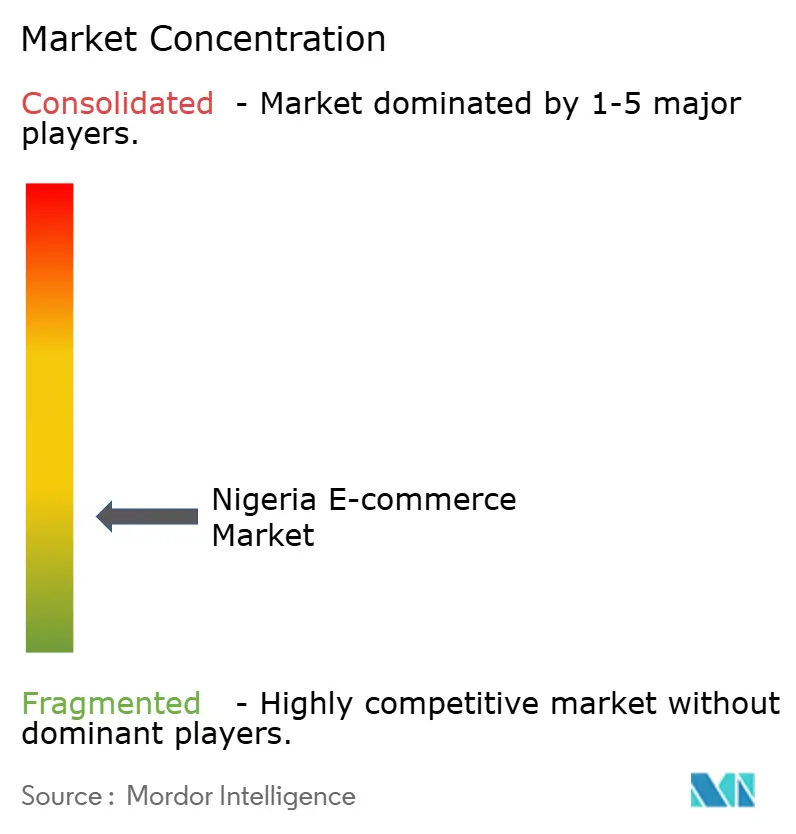
Competition is fragmented across procurement services and category retailers serving distinct buying needs. Chrisvicmall procures and ships China-sourced products and accepts online orders for Nigeria-stock items, while Zikel Cosmetics International Limited sells makeup and skincare online. Soso Games Limited pairs online video-game retail with 5 Nigerian locations for in-person visits, BonAmour Nigeria Limited runs an online pharmacy in Ipaja, Lagos, and Ajebomarket Limited sells men's apparel online. Alongside retailing, on-demand delivery platform Glovo reported 38 million items delivered in Nigeria over the year before April 2026. Product specialization and procurement support give the named retailers distinct grounds for differentiation and put assortment depth and sourcing capability at the center of comparisons among their offers.
Zikel's product moves illustrate a strategy built around a defined product offer and collaboration. By June 2025, it had unveiled a 6-product skincare line made in South Korea, including vitamin C and E serums, toner and repair cream. Oma Jay Nneji had also partnered with Zikel by June 2025 on an 11-shade Butter Melt Concealer developed under Oma Jay's brand for women of color. For an online beauty retailer, those moves can make product identity and the partner brand part of the consumer proposition, giving assortment development a strategic role distinct from marketplace reach.
Regulatory positioning makes entry requirements depend on the service offered by a specialist retailer. Nigeria's Electronic Pharmacy Regulations 2026 require online-pharmacy registration to be undertaken by an in-house Superintendent Pharmacist responsible for pharmaceutical service delivery and operations. For an online pharmacy, that duty makes professional accountability part of the operating model. Non-pharmacist challengers can own online pharmacies, but their entry depends on recruiting the in-house Superintendent Pharmacist required for registration.
Nigeria E-commerce Industry Leaders
-
Chrisvicmall
-
Zikel Cosmetics International Limited
-
Soso Games Limited
-
BonAmour Nigeria Limited
-
Ajebomarket Limited
- *Disclaimer: Major Players sorted in no particular order
Nigeria E-commerce Market Companies Covered in this Report
- Jumia Technologies AG
- Konga Online Shopping Limited
- SLOT Systems Limited
- Omniretail Technologies Limited
- Jiji Africa B.V.
- Amazon.com, Inc.
- AliExpress – Alibaba Group Holding Limited
- PayPorte Global Systems Limited
- Chrisvicmall
- Ajebomarket Limited
- Obeezi Ecommerce Limited
- Seunman Ventures Limited
- Soso Games Limited
- BonAmour Nigeria Limited
- Zikel Cosmetics International Limited
- Vendease Africa Limited
- Mall for Africa Inc.
- Kara Nigeria Online Limited
- OList Nigeria Marketplace
Key Opportunities for Market Participants
The opportunities compare services for established buyers outside primary urban centers with support for women-led Nigerian micro, small and medium enterprises (MSMEs) entering online selling. Jumia's October 2025 report said over half of its Nigerian orders came from secondary cities and remote areas. The WE-Elevate program of the Office for Nigerian Digital Innovation offers women-led MSMEs digital, financial and entrepreneurial training, mentorship and access to global e-commerce platforms, with applications open for limited places. The regional order base creates a fulfillment-service opportunity, while the program offers a separate route for women-led sellers to prepare an online channel.
Market Opportunities Table of Nigeria E-commerce Market
| Opportunity | Why now | Buyer / lead segment | Recommended play | Main barrier | Likely beneficiaries |
|---|---|---|---|---|---|
| Consolidated regional fulfillment | Established secondary-city and remote-area orders at Jumia | Sellers serving secondary cities and remote areas | Combine collection points with scheduled delivery | Sufficient order density on each route | Regional fulfillment providers and online sellers |
| Women-led storefront activation | Open digital-skills and platform-access program | Women-led MSMEs moving online | Pair storefront setup with first-order assistance | Seller capacity to maintain product and order records | Women-led retailers and storefront-service providers |
| Transaction operations for emerging sellers | Financial and entrepreneurial support alongside digital training | Women-led MSMEs establishing online operations | Offer modular order records and payment reconciliation | Service fees relative to early online turnover | Merchant-service providers and participating sellers |
| Source: Mordor Intelligence | |||||
An order-linked service could let women-led MSMEs add operating support as transactions begin. Separating setup charges from transaction charges would align the service's cost with its stage of use. The central opening is transaction support for women-led MSMEs preparing to sell online through WE-Elevate, with service fees constrained by the turnover that early orders can sustain.
Recent Industry Developments in Nigeria E-commerce Market
- Sep 2026: Temu added Nigerian logistics company Kwikpik to its delivery network for some orders across Nigeria.
- Jul 2026: The Federal Ministry of Communications, Innovation and Digital Economy directed agencies to defer recently issued online-platform requirements only on matters under policy harmonization. Other rules within statutory agency mandates remained enforceable when consistent with the direction.
- Jun 2026: Payaza launched ShopAza for small businesses, integrating online storefronts, inventory management and multicurrency payments, including deployment in Nigeria.
Nigeria E-commerce Market Report Scope and Research Methodology
Market Definition and Coverage
The Nigeria e-commerce market measures annual spending on goods and services ordered online by buyers in Nigeria, with orders placed digitally and transactions completed for delivery or fulfillment. It covers consumer and business purchases classified by device, payment method and consumer product category.
Scope exclusions: Informal social selling where there is no online checkout, offline purchases that are only influenced by digital ads, standalone marketplace, payment-processing, and delivery-service fees, and online purchases by buyers outside Nigeria are excluded.
Segments Covered in This Report
- By Business Model
- B2C
- B2B
- By Device Type
- Smartphone / Mobile
- Desktop and Laptop
- Other Device Types
- By Payment Method
- Credit / Debit Cards
- Digital Wallets
- BNPL
- Other Payment Method
- By B2C Product Category
- Beauty and Personal Care
- Consumer Electronics
- Fashion and Apparel
- Food and Beverages
- Furniture and Home
- Toys, DIY and Media
- Other Product Categories
Data Sources, Market Sizing, and Validation
Desk Research
Public sources such as the Nigerian Communications Commission's industry statistics help track subscriber access, while Central Bank of Nigeria e-payment statistics show transaction volumes and values by channel that inform payment assumptions. National Bureau of Statistics price releases and World Bank exchange-rate series help assess affordability and currency effects when analysts compare commercial indicators across years or currencies.
Company annual reports, investor materials, regulatory disclosures and reputable Nigerian business reporting can add context on platform activity, category expansion, payments and fulfillment, with public records used to cross-check market signals and explain gaps in the official series. These named sources are not exhaustive, and further sources inform collection, validation and clarification.
Primary Interviews and Surveys
Interviews and structured surveys would target Nigerian marketplace and digital-retail executives, merchant and category leads, payment product or risk specialists, and fulfillment managers, with roles spanning CXOs, functional leaders and managers. These discussions would check secondary evidence on order activity, payment completion, product mix, device use and delivery, while surveys would test how consistently those patterns appear across Nigerian sellers and buyers. Where evidence is missing or inconsistent, analysts would record the input gap, seek clarification from knowledgeable respondents where feasible, and triangulate it against independent public data and company disclosures before carrying an assumption into the model.
Distribution of primary research fieldwork respondents
| Company type | Respondent position | Region |
|---|---|---|
| Top tier: 30% | CXOs: 15% | |
| Mid tier: 45% | Functional/Unit leaders: 35% | |
| Smaller Players: 25% | Managers: 50% |
Market-Sizing & Forecasting
A top-down model starts from Nigeria's annual spending on completed digital orders by consumers and businesses, then estimates value using buyer activity and average transaction value while counting each order once across marketplaces, merchant sites and social channels. Population and household spending conditions describe potential demand, NCC subscriber trends inform reachable buyers, CBN payment activity indicates checkout capacity, and NBS prices, exchange rates and company disclosures help explain changes in nominal order values and commercial activity. When a signal is reported in naira rather than dollars, analysts translate it using an annual exchange-rate series so it shares the model's currency basis. Analysts build segment shares by assigning estimated order value to B2C or B2B, device, payment method and B2C product category, then reconcile each classification to the same market total. Multivariate regression can project demand where buyer, spending and payment series align, with scenario analysis for exchange-rate, affordability and fulfillment changes, while selective bottom-up checks compare sampled average transaction value times completed order volume with platform and channel roll-ups. Experts check the assumptions behind each forecast variable, and gaps in sampled order or supplier data are recorded and tested against public indicators or alternate scenarios instead of being filled with unsupported values.
Data Validation & Update Cycle
Analysts triangulate official connectivity, payment, price and macroeconomic series with company disclosures, interview evidence and independent market signals, checking that each input matches the Nigeria boundary, transaction basis and measurement year. They investigate outliers, source conflicts, unusual segment movements and differences between top-down totals and selective order-value checks, then resolve or document each issue through analyst review and a separate senior review before sign-off. Re-contact is triggered when definitions, periods or material assumptions remain unclear. The dataset is refreshed annually, updated between cycles when material economic, regulatory or platform events change the evidence, and reviewed again in a fresh pre-delivery pass.
Mordor Intelligence's Nigeria Ecommerce Market Size Compared Against Other Published Estimates
Published Nigeria e-commerce estimates diverge because sources measure different buyer groups and commercial channels, and some report retail e-commerce sales or consumer-only gross merchandise value rather than the wider value of digitally ordered goods and services. The Mordor Intelligence baseline includes consumer and business purchases, while B2C Databook A reports consumer e-commerce and Industry Journal B reports retail e-commerce sales.
Key Gap Drivers are business-buyer coverage, retail-only versus broader order coverage, and the year and status attached to each estimate. B2C Databook A covers several consumer commerce verticals but its stated B2C scope does not include business purchases, while Industry Journal B reports retail e-commerce sales across consumer retail categories. Those narrower buyer and channel boundaries can contribute to lower values than a total that includes consumer and business orders for goods and services, while the earlier actual retail-sales year also sits before the later forecast year.
Benchmark comparison
| Source | Market Size | Gaps in Research Methodology |
|---|---|---|
| Mordor Intelligence | USD 11.77 B (2027) | |
| B2C Databook A | USD 8.53 B (2026) | At its 2026 base, this estimate is 27.5% below this report's 2027 value of USD 11.77 B, 1 year later. Its stated B2C coverage omits digitally ordered purchases made by Nigerian businesses. |
| Industry Journal B | USD 368 M (2025) | At its 2025 base, this estimate is 96.9% below this report's 2027 value of USD 11.77 B, 2 years later. Its reported sales cover retail e-commerce, a narrower channel measure than consumer and business orders for goods and services. |
The external figures describe narrower slices of Nigeria's digital commerce activity, so their lower readings should be interpreted as comparisons with consumer-only and retail-only measures rather than equivalent totals for all completed online orders in the report boundary.
Key Questions Answered in the Report
What is the Nigeria e-commerce market size and growth outlook?
The size is projected to rise from USD 11.77 billion in 2027 to USD 20.61 billion by 2032, registering an 11.86% CAGR between 2027 and 2032.
What is driving e-commerce adoption in Nigeria?
Connectivity and social-business use provide support, with broadband penetration at 56.11% in May 2026 and about 14 million SMEs using Meta applications for business in 2025.
Which business model leads e-commerce in Nigeria?
B2C led business models with an 85.67% share in 2026.
Which companies compete in Nigeria's e-commerce sector?
Key companies include Chrisvicmall, Zikel Cosmetics International Limited, Soso Games Limited, BonAmour Nigeria Limited and Ajebomarket Limited.
What constrains e-commerce merchant profitability in Nigeria?
Under Paystack's Nigeria-market terms, merchants bear the full amount of accepted or auto-accepted chargebacks and fraud claims, except where a dispute is accepted partially. Processing fees are nonrefundable.
Where are online orders concentrated within Nigeria?
Greater Lagos accounted for 38.96% of online orders in 2026. The northern states are forecast to grow fastest, registering a 14.65% CAGR between 2027 and 2032.